The 8 best Zoho Desk Zia alternatives in 2026

Riellvriany Indriawan

Katelin Teen
Last edited October 14, 2026

Why teams start looking for a Zoho Desk Zia alternative
Let me be fair to Zoho Desk first, because it earns it. It's one of the best-value full helpdesks going: ticketing, a knowledge base, community forums, multichannel support, and a 40+ language help center, starting at $7 per user per month, with a free tier for 3 users. Zoho says it serves 125,000+ companies, and on its own pricing page a customer puts the appeal plainly:
"Zoho Desk comes at a better price when compared to Zendesk, and it offers integration with other Zoho applications so you can keep your information in a single place."
Miguel Useche, Full-Stack Developer, Zoho Desk pricing page
So the problem is rarely the helpdesk. It's Zia, and specifically two things about it. I've dug into Zoho Desk's AI at length before, and it always comes back to these two.
The first is what it can read. I work a support queue every day, and the single thing that decides whether an AI resolves a ticket or fumbles it isn't the model, it's what the model is allowed to see. Zoho's Answer Bot answers customers from your Zoho knowledge base articles, and that's essentially the well it draws from. If half your real answers live in Confluence, a Google Doc, or a Slack channel, Zia can't reach them, and a confident bot answering from half your knowledge is worse than no bot at all.
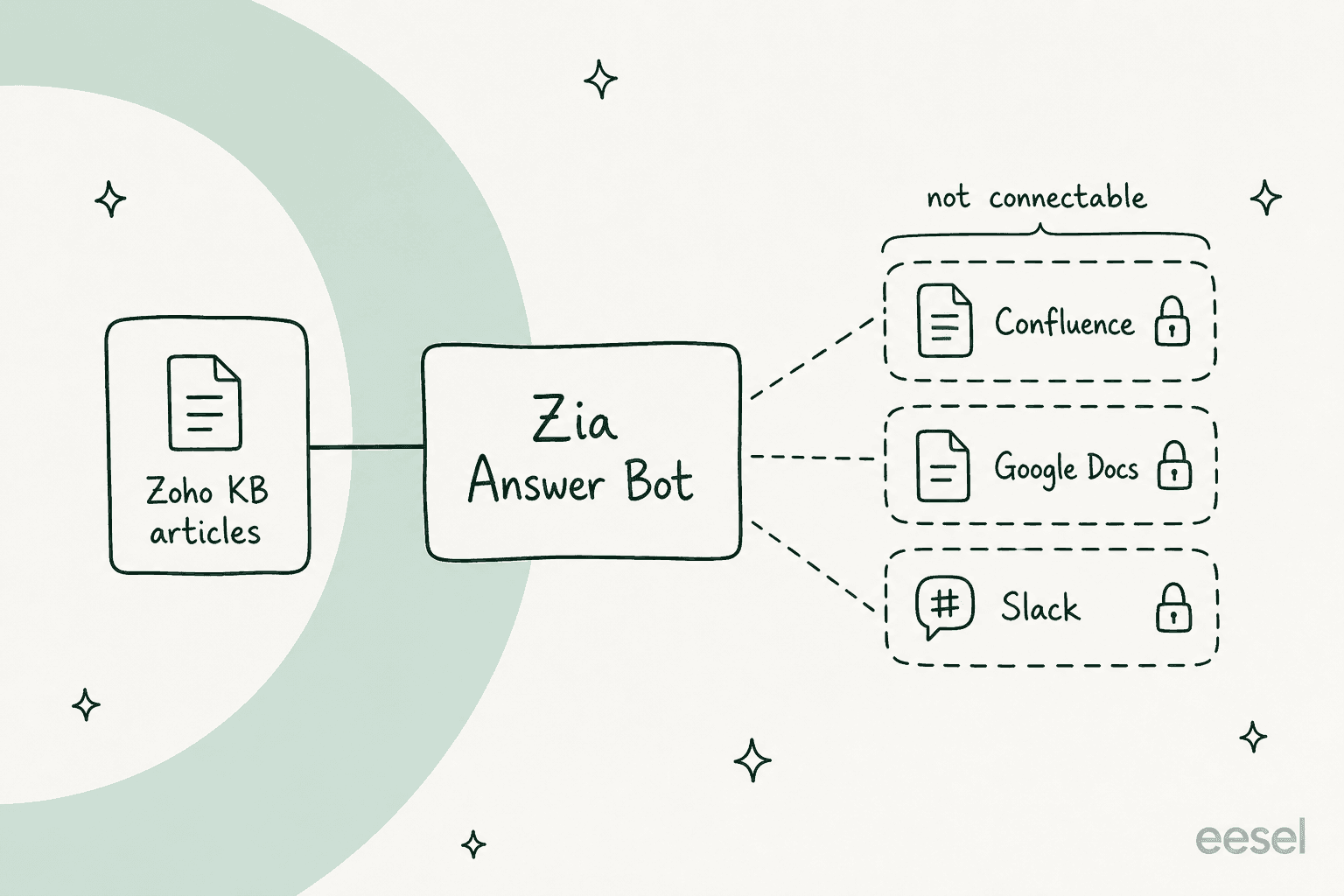
The second is where the AI sits in the price list. Zia isn't one switch, it's several features spread across plans (per Zoho's pricing page):
| Zia AI piece | What it does | Plan it's on |
|---|---|---|
| Generative AI (BYOK) | Sentiment, ticket summaries, reply suggestions | Express $7, but you bring your own OpenAI key |
| Answer Bot | Replies to customers from your knowledge base | Standard $14 |
| Zia AI (built in) | Generative, predictive, and analytical AI | Professional $23 |
| Guided Conversations | Low-code self-service flow builder | Enterprise $40 |
None of that is outrageous, and Zoho recently moved the good pieces down tier, so this is better than it used to be. But it means the answer to "how much is Zia?" is "which piece, on which plan, and are you paying OpenAI separately?" That ambiguity, plus the source limit, is what sends teams shopping. (If you just want the full field, I keep a wider Zoho Desk alternatives roundup too.)
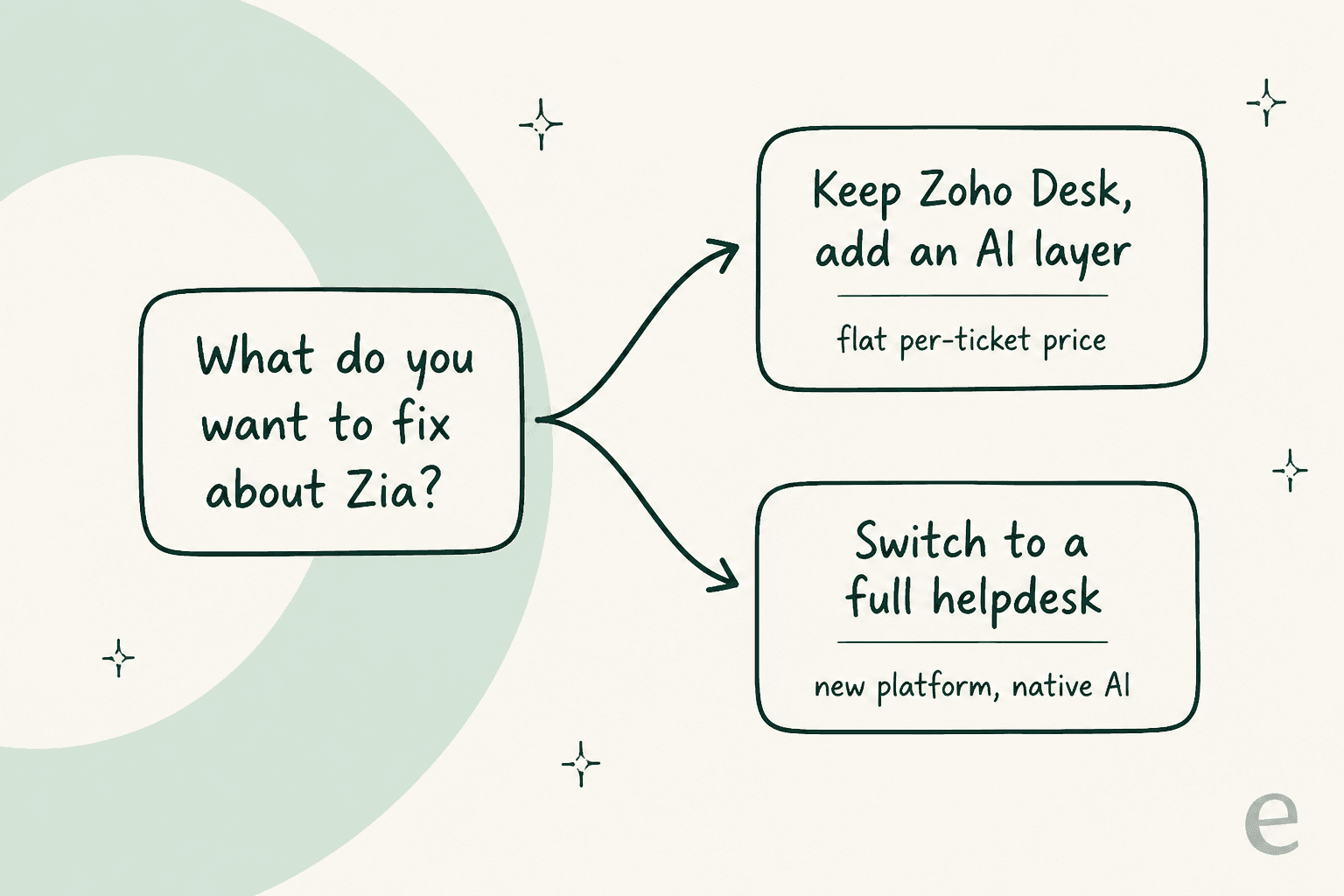
That leaves you on one of two branches, and it's worth being honest about which one you're on. If Zoho Desk still fits and Zia is the only sore spot, you don't need to migrate anything, you need a better agent in front of it. If you're bumping into Zoho Desk's ceiling as a platform, then you're really shopping for a new helpdesk, and the AI is one column among many.
How I compared these (and the two numbers that matter)
I've spent the last few years on the eesel side watching AI agents go live on real support queues, and the thing that surprises teams most isn't accuracy, it's two numbers the pricing pages work hard to keep separate: what the AI can read, and how it bills. So for every Zia alternative here I checked the knowledge sources it connects to first, then the billing unit, then whether it layers on or replaces Zoho Desk. It's the same lens I'd use on any piece of AI customer service software.
Here's the per-unit AI price side by side, because it's the comparison the marketing pages avoid making easy:
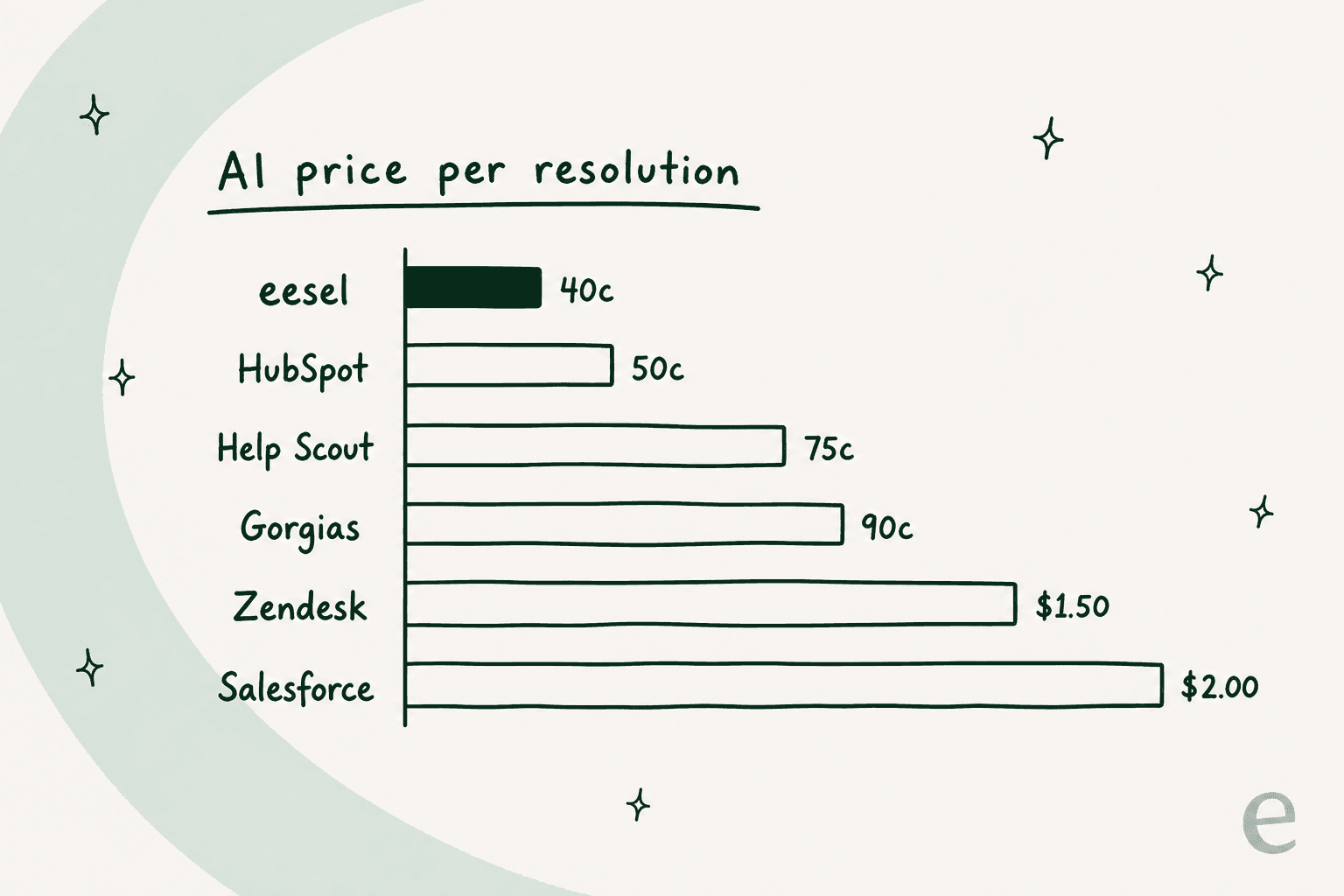
Two things the chart can't show. First, most of those per-resolution prices sit on top of a per-seat helpdesk bill, so the real AI cost is the resolution price plus the seats it rides on. Second, "a resolution" means different things: Zendesk counts only an LLM-verified resolution, Gorgias counts each resolved conversation and the ticket it creates, Freshdesk bills a 72-hour "session," and Salesforce bills a whole "conversation." Read the fine print against your own volume before you commit.
The 8 best Zoho Desk Zia alternatives at a glance
| Tool | Best for | AI billing unit | Reads external sources? | Helpdesk price (from) | Free tier |
|---|---|---|---|---|---|
| eesel AI | Keeping Zoho Desk, upgrading the AI | From $299/mo (500 credits) | Yes (docs, tickets, Confluence, Slack) | No seat fee (fixed monthly price) | 100 free credits |
| Freshdesk | Budget full helpdesk, direct swap | $49 / 100 sessions | Limited | $19/agent/mo | Yes (2 agents) |
| Zendesk | Scaling / enterprise support | $1.50 per resolution | Yes (with setup) | $55/agent/mo | 14-day trial |
| Help Scout | Simple shared-inbox support | 75c per resolution | Limited | $25/user/mo | Yes (5 users) |
| Gorgias | Shopify / ecommerce stores | 90c per resolution | Limited | $10/mo | 7-day trial |
| HubSpot Service Hub | Teams already on HubSpot CRM | 50c per resolution | Limited | $7/seat/mo | Yes (2 users) |
| Salesforce Service Cloud | Enterprises already on Salesforce | $2 per conversation | Yes (with setup) | Quote / per seat | 30-day trial |
| Tidio | Small sites wanting a chatbot | Per Lyro conversation | Limited | $24.17/mo | Yes (50 Lyro convos) |
Now the detail, starting with the option that doesn't ask you to leave Zoho Desk.
1. eesel AI
Best for: teams who like Zoho Desk and just want an AI that reads all their knowledge and resolves more, without switching helpdesks.
This is the one alternative that fixes Zia's biggest limit head-on. Where the Answer Bot is scoped to your Zoho knowledge base, eesel AI trains on your help docs, your past support tickets, and the external sources Zia can't reach, Confluence, Google Docs, Slack, and more, so it answers from everywhere your real answers actually live.
One thing worth knowing: eesel has a Zoho Desk helpdesk integration (added in September 2026), the same way it connects to Zendesk or Freshdesk. You can also run it as a customer-facing agent, a chat widget or public chat link on your site and help center, resolving tier-1 questions before they ever become tickets. Anything it can't handle lands as a normal Zoho Desk ticket in the queue your team already works. So your Zoho workflows, SLAs, and reporting stay exactly where they are.
The part that makes it fast: on connection, eesel automatically imports your knowledge and past conversations, so there's no manual training, and you can simulate the agent against your historical tickets before it ever replies to a customer, which is the step I'd never skip. It handles chat, email, and more across 80+ languages.
On price, eesel is one fixed monthly price sized to your volume, from $299/month for 500 credits (1 credit per ticket or chat), with no per-seat fees and no platform fee. Only tickets the agent actually works on count, so it doesn't scale with headcount the way a per-seat helpdesk does.
Pros:
- Reads external sources (Confluence, Google Docs, Slack, past tickets) that Zia can't.
- One fixed monthly price with no seat or platform fee, so cost doesn't scale with headcount.
- Simulates against your past tickets before go-live, so you know the resolution rate first.
Cons:
- The Zoho Desk integration is one of eesel's newer ones (added September 2026), so simulate it against your own tickets before you rely on it.
- It's an AI layer, not a helpdesk, so you still keep Zoho Desk (or another platform) underneath.
My take: if Zoho Desk is fine and Zia's source limit is the real problem, this is the cleanest fix on the list, and the only one where you don't pay a migration cost. It's the route I'd reach for first when someone asks about the best AI for Zoho Desk. If you actually want to leave Zoho Desk, read on.
2. Freshdesk
Best for: budget-conscious teams that want a direct, feature-for-feature swap out of Zoho Desk.
If you're leaving Zoho Desk over the platform rather than just Zia, Freshdesk is the most natural landing spot: it's the other big value helpdesk, at a similar price point, with a similar breadth. I've compared Freshdesk vs Zoho Desk directly if you want the head-to-head. Standalone plans run Growth $19, Pro $55, Enterprise $89 per agent per month (pricing); the omnichannel Freshdesk Omni suite runs $29/$79/$119. There's a real free tier for up to 2 agents.
The AI is Freddy, with a customer-facing AI Agent and an agent-side Copilot. The quirk is the billing: the AI Agent is priced per session, where a session is a 72-hour window from the customer's first message, and every AI reply inside that window counts as one session. You get 500 sessions free once, then it's $49 per 100 sessions; Copilot is a separate $29/agent add-on.
Pros:
- Genuinely free for up to 2 agents; low starting prices, like Zoho Desk.
- Session-based AI billing can be cheaper than per-reply for chatty threads.
- No-code Freddy AI Agent Studio and a dedicated Email AI Agent.
Cons:
- Two similarly named SKUs (standalone vs Omni) make pricing easy to misread.
- Session counting surprises high-volume teams.
My take: the closest like-for-like replacement if the issue is Zoho Desk itself and you want to stay on a budget. Model your real volume against the 100-session blocks first, or run eesel's Freshdesk integration on top if you'd rather pay one fixed monthly price.
3. Zendesk
Best for: teams scaling into higher volumes that need enterprise routing, reporting, and a mature ecosystem.
Zendesk is the enterprise default, and Zoho Desk's own marketing even benchmarks its price against it. If Zoho Desk's ceiling is depth, deep ticketing, a huge app marketplace, strong reporting, Zendesk is the obvious step up, and the Zendesk vs Zoho Desk gap is real. Its AI agents resolve autonomously, and it publishes real outcomes like Humi's 57% automated resolutions.
The pricing is where I'd slow down. Suite plans start at $55/agent/mo, and AI resolutions bill separately at $1.50 per committed resolution or $2.00 pay-as-you-go, per Zendesk's tiers. That's the highest combination of seat price plus AI price here. And, like Zia, the AI leans heavily on a well-curated knowledge base:
"The Co-Pilot stuff is decent, but we found its effectiveness really depends on having a perfectly curated Zendesk knowledge base, which... ours isn't, lol."

Pros:
- Mature ticketing, routing, and reporting at real enterprise scale.
- Largest integration ecosystem of anything here.
- Publishes verified per-resolution outcomes.
Cons:
- Most expensive combination of seat price plus AI resolution price.
- AI quality still leans on a curated knowledge base, same trap as Zia.
My take: the right call when you've truly outgrown a value helpdesk and need enterprise depth. If cost per resolution is your deciding factor, it's the pricey end, and eesel layers onto Zendesk at a fraction of the per-resolution price.
4. Help Scout
Best for: teams that find Zoho Desk feature-heavy and want something cleaner and more email-first.
Zoho Desk packs a lot in, and for some teams that's the problem. Help Scout is the antidote: a clean shared inbox with a real knowledge base, an embeddable widget (Beacon), and AI split into four named pieces, AI Answers (the customer-facing agent), plus AI Assist, AI Drafts, and AI Summarize for agents.
Pricing is per user per month: Standard $25, Plus $45, Pro $75 (pricing), all billed annually, with a real free plan for up to 5 users. The customer-facing agent, AI Answers, is a separate usage-based add-on at $0.75 per resolution. So unlike Zia's tier scatter, the agent-assist pieces are baked into the seat price and only the autonomous resolutions meter.
Pros:
- Clean, simple UX if Zoho Desk feels overloaded.
- Built-in knowledge base and widget; free plan for up to 5 users.
- Agent-assist AI included in the seat, only resolutions meter.
Cons:
- AI Answers at 75c/resolution stacks on top of the per-seat bill.
- Lighter on deep automation and multi-department routing than Zoho Desk.
My take: a good pick if you want to trade Zoho Desk's breadth for something tidier. Price the AI Answers add-on against your resolution volume, and note that eesel also integrates with Help Scout if you want the same layer-on approach.
5. Gorgias
Best for: Shopify and ecommerce brands where support and revenue live in the same conversation.
If your Zoho Desk tickets are mostly WISMO, refunds, and order changes, Gorgias is built for exactly that. It's an ecommerce-first helpdesk with deep native Shopify integration, so orders and customer data sit inside the ticket and the AI Agent can take store actions, not just answer questions. Here's how ecommerce folks frame the trade-off, which I think is fair:
"I've been around ecommerce for 10+ years and this is honestly how I'd choose: 40%+ tickets need Shopify actions -> I'd lean Gorgias. Mostly conversational support -> Zendesk is fine."
Pricing is ticket-volume based: Starter from $10/mo (50 tickets), Basic $50 (300), Pro $300 (2,000), Advanced $750 (5,000). The AI Agent is a usage add-on at $0.90 per resolved conversation on annual plans ($1.00 monthly), and each AI interaction also counts as a billable helpdesk ticket, the double-count to watch.
Pros:
- Deepest native Shopify/ecommerce context of anything here.
- AI can take store actions, not just answer questions.
- Ticket-based pricing suits high-volume, low-seat teams.
Cons:
- Each AI resolution also burns a helpdesk ticket, so the effective cost is higher than 90c looks.
- Overkill (and off-target) if you're not an online store.
My take: worth the premium if a real chunk of your tickets need Shopify actions; skip it otherwise. eesel plugs into Gorgias too, if you'd rather keep the helpdesk and swap the AI.
6. HubSpot Service Hub
Best for: teams already on HubSpot who want support in the same system as sales and marketing.
Zoho Desk pairs neatly with the rest of Zoho, and the equivalent argument on the other side is HubSpot. If your company runs on HubSpot, Service Hub puts a help desk, knowledge base, and the Breeze Customer Agent on the same CRM record your sales team uses.
Pricing is per seat: Free (2 users), Starter $7, Professional $90, Enterprise $150 per seat per month (pricing), with one-time onboarding fees of $1,500 and $3,500 on the top plans. The Breeze Customer Agent bills at 50 credits ($0.50) per resolved conversation. The recurring complaint isn't the AI, it's total cost and lock-in:
"Additionally, pricing has become difficult to justify compared to alternative solutions in the market. The Knowledge Base page customization options are also quite limited."

Pros:
- Support, sales, and marketing on one shared CRM record.
- Breeze at 50c/resolution is among the cheaper native agents.
- Strong automation and reporting inside the ecosystem.
Cons:
- Onboarding fees ($1,500 to $3,500) and per-seat jumps get expensive fast.
- Knowledge base customization is limited, per reviewers.
My take: an easy yes if you're already on HubSpot, a hard sell if you're not, the value is the CRM tie-in, not the AI alone. eesel connects to HubSpot if you want a cheaper agent on the same records.
7. Salesforce Service Cloud
Best for: larger enterprises already standardized on Salesforce.
At the top of the market, Salesforce Service Cloud with Agentforce is the enterprise CRM answer to Zia, drawing on the same customer 360 your sales and revenue teams already run on. It's the heaviest, most configurable option here, and priced accordingly.
Agentforce is metered on top of your Service Cloud seats. The headline rate is $2 per conversation (Agentforce pricing), and Salesforce has been openly reworking the model, adding Flex Credits and per-user licenses alongside it, with pay-per-resolution flagged for later in 2026. That's the highest per-unit AI price on this list, on top of enterprise seat costs, so it only makes sense at real Salesforce scale.
Pros:
- Deep customer 360 and the most configurable automation of anything here.
- Agentforce agents can take actions across the Salesforce platform.
- Fits cleanly if you're already a Salesforce shop.
Cons:
- $2 per conversation is the priciest AI unit here, on top of enterprise seats.
- Heavy to set up and overkill for a team currently happy on a $7 Zoho seat.
My take: the right move only if you're already committed to Salesforce; for a value-helpdesk team leaving Zoho Desk, it's a big jump in cost and complexity. eesel integrates with Salesforce if you want a cheaper agent on the same data.
8. Tidio
Best for: small sites and stores that mainly want a website chatbot, not a full ticketing helpdesk.
If what you actually wanted from Zia was a good website chatbot, not the whole ticketing system, Tidio is the lighter fit. It's a live chat and chatbot tool with Lyro, an AI agent that answers customers on your site, and it's aimed squarely at small businesses and ecommerce. It's one of the more common picks in any AI chatbot for customer service shortlist.
Pricing starts with a free plan (50 one-time Lyro AI conversations), then Starter at $24.17/mo billed annually (pricing). Lyro is metered separately by AI conversation, where a conversation is any interaction with at least one AI reply, and Tidio advertises a "guaranteed 50% Lyro AI resolution rate" on its higher plans. Be clear on what it is, though: Tidio is a chatbot and live chat tool, not a ticketing helpdesk with SLAs and a full agent workspace like Zoho Desk.
Pros:
- Genuinely simple to stand up on a small website or store.
- Free plan to trial Lyro, low entry price.
- Chatbot-first, so it's cheaper than a full helpdesk if that's all you need.
Cons:
- Not a full helpdesk: no deep ticketing lifecycle or SLA engine like Zoho Desk.
- Lyro conversations meter separately on top of the base plan.
My take: a fine downgrade-in-scope if you realize you wanted a chatbot, not a helpdesk. If you need real ticketing and better AI, pair a helpdesk with a layer like eesel instead.
Try eesel with Zoho Desk
Here's the thing most of this list misses: you probably don't need to leave Zoho Desk. If the helpdesk is fine and Zia's the sore spot, eesel AI sits in front of your support, trains on your help docs, past tickets, and the sources Zia can't read, Confluence, Google Docs, Slack, and resolves the front line on a fixed monthly price from $299/month with no seat or platform fee. Whatever it can't handle lands as a normal Zoho Desk ticket, so nothing about your queue changes. You can simulate it against your own historical tickets before it ever answers a customer, and the free plan gives you 100 credits, no card required.
If you do decide to switch helpdesks entirely, everything above still stands, just match the AI's knowledge sources and billing unit to your volume, and don't let the seat price hide the AI price. Either way, the win is the same: customer service automation that actually reads all your knowledge.