The 10 best Help Scout AI integration alternatives in 2026

Riellvriany Indriawan

Katelin Teen
Last edited October 14, 2026

Why teams start looking for a Help Scout AI alternative
Let me be fair to Help Scout first, because it earns it. It's a clean, email-first shared inbox with a genuine knowledge base (Docs), an embeddable widget (Beacon), and an AI suite split into four named pieces: AI Answers (the customer-facing chatbot), plus AI Drafts, AI Assist, and AI Summarize that sit inside the mailbox and help your agents. It's one of the friendliest tools in the category to actually set up and live in, which is exactly why teams love it and why leaving feels like a big deal.
So the problem usually isn't that Help Scout's AI is bad. It's two things. First, the shape of the bill. Seats run Standard $25, Plus $45, and Pro $75 per user per month on the pricing page, all billed annually, with a real free plan for up to 5 users. The agent-assist pieces are included in that seat price, which is a nice touch. But the autonomous, customer-facing part, AI Answers, is a separate usage-based add-on at $0.75 per resolution on top of whatever plan you're on. So the "AI that deflects tickets" line grows with your resolution volume, separate from your seat count.
Second, where the AI gets its knowledge. AI Answers is built from your Docs (your published help center). That's a fine starting point, but it means the agent answers from articles a human wrote for humans, not from the thousands of real replies your team has already sent. If your best answers live in past tickets and saved replies rather than in polished Docs, a Docs-only bot leaves resolution on the table.
That leaves you with a real two-branch decision, and it's worth being honest about which branch you're on before you shop.
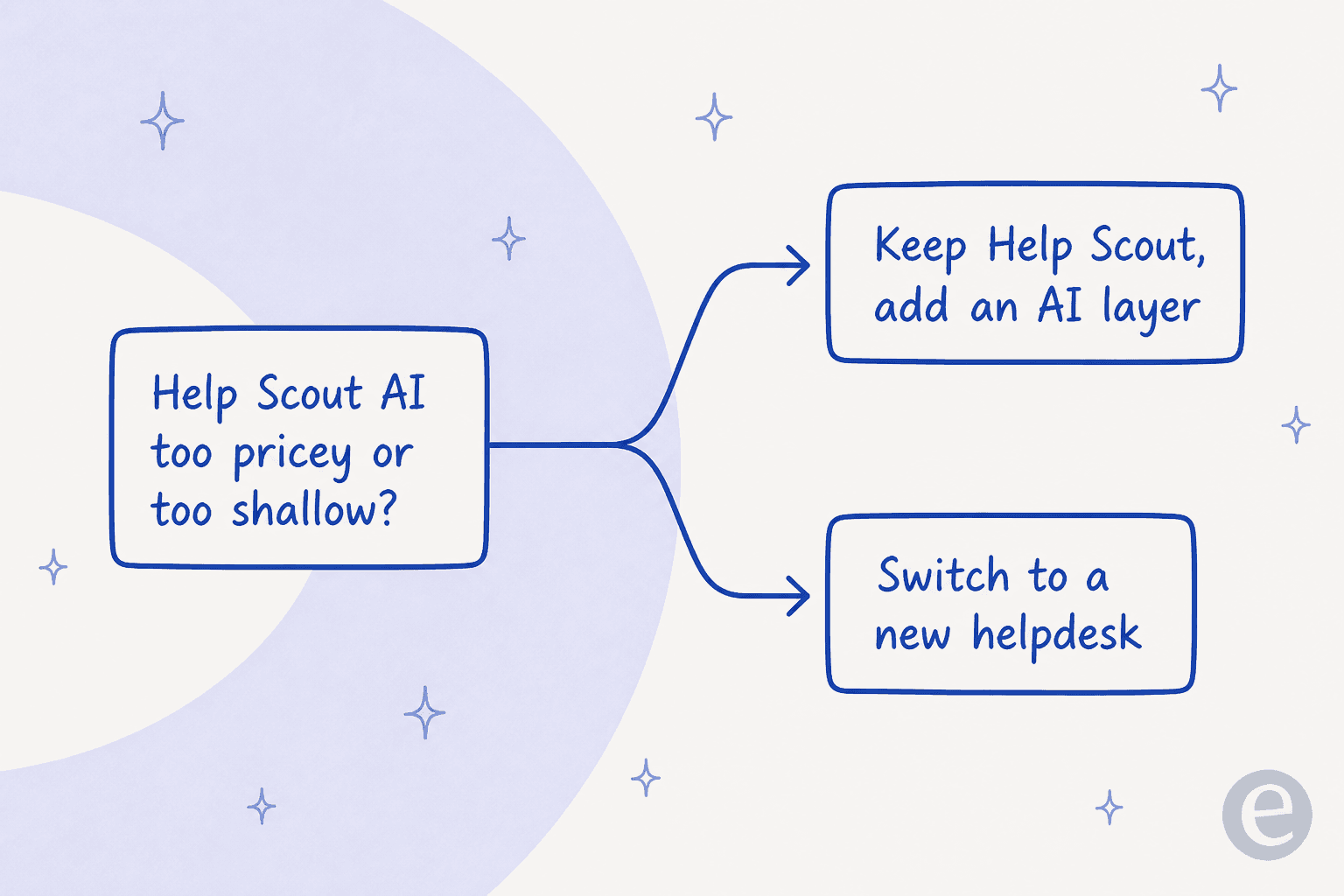
If Help Scout's inbox still works for your team and the AI is the only sore spot, you don't need to migrate anything, you need a better agent that plugs in and can fully answer tickets, not just draft replies for your agents. If you've outgrown Help Scout as a platform (you need heavier ticketing, deeper automation, ecommerce actions, or voice), then you're really shopping for a new helpdesk, and the AI is one column among many.
How I compared these (and the one number that matters)
I work eesel's support queue most days, so I'll admit my bias up front: the thing that trips teams up isn't AI accuracy, it's the invoice. Two tools can both quote "AI resolutions" and bill you in completely different ways. Over the last few years of putting AI agents on live queues, the pattern I've watched again and again is a team switching for a shinier bot and landing on a bigger, weirder bill. So the first thing I compare on any Help Scout alternative is the billing unit, then whether it plugs into Help Scout or replaces it, then how fast it actually goes live.
Here's the per-unit AI price laid out, because it's the comparison the pricing pages work hard to avoid making easy:
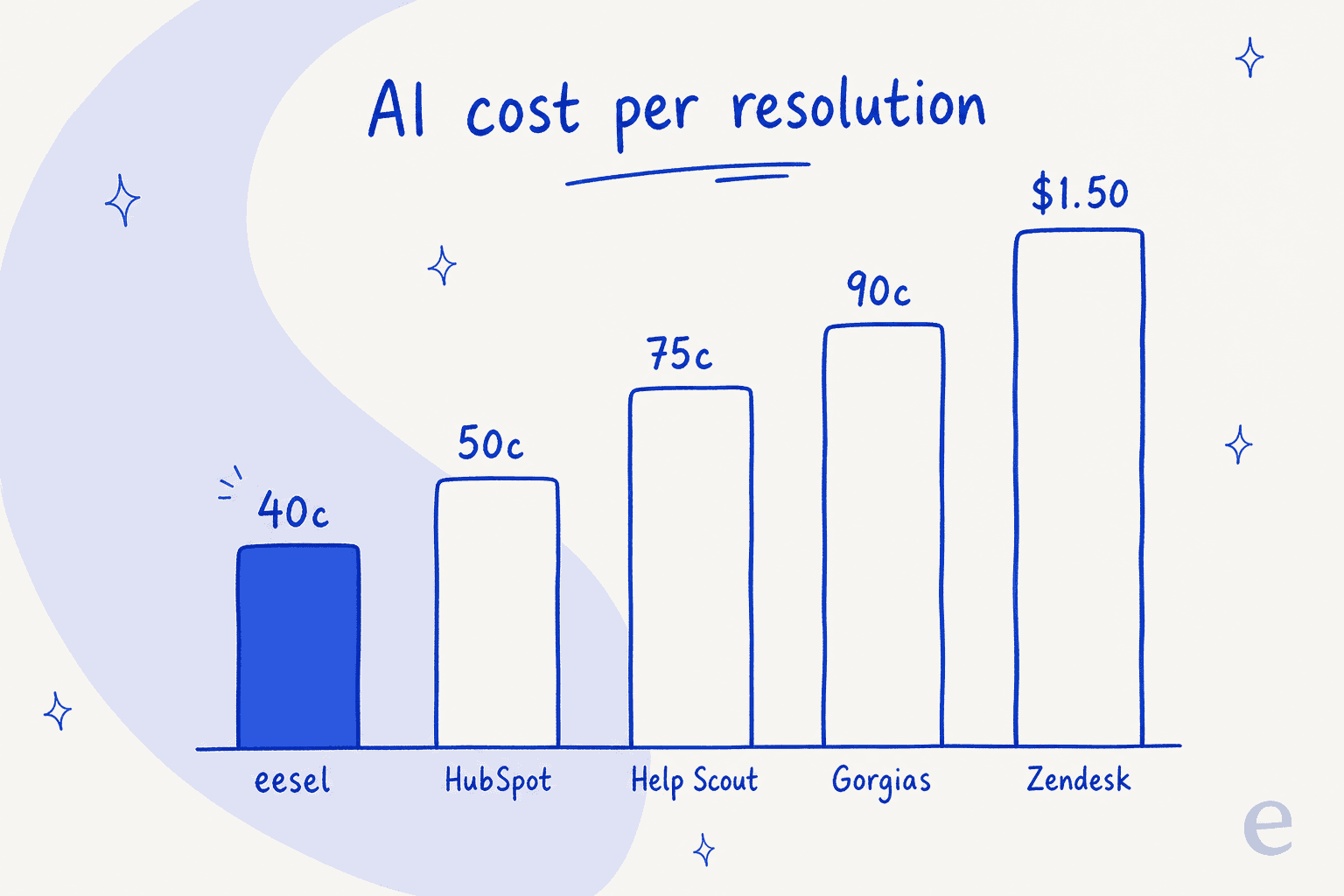
Two watch-outs the chart can't show. First, most of those per-resolution prices sit on top of a per-seat helpdesk bill, so the true cost of AI is the resolution price plus the seats it rides on. Second, the definition of a billable event shifts between vendors: Zendesk only counts an LLM-verified resolution, Gorgias counts each resolved conversation and the helpdesk ticket it creates, and Freshdesk bills a 72-hour "session" rather than a single reply. Read the fine print for your own volume before you commit.
The other habit I'd never skip: whatever you pick, test it on your own past tickets before it touches a live customer. A confident-sounding bot answering wrong is worse than no bot at all, and the only way to know your real resolution rate is to replay history, not trust a marketing percentage.
The 10 best Help Scout AI alternatives at a glance
| Tool | Best for | AI billing unit | Plugs into Help Scout? | Helpdesk price (from) | Free tier |
|---|---|---|---|---|---|
| eesel AI | Keeping Help Scout, upgrading the AI | 1 credit per ticket, from $299/mo for 500 credits | Yes, native | No seat fee | 100 free credits |
| Zendesk | Scaling / enterprise support | $1.50 per resolution | No (replace) | $55/agent/mo | 14-day trial |
| Freshdesk | Budget all-rounder | $49 / 100 sessions | No (replace) | $19/agent/mo | Yes (2 agents) |
| Gorgias | Shopify / ecommerce stores | 90c per resolution | No (replace) | $10/mo | 7-day trial |
| HubSpot Service Hub | Teams already on HubSpot CRM | 50c per resolution | No (replace) | $7/seat/mo | Yes (2 users) |
| Front | Collaborative shared inbox | From $0.05/conversation (outcome-priced) | No (replace) | $25/seat/mo | 7-day trial |
| Zoho Desk | Cheapest full helpdesk | Zia (tier-based) | No (replace) | $7/user/mo | Yes (3 users) |
| Gladly | Premium, voice-heavy brands | Sidekick (quote-based) | No (replace) | Quote-based | Demo only |
| Forethought | Larger teams adding an AI layer | Platform fee + outcome-based (quote) | Yes, listed integration | No helpdesk (quote-based platform fee) | Proof of Value |
| Decagon | Enterprise AI concierge across voice, chat, email | Quote-based | Not a named integration | No helpdesk (quote-based) | Demo only |
Now the detail, starting with the option that doesn't ask you to leave Help Scout at all.
1. eesel AI
Best for: teams who like Help Scout and just want stronger AI with a predictable price, without switching helpdesks.
This is the one alternative on the list that doesn't make you choose between Help Scout and better AI. eesel AI connects to your Help Scout mailbox in a few clicks and works the queue like a teammate, not a chatbot widget bolted on the side. It reads conversations, drafts and sends replies, adds internal notes, and hands off the ones it shouldn't touch to a human, respecting the workflows you already run in Help Scout.
The part that makes it fast: on connection, eesel automatically trains on your Help Scout Docs, past conversations, and saved replies, so there's no manual setup of a separate knowledge base. That's the key difference from a Docs-only bot: eesel learns from the real replies your team has already sent, not just the articles you published. It claims 85%+ average tier-1 resolution out of the box within a week, across email and web chat in 80+ languages.
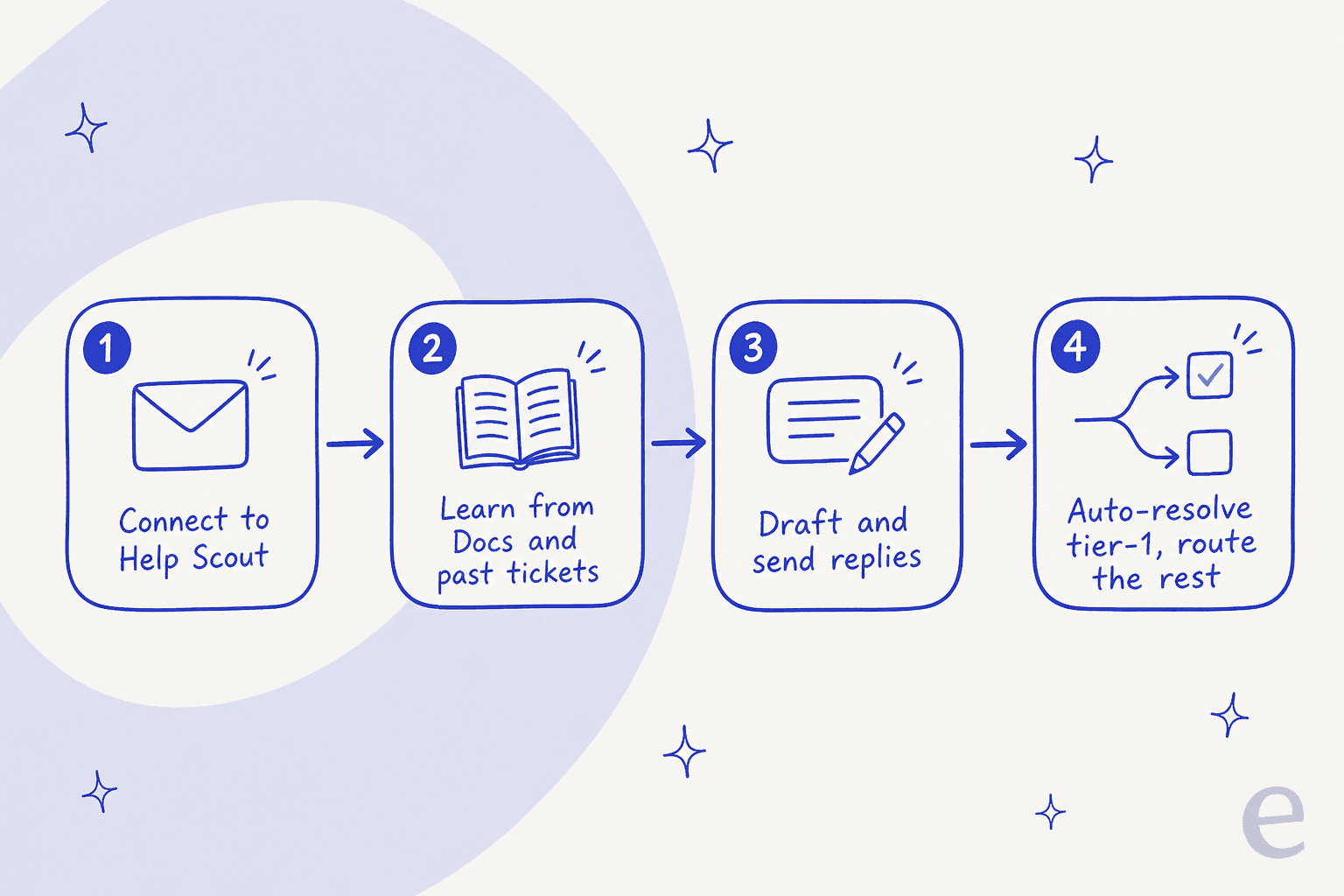
On price, eesel is one fixed monthly price: 1 credit per ticket or chat, from $299 a month for 500 credits, with no per-seat fees and no platform fee. Only tickets the agent actually works on count, so a team handling 1,000 tickets a month but sending 200 to eesel uses 200 credits and fits the 500-credit plan. And before going live, you can simulate the agent against your historical Help Scout conversations to see exactly what it would have resolved. That's the step I'd never skip, because it turns "the vendor says 70%" into "here's what it does on our tickets."
Pros:
- Keeps your Help Scout mailbox; nothing to migrate.
- One fixed monthly price (from $299 for 500 credits) with no seat or platform fee, so cost doesn't scale with headcount.
- Learns from past conversations and saved replies, not just Docs, and simulates before go-live.
Cons:
- It's an AI layer, not a helpdesk; you still need Help Scout (or another inbox) underneath.
- Fully autonomous resolution is only as good as your knowledge; thin history means more escalations.
Our take: if the inbox is fine and the AI is the problem, this is the cleanest fix on the list, and the only one where you don't pay a switching cost. If you actually want to leave Help Scout, read on.
2. Zendesk
Best for: teams scaling into higher volumes that need enterprise routing, reporting, and a mature ecosystem.
Zendesk is the enterprise default, and for good reason: deep ticketing, a huge app marketplace, strong reporting, and AI agents that resolve autonomously. If Help Scout's ceiling is that it's deliberately simple, Zendesk is the obvious step up in power. It publishes real outcomes too, like Humi hitting 57% automated resolutions.
The pricing is where I'd slow down. Suite plans start at $55/agent/mo (Suite Team), and AI resolutions are billed separately at $1.50 per committed resolution or $2.00 pay-as-you-go, per Zendesk's tiers. That's the highest per-resolution price on this list, on top of the highest starting seat price. And the sentiment on the AI itself is mixed:
"The Co-Pilot stuff is decent, but we found its effectiveness really depends on having a perfectly curated Zendesk knowledge base, which... ours isn't, lol."

Pros:
- Deep ticketing, reporting, and the biggest app ecosystem here.
- Mature AI agents with published resolution outcomes.
- Scales cleanly from mid-market to enterprise.
Cons:
- Highest combined cost on the list: top seat price plus $1.50/resolution.
- A big step up in complexity from Help Scout's clean UX.
Our take: the right move if you've truly outgrown a simple inbox and need enterprise muscle. If you mostly liked Help Scout's simplicity, Zendesk can feel like a lot. eesel layers onto Zendesk too, if you go this way but want a predictable monthly price for the AI.
3. Freshdesk
Best for: budget-conscious teams that want a full helpdesk without Zendesk-level pricing.
Freshdesk is the value all-rounder: a proper ticketing helpdesk with a 6-month Free Program for 2 agents (there is no $0 plan on the pricing page), and paid plans from $19/agent/mo (Growth). Its Freddy AI Agent handles autonomous resolutions and is available from the Growth plan up, not gated to Enterprise, which is a nice surprise in this category.
The billing quirk to understand is the "session." Freddy bills roughly $49 per 100 sessions, and a session is a 72-hour window of interaction rather than a single reply. That can work in your favor (multiple back-and-forths inside one session count once) or against it (a customer who comes back on day 4 starts a new session). For steady, self-contained questions it's competitive; for long, drawn-out threads, model it against your own patterns.
Pros:
- Real free tier and low entry price for a full helpdesk.
- Freddy AI Agent available from Growth, not locked behind Enterprise.
- Session-based billing can be cheap for chatty, multi-turn tickets.
Cons:
- The 72-hour session unit is harder to forecast than a flat per-resolution price.
- Heavier and busier than Help Scout's minimal interface.
Our take: the best budget helpdesk here if you want to own the whole stack cheaply. If Help Scout's simplicity was the draw, Freshdesk is a trade of elegance for features and price.
4. Gorgias
Best for: Shopify and ecommerce brands where support and revenue live in the same conversation.
If your Help Scout inbox is mostly WISMO, refunds, and order changes, Gorgias is built for exactly that. It's an ecommerce-first helpdesk with deep native Shopify integration, so orders, customers, and store data sit inside the ticket and the AI Agent can actually take actions. Gorgias says it powers 40% of Shopify brands and serves 17,000+ stores. That commerce context is the thing a general shared inbox like Help Scout can't match.
Here's how ecommerce folks describe the trade-off, which I think is fair:
"I've been around ecommerce for 10+ years and this is honestly how I'd choose: 40%+ tickets need Shopify actions -> I'd lean Gorgias. Mostly conversational support -> Zendesk is fine."
Pricing is ticket-volume based, not per seat: Starter from $10/mo (50 tickets), Basic $50 (300), Pro $300 (2,000), Advanced $750 (5,000). The AI Agent is a usage add-on at $0.90 per resolved conversation on annual plans ($1.00 monthly), and each AI interaction also counts as a billable helpdesk ticket, which is the double-count to watch.
Pros:
- Deepest native Shopify/ecommerce context of anything here.
- AI can take store actions, not just answer questions.
- Ticket-based pricing suits high-volume, low-seat teams.
Cons:
- Each AI resolution also burns a helpdesk ticket, so the effective cost is higher than 90c looks.
- Overkill (and off-target) if you're not an online store.
Our take: if a meaningful chunk of your tickets need Shopify actions, Gorgias is worth the premium. For non-ecommerce teams, skip it. eesel plugs into Gorgias too, if you'd rather keep the helpdesk and swap the AI.
5. HubSpot Service Hub
Best for: teams already living in HubSpot's CRM who want support in the same place as sales and marketing.
If your company already runs on HubSpot, Service Hub is the path of least resistance: tickets, knowledge base, and the Breeze Customer Agent all sit inside the same CRM where your contact records already live. Support conversations get the full customer context for free, and you're not stitching another tool into your stack.
Pricing starts low, from $7/seat/mo on the Starter tier, with a free plan for up to 2 users. The Breeze Customer Agent resolves autonomously and bills at 50c per resolution, which is one of the cheaper native rates here. The catch is the usual one: it's a strong fit if you're already on HubSpot, and a heavy lift (a whole CRM) if you're not. It's also a big jump in surface area from Help Scout's focused inbox.
Pros:
- Support lives inside the same CRM as sales and marketing.
- Breeze resolutions at 50c are among the cheapest native rates.
- Low starting seat price and a real free tier.
Cons:
- Only makes sense if you're already invested in HubSpot's ecosystem.
- Far more product than a team that just wanted a clean inbox needs.
Our take: an easy yes if HubSpot is already your source of truth, an easy no if it isn't. eesel also connects to HubSpot if you want to keep the CRM and run the AI on a predictable monthly price.
6. Front
Best for: teams that want a collaborative shared inbox across email, chat, SMS, and social.
Front is the closest sibling to Help Scout in spirit: a shared inbox built so a whole team can see, assign, comment on, and resolve conversations together, across email, chat, SMS, social, and WhatsApp. It's a natural landing spot if you like the inbox-first model but want heavier collaboration and omni-channel reach than Help Scout offers.
Front's AI comes as a stack of pieces: Autopilot, the autonomous agent, starts at $0.05 per conversation (triage; handoff $0.39, resolution $0.89); Copilot (agent assist) is $20/seat/mo; and analytics add-ons layer on again. Seats run $25 (Starter), $65 (Professional), and $105 (Enterprise) per seat per month. The headline from-$0.05 rate covers triage only (a full resolution is $0.89), so it looks cheaper than it is, but remember it rides on top of those seats and the assist add-ons, so the "AI" line stacks the same way Help Scout's does.
Pros:
- Strong multi-channel, multi-teammate collaboration.
- Autopilot's per-conversation rate looks low on paper.
- Familiar inbox model for Help Scout users.
Cons:
- AI is a stack of add-ons (Autopilot + Copilot + analytics) on top of seats.
- Higher top-end seat price than Help Scout.
Our take: a good move if you want a more collaborative, omni-channel inbox and don't mind the add-on math. eesel installs into Front as well, so the layer-on option follows you here too.
7. Zoho Desk
Best for: teams that want the cheapest full-featured helpdesk and are happy inside the Zoho ecosystem.
Zoho Desk is the value pick for a complete helpdesk: multichannel ticketing, a knowledge base, and its Zia AI assistant, all from $7/user/mo (Express) with a free plan for up to 3 users. Zia's answer bot and reply assist are now available across the paid tiers rather than locked to the top plan, which makes the AI reachable even on a small budget.
The trade-offs are familiar for Zoho: it's deep and configurable, but the UX is busier and less polished than Help Scout's, and you get the most value if you're already using (or willing to adopt) other Zoho apps. Zia is competent for deflection and assist, but it's not marketed as an aggressive autonomous resolver in the way Zendesk's or eesel's agents are.
Pros:
- Cheapest full helpdesk here, with a free plan.
- Zia AI available across paid tiers, not gated to the top plan.
- Very deep and configurable if you invest in it.
Cons:
- Busier, less refined UX than Help Scout.
- Best value only if you buy into the wider Zoho ecosystem.
Our take: unbeatable on price for a complete helpdesk, and a fair landing spot if budget is the main driver. Just go in knowing you're trading Help Scout's polish for Zoho's breadth.
8. Gladly
Best for: premium, high-touch brands with heavy voice and a people-first support model.
Gladly takes the opposite bet from most tools here: instead of tickets, it centers a single lifelong customer conversation across voice, chat, email, and messaging, so agents see one continuous history rather than a stack of disconnected tickets. Its Sidekick AI agent resolves and assists on top of that model. If your brand is premium and voice-heavy (think retail, travel, hospitality), that people-first framing is a real departure from Help Scout's email-first inbox.
Pricing is the honest catch: Gladly is quote-based and sits at the premium, enterprise end of the market, with Sidekick priced as part of a packaged deal rather than a public per-resolution rate. There's no self-serve free plan, and you'll go through a demo and sales process. It's a deliberate positioning, not an oversight, but it means Gladly is a very different budget conversation from a $25/seat inbox.
Pros:
- Customer-centric (not ticket-centric) model that suits high-touch brands.
- Strong native voice, which most tools here treat as an afterthought.
- Sidekick resolves across channels on one unified timeline.
Cons:
- Quote-based, premium pricing with no public rate or free plan.
- Overkill for a small team that just wanted better AI in a simple inbox.
Our take: the right call for a premium, voice-first brand that's outgrowing email-only support. For most Help Scout teams looking to trim an AI bill, it's a bigger move than the problem calls for.
9. Forethought
Best for: larger support teams that want to keep their helpdesk and add an enterprise AI agent on top.
Forethought is the other option here that sits on top of a helpdesk rather than replacing it. Help Scout is one of the helpdesks on its integrations page, alongside 70+ helpdesks, knowledge sources, and connectors. Its plans, per the pricing page, cover AI agents for chat and mobile, Autoflows, custom actions, and ready-made ticket triage models on Team, with AI agents for email, voice, and Slack plus custom handoff models from Professional up.
Pricing is quote-only. Forethought describes it as a blend of a platform access fee and an outcome-based cost, with optional add-ons (Multibrand, Analytics API, Discover) on top, and every plan on the pricing page is "Get a Quote." Instead of a free trial, it runs a Proof of Value with your data. So the billing unit is part outcome, part platform fee, and you'll only see the real number after a sales conversation.
Pros:
- Plugs into Help Scout, so there's no helpdesk migration.
- Covers chat, email, voice, and Slack, plus ticket triage.
- Proof of Value on your own data before you commit.
Cons:
- Quote-only pricing with a platform fee, so it's hard to compare per ticket up front.
- Email AI agents start on the Professional plan, not Team.
Our take: a fit for bigger teams that want an AI layer over Help Scout and are fine with a sales-led, quote-based buy. If you want a public monthly price you can check yourself, it's a heavier process than a small Help Scout team usually needs.
10. Decagon
Best for: large consumer brands that want an AI concierge across voice, chat, and email, built and tuned with the vendor.
Decagon builds AI agents for enterprise support across voice, chat, and email, with workflows written as AOPs and simulation-based testing before changes go live. Its homepage shows vendor-reported results such as 70% chat and voice resolution at Chime and an 80% deflection rate at Duolingo.
The Help Scout question is the one to ask early. Decagon's integrations page names Salesforce, Zendesk, and others for helpdesk and ticketing, but Help Scout isn't one of the named examples, so confirm support for your mailbox on a demo. Decagon doesn't publish pricing; the site routes you to "Get a demo," so plan for a quote-based, sales-led process.
Pros:
- Voice, chat, and email from one AI agent.
- Simulation testing before changes reach customers.
- Published enterprise results, attributed to the vendor.
Cons:
- No public pricing or free plan.
- Help Scout isn't among the helpdesks it names, so the integration path needs checking.
Our take: built for enterprise brands with high volume and a team to run an AI rollout. For most Help Scout teams, it's a bigger buying process than the problem calls for.
So which Help Scout AI alternative should you pick?
Back to the fork. If you like Help Scout and the AI is the only thing pinching, the cheapest and fastest fix is to keep the inbox and layer eesel on top: one fixed monthly price from $299 for 500 credits, trained on your real history, live in an afternoon, and no migration.
If you've really outgrown Help Scout, match the switch to your shape: Zendesk for enterprise scale, Gorgias for Shopify, Freshdesk or Zoho Desk for budget, HubSpot Service Hub if you live in the CRM, Front for collaborative multi-channel, and Gladly if you're premium and voice-heavy. Whatever you pick, price the AI by its billing unit, not its sticker, and simulate it on your own tickets before it answers a real customer.
Try eesel for Help Scout
If your read on all this is "Help Scout is fine, the AI just costs too much and answers too shallow," that's exactly the gap eesel is built to close. It joins your Help Scout mailbox as an AI agent in a few clicks, trains itself on your Docs, past conversations, and saved replies, and starts drafting and resolving from $299 a month for 500 credits (1 credit per ticket), no new seats. You can simulate it on your historical conversations first to see your real resolution rate, then flip it live, all while keeping the inbox your team already knows. It's free to try with 100 free credits, no card required.