5 call center outsourcing alternatives worth considering in 2026

Kurnia Kharisma

Katelin Teen
Last edited October 9, 2026

Why teams go looking for call center outsourcing alternatives
The sticker price on outsourcing is rarely the real price. One r/ecommerce operator was quoted $4,200 a month for one US-based support agent, versus $2,400 a month for the same seat offshore in the Philippines. Go cheaper than that and you're gambling on quality: a founder who has run Philippines-based teams put the real quality floor at $12 to $14 an hour, warning that "anything lower is a red flag."
Then there's turnover. Call-center agent turnover ran 28 to 34% a year even after improving, per Humach's 2025 benchmarking report citing Everest Group, and the U.S. Bureau of Labor Statistics flags the work itself as structurally stressful, with reps "under pressure to answer a designated number of calls while supervisors monitor them." One burned-out agent described hitting 120 to 130 calls a day on an 8-hour shift.
Every time a seat turns over, you're paying for ramp time again, and the quality dip shows up in your CSAT before anyone tells you why. That same churn is why teams keep revisiting their call center organizational structure and quality assurance process every time a contract renews.
PartnerHero, one of the outsourcing alternatives further down this list, sums up "the old way" bluntly in its own marketing: seat and license-based pricing, big upfront setup fees, and high-turnover 24/7 staffing. Peak Support goes further, pitching itself directly against giant legacy BPOs: "Big BPOs Don't Want Your Business," the argument being that mega-outsourcers "focus on their largest clients" and leave everyone else under-served.
Not everyone thinks outsourcing is fixable at all. A long-time ecommerce operator argued against it outright: "I absolutely advise against it. Actually speaking to customers directly... is a unique opportunity to supercharge your customer relationship." That's the tension underneath every "alternatives" search: it's rarely really about finding a better outsourcer. It's about whether a human even needs to touch the repetitive half of your queue, and whether that half is a textbook case for ticket deflection rather than a new contract.
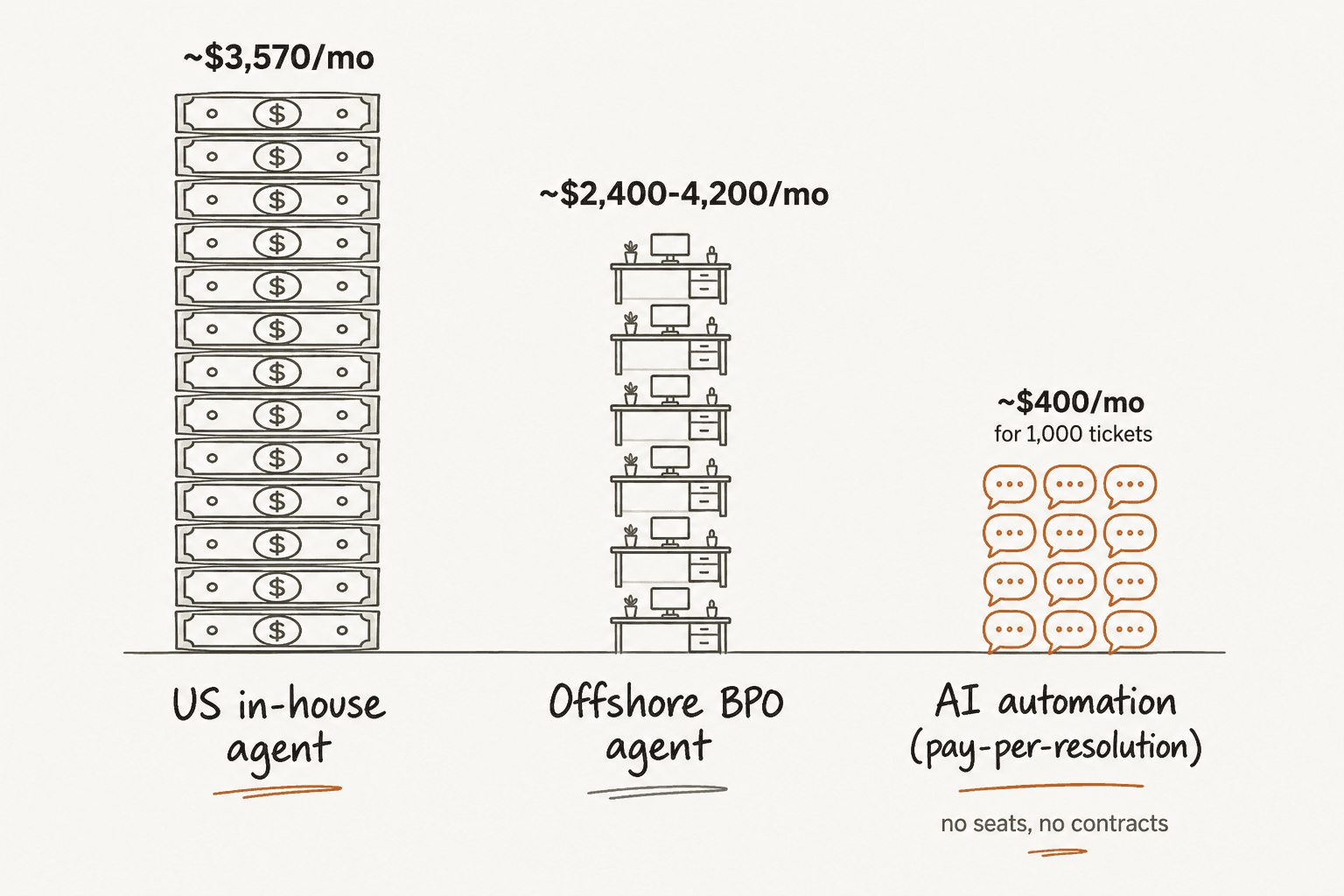
The three real alternative paths
Every "alternative" on the market fits one of three buckets, and they solve different problems:
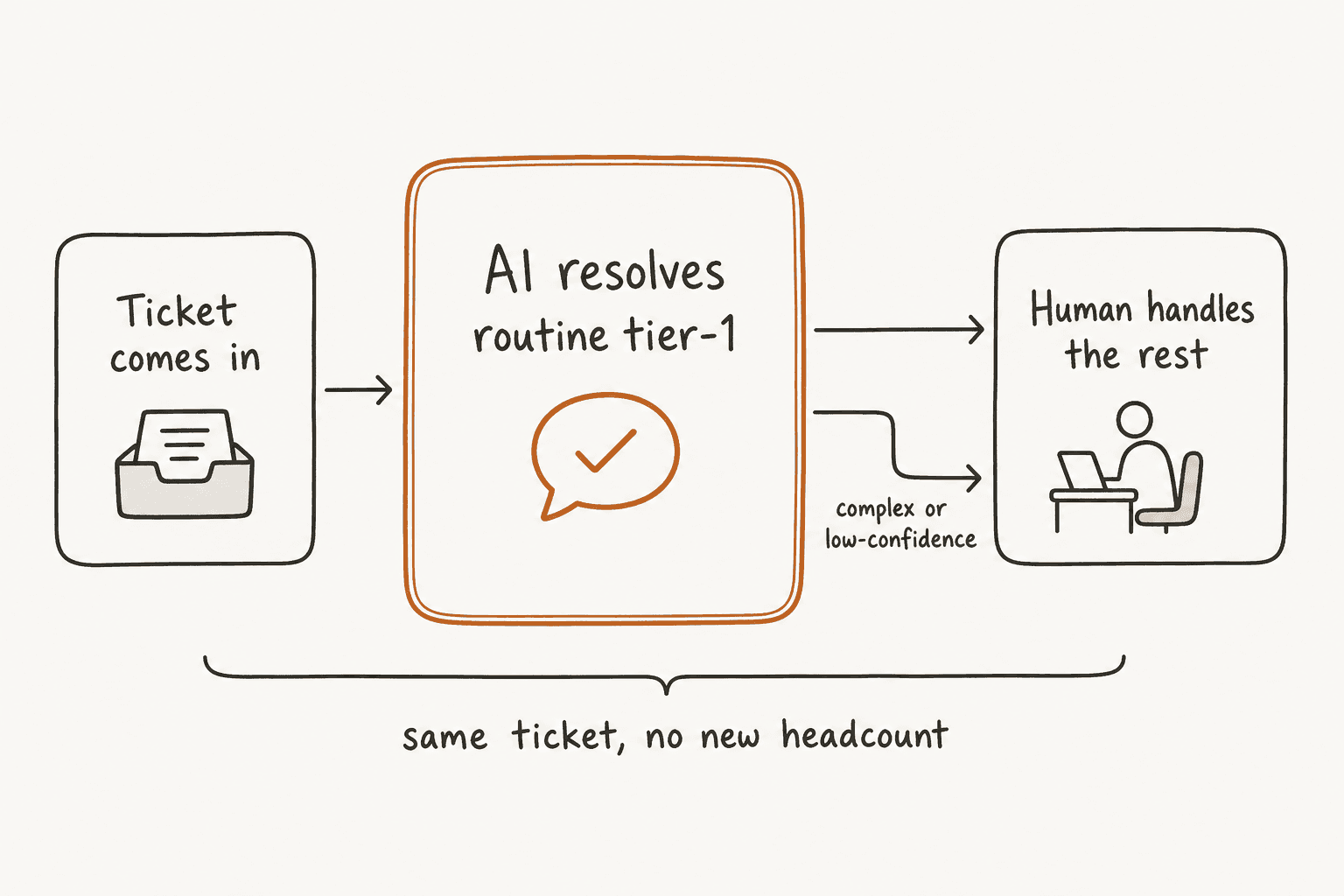
- AI-first automation. Instead of moving the same manual work to a cheaper location, this removes the manual work for repetitive tickets entirely by resolving them from your knowledge base and past tickets, with a real AI agent, not a scripted bot. It's instant, consistently on-brand, and doesn't ramp or churn. eesel is the example here; see the full support automation roundup if you want other vendors in the same bucket.
- Flexible, modern outsourcing. Same idea as a BPO, different pricing and contract model: month-to-month terms, published rates, and pay-per-resolution instead of a locked seat. Influx and PartnerHero fit this bucket.
- On-demand contractor networks. Independent contractors instead of a fixed offshore floor, flexed up or down for seasonal spikes without a hiring lag. Working Solutions and Peak Support fit here, with Peak Support leaning more boutique-BPO than pure gig network.
Deciding between the first two is really an AI vs human question specific to your own ticket mix, and it's worth reading the build vs buy case before you commit to either.
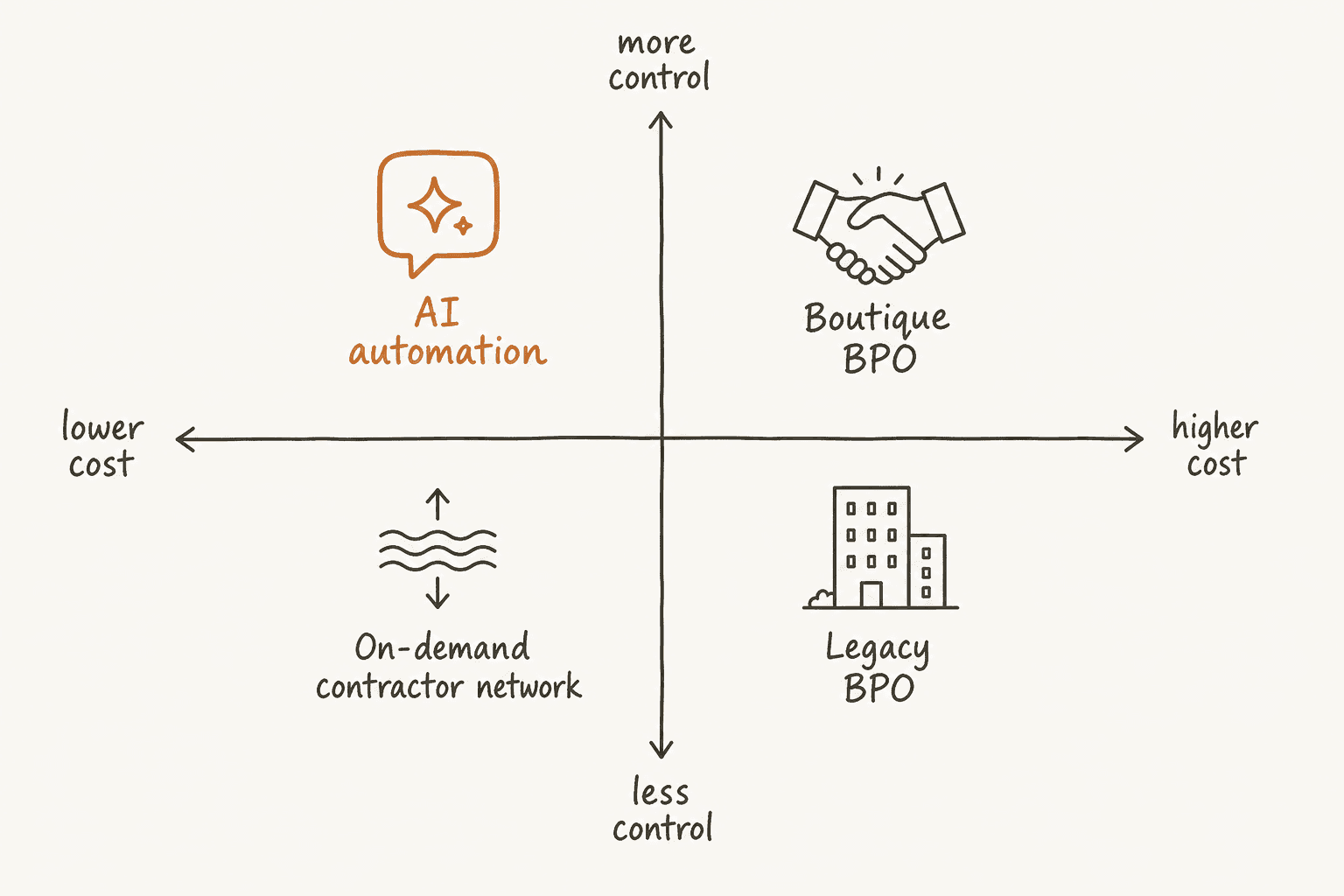
Most teams that get this right don't pick just one path. They automate the tier-1 volume first, then decide whether the remaining, harder tickets justify outsourcing at all or are better handled by a small in-house team.
The 5 alternatives, compared
1. eesel - best for teams that want to automate tier-1 without adding headcount

eesel is an AI teammate that plugs into your existing helpdesk (Zendesk, Freshdesk, Intercom, HubSpot, Gorgias, Front, and 100+ other integrations) and learns from your past tickets and docs on day one, rather than requiring months of BPO knowledge transfer. It drafts replies, triages, and escalates, starting supervised and earning autonomy as its confidence score holds.
Features: simulation mode runs the agent against your ticket history before it ever goes live, so you see the resolution rate before committing; confidence-based routing sends anything uncertain to a draft instead of an autonomous reply; support in 80+ languages; automatic knowledge-base article generation for gaps it finds in your docs.
Pricing: one fixed monthly price, starting at $299/month for 500 credits (1 credit per ticket or chat), no per-seat fee and no platform fee. A free plan with 100 credits and no credit card required. SSO and MFA are add-ons from $199/month, and HIPAA is available on request.
| Tickets or chats per month (credits) | Monthly cost |
|---|---|
| 100 | Free plan |
| 500 | $299 |
| 1,000 | $499 |
| 2,500 | $999 |
My take: eesel is the pick if the problem is volume, not headcount. E-commerce logistics platform Gridwise saw 73% of tier-1 requests resolved in the first month, and German lending marketplace Smava now runs a fully automated Zendesk agent processing 100,000+ tickets a month. Teams still handling truly complex or sensitive tickets in-house or through a small outsourced team, on top of AI clearing tier-1, is the setup that actually works, and the ROI tends to show up within the first month.
Read my cost-savings breakdown, or the wider customer service system it slots into, before running the math on your own volume.
2. PartnerHero (now part of Crescendo) - best for managed AI+human CX without a legacy BPO contract
PartnerHero built outsourced CX teams for scaling brands like Airtable, Etsy, and Loom before Crescendo acquired it in October 2024, one of the largest acquisitions by an early-stage company in the CX space at the time. The brand now runs on Crescendo's combined AI-plus-human model rather than as a standalone outsourcer.
Features: omnichannel agentic AI across chat, email, and voice, with human agents handling what the AI can't; 100% automated QA scoring on every interaction via its insights and reporting layer; delivery across EMEA, North America, LATAM, and APAC; a stated launch timeline of under 2 weeks.
Pricing: publicly posted, but inconsistent across tiers. Its "Managed AI" package lists $1.25 per solve plus a $2,900/month base fee. Elsewhere on the same page, the all-inclusive "Augmented AI" rate is listed as starting at $2.99 per resolution. Treat either as illustrative rather than fixed until you re-check the live page.
My take: worth a look if you want AI-assisted CX bundled with a managed human layer and don't mind an outcome-based bill that can swing between roughly $2.99 and $4.15 per resolution depending on the package. Its AI layer chases the same first contact resolution goal most outsourced floors struggle to hit consistently, with a human agent assist layer behind it rather than full automation. Community proof is thin: G2 has no reviews on file, and the one review I could verify on Trustpilot called it "Worst outsourcing company we've ever experienced," so weigh the vendor's own numbers more heavily than sentiment here until more reviews land.
3. Influx - best for teams that want transparent, published, month-to-month pricing
Founded in 2013, Influx runs a nearshore, follow-the-sun support model across APAC, EMEA, and the Americas, and is unusual in the outsourcing category for actually publishing its rates instead of gating everything behind a sales call.
Features: two ways to buy, either dedicated agents you manage (Talent as a Service) or a fully managed team with a Team Leader, QA, and reporting (Managed Operations); 24/7 follow-the-sun coverage; an AI layer paired with human agents for volume handling; agents onboarded in as little as 1 to 2 weeks.
Pricing: Talent as a Service starts from $1,400/month in APAC and $1,700/month in the Americas for a Level 1 agent, with part-time roles from $1,000/month. Managed Operations starts from $2,100/month per agent plus a Team Leader fee. No setup fee, no long-term lock-in on either line.
My take: the clearest pricing on this list, which makes it easy to actually compare against AI automation on a real number. 750+ brands have used it, including Linktree (93% CSAT across 26 agents in 4 regions) and Meshki (95% CSAT alongside 589% growth), and its omnichannel coverage doubles as a multichannel support setup out of the box. No verifiable G2 or Reddit reviews turned up during my research, so weigh the published numbers more than sentiment, same caveat as PartnerHero.
4. Peak Support - best for mid-market teams that want a boutique, attentive BPO
Peak Support is a US-managed BPO that leads with culture and low attrition rather than the cheapest per-seat rate, delivering from five locations (the US, Philippines, Colombia, India, and Eastern Europe) and capping team leads at just 10 direct reports for closer supervision than a mega-BPO typically offers.
Features: its own AI tooling suite (sentiment analysis, an AI chatbot, in-browser RPA, and an agent-assist tool) layered on top of human agents; SOC 2 and PCI DSS certified, HIPAA-capable; integrates with Zendesk, Freshdesk, Gorgias, Intercom, and most major CX and voice platforms; an average client tenure of 5 years.
Pricing: fully quote-gated, no public rate card exists. What's publicly known is the billing model: clients are billed only for hours actually worked, with training, QA, reporting, and workforce management bundled in rather than billed as add-ons.
My take: the strongest community proof of the four outsourcing alternatives here, and its QA layer is closer to the improvement strategies most legacy BPOs talk about but rarely ship. Peak Support holds a 4.8/5 rating on G2 from 39 reviews, and one Senior Director of Operational Excellence wrote:
"I really like how Peak Support has become an extension of our team, knowing how to work with us to meet our needs... It's more of a partnership with them, and that level of collaboration is something that stands out to me."

The recurring criticism is the standard offshore friction: language and cultural gaps on complex product questions, not price or service quality.
5. Working Solutions - best for flexing capacity 200-300% for seasonal spikes
Working Solutions has run a virtual, independent-contractor call center since 1996, staffing programs from a network of over 150,000 US, Canadian, and Jamaican contractors instead of a fixed offshore floor.
Features: trains 2 to 3 contractors for every 1 FTE a program needs, enabling 200 to 300% surge capacity without a hiring lag; a blended AI plus Intelligent Agents model that pairs workflow automation for routine tasks with human contractors for complex ones; billing tracked in 15-minute worked increments rather than paid full shifts.
Pricing: fully quote-gated, no rate card published anywhere on the site.
My take: the go-to if your real problem is seasonality, not steady-state volume, like a seasonal ecommerce call center rather than steady year-round demand. During a Southwest Airlines crisis, its agents closed over 200,000 open tickets in five days. Named BPO of the Year at CCW's 2025 awards. No verifiable third-party reviews turned up on G2, Capterra, or Reddit during my research; only the model, not any independent rating, is confirmed here.
Comparison table
| Provider | Model | Starting price | Contract | Setup fee | Security | Best for |
|---|---|---|---|---|---|---|
| eesel | AI automation | From $299/mo for 500 credits | None, change plan any time | None | SOC 2 in progress, HIPAA on request | Automating tier-1 without new headcount |
| PartnerHero (Crescendo) | Managed AI + human | $2.99/resolution (varies by tier) | Quote-based | None stated | Not publicly detailed | Managed AI+human CX bundle |
| Influx | Human outsourcing + AI | $1,400/mo per agent | Month-to-month | None | Not publicly detailed | Transparent, published pricing |
| Peak Support | Boutique BPO | Quote-gated | Quote-based | Not stated | SOC 2, PCI DSS, HIPAA-capable | Attentive mid-market BPO |
| Working Solutions | Contractor network | Quote-gated | Quote-based | Not stated | Not publicly detailed | Seasonal capacity spikes |
None of these five automate everything on their own. Call center RPA still has its place for structured back-office work, and if your channels span voice, chat, and social, the omnichannel vs multichannel distinction affects which of these five actually solves your problem.
Watch out: some "alternatives" quietly stop existing
Before you sign anything, check that the alternative you're evaluating is still an independent, live product. Simplr was a well-known AI-plus-human hybrid, pitched explicitly as a way to "eliminate the customer service BPO." As of this writing, simplr.ai 301-redirects straight to its parent, Asurion, and the standalone product page no longer resolves. Its last live pricing page had already flagged the most common G2 complaint: reviewers who liked the product still called out cost. One 5-star G2 reviewer put it plainly:
"The pricing is high as compared to other platforms and sometimes we do face technical problems with Simplr."
None of this means Simplr's approach was wrong. It means an "alternative" you're comparing today can be absorbed into a parent company or discontinued by the time you're ready to sign, which is exactly the kind of vendor risk that a call center technology decision, or any modern call center build, should account for up front, not discover a year in.
The real math: a worked example
Take a mid-size support queue doing 1,000 tickets a month, mostly repetitive order-status, refund, and account questions. Here's what the same volume costs across the paths above:
- One outsourced US agent seat, at the $4,200/month rate quoted on Reddit, covers a fraction of 1,000 tickets and needs a second seat to clear the queue.
- PartnerHero's all-inclusive rate, at $2.99 per resolution, comes to roughly $2,990/month for 1,000 resolutions.
- Influx's Talent as a Service, at $1,400 to $1,700/month per agent, needs multiple seats to hit 1,000 tickets, pushing the real number well past $2,800 to $3,400/month before management overhead.
- eesel's Teammate plan, at 1,000 credits (1 credit per ticket or chat), comes to $499/month for the same 1,000 tickets, with no seat to hire, train, or replace when it churns.
The gap isn't because outsourcing is a bad business model. It's because most of that 1,000-ticket queue is the same handful of questions asked a thousand different ways, and that's exactly the ticket volume an AI agent is built to absorb at a cost per ticket that a per-seat model structurally can't match. See the wider AI customer support cost savings numbers for how this plays out past 1,000 tickets.
The call center automation playbook that works in 2026 is almost always AI-first on the repetitive volume, with whatever outsourcing or in-house headcount is left over reserved for the actually hard tickets, following the same SaaS support best practices that apply whether the team behind it is in-house or outsourced.
Try eesel
If the real problem behind your outsourcing search is a queue full of repetitive tier-1 tickets, eesel plugs into your existing helpdesk, Zendesk, Freshdesk, Intercom, Gorgias, HubSpot, or Front, and starts drafting from your own past tickets and docs on day one. Run it in simulation mode against your ticket history first, so you see the resolution rate before a single ticket goes live, and before you sign another outsourcing contract to cover volume an AI agent could clear for $499 a month at 1,000 tickets.
Rather not run it yourself? eesel Managed Support is the done-for-you version. For a flat $5,000 a month, we handle every customer conversation across email, chat, social DMs, SMS, WhatsApp, reviews and phone, inside the tools you already use, with our team watching over the AI. There's no setup fee and you can cancel anytime. That's less than most outsourced teams charge for 24/7 cover.
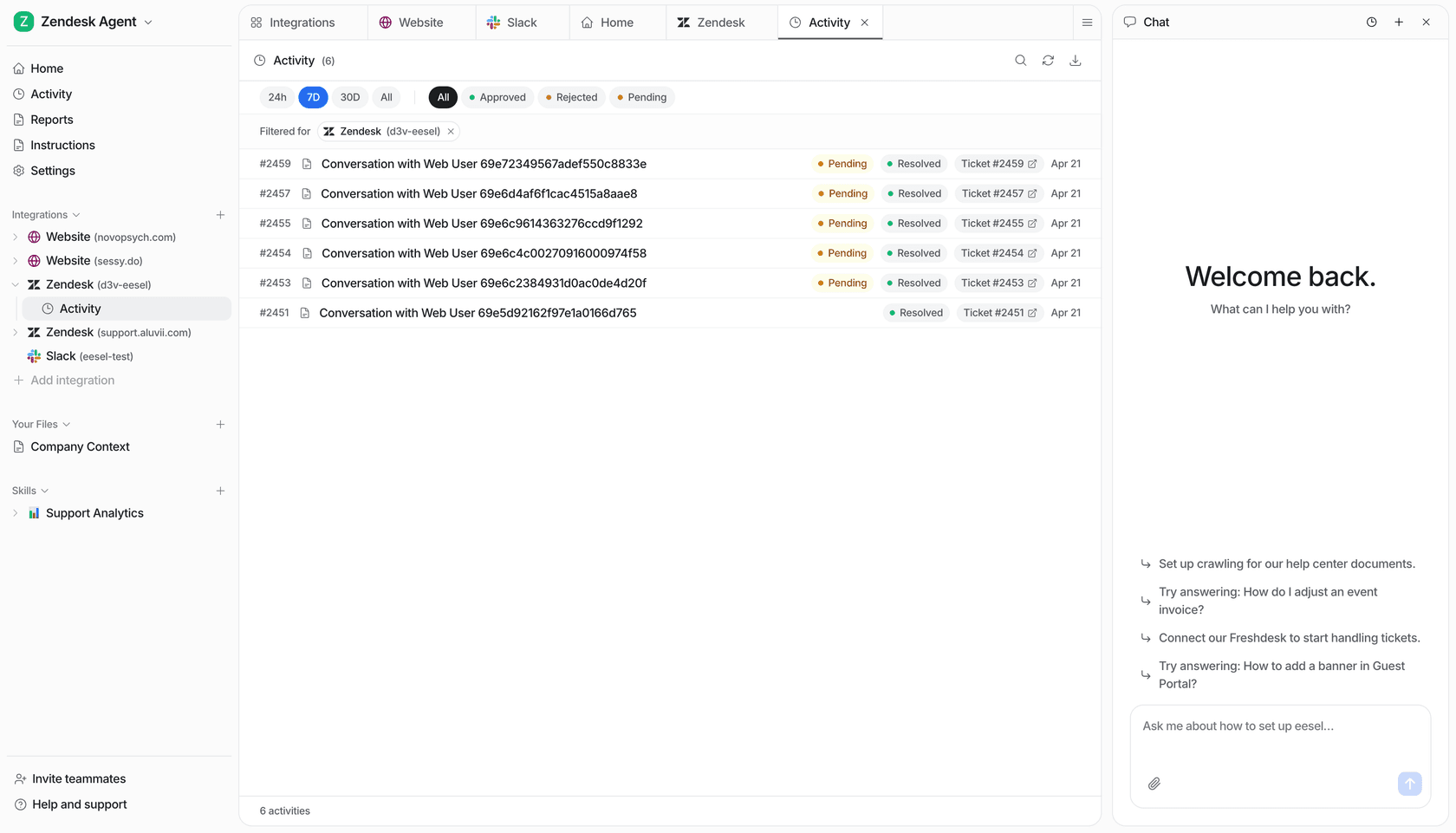
Try it free, with 100 credits and no credit card required, at eesel.ai.