Why people go looking for a Mavenoid alternative
Mavenoid is genuinely excellent at one job: helping a person fix a physical product that has stopped working. It identifies the device, then walks the owner through a model-specific fix across text, voice, image, and video, and it leads on real resolution rather than deflection. For an appliance, power-tool, or audio brand with a huge catalog, that focus is a real strength, and the case studies are real hardware names like Stanley Black & Decker, which reports 41% resolution.
That same focus is exactly why people start shopping. Three reasons come up over and over.
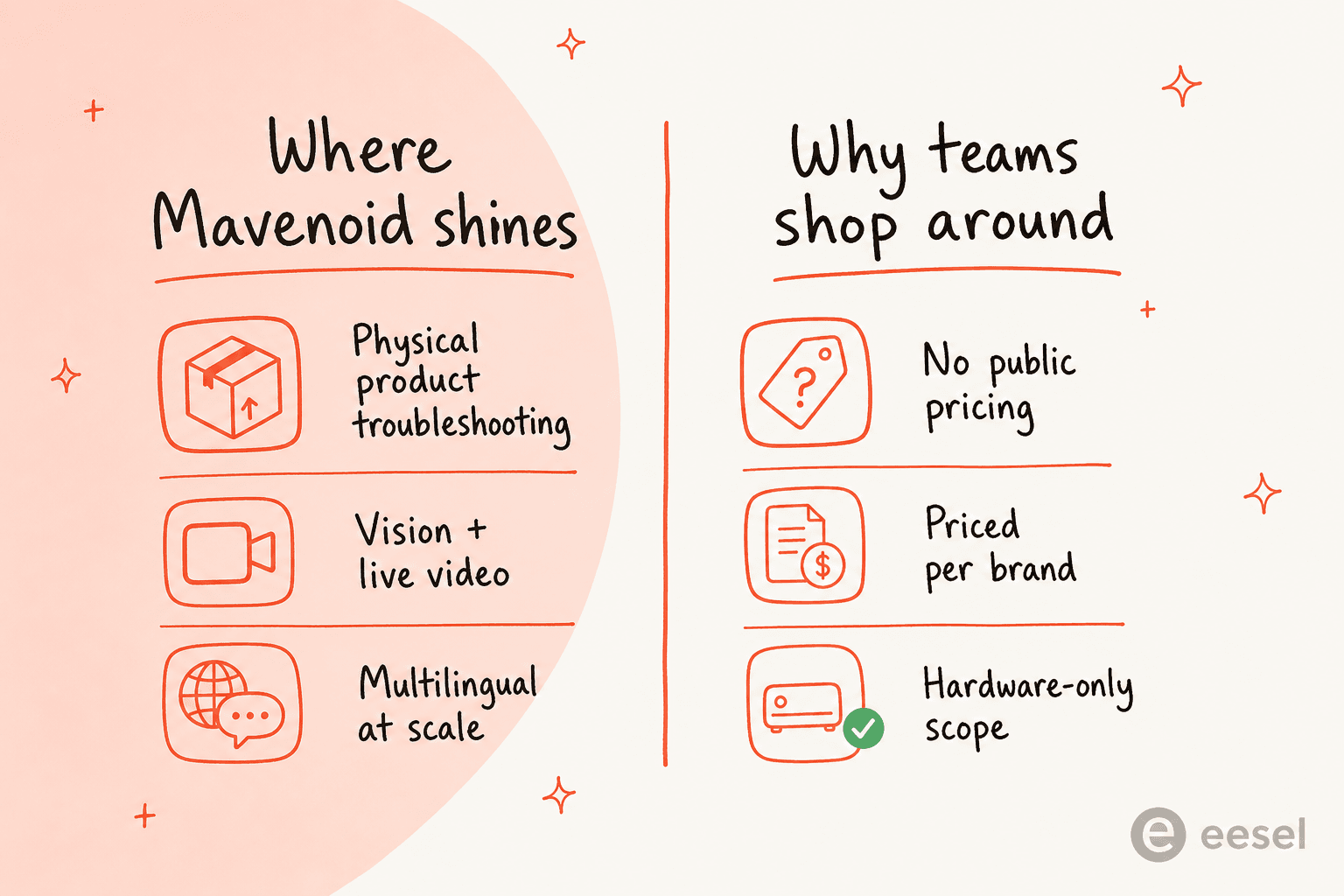
First, the price is invisible. There's no pricing page and no rate card, and every button on the site routes to a demo request. G2 reviewers peg the perceived cost at the very top of the scale ($$$$$) with a roughly nine-month payback, and the quote is built around how many brands you run plus add-ons. We dug into that in our Mavenoid pricing guide.
Second, it's narrow on purpose. If you don't sell physical products, almost none of Mavenoid's best features apply. Camera-based model ID and live video on a chainsaw do nothing for a SaaS desk answering "how do I reset my password."
Third, the "no-code" setup hides real work. The guided-flow modeling is where the effort lives, and G2 reviewers report a roughly two-month implementation. To be fair, reviewers like the people who do that work with them:
"What stands out most about Mavenoid is how easy it is to build and deploy guided troubleshooting flows without requiring deep technical knowledge. The visual flow builder is incredibly user-friendly, allowing our team to create complex decision trees."
Shom D., Mid-Market, G2 review

So the real question behind "best Mavenoid alternative" isn't "what's the flashiest tool." It's "which of these am I actually solving for: hardware-shaped support, ecommerce, enterprise scale, or just getting AI live on the helpdesk I already have." I've ranked the list with exactly that in mind.
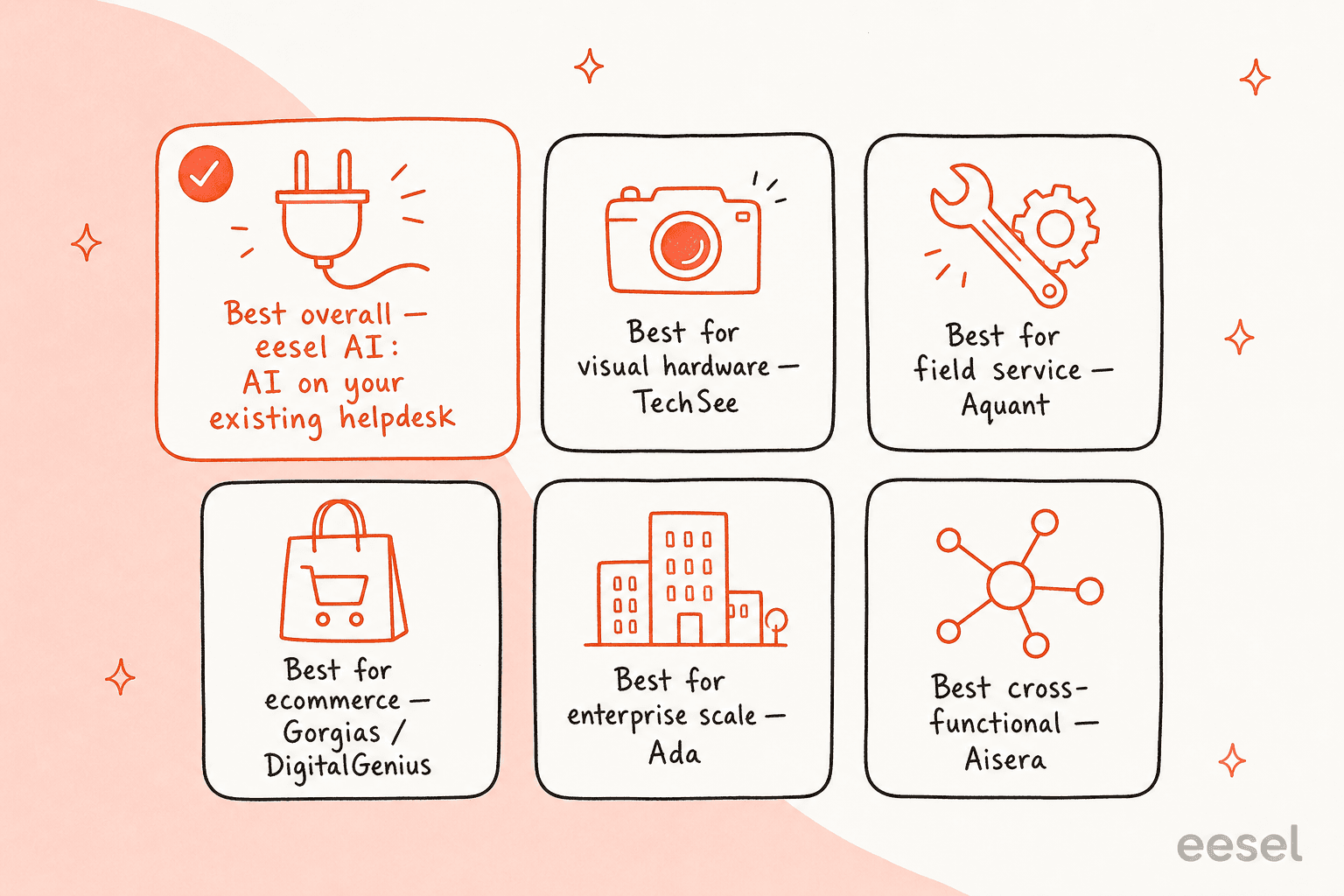
The best Mavenoid alternatives at a glance
Before the deep dives, here's the comparison I'd actually use. The two columns that matter most to a switcher are whether the pricing is public and how long it realistically takes to go live, so those sit up front.
| Tool | Best for | Pricing model | Public price? | Built for hardware? | Time to live |
|---|---|---|---|---|---|
| eesel AI | Best overall, AI on your existing helpdesk | Usage-based, ~$0.40/ticket, no seat fees | Yes | No (any helpdesk) | Minutes to days |
| TechSee | Visual / AR hardware troubleshooting | Quote-only, enterprise | No | Yes | Weeks |
| Aquant | Complex equipment and field service | Quote-only, enterprise | No | Yes | Weeks+ |
| DigitalGenius | Ecommerce returns and WISMO | Quote-only | No | Ecommerce | Weeks |
| Gorgias | Shopify and DTC product brands | Ticket-based from $10/mo + AI add-on | Yes | Ecommerce | Days |
| Ada | Enterprise-scale automation | Quote-only, 300k+ conversations floor | No | No | Weeks |
| Aisera | Cross-functional (IT + HR + CX) | Quote-only, enterprise | No | No | Weeks+ |
| Zendesk | AI inside an all-in-one suite | Seat-based from $19/agent + per-resolution AI | Partly | No | Days to weeks |
One note on reading this. The "built for hardware" column is the tell for whether a tool is a true Mavenoid replacement or a different category wearing the same label. If you sell physical products, weight TechSee, Aquant, and DigitalGenius heavily. If you don't, that column is noise, and you should optimize for public pricing and fast setup instead.
1. eesel AI
Best for: the best overall pick for teams that want an AI agent live on their existing helpdesk this week, with no multi-month modeling project and no sales call to learn the price.
I'll be straight that this is our own tool, so read the verdict with that in mind. But it ranks first for a concrete reason: most people searching for a Mavenoid alternative don't sell physical products, and for them the entire "vision-based hardware troubleshooting" category is the wrong purchase. What they need is an AI agent that plugs into the helpdesk they already run and starts clearing tickets.
That's what eesel AI is. It connects to Zendesk, Freshdesk, Salesforce, Gorgias, Help Scout, or a shared inbox, trains on your past tickets, macros, and help center, and drafts or fully resolves tickets inside the tool your team already lives in. There's no separate platform to log into and no flow library to hand-build before you see value.

The part I'd point a switcher to is the simulation mode. Before eesel auto-replies to a single customer, you run it against thousands of your own historical tickets to see exactly what it would have said and what your resolution rate would be. You start in draft-for-review mode, then hand it more autonomy as your confidence grows. That's the practical version of the same "don't let a confident bot answer wrong" worry that Mavenoid's resolution framing is built around, and it's why one team resolved 73% of tier-1 requests in its first month after testing on real history.
Pros
- Usage-based pricing at roughly 40 cents per resolved ticket, no per-seat fees, free to start. You see the price without a demo.
- Goes live in minutes to days because it learns from existing tickets and docs, not a hand-built flow library.
- Simulation proves the resolution rate on your own history before you go live.
- Connects to 100+ tools and keeps a human in the loop on anything it isn't confident about.
Cons
- Not built for physical-product diagnosis. No camera-based model scanning or AR live video, so a power-tool brand that needs those should look at TechSee or Mavenoid.
- It layers on your helpdesk rather than replacing it, so you keep paying for the underlying support tool too.
- Cost is the top con from G2 reviewers at very high ticket volumes, so model your numbers at massive scale.
Pricing: Usage-based, around $0.40 per resolved ticket, no seat fees, free to start. Enterprise adds a flat platform fee plus usage. Rated 4.6/5 on G2.
Verdict: If you don't sell hardware, eesel is the most direct answer to "I want what Mavenoid does (real resolution, kept honest) but on my existing helpdesk, this week, at a price I can see." If you do sell complex hardware, treat it as a complement to a vision tool, not a replacement.
2. TechSee
Best for: telecom, consumer-electronics, and home-security brands with field-service operations that want to see the customer's device and cut truck rolls.
For the closest like-for-like to Mavenoid's visual approach, TechSee is the pick. The whole platform is built around computer vision: agents, technicians, and AI agents see a physical product through the customer's phone camera and guide them with augmented-reality overlays. Its flagship, Sophie AI, is pitched as a "visual agentic AI" that identifies make and model, reads LED patterns, scans barcodes, and walks someone through a fix.
That visual-first angle is exactly where it out-specializes a guided-text tool. A G2 reviewer supporting Google Nest products put the value plainly:
"Technical Support for Google Nest products requires a lot of details... Product symptoms, LED colors, patterns, icons... so TechSee enables us to see what the customer sees."
Pablo M., Mid-Market, G2 review
It backs that up with field-service economics: TechSee claims over a 20% reduction in technician dispatch and savings up to $3.5 million a year by minimizing truck rolls, with named logos like Vodafone, Orange, and Whirlpool. The company has raised around $53.5 million across its rounds.
Pros
- True computer-vision and AR remote assistance, the strongest visual-troubleshooting story on this list.
- Strong field-service ROI for dispatch-heavy industries (telecom, utilities, home security).
- 4.9/5 on G2, with reviewers praising how fast it makes newer agents effective.
Cons
- Quote-only, enterprise sales motion. No public pricing and no free trial, the same opacity that frustrates Mavenoid buyers.
- The G2 footprint is small (10 reviews) and mostly dated to 2023, and reviewers call the web UI "a bit outdated."
- Like Mavenoid, it's overkill if you don't support physical products.
Pricing: Not public. Enterprise, request-a-demo only.
Verdict: Pick TechSee over Mavenoid when the camera is the point, when support hinges on actually seeing the device and reducing field dispatches. Skip it if you want transparent pricing or you don't sell hardware.
3. Aquant
Best for: OEMs and service organizations supporting complex, high-value equipment (medical devices, industrial machinery) that want to scale their best technicians' knowledge.
Aquant plays in the same complex-equipment world as Mavenoid but from the technician's side. Instead of leading with customer self-service, it leans into service intelligence: it mines your historical service data and the expertise locked in senior technicians' heads, then turns that into agents that help frontline teams triage, diagnose, and fix faster. Think medical-device field service and industrial machinery, not consumer appliances.
The proof points are enterprise-grade. Aquant says that when a whole team performs like its top 20%, customers see a 28% reduction in service costs, and it names blue-chip customers like Siemens, Hologic, and John Deere. It has raised a $70M Series C and carries heavy compliance coverage (SOC 2, ISO 27001, HIPAA), backed by a public Trust Center.
The honest caveat is structural: accuracy depends on you having rich, clean historical service data to learn from. That's also the dominant theme in its thin G2 reviews, which sit at 4.8/5 from 4 reviews and flag "data management" alongside praise for how well the engine learns each org's failure patterns.
Pros
- Purpose-built for complex equipment and field service, with a strong "capture your experts' knowledge" angle.
- Serious enterprise credentials: blue-chip customers, $70M+ raised, deep compliance including HIPAA.
- Offline mode and Voice AI for technicians in the field, which Mavenoid doesn't emphasize.
Cons
- Quote-only with no public pricing and no free trial.
- Results hinge on the quality of your historical service data.
- Very small public review base, so lean on the named customers rather than review volume.
Pricing: Not public. Sales-led, demo only.
Verdict: Aquant is the pick when your problem is field-service complexity and tribal knowledge walking out the door, not consumer self-service. If you mostly need customers to fix their own gadgets, Mavenoid or TechSee fit better.
4. DigitalGenius
Best for: ecommerce and retail brands that want to fully resolve order, returns, and WISMO journeys end to end.
If your "products" ship in a box rather than need troubleshooting, DigitalGenius is a more natural fit than Mavenoid. It's an ecommerce-focused AI platform that, like Mavenoid, emphasizes full resolution over surface deflection, but the resolutions are retail ones: processing returns, issuing replacements for lost deliveries, editing orders, and handling warranty claims through chat.
Its pitch leans on Genius Flows, pre-built ecommerce workflows distilled from a decade in the category, plus deep code-free integrations it builds into your stack for free. The published results are vendor-cited but specific: the footwear brand On reports it cut customer wait times by 93%, and Beauty Pie says it launched in a couple of weeks while automating 40% of contacts at over 90% resolution.
Pros
- Built specifically for ecommerce and retail support journeys, with ready-made flows.
- Action-oriented: it takes real steps (returns, order edits) rather than just answering.
- Free, hands-on integration builds into your existing tech stack.
Cons
- Quote-only. The pricing page redirects to a demo booking.
- Public proof is mostly vendor testimonials rather than independent review volume.
- Not for hardware troubleshooting, and the wrong shape for a software or internal IT desk.
Pricing: Not public. Book-a-demo only.
Verdict: A strong Mavenoid alternative specifically for product brands whose support is about orders and returns, not device diagnosis. For Shopify-native stores, weigh it against Gorgias next.
5. Gorgias
Best for: DTC and Shopify brands that want AI support wired tightly into their store data, with pricing they can actually see.
Gorgias is the ecommerce helpdesk that powers a big chunk of Shopify brands, and its AI Agent is pre-trained on a billion-plus ecommerce conversations. It earns a spot here because, for a product brand selling online, the support questions are mostly commerce questions, and Gorgias pulls order, customer, and subscription data straight into the conversation so the AI can cancel, discount, edit, or upsell in context.
Crucially, unlike Mavenoid, it publishes pricing. Plans are ticket-based rather than per-seat, starting at $10/month, and the AI Agent is a usage-based add-on at $0.90 per resolved conversation on annual plans. That transparency alone makes budgeting far less painful than a Mavenoid quote.
Pros
- Deep native Shopify integration; no other tool pulls store data this cleanly into the ticket view.
- Public, ticket-based pricing from $10/month, with a clear per-resolution AI add-on.
- Strong automation at peak season, with brands reporting 50%+ automation rates.
Cons
- Ecommerce-only by design, so it's no help for hardware diagnosis or a non-retail desk.
- Reviewers note it runs roughly 3x the cost of a generic helpdesk at similar ticket volumes.
- The AI Agent is an add-on on top of the helpdesk seat cost, so model both.
Pricing: Public. Helpdesk from $10/month (ticket-based); AI Agent add-on $0.90 per resolved conversation (annual).
Verdict: For a Shopify-first product brand, Gorgias is a more sensible Mavenoid alternative than any hardware tool, and the public pricing is a relief. If you want the same store-aware automation on a different helpdesk, eesel also connects to Gorgias and Shopify.
6. Ada
Best for: large enterprises with very high conversation volumes that want a standalone AI agent layer on top of their existing helpdesk.
Ada is a Toronto-based, enterprise-tier AI customer service platform that brands its category as "agentic customer experience." Like eesel, it's a standalone AI layer that sits on top of helpdesks like Zendesk, Salesforce, and ServiceNow rather than a feature inside one. Its Reasoning Engine orchestrates across multiple LLMs, and it's strong on omnichannel (including voice) and multilingual support.
The catch is the segment. Ada states a floor of 300,000 annual conversations to be a good fit, and it doesn't publish pricing. That's a deliberate enterprise gate, with customers like Monday.com and Cebu Pacific. If you're not at that scale, Ada isn't pitched at you, but at the top end it's one of the most credible standalone agent platforms going, and Monday.com reports a 42% cut in average handle time.
Pros
- Genuinely standalone AI agent platform, helpdesk-agnostic, multi-LLM, strong voice roadmap.
- Strong enterprise compliance story, including AI-specific certification and zero data retention with LLM providers.
- Published customer outcomes are big and named.
Cons
- Enterprise-only by qualification (300k+ annual conversations), so it excludes SMB and most mid-market.
- No public pricing; sales-led with a services wrap.
- No hardware-specific troubleshooting, so it's a general-CX alternative, not a Mavenoid like-for-like.
Pricing: Not public. Enterprise, contact-sales only.
Verdict: Consider Ada if you're a large brand consolidating onto a powerful standalone agent layer. For smaller teams, the volume floor and hidden pricing make eesel or Gorgias an easier start.
7. Aisera
Best for: large enterprises that want one agentic AI platform spanning IT, HR, and customer service, not just CX.
Aisera is the most cross-functional option here. Where Mavenoid is laser-focused on product support, Aisera is an enterprise AI platform whose Universal Agent orchestrates domain agents across IT, HR, finance, and customer service. It's heavily funded (around $171M raised, last at a $1.6B valuation) and was acquired by Automation Anywhere in late 2025, so its go-to-market is increasingly bundled into that agentic-automation suite.
Customer outcomes skew toward big internal-support wins: LifeScan auto-resolves 65% of incoming requests, and OmniTRAX auto-resolved 70% of tickets. It's the kind of tool a transformation or IT leader buys for the whole company, not a CX manager buying for one desk.
Pros
- Cross-functional from day one (IT + HR + CX + finance), with an LLM gateway and open orchestration standards.
- Heavyweight enterprise references and analyst recognition in ITSM and conversational AI.
- Deploys alongside your systems of record (ServiceNow, Salesforce, Zendesk).
Cons
- No public pricing; annual enterprise contracts only.
- Too heavy a buy for a CX-only team of 50 to 500 seats.
- Not built for physical-product diagnosis, so it's an adjacent category to Mavenoid, not a direct swap.
Pricing: Not public. Enterprise, contact-sales only.
Verdict: Aisera makes sense if your real goal is one agent platform across the whole enterprise. If you just need to automate a product-support queue, it's far more platform than you need.
8. Zendesk
Best for: teams that want AI agents inside a full, all-in-one support suite they may already use.
Zendesk rounds out the list as the incumbent suite. Its "Resolution Platform" bundles AI agents, human agents, ticketing, omnichannel messaging, voice, and analytics, and it's been pushing hard "beyond deflection" toward real resolutions, especially after folding in Forethought for self-improving AI agents. If your team already lives in Zendesk, its AI is one toggle away rather than a separate contract.
The thing to watch is the layered pricing. Seats run from $19/agent/month (no AI) up to $115 for Suite Professional, and the AI agents are billed separately per automated resolution on top, with several $50/agent/month add-ons. The entry price most people quote ($19) includes no AI at all, so the real bill is easy to underestimate. This is why many teams bolt a more flexible AI agent onto Zendesk rather than buying every native add-on.
Pros
- Full suite: ticketing, messaging, voice, knowledge base, and AI in one place.
- Publishes seat pricing, so at least part of the cost is transparent.
- Massive integration marketplace and enterprise-grade scale.
Cons
- Layered pricing (seat + per-resolution AI + add-ons) makes the total cost hard to predict.
- The cheapest plan has no AI, and enterprise pricing is hidden behind sales.
- Not built for hardware troubleshooting, so it's a general-CX alternative to Mavenoid.
Pricing: Partly public. Seats from $19/agent/month; AI billed per automated resolution on top; enterprise is custom.
Verdict: A safe choice if you want everything under one roof and you're already a Zendesk shop. If you want the AI smarter and cheaper than the native add-ons, layer eesel on top of Zendesk instead.
How to choose the best Mavenoid alternative for you
The decision mostly comes down to what you sell and how fast you need to move. Here's the shortcut I'd use.
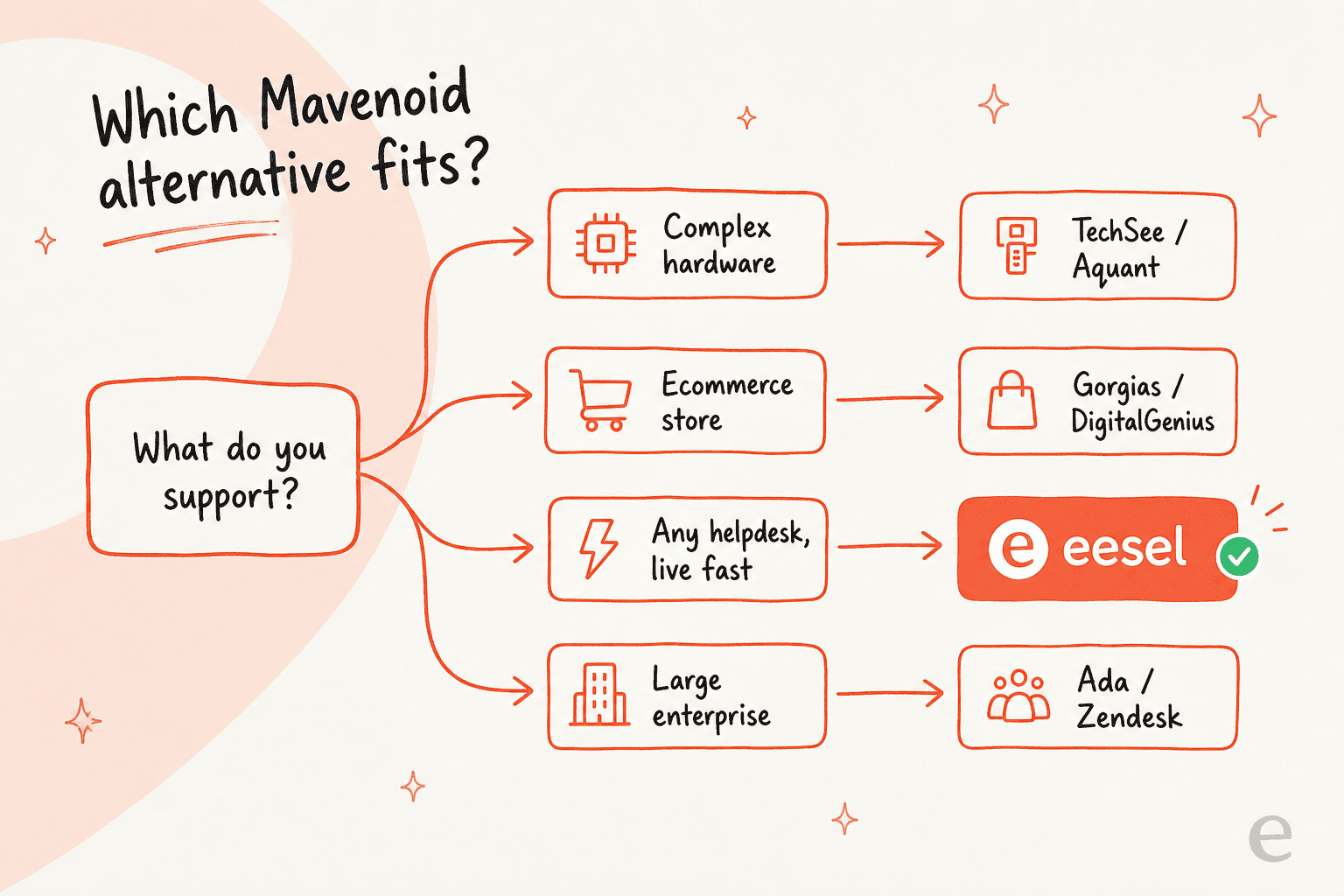
If you sell complex physical products and the camera is central, the real Mavenoid competitors are TechSee and Aquant. If you sell online and support is mostly orders and returns, look at Gorgias and DigitalGenius. If you're a large enterprise standardizing across functions, Ada and Aisera are in the conversation. And if you run a normal helpdesk and just want AI clearing tickets quickly, a general agent like eesel is the fastest path.
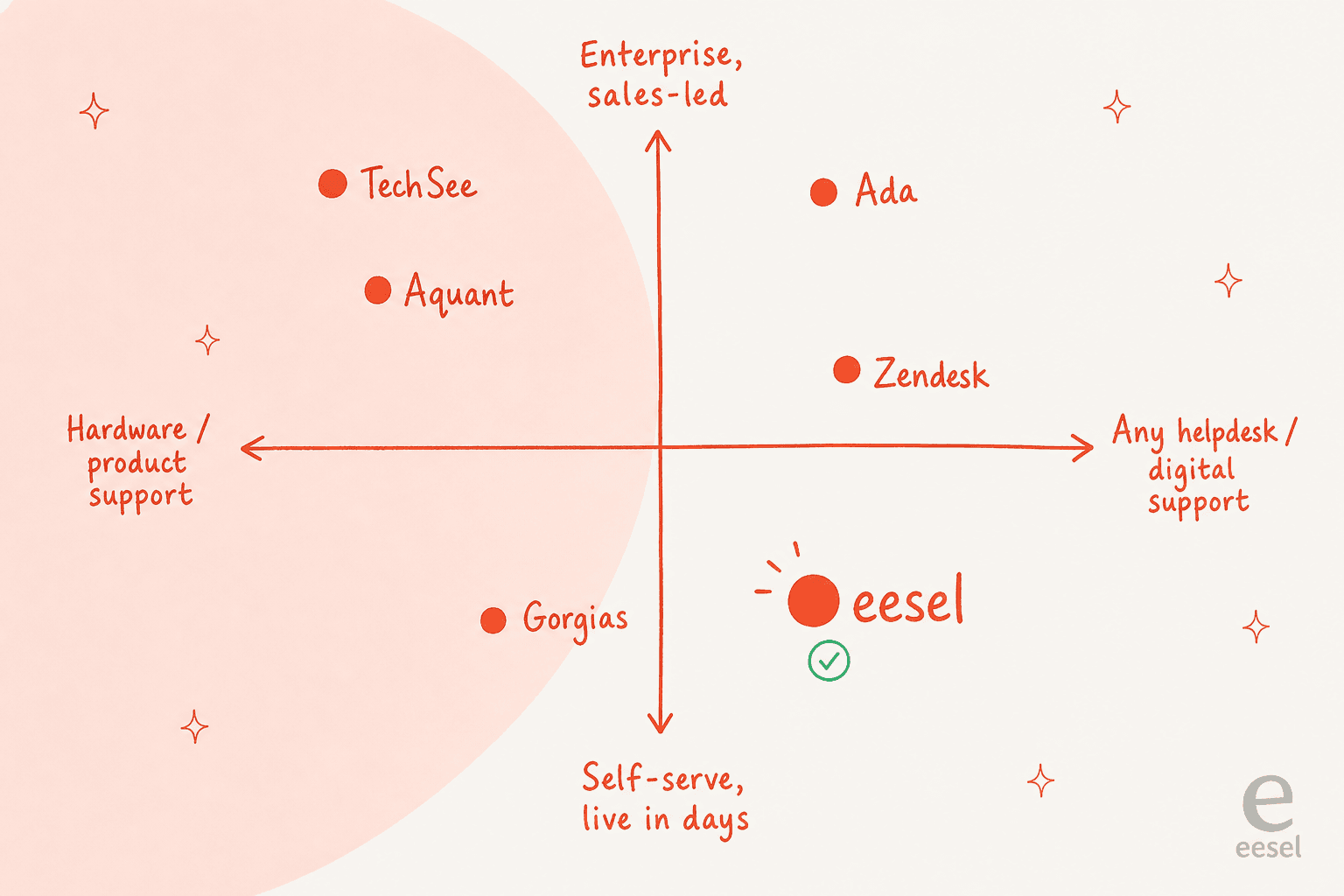
It also helps to plot these tools on two axes: how hardware-specific they are, and whether they're self-serve or sales-led. Most of the genuine Mavenoid look-alikes cluster in the same expensive, enterprise, hardware-first corner, which is exactly the corner people are trying to escape when they search for alternatives.
Whatever you pick, the one hard rule I'd carry over from Mavenoid's own framing is to insist on testing before you trust. The CX lead at a DTC supplements brand we work with put it perfectly: what you want is "an AI who is only handling the tickets that it's confident to handle, and all the other ones, leave them alone." A tool that lets you simulate against your own history and keep a human in the loop is worth more than the one with the slickest demo.
Try eesel AI on your helpdesk
If you sell complex hardware, I'd genuinely point you at Mavenoid or TechSee, because those tools are built for diagnosing physical devices in a way a general agent isn't. But most teams searching for the best Mavenoid alternative don't need that machinery. They run a normal helpdesk and want an AI teammate live this week, not next quarter.
That's where eesel AI fits. It connects to Zendesk, Freshdesk, Gorgias, and your other tools in minutes, trains on your past tickets and macros, and keeps a human in the loop on anything it isn't confident about. Where Mavenoid hides its price behind a demo, eesel is self-serve with transparent, usage-based pricing and no per-seat fees.
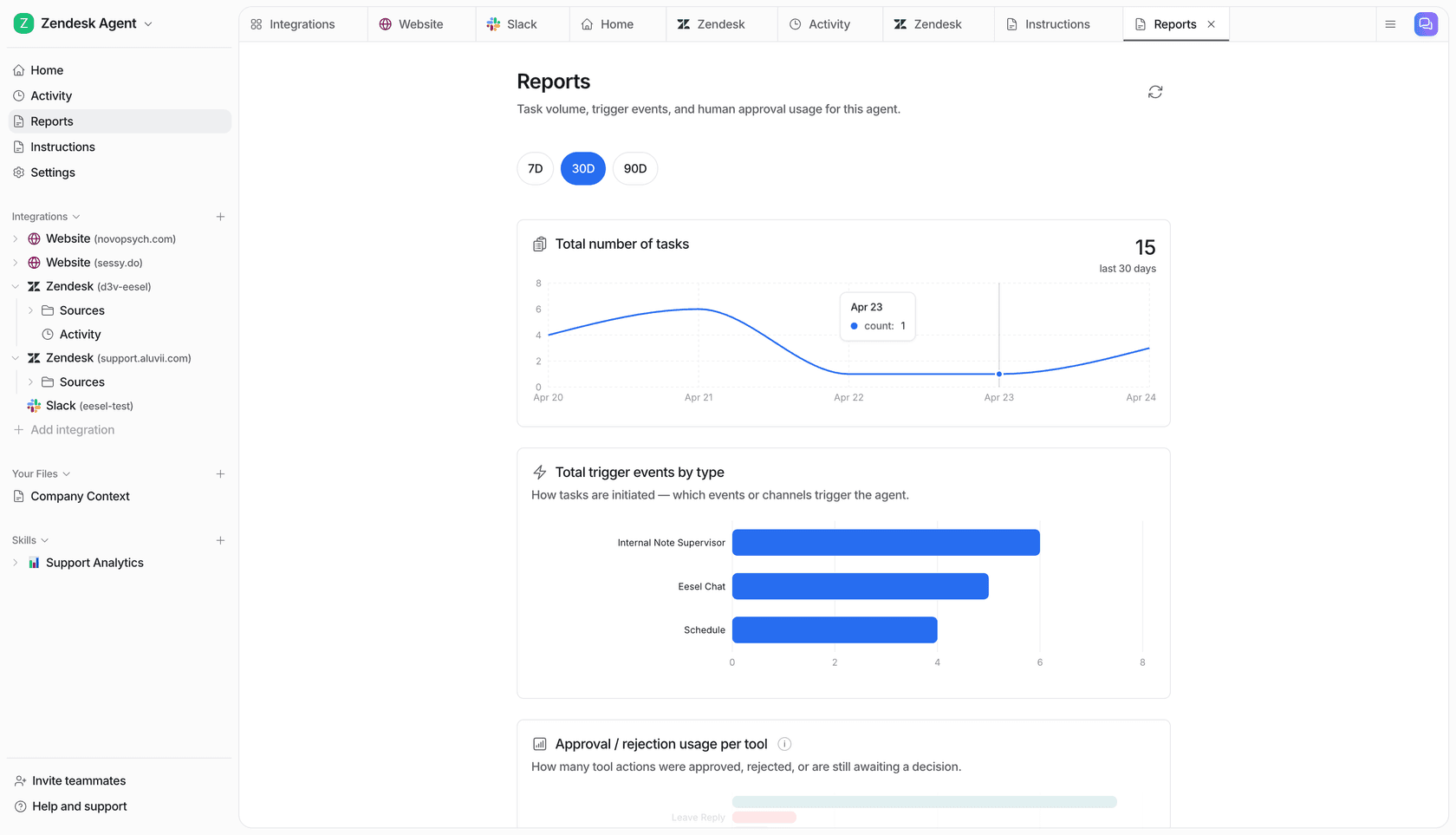
Best of all, you don't have to take my word for it. You can try eesel free, simulate it on your own ticket history, and see your real resolution rate before committing to anything, which is exactly how the team that saw eesel resolve 73% of tier-1 requests got the confidence to turn it on.
Frequently Asked Questions
What is the best Mavenoid alternative in 2026?
There's no single winner, it depends on what you support. For physical-product brands that want camera-led troubleshooting, TechSee is the closest like-for-like. For ecommerce, Gorgias fits better. And if you run a normal helpdesk and just want an AI helpdesk agent live this week, eesel AI is my pick for best overall because it trains on your tickets and shows you a price.
Do I need a hardware-specific tool to replace Mavenoid?
Only if you sell physical products. Mavenoid's vision scanning and live video are built for diagnosing devices. If you run a software, SaaS, or services desk, a general AI helpdesk is a closer fit and far cheaper than a hardware engine you won't use.
Which Mavenoid alternative is best for ecommerce?
Gorgias is the natural pick for Shopify and DTC brands because it pulls order data into the conversation, and DigitalGenius specializes in retail resolution flows. eesel also connects to Gorgias and Shopify if you want an AI agent for ecommerce on your stack.
How do I switch off Mavenoid without rebuilding everything?
Pick a tool that learns from your existing knowledge and tickets instead of a months-long modeling project. With eesel AI you connect your helpdesk, let it learn from past tickets and macros, and simulate it on historical tickets before it answers anyone, so the switch takes days, not quarters.


Article by
Kurnia Kharisma Agung Samiadjie
Kurnia is a software engineer and writer at eesel AI with two years of SEO experience, writing about AI tools, helpdesk software, and customer support. He pairs a developer's understanding of how these products are built with search-driven research into what actually ranks and resonates with the people searching for them.