The 7 best Maven AGI alternatives and competitors in 2026

Rama Adi

Katelin Teen
Last edited October 6, 2026

Why teams look for a Maven AGI alternative
Let me be fair to Maven first, because it is a serious product. It was founded in early 2023 in Boston by a strong team: Jonathan Corbin, previously Global VP of Customer Success at HubSpot, Sami Shalabi, a 25-year Google engineering veteran, and Eugene Mann, who led applied ML at Stripe. It has raised $78M to date, including a $50M Series B led by Dell Technologies Capital in June 2025. Its Agent Maven platform markets up to 93% of queries answered autonomously, and Tripadvisor's Head of Data and AI says Maven handles 90% of incoming queries. That is real.
So why do people shop around? A few reasons come up again and again.
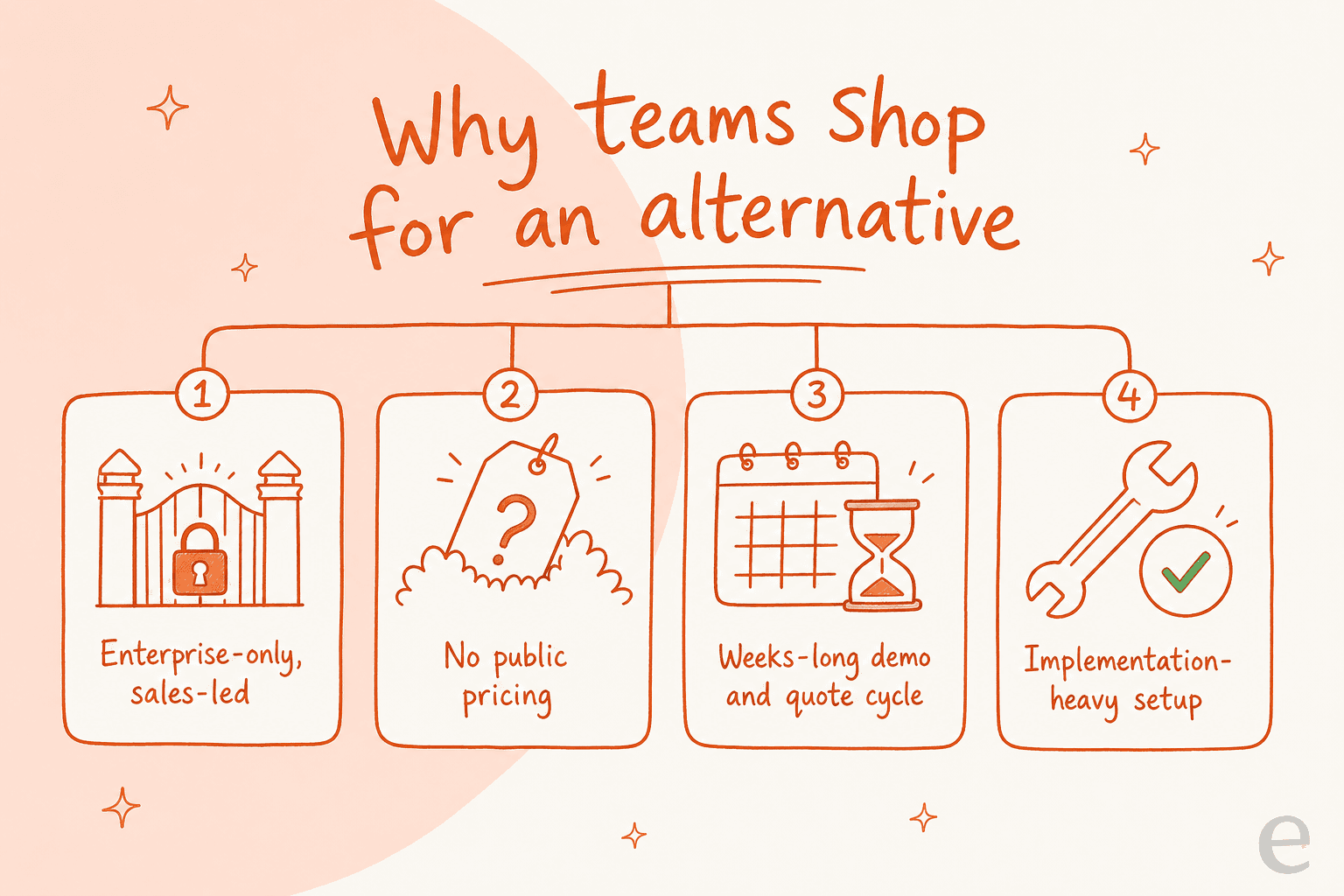
First, the pricing is invisible. Maven publishes no public pricing at all: its /pricing page 404s, there is no free tier, and every conversion path is a "book a demo." Third-party marketplaces confirm it is a custom, contact-sales model. One reviewer put the frustration plainly:
"Pricing is not good and Need continuous maintenance."
Second, it is an enterprise, sales-led motion. Maven positions squarely on enterprise CX and publicly traded companies. That is a great fit if you have a procurement team, and a mismatch if you are a mid-market SaaS or a growing e-commerce brand that wants to sign up and try something this week.
Third, it needs ongoing tuning. The same reviewer flagged that it "needs continuous maintenance," and even happy customers describe improving the agent through targeted prompt training over time. It is not fully set-and-forget.
Fourth, the public track record is still thin. Maven has only around 16 reviews on G2 and was founded in 2023, so risk-averse buyers have limited independent proof to lean on compared with the enterprise incumbents.
None of this makes Maven a bad tool. It just means that for a lot of teams, the shape of the product and the way you have to buy it do not match the problem they actually have.
What I looked for in a Maven AGI alternative
I did not want to just swap one enterprise AI platform for another. The point of a shortlist is to cover the range of what a buyer might actually need. So I judged each tool on a few things that matter more than a benchmark score:
- Pricing you can see. Can you get a number, or even sign up, without booking a sales call? This is the single biggest split in the market.
- Where it lives. Is it native to your helpdesk, or a separate platform that sits on top of your stack?
- How fast you get value. Weeks of implementation and tuning, or live in days?
- How you de-risk it. Can you test the AI on your own history before it touches a real customer? This is the difference between a controlled rollout and a leap of faith.
- What it actually costs to run at your volume, ideally as a cost per resolved conversation, not the sticker on the marketing page.
That last point is worth a picture, because pricing transparency is where this whole category separates.
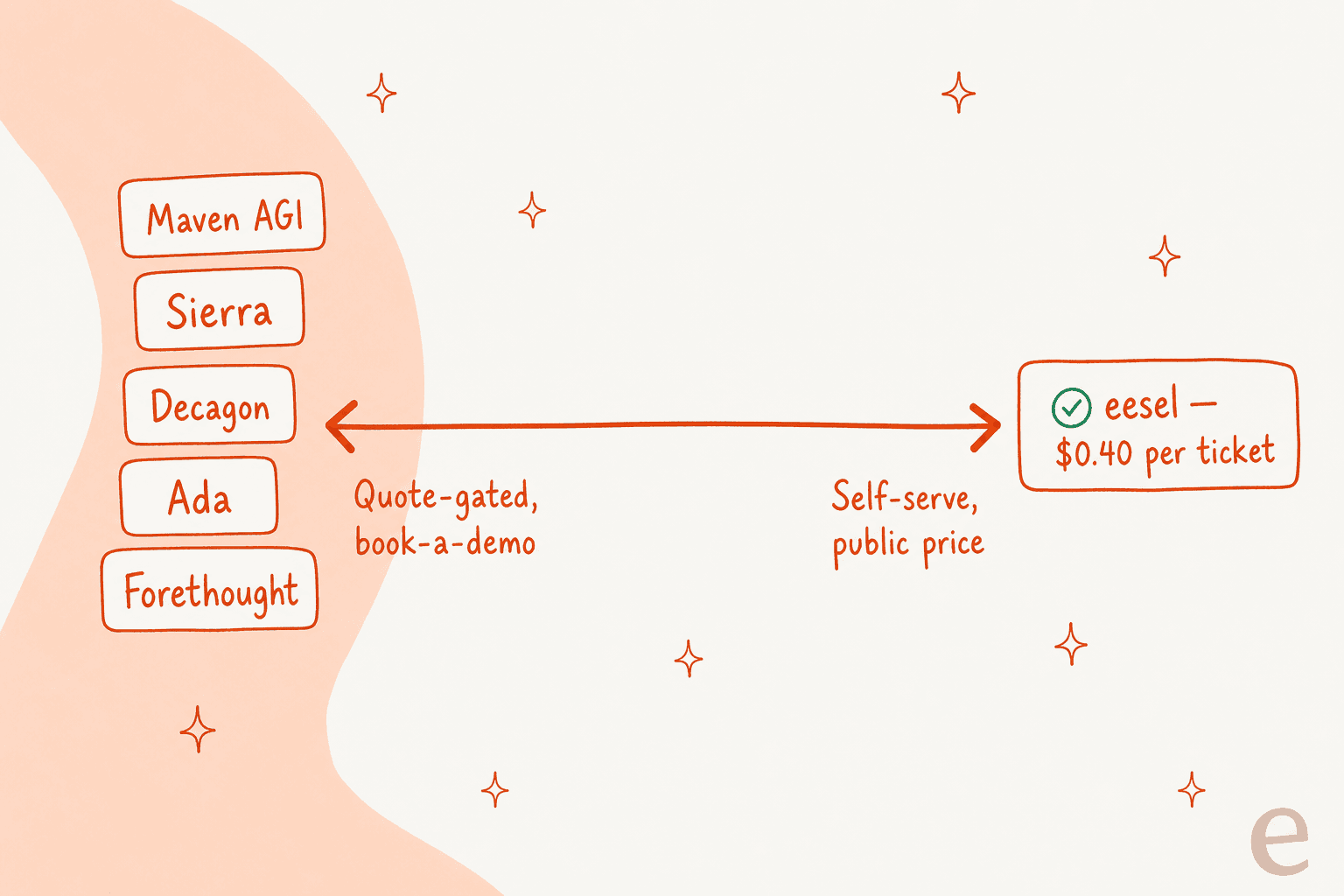
Almost every serious Maven AGI competitor is sales-led with no public pricing. That is not a knock on their tech, but it does mean the buying process looks the same as Maven's: a demo, a discovery call, and a quote weeks later. The one genuinely self-serve option on this list is eesel, which is why it lands at number one.
The 7 best Maven AGI alternatives at a glance
Here is the whole shortlist in one table before I get into each one. This is the view I would screenshot and send to whoever signs the invoice.
| Tool | Best for | Pricing model | Public price? | Channel focus | Deployment | G2 rating |
|---|---|---|---|---|---|---|
| eesel AI | Self-serve helpdesk automation | Fixed monthly, credits | Yes, from $299/mo (500 credits) | Tickets, chat, Slack | Self-serve, live in days | New entrant |
| Sierra | Enterprise, outcome-priced agents | Outcomes-based | No | Chat, voice, SMS | Sales-led, weeks | Limited |
| Decagon | Omnichannel enterprise agents | Volume-based | No | Chat, voice, email, SMS | Sales-led, weeks | Limited |
| Ada | Large enterprise ACX + voice | Volume-based | No | Omnichannel + voice | Sales-led, 300k+ convos floor | 4.6/5 |
| Forethought | Multi-agent CX suite | Platform fee + outcomes | No | Chat, email, voice | Sales-led, POV not trial | 4.5/5 |
| Level AI | QA + agent assist | Quote-based | No | Voice, chat, email | Sales-led, ~3 mo | 4.7/5 |
| Observe.AI | Voice-native QA + agents | Quote-based | No | Voice-first + chat | Sales-led, weeks | 4.6/5 |
Now the detail on each.
1. eesel AI, the best self-serve Maven AGI alternative

Best for: teams on a helpdesk who want to automate tier-1 support without a sales cycle or a per-seat contract.
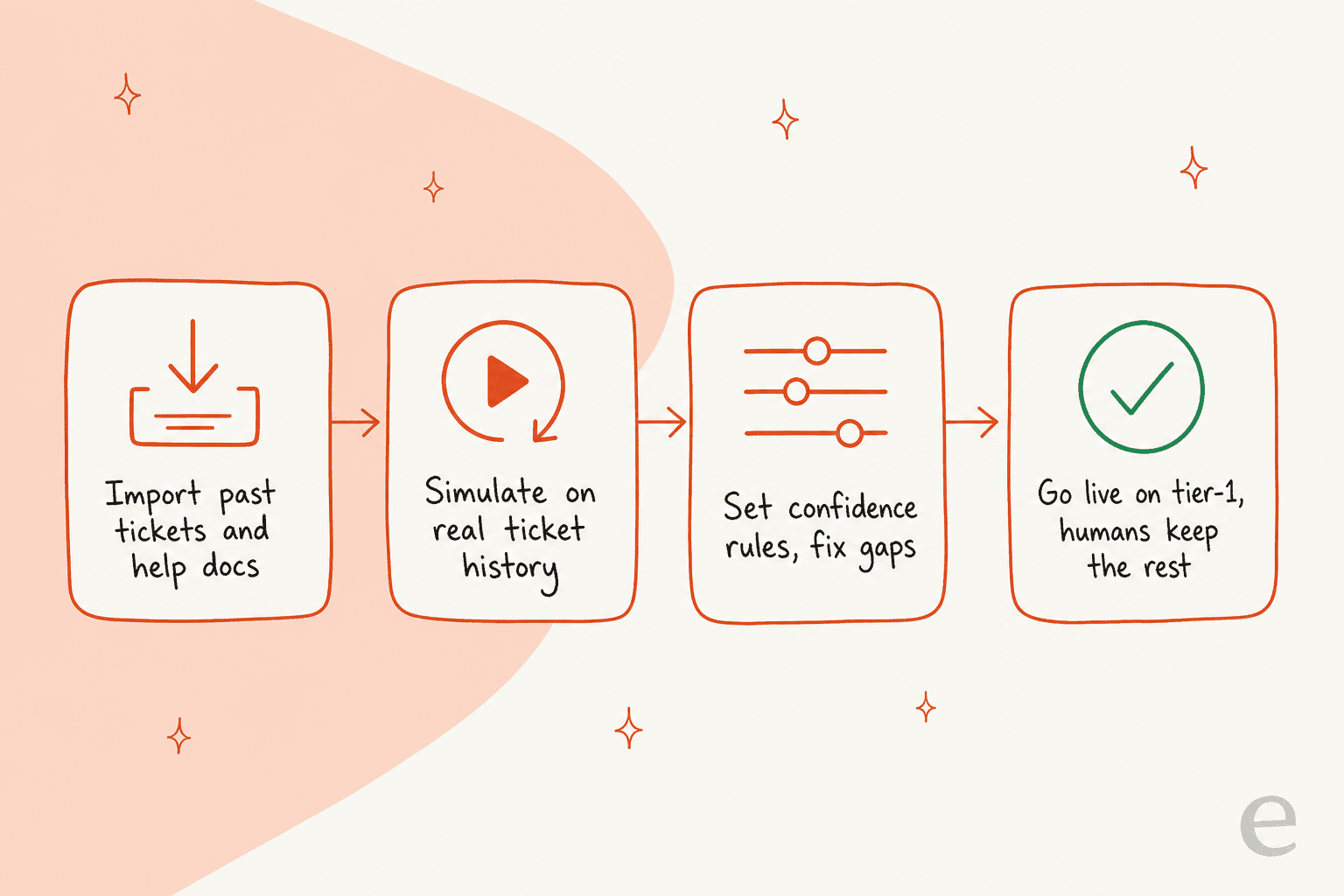
eesel AI takes the opposite approach to Maven. Instead of an enterprise platform you buy through procurement, it is an AI teammate you connect to the helpdesk you already run: Zendesk, Freshdesk, Gorgias, HubSpot, Front, and around 100 other tools. It learns from your past tickets and help docs on day one, then drafts replies, triages, and resolves tickets, with you deciding how much autonomy it gets.
The thing I find most useful, and the thing an enterprise rollout makes you take on faith, is the simulation. Before eesel replies to a single live customer, it runs against thousands of your historical tickets and shows you exactly what it would have said and what your resolution rate would be. You find the gaps, fill them, and re-run. That is how you turn a scary "will the AI say something wrong" question into a number you can actually look at.
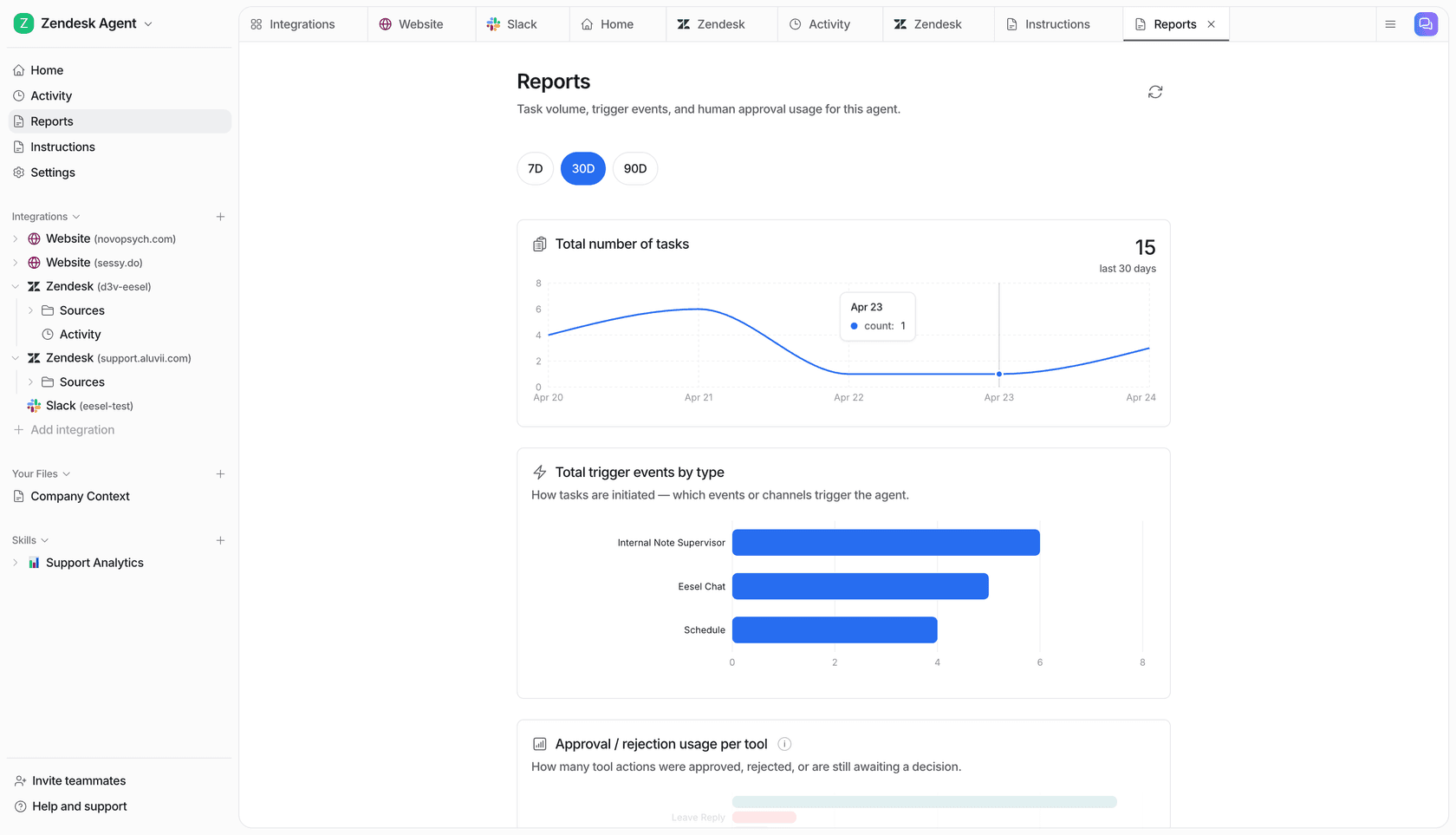
This addresses the objection I hear most from support leaders, which is control. Nobody wants an AI answering everything. One CX lead put it perfectly:
"The AI will never be able to answer 100% of the questions. I need an AI who is only handling the tickets that it's confident to handle and all the other ones, leave them alone."
A DTC supplements CX lead, eesel customer call
eesel's confidence-based routing is built for exactly that. Low-confidence tickets get drafted for a human instead of auto-sent. You start supervised, then grant autonomy on the easy stuff as trust builds.
Pros:
- Fully self-serve with public, fixed monthly pricing, no per-seat fee and no platform fee on the Teammate plan.
- Simulation on your real tickets before go-live, so you see resolution rate before you commit.
- Native to your existing helpdesk, not a separate platform you have to migrate to.
- Fast time to value: Gridwise saw eesel resolve 73% of tier-1 requests in the first month, with results during a 7-day trial.
- 80+ languages out of the box, and multiple agents (helpdesk, e-commerce, blog writer) under one account.
Cons:
- It is not built as a heavyweight enterprise CX suite with a services team attached. If you specifically want a vendor to run a months-long, high-touch implementation for you, that is not the model.
- It is newer than the enterprise incumbents, so it does not have a decade of Fortune 500 logos (though Smava runs 100,000+ tickets a month through it).
Pricing: self-serve Teammate plan from $299/month for 500 credits (1 credit per ticket or chat, however long), with 100 free credits to start (no card). A 1,000-credit month is $499, a 2,500-credit month is $999. Add-ons cover SSO and MFA from $199/month, priority support from $299/month, and HIPAA (talk to us).
Verdict: for the large majority of teams reading a "Maven AGI alternatives" post, eesel is the one to try first, precisely because you can try it. It is the only pick here where you can go from signup to a simulated resolution rate this afternoon, without talking to anyone.
Here is how that rollout actually works, because "test before you commit" is the whole pitch:
2. Sierra, the best for enterprise outcome-based pricing

Best for: large consumer brands that want an AI-first agent and are comfortable with a sales-led, outcome-priced contract.
Sierra is the highest-profile AI agent company on this list. It was co-founded by Bret Taylor, former co-CEO of Salesforce and current chair of the OpenAI board, and Clay Bavor, an 18-year Google veteran. It has raised aggressively, with a reported Series D near a $10B valuation, and its logo wall reads like a Fortune 500 directory: SoFi, Ramp, ADT, SiriusXM, The North Face.
Like Maven, Sierra is AI-agent-native rather than a legacy suite with AI bolted on. Its most distinctive wedge is outcome-based pricing: you pay for resolved outcomes, not seats or messages, which shifts implementation risk onto Sierra. Its "Ghostwriter" agent builds agents from your SOPs and transcripts, and it leads with ISO 42001 and a heavy compliance footprint.
Pros:
- AI-first architecture from the ground up, with elite founder pedigree.
- Outcome-based pricing aligns cost with value delivered.
- Enterprise pull and regulated-industry credibility that few AI-native vendors can match.
Cons:
- No public pricing, no free trial, no self-serve. Everything routes through a sales form, same as Maven.
- Aimed squarely at large enterprise, so it is overkill (and over-budget) for most mid-market teams.
Pricing: outcome-based, quote-only. Defined per use case, per customer.
Verdict: if you are a large brand that wants a top-tier AI agent and likes paying per resolution, Sierra is the flagship option and a direct peer to Maven. If you want to see a price or test it yourself first, it works the same way Maven does, which is the thing you were trying to get away from.
3. Decagon, the best for omnichannel enterprise agents
Best for: enterprises that want one agent runtime across chat, voice, email, and SMS, authored by ops teams rather than engineers.
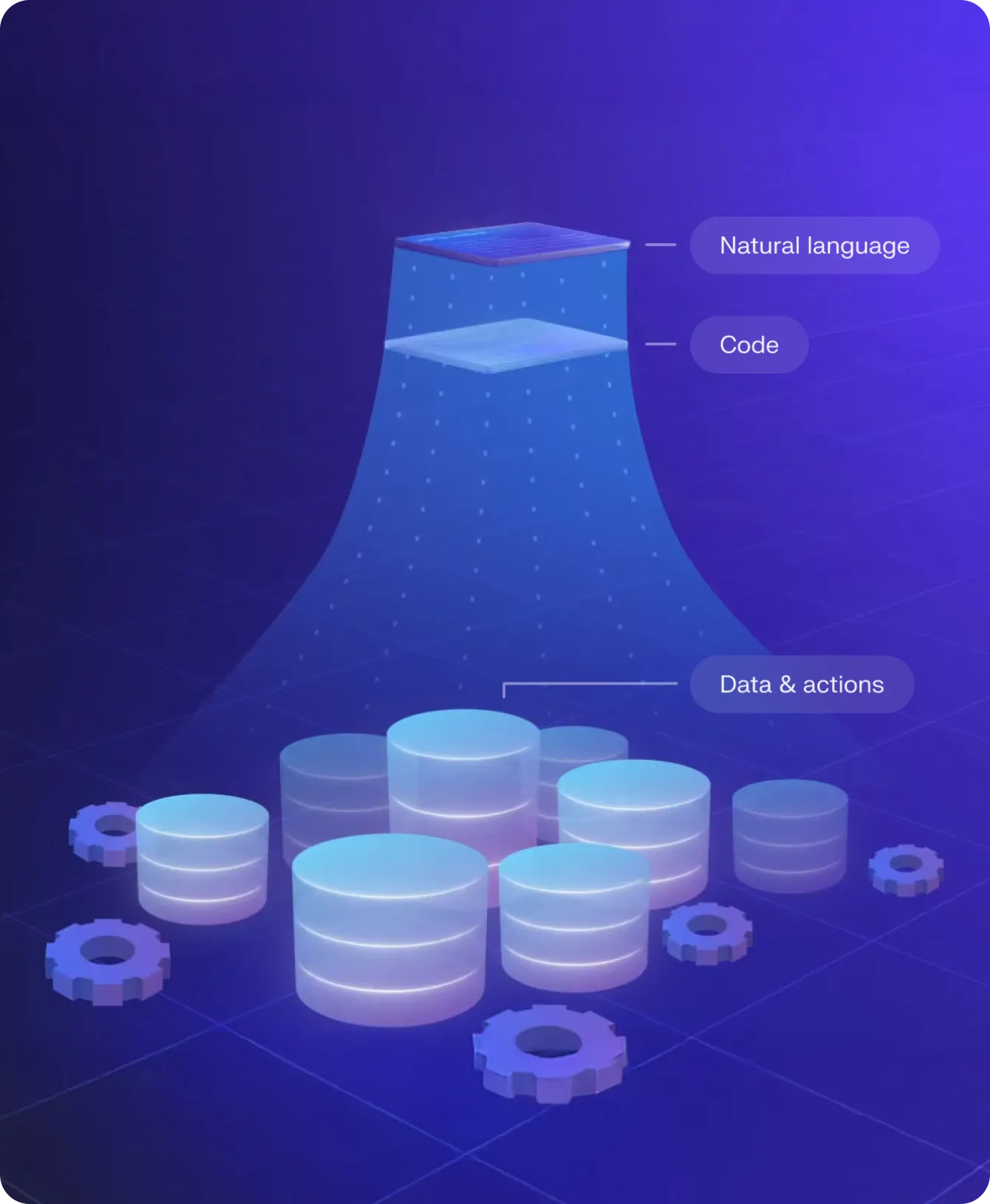
Decagon is the other AI-native unicorn in this bracket, backed by a16z and Accel at a reported ~$1.5B valuation. Its technical wedge is Agent Operating Procedures, natural-language instructions that compile into executable code, so a CX operator can author agent logic while engineers keep control of guardrails. It runs the same agent across chat, voice, email, SMS, and custom API surfaces.
The customer results it publishes are strong: Duolingo cites an 80% deflection rate, and ClassPass cites a 95% cost reduction. Its roster (Chime, Hertz, Notion, Figma) is deep and brand-heavy, and like Maven it stages itself as the tool you pick when replacing a legacy vendor's brittle bot.
Pros:
- True omnichannel parity from a single runtime, with voice and email as first-class channels.
- The AOP model is a clever abstraction for non-technical teams.
- Deep, brand-heavy customer roster.
Cons:
- Sales-led and volume-bracketed, with no public pricing and no self-serve.
- Mid-market-to-enterprise focus, so small teams are not the target.
Pricing: annual contract bracketed by monthly ticket volume, quote-only.
Verdict: Decagon is one of the best pure AI-agent platforms going and a very direct Maven alternative, especially if omnichannel voice matters. But it is another enterprise sales motion, so weigh it against a self-serve option if speed and transparency matter.
4. Ada, the best for large enterprise ACX and voice
Best for: very large support operations (think airlines and big retail) that clear the volume floor and want a multi-LLM platform with strong voice.
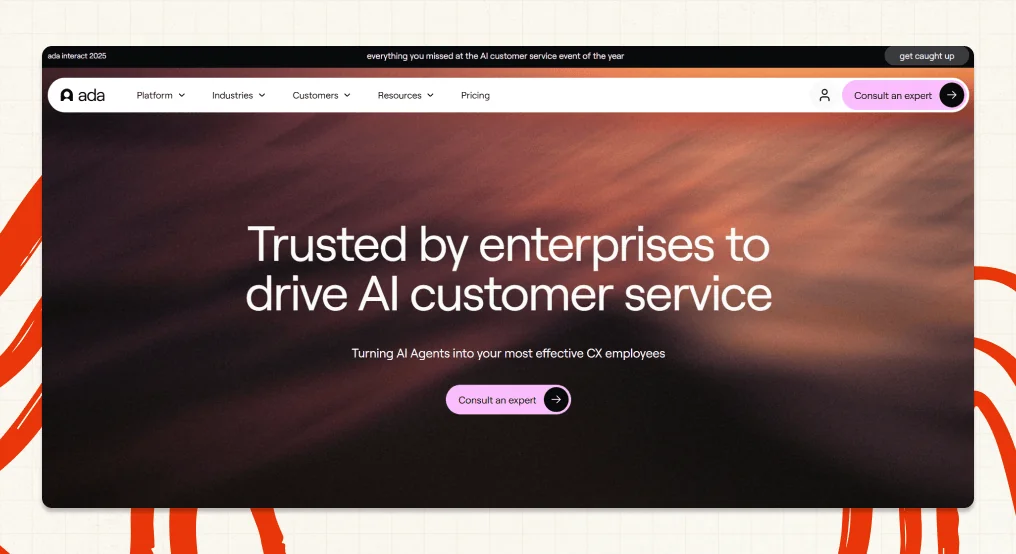
Ada is a Toronto-based enterprise platform that brands its category as Agentic Customer Experience. Its Reasoning Engine orchestrates across multiple LLMs rather than betting on one, and it is properly omnichannel, including a serious voice product. Customer proof is heavyweight: Monday.com cut agent handle time 42%, and IPSY reported a 943% ROI in four months.
The catch is the gate. Ada's pricing page states plainly that it is "a great fit for companies with at least 300,000 annual customer service conversations." That is a deliberate enterprise floor, and a higher bar than Maven sets. If you are under it, Ada is not for you. I dug into this more in my Ada CX review if you want the full breakdown.
Pros:
- Multi-LLM orchestration and a mature omnichannel + voice stack.
- Strong AI-specific compliance and a deep enterprise track record.
- Genuinely omnichannel, including voice.
Cons:
- Enterprise-only by qualification, with a stated 300k-conversations floor.
- No public pricing, no trial, sold as a platform-plus-services bundle.
Pricing: volume-based annual contracts, quote-only.
Verdict: for a genuine large-enterprise buyer, Ada is a legitimate Maven alternative with a broader voice footprint. For everyone below that volume floor, it is simply out of reach, which pushes most readers back toward a self-serve tool.
5. Forethought, the best multi-agent CX suite
Best for: mid-market and enterprise teams that want a suite of specialized agents (resolve, assist, triage, QA) rather than a single bot.
Forethought markets itself as a multi-agent system: Solve (the customer-facing agent), Assist (the agent copilot), Discover (insights and knowledge-gap detection), plus Triage and Agent QA. Its reasoning engine, Autoflows, runs action-based workflows rather than just answering FAQs. Headline claims include 15x average ROI and up to 98% resolution, though those are vendor figures, so I would treat deflection or containment rate as a vanity metric unless it is tied to CSAT.
It integrates with a long list of helpdesks (Zendesk, Salesforce, Freshworks, Help Scout, Gorgias, and more), which makes it flexible if you are not tied to one stack.
Pros:
- A coherent suite covering resolution, agent assist, triage, and QA under one platform.
- Broad helpdesk integration coverage.
- Assist is a solid copilot for human agents.
Cons:
- Quote-gated pricing, described as a blend of platform fees and outcome-based cost, with usage overages.
- No free trial, only a Proof of Value run against your data.
Pricing: platform access fee plus outcome-based cost, quote-only, with named Basic / Professional / Enterprise tiers.
Verdict: Forethought is a sensible middle ground if you want the multi-agent structure rather than a single agent like Maven. If you are comfortable with an enterprise buying process, it earns a look.
6. Level AI, the best for QA and agent assist
Best for: contact centers that want to replace manual QA sampling with automated scoring across 100% of interactions.
If part of what draws you to Maven is coaching your human agents alongside the AI, Level AI is the most focused option for that job. Its QA-GPT engine auto-scores conversations against your scorecard, including subjective rubric items, and delivers evidence and reasoning for each score. It also does real-time agent assist, coaching, and screen recording.
Crucially, its user reviews are the strongest on this list. It holds 4.7/5 across 200 reviews on G2. Reviewers are candid about the trade-offs, though:
"AI QA scores at times are not accurate, and they need to be more tailored towards our company's score sheets."

That is a real and common gripe with automated QA: it can be over-literal. Worth testing on your own rubric before you commit.
Pros:
- Purpose-built QA that scores 100% of interactions, versus the legacy 1-2% manual sample.
- Excellent G2 standing and a strong real-time assist and coaching layer.
- Semantic scoring rather than keyword matching.
Cons:
- Quote-only pricing (the public pricing page 404s), and G2 lists a ~3-month average time to implement.
- Built for contact centers with QA managers, so it is heavy for a simple ticket-deflection use case.
Pricing: custom, no public tiers. Demo required.
Verdict: for QA and coaching specifically, Level AI is a better focused buy than a general agent platform, and the reviews back that up. If QA is a nice-to-have rather than the main event, it is more tool than you need.
7. Observe.AI, the best voice-native alternative
Best for: voice-heavy contact centers that want AI agents plus QA built for real phone audio.
Observe.AI is the pick if your support is more phone queue than shared inbox, an area where Maven's newer voice product is less proven. Founded in 2017 and backed by ~$213M (including a $125M Series C from SoftBank Vision Fund 2), it is an Agentic CX platform purpose-built for noisy, multi-speaker phone conversations, not a chat tool with voice bolted on. It pairs AI agents with Auto QA that scores 100% of interactions and a coaching copilot.
It rates well, at 4.6/5 across 233 reviews on G2, with the usual caveats around sentiment accuracy and setup complexity.
Pros:
- Genuinely voice-native, built for real contact-center audio.
- Full lifecycle in one platform: customer agents, agent assist, and QA.
- Strong third-party review standing.
Cons:
- Voice and contact-center skewed, so it is not a general helpdesk or email-ticket AI.
- Quote-only pricing (the pricing page 404s) and no self-serve tier.
Pricing: quote-only, sales-negotiated.
Verdict: if your channels are voice-first, Observe.AI is a stronger structural fit than Maven. If your support is mostly digital tickets and chat, it is the wrong shape of tool.
How to actually choose
Strip away the marketing and the decision comes down to two questions.
How do you want to buy? Every option here except eesel is a sales-led enterprise motion with no public price, exactly like Maven. If you are an enterprise with a procurement team and a long runway, that is fine, and Sierra, Decagon, and Ada are excellent. If you want to see a number, test on your own data, and be live this week, that narrows things fast.
What is your primary channel and team size? If you are a large voice operation, stay in the contact-center lane with Observe.AI or Level AI. If you are a mid-market or growing team running digital tickets and chat, a helpdesk-native agent will fit better and cost far less to run than an enterprise platform built for a bigger buyer.
For a deeper cost breakdown, I would also read up on what AI customer service actually costs and the cheapest AI apps for helpdesks before you sign anything.
Try eesel AI
If the whole reason you are reading a Maven AGI alternatives post is that you wanted a price, a fast rollout, or a tool that lives on the helpdesk you already run, that is exactly the gap eesel AI fills. It connects to Zendesk, Freshdesk, Gorgias, and around 100 other tools, learns from your past tickets, and lets you simulate the results on your own history before it ever answers a live customer.
The differentiator is control plus transparency: confidence-based routing so the AI only handles what it is sure of, fixed monthly pricing from $299/month for 500 credits with no per-seat fee, and no sales cycle required to get started. You can start free with 100 credits (no card) and see your own resolution rate before you decide anything.
Frequently Asked Questions
What are the best Maven AGI alternatives in 2026?
How much does Maven AGI cost?
/pricing page 404s and every path is a book-a-demo flow). Third-party marketplaces list it as custom, contact-sales pricing driven by conversation volume and integrations. If you want a number without a sales cycle, a self-serve tool like eesel AI starts at $299/month for 500 credits.