
Why teams look for a Gradient Labs alternative
I'll be straight with you, because flattery doesn't help you buy. Gradient Labs is a well-built product. Founded in 2023 in London by ex-Monzo AI leads, it raised a $26M Series A and ships specialist agents for disputes, KYC, collections, lending, and insurance claims. Its "we handle what others hand off" pitch is real: it aims for full resolution, not just deflection, and its published customer results (Pockit at 70% resolution, Zego cutting handling time from 12 minutes to 3) back that up.
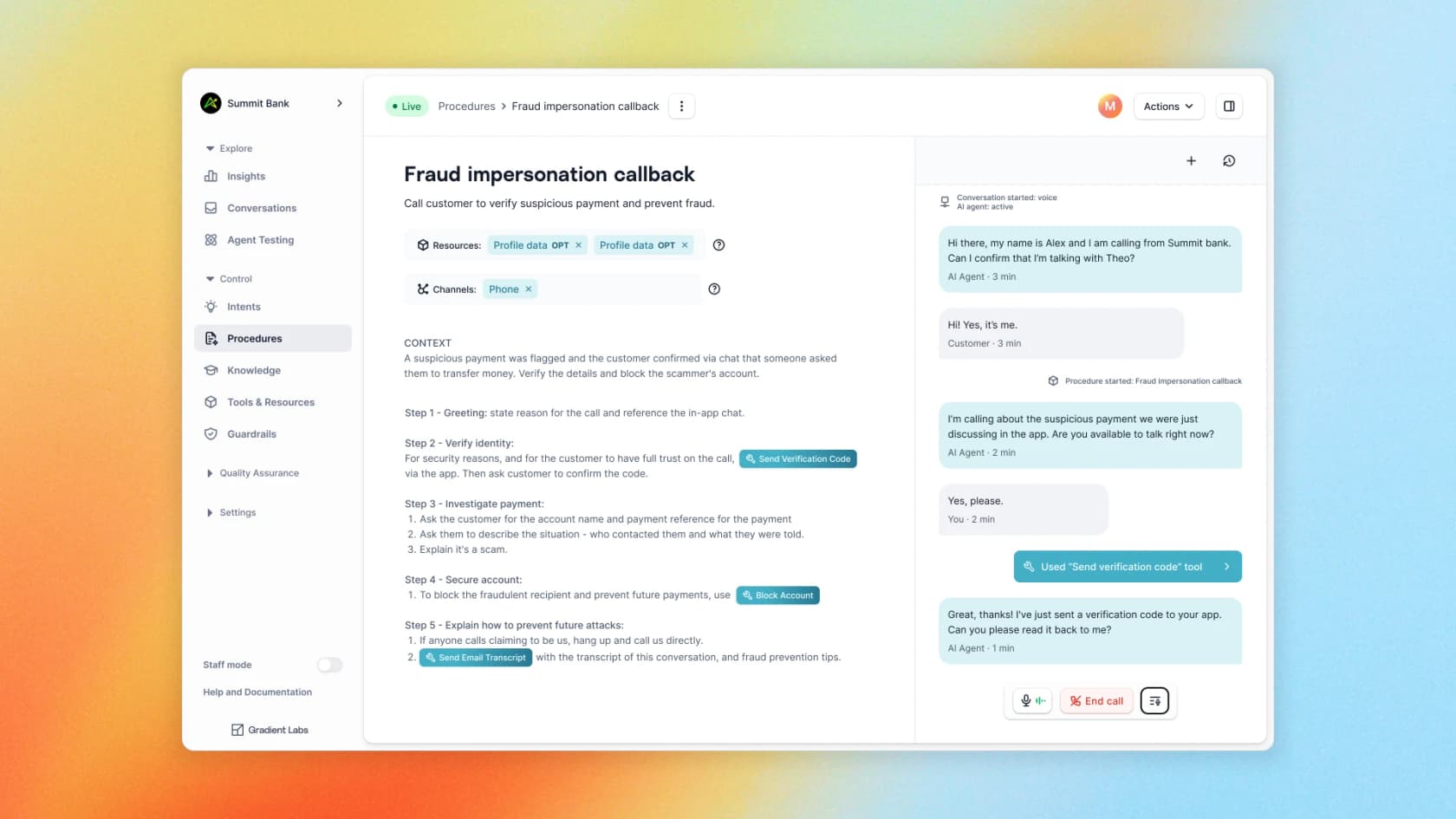
So why shop around? Because the thing that makes Gradient Labs strong, its tight focus on regulated finance, is also what makes it the wrong fit for a lot of buyers:
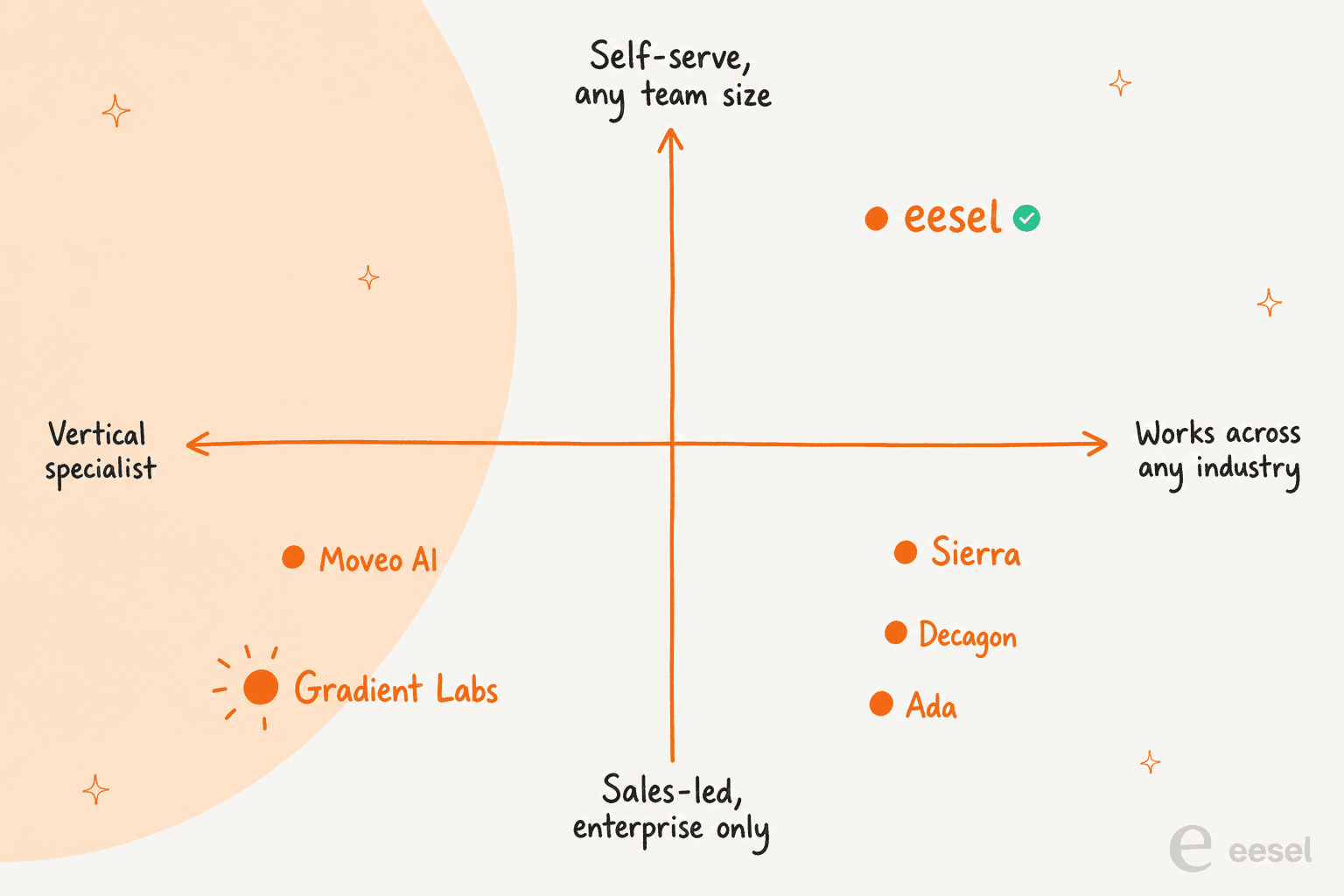
- It is built for one vertical. If you are not a bank, lender, insurer, or fintech, you are paying for compliance machinery (FCA, CONC, Reg E, PSD2 guardrails) you will never use. A Shopify store or a B2B SaaS gets more from a horizontal agent.
- It is sales-led, with no public pricing. Like most enterprise AI agents, Gradient Labs is contact-sales only. Outcomes-based pricing is buyer-friendly in spirit, but you cannot estimate your bill before a procurement cycle, which is a problem if you just want to test something this quarter.
- There is no self-serve trial. You can't sign up tonight and see it run against your tickets. For a lot of teams, "try it on my own data before I commit" is the whole decision.
- It is white-glove, not fast. The deep, regulated deployments it specializes in take time. If you need an AI agent live on your helpdesk in days, that model works against you.
That last point is the one I keep coming back to. We have spent years putting AI agents on live support queues, and the single most common objection we hear isn't "will it work," it's "will it answer wrong." As one fintech buyer evaluating session-based pricing competitors put it to us, they explored a high-end agent but it simply "didn't fit their use case" at their volume. The fix isn't a fancier model; it's being able to test the agent on your real tickets before it ever talks to a customer. Keep that in mind as you read the list, because it separates the tools that demo well from the ones you can actually trust.
The 8 best Gradient Labs alternatives at a glance
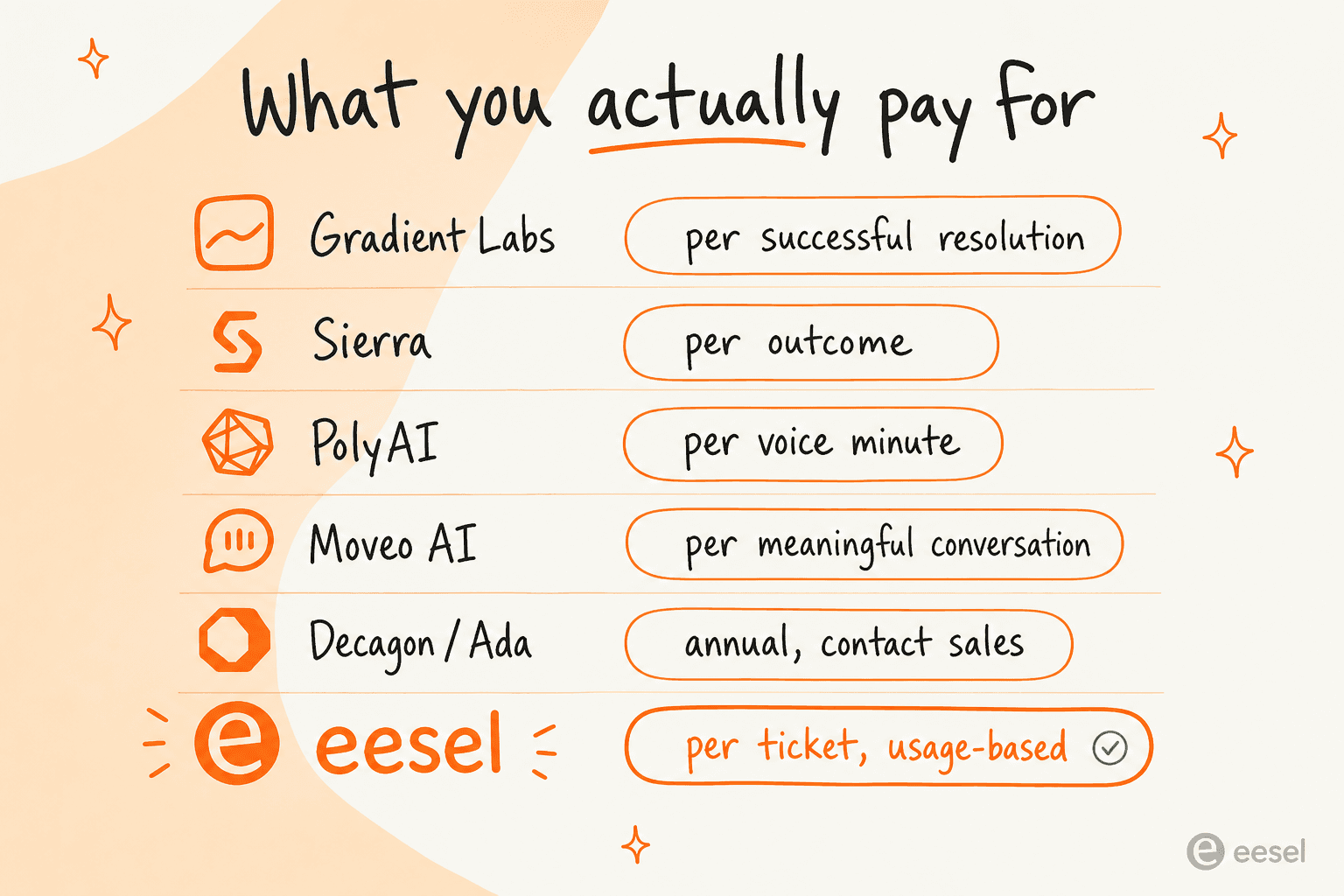
Before the deep dives, here is the whole field in one table. I've leaned on the dimensions that actually decide these deals: who it is built for, the billing unit, whether you can try it without a sales call, and the security posture that regulated buyers screen on first.
| Tool | Best for | Pricing model | Self-serve trial | Channels | Security | Setup speed |
|---|---|---|---|---|---|---|
| eesel AI | Teams on an existing helpdesk who want to go live fast | Usage-based, $0.40/ticket, public | Yes (free credit, no card) | Chat, email, Slack, helpdesk | SOC 2 in progress, GDPR, EU residency | Days |
| Gradient Labs | Regulated finance (banks, lenders, fintech) | Outcomes-based, contact sales | No | Voice, text, email | SOC 2 Type 2, FCA/PSD2/EU AI Act | Weeks+ |
| Decagon | High-volume consumer brands | Annual, volume-bracketed, contact sales | No | Chat, voice, email, SMS, API | SOC 2 (Trust Center) | Weeks |
| Sierra | Large, brand-sensitive enterprises | Outcomes-based, contact sales | No | Chat, voice, SMS, WhatsApp, email | SOC 2, ISO 27001, ISO 42001, HIPAA | Weeks |
| Moveo AI | Fintech, banking, collections | Per "meaningful conversation," contact sales | No | Chat, voice, WhatsApp, email | SOC 2 Type 2, ISO 27001, HIPAA | Weeks |
| Ada | Enterprise with 300k+ conversations/yr | Volume-based, contact sales | No | Voice, chat, email, social, SMS | SOC 2, HIPAA, GDPR, AIUC-1 | Weeks |
| Forethought | Keeping your helpdesk, adding agents on top | Platform fee + outcomes, contact sales | No (Proof of Value) | Chat, email, voice, SMS, Slack | SOC 2, GDPR | Weeks |
| Parloa | Voice-first enterprise contact centers | Contact sales | No | Voice, chat, messaging | ISO 27001, SOC 2, PCI DSS, HIPAA, DORA | Weeks |
| PolyAI | Phone-only call automation | Per voice minute, contact sales | No | Voice (phone) | SOC 2, HIPAA, GDPR, PCI DSS | Weeks |
The pattern jumps out once it is in a grid: almost everyone in this category is enterprise, sales-led, with no public price and no way to try it before you talk to a rep. That is the gap most of these readers are actually feeling.
How I picked them
I kept the list to AI agents that genuinely go after the same job Gradient Labs does, resolving real support conversations end to end, not just deflecting FAQs. I scored each on five things a buyer actually weighs: who it is built for, how it bills you, whether you can test it before committing, channel coverage (text vs voice), and the compliance footprint. I left out the legacy helpdesk bolt-ons here, because if you are looking at Gradient Labs you have already decided you want a real agent, not an AI feature inside a ticketing tool.
Not sure which one fits? Start here
1. eesel AI
Best for: support, IT, and ops teams already on a helpdesk who want a real AI agent live in days, with pricing they can actually read.
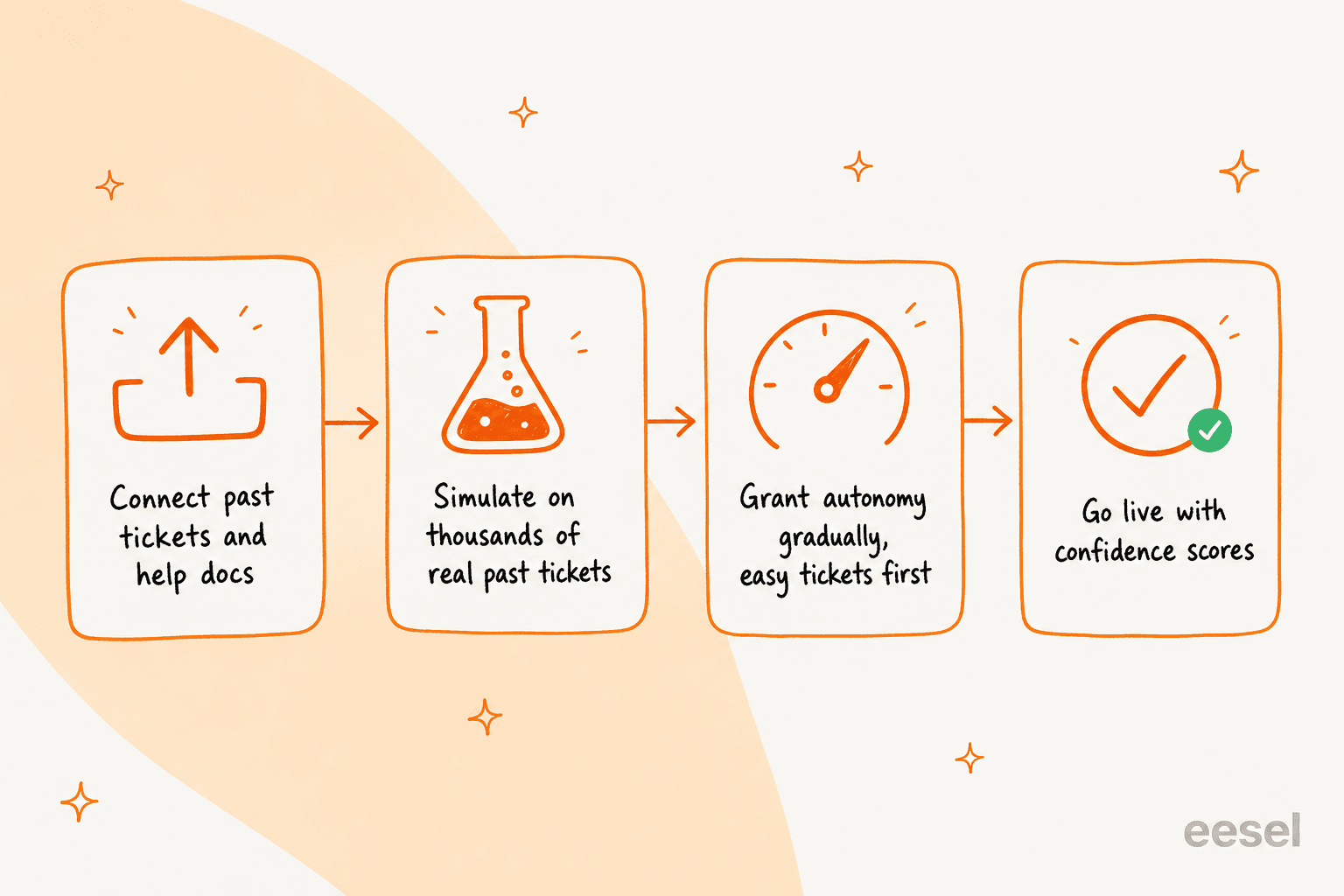
eesel AI is the alternative I'd point most people to first, and not because I help build it, but because it answers the exact frustrations that send people away from Gradient Labs. Instead of a months-long regulated deployment, eesel is an AI teammate that plugs into the helpdesk you already run, learns from your past tickets and help docs, and starts drafting and resolving from day one.
The piece that matters most for nervous buyers is the simulation mode: before the agent talks to anyone, you run it against thousands of your historical tickets, see the resolution rate by topic, find the gaps, and only then turn it loose, with confidence-based routing so it answers what it is sure about and leaves the rest alone.
That instinct is exactly what regulated teams ask for. As the co-founder of one legal-tech company told us about choosing an agent:
"In legal tech you can't afford to get anything wrong, there's a fine line between being helpful and overstepping into legal advice. With eesel we can set exact guardrails on sourcing and it always provides transparent citations."
Pros:
- Genuinely self-serve: start free with usage credit, no card, no sales call.
- Transparent, usage-based pricing at $0.40 per ticket, no per-seat fee.
- Works across 100+ integrations and 80+ languages out of the box.
- Simulation on past tickets means you measure accuracy before going live.
Cons:
- Not a regulated-finance specialist; if you need FCA-specific dispute or KYC agents like Gradient Labs ships, eesel is a horizontal agent, not a vertical one.
- SOC 2 is in progress rather than certified (HIPAA and a BAA are available on Enterprise).
- Voice is not its lead channel the way it is for PolyAI or Parloa.
Pricing: $50 in free trial credit, then usage-based at $0.40/ticket (light dashboard lookups are free, blog drafts are $4). Annual commits over $300/month get 25% off; Enterprise adds a $1,000/month platform fee for SSO, HIPAA, and a BAA. Real numbers, published.
Verdict: If you're leaving Gradient Labs because it's slow to deploy, sales-gated, or overkill for a non-finance team, eesel is the most direct swap. It loses to Gradient Labs only when you specifically need deep, regulated-finance agents.
2. Decagon
Best for: large consumer brands running massive chat and voice volume that want one agent across every channel.
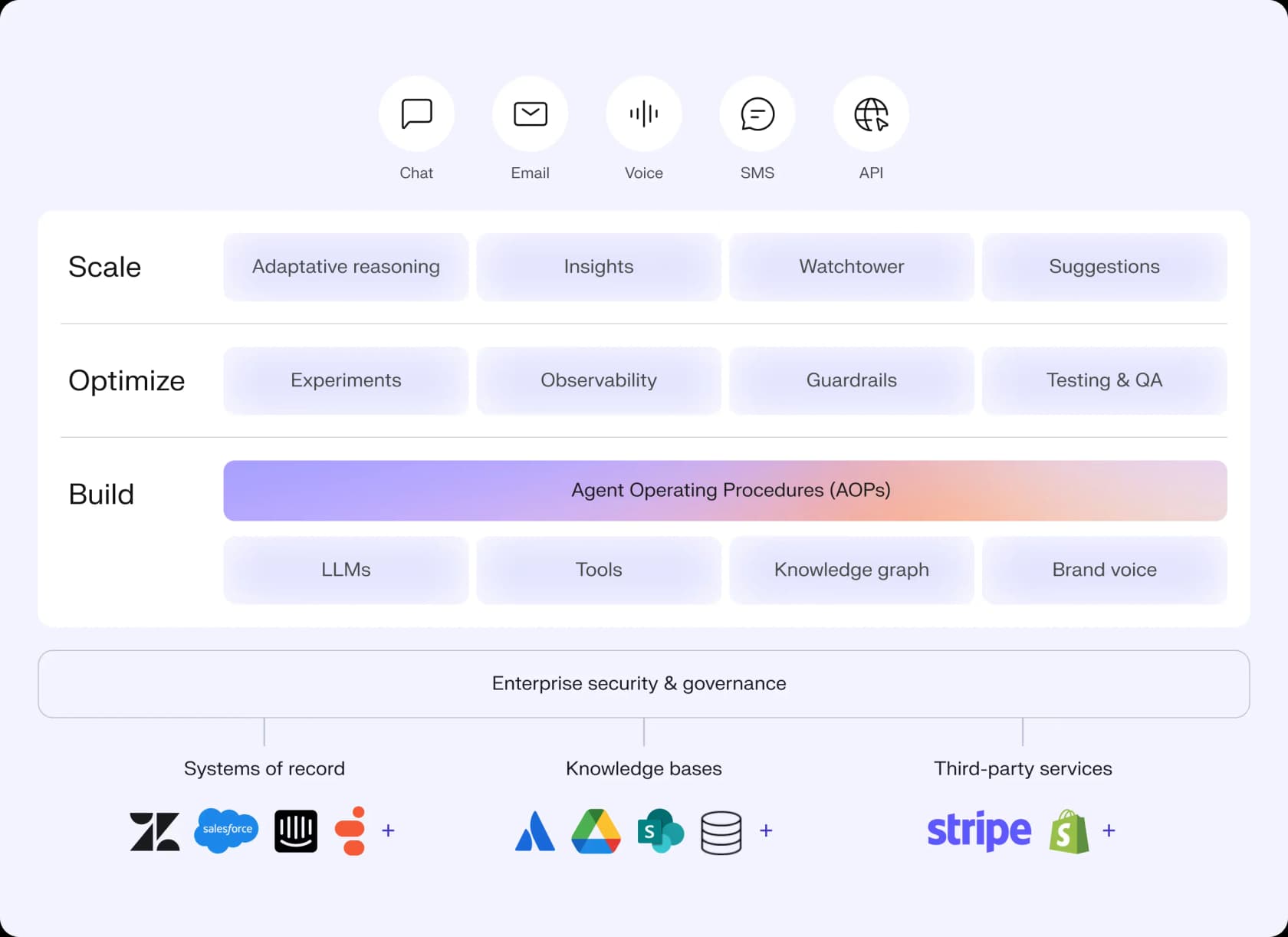
Decagon is one of the most credible AI-native agent platforms out there, with a roster (Chime, Affirm, Duolingo, Hertz) and funding (a reported ~$1.5B valuation) to match. Its wedge is Agent Operating Procedures: natural-language agent logic that compiles into executable code, so CX ops can author flows while engineers keep the guardrails.
It's a fair head-to-head with Gradient Labs on horizontal consumer volume, where Gradient Labs is the finance specialist. But it shares the same buyer friction: a fintech doing 7-8k escalated tickets a month told us they evaluated Decagon's session-based pricing (a quote of 250k chats) and concluded it just didn't fit their use case at that volume.
Pros:
- True omnichannel: chat, voice, email, SMS, and API from one runtime.
- AOPs make iteration fast without rebuilding decision trees.
- Heavy, brand-name consumer and fintech logos.
Cons:
- Sales-led and volume-bracketed; no public price, no self-serve trial.
- Mid-market-to-enterprise focus; not aimed at smaller teams.
Pricing: No public pricing. Sold as an annual contract bracketed by monthly ticket volume (the demo form's bands run from <10k to 250k+). Contact sales.
Verdict: A strong pick if you're a high-volume consumer brand and voice matters as much as chat. If you want to test before you commit, the lack of a trial will frustrate you, same as Gradient Labs.
3. Sierra
Best for: large, brand-sensitive enterprises (including regulated ones) that want a flagship agent and the credibility to match.
If Gradient Labs is the regulated-finance specialist, Sierra is the enterprise generalist with the deepest pedigree. Co-founded by Bret Taylor (ex-Salesforce co-CEO, current OpenAI board chair) and Clay Bavor, it has raised aggressively (a reported $350M Series D) and landed regulated logos most AI-native vendors can't, like SoFi, Vanguard, and FINRA.
Sierra is one of the few vendors leading with ISO 42001 (an AI management certification) on top of SOC 2, ISO 27001, and HIPAA, which is exactly the kind of compliance footprint a regulated buyer comparing it to Gradient Labs will screen for. Its "Ghostwriter" agent-building agent also shortens the usual implementation slog.
Pros:
- Unmatched enterprise credibility and regulated-industry logos.
- Outcomes-based pricing, so you pay when the agent delivers.
- Strongest compliance story in the category (ISO 42001 stands out).
Cons:
- Enterprise/Fortune 500 focus; not for smaller teams.
- No public pricing, no self-serve trial, weeks-long deployment.
Pricing: Outcomes-based, defined per use case. No published rate, no free trial. Contact sales.
Verdict: The closest peer to Gradient Labs for big regulated brands that aren't strictly finance. If you're a Fortune 500, shortlist it. If you're a 20-person support team, it's out of reach.
4. Moveo AI
Best for: fintech, banking, and collections teams that want a vertical specialist but on their own helpdesk stack.
Moveo AI is arguably the most direct vertical analog to Gradient Labs on this list. It's an agentic platform purpose-built for financial complexity, spanning banking, fintech, insurance, debt collection, and utilities, running on its own CX-tuned private LLM and layering over your existing helpdesk rather than replacing it.
It bills by the "meaningful conversation," handles 10M+ conversations a month across 100+ enterprises, and offers on-prem deployment with its private model, a real draw for banks that can't send data to a third-party LLM. Independent review volume is thin (a 4.0 on G2 from a handful of reviews), so lean on its docs and a proof-of-concept rather than crowd sentiment.
Pros:
- Deep finance/collections focus, the same lane as Gradient Labs.
- Private, CX-tuned LLM with cloud or on-prem options.
- Layers on your existing stack; integrates with Zendesk, Intercom, and Front.
Cons:
- No public pricing; all tiers are "talk to sales."
- Thin, partly incentivized third-party reviews.
- Reviewers flag onboarding friction and a clunky admin panel.
Pricing: Three tiers (Pro, Growth, Enterprise), all contact-sales, billed by meaningful conversations per month. Only public figure is a $40/user seat add-on; community reports peg Growth near $999/month.
Verdict: If you specifically want Gradient Labs' vertical focus but with a more flexible deployment, Moveo AI is the closest match. Just push for a proof-of-concept on your data, given the limited public review signal.
5. Ada
Best for: enterprises with very high conversation volume that want a standalone AI agent layer over their helpdesk.
Ada brands its category "Agentic Customer Experience" and sits, like Gradient Labs, as a standalone agent layer on top of whatever helpdesk you run. Its Reasoning Engine orchestrates across multiple LLMs, and it leans hard into compliance with SOC 2, HIPAA, GDPR, and the rarer AIUC-1 AI-specific certification plus zero data retention with model providers.
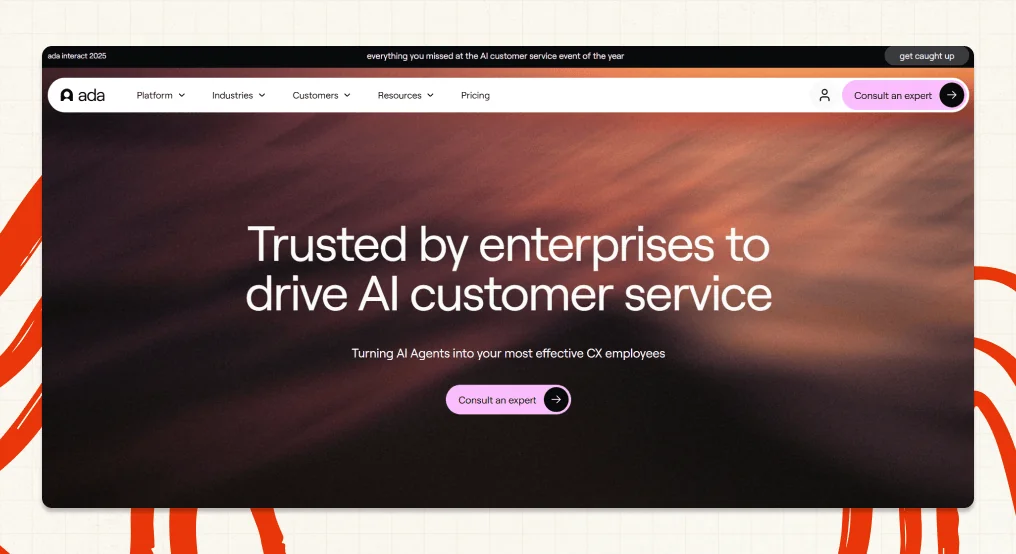
The catch is the floor: Ada explicitly states it's "a great fit for companies with at least 300,000 annual customer service conversations." That's an even harder enterprise gate than Gradient Labs, and the qualification form runs up to "more than 100 million."
Pros:
- Multi-LLM Reasoning Engine and strong omnichannel (including voice).
- Leading AI-specific compliance (AIUC-1) and zero data retention.
- MCP-native developer toolkit for the agentic ecosystem.
Cons:
- 300k+ annual conversations floor rules out most teams.
- No public pricing, no trial, services-heavy deployment.
Pricing: No public pricing. Volume-based annual contracts gated by the 300k-conversation floor. Contact sales.
Verdict: A solid Gradient Labs alternative if you're a large consumer enterprise (airlines, big retail, gaming) and not strictly finance. Below the volume floor, look elsewhere.
6. Forethought
Best for: teams committed to their current helpdesk who want agentic AI on top, not a rip-and-replace.
Forethought is the veteran here, a TechCrunch Disrupt winner that's grown into a multi-agent system: Discover (insights), Solve (the customer-facing agent), Triage (classification), Assist (agent copilot), and Agent QA. Its strongest pitch, and the one that contrasts cleanly with Gradient Labs, is that it's helpdesk-agnostic: it sits on top of Zendesk, Salesforce, or whatever you run, so you keep your stack.
Its Solve agent even includes a Browser Agent for taking actions in legacy systems that lack APIs, useful if your back office is older than your front end. Published benchmarks claim up to 98% resolution and 15x ROI.
Pros:
- Helpdesk-agnostic; strongest "keep your stack" story.
- Mature multi-agent suite with a built-in Browser Agent.
- Established mid-market and enterprise customer base.
Cons:
- No public pricing; a blend of platform fees plus outcomes.
- No free trial (it runs a Proof of Value instead).
Pricing: Three tiers (Team, Professional, Enterprise) plus add-ons, all quote-only. Secondary sources peg ACV in the mid-five to low-six figures. Contact sales.
Verdict: Pick Forethought over Gradient Labs if you're locked into a helpdesk (especially Salesforce Service Cloud) and want agents on top without migrating. eesel competes here too, with the added benefit of self-serve pricing.
7. Parloa
Best for: voice-first European enterprise contact centers (insurance, telecom, travel).
Parloa is a Berlin- and New-York-based agentic platform with a voice-first emphasis, built around its AI Agent Management Platform. It's scaled fast, hitting a ~$3B valuation on a $350M Series D in early 2026, and targets exactly the kind of regulated, high-volume verticals Gradient Labs does, just through the phone line first.
Its compliance footprint is genuinely strong for European buyers (ISO 27001, SOC 2, PCI DSS, HIPAA, and DORA), and its simulation tooling runs thousands of synthetic conversations across languages and edge cases before launch. Public review volume is near-zero (a single G2 review), so it's a primary-source evaluation.
Pros:
- Voice-first with deep multilingual support.
- Excellent European compliance story (DORA, PCI DSS).
- Strong simulation and evaluation tooling pre-launch.
Cons:
- No public pricing, enterprise-only, no self-serve.
- Almost no independent review signal.
Pricing: No public pricing. Custom enterprise contracts. Contact sales.
Verdict: If your support is mostly inbound calls and you operate in regulated European markets, Parloa is a sharper fit than Gradient Labs. For text-led support, look at the others.
8. PolyAI
Best for: teams whose support is overwhelmingly phone calls and want full-stack voice automation.
PolyAI is the most specialized tool on this list: a full-stack voice dialog agent for the contact center, running on its proprietary Raven model trained on a billion-plus enterprise conversations. It's built for the hardest calls, fraud, outages, multilingual disputes, in banking, healthcare, and hospitality.
The standout praise across G2 reviews is how human the voice sounds, with one customer saying it "sounded like one of our own agents." It's the clearest pick if voice, specifically, is where Gradient Labs felt thin for you. Pricing is per voice minute, bundling maintenance and a 99.9% uptime SLA.
Pros:
- Purpose-built voice agent with a very natural-sounding model.
- Per-minute pricing is at least a legible unit, even if the rate is quote-only.
- Compliance by default (SOC 2, HIPAA, GDPR, PCI DSS).
Cons:
- Voice only; no real text/chat story.
- Enterprise, quote-based, no self-serve trial.
Pricing: Per voice minute, quote-based, with a 99.9% uptime SLA. Contact sales.
Verdict: If the phone is your battleground, PolyAI beats a generalist. For omnichannel support that's mostly text, it's too narrow, and you'd want eesel, Decagon, or Sierra instead.
Try eesel AI
If you came here because Gradient Labs is sales-gated, slow to deploy, or too finance-specific for your team, eesel AI is the alternative built for exactly that gap. It plugs into the helpdesk you already run, Zendesk, Freshdesk, Gorgias, Front, and more, learns from your past tickets on day one, and lets you simulate the agent against your real ticket history before it ever replies to a customer.
The difference that matters: it's the one tool here you can actually try yourself, free, no sales call, with a published $0.40-per-ticket price so you can estimate your costs before committing to anything. For most teams, that's the whole reason to switch.
Frequently asked questions
What is the best Gradient Labs alternative?
How much does Gradient Labs cost?
Is there a free Gradient Labs alternative to try?
What should I look for in an AI support agent for a regulated industry?


Article by
Rama Adi Nugraha
Rama is a software engineer at eesel AI with two years of experience writing about B2B SaaS, AI tools, and customer support technology. Based in Bali, Indonesia, he brings a developer's perspective to product comparisons — cutting through marketing copy to what the integrations and APIs actually do.