If you've been researching AI customer service platforms, you've probably come across Netomi. The company has spent the past year positioning itself as the "post-pilot" enterprise AI platform — the tool for companies that tried AI chatbots, found them disappointing at scale, and need something that actually holds up in production. A $110 million funding round in April 2026 from Accenture Ventures, Adobe Ventures, and WndrCo suggests there's real demand for that pitch.
But Netomi isn't for everyone. It has no public pricing, no self-serve trial, and a customer list that reads like a Fortune 500 directory (Delta Air Lines, MetLife, the NBA). If you're not deep in enterprise procurement territory, the sales cycle alone can take months before you see a number.
A quick note for anyone who searched "Netomi alternatives" after hearing it was acquired: Netomi is still an independent company. The confusion probably stems from Zendesk's acquisition of Forethought in March 2026 — a different AI customer service company in the same category. More on that below.
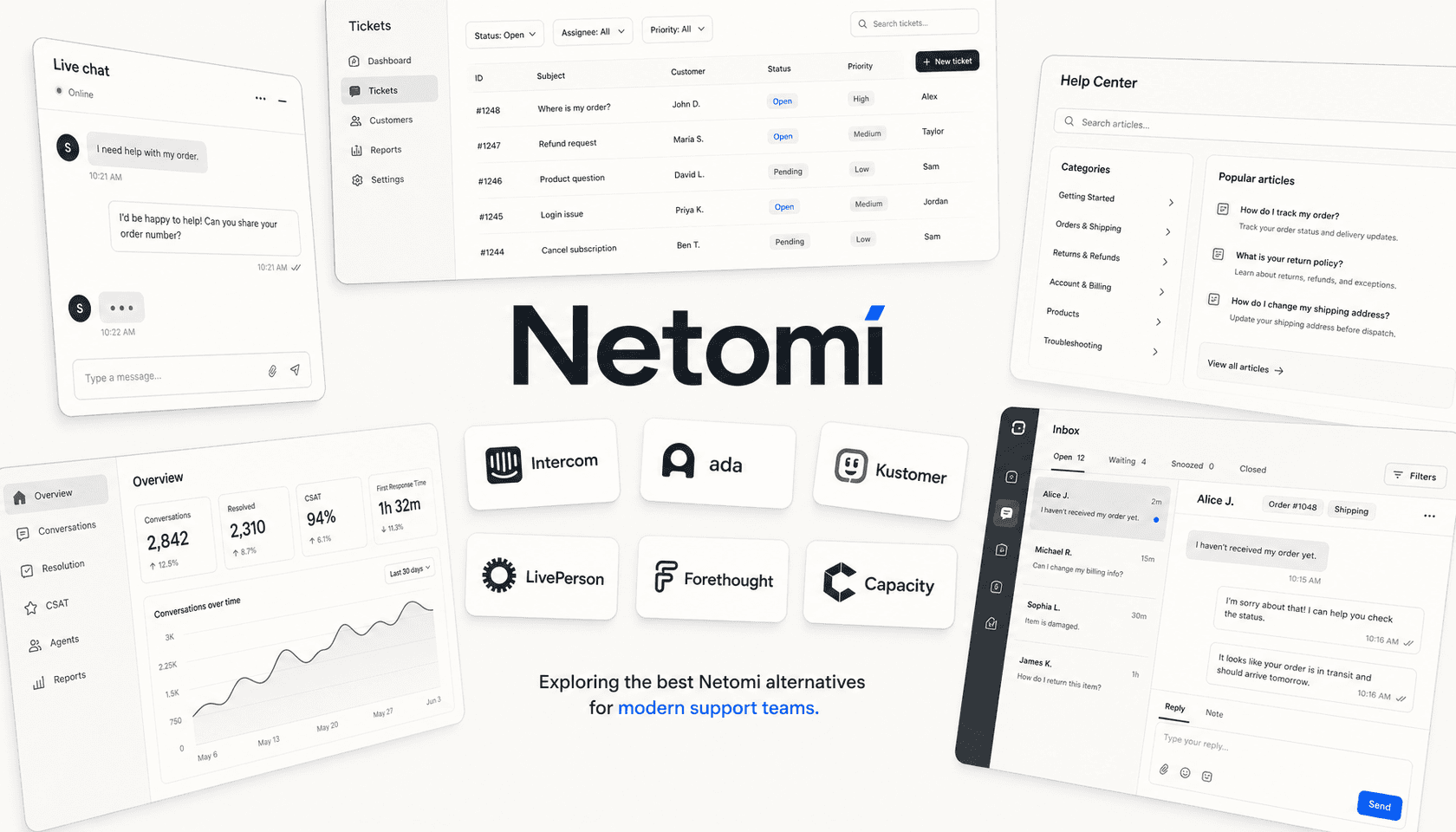
This post covers six alternatives to Netomi, with full pricing tables for each, honest pros and cons, and guidance on which one fits which kind of team. All information is verified against each company's current pricing pages as of May 2026.
Quick comparison
| Tool | Best for | Pricing model | Starting price | Key limitation |
|---|---|---|---|---|
| eesel AI | Teams on existing helpdesks | Per task | $0.40/task (free trial) | Layers on top of another tool |
| Ada | High-volume enterprise | Sales-gated | ~$100K+/year | Requires 300K+ conversations/year |
| Forethought (Zendesk) | Zendesk shops, mid-market | Sales-gated | Not disclosed | Now owned by Zendesk |
| Tidio | SMB and e-commerce | Per conversation | Free / $24.17/mo | Conversation caps on lower plans |
| Freshdesk (Freddy AI) | Teams wanting all-in-one | Per seat + usage | $29/agent/mo (Omni) | Heavy AI features need Pro/Enterprise |
| Decagon | Large enterprise with engineering team | Sales-gated | ~$95K–$590K/year | Not suitable for SMBs |
What Netomi is
Netomi was founded in 2015 by Puneet Mehta, originally under the name msg.ai. The company rebranded to Netomi in 2019, and over the past few years has built a reputation in large enterprise customer service AI — specifically around auditability and governance, two things that matter a lot to regulated industries and large brands.
The product has three main modes: Autopilot for fully autonomous resolution, Co-Pilot for AI-assisted human agents, and Agentic Insights (branded as "Brand Telemetry") for transparency into what the AI is doing and why. That last piece is unusual — most AI support platforms don't give you full visibility into the reasoning chain, and Netomi's pitch is that its AI is "never a black box."
Supported channels: voice, chat, email, SMS, and social. The platform is SOC 2 Type II, HIPAA, GDPR, and ISO 27001 certified.
Pricing: No public pricing. Sales-gated. Demo required to get any numbers. Based on the customer tier they target (Fortune 500 enterprises), contracts are almost certainly six figures annually.
Who it's for: Enterprise teams at real scale — Delta Air Lines, MetLife, United Airlines, ESPN+, NBA, DraftKings. If you're not at that tier, the sales cycle and the likely price point will disqualify it.
The 6 best Netomi alternatives
1. eesel AI
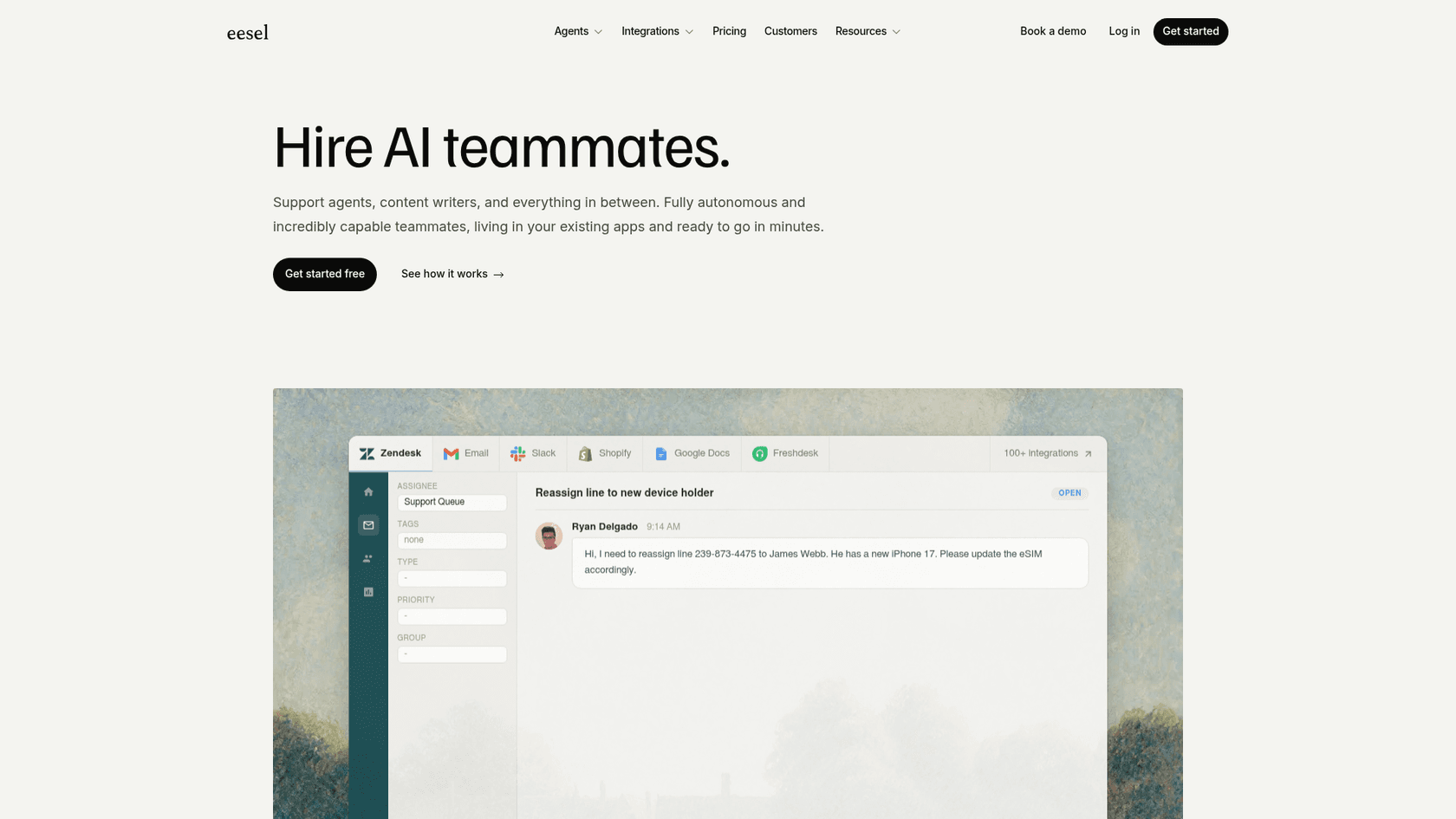
eesel AI takes a fundamentally different approach from Netomi. Instead of replacing your helpdesk, it layers on top of it — treating your existing Zendesk, Freshdesk, Gorgias, or other setup as the foundation and adding an AI agent that handles frontline replies, triages, and escalates. The tagline is "AI teammates. Not chatbots. Not copilots."
The appeal for teams evaluating Netomi is practical: you don't have to migrate your tickets, your workflows, or your team. eesel connects to what you already have, ingests your help center, past tickets, and knowledge docs, and starts working. Setup is genuinely fast — under 15 minutes according to eesel's own claims, and independent reviewers consistently cite fast deployment as a differentiator.
One useful feature for teams nervous about handing over replies to AI is Simulation Mode — you can test the AI against thousands of past tickets before going live and see a data-driven forecast of how it'll perform. That's a meaningful risk-reduction step, especially for support teams that care about consistency.
Key features:
- Autonomous ticket resolution with confidence-based routing (low-confidence responses become drafts for human review)
- Simulation mode to test before launch
- Theme analysis that surfaces recurring ticket patterns and auto-drafts knowledge base articles
- 80+ language support with auto-detection
- Knowledge from Google Drive, Notion, Confluence, Shopify, SharePoint, past tickets
- Deployable via Zendesk, Freshdesk, Gorgias, Help Scout, Slack, Microsoft Teams, email, web chat
Pricing:
| Task type | Price |
|---|---|
| Light tasks (dashboard questions) | Free |
| Regular tasks (support tickets, chats) | $0.40 each |
| Heavy tasks (long-form content) | $4.00 each |
Free trial: $50 in free credits on signup, no credit card required.
Enterprise add-on: $1,000/month flat fee adds dedicated solutions engineer, SSO, HIPAA, and BAA.
Annual commitment discount: commit to $300+/month for a year and pay 25% less.
Pros:
- Transparent pricing; no sales call needed to know what you'll pay
- Works alongside your existing helpdesk — no migration required
- Free trial with $50 in credits lets you test before committing
- Per-task pricing scales with actual usage, not headcount
- Fast setup (sub-15 minutes for basic configuration)
Cons:
- You're paying for two tools: eesel plus your existing helpdesk
- Quality depends on the quality of your source documents
Who it's for: Teams already on a helpdesk (Zendesk, Freshdesk, Gorgias) that want to add AI without switching platforms. Also good for teams that want clear, predictable costs before signing anything. Smava uses eesel to handle 100,000+ tickets/month in German; Gridwise resolved 73% of tier-1 requests in the first month.
2. Ada
Ada is a Canadian AI customer experience platform founded in 2016 that has deployed 550+ AI agents globally and powered over 6.4 billion interactions for customers including Monday.com, Pinterest, Square, and Cebu Pacific. Its February 2026 launch of the Unified Reasoning Engine — a patent-pending dual-reasoning architecture — marked a significant architectural upgrade, letting Ada agents handle both immediate and background tasks with a single AI brain across all channels.
Ada competes directly with Netomi in the enterprise segment. Like Netomi, it requires a sales conversation, targets high-volume deployments, and prices on resolved conversations rather than a flat seat fee. Unlike Netomi, Ada has more public data on results — Tilt achieved 84% automated resolution on chat, Loop Earplugs saw 357% ROI, and Cebu Pacific cut wait times while achieving a 50% CSAT increase.
The most significant constraint is the minimum volume requirement: Ada explicitly states its platform is built for companies with at least 300,000 annual customer service conversations. That's 25,000 conversations per month. If you're below that threshold, Ada will likely tell you it's not the right fit.
Key features:
- Unified Reasoning Engine across 8+ channels (voice, email, chat, WhatsApp, SMS, Instagram, in-app)
- Playbooks for multi-step actions using live data (order edits, invoice retrieval, shipping tracking)
- Coaching: refinements to past conversations automatically improve future interactions
- 50+ integrations including Zendesk, Salesforce, ServiceNow
- HIPAA, SOC2, GDPR, AIUC-1 certification
- Performance Center for monitoring across build, launch, and scale stages
Pricing:
Ada has no public pricing. All pricing is custom and requires a sales conversation.
| What's known | Details |
|---|---|
| Minimum volume | 300,000 annual conversations |
| Typical range (user reports) | $100,000–$300,000+ per year |
| Per-resolved-interaction estimate | $1–$3.50 per resolved conversation |
| One Reddit report | "~$300K+ for ~150,000 tickets a month" |
Source: Ada pricing page; third-party cost data from community reporting.
Pros:
- Strong enterprise track record with verifiable case studies
- Unified omnichannel architecture means consistent AI behavior across every channel
- Coaching loop for continuous improvement without manual retraining
- Serious compliance certifications for regulated industries
Cons:
- No pricing transparency at all — even ballpark estimates require a sales call
- 300,000 conversation minimum locks out mid-market teams
- Setup takes 8–16 weeks with Ada's professional services
- G2 admins rate it 4.6/5; Trustpilot end-users rate it 2.0/5 — a gap worth noting
Who it's for: Enterprises running 25,000+ customer service conversations monthly that need omnichannel AI with serious compliance requirements. Not for teams under that threshold.
3. Forethought (now part of Zendesk)
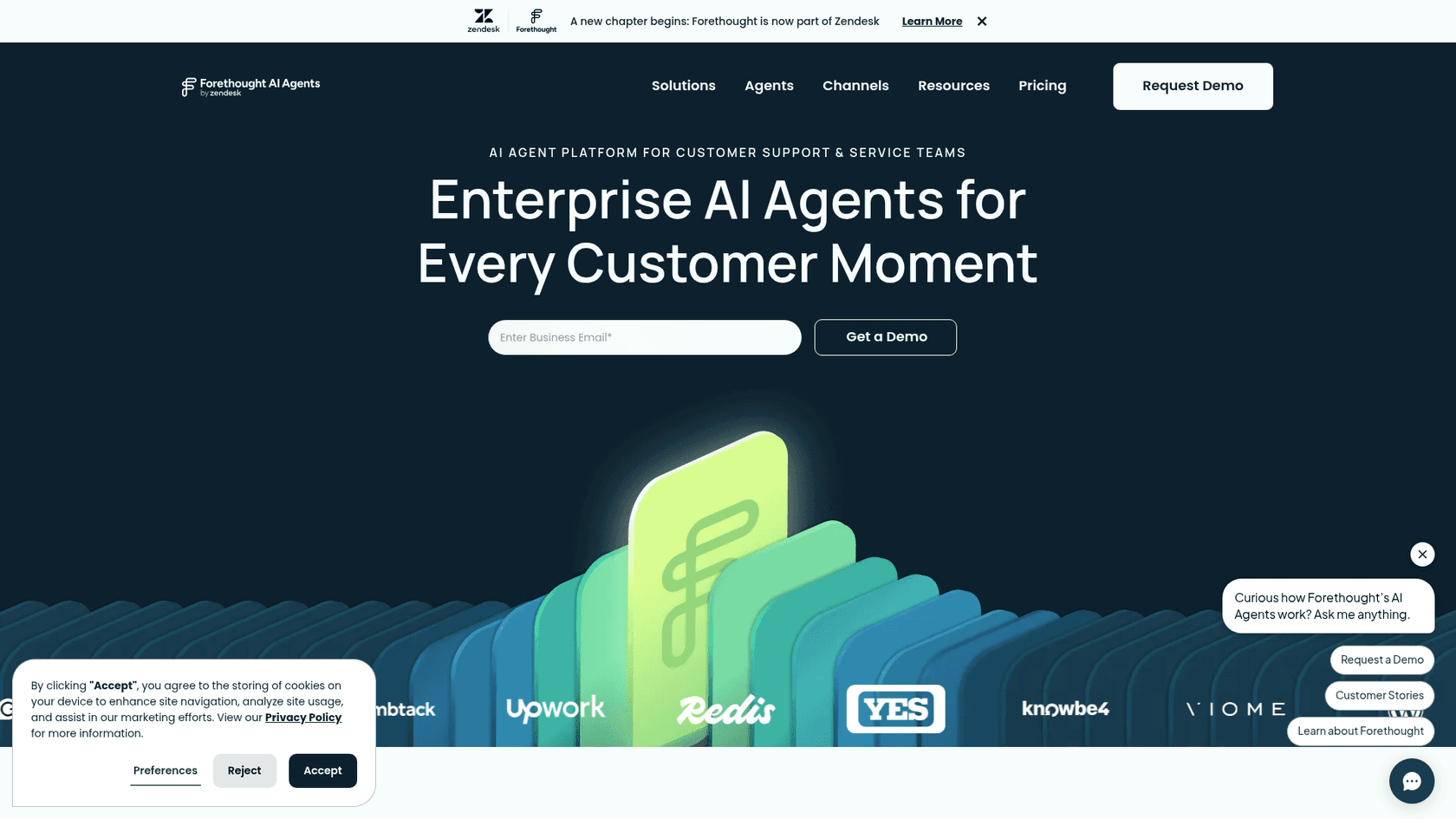
Forethought has an important asterisk in 2026: Zendesk completed its acquisition of the company in March 2026. Zendesk called it its largest acquisition in two decades. Forethought's CEO Sami Ghoche described it as "an acceleration of the mission" — meaning the product continues, but under new ownership.
What that means in practice: Forethought's products (Solve for autonomous resolution, Triage for intelligent routing, Assist for agent co-pilot, Discover for insights) remain available. Zendesk has said existing customers will see uninterrupted service, and new customers can adopt Forethought independently — not exclusively through Zendesk. But the long-term roadmap is now Zendesk's call, and deeper integration with the Zendesk platform is clearly the direction of travel.
Before the acquisition, Forethought had raised $115 million and served over 1 billion monthly customer interactions for companies like Upwork, Grammarly, Carta, Brex, and Datadog. Its technical strengths were in intelligent triage (custom ML models for ticket routing), omnichannel coverage, and an April 2026 launch of Browser Agents — AI that can handle automation tasks APIs can't reach.
Key features:
- Solve: omnichannel autonomous resolution (chat, email, voice, social)
- Triage: custom ML models for ticket classification and routing
- Assist: real-time AI co-pilot for human agents
- Discover: AI-surfaced knowledge gaps and conversation insights
- Browser Agents (April 2026): handle web-based automation tasks
- Test Suite (April 2026): validate agent behavior before deployment
- 70+ integrations
Pricing:
All pricing is sales-gated. Three tiers: Basic, Professional (most popular), Enterprise.
| Feature | Basic | Professional | Enterprise |
|---|---|---|---|
| Price | Contact sales | Contact sales | Contact sales |
| AI agent for chat | Yes | Yes | Yes |
| Omnichannel agent | No | Yes | Yes |
| Custom triage models | No | Yes | Yes |
| Multilingual | No | Yes | Yes |
| Brands supported | 2 | Unlimited | Unlimited |
| QA rubrics | 5 | 20 | Unlimited |
| API access | No | No | Yes |
| Knowledge base gap detection | No | No | Yes |
| Security tier | Standard | Standard | Advanced |
Source: Forethought pricing page.
Pros:
- Strong triage and routing ML — often cited as best-in-class for ticket classification
- Now backed by Zendesk's resources and global reach
- Omnichannel coverage including voice
- Browser Agents for automation beyond standard API integrations
Cons:
- Acquired by Zendesk — strategic direction is uncertain for non-Zendesk customers
- No public pricing at any tier
- Deeper Zendesk integration means less appeal if you're on a different helpdesk
Who it's for: Mid-market to enterprise teams, especially those already on Zendesk. If you're evaluating Forethought and Zendesk isn't your helpdesk, it's worth considering whether the acquisition changes the calculus — eesel AI and tools like eesel are explicitly platform-agnostic and work across multiple helpdesks.
4. Tidio
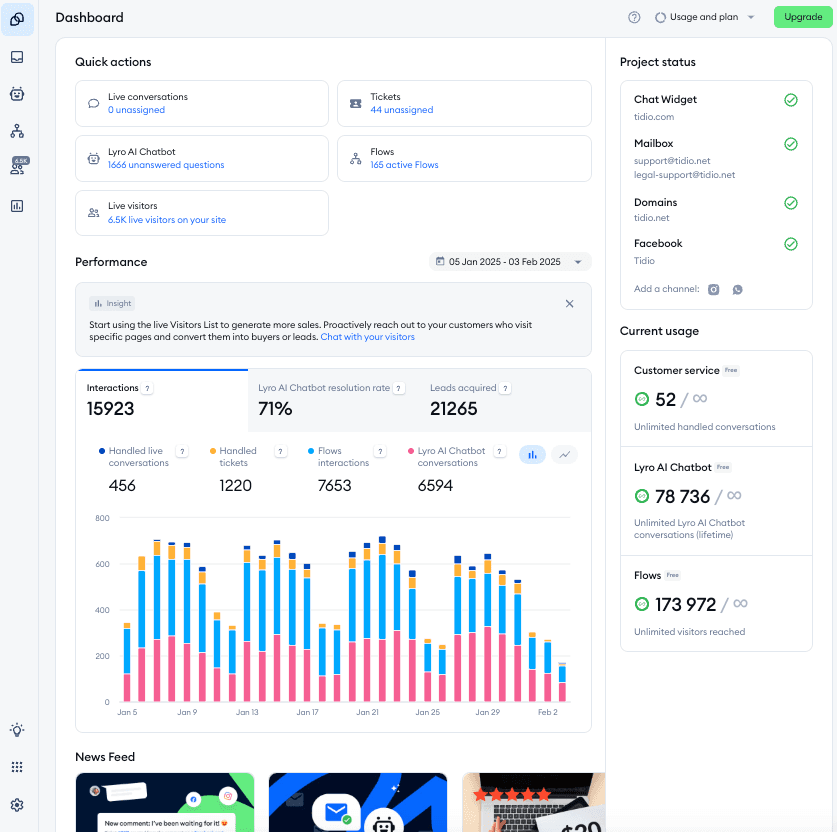
Tidio is the most accessible entry in this list — a customer service platform built primarily for small and mid-sized e-commerce businesses, with a genuinely usable free tier and plans starting at $24.17/month. Its AI layer, Lyro, claims a 67% resolution rate (which it calls "the highest in the market") and trains on your support documentation rather than generic web data.
The company has 300,000+ customers and a 4.6/5 rating across 1,879+ reviews on G2. Customer logos include Under Armour, The Body Shop, Dermalogica, and Stanley. Tidio's positioning is straightforward: if you're a growing e-commerce brand that needs AI-assisted support without an enterprise procurement cycle, this is the category it competes in.
What makes Tidio meaningfully different from Netomi is the price floor and the self-serve model. You can sign up, connect your Shopify store, and have Lyro answering questions the same day — no sales calls, no custom onboarding, no six-figure contract. The tradeoff is ceiling: Tidio doesn't have the governance tooling, omnichannel sophistication, or enterprise security posture that Netomi targets.
Tidio's Premium tier does offer a 50% Lyro resolution rate guarantee with a money-back option, which is an unusual commitment in the AI support category.
Key features:
- Lyro AI Agent: conversational AI trained on verified support data
- Flows: automated proactive chat triggers and lead capture
- Help desk: ticket management and workflow organization
- Live chat with video call support
- 120+ integrations including Shopify, HubSpot, Zapier, Zendesk
- Lyro can be purchased as a standalone add-on separate from the Tidio platform
Pricing:
| Plan | Monthly | Annual | Conversations | Seats |
|---|---|---|---|---|
| Free | $0 | $0 | 50/month | 10 |
| Starter | $29 | $24.17/mo | 100/month | 10 |
| Growth | ~$59+ | $49.17+/mo | 250+/month | 10 |
| Plus | $749/mo | $749/mo | Custom | Custom |
| Premium | Custom | Custom | Custom | Custom |
Lyro AI as standalone add-on: starts at $32.50/month (annual) for 50 conversations.
Growth plan scales with conversation volume. Plus includes departments, multi-project support, custom branding, OpenAPI access, and a dedicated success manager. Premium adds SSO, managed service, and the 50% resolution rate guarantee.
Pros:
- Genuinely free tier for testing (50 conversations/month)
- Transparent, self-serve pricing — no sales call needed
- Fast setup for Shopify and other e-commerce platforms
- 50% resolution guarantee on Premium plan is a genuine differentiator
Cons:
- Conversation caps on lower plans are tight (50 on Free, 100 on Starter)
- Not built for complex enterprise deployments or regulated industries
- Lyro resolution rate drops if your documentation is thin or inconsistent
Who it's for: Small to mid-sized e-commerce businesses, especially those on Shopify. Also good for teams that need live chat plus AI in one tool without paying enterprise prices. Not suitable for Fortune 500 deployments.
5. Freshdesk with Freddy AI
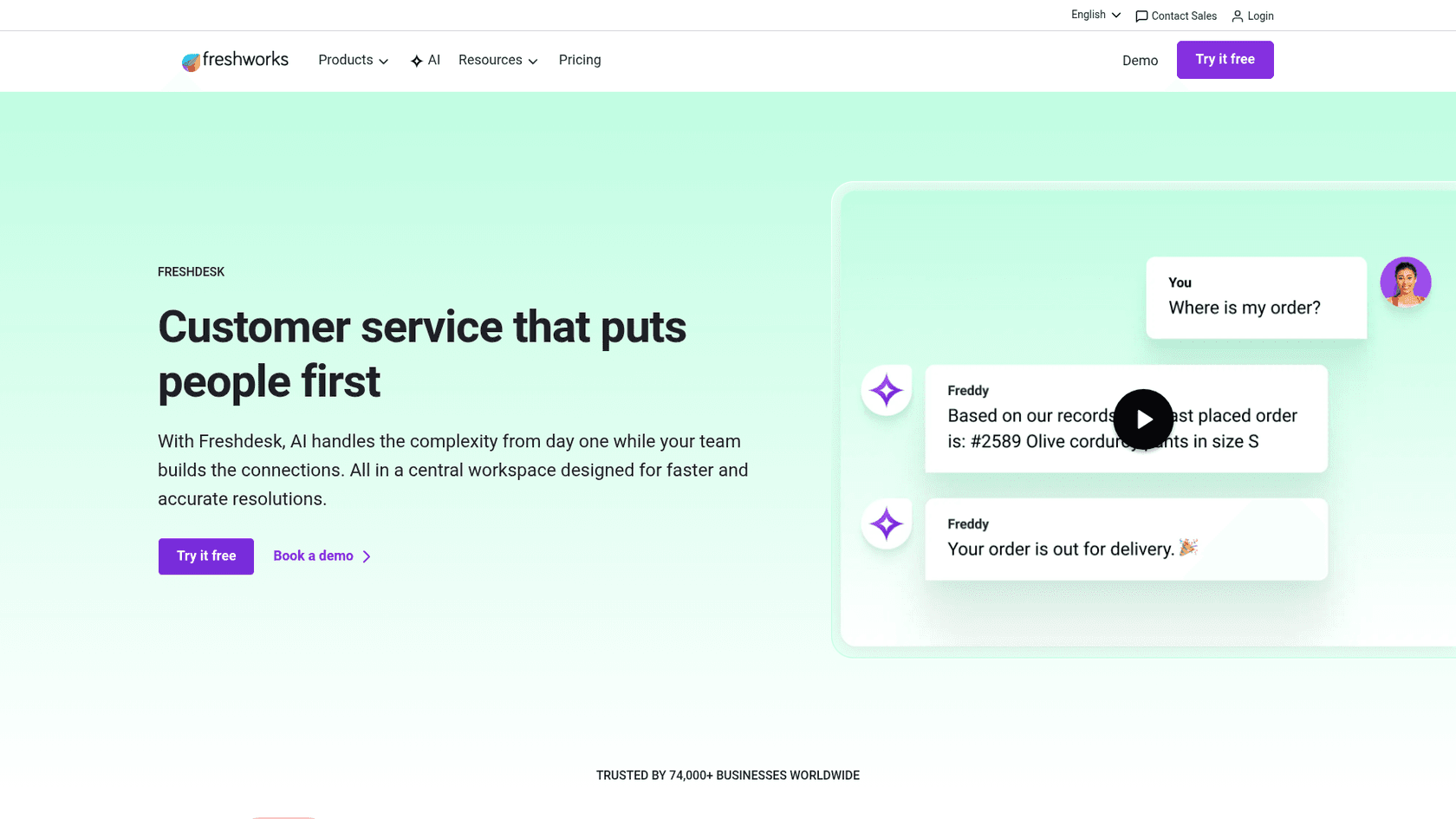
Freshdesk takes a different angle from every other tool on this list: rather than being an AI layer you add to your workflow, it's a full helpdesk platform that has AI built in. Freddy AI is the AI layer inside Freshdesk, available in three forms — Freddy AI Agent (customer-facing autonomous bot), Freddy AI Copilot (agent-assist add-on), and Freddy AI Insights (analytics, currently in beta).
The product case for Freshdesk is consolidation: one platform for ticketing, live chat, automation, and AI rather than three or four separate tools. For teams currently paying Zendesk plus an AI overlay, moving to Freshdesk Omni can simplify the stack. The Q4 2025 earnings call disclosed that 8,000+ customers are now using Freddy AI and Freddy AI topped $25M ARR, suggesting meaningful adoption.
Some important constraints worth knowing before you evaluate it: Freddy AI Agent's knowledge sources are limited to files, URLs, solution articles, and Q&As. There is no native connector to Confluence, Google Docs, Notion, or SharePoint — which is a real limitation if your knowledge lives in those tools. File limits are also specific: 200 files per agent, 35MB per file maximum, 10 URLs per agent. And Email AI Agent (which auto-resolves email tickets) is only available on Pro and Enterprise plans — Growth-plan customers can't access it.
Key features:
- Freddy AI Agent: customer-facing bot with 50+ pre-built agentic workflows, 60+ language support, no-code configuration
- Freddy AI Copilot: writing assist, translation, summarization, sentiment analysis, resolution suggestions
- Freddy AI Insights (beta): anomaly detection, conversational analytics dashboard
- Email AI Agent: auto-resolves email tickets at creation (Pro/Enterprise only)
- AI Agent Studio: no-code admin surface for building, testing, and deploying agents
- Full helpdesk included: ticketing, live chat, automation, SLA management
Pricing:
Two tracks: standalone Freshdesk (ticketing only) or Freshdesk Omni (ticketing + live chat bundled).
Freshdesk (ticketing only):
| Plan | Price (annual) |
|---|---|
| Free | $0 (up to 2 agents, 6 months) |
| Growth | $19/agent/month |
| Pro | $55/agent/month |
| Enterprise | $89/agent/month |
Freshdesk Omni (ticketing + chat, includes Freddy AI):
| Plan | Price (annual) |
|---|---|
| Growth | $29/agent/month |
| Pro | $79/agent/month |
| Enterprise | $119/agent/month |
Freddy AI add-ons:
| Add-on | Price |
|---|---|
| Freddy AI Copilot | $29/agent/month (annual) — Pro/Enterprise Omni only |
| Freddy AI Agent sessions | 500 free/month, then ~$0.50/session (new list price from Q4 2025 earnings) |
| Freddy AI Insights | Free in beta, bundled with Copilot license |
Source: Freshdesk pricing; Freshdesk Omni pricing; Q4 2025 earnings.
Pros:
- All-in-one: helpdesk + AI in one platform, one contract
- Meaningful adoption with 8,000+ customers using Freddy AI
- No-code AI Agent Studio makes setup accessible to non-technical admins
- Strong G2 rating: 4.4/5 across 3,728 reviews
Cons:
- No native connectors to Confluence, Google Docs, Notion, or SharePoint — knowledge portability is limited
- Heavy AI features (Email AI Agent, Copilot) require Pro or Enterprise plan
- Ecosystem lock-in: Freddy AI only works within Freshworks products
- Session-based pricing for AI Agent adds variable cost on top of seat fees
Who it's for: Teams that want to consolidate their helpdesk and AI into one platform, especially those without Confluence or Google Docs-heavy knowledge bases. Good fit for growing teams that want a single vendor relationship. Not the right pick for teams whose knowledge lives outside Freshworks.
6. Decagon
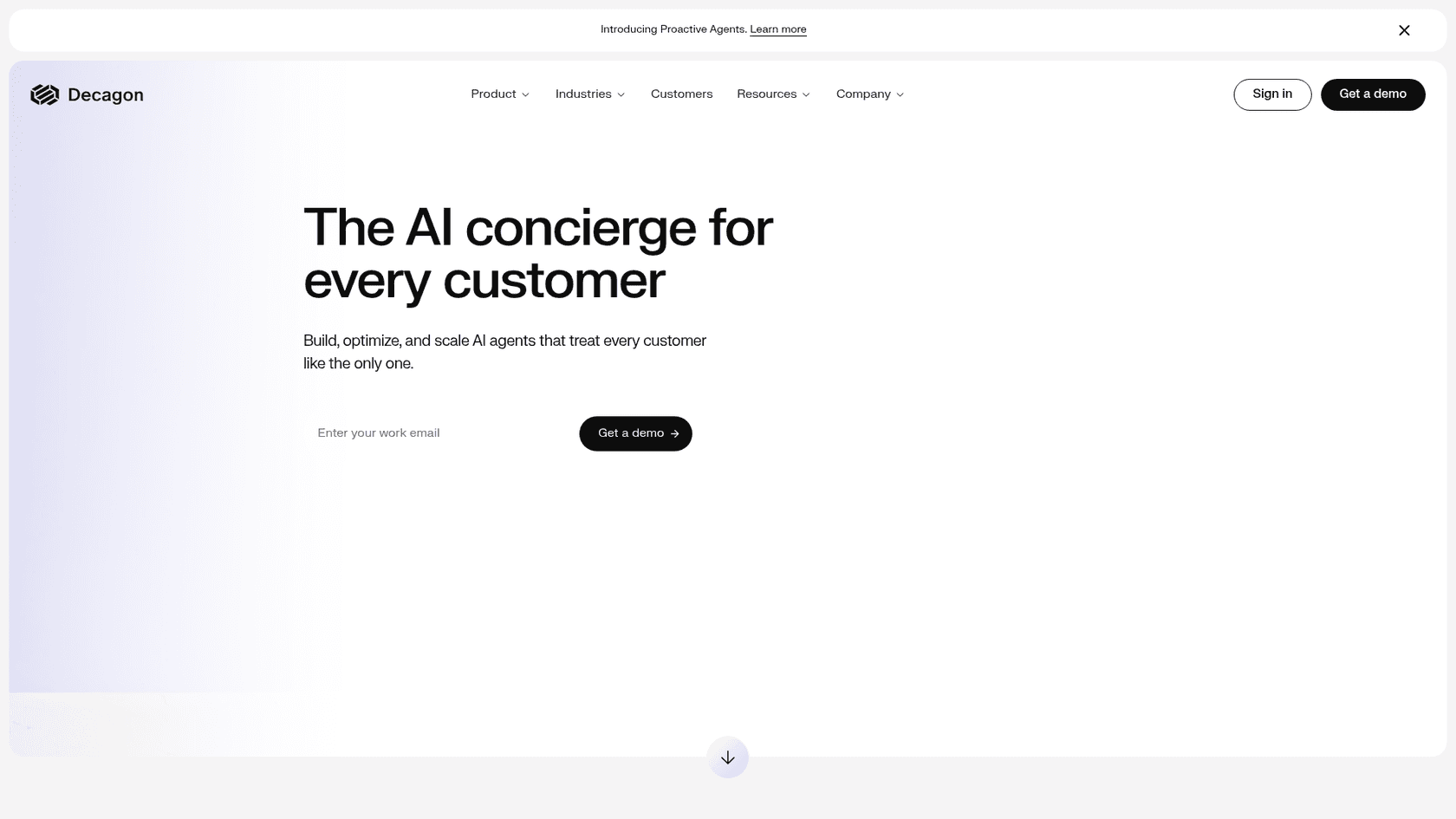
Decagon is the highest-ceiling option on this list. Founded in 2023 by Jesse Zhang (ex-Niantic) and Ashwin Sreenivas (ex-Scale AI), Decagon builds enterprise AI agents for the largest support operations in the world. Its customer list includes Duolingo (80% deflection rate), Chime (70% chat and voice resolution), ClassPass (95% cost reduction in chat operations), and Dropbox, Figma, Notion, Substack, Square, and Rippling. Duolingo alone deflected 80% of support volume through Decagon, saving over 100,000 human touch hours per year.
The technical differentiator is Agent Operating Procedures (AOPs) — natural-language instruction sets that CX teams write (rather than code) to define how the AI agent behaves. AOPs compile to executable workflows, which means non-engineers can iterate on agent logic without involving developers. Decagon also launched voice agents (Decagon Voice) for phone-based customer support, and a newer "Duet" tool in March 2026 that helps teams build self-improving agents.
The honest caveat: Decagon is expensive and requires significant engineering resources to implement. Setup takes weeks. Contracts start around $95K annually and scale well past $500K for large deployments. It's not a product you try before you buy.
Key features:
- Agent Operating Procedures (AOPs): natural-language agent logic without code
- Voice agents for phone-based support (Decagon Voice)
- Agent Workbench: autonomous debugging and root cause analysis
- Agent Versioning: CI/CD-style governance for agent updates
- Trace View: full transparency into agent reasoning
- Watchtower: always-on QA monitoring in production
- Zendesk two-way sync, Salesforce, Confluence, RingCentral integrations
Pricing:
No public pricing. Sales-gated with a multi-week proof-of-concept process.
| Component | Estimate |
|---|---|
| Annual platform fee | ~$50,000/year |
| Per-conversation (most customers) | ~$0.99/conversation |
| Per-resolution alternative | ~$0.50/successful resolution |
| Typical contract range | $95K–$590K+ annually |
| Median reported contract | ~$400,000/year |
Pros:
- Outstanding customer outcomes at scale (70–80% deflection rates common)
- AOPs mean CX teams — not engineers — control agent behavior
- Voice support is included, not an add-on
- Best-in-class auditability via Trace View
Cons:
- Among the most expensive options in the market
- Requires dedicated engineering resources for implementation and ongoing optimization
- No self-serve trial; full sales cycle required
- Not viable for teams under ~$100K/year support AI budget
Who it's for: Large enterprises with high support volume, existing helpdesk infrastructure, and internal engineering capacity. If you're spending more than $200K/year on support software and want to get to 70%+ deflection, Decagon is worth the conversation.
How to choose
The choice comes down to three things: scale, budget transparency, and how much you want to change.
If your team is under 25,000 conversations per month and you want to start quickly without a sales cycle, Tidio (for e-commerce) or eesel AI (for teams on existing helpdesks) are the most accessible paths. Both have real pricing you can evaluate before talking to anyone.
If you're already on Freshdesk or are considering a full helpdesk change, Freshdesk with Freddy AI consolidates AI and ticketing into one platform. The main question is whether your knowledge lives in Google Docs or Confluence — if it does, the knowledge source limitations will matter to you.
If you're at enterprise scale (50,000+ conversations/month, six-figure support AI budget) and need serious governance, auditability, and omnichannel reach, Ada and Decagon are the strongest options. Ada has a broader channel footprint and more public case study data; Decagon's AOP model gives more CX control without engineering involvement.
Forethought is worth evaluating if you're on Zendesk and want a deeply integrated AI layer — the acquisition means you'll have Zendesk's resources behind the product, though the long-term roadmap for non-Zendesk customers is less clear.
For teams that specifically want the "post-pilot production scale" positioning that Netomi offers but prefer a product with transparent pricing and a faster on-ramp, eesel AI's simulation mode is worth a look — it lets you run the AI against your actual historical ticket data before going live, which is a meaningful version of the production-readiness guarantee Netomi's positioning promises.
Conclusion
Netomi is a legitimate product with serious enterprise credibility — the April 2026 $110M raise from Accenture Ventures and Adobe Ventures is not a distress signal. But its pricing opacity, six-figure contracts, and Fortune 500 focus make it the wrong fit for most teams evaluating AI customer service tools.
The alternatives above cover the full range: from Tidio's free tier for small e-commerce teams to Decagon's $400K+ median contracts for large enterprises. Whatever you're replacing or upgrading, there's an option here with pricing you can evaluate without a three-month procurement cycle.
If you want to see what AI on top of your existing helpdesk looks like before committing, eesel AI's free $50 trial is the fastest way to get data — you can run it against real tickets and see resolution rates before making any decision.