Fini AI alternatives in 2026: 9 options and what each costs to start

Rama Adi

Katelin Teen
Last edited August 19, 2026
Why teams look past Fini AI in the first place
Before I pick Fini apart, some credit where it's owed, because there is a real product here.
The company came out of Y Combinator's S22 batch, and in January 2026 it raised a $3.6M seed led by Matrix Partners. Its founders, Hakim Khalafi and Deepak Singla, are both ex-Uber.
The architecture isn't a me-too RAG wrapper either. Fini's platform page describes a deliberately "RAGless" design with no embeddings: a query-writing model hits trusted internal sources at runtime, and every answer carries single-source attribution instead of a blended one. Then there's Knowledge Atlas, which watches your humans resolve escalated tickets and writes the article afterwards. Smarter loop than most vendors ship, and a better answer to the AI knowledge base problem than most competitors have bothered with.
The customer proof isn't vapour, either. Of the case studies on the site, Peaksware is the most substantive: two sports-software brands sharing one Zendesk instance, 1,700 tickets in a peak week, the queue cut by "70%+," and average response time down to 25.9 seconds from up to 24 hours.
"We have on our busiest week potentially 1,700 tickets submitted into Zendesk. But what we saw in our queue at max was right around 500. Clearly, Fini is taking a huge number of those."
Kristina Green, Senior Support Rep, TrainingPeaks, Fini case study
So why do people shop around anyway? Four reasons, roughly in the order they bite.
The entry price is nowhere near the advertised price
This is the big one. The homepage leads with $0.49 per resolution and never once links to a pricing page. Go and find the pricing page yourself and it defaults to annual billing, with three tiers laid out on it.
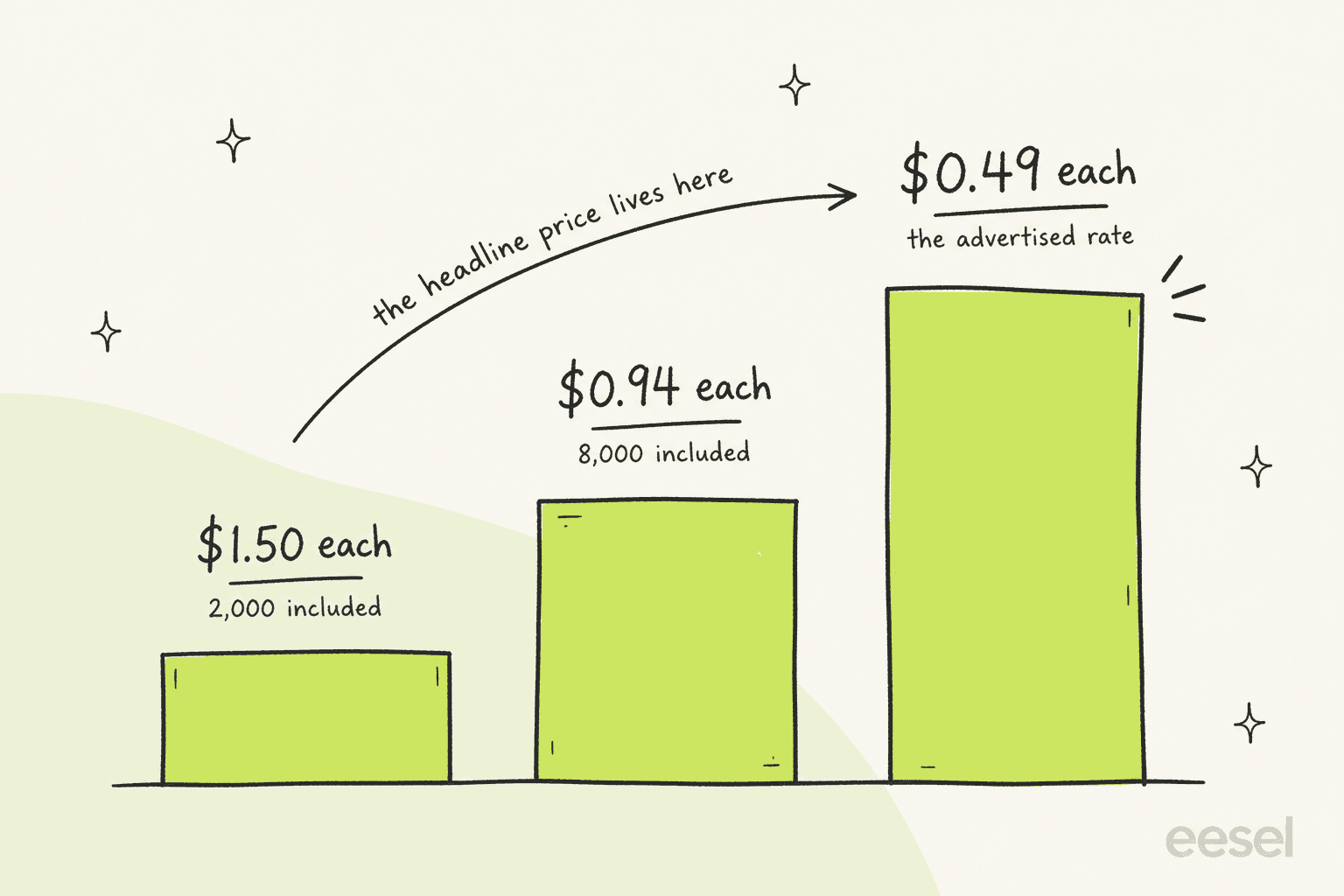
| Fini tier | Annual rate | True monthly rate | Resolutions included | Overage per resolution | Effective rate on included volume |
|---|---|---|---|---|---|
| Growth | $3,000/mo ($36,000/yr) | $3,600/mo | 2,000 | $0.89 | $1.50 |
| Scale | $7,500/mo ($90,000/yr) | $9,000/mo | 8,000 | $0.69 | $0.94 |
| Enterprise | $15,000/mo ($180,000/yr, per the FAQ) | $18,000/mo | "Unlimited" | $0.49 | n/a |
Two things fall out of that table. One: the block you commit to costs more per unit than the overage you pay after it. Volume pricing normally runs the other way round. Two: that $0.49 from the homepage only exists on the tier the FAQ prices at $180,000 a year.
A third wrinkle, worth having in your pocket before a negotiation. Fini's own Decagon comparison page went up in June 2026 and is still live, and it prices Fini at $0.69 per resolution with a $1,799 monthly minimum. The August pages put the same product at a $3,600 monthly minimum. So a stale rate card is sitting there in public, showing a floor that doubled inside two months. Ask which one applies to you.
The 90-days-free guarantee has a volume gate most readers will not clear
The pricing page says "You pay nothing during the 90 days." The guarantee terms say something a good deal narrower. It's a conditional waive-or-refund, triggered only if Fini underperforms, and to be eligible you need 1M+ annual tickets plus 100,000 AI-handled interactions inside the 90 days. New enterprise logos only. Once per company. Void if you took a promotional discount. And the benchmarks themselves are measured against "eligible queries," with fraud, legal and regulatory disputes pulled out of the denominator.
Clear that bar and it's a strong offer, roughly $54,000 of risk handed back to you. On Growth or Scale it doesn't apply at all, so the effective trial there is nothing.
There is no way to test it on your own tickets first
Fini's capability card reads "Production-Ready from Day 1." Hunt around the site for pre-deployment validation and the only thing described anywhere is vendor-run: a demo where, in Fini's words, "We'll take your ticket mix and show you what Fini resolves and what it escalates to your team." The evaluation loop inside the product runs after go-live, on real customer conversations.
You don't have to take my word for the gap. On Fini's own Ada comparison page, the row "Pre-production simulation and testing" gets a tick for Ada and nothing at all for Fini. The same page concedes that Fini "does not publish native social or messaging channels," and marks itself absent on AIUC-1 and on PCI DSS, even though the homepage claims PCI DSS Level 1 elsewhere. Worth reconciling on the call.
Why does this bite harder for Fini than for some chat widget? Look at what it's showing off. Three of the four worked examples on Fini's platform page are refunds, duplicate-charge diagnosis and subscription cancellation, and in the refund case the agent fires the API call itself. An agent that can move money is the exact one you want a dry run on. My notes on AI agent handoff cover what should happen when it decides not to.
Fini's own customers say as much, on Fini's own site:
"Last week we saw a couple of cases where the bot told someone it took care of something it actually couldn't and didn't flag it. We saw it, are fixing it, and watching closely for anything else like it."
Kai Moon, Success Team Lead, Wefunder, Fini case study
That's a candid quote and I respect Fini for leaving it up. It's also the single best argument on this page for testing against your own history before go-live.
It plugs into eight things
Fini's integrations page is one logo strip. It isn't a directory. Seven of the eight tiles are Zendesk, Front, LiveChat, Salesforce, Gorgias, HubSpot and Slack, and only Zendesk has an independent marketplace listing linked from the page.
Absent: Freshdesk, Help Scout, Zoho Desk, Kustomer, Jira Service Management. Also absent as knowledge sources: Confluence, Notion, Google Drive, Microsoft Teams. The homepage, meanwhile, runs a logo wall with Freshdesk and Discord on it that the integrations page never mentions. The two pages disagree with each other.
Run Freshdesk or Jira Service Management, or keep half your institutional knowledge in Confluence, and this stops being a preference. It's a hard stop.
The third-party review base is thin
Fini holds 4.9/5 from 13 reviews on G2. Capterra has no listing at all. Trustpilot has one review. Of the ones I could read in full, most carry G2's "Source: Seller invite" flag, and they bunch up in the months right after the seed round.
For a company this young that's normal, and I'm not going to pretend it's damning. What it does mean is that you can't triangulate the 95% accuracy claim against strangers. The two most useful reviews are the ones that hedge:
"When Fini learns a new model, sometimes it gets a little loosey goosey and makes up features or processes that don't exist in our product."
Jacqueline M., Lead Success and Experience, G2

Which brings me to the metrics. Fini's trust-metrics page publishes seven numbers, 95% resolution accuracy and 99.8% on policy and guardrails among them, under a column header that literally reads "Fini Benchmark." Not one of the seven carries a sample size, a time window or an independent evaluator. Further down the same page, a competitor chart plots Fini at 80 against four named rivals between 30 and 60, and never labels what the axis is measuring.
None of which means the numbers are wrong. It means they're marketing, and the move is to ask for the same figures on your ticket mix. Fini's co-founder has been clear-eyed about how hard that bar is, in a Show HN post launching the team's open-source evaluation tool:
"In our day to day work, we have found that Automatic Evals are not enough to get the required 95% accuracy for our Enterprise customers. Automatic Evals are efficient, but still often miss nuances that only human expertise can catch."

A founder saying out loud that hitting 95% takes human evaluation on real cases. Which is the argument for testing on your own tickets, made by the vendor. Pair it with my notes on AI support quality assurance and the customer service metrics that actually move.
How I picked these nine
I've spent the last few years building the integration layer at eesel. In practice that has meant reading other vendors' rate cards very carefully, then finding out what the meter counts once real tickets start flowing through it. So this shortlist isn't "the nine most famous AI support agents." These are the nine that answer a Fini buyer's actual question, screened on four things:
- It replaces the same job. An autonomous agent that resolves tickets end to end. A copilot that only drafts is a different animal, and there's a real difference between agents and chatbots. Agent-assist tools are a different purchase.
- The pricing is checkable. Published, or quote-only with the quote-only status said out loud. I didn't restate any vendor's claim about a rival's price as fact.
- It sits on top of a helpdesk, or replaces one honestly. Fini's pitch is "runs on your existing stack," so anything below that quietly demands a migration gets flagged for it.
- The billable unit is defined. Where a vendor charges per "resolution" and never says what triggers one, that's in the write-up.
Everything below comes from the vendors' own pages and docs, plus public reviews on G2, Capterra, Trustpilot and Hacker News, all checked in August 2026. Where a number has moved recently, I say so.
The 9 best Fini AI alternatives at a glance
| Tool | Best for | Entry price | Billable unit | Test on your own tickets first? | Self-serve start? | Helpdesk reach | Free tier |
|---|---|---|---|---|---|---|---|
| eesel AI | Proving the resolution rate before go-live | $0.40/ticket, no platform fee | Ticket handled | Yes, simulation on closed tickets | Yes | 100+ integrations | $50 free usage, no card |
| Decagon | Enterprise CX with version-controlled procedures | Quote only | Not published | Not published | No | Major helpdesks | No |
| Ada | Enterprise multichannel with formal AI assurance | Quote only | Not published | Yes (per Fini's own comparison) | No | Broad, plus CCaaS voice | No |
| Aisera | Internal IT, HR and employee support | Quote only | Not published | Not published | No | ITSM-first | No |
| Zendesk AI agents | Teams already paying for Zendesk seats | $19/agent/mo annual | Automated resolution | Limited | Yes | Zendesk only | No |
| Gorgias AI Agent | Shopify and ecommerce brands | $40/mo bundled | Automated interaction | Limited | Yes | Gorgias only, 254 apps | No |
| Freddy AI Agent | Cheapest credible path from zero | $19/agent/mo annual | 72-hour email session | Limited | Yes | Freshworks only | Free Freshdesk plan |
| Pluno AI | European Zendesk teams wanting escalations free | €249/mo base | Resolution (72h of silence) | No | Yes, 14-day trial | Zendesk only | No, 14-day trial |
| Tidio Lyro | SMBs testing the idea for under $50 | $32.50/mo add-on | Conversation | No | Yes | Standalone, any helpdesk | 50 Lyro chats free |
That table answers "what does it cost." What it can't answer is "what will my month cost." So here's the calculator I'd actually open before booking any demo.
Slide it to 1,000 tickets and the spread runs from roughly $340 to $3,600. Push it out to 8,000 and the picture flips: the per-unit tools keep climbing, Fini's floor just sits there. Fini is not expensive at scale, it is expensive to start. That's a different objection, and it has a different answer.
Now the nine. Same shape each time: what it is, pricing, where it beats Fini, where Fini still wins, then a verdict.
1. eesel AI
Best for: teams that want the resolution rate on paper before a customer ever sees an AI reply.
What it does
eesel sells AI teammates that live inside the helpdesk you already run instead of replacing it. Same architectural bet Fini makes, for what it's worth. The helpdesk agent trains on closed ticket history, help-centre articles and whatever docs you connect, then drafts, triages, escalates and handles ticket classification across those tools.
The part that matters here is simulation mode. Before anything goes live, eesel replays the agent over your own closed tickets and reports projected coverage broken out by topic. You find the gaps, fill them, run it again. That's the axis Fini's own comparison table leaves unticked.
I'm biased, obviously. So here's the honest version of why it got built that way. On a cross-validated trial for a European ecommerce team, our agent hit 93% triage accuracy and 100% spam detection across a 284-chat sample. The same run also showed a 7% factual error rate on drafts. Both of those were true at once. And you only ever surface the second number by replaying the thing against tickets whose answers you already know. We've shipped the failure too: paying customers have had our bot answer from training data when knowledge retrieval came back empty. Simulation isn't a marketing feature here. It's the fix for a bug we caused.
Pricing
Usage-based, and published in full on the pricing page. $0.40 per ticket or helpdesk conversation handled, billed per interaction rather than per reply, with no platform fee, no per-seat fee and no minimum. Commit annually and 25% comes off. Enterprise adds a $1,000/month platform fee, which buys SSO, HIPAA, a BAA and a dedicated solutions engineer.
| Tickets routed to AI / month | eesel cost |
|---|---|
| 100 | $40 |
| 500 | $200 |
| 1,000 | $400 |
| 2,500 | $1,000 |
You start on $50 of free usage with no credit card, and you're only charged for tickets you actually route to AI. A cautious 200-ticket pilot on a 1,000-ticket inbox therefore costs $80.
Where it beats Fini
- Entry cost. $0 to start against a $3,600 monthly floor.
- Testing. Simulation on your real history, self-serve, before go-live.
- Reach. 100+ integrations against eight tiles, including Freshdesk, Help Scout, Jira Service Management and Confluence, all missing from Fini.
- Proof at volume. Smava runs a fully automated Zendesk agent over 100,000+ German tickets a month, and Gridwise hit 73% of tier-1 requests in month one.
Where Fini still wins
Fini publishes SOC 2 Type II, ISO 27001 and HIPAA BAA-readiness as standard. eesel gates HIPAA and a BAA behind the $1,000/month Enterprise tier, and lists SOC 2 as in progress. If you're a regulated fintech buying on a security questionnaire first, that's a real difference, and Fini's Swiss banking logo wall suggests it has already sat through those reviews. Knowledge Atlas does something we don't, as well: it authors help-centre articles by watching your humans resolve escalations.
Verdict: the right pick when your objection to Fini is "I can't commit $36,000 up front on a bet." Skip it if HIPAA and a signed BAA are day-one procurement blockers and the Enterprise tier isn't somewhere you want to be.
2. Decagon
Best for: enterprises that want Fini's positioning with a much longer buyer track record.
What it does
Decagon builds AI agents for large consumer brands. The differentiator is Agent Operating Procedures, version-controlled and human-readable workflow documents the agent follows, in place of opaque model behaviour you tune by prompt. Same "concierge" framing Fini uses, aimed a tier further up market.
Fini agrees, which is the interesting part. On Fini's own Decagon comparison page, workflow authoring is the single row where Decagon takes the tick and Fini doesn't, and the prose underneath grants that post-launch ownership "is where Decagon is strongest."
Pricing
Not published. Decagon is contact-sales, full stop. Fini's comparison page does cite a third-party reconstruction of Decagon contract values, but that's a competitor quoting a marketplace estimate, so I'm not going to restate it here as Decagon's price. My notes on Decagon pricing walk through what buyers have reported instead.
For a sense of the money behind it, Decagon raised a $250M Series D in January 2026 at a $4.5B valuation, roughly tripling inside seven months.
Where it beats Fini
- Version-controlled workflow authoring, conceded by Fini itself.
- Vastly more capital and a longer enterprise deployment history.
- Published named case studies at consumer-brand scale, including Hunter Douglas attributing $1M in revenue to fully AI-handled conversations.
Where Fini still wins
Fini publishes a rate card. Decagon publishes nothing, so there's no modelling spend before a call, and Fini's single-meter pricing with free escalations forecasts far more easily than a bespoke enterprise contract. Fini is also much smaller, which usually means faster movement on your feature requests.
Verdict: the natural upgrade when you liked Fini's pitch and procurement wants a vendor with a decade of scar tissue behind it. Skip it if you need a number before you'll take the meeting. Worth reading next to the other Decagon alternatives.
3. Ada
Best for: enterprise CX teams that need nine channels and a formal AI assurance certificate.
What it does
Ada is the incumbent here. A Toronto company, it raised a $130M Series C at a $1.2B valuation back in 2021, and it has been selling automated resolution since long before "AI agent" was the phrase anyone used. What you buy is a bundle: the ACX platform, a professional-services practice, and assigned experts on top.
The strongest endorsement of Ada in this whole post comes from Fini. On Fini's Ada comparison page, Ada takes ticks that Fini doesn't: pre-production simulation and testing, AIUC-1 AI assurance certification, PCI DSS, CCaaS voice handoff across Genesys, NICE CXone, Twilio Flex, Amazon Connect and Aircall, plus nine native channel types against Fini's three.
Pricing
Not published, and pointedly so. As of August 2026 Ada's pricing page carries no dollar figure, no currency symbol, no tier name. It's a consultation booking form, and the button on it reads "Speak to an expert." Ada's stated qualification floor is 300,000+ annual conversations. My breakdown of Ada CX pricing collects what buyers have reported paying.
Where it beats Fini
- Pre-production simulation, per Fini's own table.
- Nine channel types and real CCaaS voice handoff.
- AIUC-1 and PCI DSS certification for regulated procurement.
- A services practice that will do the knowledge-base work with you rather than handing you a to-do list.
Where Fini still wins
Price transparency, and it isn't close. Fini tells you $3,000 a month before you book. Ada tells you nothing. Fini's architecture is newer too, and single-source attribution answers "why did the agent say that" more cleanly than a retrieval blend does. Under 300,000 conversations a year, Ada won't sell to you at all. Fini will.
Verdict: pick Ada if you're a large enterprise where a security questionnaire kills deals and voice is in scope. Skip it if modelling cost before a sales cycle matters to you. See also my roundup of Ada CX alternatives.
4. Aisera
Best for: internal IT, HR and employee support rather than customer-facing tickets.
What it does
Aisera builds agents for IT, HR, procurement and finance service desks. It has raised roughly $171M across five rounds, the most recent a $90M Series E in 2023 at a $1.6B valuation. Its published outcomes lean employee-side: LifeScan auto-resolving 65% of incoming requests with $2.2M in support cost savings, and OmniTRAX at 70% auto-resolution.
If what you're really evaluating Fini for is deflecting internal IT tickets rather than customer ones, Aisera is the better shape of product. So is a purpose-built AI ticketing system.
Pricing
Not published anywhere on aisera.com. There's no pricing page, and /pricing returns a 404. Closest thing is an RFP form headed "Get a personalized quote." One detail worth flagging: the demo request path now 301-redirects off aisera.com onto Automation Anywhere's domain, and the RFP page still describes the product under a 2022-era name. The quote path looks less actively maintained than the marketing site around it. My notes on Aisera pricing go deeper.
Where it beats Fini
- Real depth in employee-facing service management, which Fini doesn't target.
- ITSM-first integrations rather than a helpdesk-and-CRM logo strip.
- A long enterprise deployment history with named public references.
Where Fini still wins
Everything about buying it. Fini publishes tiers, defines its billable unit, and will quote you inside a 30-minute call. Aisera publishes no price, no plan name, no free trial, and its own quote path shows signs of neglect. For customer-facing support specifically, Fini is the more focused product too.
Verdict: the right answer when the tickets you're automating come from employees rather than customers. Wrong tool entirely for an ecommerce or fintech support queue. Compare it against the other Aisera competitors.
5. Zendesk AI agents
Best for: teams already paying for Zendesk seats who want the cheapest incremental AI.
What it does
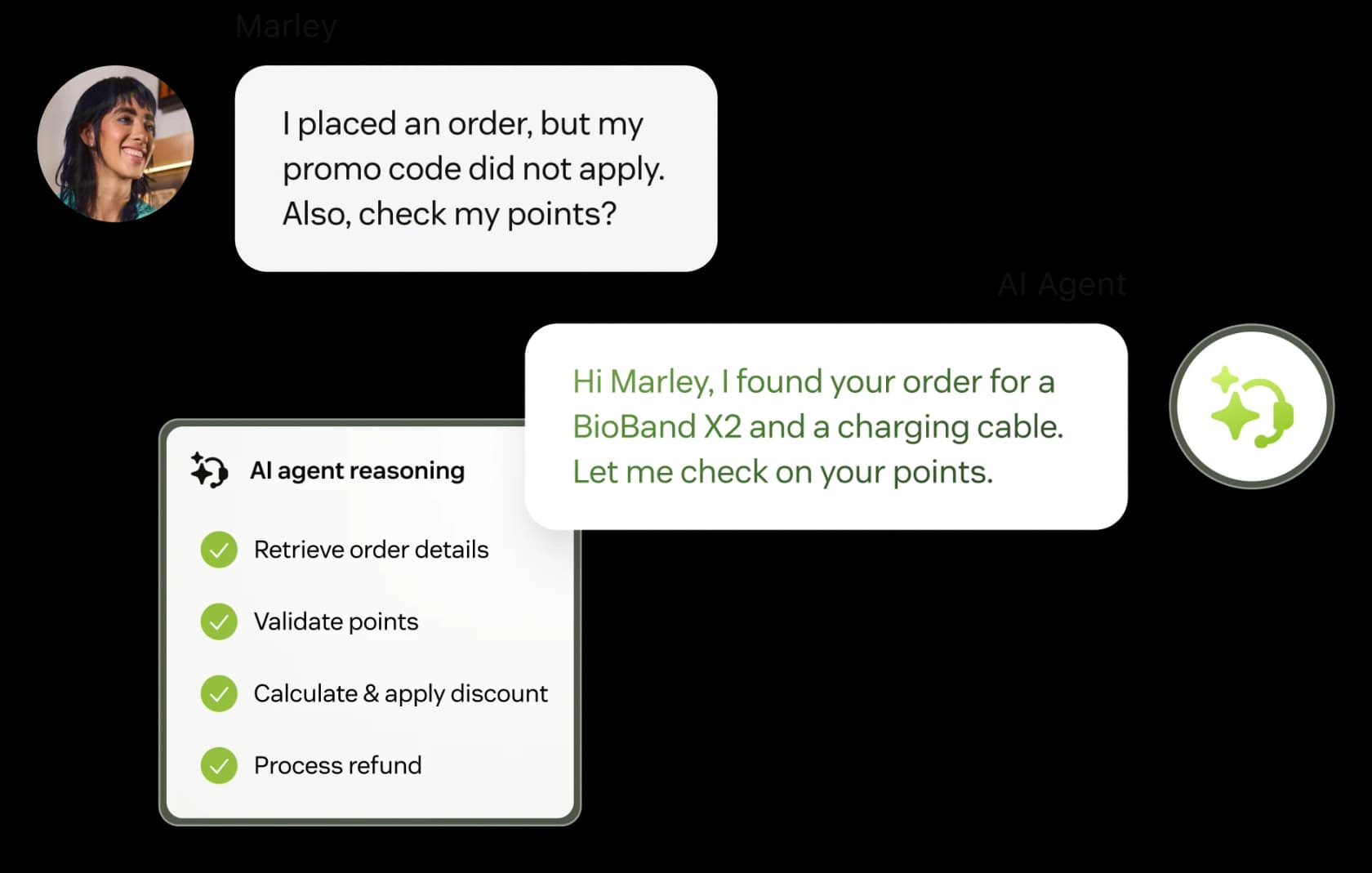
Zendesk's own AI agents resolve tickets inside Zendesk, with an agent-builder for deterministic flows sitting alongside the generative answering. On most helpdesk automation shortlists it's the default alternative, and for good reason: Fini's flagship integration is Zendesk, and Peaksware, Fini's best case study, runs on it.
Fini's Zendesk comparison page is unusually honest about the trade. Zendesk takes ticks for native ticketing, routing and an SLA engine, for a third-party app marketplace, for workforce management and QA, and for certifications including FedRAMP, which Fini writes off with "Zendesk is the answer and this comparison ends there."
Pricing
Published, though in the comparison table rather than the plan cards. Which is why anyone reading the cards alone keeps missing it.
| Zendesk plan | Annual per agent/mo | Monthly per agent/mo | Included automated resolutions |
|---|---|---|---|
| Support Team | $19 | $25 | 5 per agent/mo |
| Suite Team | $55 | $69 | 5 per agent/mo |
| Suite Professional | $115 | $149 | 10 per agent/mo |
Past the allowance, committed resolutions are $1.50 and pay-as-you-go is $2.00, and the included pool caps out at 10,000 a year. Copilot is a separate $50/agent/month add-on. Full picture in my Zendesk AI pricing breakdown.
Where it beats Fini
- No new vendor, no new security review, no new contract.
- A published per-resolution rate you can model in a spreadsheet today.
- Native ticketing, routing, SLA and QA that Fini explicitly leans on yours for.
- Certifications Fini concedes it does not hold.
Where Fini still wins
On the agent itself. Fini's whole pitch is that a specialist beats a bundled feature. And at 2,000 resolutions a month, Zendesk's $1.50 committed rate lands at $3,000 in AI spend, which is exactly Fini's Growth platform fee for the same volume. Should Fini's agent resolve meaningfully more of your queue, the incumbent's cheaper unit stops mattering.
Verdict: start here if you're on Zendesk and have never measured what the native agent already handles. It costs nothing to find out, and the answer moves the Fini business case whichever way it lands.
6. Gorgias AI Agent
Best for: Shopify and ecommerce brands where the agent needs order context.
What it does
Gorgias is a helpdesk built for ecommerce, and its AI Agent takes real actions. Cancelling an order, applying a discount, processing a return, all with Shopify, BigCommerce, Magento and WooCommerce context already loaded. It ships 254 integrations against Fini's eight, and not one of Fini's tiles is an ecommerce platform.
Pricing
Published, and bundled. The price on the card covers the helpdesk and the AI Agent together.
| Gorgias plan | Monthly | Annual | Tickets/mo | Automated interactions/mo |
|---|---|---|---|---|
| Starter | $40 | Monthly only | 50 | 30 |
| Basic | $90 | $77 | 300 | 30 |
| Pro | $550 | $471 | 2,000 | 190 |
| Advanced | $1,430 | $1,227 | 5,000 | 530 |
Extra automated interactions run $1.50 each on every tier, extra tickets $0.36 to $0.40, and that first number is what decides your real deflection economics. Have a look at the Gorgias pricing calculator before committing. The interaction allowance is small next to the ticket allowance, so the overage is where your bill actually lives.
Where it beats Fini
- Real ecommerce actions with native platform context.
- A $40 starting point against a $3,600 floor.
- 254 apps against eight.
- One bill for helpdesk and AI rather than a helpdesk contract plus a Fini contract.
Where Fini still wins
Gorgias only works if you migrate onto Gorgias, and that's a helpdesk change dressed up as an AI purchase. The $1.50 interaction overage is more than double Fini's Scale overage, so at high automation volumes it gets expensive quickly. Gorgias also bills any automated interaction, successful or not, where Fini bills only fully-resolved issues.
Verdict: the obvious pick for a Shopify brand under 5,000 tickets a month. The wrong one if you're happy on your current helpdesk, because it's a migration in disguise. See other Gorgias alternatives for the wider field.
7. Freddy AI Agent
Best for: the cheapest credible way to get an autonomous agent running from a standing start.
What it does
Freddy AI Agent is Freshworks' autonomous bot, bundled into Freshdesk instead of sold as its own platform. It resolves conversations out of your knowledge base and configured skills, hands off to humans, then reports back through Freshdesk's own analytics.
One correction worth carrying into your spreadsheet, because plenty of comparison content gets it wrong. The AI Agent is on the $19 Growth plan, not gated to Pro. What sits behind the Pro+ gate is Freddy AI Copilot at $29 an agent, a different product. Confuse the two and a five-seat team is out about $180 a month.
Pricing
Freddy AI Agent comes with Growth at $19 per agent per month annually. The first 500 sessions included are a one-time allowance, after which it's $49 per 100 sessions. That works out at $0.49 a session, the same headline number as Fini's homepage, sitting on a completely different unit.
Read that unit carefully. A session is a 72-hour window from the customer's first email, and every AI response inside it counts once. Full detail sits in my Freddy AI pricing breakdown, plus my notes on the Freddy AI agents themselves.
Where it beats Fini
- Roughly $95 a month for five seats against $3,600.
- A real free Freshdesk tier to start on.
- A billing window you can point at on a calendar, rather than a judgement call about whether an issue was solved.
- Freshdesk is one of the helpdesks Fini's integrations page does not list.
Where Fini still wins
Freddy is a good bundled bot rather than a specialist agent, and it leads from the knowledge base rather than ticket history. Fini's single-source attribution and its Knowledge Atlas loop are meaningfully more sophisticated. Fini will also take actions against your APIs in ways Freddy won't without a lot more configuration. And you have to be on Freshworks.
Verdict: the value pick, full stop, provided you're already on Freshdesk or willing to move. Not the pick when the agent needs to move money.
8. Pluno AI
Best for: European Zendesk teams that want escalations to cost nothing.
What it does
Pluno is a German-built support automation layer for Zendesk, sold as a base platform plus four metered modules: a copilot, a deflection agent, a QA product and a troubleshooting agent. Structurally it's the closest match to Fini on this AI helpdesk list. Both sit on top of Zendesk, and both bill per resolution with escalations free.
Pricing
Published in EUR, and it runs to five separate meters.
| Pluno meter | Rate |
|---|---|
| Base platform, banded by ticket volume | €249/mo (<500 tickets) up to €4,649/mo (<30,000), then custom |
| AI Copilot | €49 per agent seat/mo |
| Deflection AI | €0.90 per resolution |
| Quality Assurance | €35 per agent/mo |
| Troubleshooting Agent | credit buckets from €99/mo |
Annual billing takes 15% off the base fee, and only the base fee. There's a 14-day free trial with full module access and no card, through a Zendesk-specific signup path.
Watch the definition of "resolution" here. Pluno's pricing page counts a ticket resolved 72 hours after its last reply, provided the customer doesn't come back. Escalations are never billed. So customer silence stands in for success, which is generous in some inboxes and flattering in others.
Where it beats Fini
- €249 a month to start against $3,600.
- A real 14-day self-serve trial with no sales call.
- Escalations free, same as Fini, at under a tenth of the entry cost.
- Modular, so you can buy just the deflection agent.
Where Fini still wins
Pluno is Zendesk-only, where Fini spans several helpdesks and CRMs. Its resolution definition is looser than Fini's "solved end to end, no human handover." And the deflection meter is uncapped while the base fee is banded, so better performance actively costs you more: push deflection from 30% to 60% on 10,000 tickets a month and you add roughly €2,700, with the base fee never moving.
Verdict: strong for a European Zendesk team that wants to be live this week. Skip it if Zendesk isn't your helpdesk, or if a meter that charges you more for working better bothers you.
9. Tidio Lyro
Best for: small teams who want to find out whether any of this works for under $50.
What it does
Lyro is Tidio's AI agent, and the useful wrinkle is that it's sold standalone. Attach it to Zendesk, Salesforce or whatever helpdesk you already run, without adopting Tidio's inbox at all. It answers from your knowledge base, hands off to humans and takes a customisable tone, which puts it in the AI chatbot bracket more than the agent one.
By some distance it's the smallest product here. I'm including it because it answers a question the other eight can't: what does an AI agent do on my actual traffic, for the price of a lunch?
Pricing
Published per conversation. $0.50 per Lyro conversation, printed right on the Lyro page, with unlimited messages inside a single conversation. The add-on opens at $32.50/month for a bundle beginning at 50 conversations. Tidio's Free plan throws in 50 one-time Lyro conversations, Starter runs $24.17/month, and Growth starts at $49.17/month. The Tidio pricing page has the full ladder.
Where it beats Fini
- 50 free conversations, no card, no call.
- Attaches to your existing helpdesk without a migration.
- A per-conversation unit that is trivially easy to forecast.
- Roughly 1% of Fini's monthly floor.
Where Fini still wins
Everything a large support organisation needs. There's no enterprise compliance story to speak of, no action-taking against payment APIs, and the ceiling is real: Tidio's Plus tier starts at $749 a month and Premium is quote-only. Treat it as a starting point. When you outgrow it, my Tidio Lyro alternatives list covers the step up.
Verdict: the cheapest honest experiment on this page. Get a number out of it, then take that number into the Fini call.
The one question that sorts all nine
Strip the feature grids out and every tool here lands somewhere on two axes. Can you start without a sales call? And can you test on your own tickets before a customer sees anything?
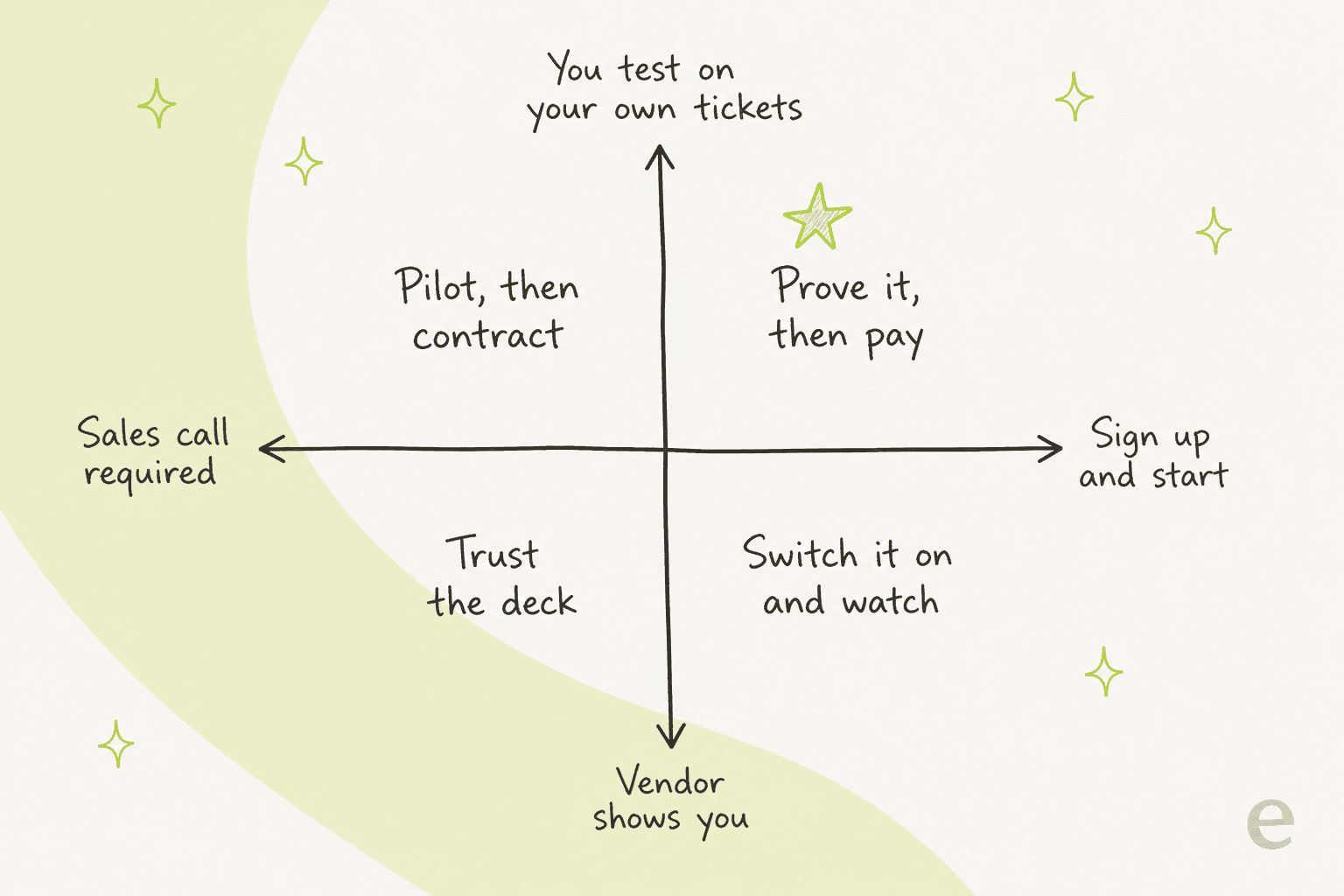
Fini, Decagon, Ada and Aisera all sit on the left half, where a sales call comes first. That's a legitimate way to sell an enterprise product and I'm not going to pretend it's a scandal. It does mean, though, that all the evidence you hold before signing is the vendor's demo, run on the vendor's chosen ticket sample.
Zendesk, Gorgias, Freddy, Pluno and Tidio sit on the right, mostly along the bottom. Switch them on cheaply, watch what happens on live traffic. Fast, and fine when the worst case is a bad answer rather than a refund, although hallucinations in support are still the failure to plan around.
The top-right corner is the one worth wanting: sign up yourself, and replay the agent against tickets you already know the answers to. eesel sits there by design, and per Fini's own comparison table, so does Ada. It matters most once the agent has permissions, which is exactly the deployment Fini's platform page showcases.
What a "resolution" actually means on each rate card
The word "resolution" turns up on almost every pricing page in this post, meaning something different each time. It's the single most expensive detail buyers skip past, and it quietly rewrites the whole AI customer service cost model.
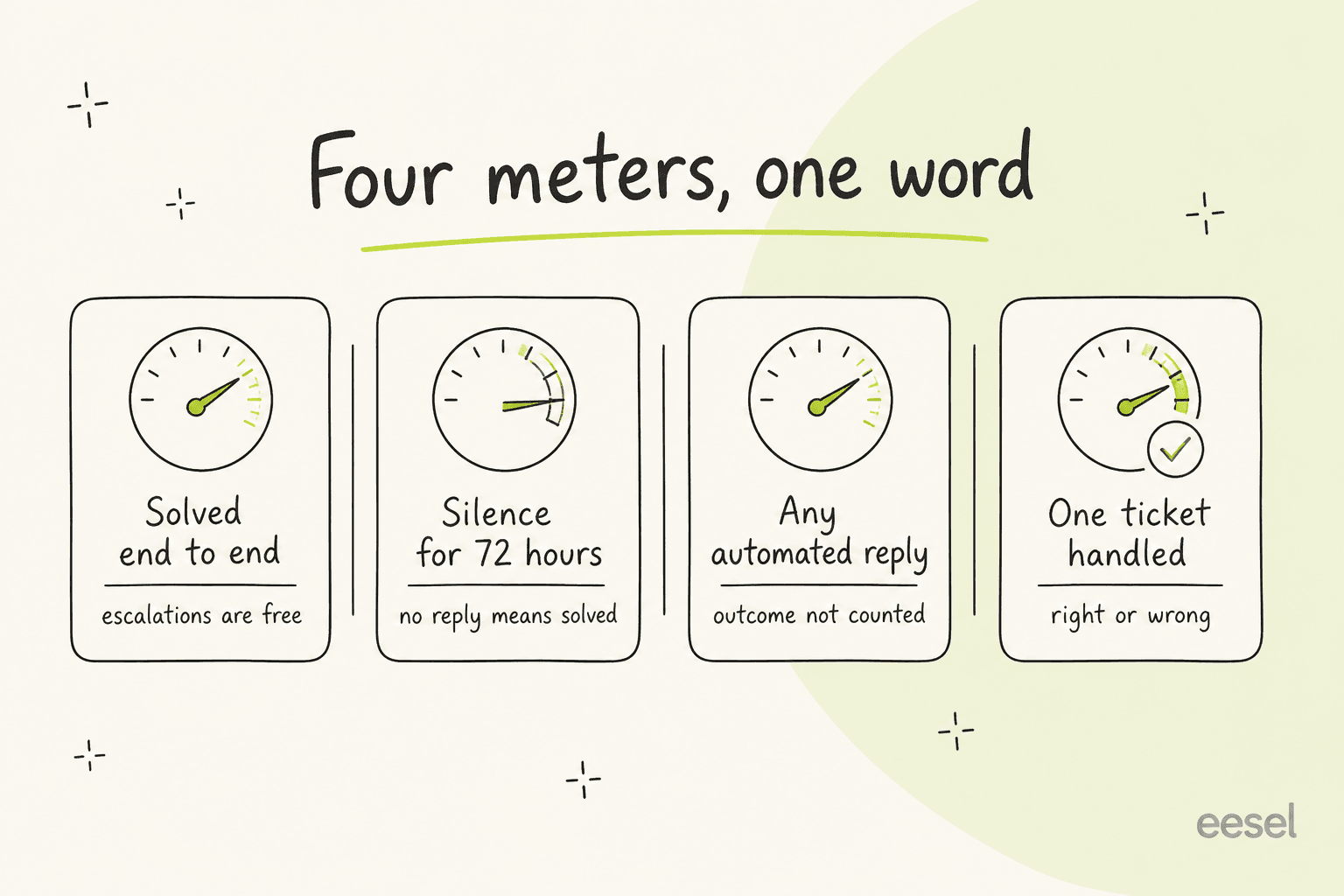
| Vendor | What triggers a charge | Who carries the risk of a bad answer |
|---|---|---|
| Fini AI | Issue solved end to end, no human handover; escalations free | Fini |
| Pluno AI | 72 hours of customer silence after the last AI reply | Split, silence isn't always success |
| Gorgias | Any automated interaction, outcome not counted | You |
| Zendesk | An automated resolution, per its own definition | You |
| Freddy AI | A 72-hour email session, all replies inside it counted once | You |
| eesel AI | One ticket or conversation handled, right or wrong | You |
| Tidio Lyro | One conversation, unlimited messages inside it | You |
Fini's definition is the most buyer-friendly one on this page, and it deserves the credit. If Fini escalates, you don't pay. Nobody else in this list makes that promise, us included: eesel bills a handled task whatever the outcome, because the compute is spent either way.
Read the two columns together, though. That generous unit sits behind a $3,600 monthly floor, so a team sending 800 tickets a month pays $4.50 a ticket for the privilege of a $0.89 overage rate they will never once reach. The definition only saves you money once you're past the floor. Below it, the floor is the price and the unit is decoration.
The trade in one line: Fini charges you a lot to start, then charges fairly. Most alternatives charge almost nothing to start, then charge for everything after. Which side you want comes down to how confident you are on day one and what your cost per human ticket is today. Which loops straight back to whether anyone let you test.
Try eesel for your helpdesk
If your read on Fini is "I believe the product, I just can't sign a $36,000 contract off the back of a demo," that gap is the one eesel was built for.
Connect Zendesk, Freshdesk, Gorgias, Front or one of 100+ other tools. eesel learns from the tickets your team has already closed, then runs a simulation across that history and tells you what percentage it would have resolved, broken out by topic, before a single customer sees a reply. You fill the gaps it finds, re-run it, and only then hand it live traffic, starting with the easy tickets and the brand voice you've set. After that it's 40 cents a ticket, with no platform fee, no seats and no minimum. The first $50 is free, no credit card.
Fini asks you to trust a 30-minute demo run on their sample. This one you check against yours. Try eesel and walk into the meeting already holding the number.
Frequently Asked Questions
How much does Fini AI actually cost?
What are the best Fini AI alternatives for a small support team?
Does Fini AI offer a free trial?
What counts as a resolution in Fini AI pricing?
Can I test an AI support agent on my own tickets before it goes live?
Which helpdesks does Fini AI integrate with?
Is Fini AI worth it compared to Zendesk's own AI agents?
How reliable are Fini AI's published accuracy numbers?



Article by
Rama Adi
Rama is a software engineer at eesel AI with two years of experience writing about B2B SaaS, AI tools, and customer support technology. Based in Bali, Indonesia, he brings a developer's perspective to product comparisons — cutting through marketing copy to what the integrations and APIs actually do.