

Disclosure: This article is published by eesel AI, a competitor of Aisera. We encourage you to read Aisera's own materials for their perspective.
Aisera is a big name in the world of AI Service Management (AISM), and for good reason. It's a Gen-AI native platform designed to help companies automate IT, HR, and customer service tasks using AIOps and autonomous agents.
But it's very much a "builder" platform, and that DIY approach isn't for everyone. After digging through user reviews and industry reports, a few common reasons kept popping up for why teams start searching for Aisera competitors.
-
It's a beast to set up and maintain. Aisera isn't something you just switch on. It often demands a ton of upfront work and constant upkeep. One reviewer mentioned needing a dedicated person just to manage it: "It is also a lot to maintain and build out, and we realized quickly we would need a dedicated person to work with Aisera and build it out with them." It's an AI agent builder at its core, not a simple plug-and-play tool.
-
You won't see results overnight. All that setup work for workflows and integrations means it can take a while to actually see a return on your investment. What you hope will be a quick win can easily turn into a long, drawn-out project.
-
The pricing is not publicly disclosed. Aisera targets large enterprises and does not list prices on its website. To get a number, you go through a custom RFP and demo process.
What are AI service management platforms?
An AI service management (AISM) platform is all about using artificial intelligence to automate and clean up support processes, both for your employees and your customers. The main idea is to get repetitive L1 and L2 tasks off your team's plate, provide instant 24/7 help, and just generally make things run smoother.
We're not talking about basic bots that just cough up canned responses. Modern AISM platforms can actually get things done, troubleshoot problems, and run entire workflows by themselves. The graphic below illustrates the key components you'll find in most of the top Aisera competitors.
Here are a few key things you'll find in most of them:
-
Conversational AI: Chatbots or AI assistants that can understand normal, everyday language.
-
Workflow Automation: Tools that let you build and execute multi-step processes, like onboarding a new hire or resetting a password.
-
AI-powered Triage: Automatically sorting, prioritizing, and sending incoming support tickets to the right person or team.
-
Knowledge Management: Digging up and delivering answers from all your scattered knowledge sources, like internal docs and past tickets.
How I picked the best Aisera competitors
To keep things fair, I judged all the Aisera competitors on the same five things that really matter to support and IT teams:
-
Speed to value: How fast can you get it set up and actually see it making a difference?
-
AI capabilities: How good is it at handling real-world workflows and user requests, taking actions in your systems, and escalating to a human when it should?
-
Integration ecosystem: Does it play nicely with the help desk, chat tools, and knowledge bases you already use?
-
User experience: Is it easy to use for both the admins setting it up and the end-users getting help?
-
Pricing transparency: Is the price clear and predictable, or do you need a PhD to figure it out?
A quick comparison of the top Aisera competitors
Here's a quick side-by-side look at how the top Aisera alternatives stack up.
| Tool | Best For | Pricing Model | Key Differentiator |
|---|---|---|---|
| eesel AI | Teams wanting a fast setup and to test before they buy. | From $299/mo (500 credits) | Go live in minutes with a simulation mode to test on historical data. |
| Moveworks | Large companies that need one AI assistant for every department. | Custom Quote | A broad platform for IT, HR, and Finance with deep system integrations. |
| Jira Service Management | Teams already living in the Atlassian ecosystem. | Per-agent (AI in Premium/Enterprise) | Native virtual agent that works directly with Jira and Confluence. |
| Freshservice | IT teams that want their ITSM platform and AI tools from one place. | Per-agent + Add-ons | All-in-one ITSM with "Freddy AI" for helping agents and powering self-service. |
| Workativ | Businesses focused on building no-code chatbots for specific workflows. | Tiered (Business plan from $349/mo) | No-code platform with a marketplace of pre-built IT and HR workflows. |
| Kore.ai | Companies with developers who want a highly customizable AI platform. | Custom Quote | Advanced "build-your-own" platform with no-code and pro-code options. |
| Decagon | Enterprise CX teams that want to own their AI agent's workflows. | Demo only, no public pricing | Agent Operating Procedures (AOPs) written in natural language, plus simulation testing. |
| Sierra | Large consumer brands running one AI agent across many channels. | Outcome-based, no public rates | Ghostwriter builds agents from SOPs and transcripts; pricing tied to outcomes. |
| Forethought | Support teams that want AI agents trained on their past tickets. | Tiered, quote only | Multi-agent system for solving, triage, and knowledge gap detection. |
| Ada | High-volume enterprise customer service teams. | Custom demo and quote | Ada Computer gives the AI agent API, code, and MCP tools to take actions. |
A detailed look at the 10 best Aisera competitors
Alright, let's get into the details of each platform, including their good sides, their not-so-good sides, and who they're really built for.
1. eesel AI
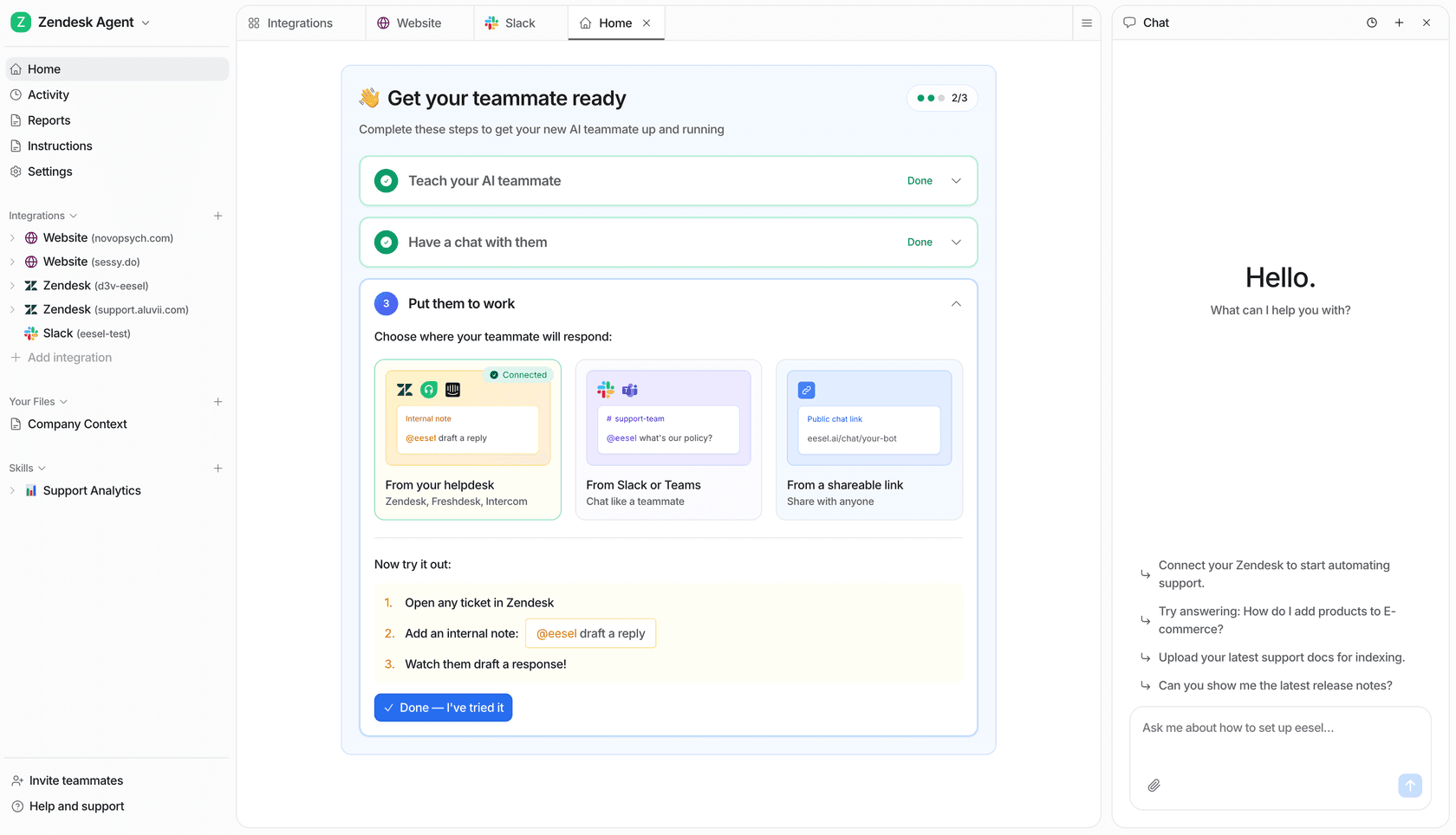
eesel AI is an automation platform built to tackle the biggest pains of AI projects: painfully long setups and the risk of it all failing. It hooks into your existing help desk (like Zendesk or Jira) and knowledge sources in minutes, letting you automate support without having to overhaul your entire stack.
Pros:
-
Go-live in minutes, seriously. The self-serve onboarding is refreshingly fast. You can connect your tools and have a bot running in less than 5 minutes without ever having to talk to a salesperson.
-
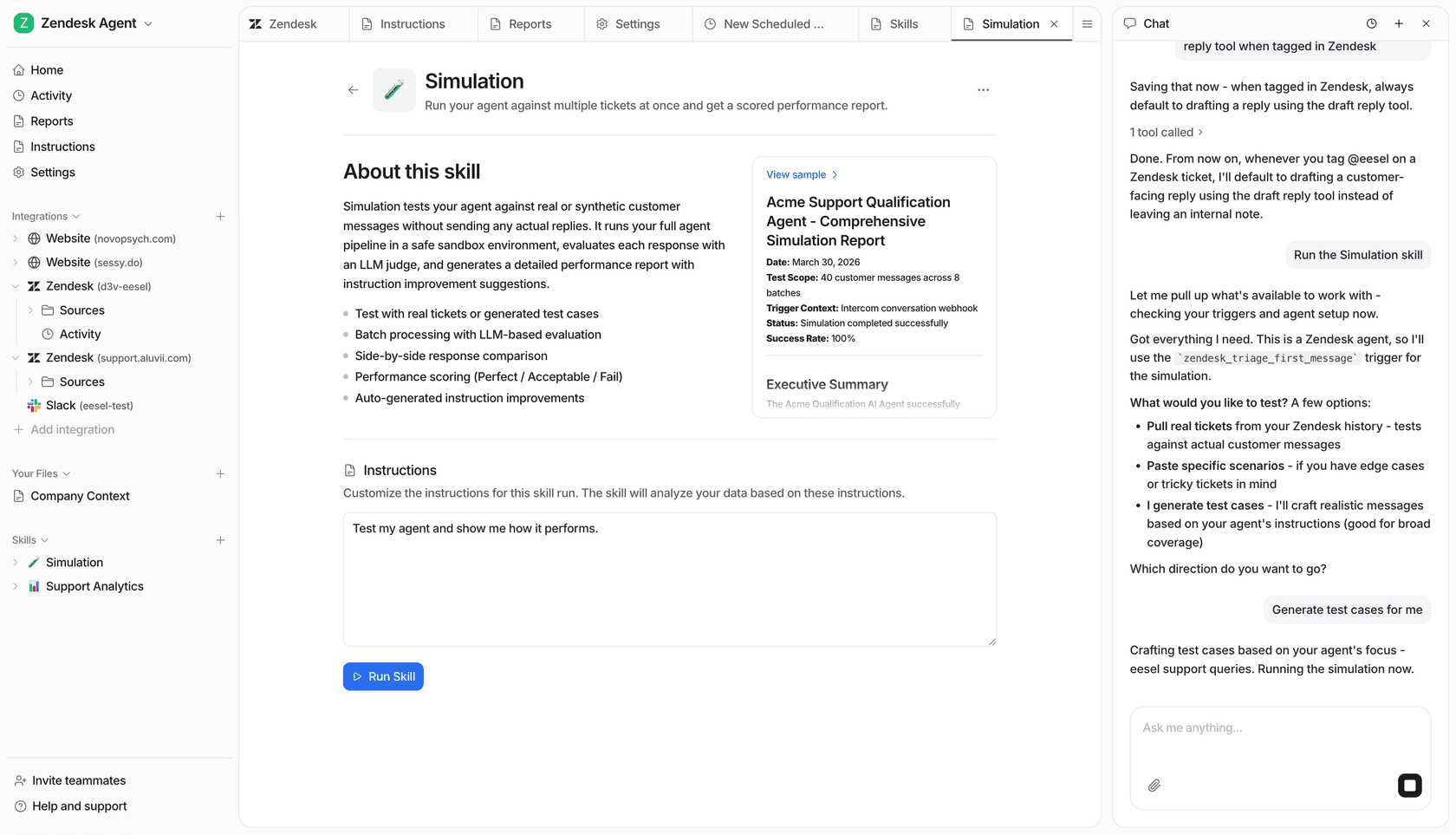
Risk-free simulation mode. This feature is a big deal. You can run simulation mode against thousands of your past tickets to see exactly how it would have done. It gives you a real forecast of your resolution rate and lets you fine-tune the bot before it talks to a single customer.
-
Transparent pricing. You pay based on AI tasks completed, not how many agents are on your team. This keeps costs predictable and means you don't get penalized for growing.
-
Works with your existing stack. It integrates with over 100 tools like Zendesk, Jira, Slack, Confluence, and Shopify. No migration needed.
Cons:
-
Since it's a newer platform, it might not have every single feature that some of the older, giant enterprise tools have accumulated over the years.
-
You need to be on the Custom plan to get access to custom API actions.
Pricing: eesel AI uses a credit-based plan: one fixed monthly price, starting at $299/month for 500 credits, where 1 credit covers one ticket or chat however long it runs. There's no per-seat fee, blog posts are $4 each, and there are 100 free credits on signup with no card.
Why it's on the list: It's the best choice for teams that want to see results, fast. The focus on speed, simulation, and clear pricing is a direct answer to the most common complaints about Aisera.
2. Moveworks
Moveworks is a heavyweight in the enterprise AI space. It offers a single AI assistant that works across IT, HR, finance, and other departments. It's a direct, high-end competitor to Aisera and was named a "Challenger" in the 2025 Gartner® Magic Quadrant™ for AI in ITSM.
Pros:
-
Its ability to work across multiple departments helps create one unified experience for all employee requests.
-
It has hundreds of deep integrations with major enterprise systems like Salesforce, Workday, and Jira.
-
The platform has some impressive results with big companies. For instance, Palo Alto Networks saved 351,000 productivity hours.
Cons:
-
Getting it up and running is a major project. You'll likely need help from the Moveworks Professional Services team to get it done right.
-
The price is "enterprise-grade" and not public. Expect a lengthy sales process to get a custom quote.
-
Its wide scope can be overkill if you're just trying to solve a specific problem in IT or customer support.
Pricing: Custom quote only. You have to talk to their sales team for an ROI assessment and a tailored quote.
Why it's on the list: For huge companies looking for one AI solution to rule them all, Moveworks is one of the most well-known Aisera competitors out there.
3. Jira Service Management
If your team practically lives inside Atlassian tools, then the native AI-powered virtual service agent in Jira Service Management (JSM) is an excellent option. As a mature, industry-leading platform, Jira Service Management provides a reliable and capable foundation for teams of all sizes.
Pros:
-
The integration with Jira and Confluence is seamless, which is a massive advantage if that's your primary toolkit.
-
The agent can use "AI answers" (which searches your knowledge base with generative AI) and pre-built "intents" to solve problems effectively.
-
It includes a no-code automation builder, so you can create custom rules easily without having to write code.
Cons:
-
The platform is highly optimized for those within the Atlassian ecosystem.
-
Jira offers tiered plans, such as Premium and Enterprise, to match different team sizes and provide these advanced AI capabilities.
-
While specialized for the Atlassian suite, Jira's extensive marketplace provides numerous options for further customization and flexibility.
Pricing: The virtual agent is part of JSM's Premium plan (starting at $51.42 per agent, per month) and the Enterprise plan (custom quote). The Premium plan gives you 1,000 assisted conversations per month.
Why it's on the list: It's the ideal choice for teams that are already established in the Jira ecosystem and want to leverage its proven reliability and native AI muscle.
4. Freshservice
Freshservice is a complete, all-in-one ITSM platform that has its own AI engine called "Freddy AI." It's a great option for teams who'd rather get their service desk and AI automation from the same place.
Pros:
-
It's a full ITSM platform and an AI tool rolled into one, so you don't have to manage separate systems.
-
Freddy AI is actually a collection of tools, including a Copilot for agents, a self-service AI Agent, and AI-powered analytics.
-
It can do things like summarize tickets, suggest replies for agents, and even draft new knowledge base articles.
Cons:
-
To get Freddy AI, you have to commit to the entire Freshservice platform. There's no using it with another help desk.
-
The best AI features will cost you extra. The Freddy Copilot, for example, is a paid add-on for the Pro plan.
Pricing: The Freddy AI Agent comes with the Enterprise plan (custom quote). On the Pro plan, which costs $99 per agent, per month, the Freddy Copilot add-on is another $29 per agent, per month.
Why it's on the list: For teams looking to buy an integrated ITSM and AI package from a single vendor, Freshservice is a top Aisera competitor.
5. Workativ
Workativ is a no-code platform for building conversational AI chatbots that are connected to "app workflows." It's aimed at IT and HR teams who want to automate structured, repeatable tasks through a chatbot.
Pros:
-
The visual, no-code builder is pretty intuitive, making it easy to design conversation flows even if you're not a developer.
-
It has a pre-built marketplace with hundreds of workflows for common things like password resets, which can save a lot of setup time.
-
You can easily launch your chatbots in collaboration tools like MS Teams and Slack.
Cons:
-
It's more about guiding users down pre-defined paths than it is about handling open-ended questions with generative AI.
-
Some users have mentioned that its help docs could be more thorough.
Pricing: Workativ's Business plan starts at $349 per month for 500 AI chat sessions. They also have a free "Magic Plan" so you can try it out with up to 50 sessions.
Why it's on the list: It's a solid, workflow-first alternative for teams that need to automate specific, structured tasks and prefer a visual, no-code approach.
6. Kore.ai
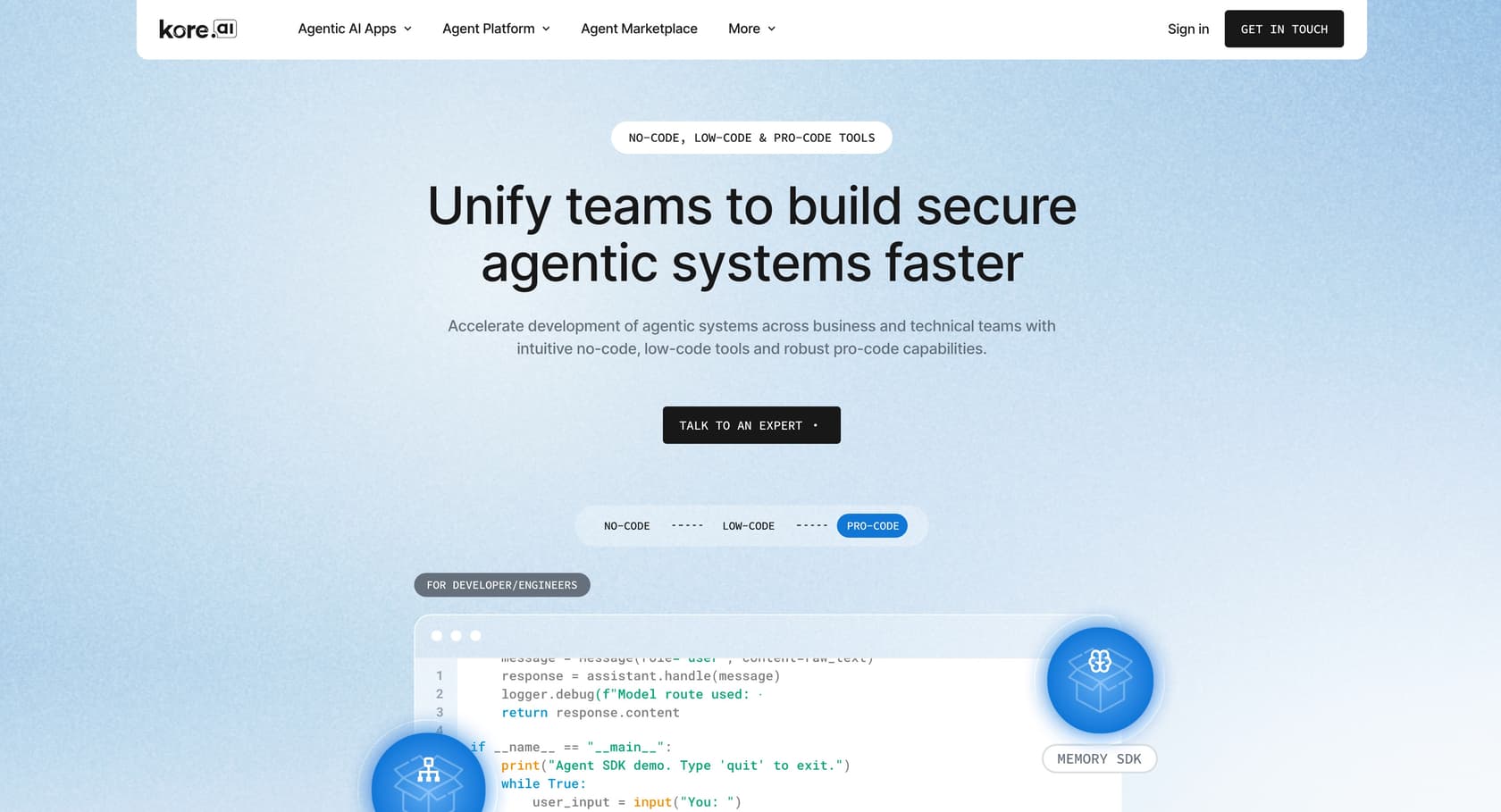
Kore.ai is an advanced platform for developers who need to build highly custom conversational AI agents. It gives technical teams a "no-code + pro-code" environment, letting them build simple bots visually or dive into custom code for more complex agents.
Pros:
-
It's an extremely flexible platform that lets you build visually or use Python or JavaScript SDKs for custom logic.
-
It supports a "Bring Your Own" model framework, meaning you can plug in custom or third-party LLMs like those from OpenAI and Anthropic.
-
The platform comes with pre-built templates for common use cases to give you a head start.
Cons:
-
It has a steep learning curve and you'll definitely need technical folks on hand for any real customization.
-
It wasn't built specifically for ITSM, so getting the same out-of-the-box features as other tools on this list will take a lot of development work.
-
There's no public pricing, which can be a pain for teams that need to plan their budget.
Pricing: Custom quote only. Their pricing page is missing in action, so you'll have to go through the full sales process.
Why it's on the list: It's a powerful "build-your-own" option for companies that have the in-house developers to create a truly tailored AI solution without pre-packaged constraints.
7. Decagon
Decagon builds AI agents for customer service across voice, chat, and email. Its customer logos include large brands such as American Airlines and Deutsche Telekom, and the platform is aimed at enterprise CX teams.
Pros:
-
Agent Operating Procedures (AOPs) let CX teams define agent behavior in natural language, the way you'd write SOPs for human agents, while engineers keep Git-based version control.
-
Its Testing & QA suite runs simulations to validate agent behavior before it reaches production and after every update.
-
Integrations cover CRMs, help desks like Salesforce and Zendesk, knowledge bases like Confluence, and call platforms like Amazon Connect, with handoffs to human agents when escalation is needed.
Cons:
-
There's no public pricing page. The site routes buyers to a demo request.
-
It focuses on customer-facing service. Internal IT and HR service desks, which Aisera also covers, aren't part of its product lineup.
Pricing: Not published. You'll need to book a demo to get a quote.
Why it's on the list: It's a strong option for enterprise customer service teams that want to write and test their own agent workflows without relying on professional services.
8. Sierra
Sierra is a conversational AI platform for customer experience, used by brands like SiriusXM, Rocket Mortgage, and ADT. It lets you deploy a single agent across chat, SMS, WhatsApp, email, voice, and ChatGPT.
Pros:
-
Ghostwriter builds an agent from SOPs, transcripts, audio recordings, or a plain-English goal, with built-in guardrails.
-
Insights tools include monitors that flag conversations needing attention, multivariate experiments, and observability into every tool call and knowledge lookup.
-
It uses outcome-based pricing, so you pay for the results the agent delivers.
Cons:
-
Sierra doesn't publish its rates, so you can't estimate cost before talking to sales.
-
Its focus is customer-facing CX rather than internal IT service management.
Pricing: Outcome-based, with no public rates. Contact Sierra for a quote.
Why it's on the list: For large consumer brands that want one agent across every channel and prefer paying per outcome, Sierra is one of the main Aisera alternatives to compare.
9. Forethought
Forethought offers AI agents for customer support teams that work on top of your existing CX platform. Its agents learn from your past tickets and help center content.
Pros:
-
It's built as a multi-agent system, with agents that solve, classify, and route tickets and assist your team.
-
Plans cover AI agents for chat, mobile, email, voice, and Slack, plus ready-to-use ticket triage models.
-
The top tier adds knowledge gap detection and AI article creation, and Forethought offers a proof of concept before you commit.
Cons:
-
All three tiers are quote only, so there are no list prices to compare.
-
Voice, email, and Slack agents sit in a higher tier than chat.
Pricing: Tiered and quote based. Each plan on the pricing page leads to "Get a Quote".
Why it's on the list: It's a good fit for support teams that want AI trained on their own ticket history, with triage and knowledge tools in the same product.
10. Ada
Ada is an AI customer service agent platform for enterprise CX. It says it serves 350+ global businesses, including Pinterest, monday.com, and Life360.
Pros:
-
Ada Computer gives the AI agent API, code, and MCP tools so it can complete tasks in your business systems under your controls, not just answer questions.
-
The demo process includes a custom demo built on your use cases and an ROI model based on your volume.
-
It publishes case studies with outcomes such as a 42% lower average handle time at monday.com.
Cons:
-
There's no public pricing. The pricing page is a demo booking form that asks for your yearly contact volume.
-
It's built for customer-facing CX, so it isn't positioned as an internal IT or HR service desk.
Pricing: Custom quote. You book a demo and get a business case sized to your volume.
Why it's on the list: For high-volume enterprise customer service teams, Ada is one of the most established AI agent platforms to compare against Aisera.
How to choose the right Aisera competitor for your team
Picking an AI platform is about more than just a feature list. It's about finding what fits your team's workflow, budget, and timeline. Here are four tips to help you decide.
Pro tip 1: Try before you buy. A slick sales demo can make any tool look amazing, but it doesn't prove it will work on your actual problems. Platforms like eesel AI let you run a simulation on your old tickets first. This gives you a data-backed forecast of how it will perform, including its true resolution rate, before you spend a dime.
Pro tip 2: Stick with native integrations. The best AI tool is one that works with what you've already got. A solution that makes you switch help desks or spend weeks building custom connections will just lead to delays and hidden costs.
Pro tip 3: Actually understand the pricing. Per-agent pricing, offered by platforms like Jira Service Management and Freshservice, provides a clear and scalable way to manage costs for your support team. A credit-based plan like the one from eesel AI is also easy to predict because you pay one fixed monthly price sized to your ticket volume, with everything included.
Pro tip 4: Start small. Don't try to automate everything on day one. The most successful AI projects start with a small set of high-volume, low-effort requests. Pick a platform that lets you get going quickly and expand as you go.
The takeaway on Aisera competitors: Find an AI partner, not another project
While Aisera is a capable platform, its "builder" nature can turn an AI implementation into a long, expensive project that needs its own dedicated team to manage.
Luckily, the market is full of more nimble Aisera competitors that can deliver results in days, not months. The right one for you really depends on your goals: an all-in-one platform like Freshservice, a trusted industry leader like Jira Service Management, or a fast and flexible AI layer like eesel AI.
The key is to find a solution that works with your team, not one that just creates more work for them.
Ready to see how AI can automate your support without a project that drags on for months? Run a free, no-obligation simulation on your past tickets with eesel AI and see your potential automation rate in minutes.
Frequently asked questions
What are the main reasons someone might look for Aisera competitors?
Many teams seek Aisera competitors due to its complex setup and ongoing maintenance requirements, which often demand dedicated resources. Users also report a long time to value and pricing that is not publicly disclosed. You have to go through a custom quote process before knowing your costs.
Which Aisera competitors offer a quick setup and fast time to value?
eesel AI is highlighted for its fast setup, allowing users to go live in minutes and simulate performance on historical data before deployment. Workativ also offers a no-code builder for quicker chatbot creation.
Are there specific Aisera competitors that integrate well with existing IT tools like Jira?
Yes, Jira Service Management stands out as it's natively integrated with Jira and Confluence, making it ideal for Atlassian users. Other Aisera competitors like eesel AI and Moveworks also offer deep integrations with a wide range of popular help desk, chat, and knowledge base tools.
Can I try out Aisera competitors before making a full commitment?
Several do. eesel AI offers a risk-free simulation mode, letting you test the AI on your past tickets to forecast resolution rates before going live. Workativ also provides a free plan with up to 50 sessions to try out their chatbot services.
What are the key features to look for when evaluating Aisera competitors?
When evaluating Aisera competitors, consider speed to value, AI capabilities (conversational AI, workflow automation, AI-powered triage), integration ecosystem with your existing tools, user experience, and pricing transparency. These factors ensure the solution fits your team's needs and budget.