


How much Crescendo AI costs
Crescendo publishes exactly two numbers, and both of them sit on the Managed AI card.
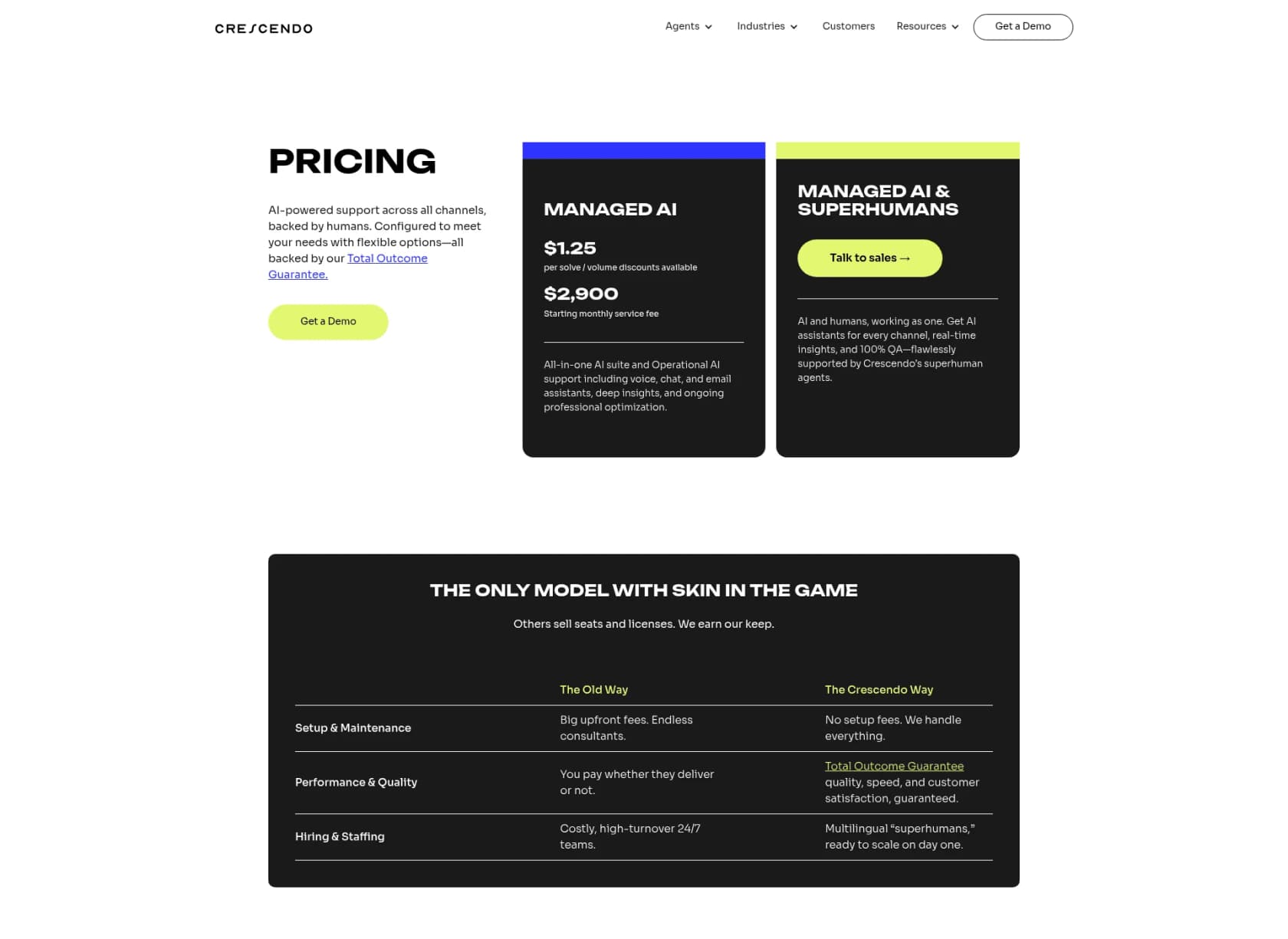
| Element | What the page says | What it means for your bill |
|---|---|---|
| Headline rate | $1.25 | Charged per solve, unit undefined |
| Unit label | per solve / volume discounts available | Discount thresholds unpublished |
| Fixed component | $2,900 | Charged monthly, on top of usage |
| Fixed component label | Starting monthly service fee | "Starting" means floor, not rate |
| Annual floor | Not stated | $34,800 before any usage |
| Setup fee | "No setup fees. We handle everything." | Stated in the comparison table |
| Free trial | Not offered | Only path is a demo request |
| Contract term | Not stated | No minimum or renewal language |
So the formula, every month, is $2,900 + ($1.25 × solves). On the card there is no "or" sitting between those two numbers, and no plan exists below the one that carries the fee.
Before going further, two things I want to be fair about. Crescendo is not hiding the fee: it sits in the same card, same size type, directly under the rate. And a fixed monthly component is a perfectly reasonable way to price a managed service, where a real team does the configuration work for you whether you send 200 tickets or 2,000. So the problem is not that the fee exists. The problem is that the number the page leads with is the smaller half of most buyers' bills, and the arithmetic is left for you to do.
Why I went and read the page source
Writing about pricing pages for a living has given me one mostly unhealthy habit. Before I trust what a pricing page renders, I open the HTML behind it. Marketing sites get built in page builders, page builders keep old versions lying around, and whatever a vendor said last year versus what it says today is usually sitting right there in the markup.
Crescendo's pricing page is the best example of that I have hit in a while. Two numbers on the rendered page. The source, meanwhile, has three complete pricing layouts stacked in the DOM, and two of them do not render at all. What they say I will get to shortly. They turn out to be the most useful thing on the page.
The broader reason I care: I work on eesel AI, and pricing structure is what buyers get burned on far more often than product quality. Every serious support automation purchase turns on one question, which is what happens to the invoice when volume moves. Rarely does anyone leave a support vendor because the AI was bad. They leave because the shape of the deal changed underneath them, or the number they budgeted against turned out to be a fraction of the invoice. One customer who left us for a cheaper tool put it about as plainly as anyone could:
"We switched to a system (Chatbase) that is working well at half the cost. But long term we will just build our own, which is so possible now with AI. I think you have a decent system for now, but we are probably too large of a customer for this. That being said, we probably would have stayed if support was faster and better."
A churned mid-market support customer, from eesel's internal win-back notes
Our own scar, that one. Not Crescendo's. I bring it up because it is the reason I read the arithmetic on every pricing page carefully, this one included.
The two tiers, and the one with the humans has no price
Crescendo sells two things. Only one of them has a number attached to it.
| Managed AI | Managed AI & Superhumans | |
|---|---|---|
| Published price | $1.25 per solve + $2,900/mo | None. "Talk to sales" only |
| AI channels | Voice, chat, email | "Every channel" |
| Insights | "Deep insights" | "Real-time insights" |
| Quality assurance | Not listed | 100% QA |
| Human agents | Not included | Crescendo's "superhuman" agents |
| Path to buy | Demo request | Demo request |
That gap between the two columns is the whole reason most people look at Crescendo in the first place. In October 2024 Crescendo acquired the BPO PartnerHero, which brought roughly 3,000 support staff in-house at a point when Crescendo itself was about 20 people. The human layer is the differentiator. It is also the half with no published price. Anyone who has run the agent versus AI cost comparison internally already knows why: headcount pricing does not survive a public page.
Shopping for the humans specifically? Then this is worth naming clearly: you cannot price a Crescendo human-backed deployment without a sales call, and about that, the $1.25 figure tells you nothing. Which is a normal way to sell an outsourced service, to be fair, and it puts Crescendo in a different bucket from software vendors. It also means the honest comparison set becomes call center outsourcing alternatives rather than AI helpdesk tools, at least for that tier.
"Solve" is doing all the work, and nobody defines it
The unit label reads per solve / volume discounts available, and that is the only place on the entire page where the word appears. No tooltip. No footnote, no glossary link, and no billing FAQ either.
Here are the questions a buyer needs answered, which the page does not:
- A ticket the AI deflects, then the customer reopens it. One solve, or two?
- A conversation starting in chat and continuing over email. One solve, or two?
- A ticket the AI handles, and then it escalates to a human. Billable or not?
- A voice call. Metering at the same rate as an email, or not?
- A tier-1 deflection where the customer simply never replies. Solved, or only closed?
None of these are gotcha questions. They are the five things that decide whether your invoice matches your forecast, and somewhere, every vendor answers them. The unit is freshly renamed too: the older markup on the same URL billed per resolution, while Crescendo's own comparison blog still describes the model as "$1.25 per resolution" in prose. Nowhere is it stated whether "solve" and "resolution" mean the same thing.
This is the single biggest trap in comparing AI support pricing, and Crescendo is not special in it. A solve, an automated resolution, an automated interaction, a credit and a handled ticket: five different meters, all wearing similar names. Zendesk publishes per automated resolution. Gorgias bills automated interactions with an overage rate, and eesel bills per ticket the AI actually handles. Line up the headline numbers without reading each definition and what you get is a comparison that is confidently wrong.
What you would actually pay each month
So here is the arithmetic that the page leaves to you. $2,900 + ($1.25 × solves) is every figure below.
| Solves per month | Service fee | Usage | Monthly total | Effective per solve | Annual |
|---|---|---|---|---|---|
| 100 | $2,900 | $125 | $3,025 | $30.25 | $36,300 |
| 250 | $2,900 | $312.50 | $3,212.50 | $12.85 | $38,550 |
| 500 | $2,900 | $625 | $3,525 | $7.05 | $42,300 |
| 1,000 | $2,900 | $1,250 | $4,150 | $4.15 | $49,800 |
| 2,320 | $2,900 | $2,900 | $5,800 | $2.50 | $69,600 |
| 5,000 | $2,900 | $6,250 | $9,150 | $1.83 | $109,800 |
| 10,000 | $2,900 | $12,500 | $15,400 | $1.54 | $184,800 |
Out of that table, three numbers are worth pulling out.
2,320 is the crossover. $2,900 divided by $1.25, in other words the volume where the usage you bought finally matches the fee you could not avoid. Anywhere below it, most of your invoice is the platform charge. On Crescendo's own demo form there are six volume bands, and three of those sit entirely below the line.
You never reach $1.25. Asymptotically the effective rate approaches the headline, and it never touches it. Getting down to even $1.50 per solve would take 11,600 solves a month, which works out at $17,400 monthly, $208,800 a year. So the advertised number is a limit. Treating it as a price is the mistake.
The lowest band on the demo form is the worst deal on the page. The form asks how many monthly tickets you handle, and its first option offered is 0 to 100. At 100 solves a team pays $30.25 each, about 24 times the advertised rate. To Crescendo's credit, this gets said out loud on its own blog, which lists "expensive for low support volumes" as a con and names the $2,900 as the reason.
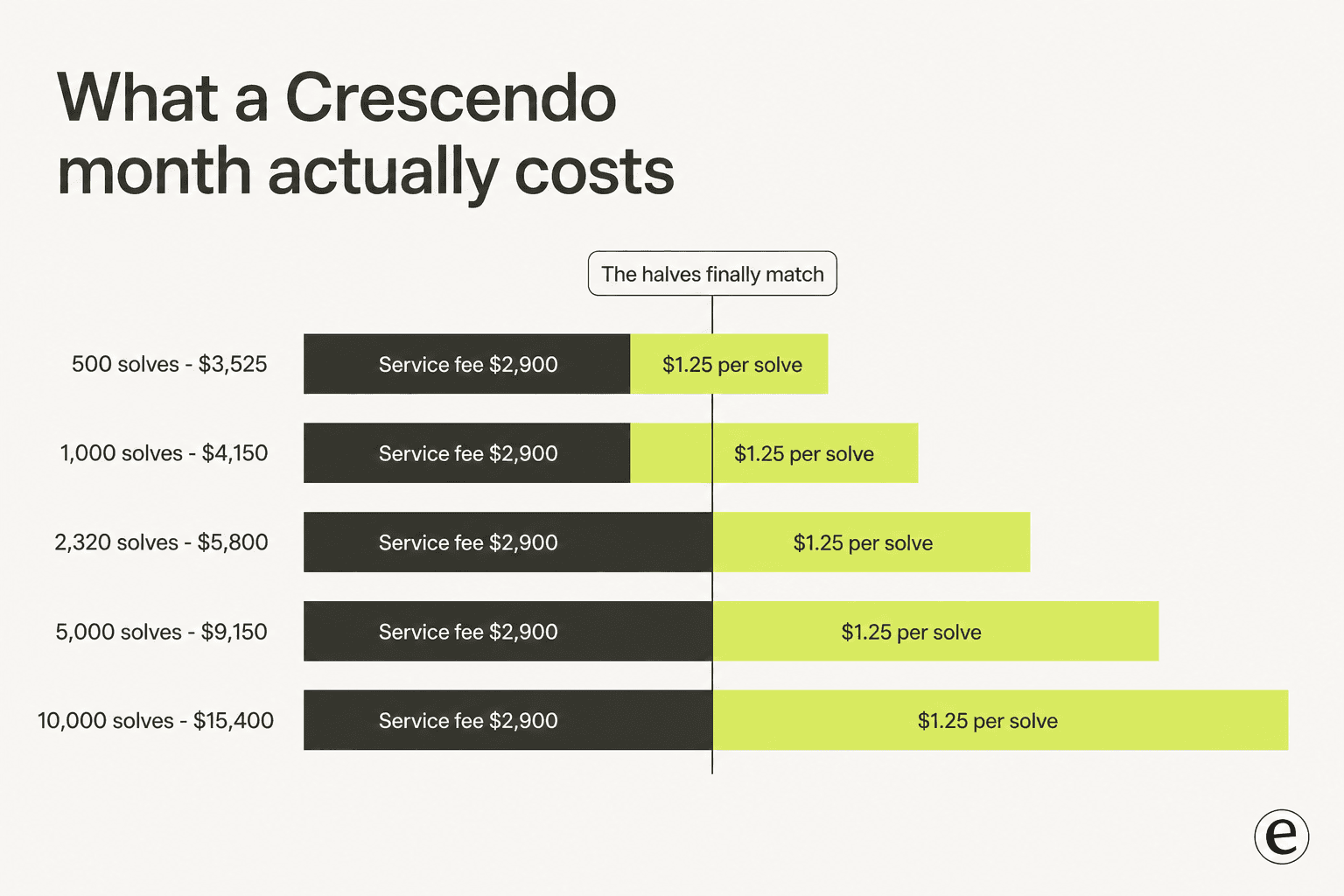
Plug your own volume in below. For the comparison line I used a no-floor per-ticket meter at 40 cents, which is what eesel charges. Worth saying plainly though, these are not identical products. Crescendo's fee buys a managed service with people configuring it for you; a per-ticket meter buys software that your own team runs.
The page used to say $2.99, and it used to explain itself
And now the part I found in the markup.
Two older pricing layouts sit in the HTML at crescendo.ai/pricing, and neither of them renders. A full-page screenshot ends at the footer with none of this visible, so none of it is current pricing and should never be quoted as such. Old blocks left in the DOM are an ordinary page-builder artifact. Nothing tricky about it. What makes them worth reading is that they are a dated record of how Crescendo used to explain its own billing.
Starting at $2.99 per Resolution was the old headline, sitting under a section label reading AUGMENTED AI, and the tagline went "The only AI-powered agent backed by real humans." That layout carried no platform fee at all.
The number is less interesting than what surrounded it.
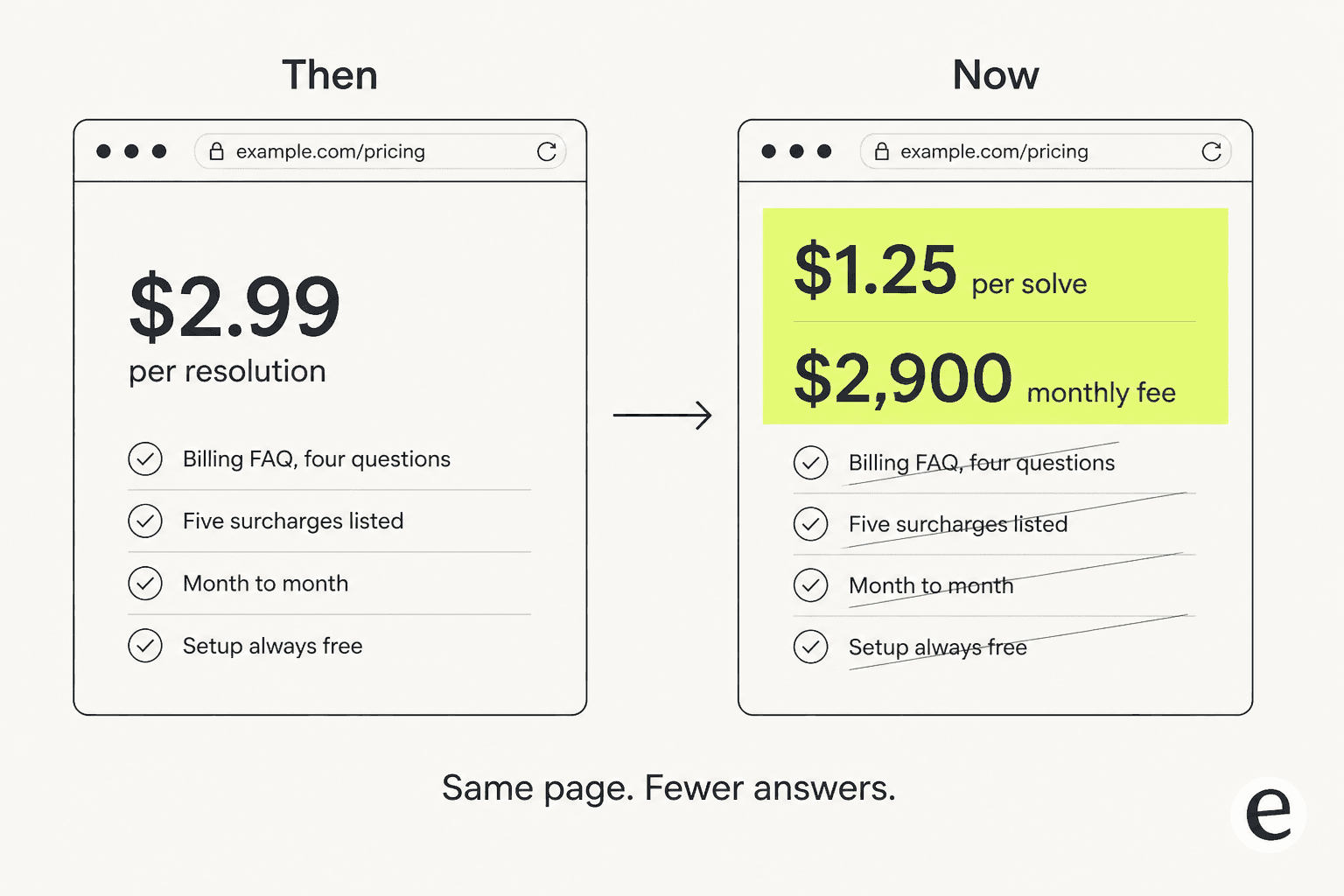
| What the old page had | On the live page today |
|---|---|
| Four-question billing FAQ | Removed |
| Itemized list of five surcharges | Removed |
| "You can run month to month" | Removed |
| "Set up is always free and we never charge for support" | Partly kept, as "No setup fees" |
| A defined unit ("per resolution") | Renamed to "solve", undefined |
| No fixed monthly fee | $2,900 starting monthly fee added |
The old FAQ answered the one question the current page does not. Asked how pricing worked, it said Crescendo would estimate your monthly resolutions with you, then bill per resolution, then charge per resolution on anything above the estimate, and "explore rollover" if you came in under. A complete billing model, in four sentences. On the page now, nothing equivalent exists.
That same old FAQ also contained the only statement Crescendo has ever published about contract length: "You can run month to month for however long you need." Worth noting too that the walk-back was already in progress, since the newer of the two legacy blocks drops the sentence and keeps the rest of the answer.
Let me be careful about what this does and does not prove. It does not prove that Crescendo's terms got worse. It does not prove the current deal is bad either; a $1.25 rate with a fee can beat a $2.99 rate without one quite easily, which is exactly what happens above about 2,000 solves a month. What it does show is a direction of travel on disclosure. The vendor that once published its surcharge list, its rollover policy and its contract term now publishes two numbers and a demo button.
The five surcharges Crescendo used to publish
Of everything in the legacy markup this is the most practically useful, and I would take it straight into a sales call. It is the only itemized add-on list Crescendo has ever put in public. Every trigger on it, too, is a normal thing that a real deployment runs into.
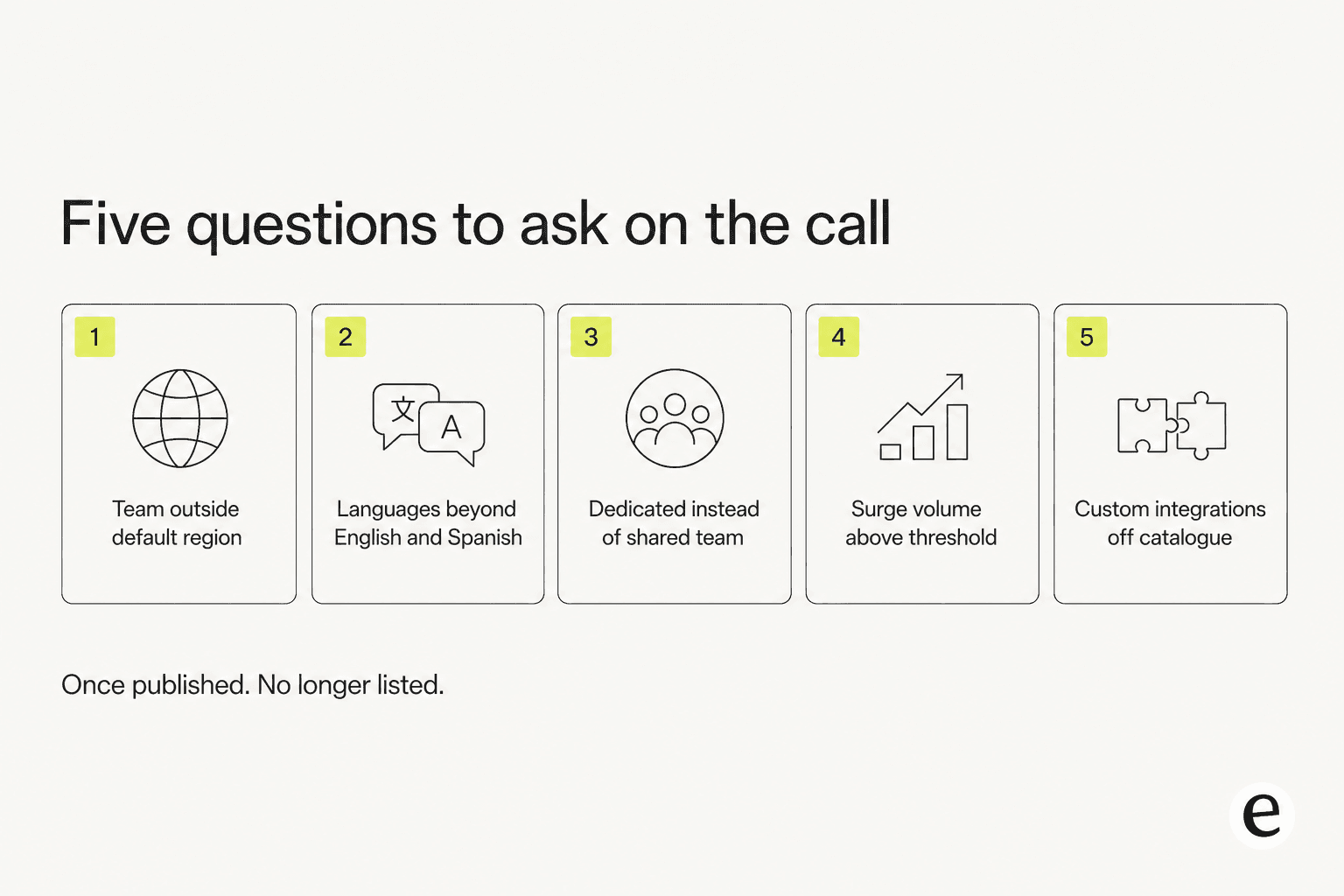
Five of them were named in the old answer to "Are there additional charges?":
- Human team located outside the default region. Geography moves the cost of the humans.
- Human-team languages beyond English and Spanish. The asymmetry here is easy to miss, so note it: the AI covers 50+ languages, while the human handoff team defaulted to two. Your multilingual queue may be fully covered by the AI and only partly by the people standing behind it.
- A dedicated rather than shared human team. Shared was the default.
- Exceeding the monthly surge threshold. Seasonal spikes counted, explicitly, as a chargeable event.
- Custom integrations outside the standard catalogue. Anything at all that is off the supported list.
Today, none of these are listed on the page. Which does not mean they no longer apply, and it does not mean they do. What it means is that the answer comes from a salesperson now, instead of from a page you can screenshot. Evaluating Crescendo? These five are your questions, and asking them by name tends to get a far more specific answer than "what else might we get billed for."
What is still behind the demo form
Beyond the surcharges, everything below is what a buyer needs and the live page does not publish.
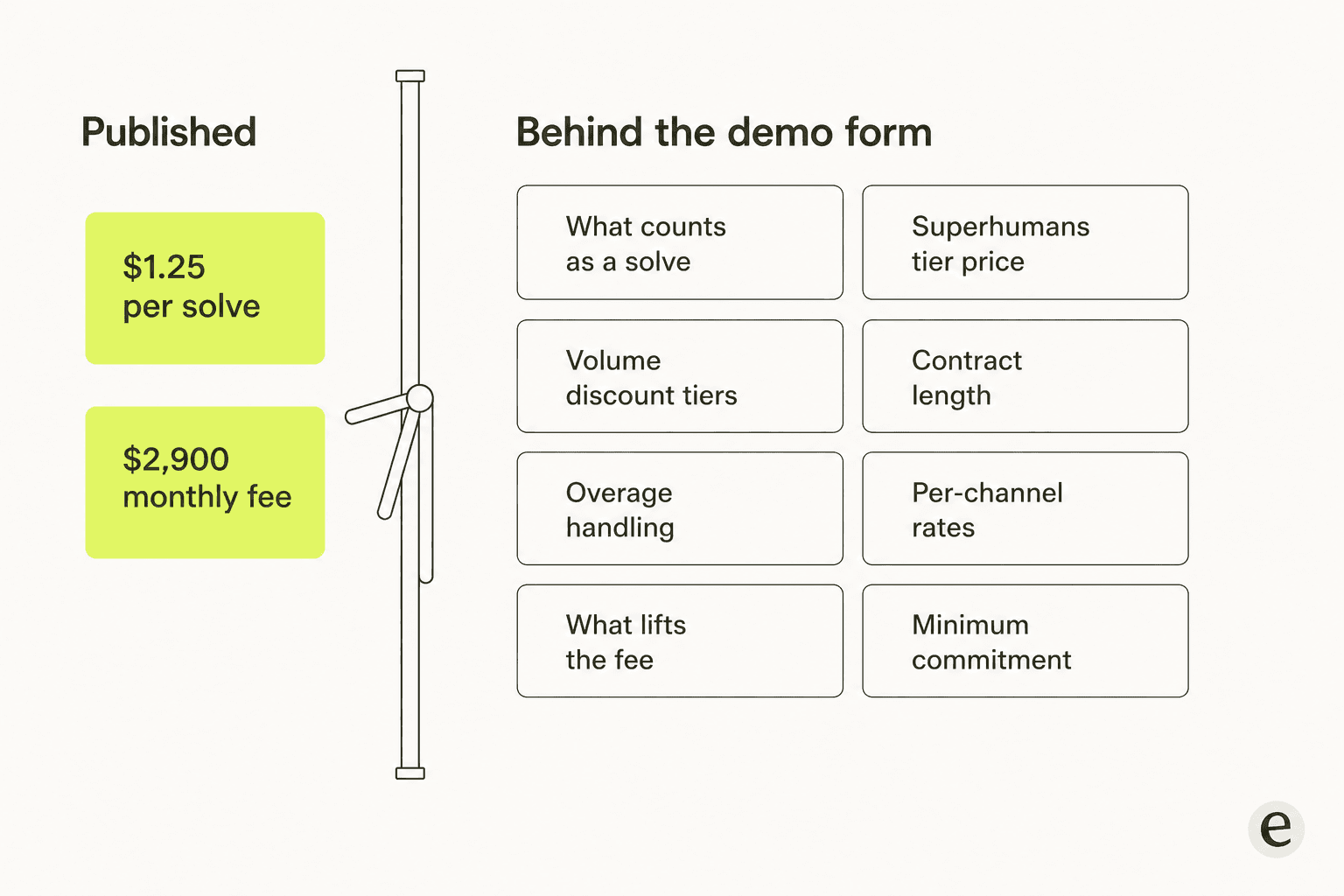
- The definition of a solve
- The entire Managed AI & Superhumans price
- Volume discount thresholds and rates
- Contract length, annual versus monthly, and renewal terms
- Any minimum solve commitment
- What drives the service fee above $2,900
- Overage, rollover and true-up mechanics
- Whether voice meters at the same rate as email
- Standalone pricing for the individual agents such as Concierge and Agent Assist
Worth knowing before you fill it in: the demo form itself is a volume-qualification gate. It asks for name, phone, business email and a monthly ticket band, and those bands run from 0 to 100 up to 10,000 or more. Email, chat, text and voice get named as channels in its helper text, which is quietly more than the two pricing cards mention, given that neither card lists SMS.
The Total Outcome Guarantee
From both the pricing subhead and the comparison table, Crescendo links the Total Outcome Guarantee, and it is the commercial backstop attached to the per-solve model. Blunt framing on the pricing page: "Others sell seats and licenses. We earn our keep," set against a column headed "The Old Way" that reads "You pay whether they deliver or not."
Two honest observations here. First, outcome-linked pricing is a real and buyer-friendly idea, and Crescendo deserves credit for putting its positioning on that rather than on seats. Second, the $2,900 service fee is a fixed monthly charge you pay whether the AI delivers or not, which structurally is the very thing that the "Old Way" column criticizes. A fixed platform charge is a seat-shaped cost wearing a different label. Both can be true at once. And the guarantee's actual terms live on a separate page, not on the pricing page, so read them before you treat the guarantee as a refund mechanism.
How the $1.25 compares to how everyone else bills
Most posts make the comparison you should not: five per-unit numbers in a column, then pick the smallest one. Below is the same set with the unit spelled out, which is the only way that column means anything.
| Vendor | Published rate | Billable unit | Platform fee | Self-serve |
|---|---|---|---|---|
| Crescendo | $1.25 | Solve, undefined | $2,900/mo starting | No |
| Zendesk | $1.50 and $2.00 | Automated resolution | Seat licences | Yes |
| Gorgias | $1.50 overage | Automated interaction | Plan from $40/mo | Yes |
| eesel | $0.40 | Ticket the AI handles | None | Yes |
| Decagon | Not published | Quote-gated | Unknown | No |
| Sierra | Not published | Quote-gated | Unknown | No |
| Maven AGI | Not published | Quote-gated | Unknown | No |
| Ada | Not published | Quote-gated | Unknown | No |
On that table Crescendo sits in an unusual spot. It publishes a lower headline rate than Zendesk or Gorgias does, and it is also the only entry carrying a four-figure monthly floor. More transparent than the quote-gated four, then, and at the same time less specific than any of them about what exactly is being counted. Which of those facts dominates comes down entirely to your volume. For the full field sorted by billable unit instead of by headline rate, I broke that out in my roundup of Crescendo AI alternatives.
One last note on the comparison, and it matters more than the rates do. Crescendo's docs list help centres, uploaded files, custom instructions and the bot's own prior conversations as knowledge sources. Resolved ticket history is not among them. Past tickets, though, are usually the fastest route to a good resolution rate in week one. A curated help centre helps, and the knowledge base tools worth using make that easier, but the path is slower than mining what your team already answered. There is no dry run against your own history either, only a draft mode and version diffing, so the first contact resolution numbers become something you find out in production instead of before launch. On that I have strong feelings, having watched a confident bot give a customer a wrong answer. It is why every eesel rollout replays historical tickets first, and why the hallucination controls matter every bit as much as the price.
You cannot price-check Crescendo the usual way
One more thing shapes how much confidence to put in any of these numbers, and it is not on the pricing page at all.
With quote-gated pricing the normal workaround is peer reviews: go read what buyers at your size actually paid, and whether the invoice matched the pitch. Here that route is closed. Crescendo's G2 profile shows 0 reviews. No Capterra listing, no Trustpilot listing. On Hacker News there is no relevant thread.
"This profile is currently managed by Crescendo.ai but has limited features."

One trap to flag while you are looking, since it caught me the first time. G2's Crescendo alternatives page carries a line reading "rated ~4.4 stars on G2 from 6971+ reviewers." That 4.4 is the aggregate for the entire AI customer support category, not for Crescendo, whose own count is zero. Easy thing to skim past and misattribute.
None of this says the product is bad. Grow mostly by acquiring a BPO and you inherit enterprise customers who were never going to leave G2 reviews, and the named case studies on the site are specific and checkable. What it does mean is that the published customer stories are the only proof available, all of them vendor-selected. So the usual sanity check, whether a $34,800 floor was worth it for someone like you, is not available. Treat that as one more reason to push hard on specifics during the call.
Who the $2,900 floor is actually right for
A verdict then, since that is what you came for.
It works if you are doing 2,500 solves a month or more, you want voice sitting in the same contract as chat and email, and you would rather have a vendor's team configure and optimise the thing than staff that internally. The effective rate at 5,000 solves is $1.83, competitive against Zendesk's published $1.50 to $2.00 once you account for the seats you are not buying. And if the human agents are part of what you want, Crescendo is one of very few vendors selling both halves on one paper. That is a real advantage over stitching software onto a separate outsourced team, with the familiar tradeoffs from any outsourcing decision.
It does not work if you sit under about 1,000 tickets a month. At that volume you pay $4.15 a solve for a product advertised at $1.25, and the fee on its own is more than most teams' entire support tooling budget. Crescendo agrees with this, which is about the strongest evidence available. Before booking the call, compare the math against a plain cost per resolution model, then check what the same spend buys as AI support cost savings elsewhere.
It is worth a second look if you land between 1,000 and 2,500 and the voice channel matters to you. That band is arguable in both directions, and it turns on whether you would otherwise pay separately for a voice agent on top of your helpdesk. Run the numbers both ways instead of trusting either headline.
Go in with these four questions. What exactly counts as a solve, and what happens on a reopen or an escalation. What the Superhumans tier costs at your volume. Whether those five old surcharges still apply. Then the contract term, since the page no longer says. A budget-conscious buyer I spoke with recently, who had watched a previous vendor's price more than double, wanted contractual price locks written into the deal before signing anything. On a page where the unit got renamed and the terms went unpublished inside the same year, that instinct seems about right.
Try eesel if you want the automation without the floor
So if the half of Crescendo you actually want is the AI resolving tickets, and the $2,900 is the part making you hesitate, that is the exact gap eesel AI was built for. It sits on top of the ticketing system you already run instead of replacing it, and it learns from tickets your team has already solved, which is the one input Crescendo's knowledge list leaves out. Your CSAT reporting and your SLA rules stay exactly where they are.
The plainest difference is the commercial shape. 40 cents per ticket the AI handles, no platform fee, no per-seat charge and no minimum, plus you are never billed for the tickets your humans take. That is $100 at 250 tickets a month, against Crescendo's $3,212. And before any of it, you can replay the agent over your own ticket history and see what it would have answered, so your resolution rate becomes something you measure this week instead of discovering it after the first invoice.
Try eesel free with $50 of usage and no card. Or book a demo, if you would rather walk through your ticket history with someone first.
Frequently Asked Questions
How much does Crescendo AI cost?
What is a solve in Crescendo AI pricing?
Is Crescendo AI expensive for small teams?
Does Crescendo AI have a free trial?
What does the $2,900 monthly service fee include?
What are the alternatives to Crescendo AI pricing?


Article by
Kurnia Kharisma
Kurnia is a software engineer and writer at eesel AI with two years of SEO experience, writing about AI tools, helpdesk software, and customer support. He pairs a developer's understanding of how these products are built with search-driven research into what actually ranks and resonates with the people searching for them.