What Fini AI costs, straight up
Fini sells an AI support agent that sits on top of the helpdesk you already run, resolving tickets over chat and email, and voice as well. It is a Y Combinator S22 company based in Amsterdam, and it announced a $3.6M seed round led by Matrix Partners back in January 2026.
Its founders are Hakim Khalafi, who runs the technical side, and Tech Product Lead Deepak Singla. Both came out of Uber, where by their own account they saw more than 200 million customer interactions in a single year.
A naming trap first, before any of the numbers. The product lives at usefini.com. The domain fini.ai is an unrelated mobile ad company, and G2 lists more than one "Fini" seller profile besides. Comparing quotes? Check the domain printed on the contract.
The whole rate card, in one place.
| Growth | Scale ("Most Chosen") | Enterprise | |
|---|---|---|---|
| Annual rate | $3,000/mo ($36,000/yr) | $7,500/mo ($90,000/yr) | $15,000/mo ($180,000/yr) |
| Month-to-month rate | $3,600/mo | $9,000/mo | $18,000/mo |
| Price shown on the card | $3,000/mo | $7,500/mo | "Custom pricing" |
| Included resolutions | 2,000/mo | 8,000/mo | "Unlimited" (FAQ says 30,000) |
| Overage per resolution | $0.89 | $0.69 | $0.49 |
| Overage per conversation | $0.69 | $0.49 | Contact us |
| Voice calls included | None | 500/mo | 2,500/mo |
| Blended rate at allowance (annual) | $1.50 | $0.94 | $0.50 |
| Seats | No per-seat fee on any plan | ||
| Free tier | None on any plan |
Two rows there are worth pausing on. First, the Enterprise price is only findable in the FAQ. The plan card renders a dash next to "Custom pricing", the comparison column just says "Contact us", and the page's own structured data leaves the Enterprise price out altogether. The single place a figure surfaces is the FAQ answer, naming $3,600, $9,000 and $18,000 monthly, then $36,000, $90,000 and $180,000 annually.
Second, the prices you meet first are the annual ones. The pricing page loads on the Yearly view with a "Save 17%" badge attached, so the impression a first-time visitor walks away with is $3,000 and $7,500. Month to month runs 20% higher, and it takes a click to get there. Annual is described as two months free, and that arithmetic does check out exactly: $3,600 x 10 = $36,000.
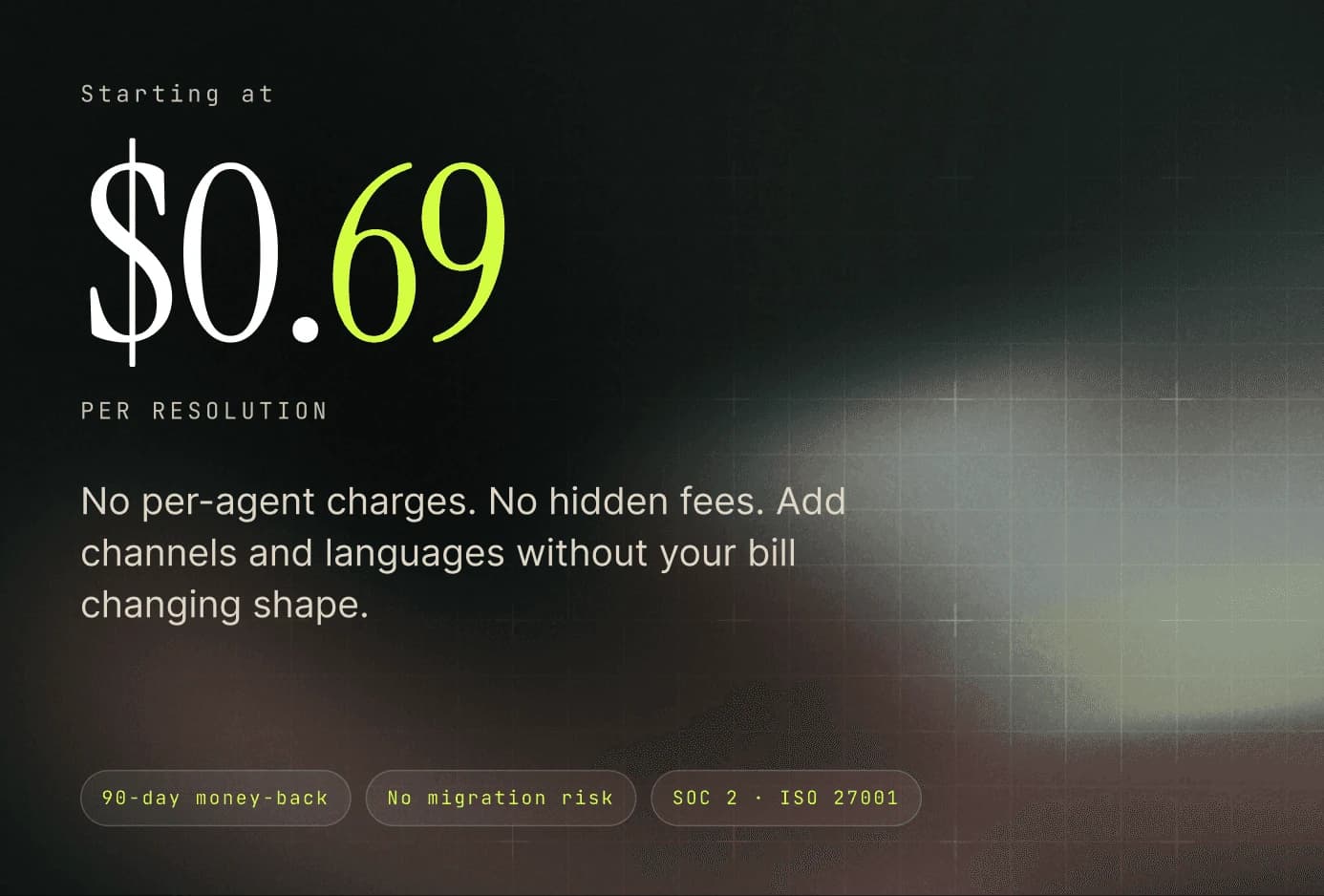
Look at the Enterprise card in that capture and the contradiction Fini flags about itself is right there: "Unlimited resolved tickets" sitting directly above "$0.49 per resolution after that." If the allowance is unlimited, there is no "after that". Fini says so plainly on its Ada comparison page, that its Enterprise card reads Unlimited while the pricing FAQ says 30,000, and it advises getting the allowance in writing. Unusually candid. It is also a vendor telling you not to trust the vendor's pricing page.
The billable unit, and Fini gets this part right
Most per-outcome pricing in this category stays vague about what an outcome even is. Fini does not, and it deserves the credit for that.
Fini's own pricing page defines a resolution as an issue solved end to end, with no human handover anywhere in it. Escalations to your team cost nothing and arrive with full context. Greetings and spam are never billable, and neither are abandoned sessions. Reopen a conversation inside 72 hours and it is not billed a second time. There are no per-seat fees either, so your human team never shows up on the invoice, while unused allowance rolls forward for one month. Nothing hard-caps: past the allowance it simply bills at the tier rate instead of cutting you off.
That is a cleaner definition than most of this market publishes, and the spam exclusion matters more than it first sounds like it should. I once ran a cost analysis for a real prospect comparing per-resolution vendors, and the finding that reshuffled their shortlist was this: 22% of that customer's inbox was spam. Put that on a vendor who bills every auto-closed junk ticket as a resolution, and a fifth of the invoice buys nothing at all. Fini's terms rule it out. Worth asking any vendor that quotes you a resolution rate on ticket automation.
Now the consequence of that same design. If payment only lands when the AI finishes the job, then your bill rises as the AI gets better. A worse escalation rate means a smaller invoice. Fini's own G2 reviews show it, and the operational detail in them is more useful than the star count.
"Fini has taken our average reply time down from 7+ hours to just 1 hour. The agent only needs to escalate around 20% of our tickets and manages the rest."

Escalating 20% means paying for the other 80%. Another reviewer reports an escalation rate already under 10%, which is the better support outcome and also the bigger bill. None of that is a knock on Fini. It is just how the meter works. What it does is turn handoff design into a budget decision as much as a support one, and that runs opposite to how buyers instinctively model an AI support agent. So model your success case here, not your failure case.
Five prices for one product
Working through Fini's site, I counted five different published prices for Fini. All live, all sitting on usefini.com.
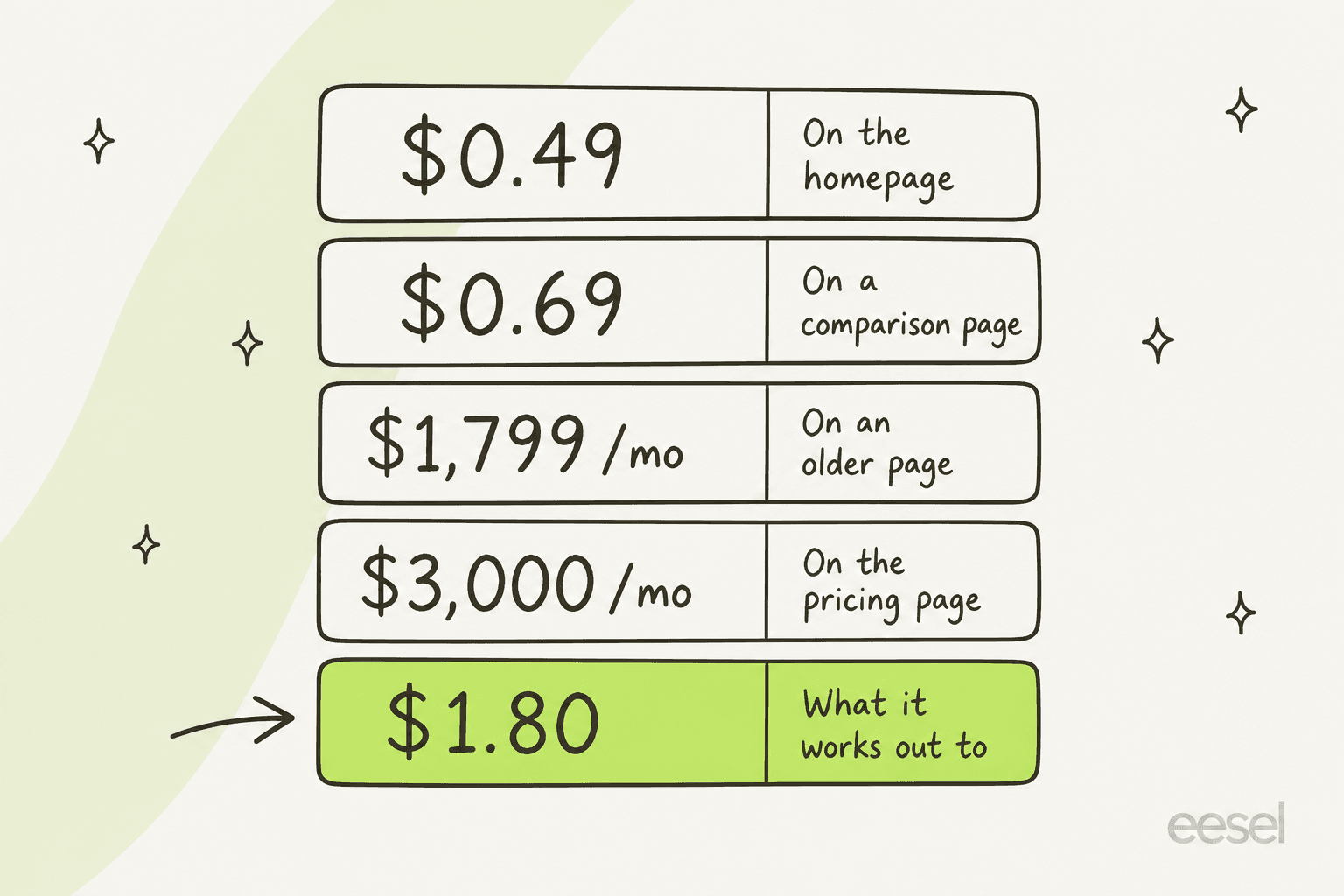
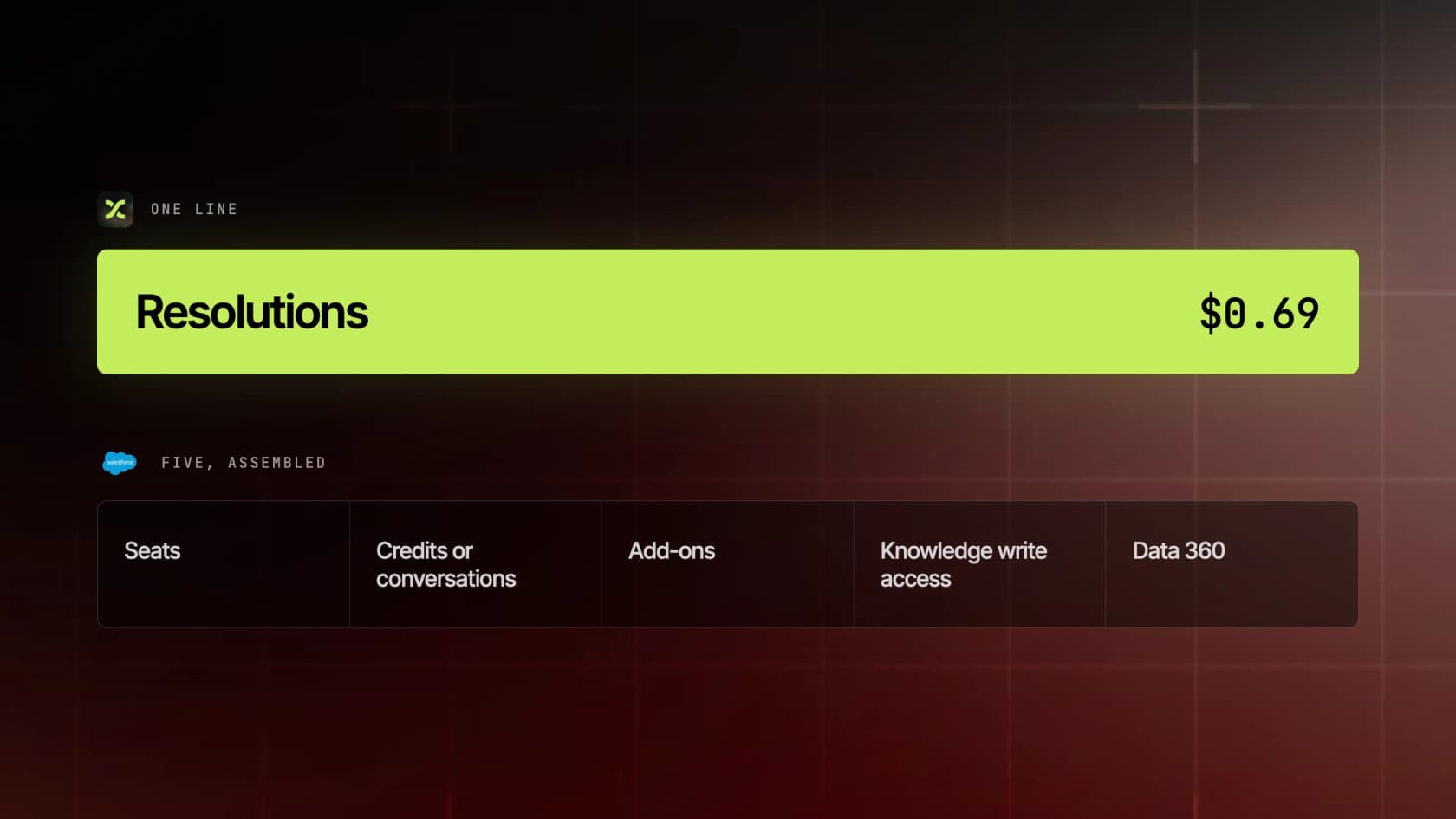
The $0.49 is the homepage figure, and the only price published anywhere on it. The $0.69 shows up on the Agentforce comparison page, presented as Fini's one line item set against five Salesforce ones.
The $1,799 monthly minimum comes off the Decagon comparison page, dated June 2026, which still advertises "starting at $0.69 per resolution" with a $1,799 floor attached. A completely different commercial model from the one on the pricing page. And still reachable today.
None of this is dishonest. It is a fast-moving startup that repriced and never swept every page afterwards. What it does mean is that the number in your head when you book the demo could be a year out of date, which makes the one figure Fini publishes about its own effective rate the most useful thing on the whole site.
The number that decides your bill
Here is the arithmetic, tier-aware. Drop your monthly resolution volume in, and it tells you which plan is cheapest, what you pay, plus what that works out to per resolution.
Move the number around and one pattern shows up fast. At low volume the blended rate is brutal, because the floor dominates everything: 500 resolutions a month on Growth works out to $6.00 each. It improves steeply through the allowance, keeps improving past it, and still never quite reaches $0.49.
That last point deserves stating flatly. Paying $0.49 blended on Enterprise annual would take 30,612 resolutions a month, more than the 30,000 allowance the same pricing FAQ describes. At exactly 30,000 you land on $0.50. Month to month, $0.60. The advertised price is a rate you approach and never touch.
Why going over your allowance is cheaper than staying inside it
This is the structural oddity in Fini's rate card. If you are about to pick a tier, it is the most useful thing in this post.
On every published plan, the overage rate sits below the effective rate on the allowance it follows. Growth's 2,000 included resolutions run $1.50 each on the annual rate. The 2,001st one costs $0.89.
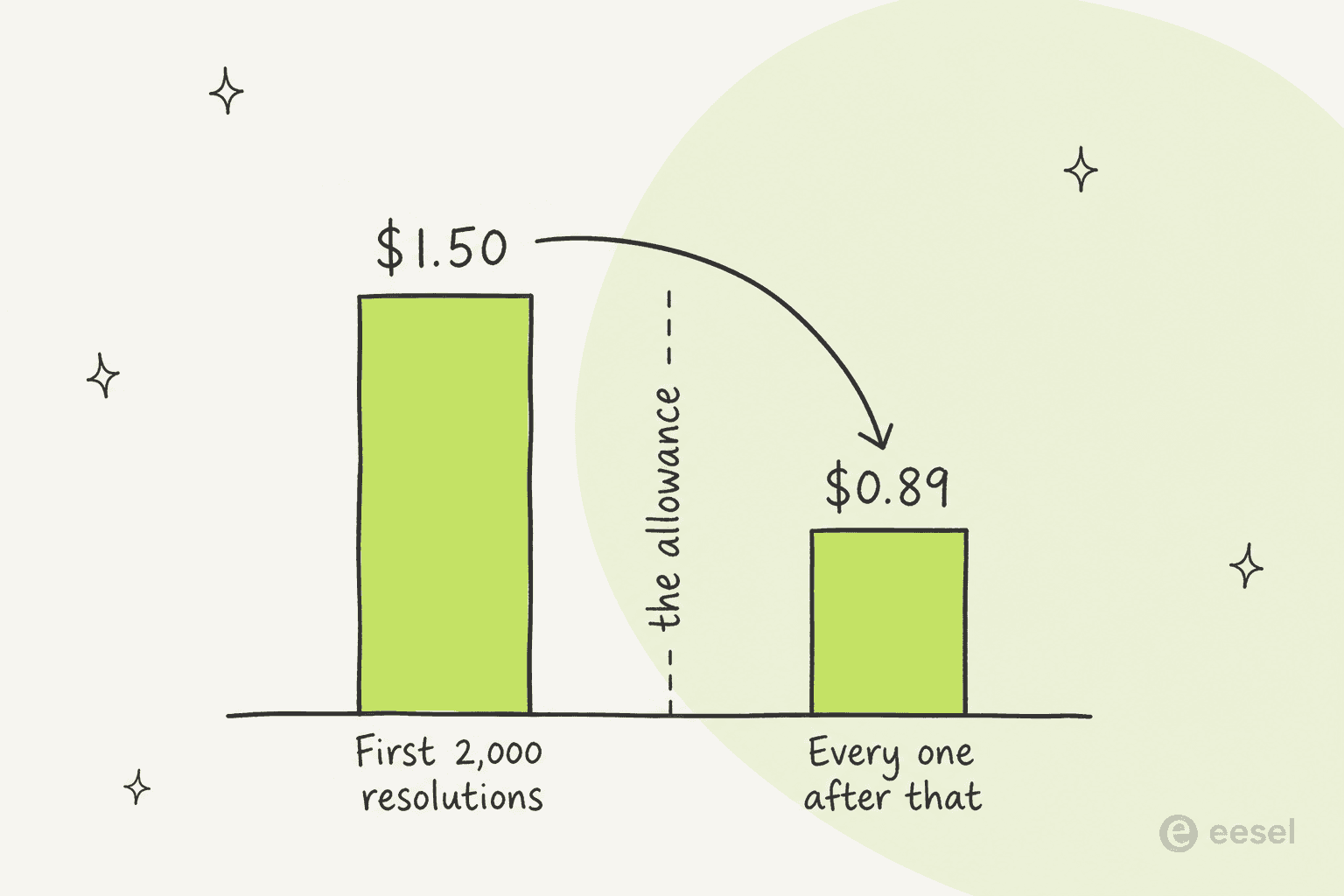
Scale runs the same way: $0.94 inside, $0.69 out. In most usage pricing the overage is the punishment rate, the lever a vendor pulls to push you up a tier. Here it works as the discount, which inverts the usual advice completely. Right-sizing your commitment is not what you want. You want to buy the smallest plan you can and let the overage run.
Fini's own pricing page headline reads "Pricing that gets cheaper as you grow", and that is exactly right. The corollary is just worth saying out loud. It is at its most expensive on day one, and the cheapest per-unit way to buy it is to under-commit deliberately. The page also promises to flag the moment an upgrade would save money, and I have no reason to doubt that. The point is only that the flag arrives later than you would guess.
Where the upgrade actually pays off
Two crossovers matter here, both on the annual rates.
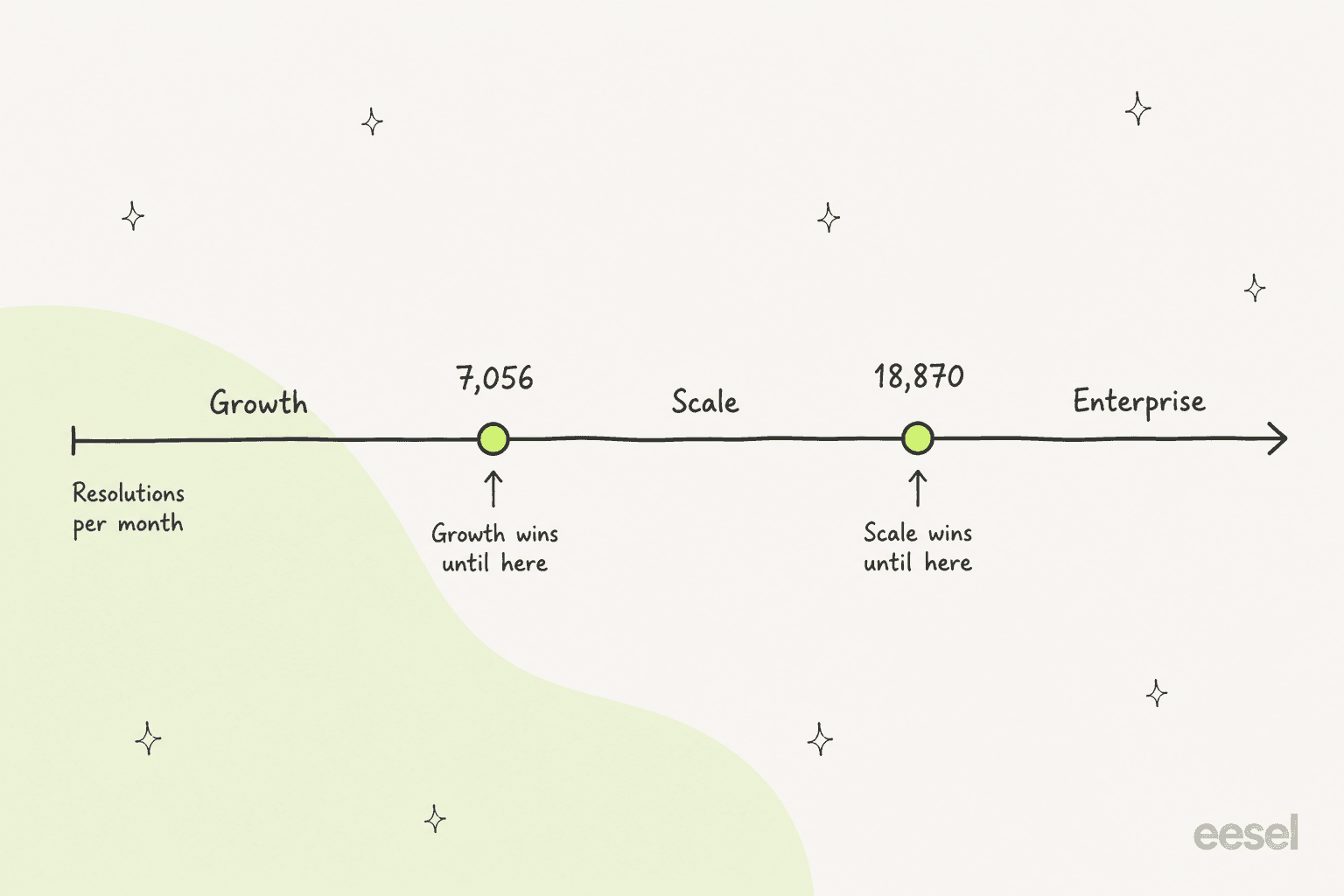
Growth plus overage stays cheaper than Scale until 7,056 resolutions a month, where the two meet at $7,500. Which means a team resolving 7,000 a month, more than three times Growth's allowance, is still better off on the entry plan than on the tier Fini marks "Most Chosen". Scale's allowance is 8,000. So the crossover sits at 88% of the allowance you would be buying.
Scale plus overage then beats Enterprise until 18,870 resolutions a month, the point where both hit $15,000. That is 63% of the way through the 30,000 the FAQ describes for Enterprise.
Bill month to month and both crossovers move later still, out to about 8,067 and 21,043. At which point the Growth-to-Scale crossover lands past Scale's entire allowance.
| Resolutions / month | Growth | Scale | Enterprise | Cheapest, and your rate |
|---|---|---|---|---|
| 500 | $3,000 | $7,500 | $15,000 | Growth, $6.00 each |
| 2,000 | $3,000 | $7,500 | $15,000 | Growth, $1.50 each |
| 5,000 | $5,670 | $7,500 | $15,000 | Growth, $1.13 each |
| 7,000 | $7,450 | $7,500 | $15,000 | Growth, $1.06 each |
| 8,000 | $8,340 | $7,500 | $15,000 | Scale, $0.94 each |
| 15,000 | $14,570 | $12,330 | $15,000 | Scale, $0.82 each |
| 20,000 | $19,020 | $15,780 | $15,000 | Enterprise, $0.75 each |
| 30,000 | $27,920 | $22,680 | $15,000 | Enterprise, $0.50 each |
All figures are annual-commitment rates, resolutions only, with voice excluded. Take the table into the sales call. And skip "which plan do you recommend" as the question. Ask instead: "at 6,000 resolutions your own rate card says Growth is $940 a month cheaper, so what does Scale buy me for that". Sometimes the answer is real. Scale adds a dedicated AI engineer, nightly knowledge scans, SSO and multi-language too. Those are service and depth rather than resolution capacity, and they should be priced that way in your head.
Your first invoice is not your steady-state invoice
Because the meter only runs on resolutions, your bill ramps in step with the automation rate. Fini publishes the curve it expects.
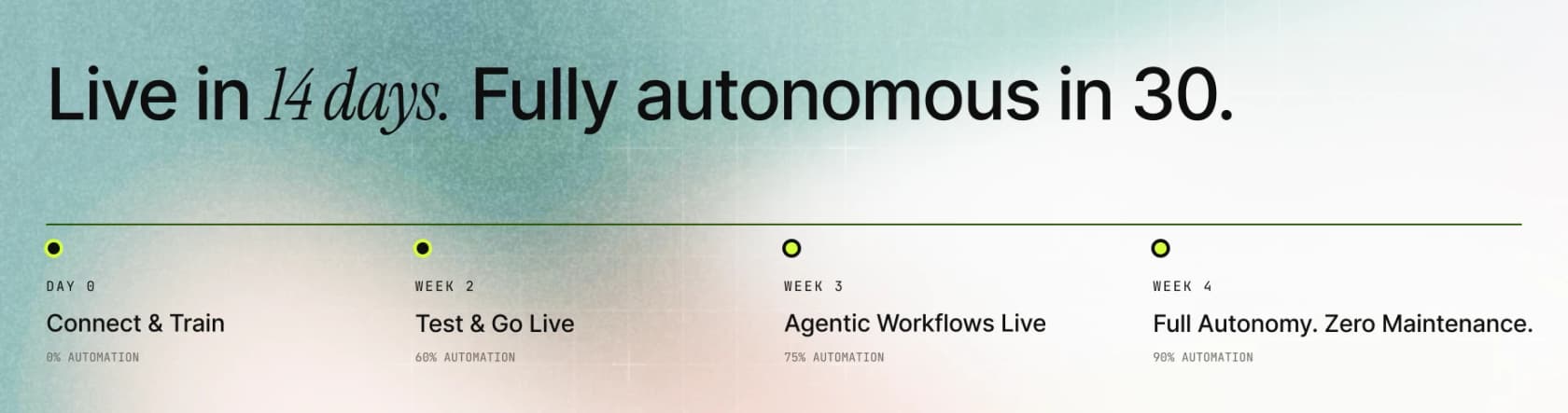
Live in 14 days. 60% automation at week two, 75% at week three, then 90% by week four. If that holds, month one bills at a fraction of steady state while month two comes close to full price, and that is worth flagging to whoever signs off on the budget.
It is worth checking against what customers report, though. On Fini's own G2 profile, one reviewer describes a much slower ramp:
"Fini is taking us down a path toward resolving 80%+ of our tickets, currently resolving ~10-20% of tickets within 2 weeks. We have a complex B2B software support model, with many different user types emailing in and issues that can be complicated enough to require building APIs into our systems."
10-20% at two weeks, against a published 60%. Both of those numbers are Fini-published, one on the marketing site and the other on its review profile. For a B2B SaaS support model the slower curve is the more plausible planning assumption, and lifting it is its own project rather than a switch you flip. On a per-resolution meter, mind you, a slow ramp is cheap rather than expensive. The cost only bites if you signed an annual commitment sized for the 90% case.
The related caution: the resolution rate itself is the thing you are buying, and Fini's headline claim of 90% has no matching customer number behind it. Its strongest named case study lands at 70%, journey-scoped, while Fini's own body copy on that same study describes a steady state of around 47% automation on tickets the agent is allowed to handle. Budget against your own ticket mix rather than the homepage figure, and treat improving the rate as ongoing work.
Voice is a second meter
Voice does not come out of your resolution allowance. It bills per answered call, on every plan.
| Monthly answered calls | Per call | Per minute alternative |
|---|---|---|
| First 10,000 | $0.89 | $0.22 |
| 10,001 to 50,000 | $0.59 | $0.18 |
| 50,000+ | $0.35 | $0.14 |
Growth includes zero voice calls, and the card just says "Standard rate card on voice". Scale includes 500 a month, and Enterprise 2,500. Fini describes the rate as all-inclusive: speech recognition, reasoning, synthesis and telephony, with multilingual thrown in at no extra cost. That is a cleaner bundle than most voice AI vendors publish.
One live inconsistency to know about. Fini's comparison hub lists its own single weakness as not supporting voice AI "for now", while all four of its head-to-head pages claim voice, and one of them publishes the rate card above. If voice is load-bearing for you, get the current state in writing instead of off a page.
The annual default, and the discounts under it
Longer terms cut the rate further, and Fini publishes these.
| Plan | 2-year term | 3-year term | Pay upfront |
|---|---|---|---|
| Growth | 15% | 20% | + extra 5% |
| Scale | 15% | 20% | + extra 5% |
| Enterprise | 20% | 25% | + extra 10% |
Described as off everything, locked for the term. Note the FAQ contradicts this table on one cell, putting the Enterprise two-year discount at 15% where the table says 20%. Small thing, and still the kind of thing to pin down in writing.
Stacked at the top end, a three-year Enterprise deal paid upfront comes to 35% off $180,000, so roughly $117,000 a year. The plan is billed in advance, while overage bills monthly in arrears on actual usage. Contracts come in EUR, GBP and AUD at the rate on the day you sign. Upgrades are allowed at any time, and at renewal you can switch from per-resolution to per-conversation billing, which is a useful option when your handle times are short. Those per-conversation rates: $0.69 on Growth, $0.49 on Scale.
One buyer instinct worth honouring here. A budget-conscious prospect I spoke with had watched a previous vendor's price more than double, and what they wanted was a contractual price lock, which is exactly what these multi-year terms are for. If price stability is the thing you actually care about, that lock is worth more to you than the headline percentage.
What the price does not include
The pricing page says the whole platform ships on every tier with no feature gates, and the comparison table backs that up. Plans differ on volume and on depth of service, not on features. Fair enough. The gaps sit elsewhere.
Your helpdesk needs to be on the list. Fini's integrations page names exactly eight platforms, Zendesk and Front among them, plus LiveChat, Salesforce, Gorgias, HubSpot and Slack. Missing: Freshdesk, Help Scout, Zoho Desk, Kustomer and Jira Service Management. Run Freshdesk or Help Scout and custom helpdesk integration becomes an Enterprise line item, which means the tier gets chosen for you. The homepage logo wall and the integrations page also disagree with each other about Freshdesk and Discord, so confirm your stack before the quote.
No knowledge-source connectors are listed at all. Confluence does not appear on that page, and neither does Notion or Google Drive. Fini's answer to this is Knowledge Atlas, a hosted knowledge base that writes its own articles out of resolved tickets, and it is a real product with a real idea behind it. Its commercial packaging is undisclosed though, so if your knowledge base lives in Confluence today, that migration is unpriced work. For regulated teams, the fintech knowledge base question usually decides it.
Compliance is included, with one caveat to resolve. Per the pricing FAQ, SOC 2 Type II, ISO 27001, HIPAA-eligible handling, GDPR and CCPA all come at no extra charge on every plan, and customer data is not used to train foundation models. That is a strong posture at this price, better than the many vendors who gate HIPAA-eligible handling behind an upgrade. Same goes for the SOC 2 and GDPR baseline, which sits on every Fini tier. Now the caveat. Fini's homepage displays a PCI DSS Level 1 badge, while its Ada and Agentforce comparison pages mark Fini as not having PCI DSS. Its own site says both things, so ask. Fini also states outright that if FedRAMP is a hard requirement, Zendesk is the answer and the comparison ends there.
There is no pre-production dry run. This is the one I would weigh most heavily, since Fini's showcase examples are money actions: issuing refunds, diagnosing duplicate charges, and cancelling subscriptions too. On its Ada page, Fini marks Ada as having pre-production simulation and testing, then leaves its own cell as "Not published", writing that Ada has a better gap-discovery surface than Fini publishes an equivalent for. Watching a vendor concede that tells you more than any feature grid does.
The reviews line up with that. One reviewer notes that Fini "requires regular maintenance and management" and can make mistakes, so the rules need careful construction. Another describes hallucination after a model change:
"When Fini learns a new model, sometimes it gets a little loosey goosey and makes up features or processes that don't exist in our product."
Fini's own co-founder made the argument for testing better than I could, over on Hacker News:
"In our day to day work, we have found that Automatic Evals are not enough to get the required 95% accuracy for our Enterprise customers. Automatic Evals are efficient, but still often miss nuances that only human expertise can catch."

I agree with him completely. It is the reason I would never put a write-capable agent onto a live queue without replaying it against real historical tickets first. Note too that Fini's review base is thin: 4.9/5 from 13 G2 reviews, most of them flagged as seller-invited, with no Capterra listing and a single Trustpilot review. Young company, not a red flag. What it does mean is that you are underwriting the rate card on the vendor's own numbers.
The 90-day pilot, read against its own terms
The pricing page offers a 90-day free Enterprise pilot. Run it on your real traffic, pay nothing, and walk away if the numbers do not work. Qualify for that and it is a strong risk reversal, worth roughly $54,000 at the Enterprise monthly rate.
The guarantee terms describe something narrower. What they set out is a conditional waive-or-refund triggered by underperformance rather than an unconditional free quarter. Meet the benchmarks and you pay for those 90 days. Eligibility means being a new enterprise customer, handling 1M+ annual tickets, deploying on a supported platform, and allowing at least 100,000 AI-handled interactions inside the window so the benchmarking comes out statistically valid.
Those two thresholds are the whole story. A million tickets a year puts the guarantee out of reach for essentially every Growth and Scale buyer, and the 100,000-interaction minimum means a careful small-scope pilot forfeits it anyway. The benchmarks themselves are three: resolution below 80% of eligible queries, AI CSAT failing to beat human CSAT, or first response above 30 seconds, with fraud reviews and legal escalations and regulatory disputes all excluded from the denominator. Claims go in within 30 business days, once per enterprise, void if you took a promotional discount elsewhere in the deal. And Fini can modify or end the program whenever it likes.
So read "90 days free" as an enterprise procurement instrument rather than a trial. Below a million tickets a year, the practical answer to "can I try Fini before I commit" is no. The tools with a real free tier sit on a different shortlist.
What three teams would actually pay
Assume an 80% resolution rate throughout, so a 10,000-ticket month bills 8,000 resolutions, and annual commitment rates all the way.
A 2,300-ticket-a-month fintech support team. That is about 1,840 resolutions, comfortably inside Growth's allowance. Cost: $3,000 a month, $36,000 a year, working out to $1.63 per resolution. Nothing in the rate card gets cheaper until the volume roughly triples. What you are buying here is the floor rather than the rate, and it is worth weighing against the cost of a human agent at that volume.
A 7,500-ticket-a-month ecommerce team. 6,000 resolutions, so that is $3,000 plus 4,000 overage at $0.89. Cost: $6,560 a month, about $78,700 a year, at $1.09 each. Scale would run $7,500, so staying put on Growth saves around $11,300 a year. Add Black Friday on top and the spike is comparatively cheap, because the fixed block already dominates the bill.
A 25,000-ticket-a-month platform. 20,000 resolutions. Growth $19,020, Scale $15,780, Enterprise $15,000. Enterprise wins at $180,000 a year, or $0.75 each. This is the volume band where Fini's pitch works as advertised, and where the guarantee starts becoming reachable at 300,000 tickets a year on the way to a million.
For context on those same volumes elsewhere, our Zendesk AI pricing guide walks the pay-per-resolution model at $1.50 to $2.00, while Gorgias AI Agent meters the same way with a published overage rate. Freddy AI on Freshdesk does too, from a much lower floor.
At the enterprise end the picture goes dark. Decagon and Sierra are quote-only, and Ada and Agentforce each publish a different billing unit again. Which is the real reason comparing headline rates across vendors comes out close to meaningless. Compare blended rates at your own volume, or what you are comparing is marketing copy.
eesel for the same job, with a bill you can read
I build eesel, so treat what follows as the interested party's pitch. The reason it belongs in a Fini pricing post is that it answers the two specific problems above.
The meter is flat and the floor is zero. eesel charges $0.40 per ticket or chat handled, and one conversation counts once however many replies it takes. No seats, no platform fee, no monthly minimum, and no allowance block for you to size wrong. Light dashboard lookups are free. There is a hard monthly spend cap available if you want one, and an annual commit at $300 a month or more takes 25% off. At the three volumes above that comes to $920, $3,000 and $10,000 a month, against Fini's $3,000, $6,560 and $15,000.
Here is the honest trade-off, since it matters: eesel bills tasks handled, not resolved. On a ticket the AI cannot solve, Fini charges nothing while eesel charges $0.40. So if your automation rate is low, per-resolution pricing is the better deal on that axis. What you get in exchange is a bill that does not climb every time the agent gets smarter, plus a number you can forecast in a spreadsheet before signing anything. For an enterprise deployment, that predictability is usually worth more than the marginal cent.
You can test it on your own tickets first. eesel replays your past tickets, scores the answers against what your team actually sent, then hands back the gaps along with the instruction changes to make. It reports where it would have been wrong rather than a projected saving. That is the check Fini's own co-founder argues for, and the one its own comparison page says it does not publish an equivalent of.
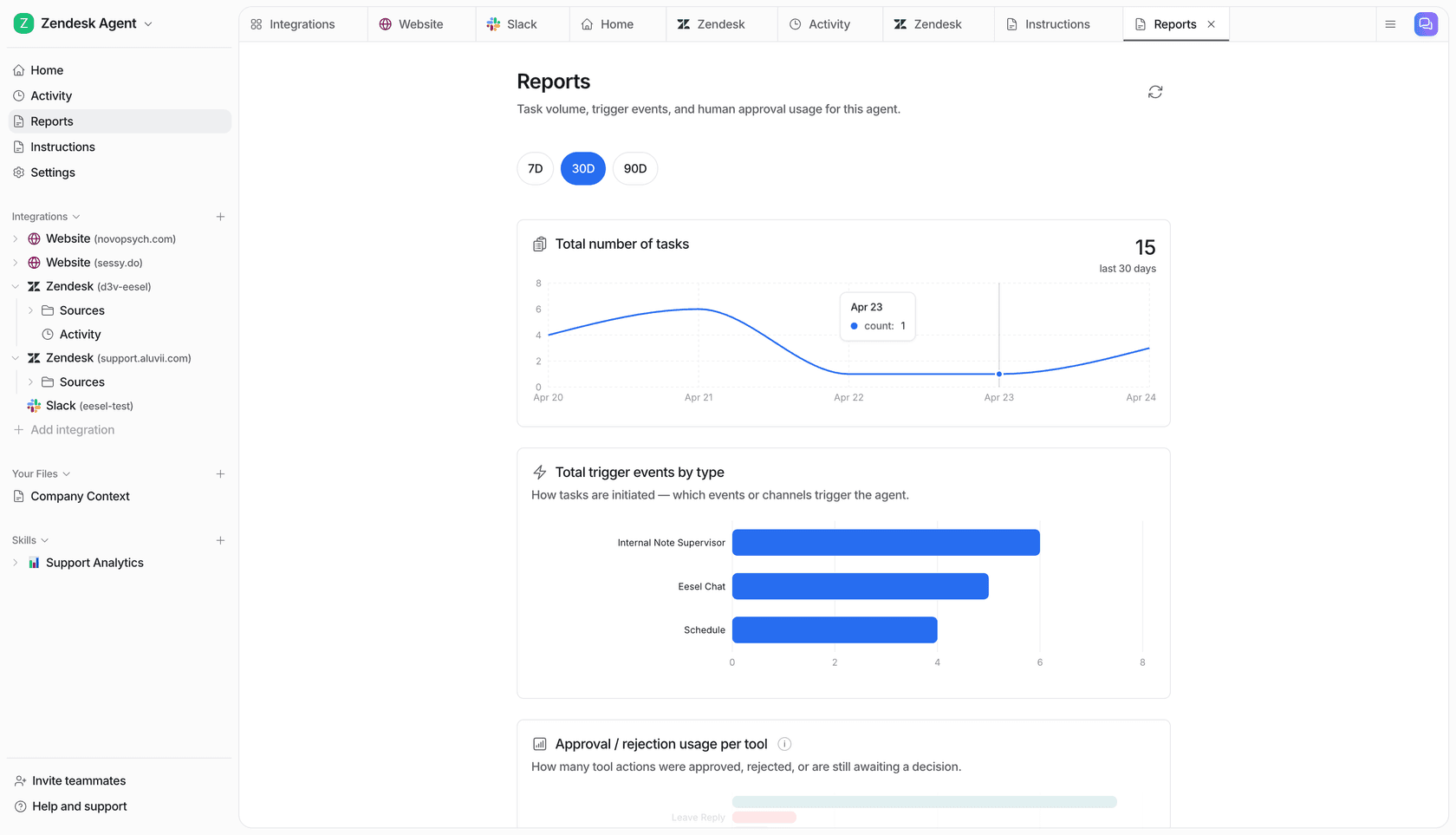
It runs on Zendesk, Gorgias, HubSpot, Salesforce and Front, plus the three that Fini's page leaves out: Freshdesk, Help Scout and Jira Service Management. It reads the knowledge sources that page does not list too, Confluence and Notion and Google Drive included. Real numbers off real rollouts: Smava handles 100,000+ tickets a month on it, Design.com 50,000+, and a first agent is usually live inside 30 minutes.
Where eesel is not the answer. If what you need is FedRAMP, or a nine-channel social and messaging estate, or a vendor-run enterprise service pod with a 15-minute SLA, that is a different shortlist and Fini or Zendesk reads better on it.
Start with the $50 of free usage, point it at last quarter's tickets, and look at the resolution rate before you talk to anyone at all. Want the wider field first? Our Fini AI alternatives roundup sorts nine options by what each one costs to start.
The verdict on Fini AI pricing
Fini is a credible product with an unusually well-defined billable unit, and a compliance posture that beats its price point. The $0.49 per resolution on the homepage is not the thing you buy. Fini publishes the honest figure itself, at $1.80 on Growth.
What I would take into the call. Ask which of the five published prices applies to your contract. Get the Enterprise allowance in writing, since Fini's own page says its card and FAQ disagree. Take the crossover table above along and make them justify Scale against Growth-plus-overage at your volume. Ask what a pre-launch dry run looks like before a write-capable agent touches a live queue, and what switching costs look like if it does not work out. And if you sit under a million tickets a year, treat the 90-day pilot as unavailable and budget for a paid one instead.
If your volume sits above roughly 19,000 resolutions a month and your helpdesk is on Fini's list of eight, the Enterprise tier is a defensible buy at $0.75 falling to $0.50 per resolution. Below about 7,000 a month, the honest reading of Fini's own rate card is that you are mostly paying for a floor, and there are cheaper ways to find out whether AI can handle your queue at all.
Frequently Asked Questions
How much does Fini AI cost?
What is Fini AI's pricing per resolution?
Does Fini AI have a free trial?
What counts as a resolution in Fini AI pricing?
Is Fini AI pricing expensive for small teams?
Which Fini AI plan is cheapest for my volume?
How does Fini AI pricing compare to Zendesk or Decagon?
Does Fini charge extra for voice?



Article by
Kurnia Kharisma
Kurnia is a software engineer and writer at eesel AI with two years of SEO experience, writing about AI tools, helpdesk software, and customer support. He pairs a developer's understanding of how these products are built with search-driven research into what actually ranks and resonates with the people searching for them.