The 6 best GLM-5.3-Flash alternatives in 2026

Rama Adi

Katelin Teen
Last edited August 29, 2026

Why look past GLM-5.3-Flash at all?
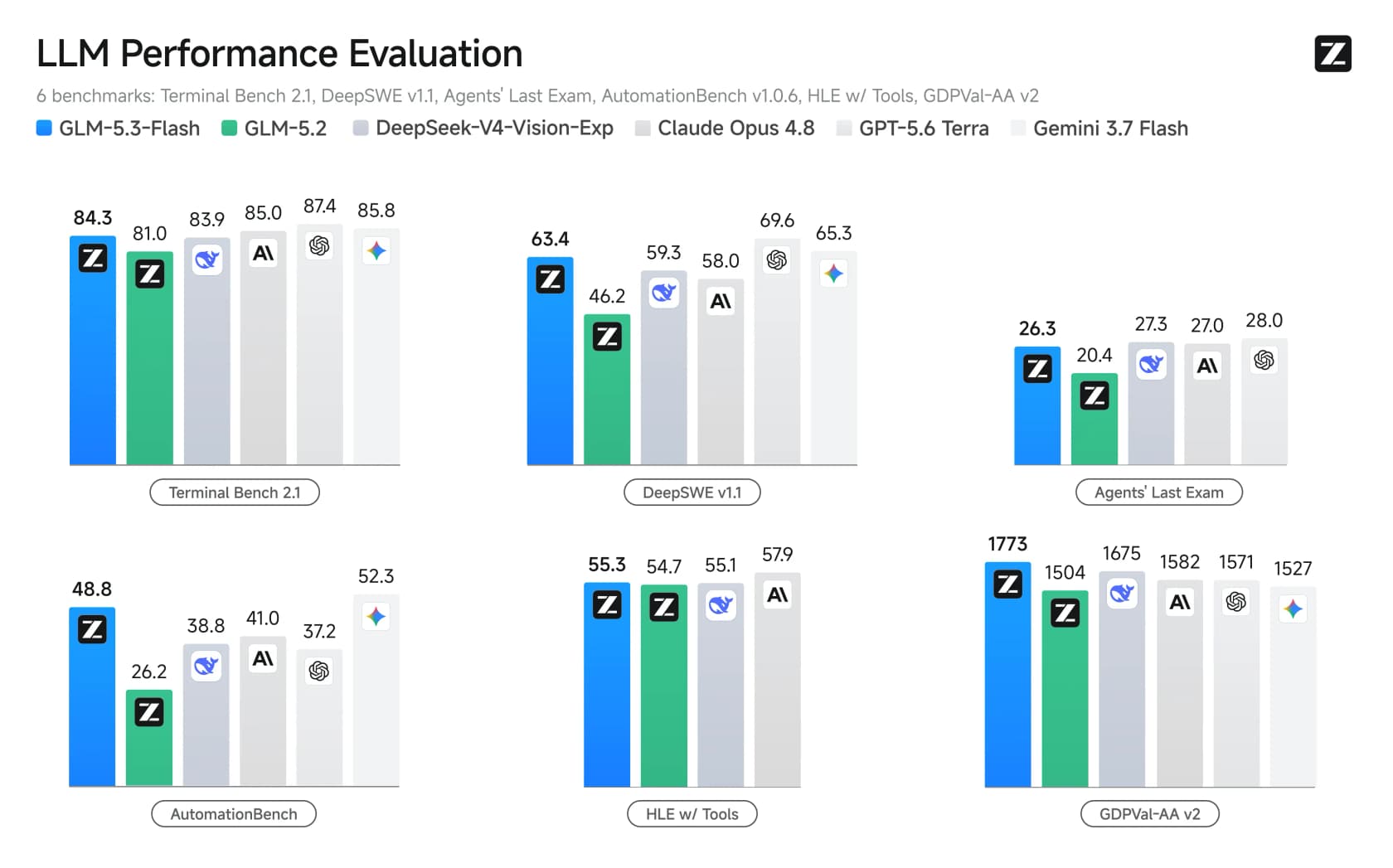
Let me be fair to the incumbent first, because it earns the benchmark. GLM-5.3-Flash is a 320B-total / 18B-active mixture-of-experts model, the first natively multimodal model in the GLM-5 series, with a 1M-token context window and open weights. Cloudflare's framing is that it beats GLM-5.2 across benchmarks "at one-tenth the price, while approaching Claude Opus 4.8 on coding and agentic benchmarks." On six coding and agentic benchmarks it clears its predecessor comfortably.
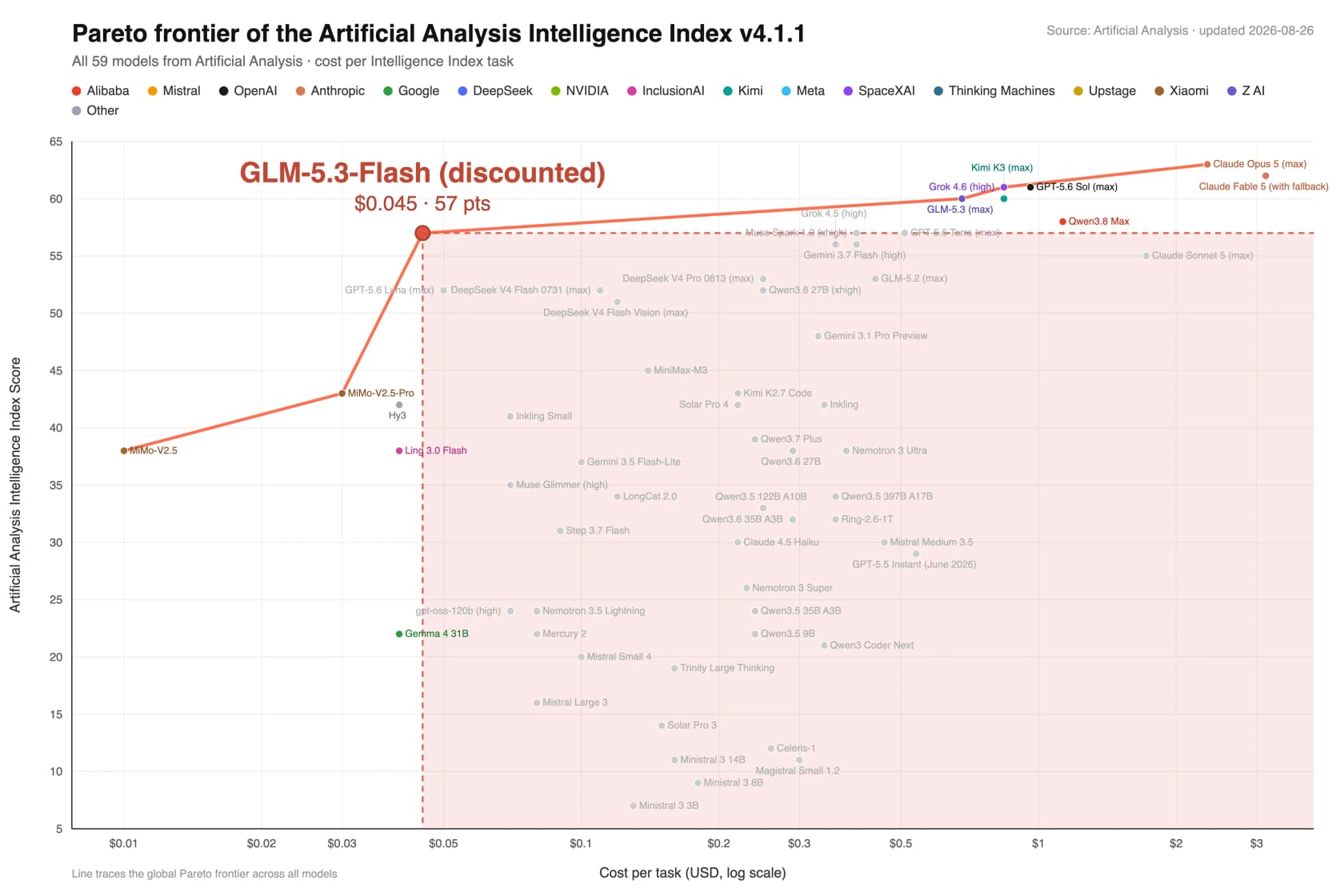
The reason it pushed the whole price/intelligence conversation is this Pareto chart. GLM-5.3-Flash lands on the frontier at about $0.045 per task and 57 points, a spot almost nothing else occupies.
So why do people still shop around? A few real reasons show up again and again:
- Speed, on the first-party endpoint. On Z.ai's own API, GLM-5.3-Flash runs slow, around 49 tokens/sec, and one r/opencode thread called it "one of the slowest models AA has ever" seen. Third-party hosts fix this (Databricks clocks 272.9 t/s), but that means committing to a reseller.
- The data story is thin. Z.ai publishes no DPA or zero-retention option, and data sits under PRC law. For regulated or customer-data workloads, that is a real blocker unless you self-host.
- The promo clock. The $0.075/$0.25 rate is a launch discount that ends September 9, 2026; list price is double.
- Text-only shops. If you never touch images, some cheaper or faster text specialists make more sense than paying for a multimodal architecture you will not use.
None of these make GLM-5.3-Flash a bad model. They just mean it is not automatically the right one for every job. If you want the deep dive on the model itself, we covered it in the GLM-5.3-Flash review.
How I picked these alternatives
I stuck to models a GLM-5.3-Flash shopper would actually cross-shop: cheap-to-midrange, fast, and ideally multimodal or open-weight. Each one is scored on the dimensions that decide a real switch, not just a headline benchmark:
- Price, and the real bill. Sticker price per 1M tokens, plus the surcharges that inflate it.
- Speed (tokens/sec and time to first token).
- Vision / multimodal support, since that is GLM-5.3-Flash's signature.
- Open vs closed weights, for anyone who needs to self-host.
- Context window and max output.
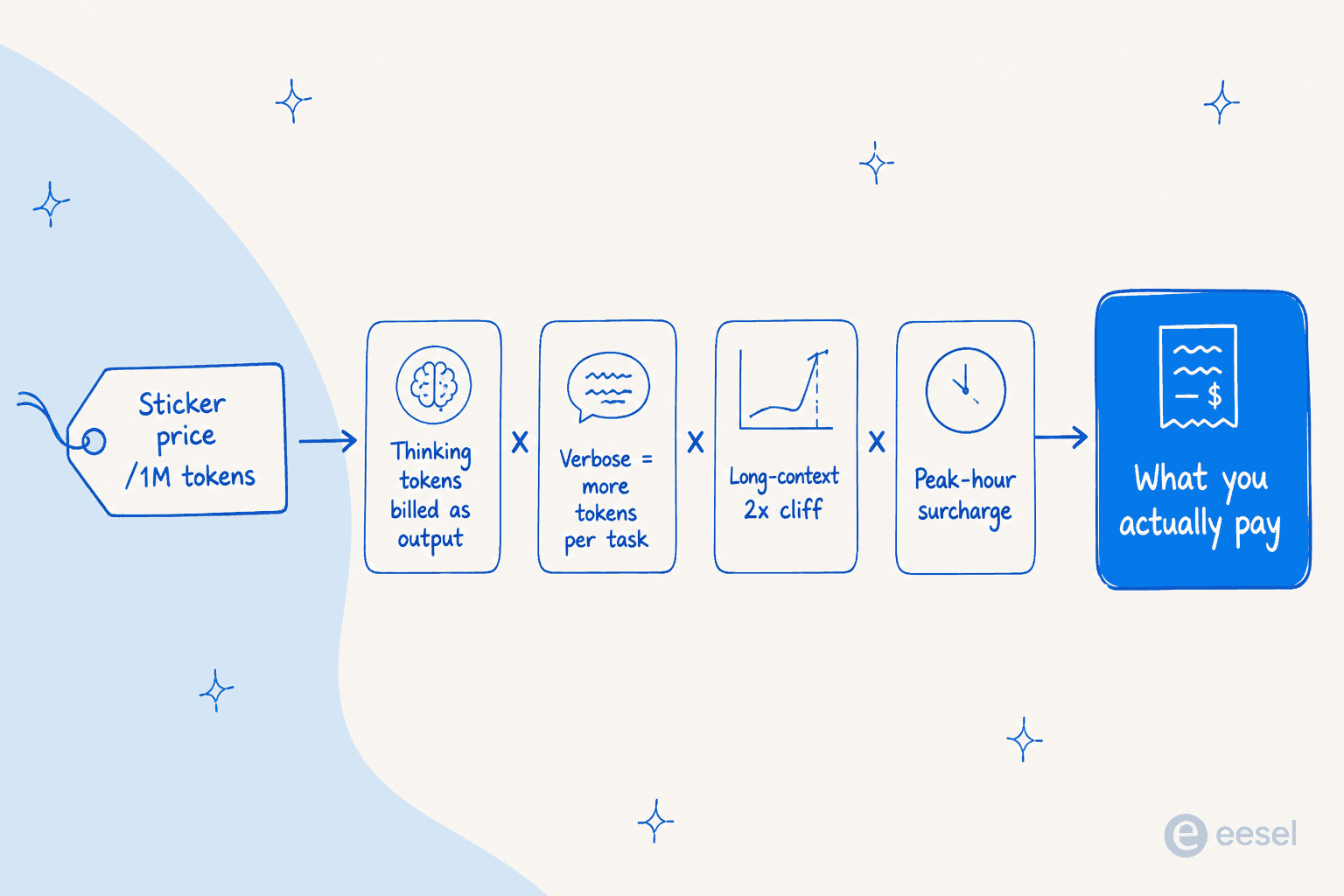
One theme runs through all of it: the sticker price is not the bill. Thinking tokens bill at the output rate, verbose models burn more tokens per task, some vendors charge a long-context surcharge, and DeepSeek even has a peak-hour multiplier. Keep this in mind for every row of the table below.
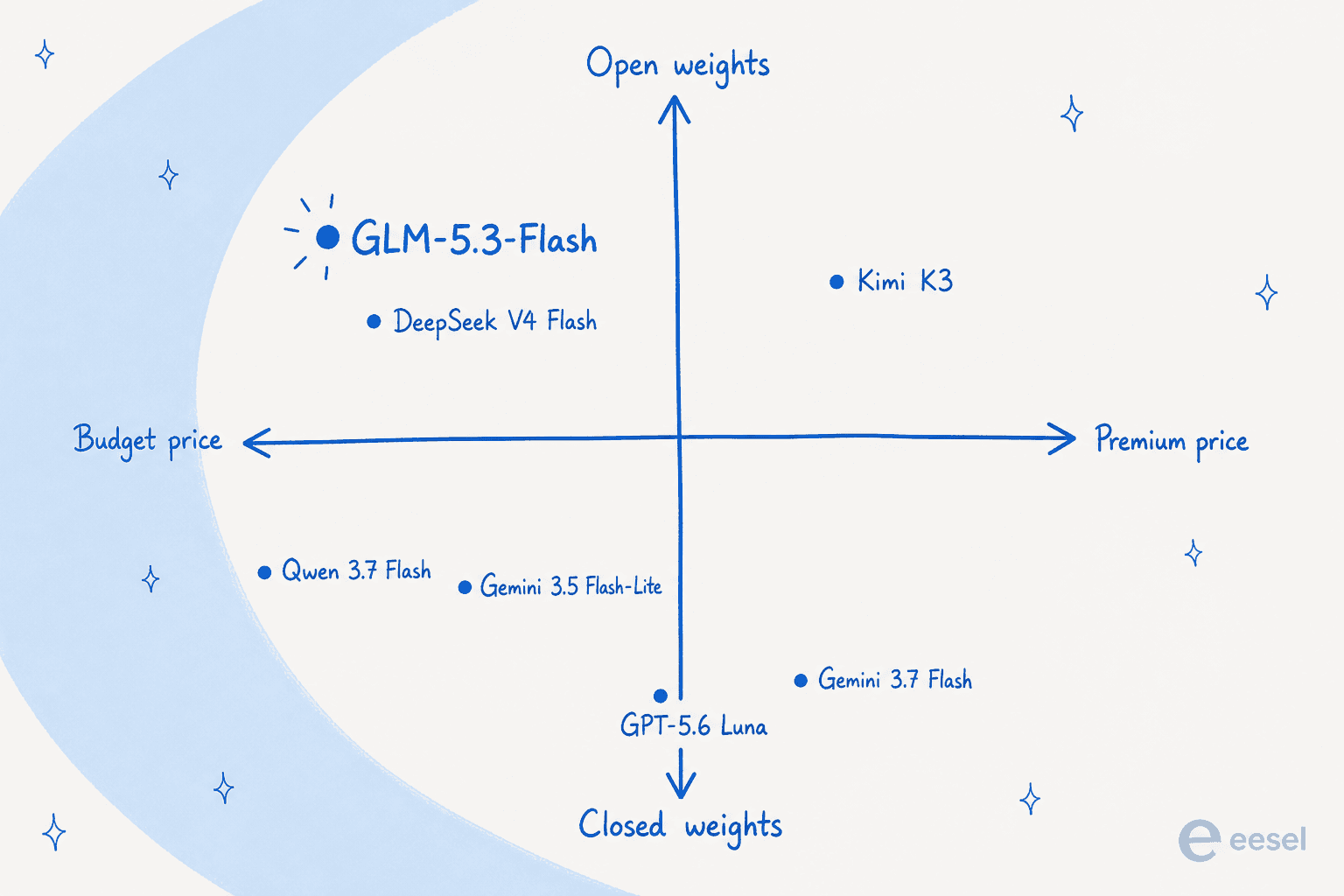
Here is where each option sits on the two axes most people actually care about: price and whether the weights are open.
GLM-5.3-Flash alternatives at a glance
| Model | Best for | Input / Output (per 1M) | Context | Weights | Vision | Note |
|---|---|---|---|---|---|---|
| GLM-5.3-Flash (incumbent) | Cheap open multimodal | $0.075 / $0.25 (promo) | 1M | Open | Yes | AA Index 57; promo ends Sep 9 |
| DeepSeek V4 Flash | Cheapest open weights | $0.22 / $0.66 (off-peak) | 1M | Open (MIT) | No (text) | Peak-hour rates 2x; verbose |
| Gemini 3.7 Flash | Fastest closed model | $0.75 / $3.75 (promo) | ~1M | Closed | Yes | ~340 t/s; doubles Jan 2027 |
| Gemini 3.5 Flash-Lite | Speed / price floor | $0.30 / $2.50 | ~1M | Closed | Yes | Fastest, cheapest Gemini tier |
| GPT-5.6 Luna | Big-brand ecosystem | $0.20 / $1.20 | 1.05M | Closed | Yes (image in) | 2x input over 272K tokens |
| Qwen 3.7 Flash | Cheapest small prompts | $0.03-$0.20 / $0.13-$0.80 | 1M | Closed | Yes | Price bracketed by prompt size |
| Kimi K3 | Open weights + native vision | $3.00 / $15.00 | 1M | Open | Yes (native) | Flagship-tier, not budget |
Now the detail on each, in the order I would consider them.
1. DeepSeek V4 Flash
Best for: teams that want open weights they can actually self-host, and the lowest possible bill on text workloads.
If GLM-5.3-Flash has one true rival on the "cheap and open" axis, it is DeepSeek V4 Flash. It is a 284B-total / 13B-active MoE released under a genuine MIT license, with 1M-token context and open weights that run on SGLang or vLLM. Community reaction to GLM even pins DeepSeek as the reference point, with one r/opencode note that GLM's "visible context grows half as fast as Deepseek Flash."
Strengths. The MIT license is the real draw: you can host the roughly 167GB of weights yourself, which drops your marginal cost toward the price of your own GPUs and keeps customer data on your own infrastructure. That last point is exactly where GLM's thin data story hurts. At max effort it is a capable reasoner (Artificial Analysis scores it 50), and it is genuinely cheap on the hosted API too.
Watch-outs. Two things. First, it is text-only, with no documented image input, so it is not a like-for-like swap if you use GLM's vision. Second, the hosted pricing has a peak-hour surcharge: cache-miss input runs $0.22/M off-peak but $0.44/M during peak hours (01:00-04:00 and 06:00-10:00 UTC), with output at $0.66 rising to $1.32. A US or EU support queue mostly bills off-peak, which is a quirk in your favor, but a fragile one. It is also verbose, spending more output tokens per task than the class median.
Pricing. Off-peak $0.22 in / $0.66 out per 1M; peak is exactly double. Cache hits are near-free at $0.007/M off-peak. Full numbers in our DeepSeek V4 Flash pricing post. There is also a text-plus-vision experiment, DeepSeek V4 Flash Vision, if you want to close the multimodal gap.
Verdict. The pick when open weights and self-hosting matter more than vision. If you never send images and you can run your own inference, this beats GLM on data control and marginal cost, and our DeepSeek V4 Flash review digs into the cheap-config trap. If you need vision or do not want to run GPUs, keep reading.
2. Gemini 3.7 Flash
Best for: teams that want the fastest closed model and a mature, well-documented platform, and do not mind a big-vendor price.
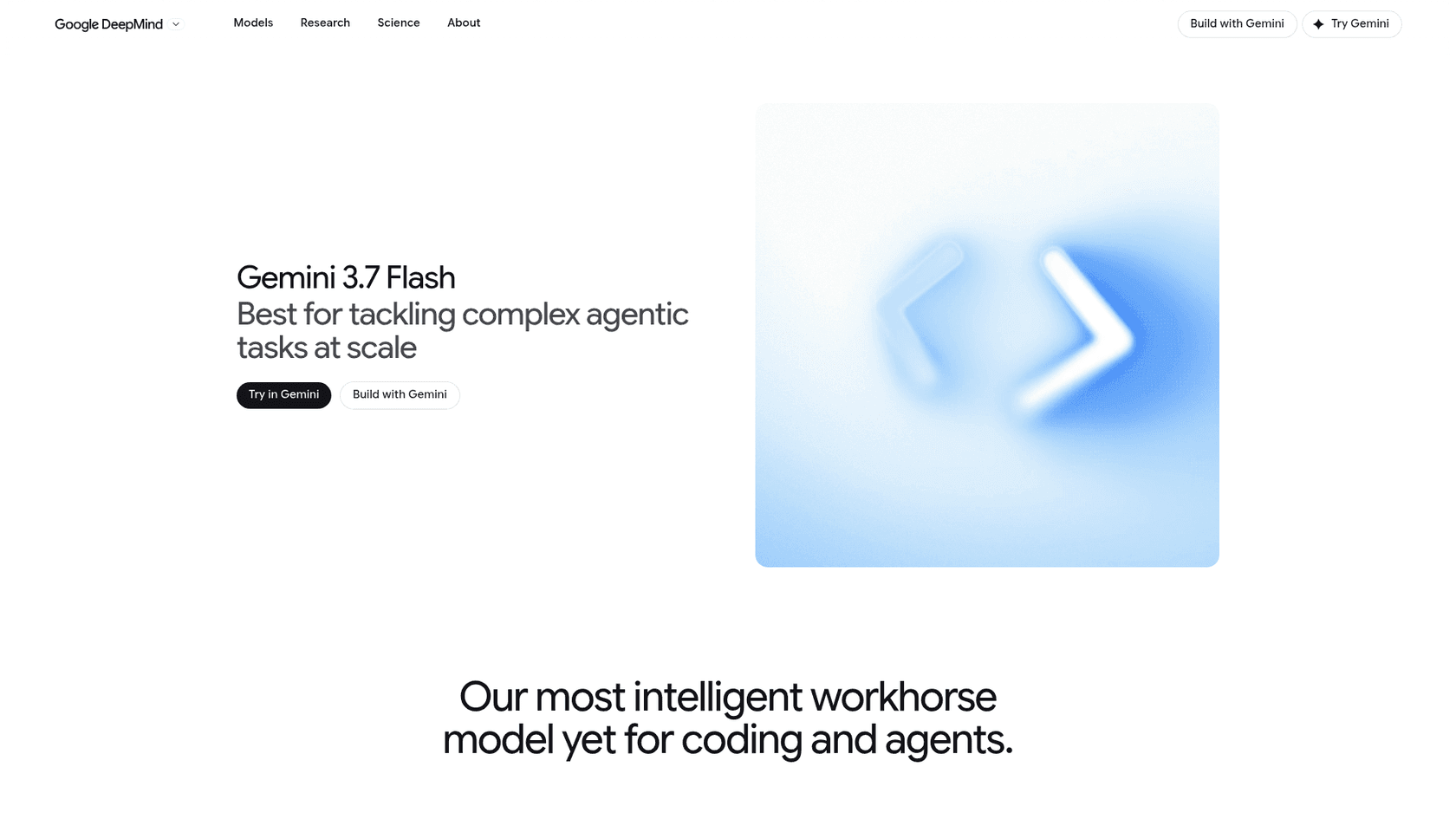
Gemini 3.7 Flash went GA on August 13, 2026 as Google's "most intelligent workhorse model yet for coding and agents." It is the natural pick if GLM's first-party speed is your dealbreaker.
Strengths. Speed is the headline: Artificial Analysis measures it at 340.1 tokens/sec, rank #1 of 188 models. It is multimodal, has roughly a 1M-token context, and comes with Google's tooling, grounding, and docs. Per-effort, low scores 50.9 on the Intelligence Index at $0.16/task and sub-second time to first token, which is within a point of the older 3.6 Flash at full effort. If you tune the effort down, it is fast and cheap at once.
Watch-outs. The price is introductory. It is $0.75/$3.75 per 1M through December 31, 2026, then $1.50/$7.50 from January 1, 2027 per Google's pricing page, an exact doubling. The API also changed a lot: temperature, top_p, and thinking_budget are gone, and the cheapest minimal thinking level was removed, so the floor for cheap OCR/classification work is higher than on 3.6 Flash. And its hallucination rate regressed to 64.5% from 3.6 Flash's 55.6%, which matters a lot if you point it at customers unprotected.
Pricing. $0.75 in / $3.75 out per 1M until end of 2026, then double. Batch and Flex are 50% off.
Verdict. The best raw speed here, on a serious platform. Choose it if latency and vendor maturity outweigh the price, and budget for the January 2027 increase now rather than being surprised by it.
3. Gemini 3.5 Flash-Lite
Best for: high-throughput, high-volume jobs where you want the cheapest, fastest Google model and can accept a lower ceiling.
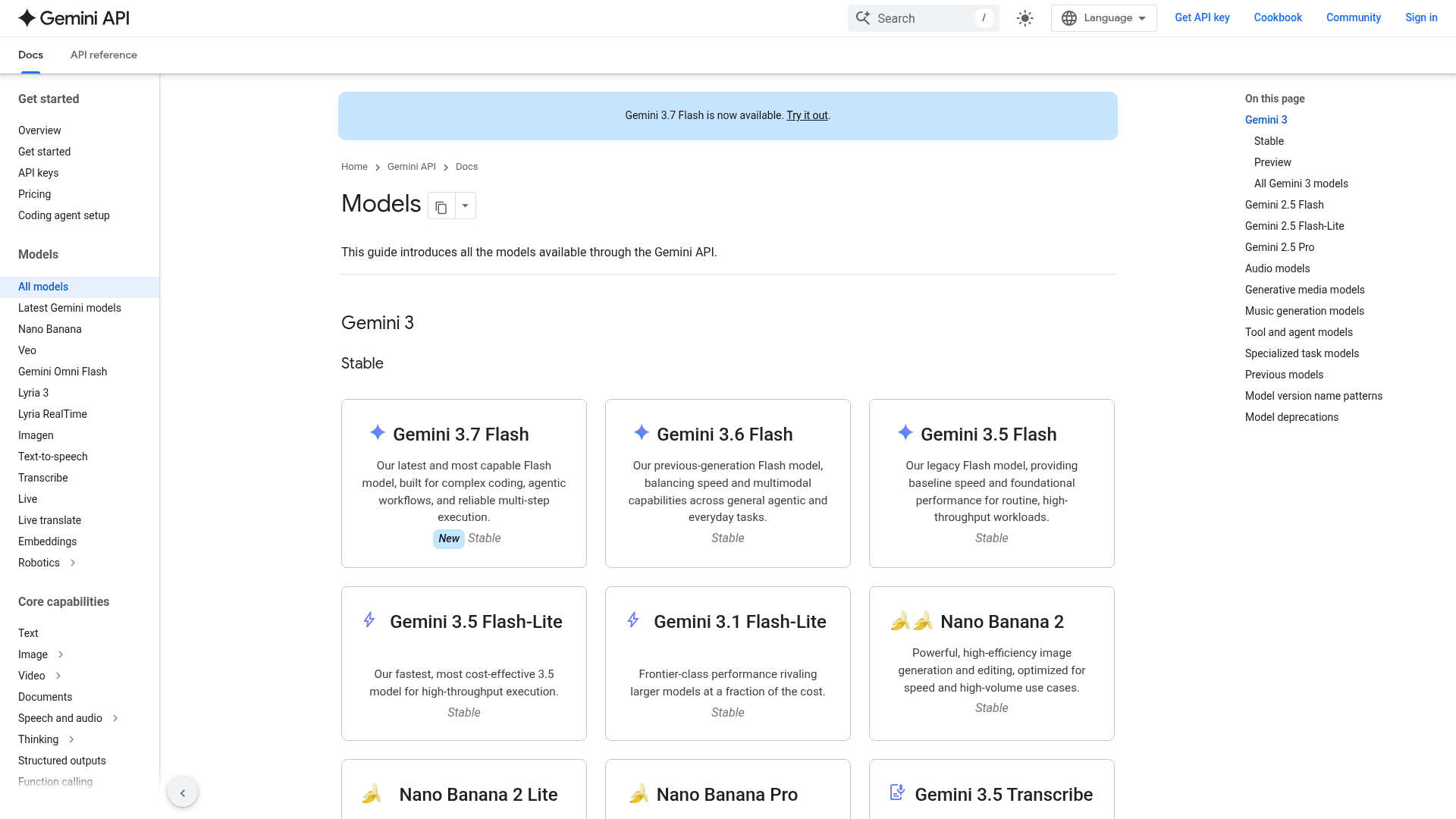
If Gemini 3.7 Flash is the workhorse, Flash-Lite is the sprinter. Google describes it as "our fastest, most cost-effective 3.5 model for high-throughput execution," and that is exactly the slot GLM-5.3-Flash struggles to fill on its own slow first-party endpoint.
Strengths. It is the price and speed floor of the closed options at $0.30/$2.50 per 1M, running around 350+ tokens/sec, and it still keeps multimodal input, computer use, and a large context. For classification, routing, tagging, and other high-volume "cheap and fast" work, it is hard to beat without going open-source.
Watch-outs. You are trading intelligence for throughput. On the Pareto chart it sits well below GLM-5.3-Flash on the Intelligence Index, so it is not the model for hard reasoning or nuanced multi-step agentic tasks. It is a specialist, not a flagship stand-in.
Pricing. $0.30 in / $2.50 out per 1M, with batch at half.
Verdict. The right call for high-volume, low-complexity pipelines where speed and cost dominate. For anything that needs GLM-level reasoning, step back up to a full Flash model.
4. GPT-5.6 Luna
Best for: teams already living in the OpenAI ecosystem who want a cheap tier without leaving it.
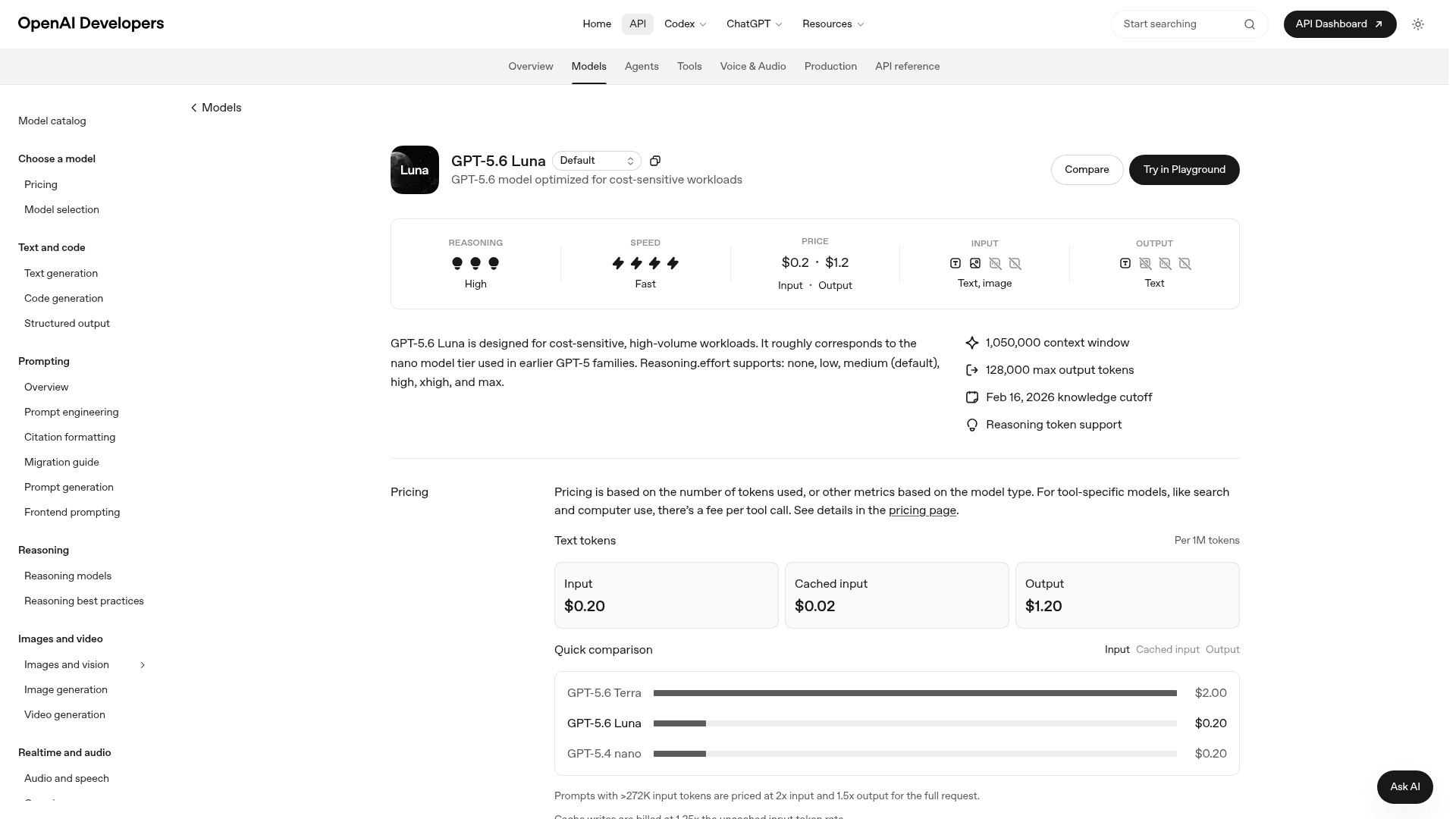
GPT-5.6 Luna is OpenAI's cost-sensitive tier, "designed for cost-sensitive, high-volume workloads," roughly the nano slot in earlier GPT-5 families. It is the alternative for shops that value the ecosystem, tooling, and support of the biggest vendor over squeezing out the last cent.
Strengths. At $0.20/$1.20 per 1M it is cheap for a frontier-brand model, with a 1,050,000-token context, image input, and the full reasoning.effort range from none to max. If your team already uses the OpenAI SDK, Agents, and tooling, staying inside it removes a lot of integration friction. It reads as the safe, boring choice, and sometimes that is the right one.
Watch-outs. There is a long-context cliff: prompts over 272K input tokens are billed at 2x input and 1.5x output for the whole request. So the "1M context" and the "$0.20" cannot both be true on a very long prompt. It is also closed, text-and-image only (no open weights, no self-host), and Luna sits below GLM-5.3-Flash on raw intelligence, since it is the budget tier of the family rather than the workhorse.
Pricing. $0.20 in / $1.20 out per 1M, cached input $0.02, with the 272K surcharge noted above. Deeper OpenAI context in our GPT-5.6 review.
Verdict. Best when ecosystem gravity beats price-per-token. If you are already all-in on OpenAI, Luna is the least-friction way to get a cheap tier; if you are shopping purely on cost or want open weights, GLM or DeepSeek win.
5. Qwen 3.7 Flash
Best for: short-prompt, high-volume vision or text work where your calls stay small.
Qwen 3.7 Flash from Alibaba is the other budget Chinese model in the mix, and its pricing model is genuinely different from everyone else's here.
Strengths. On small prompts it is the cheapest option in this roundup: $0.03/M input and $0.13/M output for calls under 32K tokens. It is a vision model with a 1M-token context, so on paper it covers GLM's multimodal ground at a lower entry price.
Watch-outs. The price is bracketed by prompt size, and the two headline numbers are mutually exclusive. Above 32K tokens it jumps to $0.10/$0.40, and in the 256K-1M band it is $0.20/$0.80, a 6.7x swing on input. OpenRouter's rolling blend of what customers actually pay is $0.044/$0.149, above the entry rate, which tells you real traffic hits the upper brackets. It is also closed-weights and thinly evaluated: no published benchmarks or architecture, and the one independent eval (Roboflow) ranks it #22 of 23 overall but #1 on cost. "Flash" here means cheap, not fast, at roughly 59 tokens/sec.
Pricing. Bracketed: $0.03-$0.20 in / $0.13-$0.80 out per 1M depending on prompt size. Full breakdown in our Qwen 3.7 Flash pricing post, and there is a bigger sibling in Qwen3.8-Max if you need more headroom.
Verdict. A real bargain if, and only if, your prompts stay small. Model your actual token distribution before switching, because a long-context support workload can quietly land you in the expensive bracket. Our Qwen 3.7 Flash review has more.
6. Kimi K3
Best for: teams that want open weights and native vision like GLM offers, and are willing to pay flagship prices for a higher ceiling.
Kimi K3 is Moonshot AI's flagship, and it is the closest match to GLM-5.3-Flash on the "open weights plus native multimodal" combination. It is a 2.8T-total / 104B-active MoE with a 1M-token context and native image and video understanding, and its weights shipped on Hugging Face on schedule.
Strengths. Capability is the story. It scores an Artificial Analysis Intelligence Index of 57, matching GLM-5.3-Flash and landing it at #4 overall, and it beats Opus 4.8 and GPT-5.5 on most benchmarks. Native vision (image and video) plus open weights means you can self-host and keep the multimodal features, which is exactly what GLM offers, but with a bigger active-parameter count behind it.
Watch-outs. The price. At $3/$15 per 1M it is in the Claude Sonnet band, roughly 50x GLM-5.3-Flash's output price. Reasoning cannot be turned off at any level, and at low effort it scores an Index of 47 at $0.24/task, which is both worse and about 8x pricier than DeepSeek V4 Flash. It also does not accept public image URLs, only base64 or file IDs. This is not a budget swap.
Pricing. $3 in / $15 out per 1M, cache-hit $0.30. See our Kimi K3 pricing and Kimi K3 alternatives posts for the full picture.
Verdict. The capability upgrade, not the cost saving. Pick Kimi K3 when you want GLM's open-plus-multimodal shape with more raw intelligence and you can absorb flagship pricing. If cost is the reason you are here, this is the wrong direction.
Which alternative actually fits you?
The table and the quadrant do most of the work, but the honest answer depends on your single biggest constraint. Pick the one that matters most and see where it points:
What matters most for your workload?
The part the model choice does not solve
Here is the thing I would tell anyone agonizing over this table, and it comes from years of putting AI on live support queues: swapping the model is the easy 5%. If your goal is to answer customer tickets, the model is the bottom layer of the stack, and it is the layer that changes least when you switch vendors.
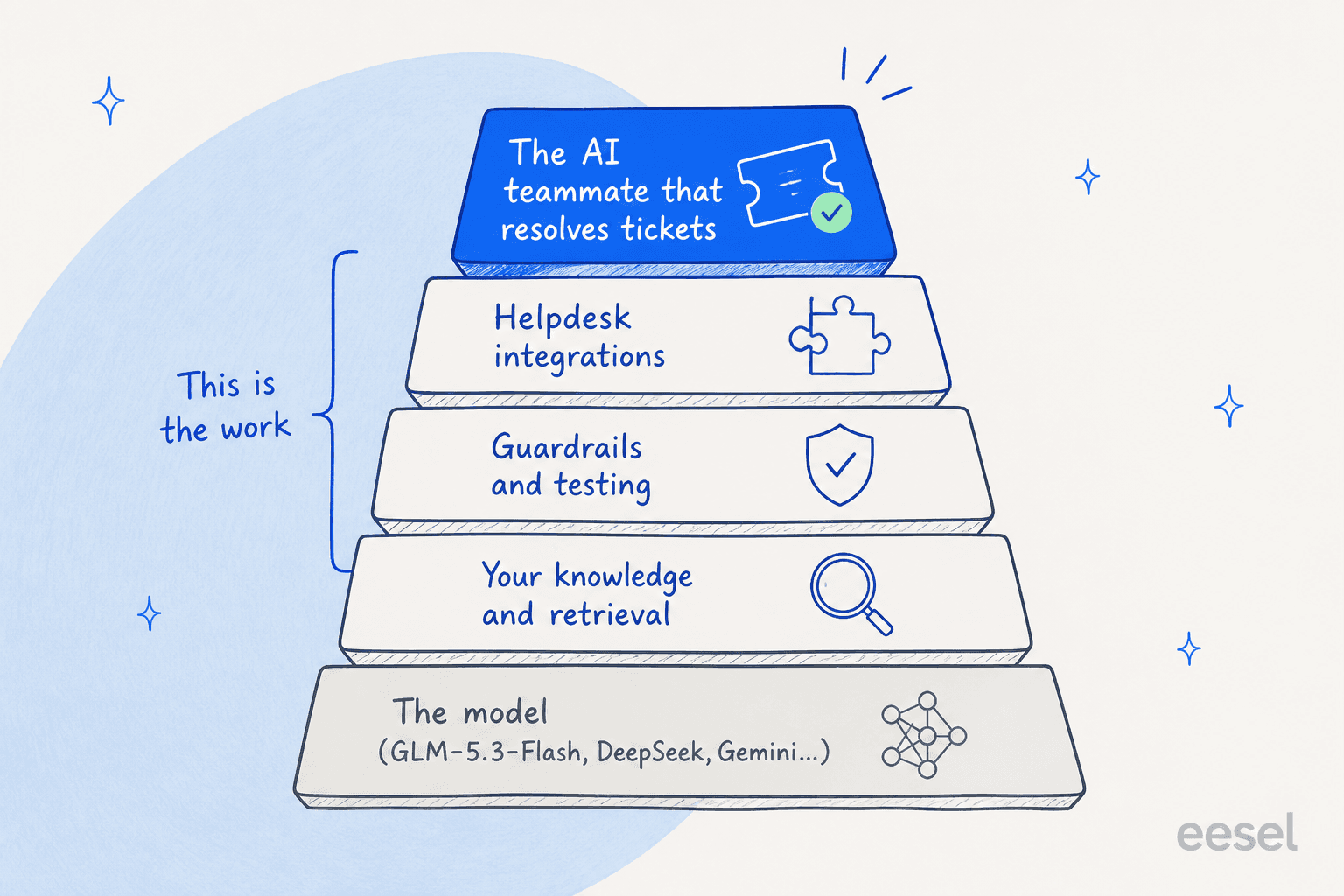
This is the same logic behind hiring an AI employee rather than renting a raw API, and it is why the best AI teammates are judged on outcomes, not tokens-per-second. Everything above the model is the work: connecting your knowledge base so answers are grounded, guardrails so it knows what not to say, testing so you find out how it behaves before customers do, and integrations into your helpdesk so it can actually act. The reason a cheaper model rarely moves your resolution rate is that resolution rate lives in those upper layers, not in the tokens-per-second.
This is also where the hallucination numbers above stop being trivia. Gemini 3.7 Flash's 64.5% hallucination rate, or any of these models answering confidently when it should not, is only dangerous if it reaches a customer untested. We have watched confident-sounding bots quietly give wrong answers, which is exactly why we now simulate every rollout against a company's real historical tickets before it goes live. No amount of picking the "right" cheap model substitutes for that. If you want the model-level view specifically for support, we wrote up the best AI model for support tickets separately.
Try eesel
If the reason you are comparing GLM-5.3-Flash alternatives is to build customer support automation, eesel is the layer that sits on top of whichever model you pick. Think of the model as the engine and eesel as the AI teammate you hire: it arrives already knowing how to plug into Zendesk, Freshdesk, or Gorgias, learns from your past tickets and help center, and follows the guardrails you set.
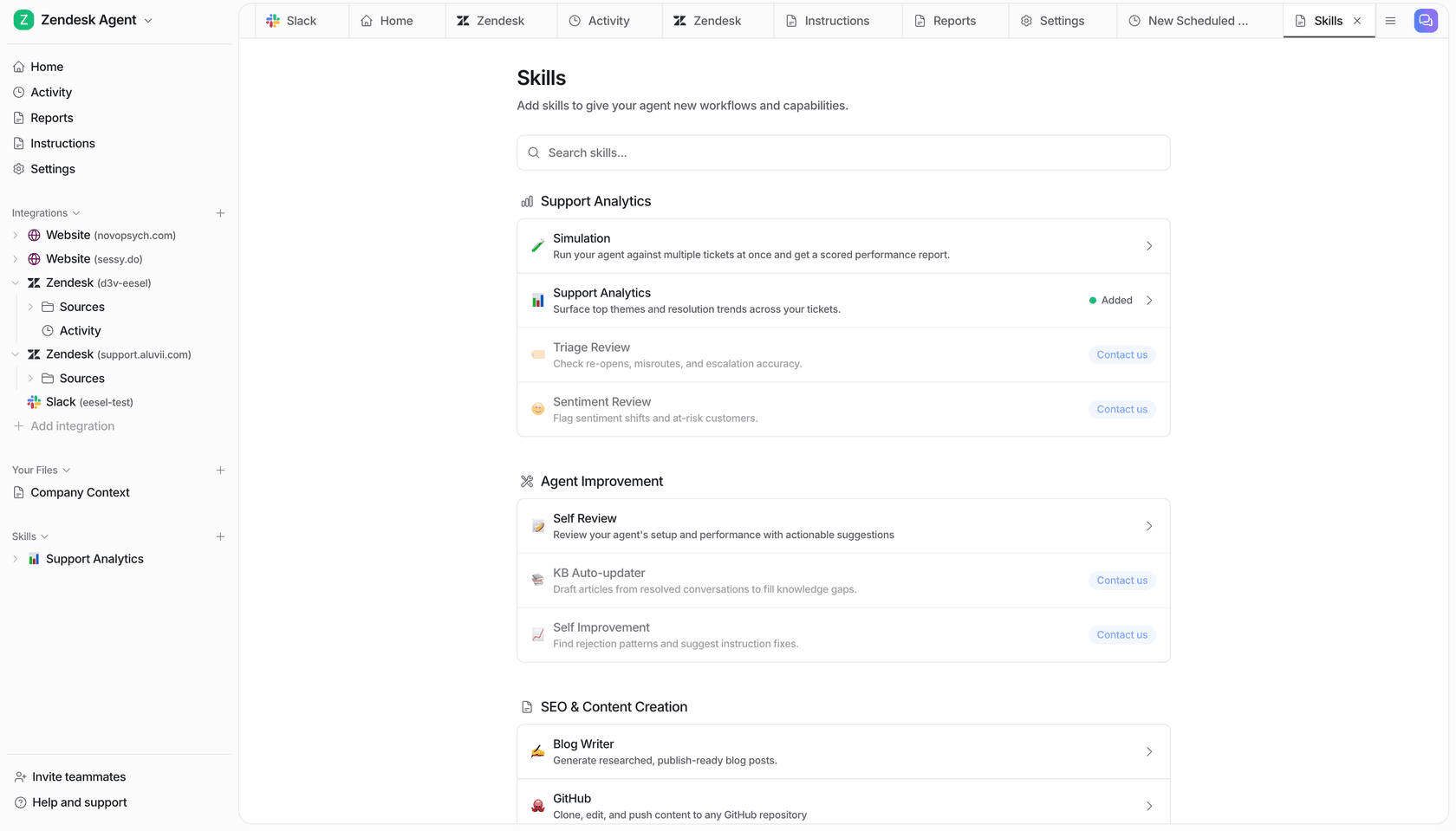
The differentiator is the simulation: before your AI teammate answers a single live ticket, eesel replays it against thousands of your real past conversations, so you see the resolution rate and the exact replies it would have sent, and can fix them, while the risk is still zero. That is the safeguard that turns a cheap, capable model into a support agent you can actually trust. It is free to try, and you can point it at your own helpdesk in a few minutes.