9 best Meta Muse Wonder alternatives in 2026, by job and price

Kira

Katelin Teen
Last edited October 14, 2026

Why look past Muse Wonder at all
I'll start with what Meta got right, because it's a lot. Muse Wonder is Meta Superintelligence Labs' first frontier model family, released on October 12, and the bigger variant, Wonder Full, came second on the Artificial Analysis index on launch day. The API model has a 1,048,576-token context window, takes text, image, video, audio and PDF, and comes with a clean rate card: no long-context premium and 3,000 requests per minute from day one. My colleague's Muse Wonder review covers all of that in depth.
The reasons people look elsewhere are specific, and all three are checkable:
- The model you can buy isn't the model on the chart. Meta's own benchmark table shows Wonder Full winning 6 of 14 rows. Plain Wonder, the only one on the API, wins 1 (MemoryBench).
- It costs frontier money. Meta used to undercut everyone. At
$4/$20, Wonder now matches Opus 5.5 to the cent and costs twice what GPT-6.1 Sol does. - It's a preview. The model docs label it preview, the safety report is "available soon," and one early tester flagged API reliability.
"It's ok, intelligent, almost SOTA, but way too expensive [0], and some issues with API failing sometimes at the moment."

I build features and AI agents at eesel, and the model underneath is the part of eesel's stack I expect to change most often. That's not a hunch. In one sales call, a B2B hardware support team running about 250 tickets a month told eesel's sales team they had to replace their AI support tool. Their reason had nothing to do with price: the vendor had changed its business model, and the team was forced to migrate. A preview model is exactly where that kind of change happens without much notice, so I'd treat Wonder as one option to test, not a platform to hard-wire.
Same price, different score
This is the one chart worth saving from this post. On output price per million tokens, Muse Wonder sits level with Opus 5.5. On the Artificial Analysis index, as shown in Meta's own launch chart, it sits six points lower.
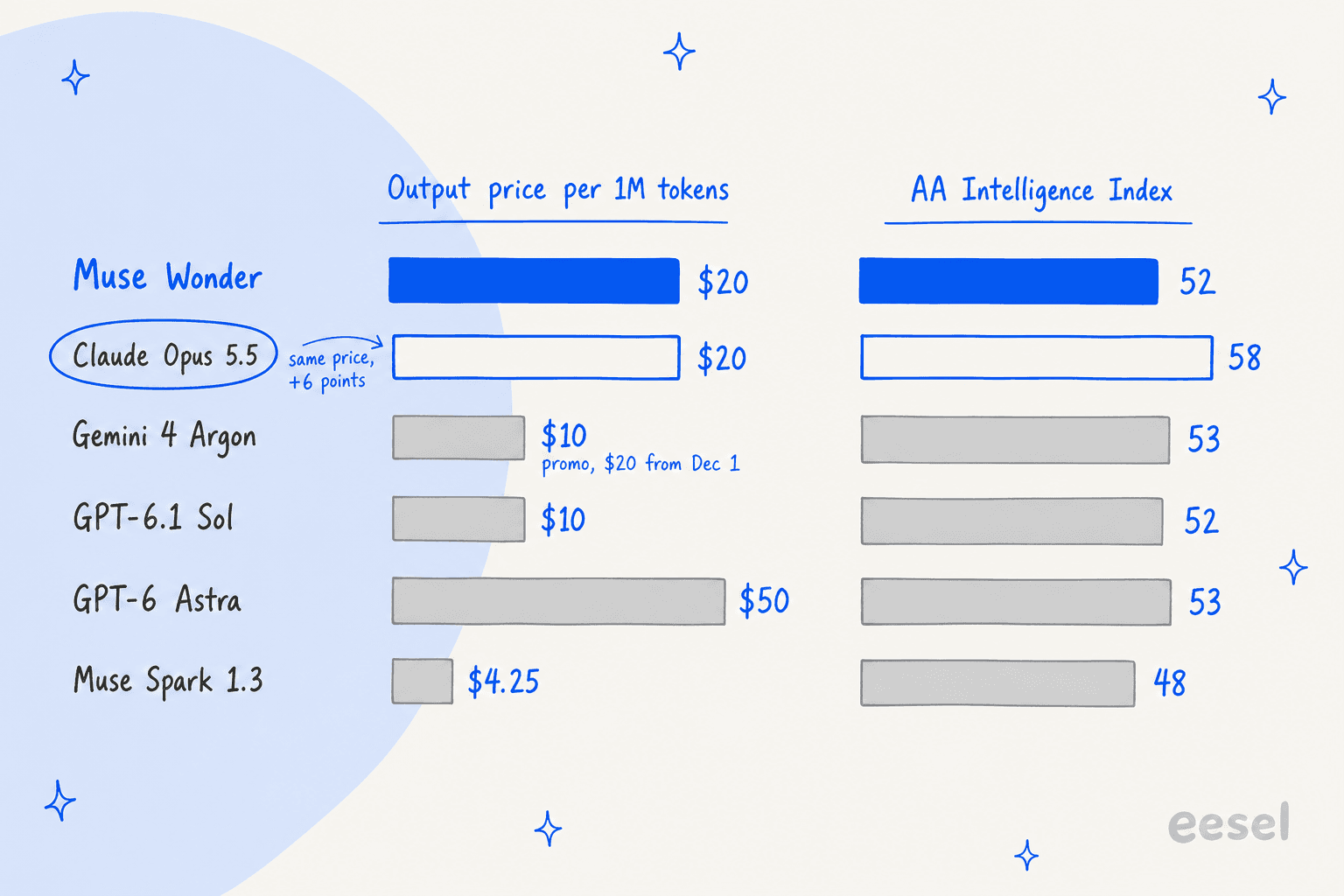
Read across the rows and three things stand out. Opus 5.5 is the same bill for 6 more points. GPT-6.1 Sol is the same score for half the output price. And GPT-6 Astra charges 2.5 times Wonder's price for one extra point. Benchmarks aren't everything (Wonder's MemoryBench result is real, and Meta built it for long agent runs), but at identical prices, the burden of proof sits with the lower-scoring model.
One HN commenter put the Sol comparison bluntly:
"sol 6.1 is 50% cheaper than this. sol pricing$2.00 output $10.00 dont know why the f people downvote for saying sol pricing."
The Muse Wonder alternatives at a glance
Prices are standard API rates per million tokens from each vendor's own pricing page, checked on October 14, 2026. Index scores come from Meta's launch chart (October 12) where the model appears on it, and from Artificial Analysis model pages otherwise.
| Model | Best for | Input / cached / output per 1M | AA Intelligence Index | Context / max output | Open weights | Trains on your data by default | Free tier | Where you get it |
|---|---|---|---|---|---|---|---|---|
| Muse Wonder (baseline) | Long agent runs, memory | $4 / $0.20 / $20 | 52 | 1M / not published | No | No (API) | No | Meta Model API, OpenRouter, Muse Code |
| Claude Opus 5.5 | Same bill, higher score | $4 / $0.20 / $20 | 58 | 1M / 128K | No | No | No | Claude API, Bedrock, Vertex, Foundry |
| Gemini 4 Argon | Long docs, cheaper until Dec | $2 / $0.10 / $10, then $4 / $0.20 / $20 | 53 | 1M unified / up to 1M | No | No (paid) | No | Gemini API, AI Studio |
| Muse Wonder Full | Meta's best, coding in Muse Code | $50 or $200 a month | 56 | 1M / not published | No | Yes (Contributor mode) | No | Muse Code Power or Max only |
| GPT-6.1 Sol | Wonder's score at half price | $2 / $0.10 / $10 | 52 | 1.05M / 128K | No | No | No | OpenAI API, ChatGPT Work, Codex |
| GPT-6 Astra | OpenAI's top tier, Ultrafast | $10 / $1 / $50 | 53 | 1.05M / 128K | No | No | No | OpenAI API, ChatGPT paid plans |
| Claude Sonnet 5.5 | Coding at half Opus price | $2 / $0.10 / $10 | 56 (max), 47 (high) | 1M / 128K | No | No | No | Claude API, clouds |
| Muse Spark 1.3 | High volume, staying with Meta | $1.25 / $0.15 / $4.25 | 48 | 1M / not published | No (promised) | Only on contributor variant | No | Meta Model API, Muse Code |
| Gemini 3.8 Flash | Cheap batch work, free tier | $0.75 / $0.075 / $3.75 | 41 (high) | 1M / 64K | No | Free tier only | Yes | Gemini API, AI Studio |
| DeepSeek V4.1 Flash | Open weights, lowest bill | $0.15 / $0.003 / $0.60 off-peak | 39.5 (max) | 1M / 384K | Yes, MIT | Terms don't say | No | DeepSeek API, self-host |
Not sure which row is yours? Pick the reason closest to why you were looking at Wonder.
What did you want Muse Wonder for?
Pick the reason closest to yours.
How I picked these alternatives
I started from the shortlist an AI assistant gives a buyer who asks what to compare Wonder against, then checked every name against primary sources. That shortlist leaned on GPT-6 Astra, Claude Opus 5.5, Gemini 4 Argon, Wonder Full and a cheap Gemini Flash. Two of those needed correcting. Gemini 4 Argon had just shipped, and the Flash model it suggested, Gemini 3.5 Flash, is deprecated with requests now routed to 3.6 Flash, so I used the current 3.8 Flash instead.
Then I added the models a Wonder buyer actually weighs on price: GPT-6.1 Sol and Claude Sonnet 5.5 at $2/$10, Meta's own Muse Spark 1.3, and one open-weights option. Every price below is from the vendor's own pricing page on October 14. Every benchmark is either from the vendor or from Artificial Analysis, and I say which.
What I didn't do is run nine models through my own test harness for this post. Wonder is three days old, and a fair comparison needs your tasks, not mine. So the last section gives you the five-task test I'd run, and each item below says which of those tasks it should win.
1. Claude Opus 5.5: the same bill for a higher score
Best for: teams that wanted a frontier model at $4/$20 and want the one that scores higher at that price.
Claude Opus 5.5 is the most direct swap on this list because nothing about your budget changes. Anthropic's pricing docs list $4 input, $20 output and $0.20 for a cache hit, the same three numbers as Wonder. The difference is the score: 58 on the Artificial Analysis index against Wonder's 52, and first place on that index at Wonder's launch.
Meta's own table makes the case for it. Opus 5.5 wins 6 of the 14 rows, including computer use (OSWorld 81.8 against Wonder's 72.6), terminal coding (59.6 against 52.0) and from-scratch programming. That last one is the widest gap in the whole table: ProgramBench 70.5 for Opus 5.5, 50.0 for plain Wonder. Where Wonder holds up is memory and long-horizon coding: it beats Opus 5.5 on DeepSWE (78.8 against 74.2) and SWE-Marathon (53.1 against 46.3).
The practical extras matter too. Opus 5.5 runs on the Claude API plus Bedrock, Vertex and Foundry, Batch halves the price to $2/$10, and Anthropic's default effort is now medium, which scores 51 for $1.34 a task on Artificial Analysis. The Opus 5.5 review goes deeper on effort levels.
Pros: identical price to Wonder; 6 points higher on the index; leads Meta's table on computer use, terminal and from-scratch coding; available on three major clouds.
Cons: forced tool_choice (any or a named tool) returns an error, which matters if your agent relies on it; max effort costs about $5.98 a task on Artificial Analysis; no open weights.
Pricing: $4 input, $0.20 cache hit, $20 output per 1M tokens; 5-minute cache write $5, 1-hour $8; Batch $2/$10; Fast mode $8/$40. Full table in Opus 5.5 pricing.
My take: if you were going to put Wonder in production at $4/$20, put Opus 5.5 there first and make Wonder beat it on your own tasks. At the same price, the higher-scoring model gets the default.
2. Gemini 4 Argon: half Wonder's price until December
Best for: long documents, long agent runs, and teams that want the lowest made-up-answer rate in the frontier set.
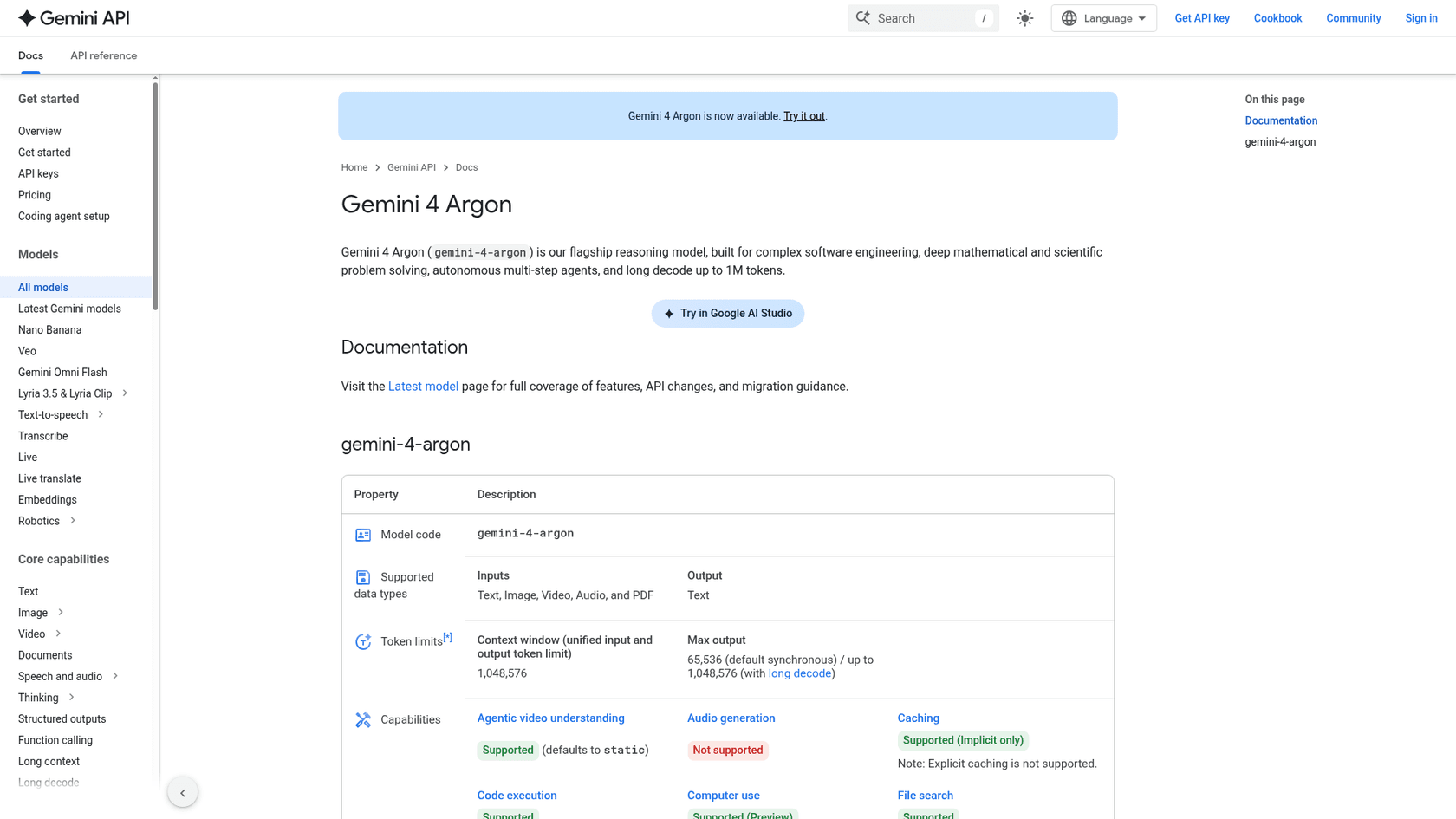
On Wonder's launch day, one HN commenter praised Wonder for being "available unlike Gemini 4 Argon." That lasted one day. Google's changelog shows gemini-4-argon went generally available on the Gemini API on October 13, and it's now in AI Studio too. The Gemini 4 Argon review was written while it was still invite-only; the facts below are from Google's live docs.
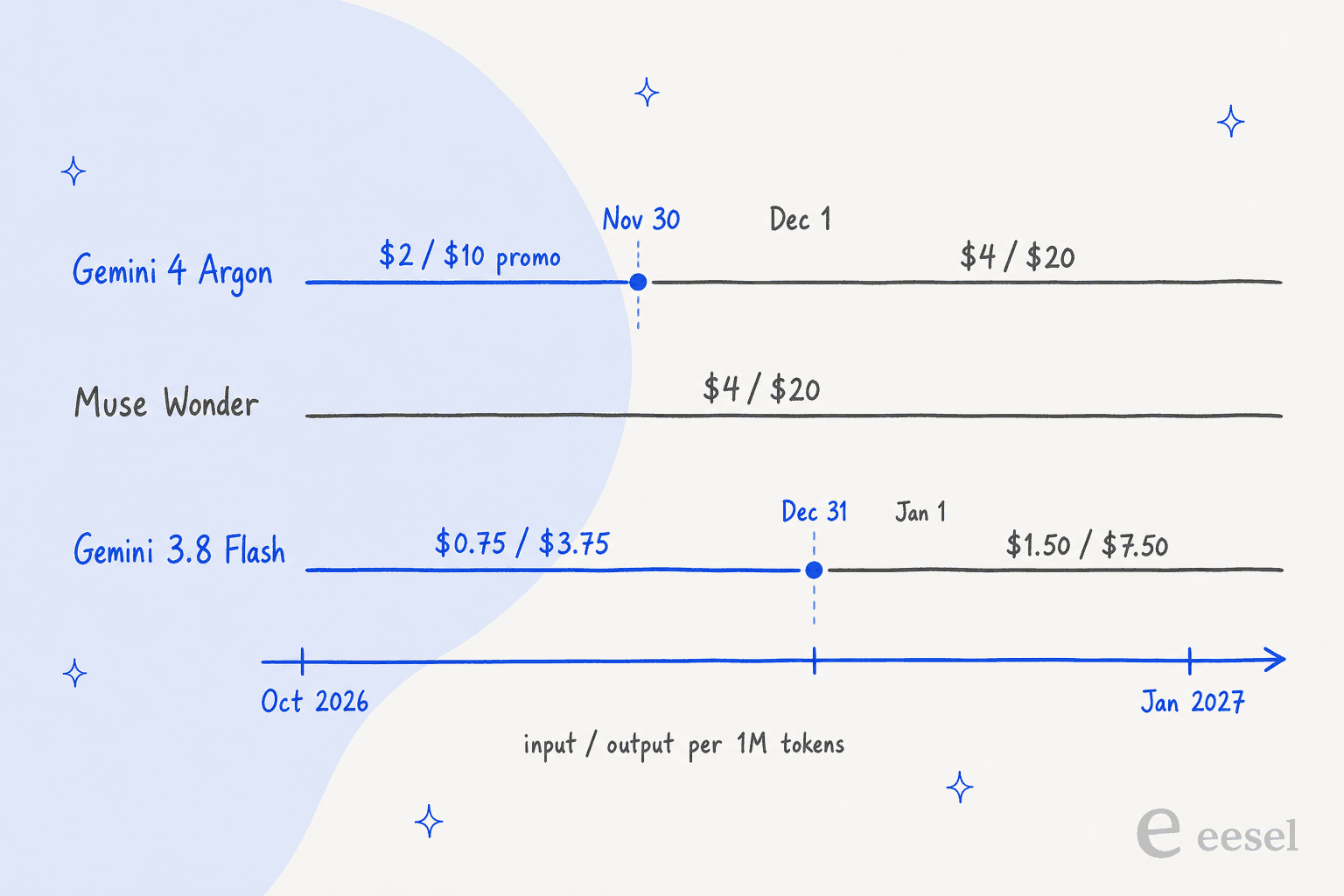
The price is the interesting part. Google's pricing page lists $2 input, $0.10 cached and $10 output through November 30, then $4, $0.20 and $20 from December 1, which is Muse Wonder's card exactly. So for about seven weeks you get a model that scores 53 on the index (one point above Wonder) at half the price, and after that you get it at the same price.
What Argon does best is long work. The model page lists a unified 1,048,576-token window, 65,536 output tokens by default and up to 1,048,576 with long decode, plus computer use in preview, code execution, file search and search grounding. On Artificial Analysis, its hallucination rate is 15%, the lowest of any frontier model I've checked. Google's own benchmark table has it leading on finance, legal and business-workflow tasks, though those are Google's runs, not the AA versions in Meta's table.
Pros: half Wonder's price until November 30; one point higher on the index; lowest hallucination rate in the frontier set; long decode up to 1M output tokens; Batch and Flex at half price.
Cons: the promo ends December 1; explicit context caching isn't supported (implicit only); no free tier; it writes a lot, about $1.99 a task on Artificial Analysis at the promo price.
Pricing: $2 / $0.10 / $10 through November 30, then $4 / $0.20 / $20; Batch and Flex $1 / $5 (then $2 / $10); Priority $3.60 / $18. See Gemini 4 Argon pricing.
My take: if long documents and accuracy are why you wanted Wonder, test Argon now while it's cheap. Just budget for the December 1 price, because after that it's a straight $4/$20 fight with Wonder and Opus 5.5.
3. Muse Wonder Full: the in-family upgrade
Best for: individual developers and small teams doing long coding projects, legal drafting or finance research inside Meta's coding agent.
If you liked Wonder because of Meta's launch chart, Wonder Full is the model that earned it. It scores 56 on the index, second only to Opus 5.5 at launch, and wins 6 of Meta's 14 rows: the internal composite, legal (13.1 against Opus 5.5's 4.2), finance, business workflows, DeepSWE and SWE-Marathon (57.5 against 46.3). No other model in this post leads on that many long, document-heavy tasks.
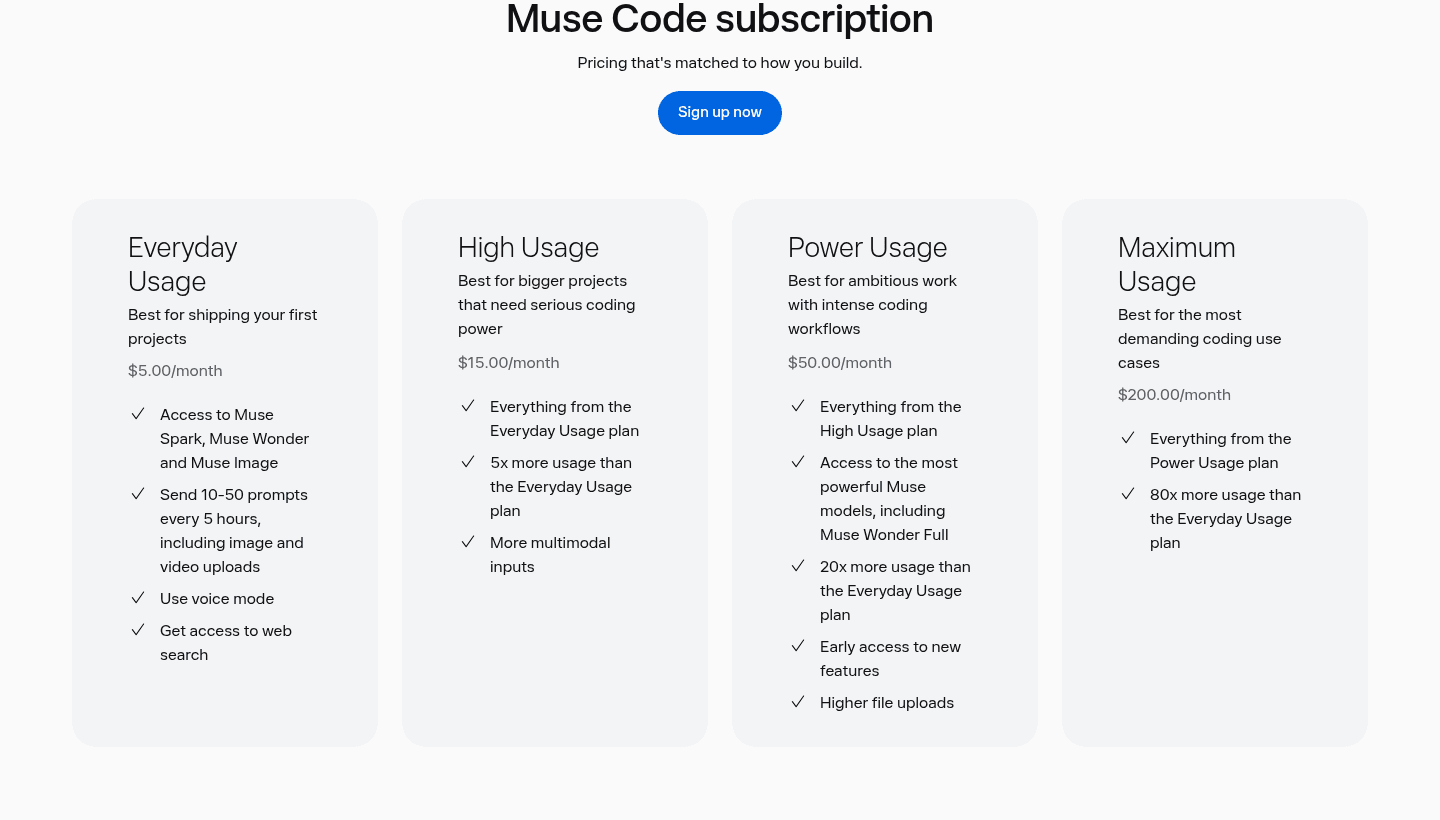
The catch is access. Full is only on the Muse Code Power Usage plan at $50 a month and Maximum Usage at $200. It has no token price, and Meta's model docs say setting effort to max on plain Wonder does not select it. A subscription key also only works inside the Muse Code CLI, so you can't put your product's traffic on it.
"Super interesting that they're not even making Wonder Full available outside of their own coding harness, and thus not providing an API price to use in comparisons."
Two more things to know before you pay. The subscriptions docs say plans default to Contributor mode, which lets Meta train on your prompts, code and files until you switch it off. And the plans are 18+, with no refunds and availability that varies by region; one commenter reported the subscription is North America only for now.
Pros: Meta's strongest model; leads on legal, finance, workflows and very long coding; flat monthly price instead of per-token billing.
Cons: subscription only, inside Muse Code only; Contributor mode on by default; region-limited; can't be used to power an app.
Pricing: Power Usage $50/month (20x Everyday usage) or Maximum Usage $200/month (80x). The cheaper Everyday ($5) and High ($15) plans include plain Wonder only. More in Muse Code pricing.
My take: if you wanted Wonder for your own coding, skip the API and pay $50 for Full, with Contributor mode off on day one. If you wanted Wonder inside a product, Full isn't an option, so look at items 1 and 2. The Muse Code alternatives post covers the other coding agents at the same budget.
4. GPT-6.1 Sol: Wonder's score at half the price
Best for: production apps where Wonder's level of quality is enough and the bill matters.
GPT-6.1 Sol scores 52 on Meta's own launch chart, the same as Wonder. OpenAI's pricing page lists it at $2 input, $0.10 cached and $10 output, exactly half of Wonder on every line. For a product team, that's the cleanest trade on this list: same benchmark level, half the bill.
It's also efficient per task. Artificial Analysis measured 6.1 Sol at max effort at about $0.72 a task, and xhigh effort beats max on its coding agent index. It has a 1,050,000-token context window, 128,000 max output tokens, and US and EU data residency. OpenAI's own claim at DevDay was that it matches GPT-6 Astra on DeepSWE at about a fifth of the cost.
Where it differs from Wonder is in the API shape. 6.1 Sol has no none or minimal effort, and Chat Completions works without tool calling only, so agents should use the Responses API. Prompts above 272K input tokens bill at a higher rate.
Pros: same index score as Wonder at half the price; cheap per task; strong coding agent results; EU data residency.
Cons: no none effort; tool calls need the Responses API; long prompts over 272K cost more; not open weights.
Pricing: $2 / $0.10 / $10 per 1M tokens, cache write $2.50; over 272K input $4 / $0.20 / $15; Batch and Flex $1 / $5. Breakdown in GPT-6.1 Sol pricing.
My take: if you were going to use Wonder as a solid workhorse rather than a showpiece, this is the one. Run your tasks through both, and unless Wonder wins clearly, half the price wins.
5. GPT-6 Astra: OpenAI's top tier, at 2.5 times Wonder's price
Best for: teams already on OpenAI who need its top model or its Ultrafast speed tier.
GPT-6 Astra was the first name on the AI assistant's shortlist, and it's a strong model: a 1,050,000-token window, hosted shell, apply-patch, computer use and MCP built in, and the top score on Meta's GDP.pdf professional-work row (34.2). It's also the first model OpenAI rated "Critical" for cybersecurity, with advanced cyber use gated.
But the numbers don't favour it as a Wonder replacement. It scores 53 on Meta's chart, one point above Wonder, while costing $10 input and $50 output per million tokens, 2.5 times Wonder's price. Wonder Full beats it on 11 of 14 rows in Meta's table. On Artificial Analysis, Astra at max effort costs about $3.26 a task.
The one thing only Astra has right now is Ultrafast. OpenAI's pricing page lists Ultrafast rates for Astra alone, at $60 input and $300 output per million tokens. If your product needs that speed tier this month, it's the only option in the GPT-6 family.
Pros: OpenAI's strongest model; built-in agent tools; top GDP.pdf score in Meta's table; the only Ultrafast option.
Cons: 2.5 times Wonder's price for one more index point; long prompts over 272K bill at $20 / $75; Wonder Full outscores it on most of Meta's rows.
Pricing: $10 / $1 / $50 per 1M tokens; Batch and Flex $5 / $25; Fast $20 / $100; Ultrafast $60 / $300. See GPT-6 Astra pricing.
My take: I wouldn't move from Wonder to Astra for quality alone. Pick it if you're standardising on OpenAI and need Ultrafast, or if your own tests show it winning on professional documents.
6. Claude Sonnet 5.5: half of Opus, close on coding
Best for: coding agents and tool-heavy apps that want Anthropic quality at half the Opus price.
Claude Sonnet 5.5 costs $2 input and $10 output, half of Wonder, and Anthropic's pricing docs now list its cache hit at $0.10, half of Wonder's $0.20. It scores 56 on Artificial Analysis at max effort, above plain Wonder. In Anthropic's launch numbers it even beats Opus 5.5 on Terminal-Bench 4.0 (70.6 against 66.4).
The caveat is effort. That 56 comes at max effort, where Artificial Analysis measured about $7.60 a task, more than Opus 5.5. At high effort it scores 47 for $1.08, and Anthropic itself says the savings show up at low and medium effort. My Sonnet 5.5 review found it great at medium and a trap at max.
It also shipped with breaking changes: forced tool_choice returns an error, thinking: disabled returns an error, and thinking blocks are bound to the model, so conversation history has to stay append-only.
Pros: half Wonder's per-token price, with a cheaper cache hit; strong terminal coding; same 1M window and 128K output as Opus.
Cons: max effort costs more per task than Opus 5.5; breaking API changes from Sonnet 5; no forced tool use.
Pricing: $2 / $0.10 / $10 per 1M tokens; 5-minute cache write $2.50, 1-hour $4; Batch $1 / $5. Breakdown in Sonnet 5.5 pricing.
My take: a good Wonder replacement for coding agents if you keep it at low or medium effort. If you find yourself turning it up to max, switch to Opus 5.5 instead.
7. Muse Spark 1.3: Meta's own answer for volume
Best for: high-volume and latency-sensitive work, for teams that want to stay with Meta's API.
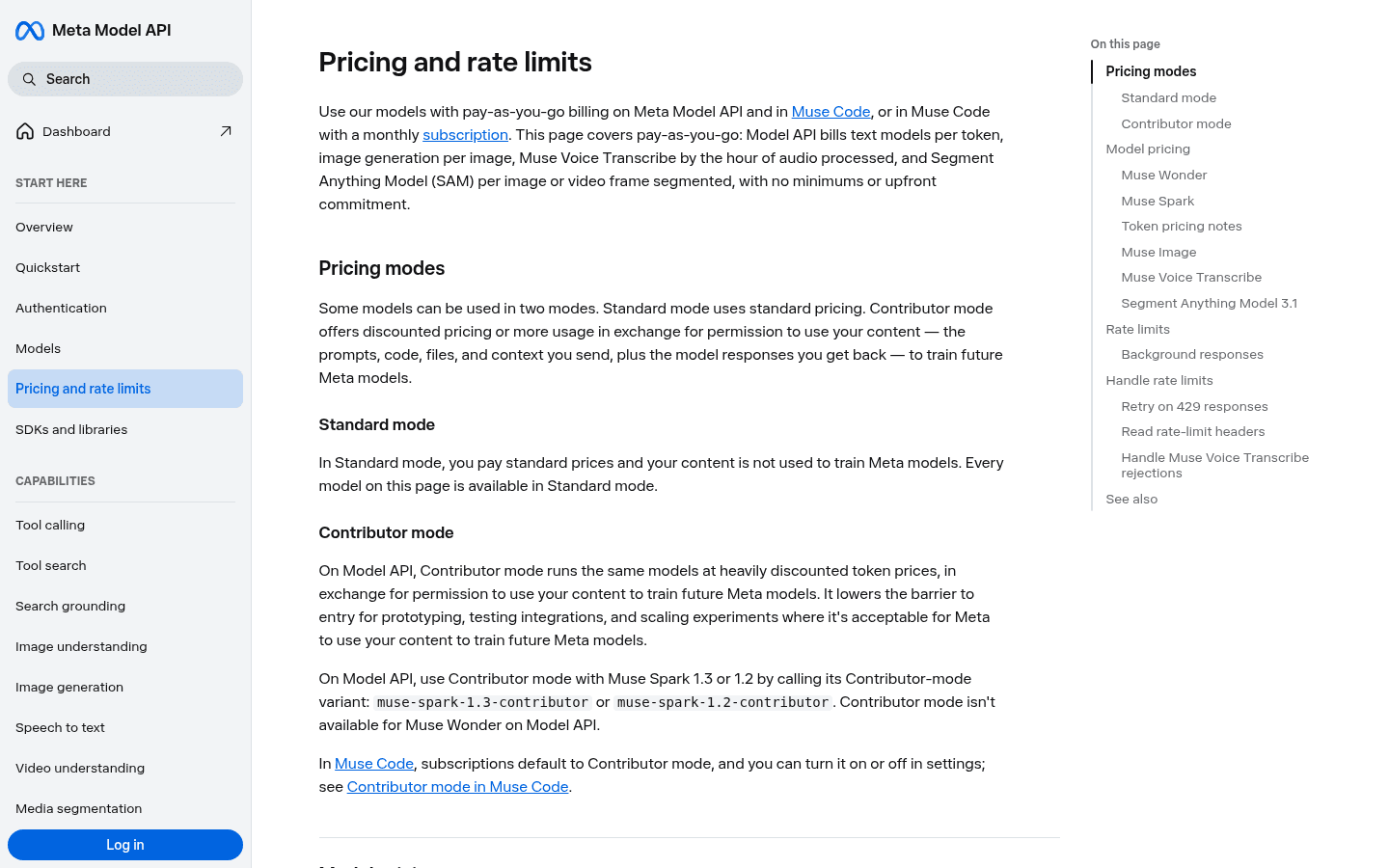
This is the alternative Meta itself recommends. Its model docs pitch Wonder for long-running, complex tasks and point high-volume, latency-sensitive or cost-sensitive work to Muse Spark. Muse Spark 1.3 costs $1.25 input, $0.15 cached and $4.25 output per million tokens, under a quarter of Wonder's output price, and scores 48 on Meta's chart.
Regular users rate it well for its price:
"I've been a regular user of muse spark 1.3 ... and I can tell you one thing for sure that this model, muse-spark-1.3 in xhigh mode, is between sol-6-medium and high."
Spark also has something Wonder doesn't: a Contributor variant on the API. Meta's pricing page explains that muse-spark-1.3-contributor runs at heavily discounted prices (around $0.10/$0.20) in exchange for letting Meta train on your content. Contributor mode isn't available for Wonder on the API. It is a fine trade for prototypes and a bad one for customer data. One more thing to know: Spark 1.3 is verbose, using about 120 million output tokens to finish the Artificial Analysis index against a 72 million median.
Pros: under a quarter of Wonder's output price; same API, same vendor, easy to route between; optional Contributor discount for non-sensitive work.
Cons: 4 points below Wonder on the index; verbose, which eats into the savings; the open weights Meta promised for Spark haven't shipped.
Pricing: Standard $1.25 / $0.15 / $4.25 per 1M tokens; Contributor variant about $0.10 / $0.20 with training on your data. See Muse Spark 1.3 pricing.
My take: the smart Meta setup is routing, not choosing: Spark for the bulk of requests, Wonder for the long, hard ones. If most of your traffic is simple, that alone cuts the bill sharply.
8. Gemini 3.8 Flash: the cheap option with a free tier
Best for: batch jobs, prototypes and cost-first pipelines where nobody is waiting on the first token.
This is the "speed and cost" slot the AI assistant filled with Gemini 3.5 Flash, which Google has since deprecated. The current model, Gemini 3.8 Flash, costs $0.75 input and $3.75 output per million tokens, about a fifth of Wonder's price, and it's the only model on this list with a free tier. Google also deprecated 3.7 Flash on October 8 and routes its requests to 3.8.
It scores 41 on Artificial Analysis at high effort, well below Wonder, for about $1.24 a task. Two catches. First, the price doubles to $1.50/$7.50 on January 1, 2027. Second, Artificial Analysis measured a 13.30-second time to first token, so it's a poor fit for anything a person waits on, like a chat widget.
On the free tier, Google's pricing page says your content is used to improve its products; on the paid tier it isn't.
Pros: about a fifth of Wonder's price; free tier for testing; Batch and Flex at half price; 1M window.
Cons: far below Wonder on the index; slow first token; price doubles on January 1; the free tier trains on your data.
Pricing: $0.75 / $0.075 / $3.75 per 1M tokens through December 31, then $1.50 / $0.15 / $7.50; Batch and Flex at 50% off. See Gemini 3.8 Flash pricing.
My take: good for the overnight batch job you were going to overpay Wonder for. Not a replacement for Wonder's hard tasks, and not for anything live.
9. DeepSeek V4.1 Flash: open weights and the smallest bill
Best for: teams that need open weights or the lowest possible per-token cost.
Muse Wonder isn't open weights, and Meta still hasn't published the weights it promised for Muse Spark. If you need a model you can run yourself, DeepSeek V4.1 Flash is the strongest option here: MIT-licensed weights on Hugging Face, a 1M context window and up to 384K output tokens.
The hosted API is very cheap. DeepSeek's pricing page lists deepseek-flash at $0.15 input and $0.60 output per million tokens off-peak, and $0.30/$1.20 during peak hours (weekday mornings UTC). That's about 3% of Wonder's output price off-peak. Artificial Analysis scores it 39.5 at max effort for about $0.27 a task.
The trade-offs are real. Its hallucination rate on Artificial Analysis is 96%, the highest I've seen on a current model, so it needs strict grounding. The hosted API processes data in China, and the paid terms don't say whether your data is used for training. Self-hosting fixes the data question but needs serious hardware for a 552B-parameter model.
Pros: open weights under MIT; the lowest price on this list; strong tool-using results for its cost; 384K max output.
Cons: 12.5 points below Wonder on the index; very high hallucination rate; data concerns on the hosted API; heavy to self-host.
Pricing: off-peak $0.003 cache hit, $0.15 input, $0.60 output per 1M tokens; peak rates double. See DeepSeek V4.1 Flash pricing. Kimi K3 is the other open-weights option, at $3/$15.
My take: pick it for open weights or bulk processing of non-sensitive text. Keep it away from anything where a confident wrong answer is expensive.
How to test your shortlist: the same five tasks for every finalist
Here's the part the benchmark tables can't do for you. Pick two or three finalists from above, then run the same five tasks through each, plus Wonder itself. Log three numbers for every run: pass or fail, cost, and seconds.
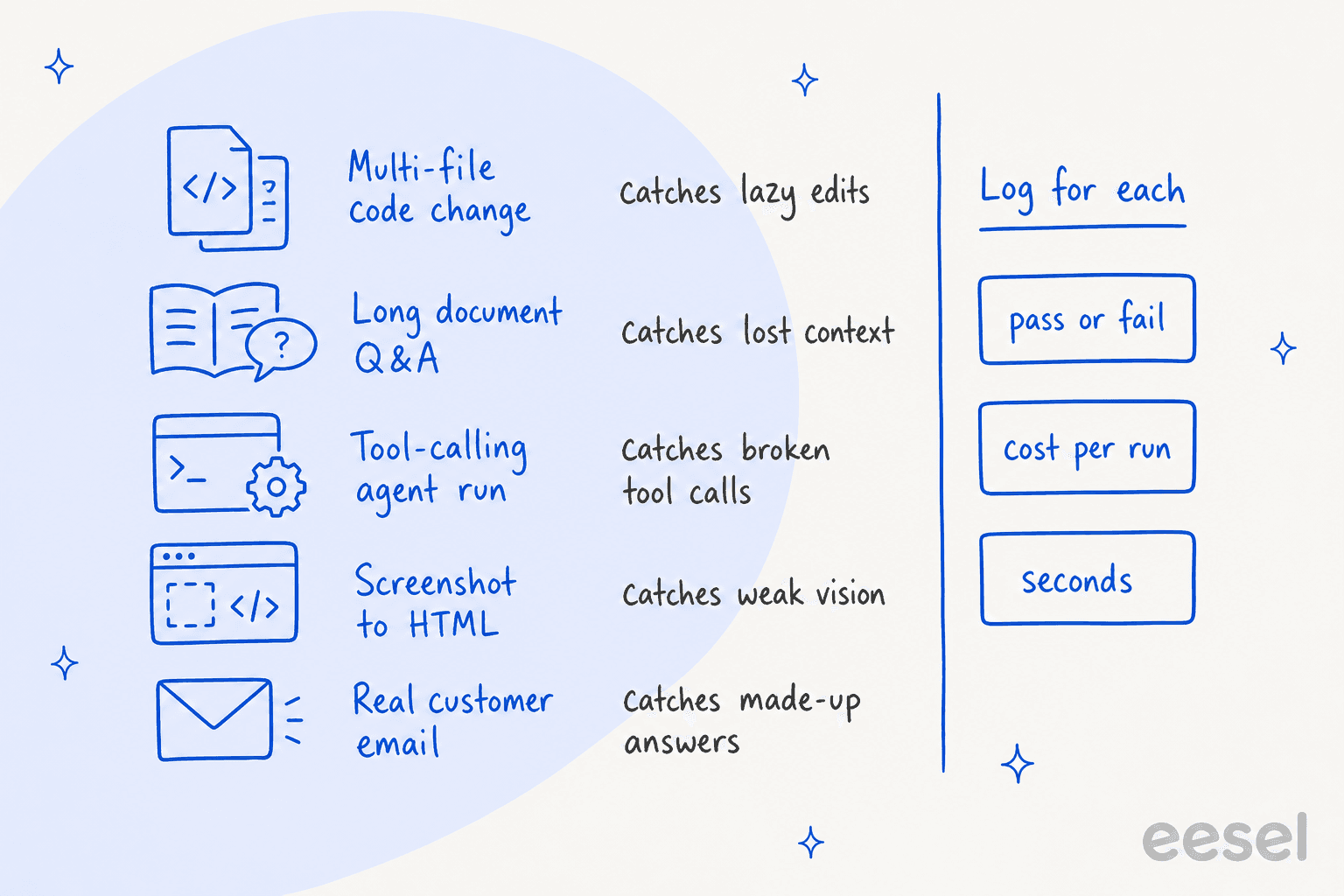
Each task is there to catch a specific failure. And each finalist has a task it should win, if its benchmarks are honest:
| Finalist | What I'd test first | Main question |
|---|---|---|
| Claude Opus 5.5 | Screenshot to HTML, multi-file code change | Does Wonder beat it on anything at the same price? |
| Gemini 4 Argon | Long document Q&A | Does it stay accurate over 500K tokens, and will the December price still make sense? |
| Muse Wonder Full | Multi-file code change in Muse Code | Is it worth $50 a month over plain Wonder? |
| GPT-6.1 Sol | Tool-calling agent run | Is half the price enough quality for production? |
| Muse Spark 1.3 or Gemini 3.8 Flash | The easiest 80% of your real traffic | Can the cheap model take most requests? |
The screenshot-to-HTML task is in there for a reason. One developer ran it on launch day and found plain Wonder much weaker than Opus 5.5, closer to Sonnet or Haiku. That's the kind of gap a one-hour test finds and a benchmark table hides.
Keep the test small enough to rerun. Model prices and versions are moving every few weeks (Argon's changes on December 1, Flash's on January 1), and the cheapest way to stay on the right model is to rerun the same five tasks whenever something ships.
What switching models means for a support team
If you're a developer, the test above is your next step. If you're a support lead who ended up here from Wonder's launch coverage, the honest answer is different: the model is the smallest part of an AI support agent.
Whichever model you pick, someone still has to connect it to your helpdesk, keep its answers inside your approved knowledge, decide when it hands off to a person, and prove it's right before a customer sees it. Those are the jobs I spend most of my time building, and none of them change when the model does. The notes on Muse for customer support and Muse for Zendesk show how much glue that takes with a raw model.
It's also why the DeepSeek and Gemini Flash hallucination numbers above matter more for support than for code. A wrong line of code fails a test. A wrong refund policy reaches a customer. If you're building it yourself anyway, the best model for support tickets guide compares models on that job specifically, and the AI agents vs chatbots explainer covers what the agent layer adds.
Try eesel
Muse Wonder and every model on this list are infrastructure; eesel is the employee. eesel is an AI teammate platform where you hire ready-to-work teammates for specific jobs, and today that's two roles: an AI helpdesk teammate and an AI blog writer. Each runs on frontier models, so you get the benefit of model upgrades without rerunning a model bake-off every month.
The helpdesk teammate plugs into Zendesk, Freshdesk or Gorgias, learns from your past tickets and help center, and answers only from what you've approved. Before it replies to anyone, you can run it against your historical tickets and see what it would have said. Plans are a flat monthly fee where one ticket is one credit, from $299 a month for 500 credits, with 100 free credits to start, per the eesel pricing page.
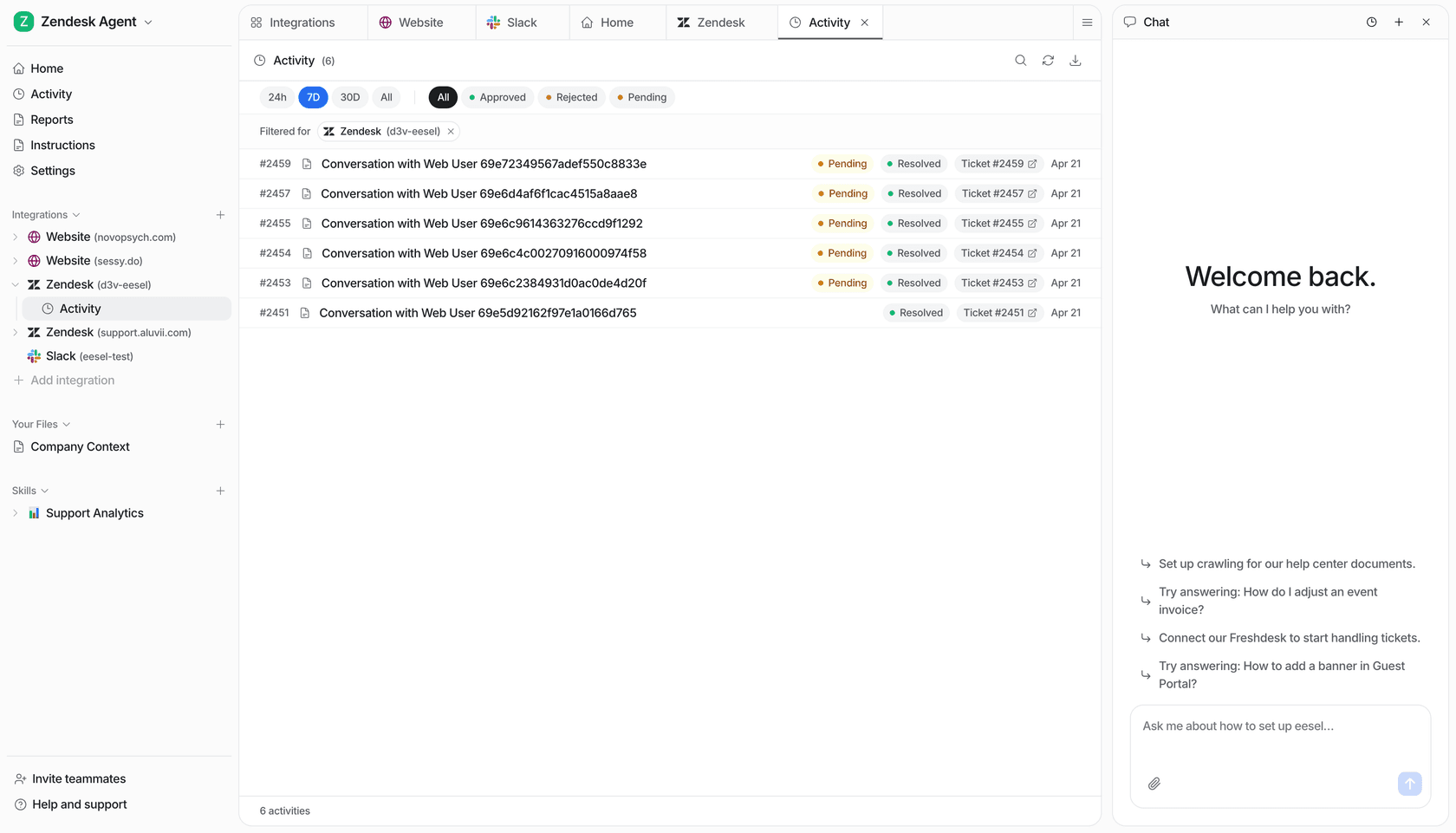
Since you're probably a developer if you read this far, the eesel CLI is worth knowing about. It's an npm package (@eesel/cli) that drives the same teammate and workspace as the dashboard, from your terminal, a script or a coding agent like Claude Code. eesel activity lists what the teammate did and lets you read any run in detail, eesel approvals list shows actions waiting for a human, and --dry-run prints the exact call a change would make without sending it. Every command prints JSON, and your workspace also works as an MCP server, so an agent can manage it the same way you would. The guide to managing agents from the terminal walks through it.
If Wonder caught your eye because you want AI working your support queue, skip the model shopping and try eesel on your own tickets.