The 8 best Xiaomi MiMo V2.6 alternatives in 2026

Rama Adi Nugraha

Katelin Teen
Last edited September 23, 2026

Why look for a MiMo V2.6 alternative
Let me be fair to MiMo first, because it earned the attention. The 1T-parameter Pro model leads the 2.8T-parameter Kimi K3 on 14 of 15 benchmarks that one commenter tallied by hand, at a fraction of the size, and Xiaomi held the price flat from V2.5. It is MIT-licensed, natively omnimodal, and ships with a 1M-token context. The community reaction was unusually warm, and mostly about the transparency rather than the scores.
So why shop around? A few honest reasons:
- The benchmark lead is narrowest where it matters most. On Terminal Bench 4.0, MiMo-V2.6-Pro scores 34.9, well below GPT-6 Astra's 59.6 and Claude Opus 5's 49.0. On the hardest real coding boards, MiMo tops the open field cheaply but trails the halo models. If your work lives on those tasks, the extra spend on a frontier model can pay for itself.
- Data residency is a real constraint. MiMo's hosted API runs under PRC law, and self-hosting the Pro checkpoint needs a 2-node, 16-GPU box. For regulated or customer data, that is a genuine blocker, not a nitpick.
- "Benchmaxxing" skepticism. A recurring worry in the community is that index leads don't survive contact with production code. As one Hacker News commenter put it, bluntly:
"No chinese lab has caught up yet... the 'best' models available from chinese labs right now (GLM 5.3 and Kimi K3) fall apart completely when you try to do real work with them."

That is one view, and the opposite is well argued too (plenty of engineers report the cheap Chinese models plus a supervising frontier beat the pricey US models on ROI). But the disagreement itself is the reason to know your alternatives.
How I picked these alternatives
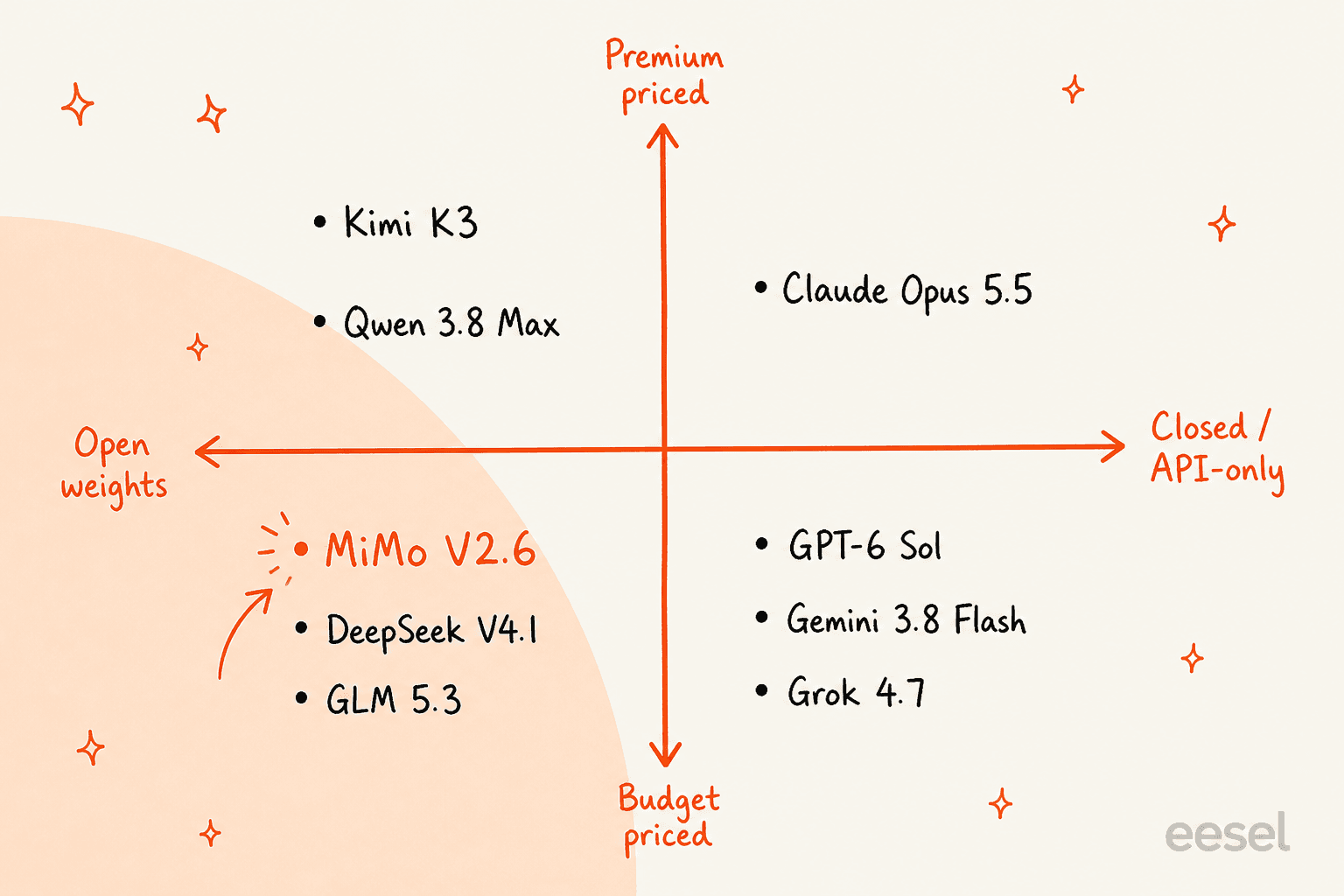
I kept the shortlist to models that are actually shipping and that a real team would consider next to MiMo V2.6. That meant three filters: current (all launched or repriced in the last few months of 2026), comparable (they show up in the same benchmark tables MiMo is measured against), and distinct (each one wins on a different axis, so the list isn't eight versions of the same trade-off).
I leaned on primary sources for every number: the vendors' own model cards and pricing pages, OpenRouter listings, and the Artificial Analysis index for a neutral intelligence-vs-cost read. Where the community had a sharp, checkable point, I quoted it with a permalink. Prices below are per 1M tokens unless noted.
MiMo V2.6 alternatives at a glance
| Model | Type | Params | Context | Price /1M (in / out) | AA Intelligence | Best for |
|---|---|---|---|---|---|---|
| MiMo V2.6 Pro | Open (MIT) | 1.02T / 42B active | 1M | $0.435 / $0.87 | 46 | Cheapest top open model |
| DeepSeek V4.1 | Open (MIT) | 552B MoE | 1M | $0.15 / $0.60 (off-peak) | workhorse tier | Cheap tool-using workhorse |
| Kimi K3 | Open | 2.8T / 104B active | 1M | $3 / $15 | 57 | Biggest open model |
| Qwen 3.8 Max | Open (hosted) | 2.4T / 95B active | 1M | $2 / $6 | 58 | Local-friendly small variants |
| GLM 5.3 Flash | Open | 320B / 18B active | 1M | $0.15 / $0.50 | 57 | Cheap real-code open model |
| Claude Opus 5.5 | Closed | Not disclosed | 1M | $5 / $25 | 58 | Highest reasoning ceiling |
| GPT-6 Sol | Closed | Not disclosed | 1.05M | $2 / $10 | 48 | Cheapest per completed task |
| Gemini 3.8 Flash | Closed | Not disclosed | 1M | $0.75 / $3.75 | 59 | Huge multimodal context |
| Grok 4.7 | Closed | Larger base model | 500K | $2 / $6 | 46 | Volume agent loops, live X data |
1. DeepSeek V4.1
Best for: teams that want the cheapest capable open model with a real track record.
DeepSeek V4.1 Flash went GA on 2026-09-10, and DeepSeek retired the older V4 Pro into it, routing those requests to V4.1 Flash at Flash rates. It is the reference Chinese open model, and MiMo is repeatedly framed as the cheaper backup to it rather than the other way around. The architecture is genuinely novel: a 552B-parameter causal encoder-decoder that uses 8B active params for input and 16B for output, with a KV cache about 4x smaller than the last generation. The weights are MIT-licensed with native vision built in.
On DeepSeek's own table, V4.1 leads on Terminal-Bench 2.1 (90.6), DeepSWE (74.2), and HLE-with-tools (63.9, just above Opus 5). Community benchmarks clock it at 250-400 tokens/second, unseating Gemini Flash as the fastest option many people had tried.
Pros:
- Cheapest serious open model: off-peak cache-miss input runs $0.15, output $0.60 per 1M, and off-peak covers most US and EU business hours.
- MIT weights, native multimodal vision, 1M context.
- A proven, widely-deployed workhorse, not a week-one release.
Cons:
- Raw reasoning is the weak spot: HLE of 36.8 sits below GPT-6 Sol and Opus 5. It is a tool-user, not a reasoning champ.
- Peak-hour rates (01:00-04:00 and 06:00-10:00 UTC) double the price, so cost is a moving target.
- The paid API terms are silent, not permissive, on training use, and data is processed in the PRC, so think twice before you send customer data through it.
Verdict: if MiMo's price is what drew you in, DeepSeek V4.1 is the most direct swap, and arguably the safer bet on maturity. Pick it when you want a cheap engine for tool-heavy work and can live with the data-residency caveat.
2. Kimi K3
Best for: teams that want the biggest open model on the board and will pay for the ceiling.
Moonshot's Kimi K3 launched on 2026-07-16 as a 2.8T-parameter model with 104B active, and Moonshot shipped the open weights on time, which not every lab does. It scores 57 on the Artificial Analysis index, good for fourth overall, and it is the model MiMo is most often measured against to make the size-versus-performance point.
The catch is that K3 is where the "bigger isn't cheaper" lesson bites. Its API runs $3 in and $15 out per 1M, the same band as a mid-tier closed model, and reasoning cannot be turned off at any level. That GodelNumbering tally is worth quoting because it captures the exact tension:
"Mimo 2.6 pro, the 1T model leads Kimi K3, a 2.8T param model in 14 out of 15 benchmarks (and the last one is near tie)!!"
Pros:
- Open weights, 1M context, native vision, strong general intelligence (AA index 57).
- Genuinely capable on hard reasoning where MiMo is thinner.
Cons:
- Roughly 50x MiMo's output price at $15 per 1M, and about the same as Claude Sonnet-tier pricing.
- Reasoning is always on, so it is a latency cost you cannot dial down.
- 1,561 GB of weights make self-hosting a serious hardware project.
Verdict: K3 is the open model you reach for when you want maximum capability and the size doesn't scare you, but on pure price-for-intelligence, MiMo and DeepSeek both beat it. Choose K3 when the ceiling matters more than the bill.
3. Qwen 3.8 Max
Best for: teams that want an open family with genuinely local-friendly small variants.
Alibaba's Qwen 3.8 Max went GA on 2026-08-02, a 2.4T / 95B-active MoE with a 1M context. On the Artificial Analysis board it sits at rank 6 with an index of 58, and it is strong on LMArena too (Text #5, Vision #2). API pricing is $2 in and $6 out per 1M through Qwen Cloud.
The reason Qwen keeps coming up as a MiMo alternative is the family, not just the flagship. The community favorite for local inference is the smaller Qwen models, which one commenter called "crazy good for how small it is" and runnable indefinitely on a workstation-class box. The hosted Max weights shipped, but under a non-Apache license; the permissive, truly-local option is the smaller Qwen3.8-27B (Apache 2.0).
Pros:
- Strong all-round intelligence (AA 58) and excellent human-preference scores.
- A real ladder of sizes, including a permissively-licensed small model for local runs.
- Sensible $2 / $6 hosted pricing.
Cons:
- The hosted Max and the open base are not feature-equivalent (vision, non-thinking, and 1M default context are hosted-only).
- Its own coding harness caps output at 65K tokens, so it never asks for the full 131K ceiling out of the box.
- Automated composite scores and human preference point in different directions, so don't trust a single-number verdict.
Verdict: Qwen 3.8 Max is the pick when you want an open family you can grow into, from a laptop-friendly small model up to a frontier-adjacent flagship. If "local" is a hard requirement, Qwen gives you the cleanest path of any model here.
4. GLM 5.3 Flash
Best for: teams that want the cheapest open model that holds up on real code.
Z.ai's GLM 5.3 Flash launched on 2026-08-26 as the first natively multimodal GLM-5 model, a 320B / 18B-active MoE with a 1M context and open weights. It scores an Artificial Analysis index of 57 at roughly $0.045 per task, which puts it right in MiMo's budget tier. API pricing is $0.15 in and $0.50 out per 1M (the launch promo of $0.075 / $0.25 has ended).
GLM is the open model people specifically name when the argument turns to real coding rather than benchmarks. In that same skeptical Hacker News thread, the counter-argument was that GLM plus a supervising frontier already beats the pricey US models in practice:
"I mean DSv4.1 Flash and GLM 5.3 kept in check by a supervising frontier like Astra or Fable already in my experience clowns massively on ever using Opus or Sonnet."
Pros:
- Very cheap ($0.15 / $0.50) with a strong AA index (57), open weights, 1M context.
- A real reputation for holding up on production coding tasks.
- A separate text-only flagship (GLM-5.3 at $1.40 / $4.40) for heavier coding and cyber work.
Cons:
- The first-party API is slow (~49 tokens/second); you need a third-party host like Databricks for real throughput.
- Thinking cannot be disabled.
- Like the other Chinese open models, the data-residency and training-use questions apply.
Verdict: GLM 5.3 Flash is the value-plus-coding pick. If DeepSeek is the cheap generalist and Kimi is the big one, GLM is the one to trial when your workload is mostly code and the bill still has to be tiny.
5. Claude Opus 5.5
Best for: teams that need the highest reasoning ceiling on the hardest agentic work.
If MiMo's weak spot is the top of the difficulty curve, Claude Opus 5.5 is the model that owns it. Anthropic's flagship posts the #1 Artificial Analysis Intelligence Index (58) and leads MiMo comfortably on Terminal Bench 4.0 and the hardest coding agent boards. It runs $5 in and $25 out per 1M with a flat 1M context (no long-context surcharge), and cache reads are a tenth of that.
The honest counterweight is cost per task. Opus spends a lot of output tokens: on the Artificial Analysis index it runs about $5.98 per task at max effort, against MiMo's $0.13. You are paying frontier prices for a frontier ceiling.
Pros:
- Top reasoning and agentic scores; the ceiling MiMo can't reach on the hardest boards.
- Flat 1M context pricing, mature tooling, and a clear data-handling posture for regulated work.
Cons:
- Expensive per token, and even more so per completed task because it is verbose at high effort.
- Slow time-to-first-token at max effort, which hurts anything a human waits on.
- Closed weights, so self-hosting and true local inference are off the table.
Verdict: Opus 5.5 is the anti-MiMo: not the value play, but the capability play. Reach for it when the task genuinely needs the best available reasoning and the budget can absorb it, and pair it with a cheaper model for the routine 80%.
6. GPT-6 Sol
Best for: teams that want a hosted frontier at the lowest cost per completed task.
OpenAI's GPT-6 Sol launched on 2026-09-22, the same day as MiMo, and its whole story is value. It priced in at $2 in and $10 out per 1M, a flat 50% cut versus GPT-5.6 Sol, with a 1.05M context. Its Artificial Analysis Intelligence Index (48) is level with the previous generation, so this is a price cut wearing a version bump, not a capability jump, but that is exactly what makes it a strong MiMo alternative for hosted work.
The number that matters is cost per task, where Sol is unusually efficient because it uses far fewer output tokens than Opus. On the Artificial Analysis index it runs about $1.06 per task at max effort against Opus 5.5's $5.98, roughly 5.6x cheaper for a model only a notch behind on intelligence. Factuality also improved, with max-effort hallucination dropping from 92% to 60%.
Pros:
- Cheap for a hosted frontier: $2 / $10, and dramatically cheaper per completed task than Opus.
- Huge 1.05M context, full Responses tool set, and a big factuality improvement over 5.6.
- The reliability and data posture of a US frontier lab.
Cons:
- Intelligence is flat versus the prior generation, so if you needed a real jump, you won't find it here.
- Closed weights and no free tier for Sol specifically.
- Long-context requests bill at a higher tier ($4 / $15), the same 200K-style cliff OpenAI and xAI both charge.
Verdict: GPT-6 Sol is the closest thing to "MiMo economics with a frontier lab's reliability". If you want a hosted model, care about the total bill, and don't need Opus-grade reasoning, Sol is the value default.
7. Gemini 3.8 Flash
Best for: teams that want massive multimodal context from a frontier lab, cheaply.
Google's Gemini 3.8 Flash shipped on 2026-09-02, its third Flash release in six weeks. It is not a new base model (the card says four times over that it is based on 3.7 Flash), which is why the price didn't move: $0.75 in and $3.75 out per 1M through the end of 2026, then $1.50 / $7.50 from January. It carries a top-tier Artificial Analysis Intelligence Index of 59 and takes text, image, audio, video, and PDF in.
The under-reported catch is responsiveness. Artificial Analysis measures a 13.30-second time to first token against a 2.99-second class median, even while ranking it #3 of 196 for raw output speed. Throughput is not the same as latency, which disqualifies it for anything a human waits on live but is fine for an overnight batch agent. Interestingly, Google itself tells efficiency-focused developers to stay on 3.7 Flash.
Pros:
- Top intelligence index (59) at a genuinely cheap price for a frontier model.
- The broadest native multimodal input of any model here, with a 1M context.
- A free tier and generous batch and flex discounts.
Cons:
- Slow to first token, so it is a poor fit for live chat or support replies.
- Verbose (about 120M output tokens to run the index versus a 71M median), which inflates the real bill.
- Google's own advice is that 3.7 Flash is the efficiency pick, which muddies the upgrade case.
Verdict: Gemini 3.8 Flash is the multimodal batch workhorse. If your MiMo use case is document, image, or video-heavy and runs asynchronously, this is the frontier alternative to beat. If a person is waiting on the output, look elsewhere.
8. Grok 4.7
Best for: teams running high-volume agent loops that want live X data and frontier-adjacent quality.
xAI's Grok 4.7 launched on 2026-09-21, built on a larger base model and trained for multi-hour agentic tasks. It is the interesting mirror to MiMo on the Artificial Analysis index: both land at 46, and the same-day timing is why "MiMo mogged Grok" made the rounds. Pricing is $2 in and $6 out per 1M below 200K prompt tokens, and $4 / $12 above, where the long rates apply to the entire request.
Grok's real edge over the open models here is native tooling: live web and X search, code execution, and a design tuned for long agent runs, plus the strongest safety stack xAI has shipped. It is frontier-adjacent rather than frontier-topping (Fable still leads peak coding and terminal work), but it is priced to actually run at volume.
Pros:
- Same AA intelligence as MiMo (46) but with a frontier lab's hosted tooling and live X and web search.
- Priced for volume in agent loops at $2 / $6, with a strong new safety and refusal stack.
- Big improvements on terminal and coding versus Grok 4.6.
Cons:
- 500K context is the smallest of the group, and the over-200K pricing cliff applies to all tokens in a request.
- It loses to GPT-6 Sol and Fable on some professional benchmarks like HealthBench.
- Closed weights, and no historical-ticket dry-run for support-style testing.
Verdict: Grok 4.7 is the "frontier-adjacent at volume" pick, especially if real-time X or web data is part of the job. If you were drawn to MiMo's price but want hosted tooling and can live with the smaller context, it is a fair swap.
What all these benchmarks miss
Here is the thing three years of putting AI on live support queues taught us: the model is the least of it. Every option above is an engine, and a good engine is not a finished car. On its own, a raw model doesn't know your product, can't see your helpdesk, can't take an action, and can't be safely tested against your real history before it talks to a customer.
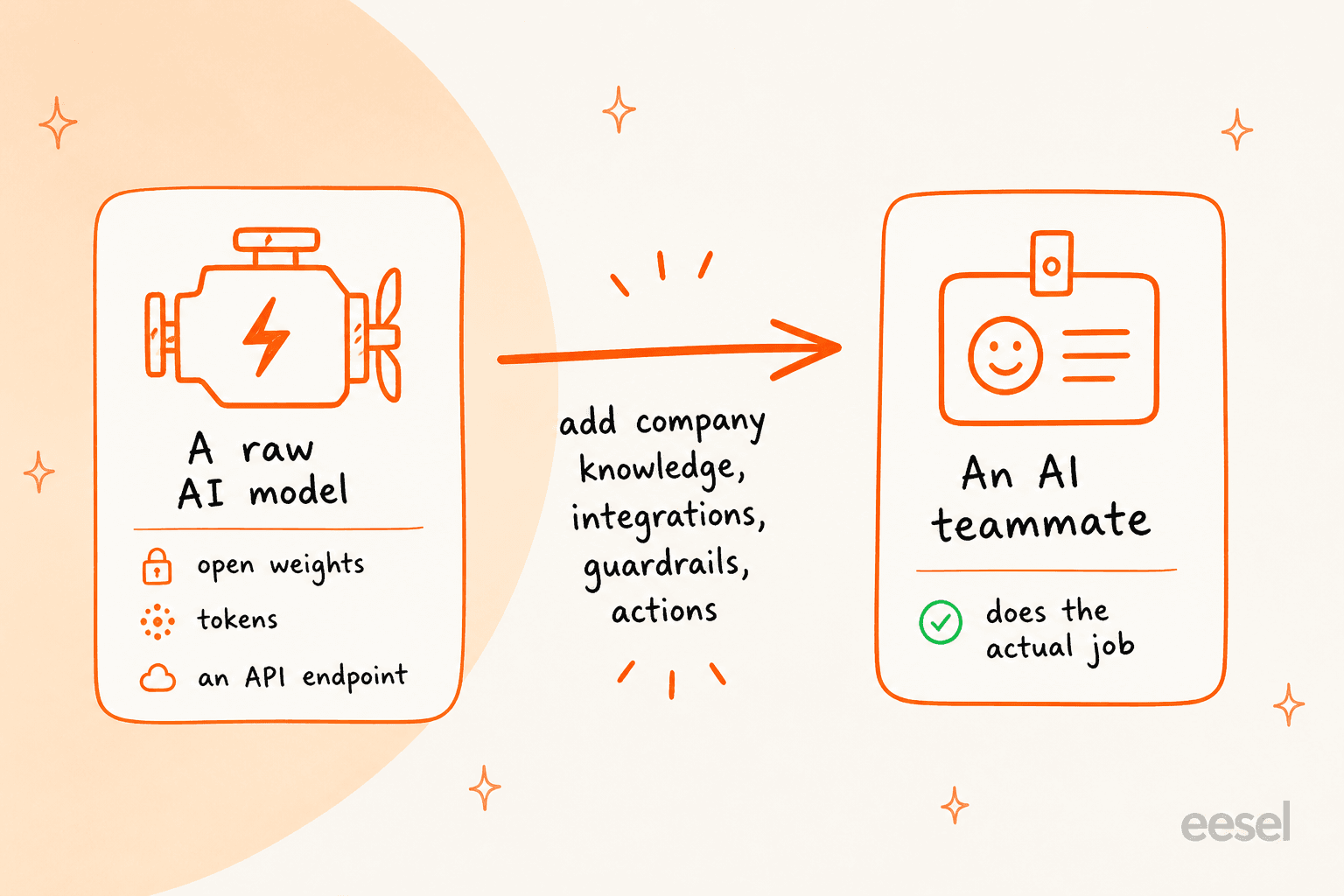
We learned that the hard way, watching a confident-sounding bot quietly give wrong answers, which is why we now simulate every rollout against historical tickets before it goes live. That gap between "a smart model" and "a teammate that does the job" is exactly what benchmarks don't measure, and it is where most of the real work lives: connecting knowledge, wiring integrations, setting guardrails, and proving it works on your own data first.
So the more useful question is often not "which model?" but "who is going to do the job?". If the answer is your engineering team, wrapping a model in all of that, then choose from the eight above based on price, ceiling, and licensing. If the answer is "I just want the outcome", the model becomes an implementation detail.
Try eesel
eesel works at the other end of this decision. Instead of handing you an engine and a build project, it gives you a ready-to-work AI teammate for your helpdesk that already knows your integrations and your company context, and lets the model underneath stay swappable. That is the whole point of the model-is-infrastructure view: you hire the teammate, not the engine.
Concretely, the AI helpdesk teammate joins your existing queue in minutes, learns from your past tickets and help center, and, critically, simulates against your real ticket history before it ever answers a live customer, so you see the projected resolution and quality up front rather than flipping a switch and hoping. And because eesel is built to be driven programmatically, there is a full eesel CLI too: you can operate the same teammate and workspace from a terminal, automate it in scripts, or let a coding agent like Claude Code or Cursor drive it, which is the natural fit if you were shopping for a raw model to script against in the first place.
If you're weighing MiMo V2.6 or any of its alternatives to power support automation, it is worth a look before you commit to a build. Try eesel free, and let the model be the easy part.
Frequently Asked Questions
What is the best Xiaomi MiMo V2.6 alternative?
Are there cheaper alternatives to Xiaomi MiMo V2.6?
Which MiMo V2.6 alternatives have open weights?
Is Xiaomi MiMo V2.6 good enough to skip the alternatives?
Do I need to pick a model at all to automate support?


Article by
Rama Adi Nugraha
Rama is a software engineer at eesel AI with two years of experience writing about B2B SaaS, AI tools, and customer support technology. Based in Bali, Indonesia, he brings a developer's perspective to product comparisons — cutting through marketing copy to what the integrations and APIs actually do.