


Ripple-65B pricing is $0.20 per million input tokens and $0.60 per million output, with cached input at $0.05, and there is only one host behind it: GMI Cloud, directly or through OpenRouter. For a coding agent session with 1M input tokens (80% cached) and 50K output, that is about $0.11, a fifth cheaper than Reflection Beam and roughly level with GPT-5.6 Luna. Self-hosting rarely pays: two rented B200s cost about $7,300 a month, which only beats the API at around 91 tasks an hour, nonstop. If you were pricing Ripple to run a support queue, the model is the cheap part; eesel's AI helpdesk teammate covers the rest, and its CLI lets a coding agent load your help docs and test answers before go-live.
How much does Ripple-65B cost?
Ricursive Intelligence released Ripple-65B Preview on 4 November 2026 as a 65B dense, Apache 2.0 coding model (the Ripple-65B overview covers what it is and how it scores). The weights cost nothing. Hosted access costs the same everywhere it exists, because everywhere it exists is one company's GPUs.
| Route | Input / 1M | Output / 1M | Cached input / 1M | Context | Status (5 Nov 2026) |
|---|---|---|---|---|---|
| GMI Cloud (direct) | $0.20 | $0.60 | $0.05 | 1,000,000 | Live, BF16, no free tier listed |
| OpenRouter | $0.20 | $0.60 | $0.05 | 1,048,576 in the API (page says 16K) | Live, GMI Cloud is the only provider |
| Together AI | Not listed | Not listed | Not listed | 1M on the spec panel | "Coming soon" |
| Hugging Face weights | Free | Free | n/a | Up to 1M | Apache 2.0, no hosted inference provider |
A few details matter more than the sticker:
- The billable unit is the token, both ways. Output costs three times input. A coding agent that reads a lot and writes a little leans on the $0.20 side; one that writes long diffs pays more of the $0.60.
- Caching is a big lever. GMI charges $0.05 for a cached input token and lists no cache-write fee. OpenRouter's pricing panel showed a weighted average of about $0.11 per million input tokens actually paid, because repeat prompts hit the cache.
- There's no free tier. OpenRouter has no
:freevariant, and GMI's model page shows none.
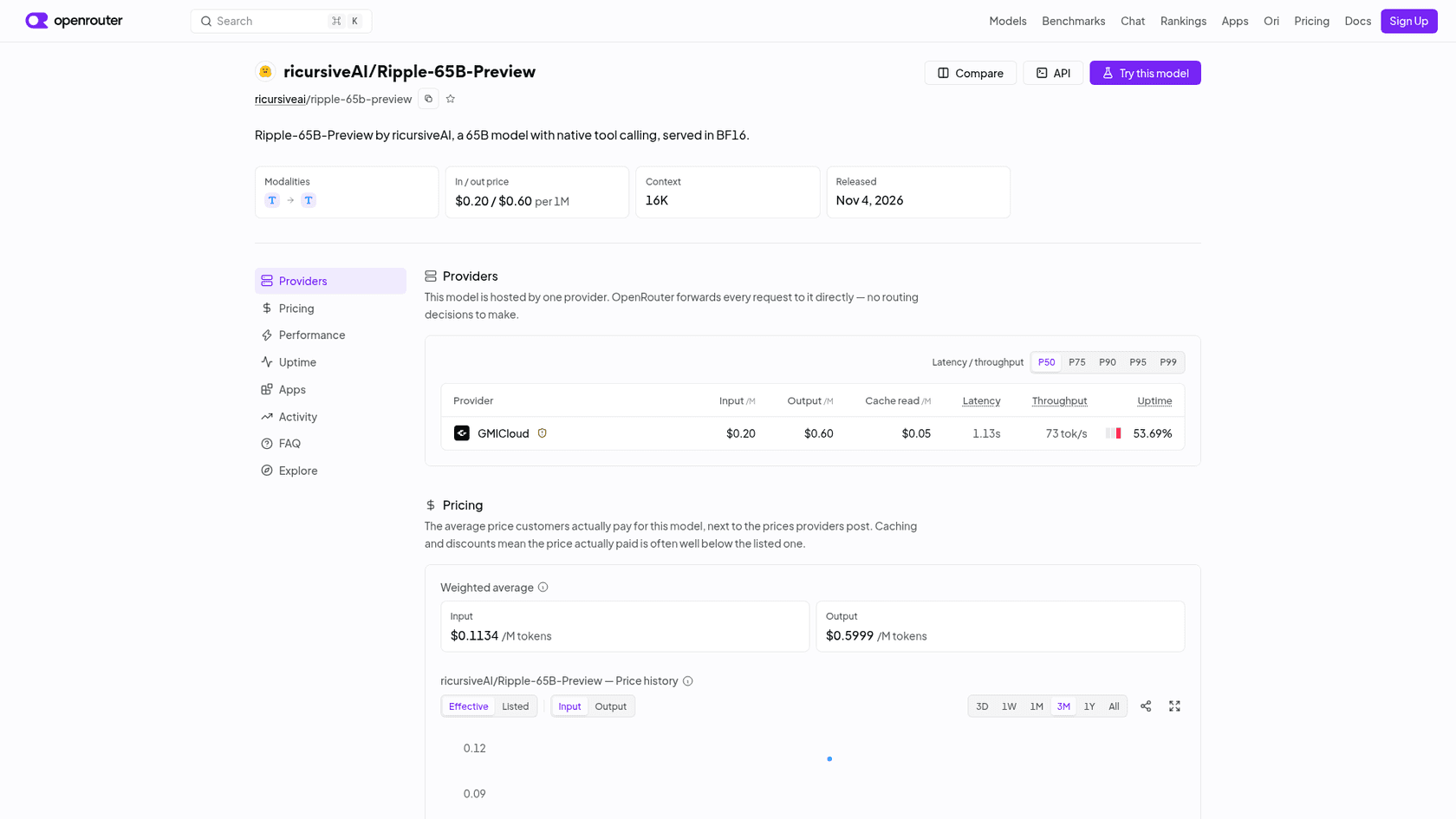
The context window changed while I was writing this
On the morning of 5 November, OpenRouter's endpoints API capped Ripple at 16,384 tokens of context and 14,745 tokens of output. By the afternoon the same API reported 1,048,576 tokens of context and 131,072 of output, while the model page above still displayed "16K". GMI's own page has said 1,000,000 all along. My read: the bigger window is rolling out, and the page hasn't caught up. Before you budget an agent that needs a long context window, send one long prompt and check it isn't truncated.
Where can you buy Ripple-65B today?
Right now, in exactly one place with two front doors. OpenRouter forwards every request to GMI Cloud, at the same price, so picking between them is about convenience: OpenRouter if you already route several models through one key, GMI direct if you want its OpenAI-compatible endpoint without a middle layer.
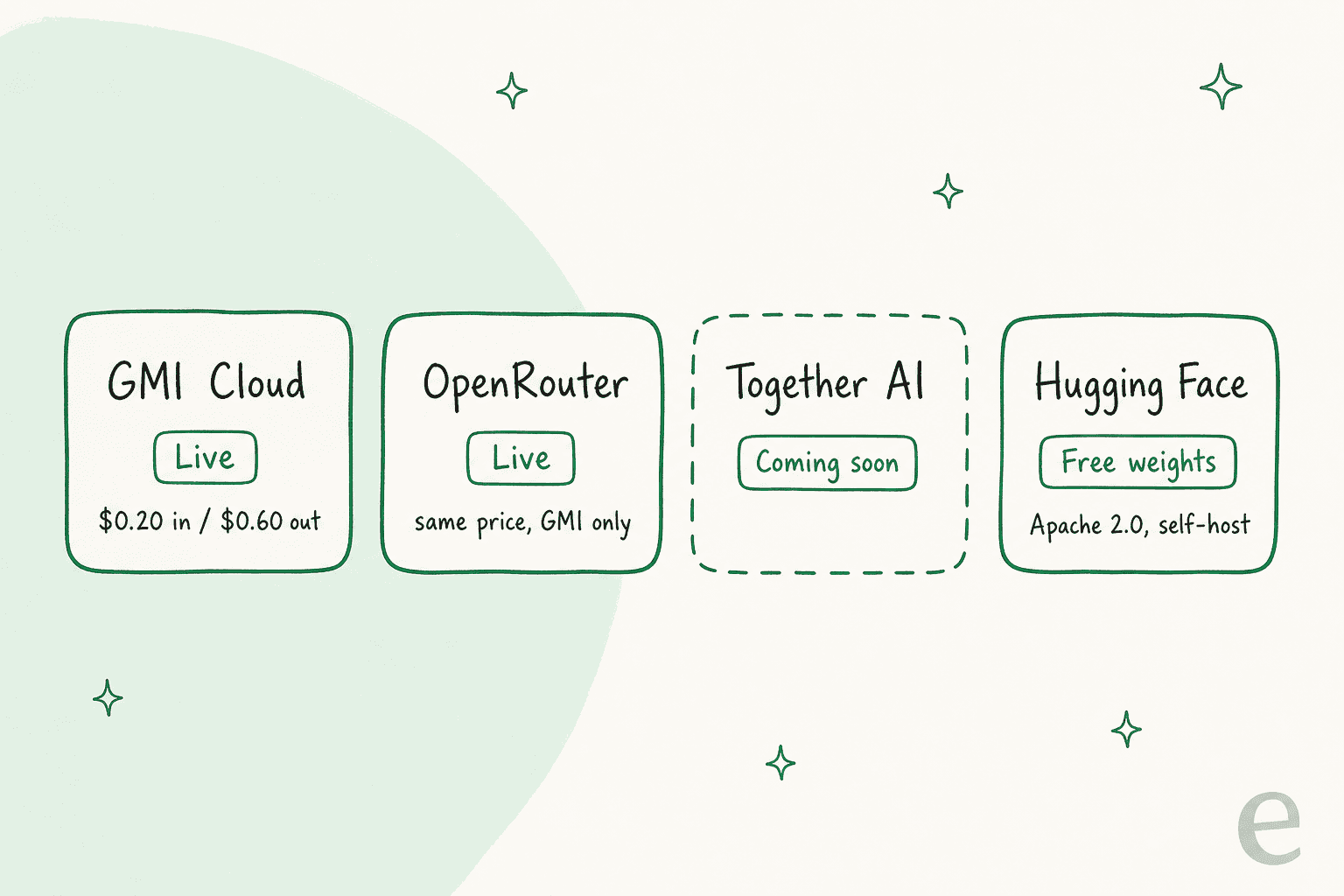
One host has a cost that doesn't show up on the rate card: capacity. OpenRouter's uptime figure for the GMI endpoint sat between 51% and 60% over the previous day when I checked on 5 November, which is normal teething for a model added the day before, but rough for anything customer-facing. Ricursive has said Ripple is headed to Together AI and Fireworks; Together's page still reads "coming soon" with a "Notify me" button and no price.
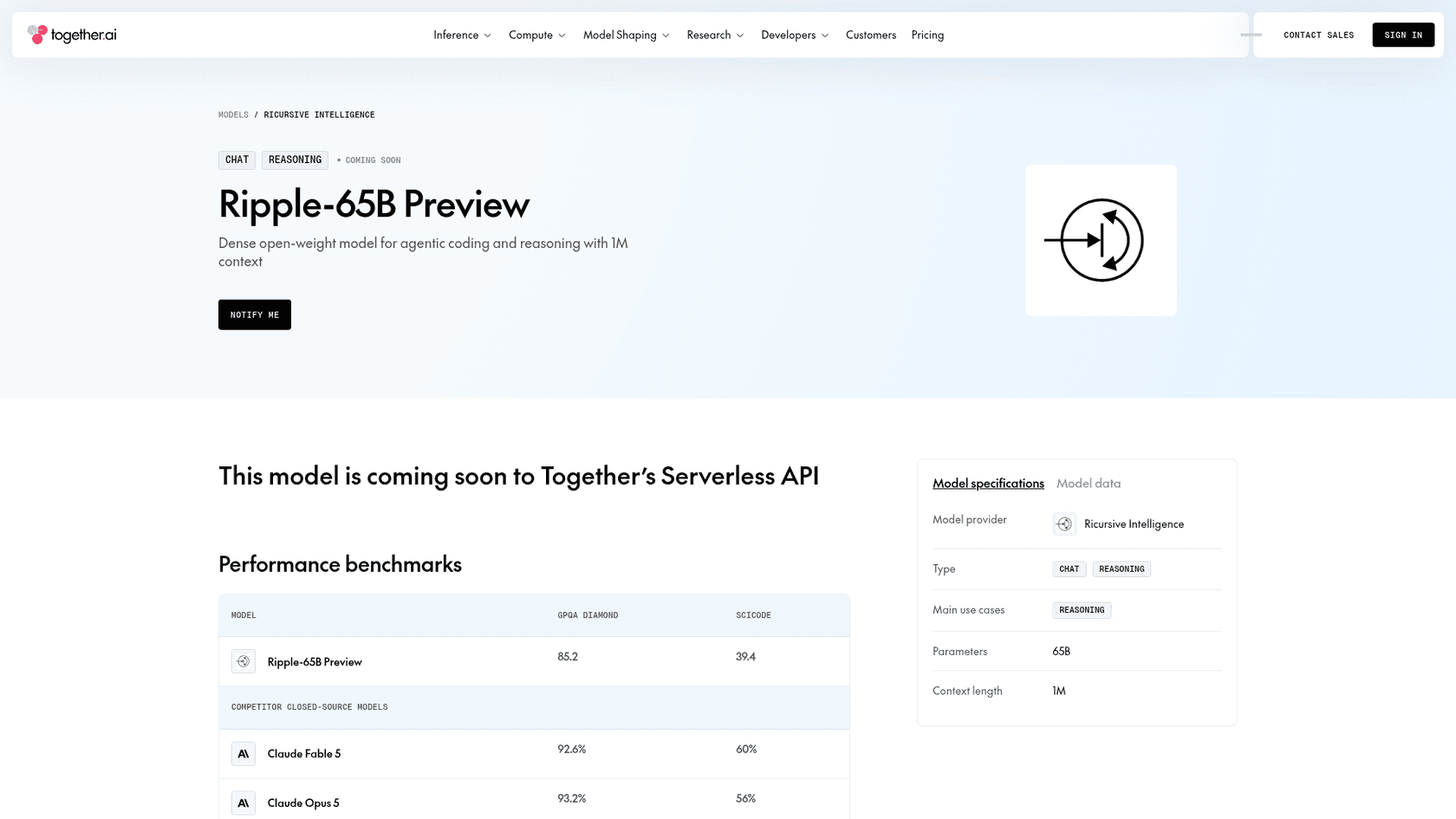
If you need a second provider for failover today, you don't have one. That's the strongest argument for waiting a few weeks before Ripple carries production traffic, and it has nothing to do with the price.
What does one coding agent task cost on Ripple-65B?
Per-million prices don't mean much until you price a real job. So here's one buyer: a coding AI agent session that sends 1M input tokens across all its turns, 80% of them cache hits, and writes 50K output tokens. That's a fair shape for an agent reading a repo, running tests and patching a few files.
On Ripple, the maths is short:
- 200K fresh input × $0.20 per million = $0.04
- 800K cached input × $0.05 per million = $0.04
- 50K output × $0.60 per million = $0.03
- Total: about $0.11 per task, or $110 per 1,000 tasks
Turn caching off and the same task costs $0.23, more than double. Here's the same task on nearby models, using OpenRouter's list prices on 5 November 2026:
| Model | Input / 1M | Output / 1M | Cached / 1M | Cost per task | Per 1,000 tasks |
|---|---|---|---|---|---|
| DeepSeek V4.1 Flash | $0.045 | $0.50 | $0.018 | $0.048 | $48 |
| Ripple-65B Preview | $0.20 | $0.60 | $0.05 | $0.110 | $110 |
| GPT-5.6 Luna | $0.20 | $1.20 | $0.02 | $0.116 | $116 |
| Reflection Beam 501B | $0.25 | $1.00 | $0.05 | $0.140 | $140 |
| Qwen3.8 27B | $0.15 | $1.875 | $0.0375 | $0.154 | $154 |
| Inkling Small | $0.45 | $1.20 | $0.10 | $0.230 | $230 |
| Nemotron 3 Ultra 550B | $0.60 | $2.40 | $0.12 | $0.336 | $336 |
| Muse Spark Open | $1.25 | $4.25 | $0.15 | $0.583 | $583 |
| Claude Sonnet 5.5 | $2.00 | $10.00 | $0.10 | $0.980 | $980 |
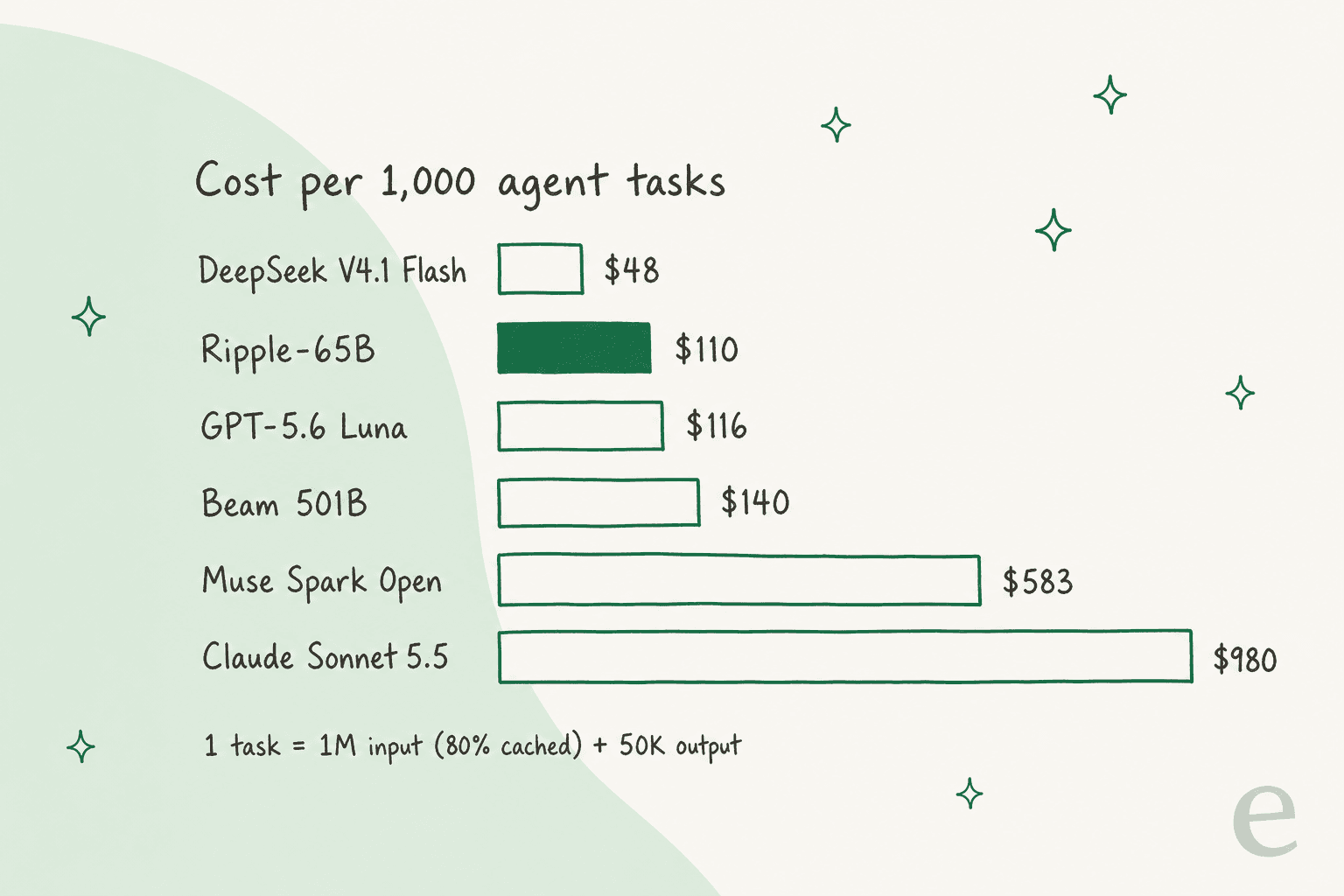
Two things jump out. First, Ripple is the cheapest US-made open-weight model in the table, about 21% under Beam, the model it ties on Terminal-Bench 2.1 (80.5 vs 80.1 on the model card). If you can only use US models, that's the comparison that matters, and Ripple wins it on price.
Second, it isn't the cheapest model, full stop. DeepSeek V4.1 Flash does the same task for less than half, and GPT-5.6 Luna lands within a cent. So "cheap" is only a reason to pick Ripple if you've already filtered the list down to US open weights. For the wider field, my Kimi K3.1 Pro pricing and DeepSeek V4.1 Flash pricing breakdowns run the same kind of maths.
Want to swap in your own numbers? This calculator reprices a month of agent work on each model. Set your task volume and token mix, and it shows where Ripple lands and whether a rented 2x B200 server would beat the API.
When does self-hosting Ripple-65B beat the API?
Later than you'd think. Apache 2.0 makes self-hosting legal and free to license, and a 65B dense model is small enough to tempt you. But the API is already priced close to the bone, so your hardware has to stay busy to compete.
Ricursive publishes two ways to run it, both on the Hugging Face model card and its NVFP4 repo:
- Datacenter: BF16 on two NVIDIA B200 GPUs with SGLang and a DFlash2 draft model, which the card says reaches "250 tok/s on 2xB200 batch=8 prior to quantization or custom kernels."
- Desk: an experimental NVFP4 build on an NVIDIA DGX Spark, limited to one request at a time and 128K context.
Here's what each costs against the API:
| Option | Cost | What it buys | Break-even vs API |
|---|---|---|---|
| Ripple API | $0.20 / $0.60 per 1M | Pay per token, one host | n/a |
| 2x B200, rented | GMI Cloud "from $5.00/GPU-hour" = $10/hour, about $7,300 for a 730-hour month | 1M context, batch serving | ~66,000 tasks a month, or ~91 an hour around the clock |
| DGX Spark, bought | $6,950 on NVIDIA's marketplace (128 GB) | One request at a time, 128K context | ~63,000 tasks over the box's life |
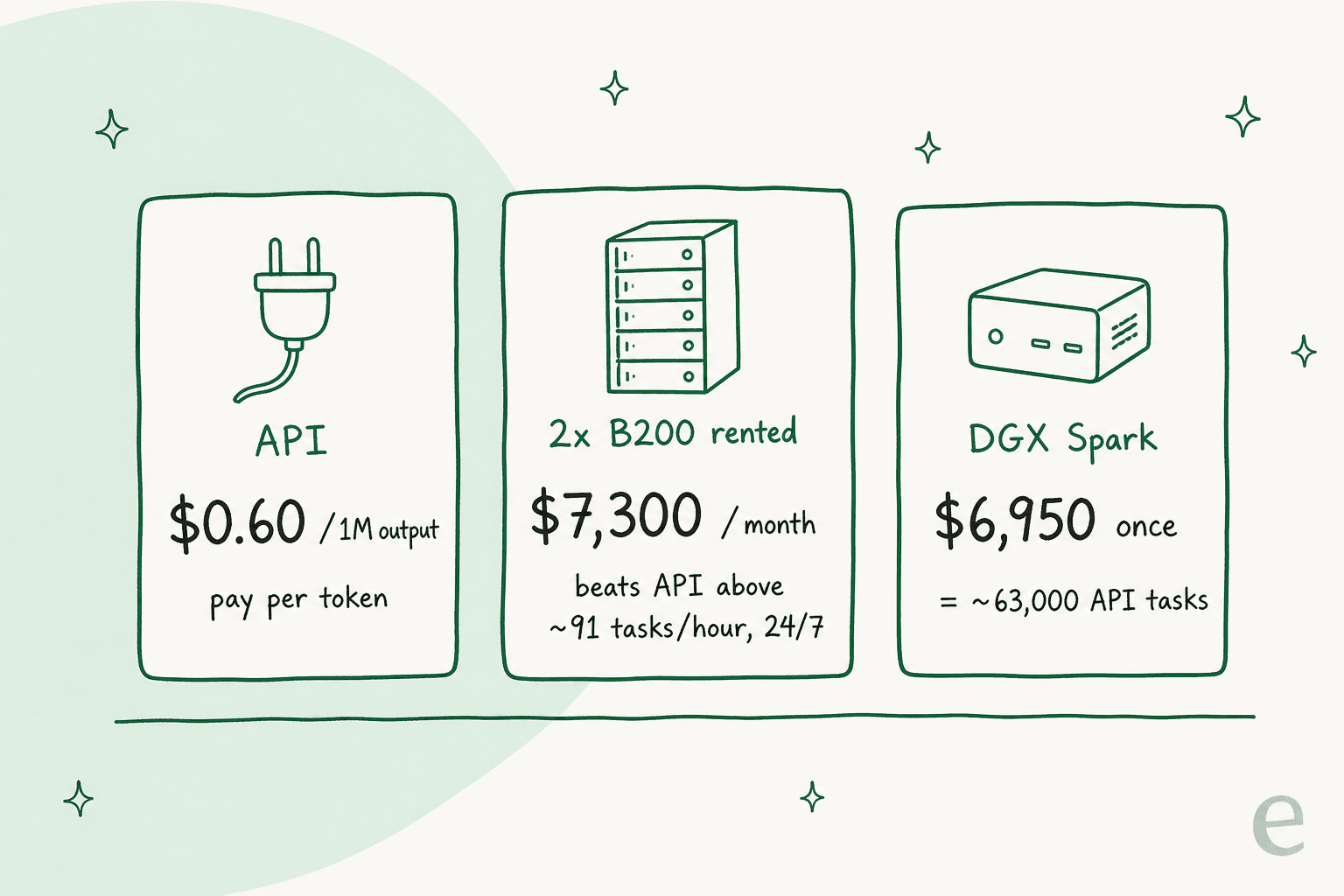
The B200 maths depends on how you read that 250 tok/s. If it's per request, eight requests at once give about 2,000 output tokens a second, or 144 of my sample tasks an hour at best, so you need the server about 63% busy, every hour of the month, just to match the API (and that's before prefill time, idle nights and an engineer's hours). If it's the total across all eight, the server tops out around 18 tasks an hour and never catches the API at all. Ricursive doesn't say which. B200s are also marked "limited availability" on GMI's page, and $5.00 is a "from" price.
The DGX Spark is a different purchase. At $6,950 it equals about 63,000 agent tasks on the API, or 11.6 billion output tokens, and it serves one request at a time. Nobody buys it to save money on Ripple. You buy it so code and data never leave the building, and a few HN commenters made exactly that case:
"There are several situations where some of us are explicitly prohibited from using models from companies not under the jurisdiction of the United States. It doesn't mean these models are competitive when looked at from a global view but it is also not an irrelevant differentiation."

Others were less sure about local speed. A 65B dense model reads every weight for every token, unlike a mixture-of-experts model that activates a slice:
"But as is, it's probably hard to become popular amongst hobbyists and local model enthusiasts like Qwen's 27B class models or MOE models because it's a 65B dense model and inference will be prohibitively slow on consumer grade hardware, and seems like the goal/mission of the company behind this model is to automate chip design."
My take: self-host Ripple when the rules force you to, or when you can keep two B200s busy most of the day. For everyone else, the $0.60 API is the cheaper way to run it, and the Ripple-65B review has the benchmark detail to decide whether it's worth running at all.
Why is Ripple-65B priced this low?
Partly size. At 65B dense parameters in BF16 it fits on two B200s, while rivals like Inkling (975B) and Muse Spark Open (816B) need far more memory per copy. Partly positioning: Ricursive is a new lab, launching into a field of cheaper Chinese models, and its pitch is efficiency. It said the whole model came from a small budget:
"Ripple was built on a $32 million compute budget, one-tenth the cost of the previous open-weight SOTA on agentic coding. We're grateful to the open-source community, whose tools and research helped make this possible."
That's training cost, not serving cost, and it doesn't set the API price; GMI Cloud does. But it explains why the launch leaned on value rather than raw scores. Treat today's price as a launch price from a single host. When Together AI and Fireworks list it, the rate could move either way, and a second provider will matter more for reliability than for cost.
Is Ripple-65B cheap enough to run your support queue?
The tokens are cheap enough. A support reply is a much smaller job than a coding session, often a few thousand input tokens and a few hundred output, so 10,000 replies a month at 3,000 tokens in and 300 out comes to under $8 on Ripple. Price isn't the blocker.
Fit is. Ripple is a coding model with light post-training, and its scores on the support-shaped rows of Ricursive's own table are middling: 31.27 on τ³-bench banking (Beam: 36.1) and 71.67 on MCP Atlas tool use (Muse Spark Open: 89.2), per the model card. And the model is the cheap 5% of a support agent. The rest is knowledge base syncing, escalation rules, guardrails against made-up answers, and a way to check replies before customers see them. That's the real cost in any build vs buy decision, and it's paid in engineer months, not tokens.
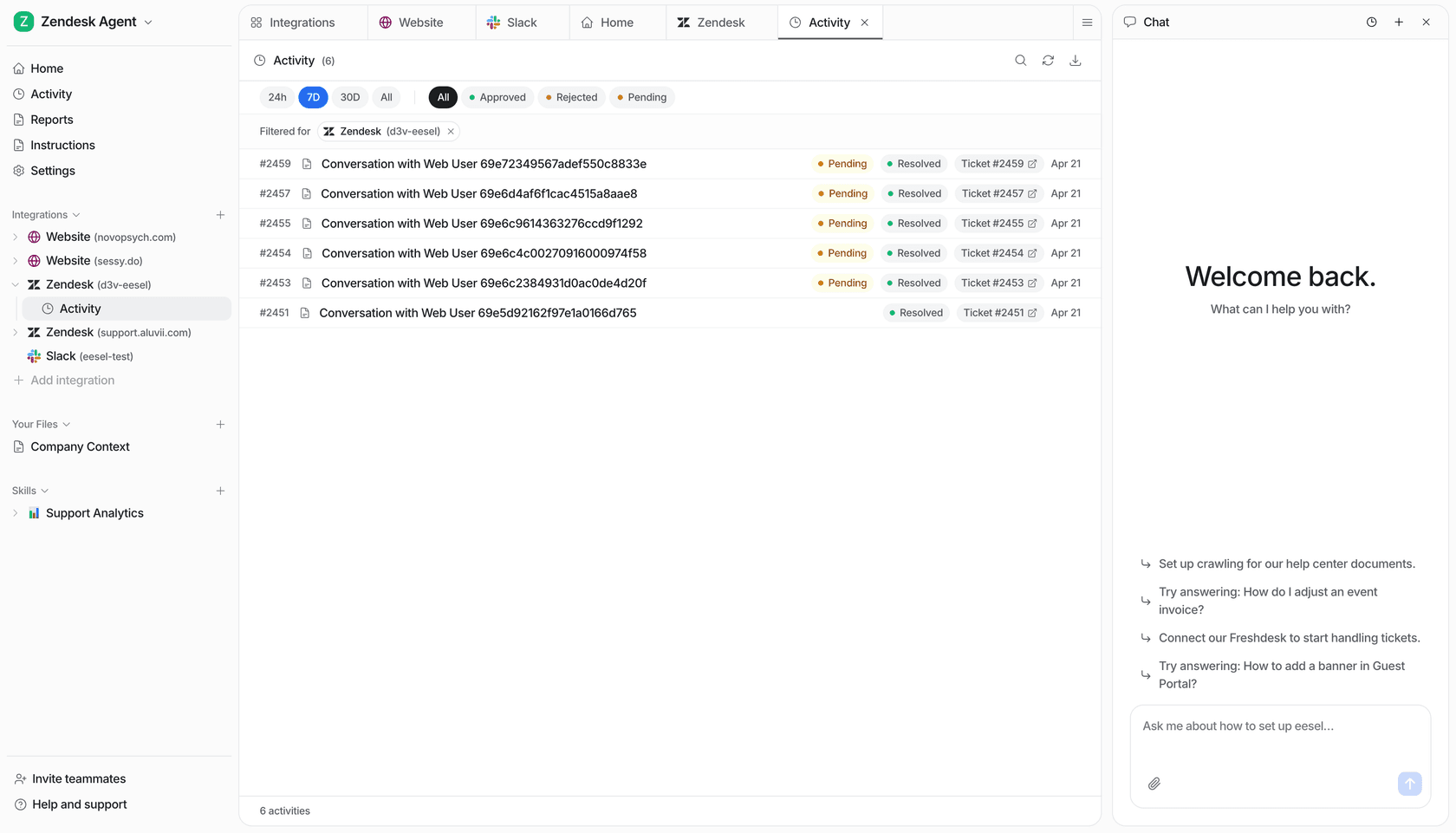
That's the part eesel handles. eesel's AI helpdesk teammate joins your existing helpdesk, learns from your help center and past tickets, and gets tested against historical tickets before it answers anyone, because I've watched confident bots give wrong answers on live queues. Timengo, which sells secure email and Digital Post software in Denmark, has eesel draft technical replies in Danish from about 5,300 past tickets, preparing around 300 Freshdesk tickets a month. SE Ranking runs one eesel agent per product on Zendesk, and they handled 4,650 conversations in one month.
If you came to Ripple because you live in a terminal, the eesel CLI will feel familiar: a coding agent can upload approved knowledge like exported help articles and macros, adjust the teammate's instructions, and run test questions before anything goes live. Connecting the helpdesk itself still needs an admin to approve it. There's a walkthrough on managing AI agents from the terminal.
Is Ripple-65B worth paying for?
Here's where I land after pricing it every way I could:
- Pay for the API if you're testing a US-made open-weight coding model. At about $0.11 per agent task with caching, it's the cheapest in its class and 21% under Beam.
- Wait a few weeks if it will carry production traffic. One host, a 51-60% daily uptime figure and a context window that changed mid-day are launch-week problems, and a second provider will fix most of them.
- Self-host only when rules keep data in-house or you can keep two B200s busy about two-thirds of every hour.
- Look elsewhere if price is the whole decision. DeepSeek V4.1 Flash costs less than half, and the best AI coding assistant tools roundup covers the wider field.
Try eesel
If you were pricing an open model to take tickets off your team, the token bill was never the expensive part. eesel's AI helpdesk teammate plugs into Zendesk, Freshdesk, Gorgias and more in minutes, learns from your past tickets, and shows you how it would have answered them before it goes live. Plans start at $299 a month, with a free tier to test on.
Try eesel for free.