

What Meta actually released on 15 October
Meta's research blog calls Muse Spark Open "the most capable US open-weight model to date," built for coding and agentic work. The PyTorch team's post adds the detail that matters most: it "shares the same base model as Muse Spark 1.3", with extra safety post-training so it holds up "as a standalone model without system guardrails." That is a big shift for a company that spent most of 2026 keeping Muse Spark closed.
The Hugging Face model card lists the specs:
| Spec | Muse Spark Open |
|---|---|
| Release date | 15 October 2026 |
| Parameters | 816B total, 42B active per token |
| Architecture | Mixture-of-experts, 256 experts, 8 active per token, 62 layers |
| Context | 1M tokens at inference |
| Input / output | Text, image, video, audio in; text out |
| Languages | Trained on data from 100+ languages |
| Reasoning effort | low, medium, high, xhigh (default xhigh) |
| Weights | BF16 and NVFP4 |
| License | Muse Model License |
The launch was loud. The Hacker News thread hit 914 points and 477 comments on day one, and Apple's own ML research post about running it on Mac Studios drew another 363 points.
How 42B active out of 816B works
This is the bit I find most interesting, because it explains both the hardware story and the price. Muse Spark Open is a mixture-of-experts model. Each layer holds 256 small expert networks, and a router picks 8 of them for every token. So the model stores 816B parameters, but each token only runs through about 42B of them.
That split has two consequences people mix up:
- Memory is set by the 816B. Every expert has to sit in memory because any token might need any expert. That's why the BF16 weights are about 1.6TB.
- Speed is set by the 42B. Each token only reads its slice, so generation is closer to a 42B model's pace. Apple puts it plainly: the M5 Ultra's 1.2 TB/s of bandwidth "is fast enough to read the small slice each token needs."
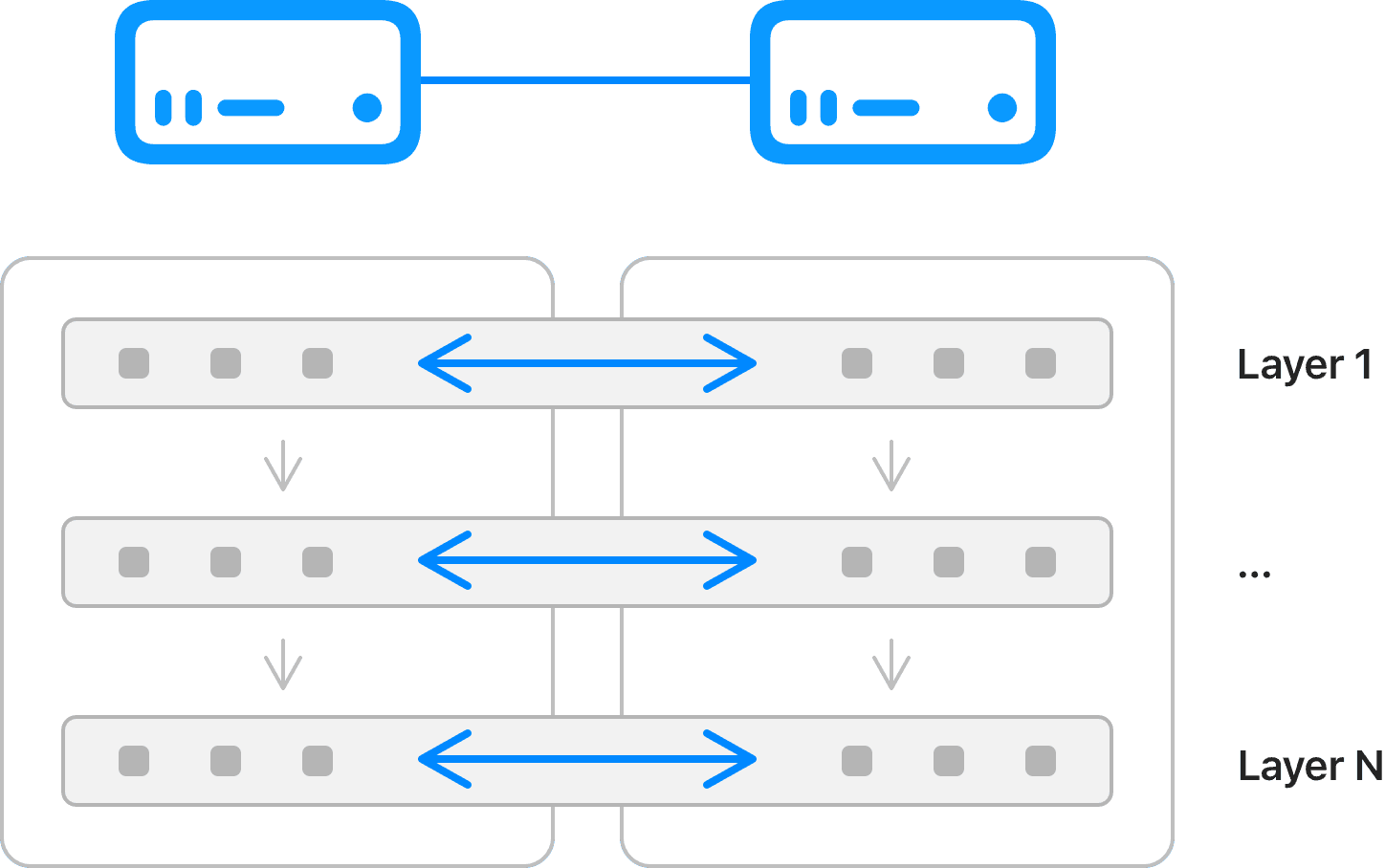
Meta's developer post says the NVFP4 checkpoint quantizes only the experts, which brings it to about 530GB. That's still too big for any single desktop, so Meta and Apple split it across two machines with tensor parallelism: each Mac holds half of every layer and does half the math on every token.
The model card also describes a separate 1.8B-parameter perception encoder for images and video. In practice that means you don't bolt a vision model on the side. One checkpoint reads screenshots, recordings and documents, which matters if you're building agents that use a computer rather than just a chat box.
Muse Spark Open pricing: same card as the closed model
The weights are free. The interesting number is what it costs to rent. Meta does not serve Muse Spark Open on its own API; its pricing page only lists Muse Wonder and the closed Spark models. Instead, seven partners host it, and the ones with public rates all landed on the same card.
| Where | Input / 1M | Cached / 1M | Output / 1M | Notes |
|---|---|---|---|---|
| OpenRouter | $1.25 | $0.15 | $4.25 | Routes across Modal, Together, Nebius, Fireworks, Baseten; 262,144 max output |
| Fireworks AI | $1.25 | $0.15 | $4.25 | Serverless LoRA training via API |
| Baseten | $1.25 | $0.15 | $4.25 | NVFP4 with a speculative drafter |
| Groq | Not public | Not public | Not public | Limited preview, 131K context |
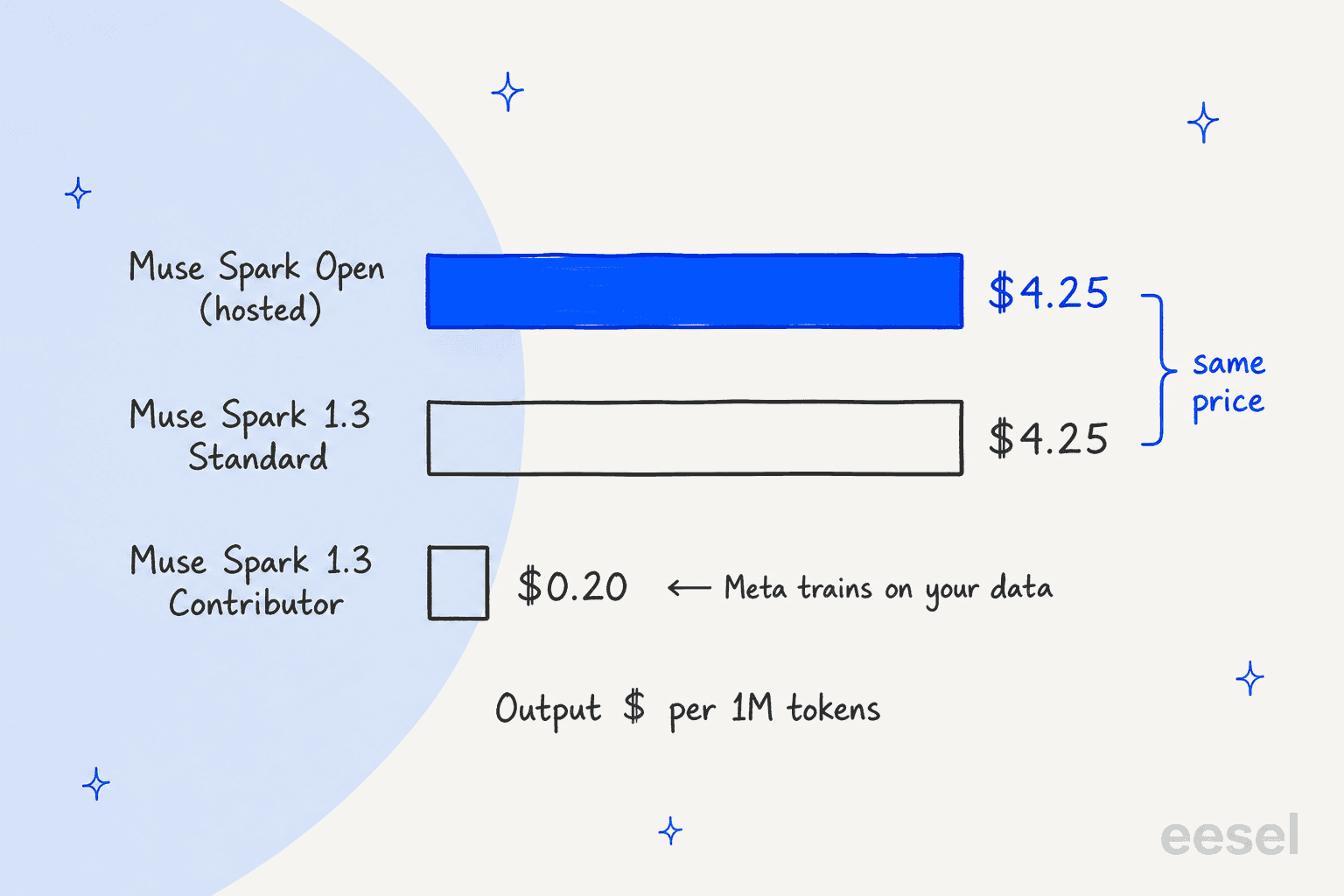
| Meta API: Muse Spark 1.3 Standard | $1.25 | $0.15 | $4.25 | Closed, Meta pricing |
| Meta API: Muse Spark 1.3 Contributor | $0.10 | $0.002 | $0.20 | Closed, Meta trains on your data |
The open model rents for exactly what the closed one costs. And the cheapest Meta token is still the closed contributor tier, at about a twentieth of the output price, in exchange for letting Meta train on your traffic. If you priced Muse Spark Open expecting the usual open-weights discount, it isn't there yet. My Muse Spark 1.3 pricing post covers how that two-tier deal works.
Two things soften this. Caching is aggressive: OpenRouter reports a weighted average input price of about $0.35 per million across real traffic, because cache hit rates run above 70% on most hosts. And Artificial Analysis found the model fairly concise, using 110M output tokens to finish its index against a 130M median, at about $0.84 per task.
One Hacker News commenter read the flat pricing as a licensing side effect:
"The usual effect of separate licensing is decreased price competition from public providers (like we saw with Kimi K3)."

That's a fair read of the license, which I get to below. Whether hosts start undercutting each other in a few weeks is the thing I'd watch. For context on how other hosts price open models, see Together AI pricing and Fireworks AI pricing.
The Mac Studio claim, and the catch
Meta's headline is that Muse Spark Open is "the first model in its class to run on your desktop using two Apple M5 Ultra Mac Studios." It's real, and Apple published the numbers. On its benchmark tables, at an 8,192-token context:
| Setup | Time to first token | Decode speed |
|---|---|---|
| 2 Mac Studios, pipeline parallel | 8.4s | 15.74 tok/s |
| 2 Mac Studios, tensor parallel | 8.2s | 24.99 tok/s |
| 4 Mac Studios, tensor parallel | 4.8s | 36.73 tok/s |
Twenty-five tokens a second is usable for a coding agent working in the background. Meta says it shipped real iOS fixes to the Ice Cubes Mastodon client and drove DaVinci Resolve end to end this way, all on-device through Muse Code.
Now the catch. The two-Mac setup needs 512GB of memory per machine, and Apple's own store lists the 512GB option for M5 Ultra as "coming late October." As of today you can't order it. The Mac Studio store page starts M5 Ultra configurations at $5,499 with 96GB of memory, before any upgrade. Meta's developer post offers a four-Mac route at 256GB each, which reaches the same 1TB of pooled memory.
If you don't own Apple hardware, here's the full ladder of what it takes:
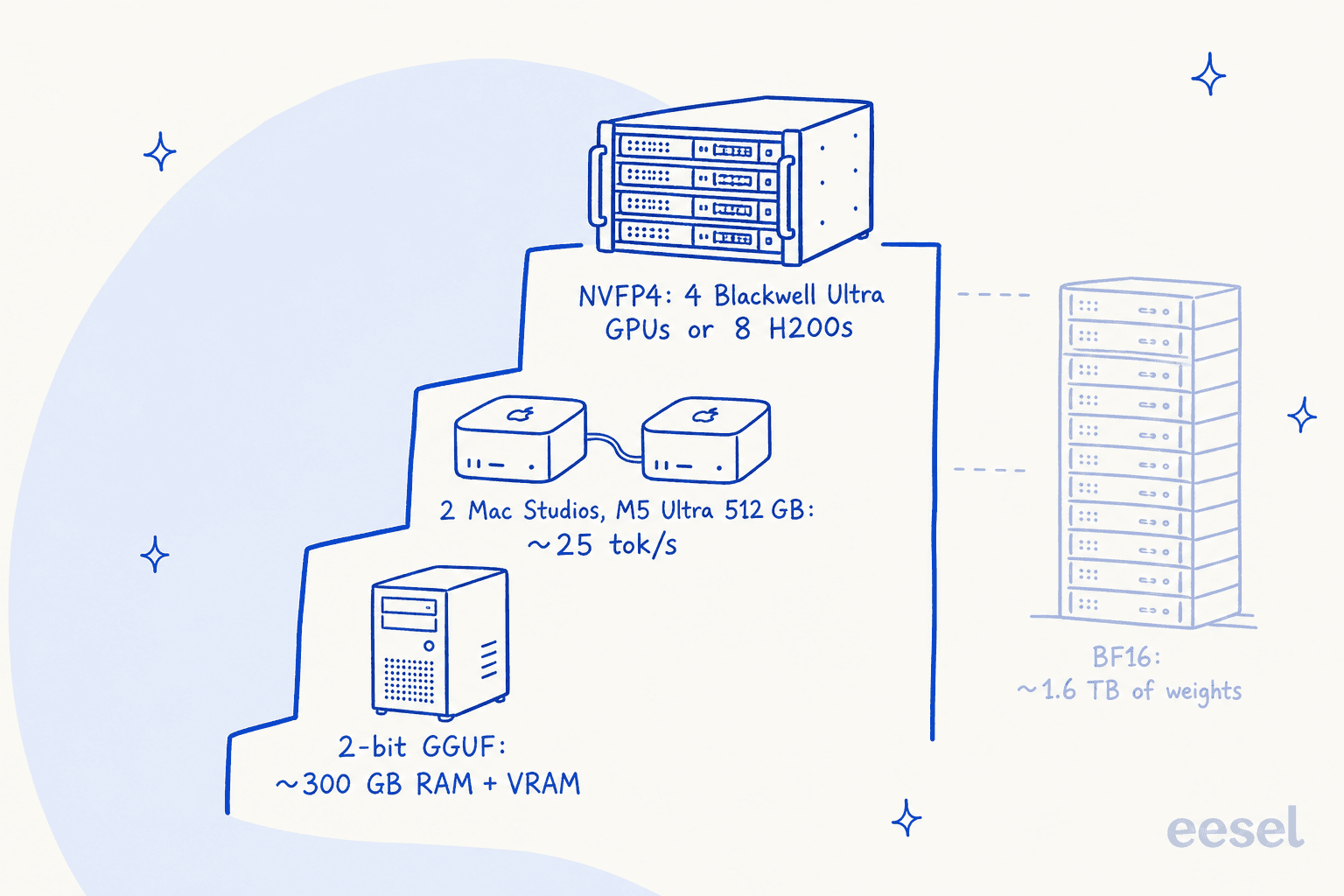
- Datacenter GPUs. The model card asks for at least 700GB of GPU memory for NVFP4 and 2TB for BF16. Meta's developer post says NVFP4 serves on four Blackwell Ultra GPUs or eight H200s, through SGLang, vLLM or TensorRT-LLM.
- One big workstation. Unsloth's 2-bit dynamic GGUF fits in about 300GB of combined system RAM and VRAM, run through llama.cpp. Expect quality loss at that compression; the model card itself warns quantized builds can differ in edge cases.
- Cloud catalogs. Amazon SageMaker AI, Google Cloud Model Garden and Microsoft Foundry Models carry the weights if you want a private instance in your own cloud account.
The most honest summary came from a commenter who read the Unsloth guide: "You & Me won't be running this one" (spwa4, Hacker News). For most teams, "open" will mean renting from a host, or running it in their own cloud for data reasons.
How Muse Spark Open benchmarks against other open models
Meta compared Muse Spark Open with seven open-weight peers, including Kimi K3, Mistral Large 4, Inkling and Reflection's Beam. It ran its own model at xhigh effort. Here's the published table:
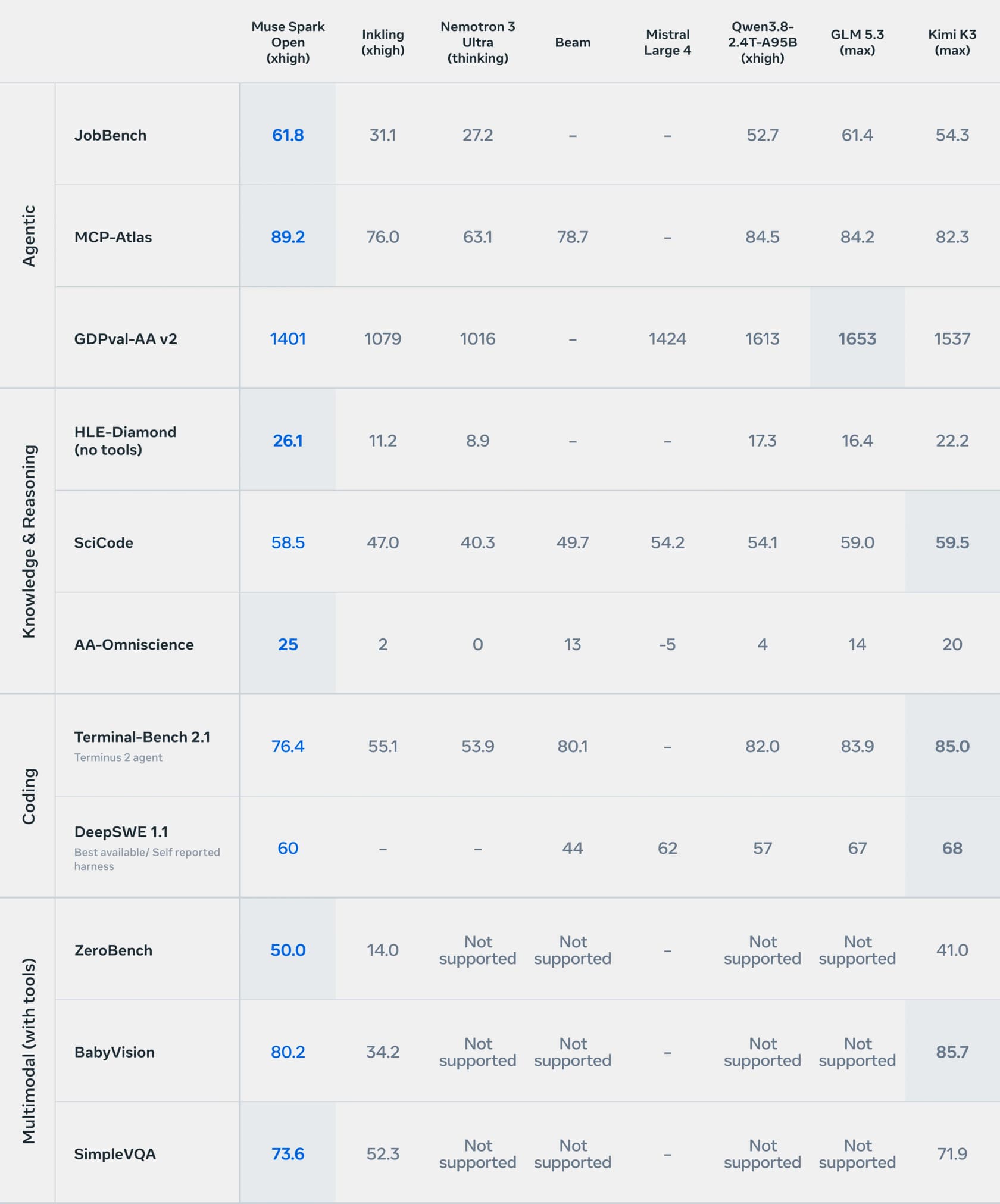
Read it row by row and a clear shape appears:
- Where it leads: tool use and agent tasks (MCP-Atlas 89.2, JobBench 61.8), knowledge without tools (HLE-Diamond 26.1, AA-Omniscience 25), and several multimodal tests (ZeroBench 50.0, SimpleVQA 73.6).
- Where it trails: the general index and coding. On the Artificial Analysis Index it scores 39, behind GLM 5.3 (45), Kimi K3 (44) and Qwen3.8 (40). On Terminal-Bench 2.1 it posts 76.4 against 85.0 for Kimi K3; on DeepSWE, 60 against 68.
- Where it's in a different league: safety. On StrongREJECT, an adaptive jailbreak test where lower is better, it scores 0.5. Every other model Meta tested lands between 62.9 and 86.4.
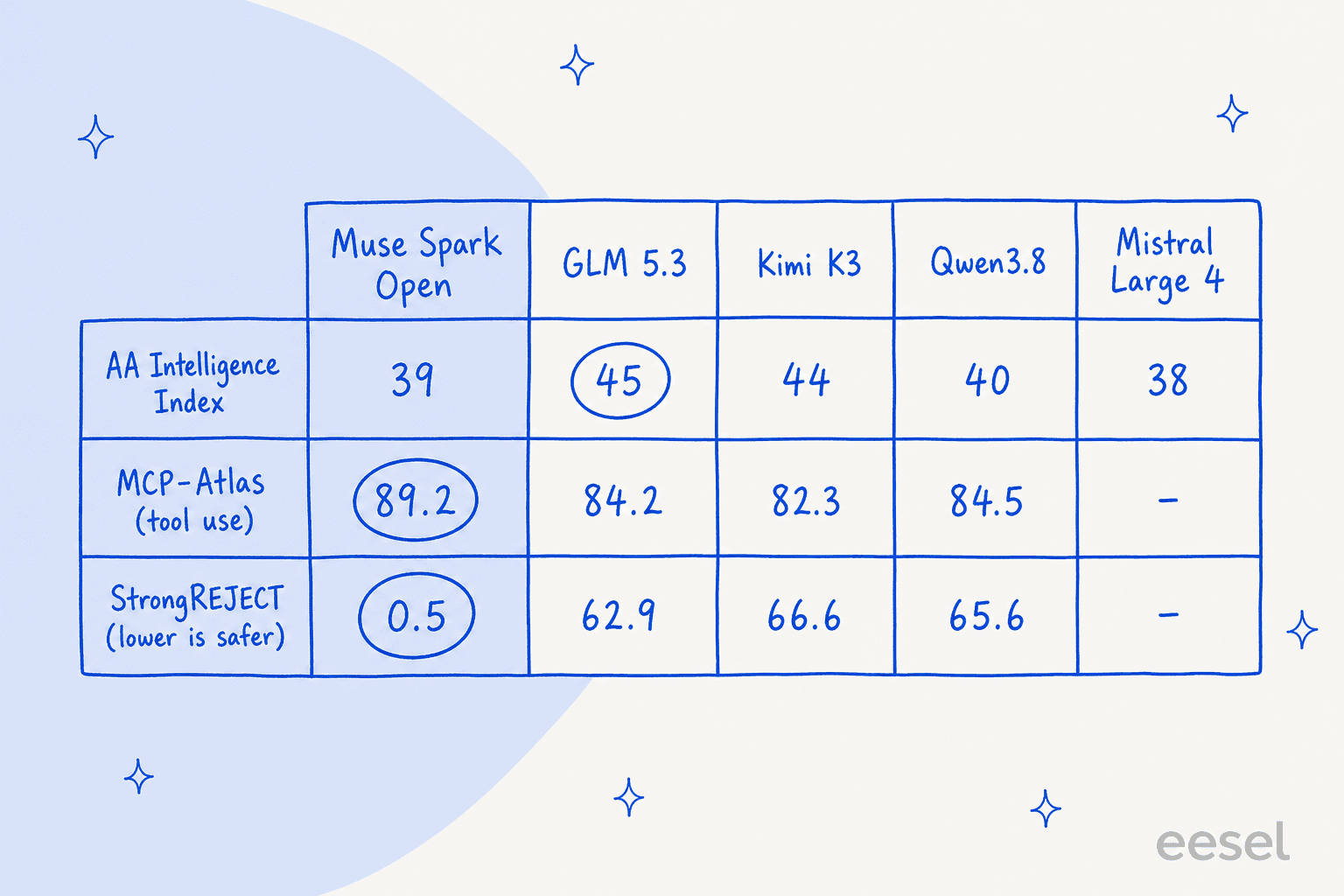
The independent number matches Meta's. Artificial Analysis lists Muse Spark Open at 39 on its index, well above the median of 19 for comparable models, at 131 tokens per second. Hacker News placed that in context fast:
"39 on AA, about the same as Deepseek v4.1 flash and Mimo 2.5 Flash. Behind Glm 5.3 flash and Qwen3.8-Flash-Next"
That comparison stings, because DeepSeek V4.1 Flash and GLM 5.3 Flash are much smaller models. Hands-on reports so far agree on the shape: one tester found it "dumber than GLM 5.3" but "really fast" on Fireworks (eknkc, Hacker News), and another put it "closer to 1.2" than 1.3 on benchmarks (modeless, Hacker News). Meta did not publish a head-to-head against its own closed models, so treat that last one as an early impression.
My read: this is a tool-calling and agent-loop model first, with strong safety behavior, rather than the best open coder. Early users quoted in Meta's developer post say the same thing, praising it for picking "the right next tool" and for clean structured outputs on multi-step and parallel calls. If your agent spends its life calling tools, the MCP-Atlas lead matters more than the index gap. If it spends its life writing code, Kimi K3 is the stronger open pick on these numbers.
The license: free, with three strings
Meta released the weights under the Muse Model License, which it describes as having "limited commercial terms." It reads like a permissive license with conditions bolted on. You may use, copy, modify, fine-tune, distill, merge, publish and sell it, free, subject to:
- The usage policy. A long list of banned uses, from weapons and critical infrastructure to fake reviews and claiming outputs are human-written. It also says the model is not intended for anyone under 18.
- Attribution. You must "prominently display" the words "Built with Muse Spark Open" in your product's interface, documentation, website or settings menu. This also applies to any model you train or distill from its outputs.
- The $20M service clause. If you sell access to AI models as a service via API, and your company group earns over $20 million in a 12-month period, you must notify Meta and sign a separate agreement first.
The third clause sounds scary and mostly isn't. It explicitly excludes internal use, research, and using the model to power features of your own product. A SaaS company running Muse Spark Open behind its support inbox owes Meta nothing beyond the attribution line. The clause is aimed at inference providers and big platforms reselling the model.
One more practical hurdle: downloading from Hugging Face means a gated form asking for your full legal name, date of birth, and full organization name with corporate identifiers. Meta also claims no ownership of outputs, which is the clause your legal team will look for first.
I'm using it internally, for research, or to power features inside my own product
Free. No separate agreement, even above $20M in revenue. You still need to follow the usage policy and show "Built with Muse Spark Open" somewhere users can find it: the UI, the docs, the website or a settings menu.
I sell API access to AI models, and my company group earns under $20M a year
Free for now, with the same attribution and usage rules. Track revenue: the test is any consecutive 12 months, counted across you and your affiliates.
I sell API access to AI models, and my company group earns over $20M a year
You must notify Meta and sign a separate written agreement before offering Muse Spark Open, or anything derived from it, in that service. Terms are not public.
I fine-tuned or distilled a new model from it
That counts as a Derivative. The attribution line and usage policy follow it, and so does the $20M service clause if you resell access to it.
Summarized from the Muse Model License dated 15 October 2026. Not legal advice; read the full text on Hugging Face before shipping.
Is it "open"? Plenty of Hacker News commenters said no, because the license isn't OSI-approved and only weights ship, no training data or code. I'd call it open weights with a commercial ceiling, and for most companies that ceiling is far above anything they'll hit. If you want fully open-source building blocks, my roundup of open-source AI agents is a better starting point.
Safety: the strongest part of the release
This is where Meta did the most work, and it shows. The model card reports, with no system-level safeguards in place:
- Cyber misuse: refused 99.2% of jailbreaks on Meta's internal benchmark and 94.8% across PolyGuard, RedCode and CyberBench 2024. Kimi K3 refused 75.5% and 70.2% in the same setup.
- Chemical and biological: over 98% refusals on SecureBio's BioTIER, over 97% on Meta's multi-turn agentic biology test.
- Honesty: a 98.1% honesty rate on the MASK benchmark, and 0% misbehavior on the Agentic Misalignment benchmark.
There's a trade-off hiding in Meta's own table. On the FORTRESS test, Muse Spark Open has the lowest adversarial risk score (5.8) but the highest over-refusal score (17.4) of the group, meaning it turns down more harmless requests than GLM 5.3 (3.2) or Kimi K3 (2.7). For a customer-facing bot, a few extra "I can't help with that" replies are a real cost. Test it on your own traffic before you trust the defaults.
Two caveats from Meta itself. The full evaluation report is still "available soon." And the model card warns that "downstream modifications could degrade safety," so the moment you fine-tune it, those numbers stop being yours. Meta's own advice is to deploy it inside a system with extra guardrails and "human-in-the-loop confirmation for irreversible actions," which is the same thing I'd tell anyone putting a model behind a support queue.
Fine-tuning on day one
This is the other thing open weights actually unlock. Meta lined up post-training support across the board at launch, per its developer post:
- PyTorch TorchTitan: pre-training, multi-turn SFT, LoRA and reinforcement learning.
- Hugging Face TRL: LoRA with SFTTrainer on top of the released checkpoint.
- Fireworks AI: serverless LoRA training through an API, with sequences up to 262,144 tokens. Its model page notes managed fine-tuning in the UI isn't available for this model yet.
- Together AI: SFT or GRPO reinforcement learning on its post-training service, then serve several LoRA adapters on one deployment.
- NVIDIA NeMo AutoModel and RadixArk's Miles for full-parameter work.
For a support team, fine-tuning sounds appealing: teach it your tone, your product names, your refund rules. In my experience it's rarely the first fix. Most wrong answers I see come from a stale or contradictory help center, not a model that needs retraining, and retrieval fixes that faster. My RAG vs LLM piece goes through why. Fine-tune once retrieval is solid and you still see style or format problems.
Who should actually use Muse Spark Open?
Here's how I'd decide:
- You need the model inside your own walls. Regulated data, a security review that blocks third-party processors, or a customer contract that says "no external AI." This is the strongest case, and the safety numbers make it easier to defend.
- You're building tool-heavy agents. The MCP-Atlas and JobBench leads are real. Pair it with an MCP server and see how it handles your tool set.
- You want to fine-tune a large multimodal model. It takes audio and video in natively, and the training stack was ready on launch day.
- You want the cheapest Meta tokens. Skip it. Closed Muse Spark 1.3 contributor pricing is far cheaper, if you're fine with Meta training on that traffic.
- You want the best open coder. Look at Kimi K3 or Qwen first, or step up to closed frontier models like Claude Opus 5.5 and the newer Muse Wonder.
For customer support specifically, model choice is the smaller decision. My support model guide explains why retrieval, escalation and testing move resolution quality more than a few index points. A 6-point index gap rarely shows up in a queue. A confident answer from an outdated article shows up every day, open weights or not.
Try eesel
Muse Spark Open is infrastructure. You get weights, a license and a hardware bill, and then you build the retrieval, the escalation rules, the testing and the audit trail yourself. eesel is the employee. Our AI helpdesk teammate plugs into Zendesk, Freshdesk, Gorgias and the rest, learns from your past tickets and help center, and you can run it against hundreds of your historical tickets before it answers a single customer. That replay is where you catch the over-confident answer before a customer does, whichever model sits underneath.
If you'd rather manage it from a terminal, the way you'd drive a self-hosted model, the eesel CLI covers it. eesel instructions reads and edits the teammate's standing rules, eesel approvals lists actions waiting on a human, and eesel activity shows each run and why it did what it did. Every command prints JSON and writes accept --dry-run, so a coding agent like Claude Code can manage your support teammate the same way it manages your repo. If you write content rather than answer tickets, the same roster has an AI blog writer.
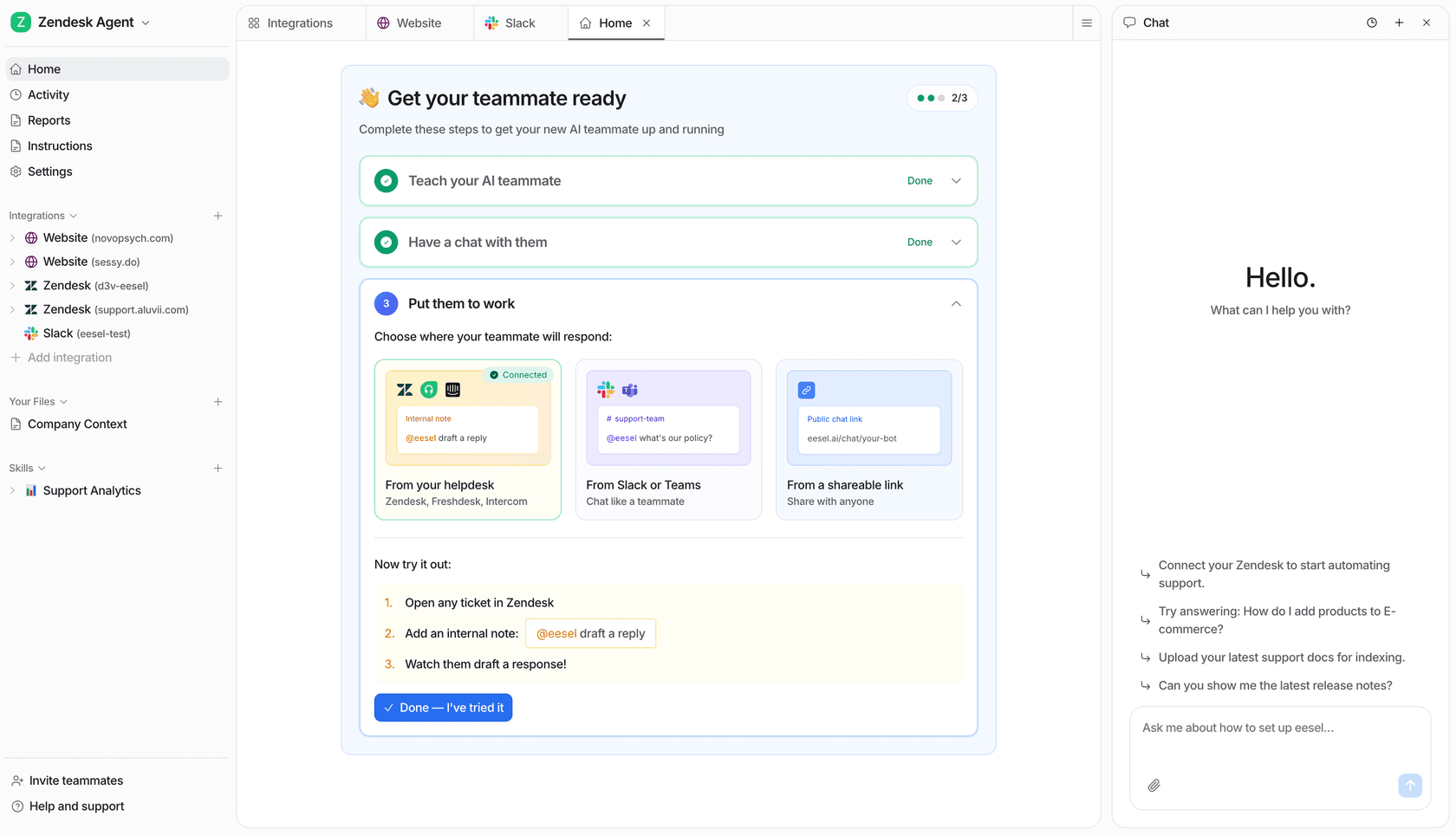
It's free to start with 100 credits and no card. Try eesel on last month's tickets and see what it would have said, before you price out a single Mac Studio. Plans are on the pricing page.