


What Tencent actually shipped
I build the AI agents that sit on top of models like this for a living, so a new open-weight flagship is the part of my week I actually look forward to. I've spent the last few years watching what separates a model that demos well from one that survives a real production queue, and Hy4 is a good test of that gap.
Here's the short version of what landed. Tencent's Hunyuan team released and open-sourced Hy4 preview on August 28, 2026, positioning it as "built for real-world productivity tasks... across coding, office work, and scientific research." It's the successor to the Hy3 line from July, and Tencent is shipping it "preview first, official release later," the same cadence as before.
The headline specs, straight from the model card:
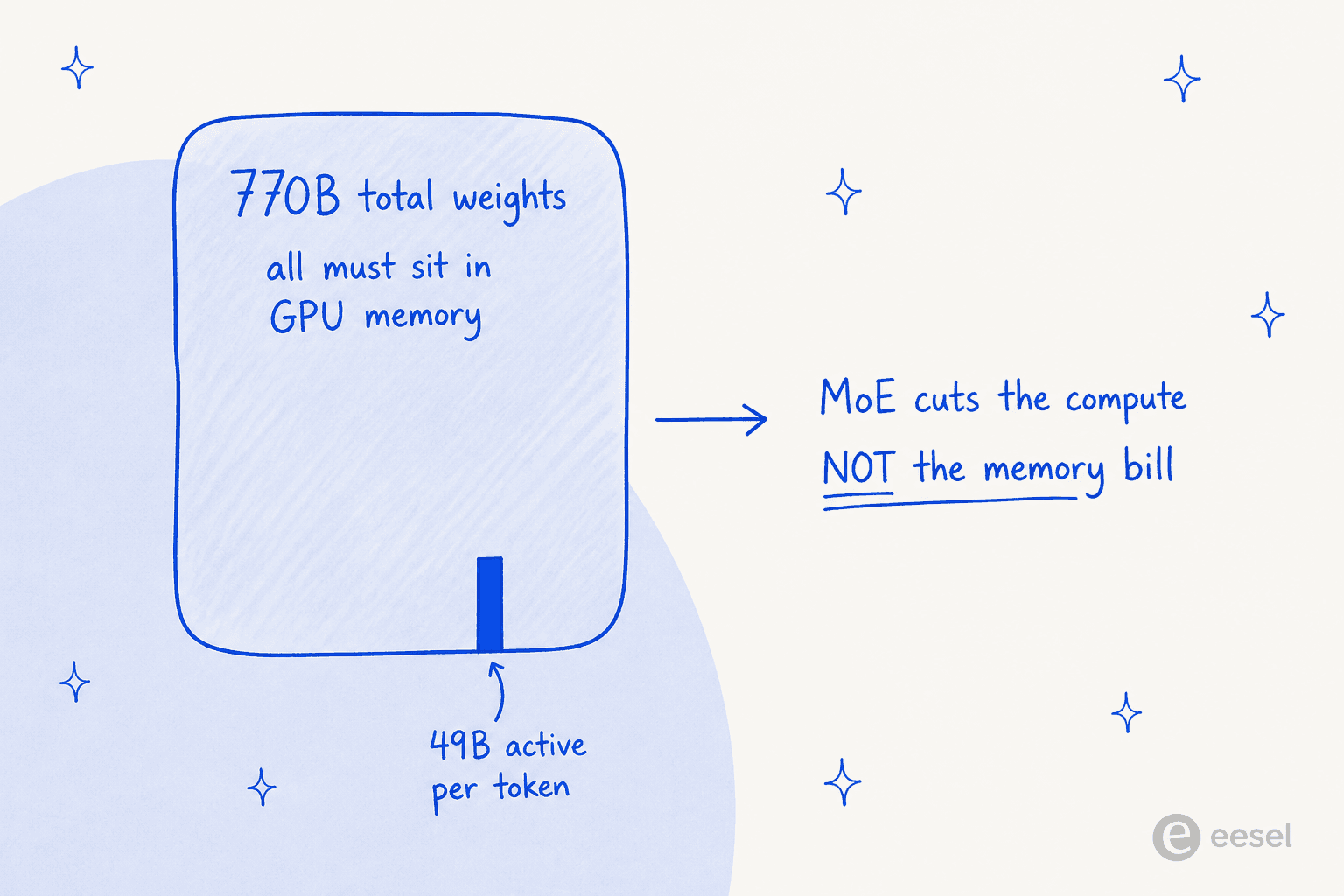
- 770B total parameters, 49B active per token (a Mixture-of-Experts design).
- 78 layers, with 256 routed experts plus 1 shared expert; every token fires the top-8 routed experts.
- 1M-token context window.
- Apache 2.0 license, with a BF16 model and an official FP8 quantized build shipped side by side.
One detail I found interesting: Tencent says Hy4 participated in its own development, proposing and running experiments on training methods and low-level operators, and it autonomously optimized its own inference stack for a 31.8% throughput gain. They call it "an early-stage recursive self-improvement loop." That's marketing framing on top of a real result, but it's the kind of claim worth filing away.
How the 770B / 49B math actually works
If you're new to Mixture-of-Experts, the two big numbers look contradictory: how is a 770B model only "49B" of anything? The answer is that MoE splits the network into many expert sub-networks and, for each token, a router picks a small handful to actually run. So the compute per token behaves like a ~49B model, which is what keeps Hy4 fast enough to serve.
The trap is assuming that smaller active count means smaller hardware. It doesn't. Every one of those 770B weights has to be resident in GPU memory, because the router might pick any expert for the next token. MoE buys you cheaper math, not a cheaper machine.
Under the hood there's more engineering than the spec sheet lets on: attention uses Gated DeepSeek Sparse Attention with an IndexCache for reusing sparse indices across layers, and there's a native multi-token-prediction layer bolted on for speculative decoding. If you've followed DeepSeek and GLM's architecture papers, a lot of this will feel familiar, which is itself a sign of how fast the open-weight frontier is converging on the same tricks.
The benchmarks, read honestly
Hy4 benchmarks well. On the verified scores Hugging Face surfaces, it hits 92.3 on GPQA Diamond, 82.9% resolved on SWE-bench Multilingual, 65.7 on SWE-bench Pro, and 64.3 on Deep SWE. For an open-weight model, those are strong coding-and-reasoning numbers, and the community noticed. One commenter on the full-benchmark thread summed up the mood:
For a 770B parameters model, it's impressive.

The comparison Tencent leads with is an internal blind evaluation: 163 experts rated outputs on 203 engineering tasks, scored out of 4.00. Hy4 came out at 2.99, ahead of Kimi K3 (2.94) and GLM-5.3 (2.92). That's a real result, but it's Tencent's own test, and a 0.05-point gap on a 4-point scale is a near-tie, not a knockout.
Their own public chart tells the fuller story, and it's worth actually looking at rather than taking the summary on faith. Against Claude Opus 5 and GPT-5.6 Sol, Hy4 (dark blue) is usually behind; against Kimi K3 and GLM-5.3 it trades blows benchmark by benchmark.
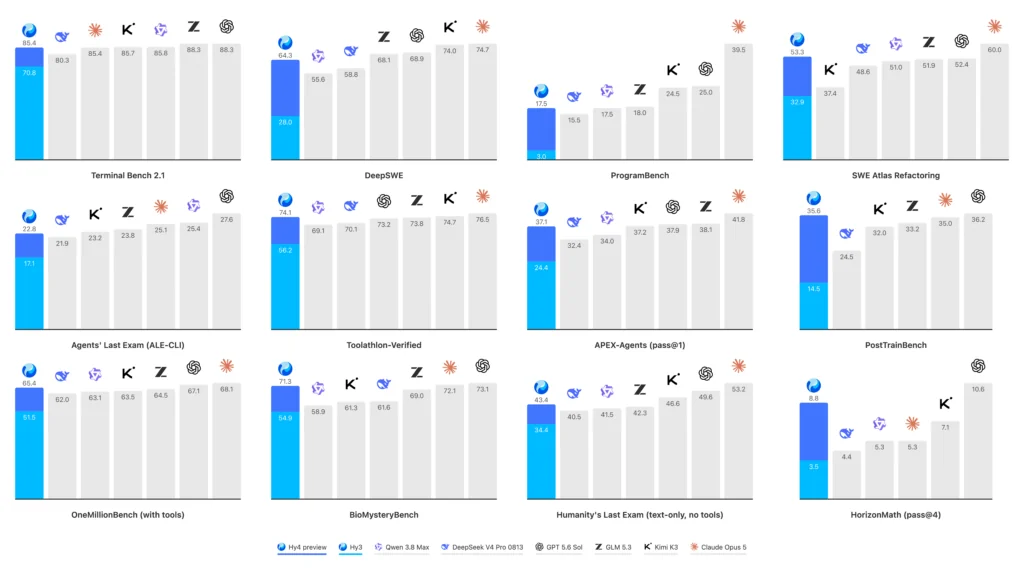
The sharpest reader in the r/LocalLLaMA thread did the counting the marketing didn't:
I don't think their own chart backs the beats glm and kimi line. Against kimi k3 it's behind on 7 of the 12 benchmarks... The beats claim comes from the internal blind test where wins only beat losses 47 to 40 against glm.
Independently, the official Arena account reported Hy4 landing ~#5 in Code Arena's WebDev leaderboard at 1,633 points, roughly #3 among open models, though it flagged this as an early AutoEval placement (a reward model voting in place of live human votes), not a settled rank. And it isn't on the Artificial Analysis index at all yet, so there's no independent intelligence score to quote. My read: this is a strong top-tier open model, not the new #1, and the "beats everyone" framing is the one part I'd discount.
One more thing Tencent is upfront about, which I respect: this preview spends longer than necessary reasoning and over-verifies its own work. They're shipping early on purpose, the same way Hy3 preview did before its final release reportedly jumped 50-100%.
Can you actually run it?
This is where the "open-weight" label gets complicated, and it's the single biggest thing to understand before you get excited. Open weights and an Apache 2.0 license mean you're allowed to run Hy4 anywhere. The hardware is what decides whether you can.
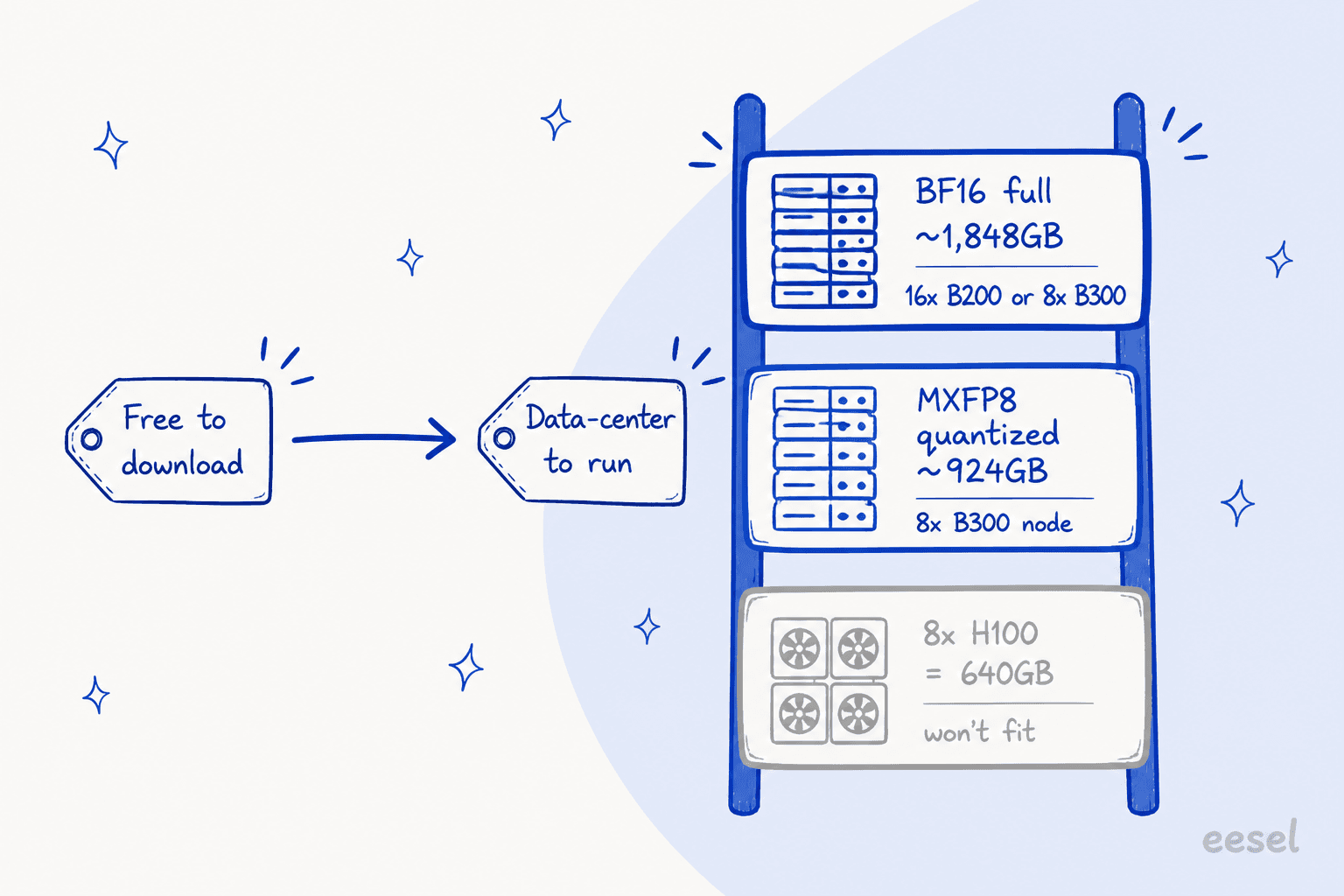
The vLLM recipe is blunt about it. Full BF16 weights are about 1,848 GB. Even the MXFP8 quantized weights are ~924 GB. The recipe's own floor: "16xB200 or 8xB300 minimum for weights + KV cache." A single 8x H100 node (640 GB) can't hold it. This is a data-center model, full stop.
The r/LocalLLaMA crowd, who run big models at home as a hobby, greeted it with equal parts admiration and resignation:
The amount of people who can drop $5-10k to run these locally is vanishingly small.
The practical quant math they worked out is useful if you're tempted: a Q4 GGUF lands around 450 GB, so 512 GB is the realistic minimum, and a 256 GB machine only fits the 1-2 bit quants. As one detailed breakdown put it, "if you have 256GB, you'll probably be much better off with GLM-5.3-Flash Q4." That's the recurring verdict: for local use, a smaller, well-post-trained model is the smarter pick, and Z.AI's Flash models keep getting named as the ones to reach for.
So realistically, "using" Hy4 means the API or one of Tencent's apps, not your own box.
What Tencent Hy4 costs
On the API, Hy4 preview is priced at $0.834 per million input tokens and $2.501 per million output, with cached input at $0.042 (official announcement). Among the flagship open models it compares itself to, that's the cheap option.
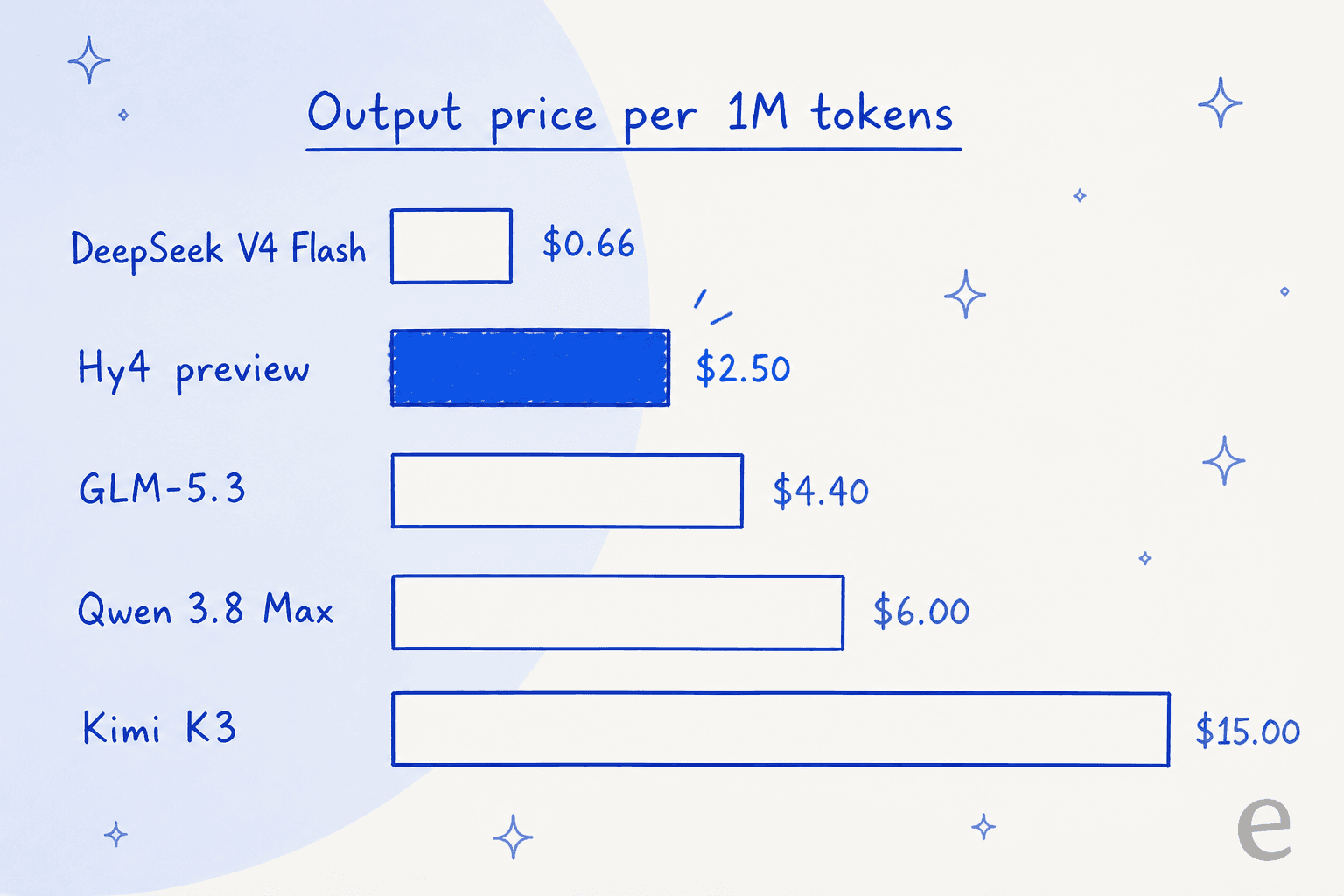
Here's the fuller picture against its rivals, all per million tokens:
| Model | Total / active params | Context | Input | Output | Cache-hit in |
|---|---|---|---|---|---|
| Hy4 preview (Tencent) | 770B / 49B | 1M | $0.834 | $2.501 | $0.042 |
| DeepSeek V4 Flash | 284B / 13B | 1M | $0.22 / $0.44 | $0.66 / $1.32 | $0.007 |
| DeepSeek V4 Pro | 49B-class active | 1M | $0.66 / $1.32 | $1.98 / $3.96 | $0.022 |
| Qwen 3.8 Max | 2.4T / 95B | 1M | $2.00 | $6.00 | $0.25 |
| Kimi K3 | 2.8T / 104B | 1M | $3.00 | $15.00 | $0.30 |
| GLM-5.3 | not disclosed | n/a | $1.40 | $4.40 | $0.26 |
Two honest caveats sit on top of that. First, Hy4 is about 5-6x more expensive than Hy3, so if you're an existing Hy3 user this is a real cost jump, not a discount. Second, DeepSeek V4 Flash is still dramatically cheaper on both meters, and for a lot of agentic work "cheap and good enough" wins. One developer ran a real test and said so plainly:
even mimo 2.5 was same good and on 1/20 of the costs... the model is interesting if the price is lower but not for 2.5 USD per million output.
If you want to try it without paying, Hy4 is free for two weeks on WorkBuddy and CodeBuddy, and it's listed on OpenRouter (with a zero-retention data policy, which is a nice touch over some first-party Chinese APIs).
So, who is Tencent Hy4 actually for?
After a few days with it and the community's testing, here's where I land.
Reach for Hy4 if you're building agentic coding, office-automation, or research tooling, you specifically want open weights and a permissive Apache 2.0 license, and you have the hardware (or the API budget) to run a frontier-scale model. The coding and math scores are real, the context window is huge, and the price undercuts the other flagship open models.
Skip it if you're running models locally on a workstation (a well-post-trained Flash-tier model will serve you better for a fraction of the memory), if raw cost-per-token is your main lever (DeepSeek V4 Flash is far cheaper), or if you just want a finished job done and don't care which model does it.
That last case is the one I see most often, and it's worth being honest about: most people asking "should I use Hy4" don't actually want a model. They want a support queue cleared, or a blog drafted, or a research task finished. A raw 770B model is a brilliant engine with no car around it, you still have to build the retrieval, the guardrails, the integrations, the evals, and the fallback logic before it does anything useful in production. That's the gap between an impressive benchmark and a thing that survives real traffic, and it's the part I spend all day on.
Try eesel: hire the teammate, skip the model plumbing
The way I think about it: models like Hy4 are infrastructure. eesel AI is the employee. Instead of picking a model and wiring up everything around it, you hire a ready-to-work AI teammate for a specific job, and it arrives already knowing how to do it.
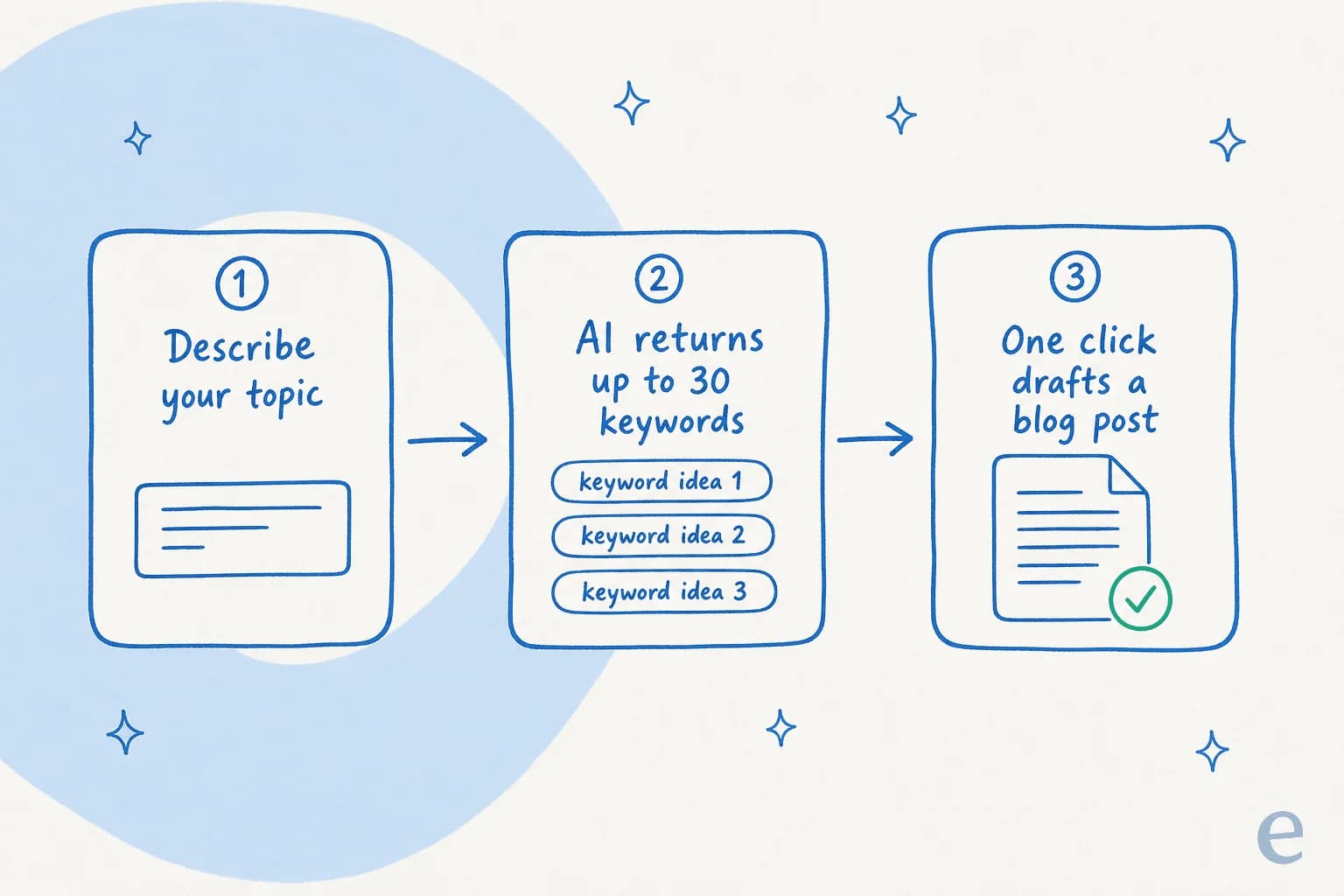
Right now the roster is two teammates. The AI helpdesk teammate joins your existing queue in Zendesk, Freshdesk, Gorgias, or a shared inbox, trains on your past tickets and help center, and drafts or sends replies, and crucially, you can simulate it against your historical tickets before it ever answers a customer, so you know how it'll behave instead of flipping a switch and hoping. The AI blog writer does the research, writing, and SEO for a long-form post in one run. Both run on frontier models under the hood, so you get the capability of something like Hy4 without provisioning a single GPU. You can start free, no credit card and no sales call.