


Tencent Hy4 API pricing at a glance
I spend most of my week thinking about how buyers actually search for tools like this, and "Tencent Hy4 pricing" is almost always really two questions: what does a token cost, and what does the whole thing cost to run. Let's take the token question first, because it is the simple one.
Here are the published API rates, straight from Tencent's launch announcement, all per million tokens:
| Meter | Price per 1M tokens | What it covers |
|---|---|---|
| Input | $0.834 | Every token you send in (prompt, context, retrieved docs) |
| Output | $2.501 | Every token the model generates back |
| Cached input | $0.042 | Input tokens served from cache on a repeat prompt |
Three things are worth pulling out of that table.
First, the output-to-input ratio is about 3:1, which is normal for a reasoning-heavy model. Because Hy4 is a heavy reasoner (more on that below), your bills will lean toward the output meter, so that $2.501 number is the one to plan around, not the headline $0.834.
Second, the cache rate is very cheap at $0.042. If your workload repeats a large system prompt or a fixed knowledge base across many calls, and most agentic workloads do, cache hits knock the effective input price down by roughly 20x. That is a real lever, and it is the kind of thing that separates a well-built AI agent from a rule-based chatbot or a naive wrapper that pays full freight on every token.
Third, there is no permanent free tier. The trial is time-boxed (two weeks on Tencent's own apps), and after that every token is metered.
Estimate your monthly Tencent Hy4 bill
Rates per million tokens are hard to feel. Plug in a rough monthly volume and see what Hy4 costs against the other flagship open models. The calculator assumes the standard non-cached rates for every model.
The price nobody quotes: running it yourself
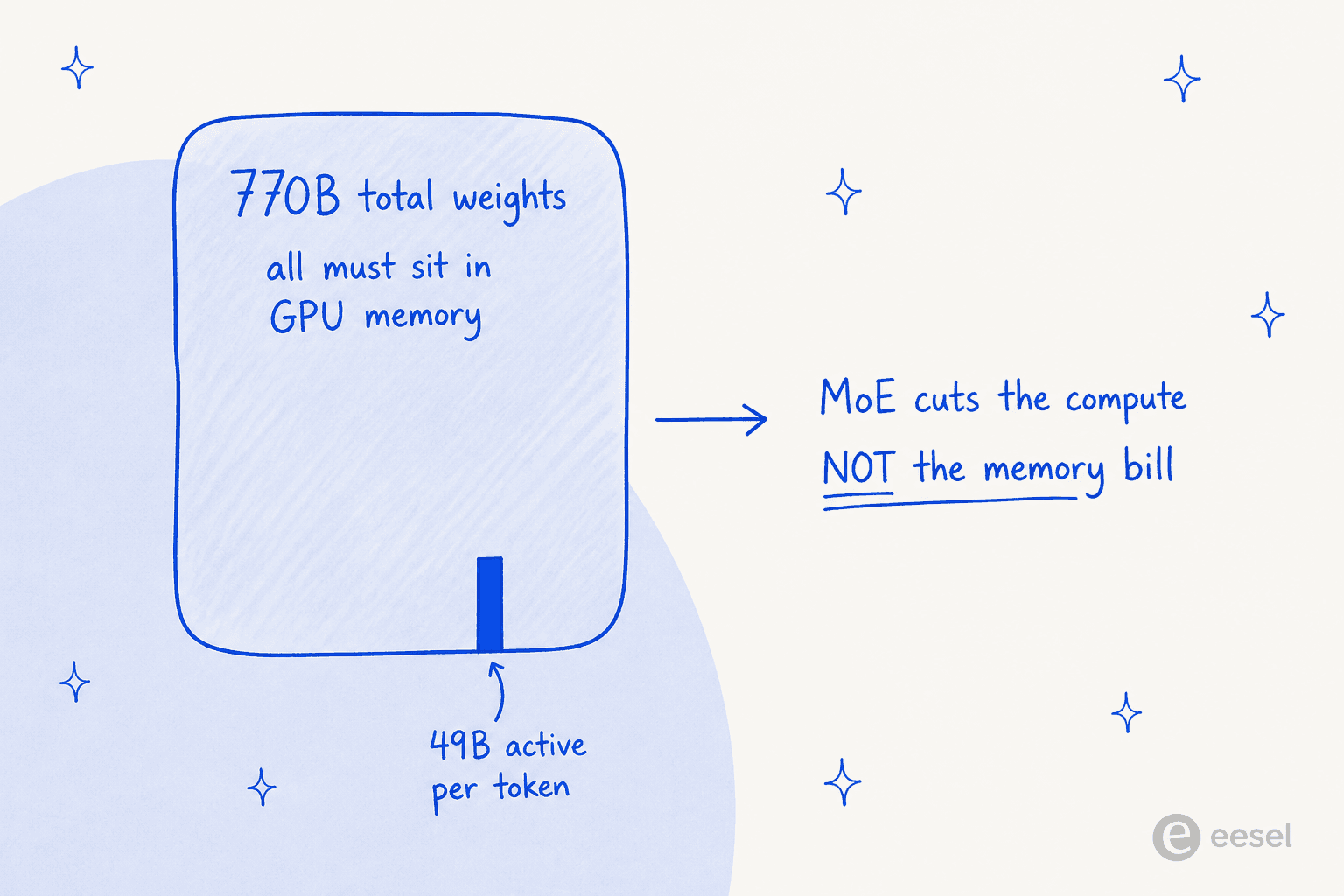
This is where "open weights" gets expensive, and it is the single biggest thing to understand before you get excited about Hy4 being open source. The Apache 2.0 license means you are allowed to run it anywhere. The hardware decides whether you can, and what it costs.
The vLLM recipe is blunt about the floor. Full BF16 weights are about 1,848 GB. Even the MXFP8 quantized weights are ~924 GB. The recipe's own minimum: "16xB200 or 8xB300 minimum for weights + KV cache." A single 8x H100 node (640 GB) cannot hold it.
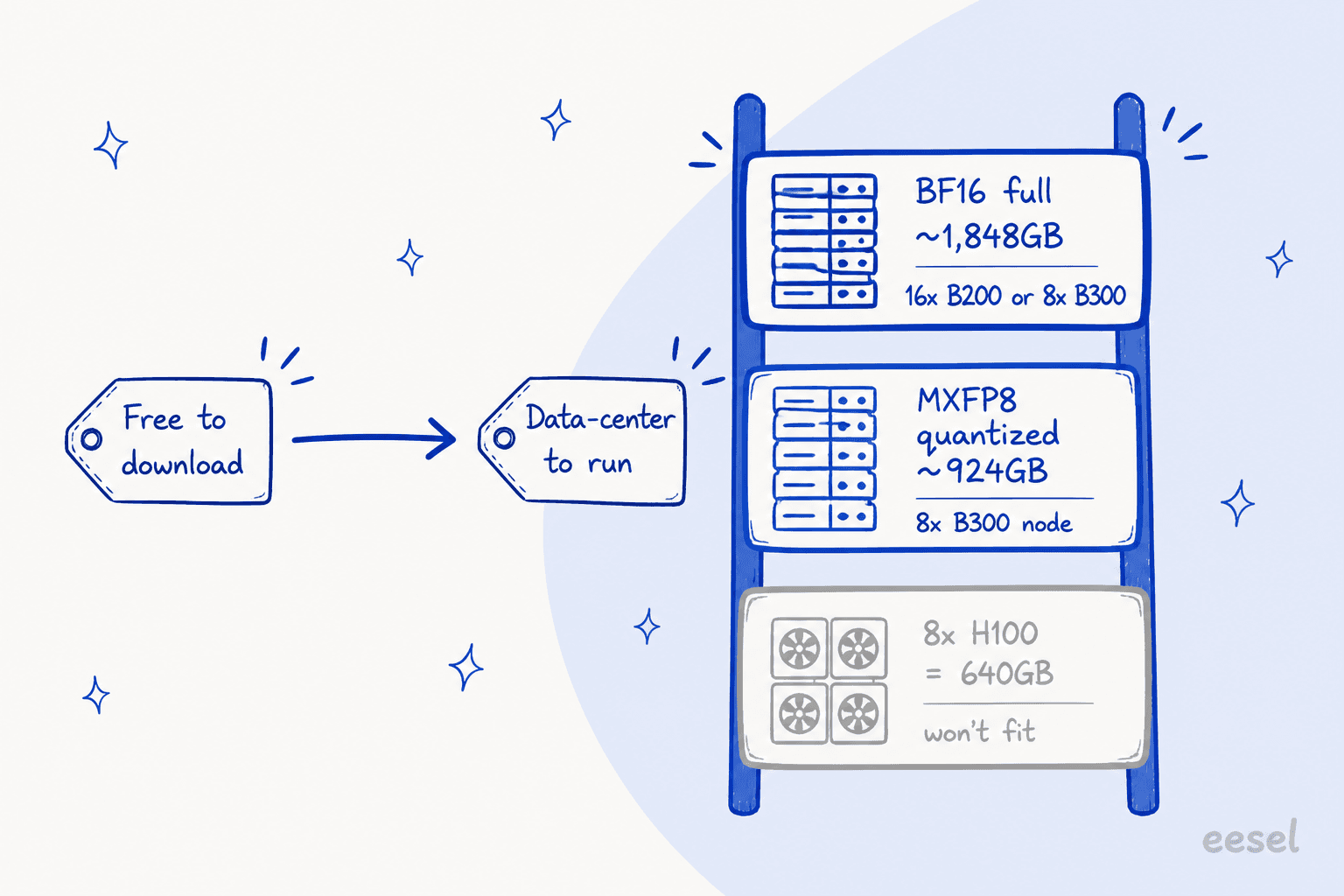
Put rough numbers on that. Renting an 8x B200 node from a cloud GPU provider runs in the neighborhood of tens of thousands of dollars a month, and the full BF16 recipe wants two of those. Buying the silicon outright is a six-figure capital purchase before you power it on. That is the real Tencent Hy4 price for anyone who wants to own their inference, and it dwarfs the token rate unless you are running the box at very high utilization.
The r/LocalLLaMA crowd, who run big models at home as a hobby, greeted it with equal parts admiration and resignation:
The amount of people who can drop $5-10k to run these locally is vanishingly small.

The quant math they worked out is useful if you are tempted. A Q4 GGUF lands around 450 GB, so 512 GB of memory is the realistic minimum, and a 256 GB machine only fits the 1-2 bit quants. One detailed breakdown put it plainly: if you have 256 GB, you are much better off with GLM-5.3-Flash. For local use, a smaller, well-post-trained model keeps winning the cost argument.
The takeaway for pricing: for almost everyone, "using" Hy4 means the API. Self-hosting is a data-center project, not a line item.
Tencent Hy4 pricing vs the other open-weight flagships
Here is where Hy4 sits against its rivals, all per million tokens, checked on August 30, 2026.
| Model | Total / active params | Context | Input | Output | Cache-hit in |
|---|---|---|---|---|---|
| Hy4 preview (Tencent) | 770B / 49B | 1M | $0.834 | $2.501 | $0.042 |
| DeepSeek V4 Flash | 284B / 13B | 1M | $0.22 / $0.44 | $0.66 / $1.32 | $0.007 |
| DeepSeek V4 Pro | 49B-class active | 1M | $0.66 / $1.32 | $1.98 / $3.96 | $0.022 |
| Qwen 3.8 Max | 2.4T / 95B | 1M | $2.00 | $6.00 | $0.25 |
| Kimi K3 | 2.8T / 104B | 1M | $3.00 | $15.00 | $0.30 |
| GLM-5.3 | not disclosed | n/a | $1.40 | $4.40 | $0.26 |
The chart tells the same story faster. On the meter that dominates most bills, output, Hy4 is the second-cheapest of this group, behind only DeepSeek V4 Flash.
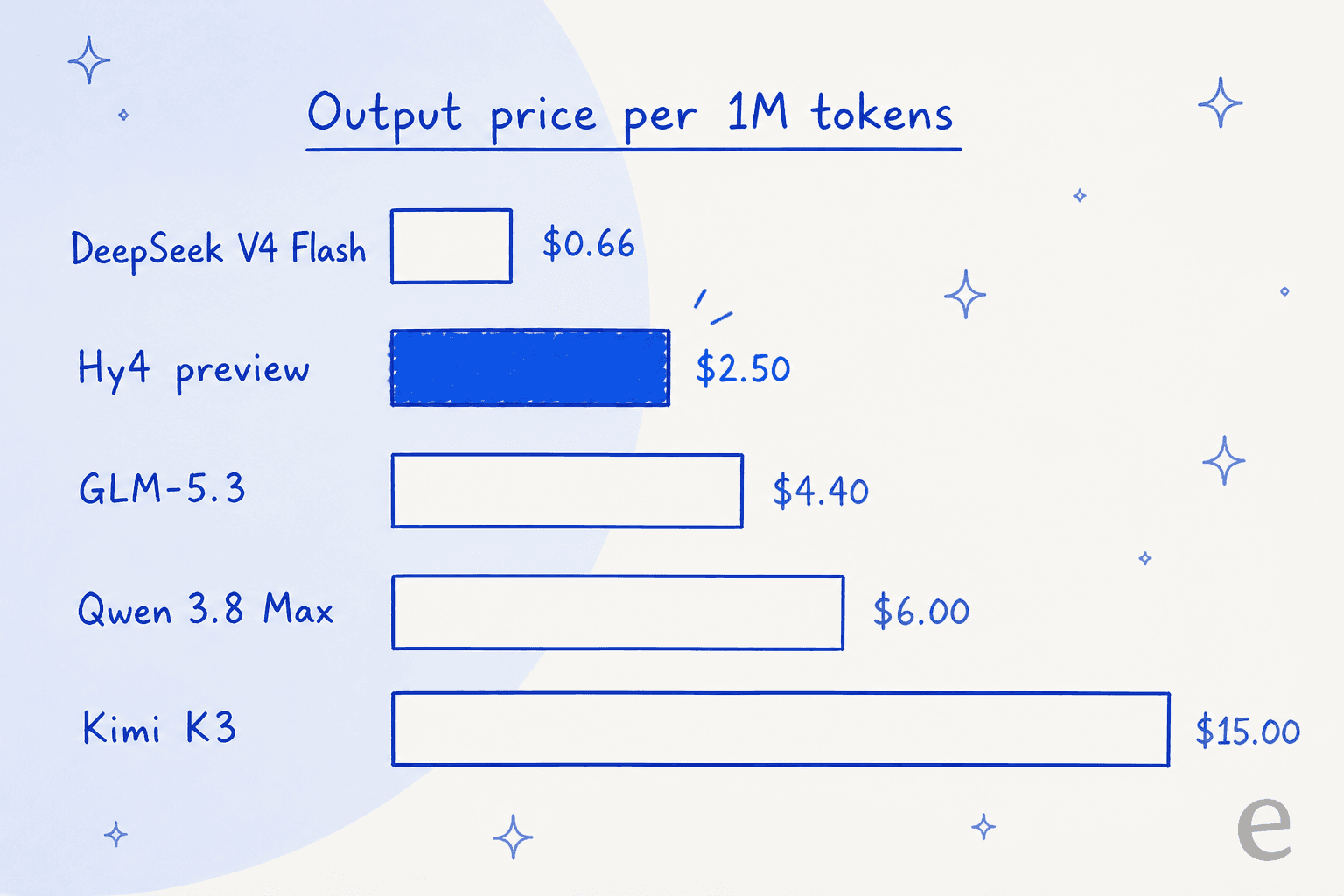
Two honest caveats sit on top of that pricing.
First, Hy4 is about 5-6x more expensive than Hy3, as flagged in the community pricing thread. If you are an existing Hy3 user, this is a real cost jump, not a discount, and you should decide whether the extra capability changes your output.
Second, DeepSeek V4 Flash is dramatically cheaper on both meters, and for a lot of agentic work "cheap and good enough" wins. One developer said so plainly after running a real test:
even mimo 2.5 was same good and on 1/20 of the costs... the model is interesting if the price is lower but not for 2.5 USD per million output.
That is the crux of Hy4's pricing position: it is not the cheapest, and it is not trying to be. It is the mid-priced option that buys you frontier-class coding scores and a 1M context, and whether that is worth the premium over DeepSeek or a Flash-tier model depends entirely on how much the extra quality moves your numbers.
How to try Hy4 cheaply (or free)
If you want to kick the tires before committing a budget, there are a few low-cost routes:
- Free for two weeks on Tencent's WorkBuddy and CodeBuddy apps from launch. No token cost during the window.
- OpenRouter, which lists Hy4 preview with a zero-retention data policy. Handy if you want a single API key across many models and care about data handling.
- Tencent Cloud TokenHub, the first-party route if you are already in Tencent's cloud.
For most buyers the smart move is to run a small pilot on the free window, measure your real input/output split (use the calculator above with those numbers), and only then decide whether Hy4's rate beats a cheaper model for your specific workload.
What Hy4's price actually buys, and where it leaks
One more pricing nuance that does not show up on the rate card. Tencent is upfront that this preview spends longer than necessary reasoning and over-verifies its own work. On a per-token model, an over-reasoner quietly inflates your bill, because you pay for every one of those extra output tokens. So the effective cost of Hy4 for a chatty, verification-heavy task can run higher than the sticker rate suggests, which is exactly the kind of thing that only shows up once you are live.
That is the gap I keep coming back to. A raw model rate tells you what a token costs. It does not tell you how many tokens the job will take, whether your prompts hit the cache, how much you will spend on retries, or what the engineering time to wire it all up is worth. Those are the numbers that decide the real bill, and they are the ones a benchmark or a price table never shows.
If you want the deeper spec-and-benchmark context behind these prices, the full Tencent Hy4 review and the Hy4 overview cover what you are paying for.
And if you are weighing it purely on cost, these breakdowns are the natural next reads:
- Qwen 3.8 Max pricing
- Kimi K3 pricing and the Kimi K3 review
- Gemini pricing
- Mistral pricing
- DeepSeek V4, the current price floor
Try eesel: hire the teammate, skip the token math
Here is the way I frame it after years of watching teams shop for models. A model like Hy4 is infrastructure, an engine with no car around it. eesel AI is the employee. Instead of picking a model, provisioning GPUs or metering tokens, and building the retrieval, guardrails, integrations, and evals yourself, you hire a ready-to-work AI teammate for a specific job and it arrives already knowing how to do it.

Right now the roster is two teammates. The AI helpdesk teammate joins your existing queue in Zendesk, Freshdesk, or a shared inbox, trains on your past tickets and help center, and drafts or sends replies, and you can simulate it against historical tickets before it answers a single customer, so you know the cost and the behavior up front instead of flipping a switch and hoping. The AI blog writer does the research, writing, and SEO for a long-form post in one run.
Both run on frontier models under the hood, so you get the capability without provisioning a single GPU or reading a rate card, and eesel's own fixed monthly pricing (from $299/month for 500 credits) is a predictable number rather than a raw token meter you have to forecast. You can start free, no credit card and no sales call.
Want the end-to-end math instead of a per-token rate? These make it concrete: