The 8 best Tencent Hy4 alternatives in 2026

Rama Adi

Katelin Teen
Last edited August 30, 2026

Why people are looking past Hy4
Let me be fair to Hy4 first, because it deserves it. Tencent's Hunyuan team shipped a real frontier open-weight model: 770B total parameters, 49B active, a 1M-token context window, open weights on Hugging Face, and pricing that comes in cheaper than GLM-5.3, Qwen 3.8 Max, and Kimi K3. On the Code Arena WebDev leaderboard it landed around #5, roughly #3 among open models, a +115-point jump from Hy3. If you have the hardware, it's a strong pick.
Here's where it gets complicated, and it's the part I run into every week building on these models. A mixture-of-experts model saves you compute per token, not memory. The router only lights up 49B of the 770B parameters for any given token, so it's fast, but the whole 770B still has to be loaded and resident. In practice that's around 924GB of weights in the MXFP8 build, which is an eight-GPU B300-class node. A box of eight H100s (640GB) won't hold it. The community read on r/LocalLLaMA landed in the same place: amazing model, can't run it at home.
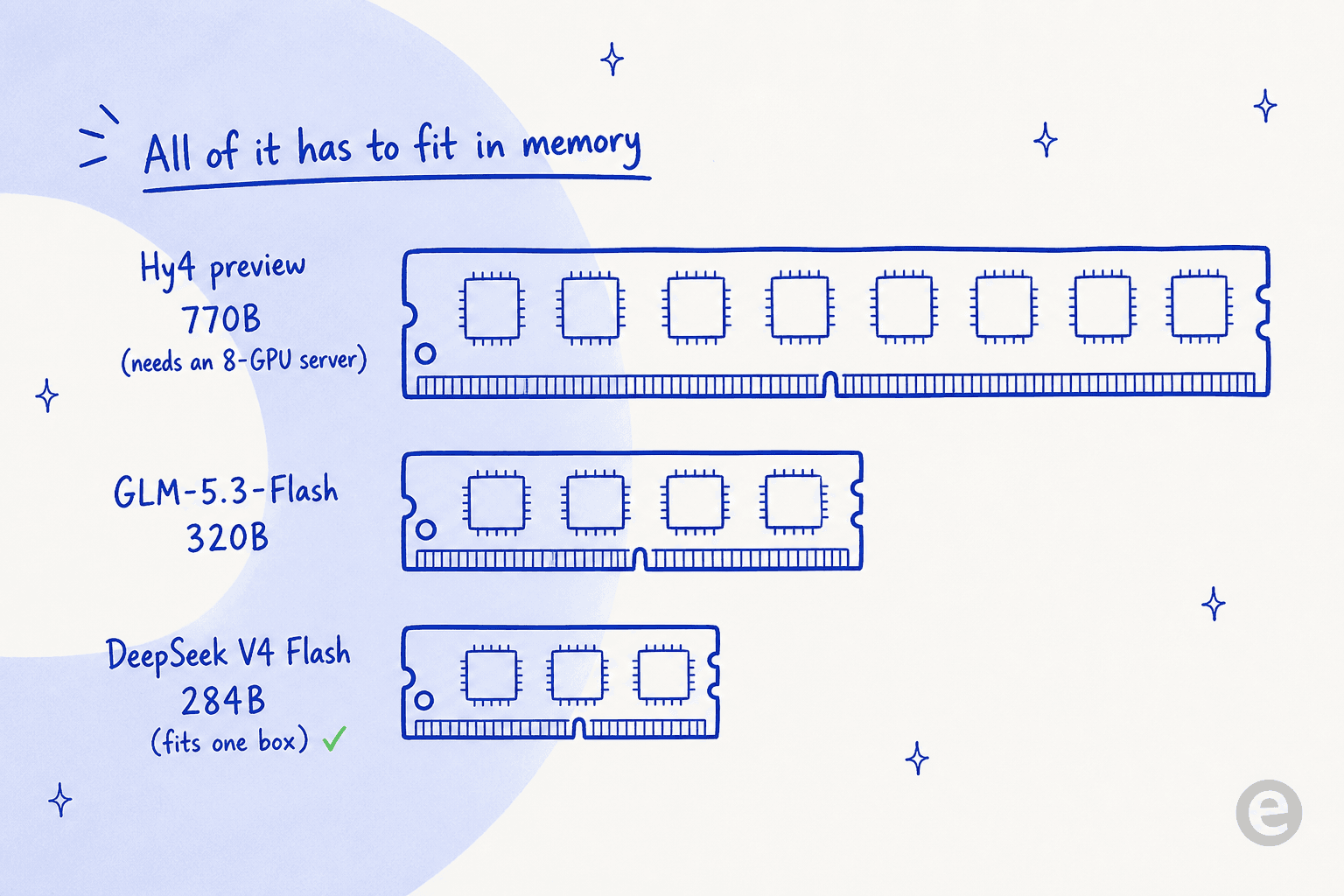
The second pain is cost. Hy4 undercuts its flagship rivals, but it's a big step up from the model it replaces, so existing Hy3 users are facing a real bill increase even as it looks cheap next to Kimi. And the third is maturity: it's a preview, and Tencent itself notes the model tends to over-reason and over-verify.
None of that makes Hy4 a bad model. It makes it a model with a narrow set of people who can actually deploy it. For everyone else, the alternatives below get you most of the way there on hardware you can afford.
How Hy4 actually stacks up against these alternatives
Before I get to the picks, it's worth seeing the head-to-head. This is Tencent's own benchmark grid from the launch, and the useful part is that the rivals on it are exactly the models in this roundup: Qwen 3.8 Max, DeepSeek V4 Pro, GPT-5.6 Sol, GLM-5.3, Kimi K3, and Claude Opus 5.
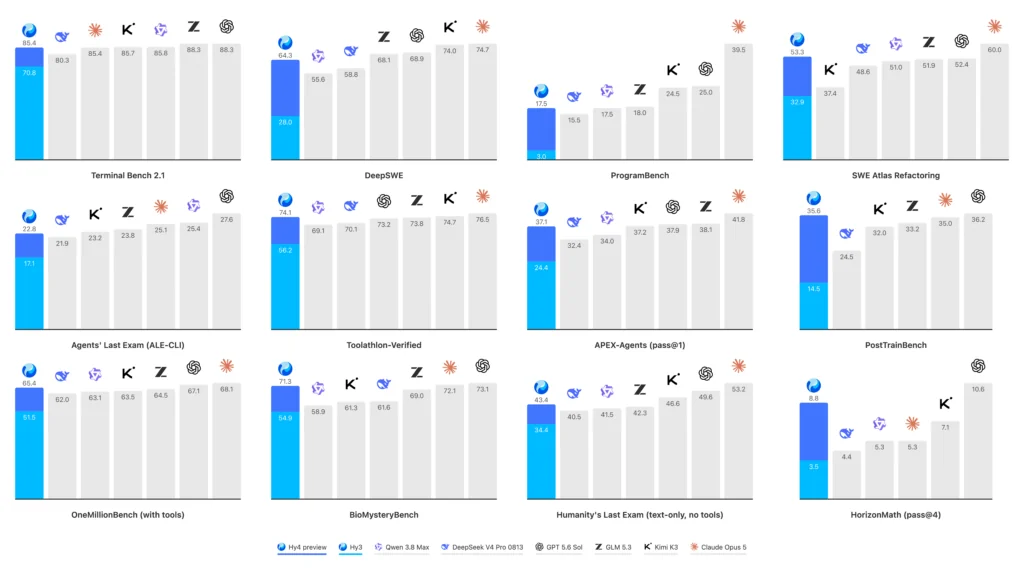
Two honest caveats. First, this is a vendor's own chart, so read it as a starting point, not a verdict. Second, Hy4 isn't on the independent Artificial Analysis index yet, so there's no neutral intelligence score to quote for it. Tencent's own internal blind evaluation put Hy4 at 2.99/4.00 against Kimi K3 (2.94) and GLM-5.3 (2.92), which is close enough that the coding-CLI community read it as roughly a three-way tie, with pricing as Hy4's real edge.
How I picked these
I build the integrations and model plumbing at eesel, so choosing which model to actually run in production is a big part of my week. A leaderboard number is the easy part. The questions that decide it in practice are: can I fit the weights, what does a real month of tokens cost, is the license one I can ship on, and does it hold up over a long agentic run rather than a single clever answer. So I weighted these on:
- Deployability - can a normal team realistically run or afford it, not just a hyperscaler.
- Price per 1M tokens - from the vendor's own rate card, with promos and peak/off-peak quirks flagged.
- License and open weights - whether you can self-host and what you're allowed to do.
- Real capability - coding and agentic strength, not just a headline score.
Every price and spec below comes from the vendor's own pages, checked on August 30 2026. Where a number is a vendor's internal benchmark rather than an independent one, I say so.
The alternatives at a glance
| Model | Best for | Total / active params | Context | Input $/1M | Output $/1M | Open weights | License |
|---|---|---|---|---|---|---|---|
| GLM-5.3-Flash | Best all-round | 320B / 18B | 1M | $0.075* | $0.25* | Yes | Open (HF) |
| DeepSeek V4 Flash | Lowest price | 284B / 13B | 1M | $0.22-0.44 | $0.66-1.32 | Yes | MIT |
| GLM-5.3 | Closest to Hy4 | Not disclosed | 1M | $1.40 | $4.40 | Yes | Open (HF) |
| Kimi K3 | Agentic coding | 2.8T / 104B | 1M | $3.00 | $15.00 | Yes | "other" |
| Qwen 3.8 Max | Multimodal + ecosystem | 2.4T / 95B | 1M | $2.00 | $6.00 | Yes (base) | qwen3.8-max |
| DeepSeek V4 Pro | Long-context recall | 49B-class active | 1M | $0.66-1.32 | $1.98-3.96 | Yes | Open |
| Claude Opus 5 | Zero infrastructure | Not disclosed | 1M | $5.00 | $25.00 | No | Proprietary |
| GPT-5.6 | Managed API tiers | Not disclosed | Long-ctx tiers | $0.20-5.00 | $1.20-30.00 | No | Proprietary |
*GLM-5.3-Flash is at a 50% launch promo ($0.15 / $0.50 list) that ends September 9 2026. DeepSeek shows off-peak to peak; a US/EU schedule mostly bills at the lower off-peak rate. All rates per each vendor's pricing page, checked August 30 2026.
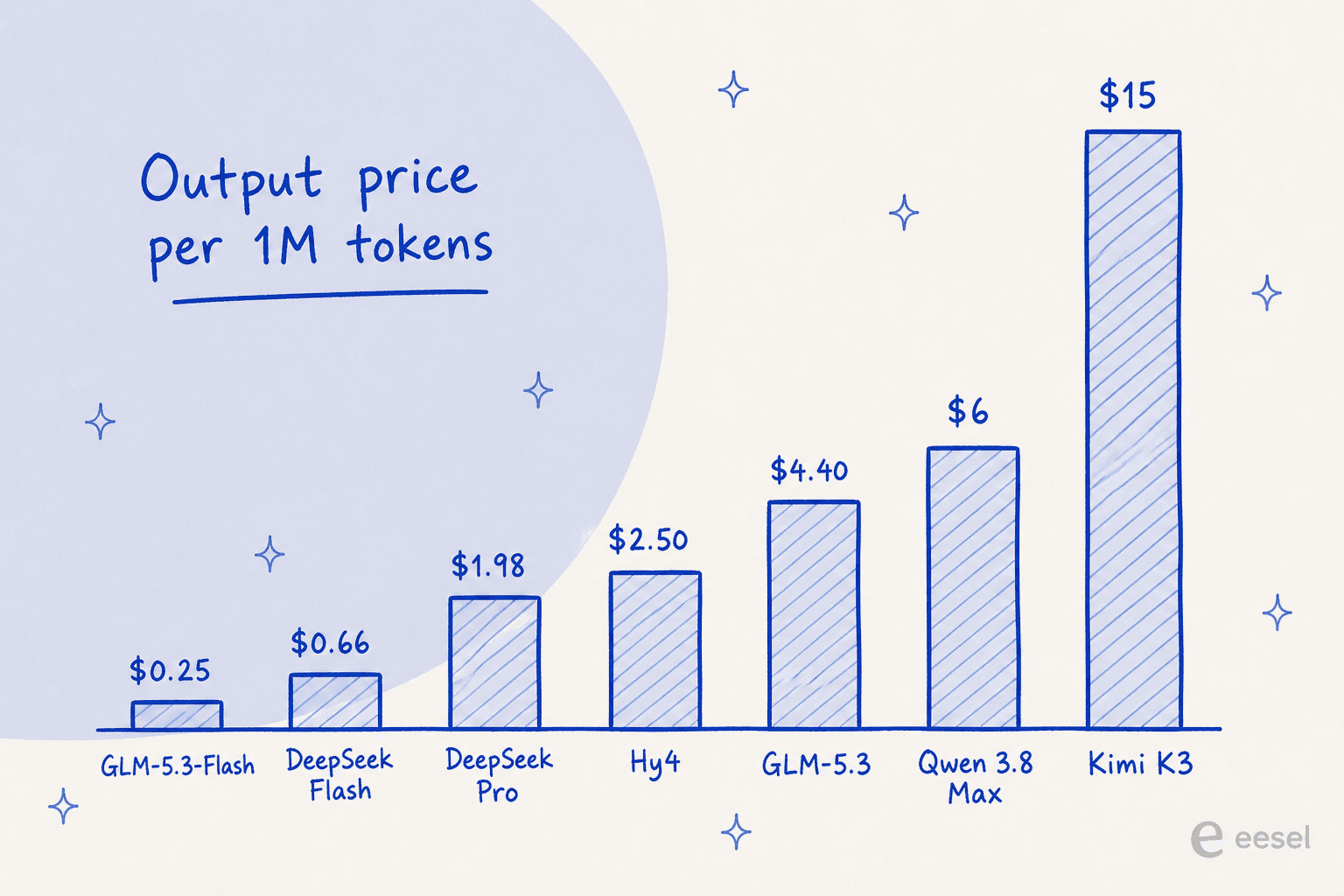
The pattern jumps out once it's laid out: the two "Flash" models are an order of magnitude cheaper than the frontier tier, and the closed APIs (Opus 5, GPT-5.6) sit at the top on price but ask nothing of you in return. Here's the same picture as output price, which is usually the bill that actually hurts on a chatty agent:
If you're not sure which corner of the map you belong in, this quick tool walks you to a pick.
1. GLM-5.3-Flash
Best for: teams who want Hy4-class quality on hardware they can actually run, at the lowest realistic price.
This is the one I'd reach for first. GLM-5.3-Flash from Z.ai (formerly Zhipu AI) is a 320B mixture-of-experts model with just 18B active, and it's the first natively multimodal model in the GLM-5 line, handling text, image, and video. Z.ai's pitch is "frontier intelligence, flash cost," and the numbers back the second half: it scores 57 on the Artificial Analysis intelligence index at about $0.045 per task discounted, a level that used to cost roughly 10x more.
The reason it beats Hy4 for most people is simple: at 320B total it's less than half Hy4's footprint, so it's meaningfully easier to serve, and it was quietly tested as "ox-alpha" on OpenRouter where it became the most-used model of the week, all served on Chinese chips. On Z.ai's own Code Bench it lands 29.0 against Claude Opus 4.8's 29.5, a near-match.
Pros: natively multimodal (text, image, video), open weights on Hugging Face, and easily the best price-to-capability ratio in this list.
Cons: the benchmark comparisons are Z.ai's own, and the headline price is a launch promo. Z.ai hasn't published a full parameter/context spec sheet as cleanly as some rivals.
Pricing: $0.075 in / $0.25 out per 1M during the 50% launch promo (list $0.15 / $0.50), promo ending September 9 2026. Cached input is $0.015. Also bundled into the GLM Coding Plan from $18/month.
Verdict: if you can only try one Hy4 alternative, make it this. It's the rare model that's cheaper and smaller and multimodal, and it's the pick I'd hand to a team that liked Hy4 but couldn't justify the eight-GPU server.
2. DeepSeek V4 Flash
Best for: the absolute lowest cost per token, and the most self-host-friendly license in the group.
DeepSeek V4 Flash is the price floor, and it's not close. It's a 284B mixture-of-experts model with 13B active, shipped under a true MIT license, and at roughly 167GB of weights it's the one frontier-class model on this list that a well-equipped team can genuinely run at home for under $10k. Off-peak, it bills at about $0.22 in / $0.66 out per 1M, roughly a quarter of Hy4's output rate.
There's a quirk worth knowing: DeepSeek's rate card is time-of-day split, with peak hours tracking Chinese business hours (01:00-04:00 and 06:00-10:00 UTC). A US or EU support queue mostly runs during DeepSeek's off-peak window, so you tend to pay the cheaper half of the card by default. The one honest knock is verbosity: independent testing has it burning through noticeably more output tokens than rivals to reach an answer, so the per-token saving shrinks a little on a per-task basis.
Pros: cheapest by a wide margin, MIT-licensed, and small enough to self-host.
Cons: wordy (higher output-token count than peers), and DeepSeek's paid-API terms are silent on training use rather than explicitly safe, with data residency in the PRC. That matters if you're piping customer data through the first-party API.
Pricing: cache-miss input $0.22 off-peak / $0.44 peak; output $0.66 / $1.32; cache-hit input from $0.007, per the DeepSeek pricing page.
Verdict: if the deciding factor is the invoice, this is your model. Just budget for its chattiness, and keep customer PII off the first-party endpoint unless you've read the terms carefully.
3. GLM-5.3
Best for: the closest thing to Hy4's actual quality, from the model Tencent chose to benchmark itself against.
When Tencent wanted to show Hy4 was frontier-class, GLM-5.3 is one of the two models it lined up against, and Hy4 only edged it 2.92 to Hy4's 2.99 on Tencent's own blind eval. In other words, if you want the model that comes closest to Hy4's real-world quality, this is the obvious candidate, and it comes from a lineage with a serious track record in long-horizon coding (its predecessor GLM-5.2 was the first open-weights model to cross 80% on Terminal-Bench).
It's also cheaper than Hy4 on the input side and lands in the same ballpark on output, so you're not paying a premium for a near-equal model. Z.ai doesn't publish GLM-5.3's exact parameter count as cleanly as some rivals, so I'm leaving that number out rather than quoting an aggregator.
Pros: the closest benchmarked rival to Hy4, open weights, strong long-horizon coding heritage, 1M context, and OpenAI- and Anthropic-compatible endpoints so it drops into existing tooling.
Cons: Z.ai's public spec sheet for 5.3 specifically is thin on total/active params, and like Hy4 it's a large model to self-host.
Pricing: $1.40 in / $4.40 out per 1M, cached input $0.26, per the Z.ai pricing docs. Also available through the GLM Coding Plan.
Verdict: if your goal is "give me Hy4 but that I can actually deploy without the preview caveats," GLM-5.3 is the safest swap. It's the like-for-like alternative.
4. Kimi K3
Best for: long, tool-heavy agentic coding runs where depth matters more than price.
Kimi K3 from Moonshot AI is the biggest model here: 2.8T total, 104B active, with a 1M-token context and open weights that shipped on time. On the Artificial Analysis intelligence index it sits at 57, in the #4 range at launch, and it's the model Hy4 beats least convincingly in Tencent's own pairwise numbers (Hy4 wins just 51.2% of the time against it). It's genuinely good at long agentic sessions.
The thing to know is that Kimi K3 is expensive, and it commits you: reasoning can't be turned off at any level, and dialing effort down doesn't make it cheaper (levels bill at the same rate). At $3 in / $15 out per 1M it's in Claude Sonnet territory, roughly 23x Hy4's output rate on a cache-miss basis. It earns that on hard, multi-step work; it's overkill for simple calls.
Pros: frontier-class agentic and coding ability, native vision, huge 1M context, and open weights on Hugging Face.
Cons: the priciest model in this roundup, no way to switch reasoning off, and public image URLs aren't accepted (base64 or file IDs only).
Pricing: $3.00 in / $0.30 cache-hit / $15.00 out per 1M, per Moonshot. Consumer app tiers run from a free plan up to $199/month.
Verdict: reach for Kimi K3 when the task is a genuinely hard, long agent run and quality is the whole game. For anything routine, one of the cheaper models above will do the same job for a tenth of the bill.
5. Qwen 3.8 Max
Best for: multimodal work plus the deepest surrounding ecosystem of the Chinese labs.
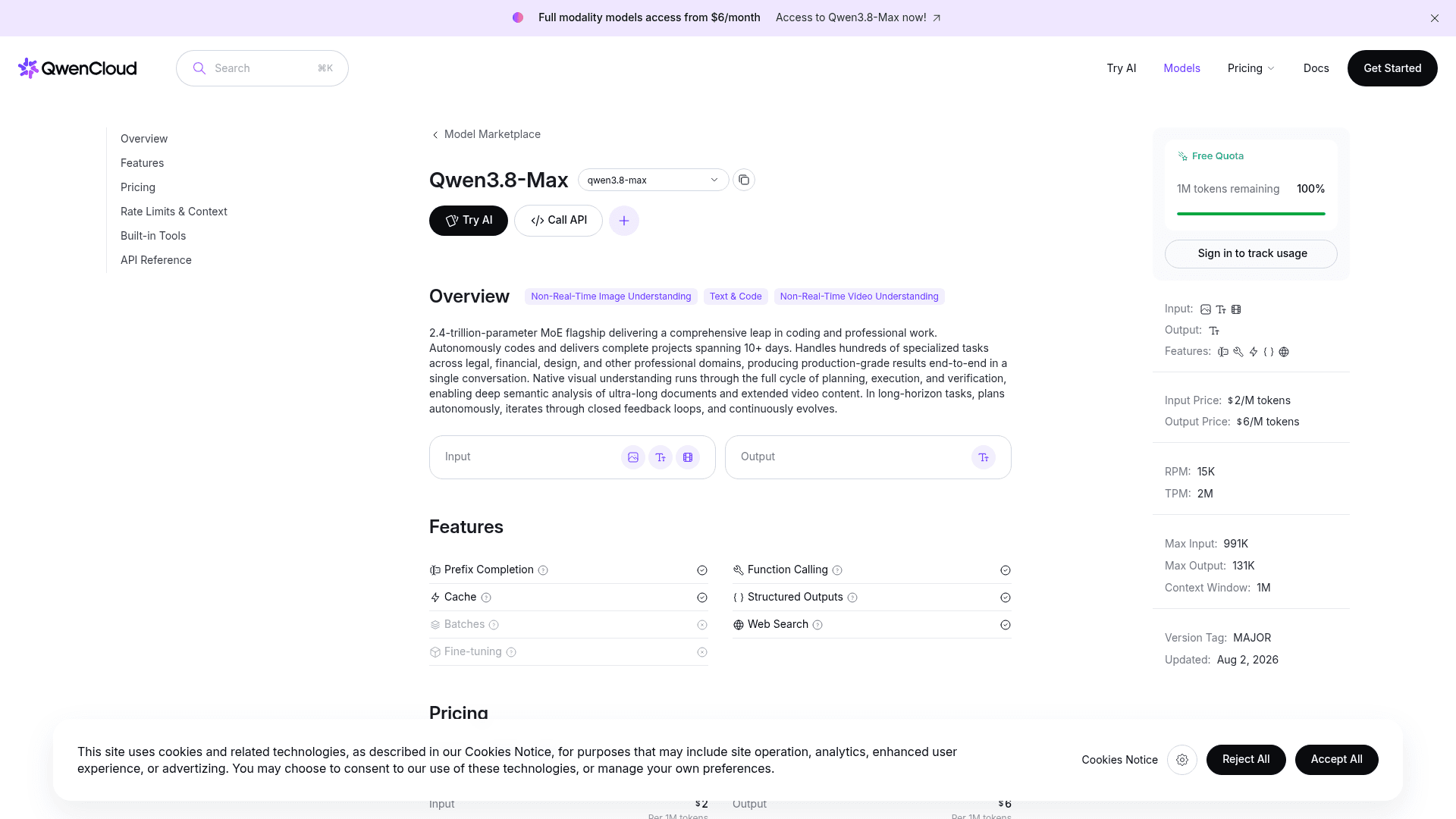
Qwen 3.8 Max from Alibaba is a 2.4T / 95B mixture-of-experts model that went GA in early August, with a 1M context and native image and video input. It's on the Artificial Analysis board at rank 6 (index ~58), and it's strong on LMArena's WebDev and vision boards too. Where it stands out from the pack is the ecosystem: Qwen has one of the largest open-model families anywhere, so there's a smaller sibling for almost any budget, and the hosted Max adds vision, non-thinking mode, and built-in tools on top of the open base.
A fairness note I always include: the fully open base weights (Qwen3.8-2.4T-A95B) shipped, but they're not feature-equivalent to hosted Max, which adds the vision input and 1M default context. And the permissive Apache-licensed member of the family is the smaller Qwen3.8-27B, not Max itself.
Pros: native multimodal, huge and well-supported model family, a real ecosystem of tools, and open base weights.
Cons: the Max license isn't Apache, the hosted and open versions differ in capability, and at $6 output it's pricier than the GLM and DeepSeek options.
Pricing: $2.00 in / $6.00 out per 1M, implicit cache $0.25, per QwenCloud.
Verdict: pick Qwen 3.8 Max if multimodal input plus a broad model family matters to you, or if you want to standardize on one lab across many model sizes. On pure price-to-capability, GLM-5.3-Flash still edges it.
6. DeepSeek V4 Pro
Best for: long-context recall and needle-in-a-haystack retrieval where the smaller Flash model strains.
If DeepSeek V4 Flash is the budget pick, DeepSeek V4 Pro is the recall pick. It runs more active parameters (49B-class) than Flash, and that shows up where it counts: on DeepSeek's own cross-mode table Pro leads Flash on SimpleQA-Verified (57.9 vs 34.1) and on 1M-context needle-finding. LMArena's human-preference ranking also still puts Pro above Flash. That's the model to use when the job is reading a very long document and getting a precise fact back out.
There's one trap I flag for anyone routing effort levels: DeepSeek's published mapping serves a low request on Pro at high, so there's no cheap Pro run, you pay the full rate and can't dial reasoning down. If cost control matters, that's a reason to stay on Flash unless you specifically need Pro's recall.
Pros: stronger recall and long-context retrieval than Flash, still open weights, still on the same time-of-day pricing that favors non-Chinese schedules.
Cons: you can't run a cheap low-effort Pro request, and it's about 3x Flash's rate on cache-miss.
Pricing: cache-miss input $0.66 off-peak / $1.32 peak; output $1.98 / $3.96, per the DeepSeek pricing page.
Verdict: most teams should start on Flash and only move to Pro for the specific workloads (long-document QA, precise recall) where Flash visibly falls short. Don't pay for Pro across the board.
7. Claude Opus 5
Best for: teams who want top-tier quality and want to run exactly zero infrastructure.
Here's the honest reframe: for a lot of teams, the real alternative to a 770B open-weight model isn't another open-weight model, it's not running one at all. Claude Opus 5 is Anthropic's flagship, it sits #1 on the intelligence index (narrowly, at 61-63 depending on the snapshot), and there is nothing for you to fit in memory. You call an API and get a frontier answer.
The tradeoff is price and openness. At $5 in / $25 out per 1M it's an order of magnitude more expensive than the open-weight options, and there are no weights to self-host. The community also flags that Opus 5 tends to spend more output tokens than its predecessor at matched effort, so cost per task rose even at the same sticker rate, though the counter-argument is cost per successful task. It's not the cheap pick; it's the no-hassle, top-of-leaderboard pick.
Pros: frontier-leading quality, 1M context with no long-context surcharge, and zero infrastructure to run.
Cons: far pricier per token than the open models, closed weights, and it can be verbose at high effort.
Pricing: $5 in / $25 out per 1M (unchanged from Opus 4.8), with batch at 50% off and cache reads at 0.1x, per Anthropic.
Verdict: if your bottleneck is engineering time rather than token budget, Opus 5 is the clean answer. You trade money for never thinking about GPUs again.
8. GPT-5.6
Best for: a managed API with a tiered lineup, so you can trade cost for capability per call.
The other managed-API answer is GPT-5.6, and its strength is the range. Instead of one price, OpenAI ships a ladder: gpt-5.6-luna at $0.20 in / $1.20 out per 1M for cheap high-volume work, gpt-5.6-terra at $2 / $12 in the middle, and gpt-5.6-sol at $5 / $30 at the top. That lets you match the model to the job instead of paying flagship rates for every call, which is a genuinely useful lever if your traffic is a mix of easy and hard requests.
The one structural gotcha to price in: OpenAI charges a long-context tier with a 2x shape once you cross the context threshold, the same pattern xAI uses (and one Anthropic and Google don't). So if your workload is long-context heavy, the effective rate is higher than the headline. GPT-5.6 Sol also lands just behind Opus 5 on the intelligence index, so it's a real frontier option, not a budget stand-in.
Pros: a tiered lineup that lets you tune cost per call, a mature API and tooling ecosystem, and no infrastructure to run.
Cons: closed weights, and the long-context tier roughly doubles the rate on big-context calls.
Pricing: from $0.20 / $1.20 (luna) to $5 / $30 (sol) per 1M, with a long-context multiplier, per OpenAI.
Verdict: if you like the idea of a managed API but Opus 5's flat rate feels heavy for your easy traffic, GPT-5.6's tiers are the more flexible pick. Just model the long-context surcharge before you commit.
The two families, in one picture
Step back and every option here falls into one of two camps: open weights you can run or cheaply rent, and managed APIs where you run nothing. This map is how I'd explain the choice to a colleague in ten seconds.
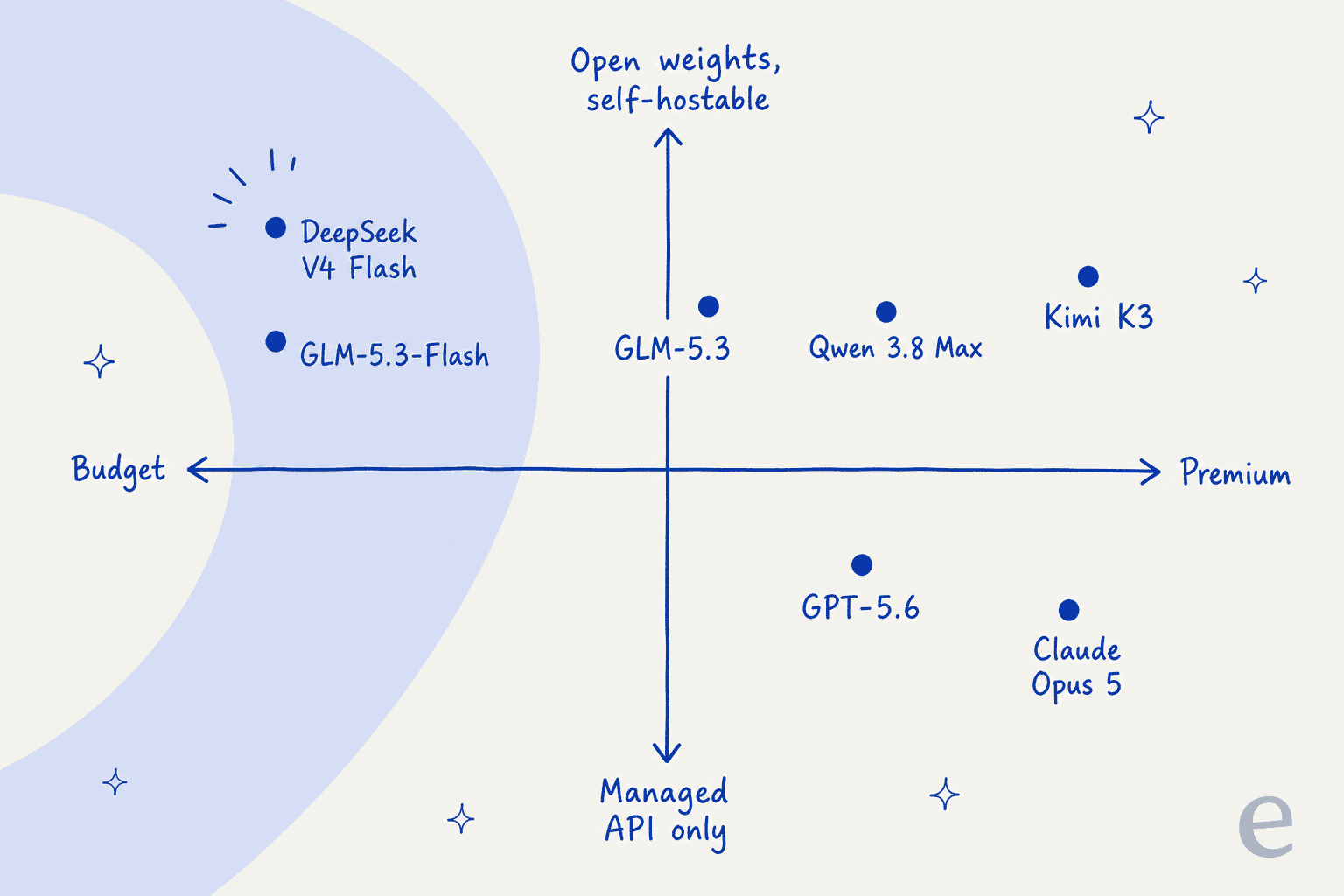
If control and cost are what pushed you off Hy4, stay in the open-weight top row and start with GLM-5.3-Flash or DeepSeek V4 Flash. If it was the sheer effort of running a 770B model, drop to the managed row and let Anthropic or OpenAI carry the infrastructure.
Try eesel
Here's the thing every model on this list has in common: they're all raw infrastructure. Picking Hy4 or any alternative is choosing an engine. You still have to build the car around it, the connection to your help center, the guardrails, the integrations, and some way to test it before it answers a real customer.
If the reason you're model-shopping is customer support, eesel skips that whole build. It's an AI helpdesk teammate that already runs on frontier models, so you inherit the model quality without ever choosing, hosting, or fitting one in VRAM. It connects to tools like Zendesk, Freshdesk, and Slack, learns from your past tickets and help center, and, the part I care about most as someone who's watched confident bots give confidently wrong answers, it lets you simulate on thousands of your real historical tickets before it replies to anyone live.

So if you got here comparing models to build a support agent, it's worth asking whether you need the model at all, or the finished teammate. You can try eesel free, and it plugs into your existing helpdesk in a few minutes.