8 best Treg alternatives in 2026 for giving AI agents tools

Rama Adi

Katelin Teen
Last edited September 30, 2026

Why people look for a Treg alternative
I build integrations at eesel, which mostly means I've written a lot of OAuth refresh code and API key plumbing. So I like what Treg does. One token, one /call/ endpoint, 3,700+ endpoints across 102 providers, and a prepaid balance billed at the provider's own rate. Your own keys are never metered, and you start with $1.00 of free credit. For an agent that needs a hundred keyword lookups this month, that beats buying a $139 Semrush seat.
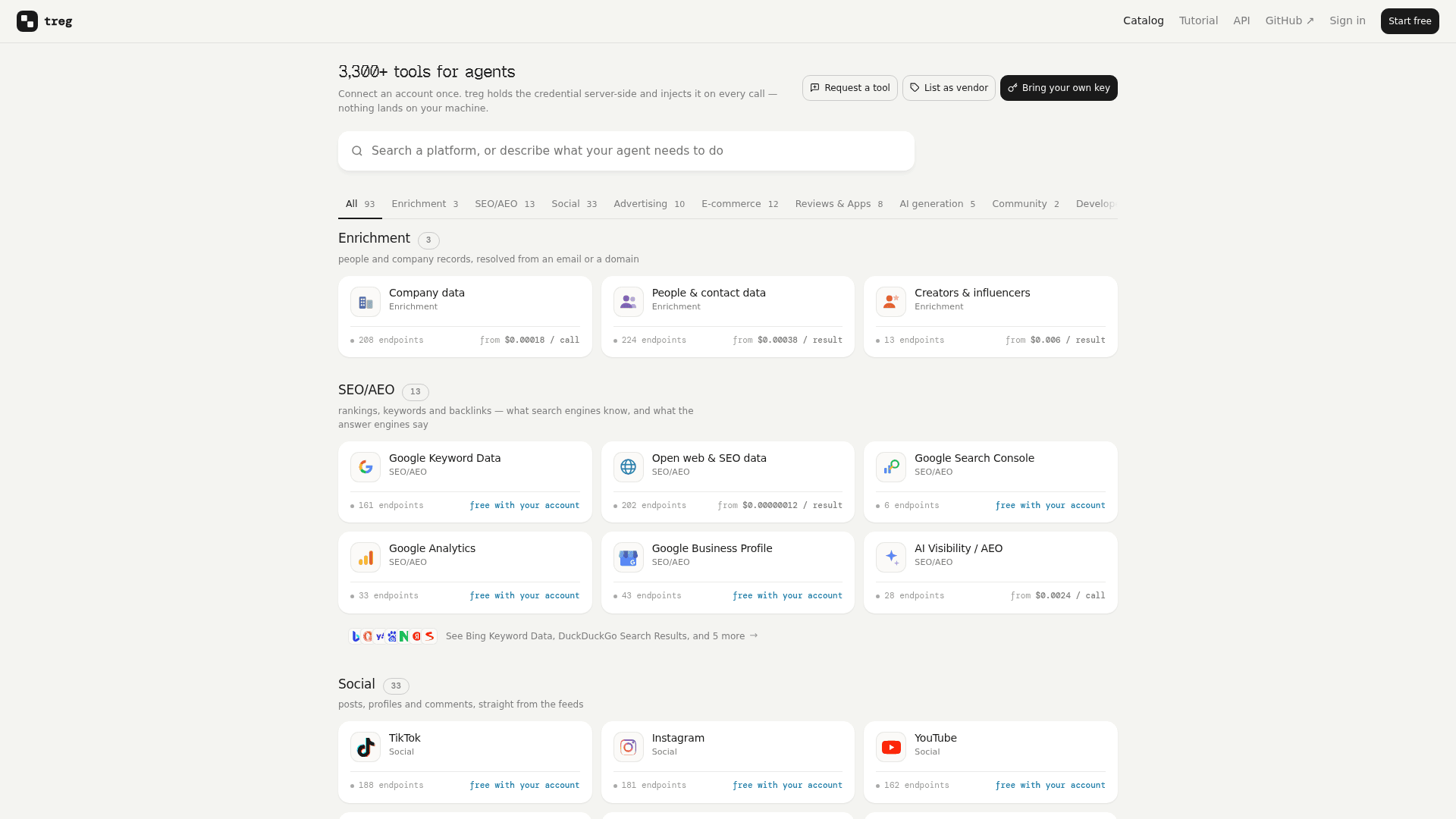
But the same research that makes me like it also shows where teams hit a wall. These are the reasons I'd expect someone to shop around:
- It's early access. Treg's terms say the hosted service has "no uptime commitment and no support commitment." Fine for a side project, harder for a pipeline your revenue depends on.
- Some big names are bring-your-own-key only. When I checked the catalog, Semrush and Crunchbase only run on your own key, and Ahrefs isn't there at all (see my Ahrefs vs Semrush take). My Treg review goes through that list.
- Your request and response bodies pass through a proxy. That's how any gateway works, but I couldn't find a public answer on data retention. If enrichment calls carry customer data, that matters.
- The licence is source-available, not open source. The repo's LICENSE is Apache 2.0 plus extra terms that block offering it as a hosted service to third parties.
- It's built for data, less for actions. You can register your own tools and OAuth accounts, but the catalog's center of gravity is data you don't own. If your agent's job is "update the ticket and post in Slack," you may want a layer built for that.
The sharpest line I found about Treg came from a reply under a launch post, and it applies to every tool in this list:
"2,800 data sources is the easy part. a CMO also decides which signals to ignore. curious how this handles that"
Keep that in mind. Every alternative below gives an agent more hands. None of them tells it what to build.
Two kinds of Treg alternatives
Before the list, here's the map I used. The horizontal line splits tools that act in your apps from tools that buy data you don't have. The vertical line splits one provider from many.
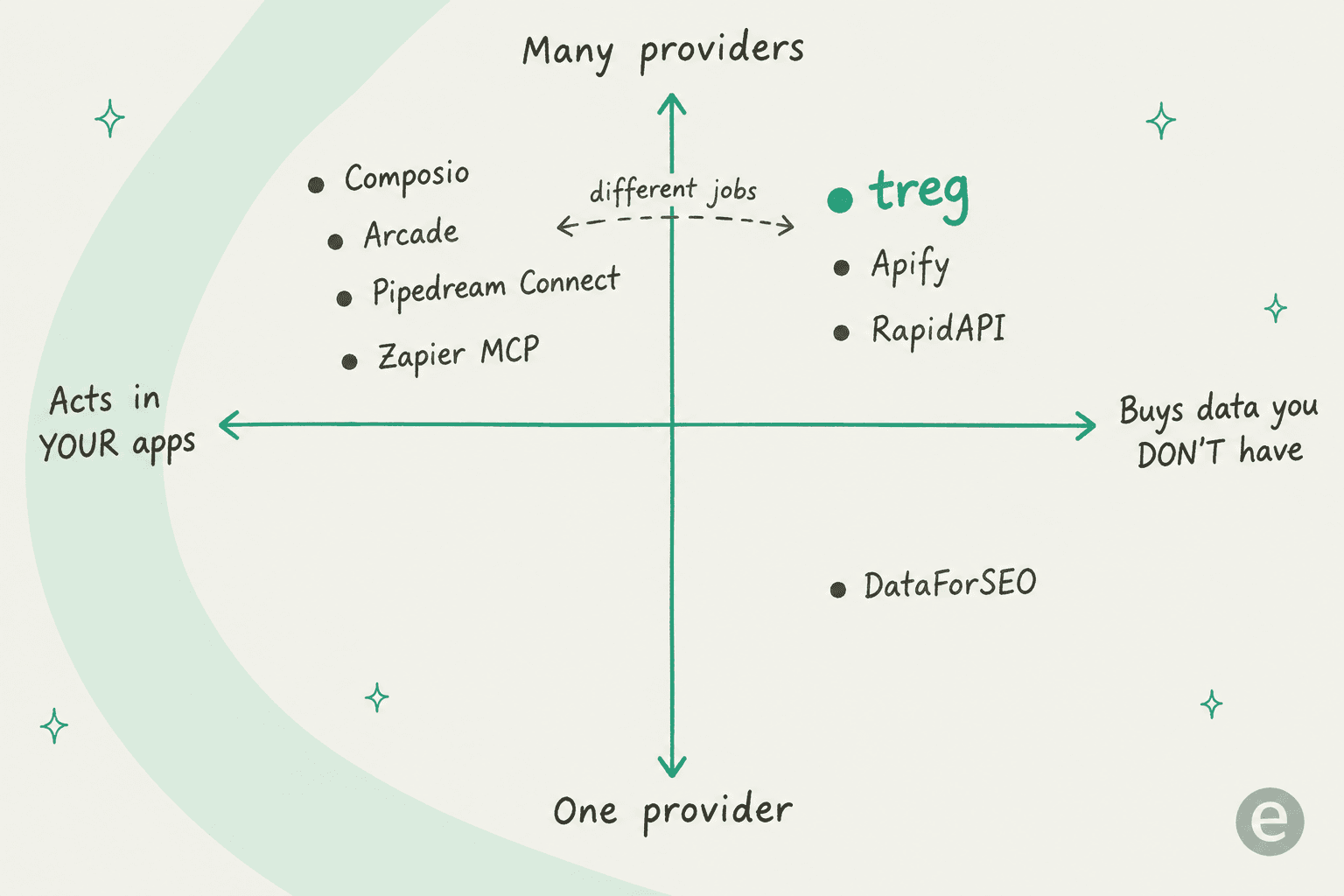
This is the reframe that matters most. Composio and Treg both get called "a gateway for agent tools," but a Composio call to Gmail costs a fraction of a cent because you already own the Gmail account. A Treg call to a work-email finder costs what the email finder charges, because you're buying the data. Comparing their per-call prices directly is comparing a toll road to a grocery bill.
How I picked the eight:
- It has to solve the same problem. Give an agent access to tools or data without signing up to every vendor.
- It has to work with the agents people actually run, like Claude Code, Codex and Cursor, over MCP or an SDK.
- Pricing has to be public, or at least the free tier and the billing unit.
- Facts come from the vendor's own pages, checked on September 30, 2026, plus reviews on G2, Capterra, Trustpilot, X and Hacker News.
Treg alternatives compared
| Tool | Best for | You pay for | Free tier | Paid from | Catalog size | Your own keys | MCP | Security stated | Self-host |
|---|---|---|---|---|---|---|---|---|---|
| Treg (incumbent) | Data from many vendors, no seats | Per call at provider rate, 0% markup | $1.00 once | Prepaid balance | 3,700+ endpoints | Yes, never metered | Yes | Encrypted secrets, team roles | Yes (source-available) |
| Apify | Web, social and e-commerce scraping | Per result or compute units | $5/mo usage | $19/mo | 77K+ tools | Your Apify token | Yes | SOC 2, GDPR | No |
| DataForSEO | SEO data, bought direct | Per request | $1 trial credit | $50 minimum top-up | 11 API families (8 via MCP) | N/A (you are the account) | Yes, first-party | Not stated on pages checked | Local MCP server |
| Composio | Actions in 1,500+ apps, cheapest calls | Per tool call and trigger | 100K calls/mo | $29/mo | 1,500+ toolkits | Yes, more free calls | Yes | SOC 2 Type II, ISO 27001 | "Bring your own cloud" listed |
| Arcade | User-level auth and governance | Tool calls + auth events | 2K calls/mo | $25/mo + usage | 7,500+ tools | Via your IdP | Yes | SOC 2 | Enterprise only |
| Pipedream Connect | Products with many end users | Compute credits + per user | Dev mode only | $99/mo (annual rate) | 3,000+ APIs | Custom OAuth apps | Yes | SOC 2 Type II, GDPR, HIPAA (Business) | No |
| Zapier MCP | No-code teams | 2 tasks per call | 50 calls/mo | $19.99/mo | 9,000+ apps | No third-party tools | Yes | SOC 2 Type II, SOC 3, GDPR | No |
| Smithery | Finding and hosting MCP servers | Per 1,000 calls | 50K calls/mo | $10/mo | 17,800 servers | Yes, you pay vendors | Yes | None published | Publish your own |
| RapidAPI | One key for REST APIs | Per-API subscriptions | Per API | Set by each provider | 20,000+ APIs | One RapidAPI key | Per API, opt-in | None found | No |
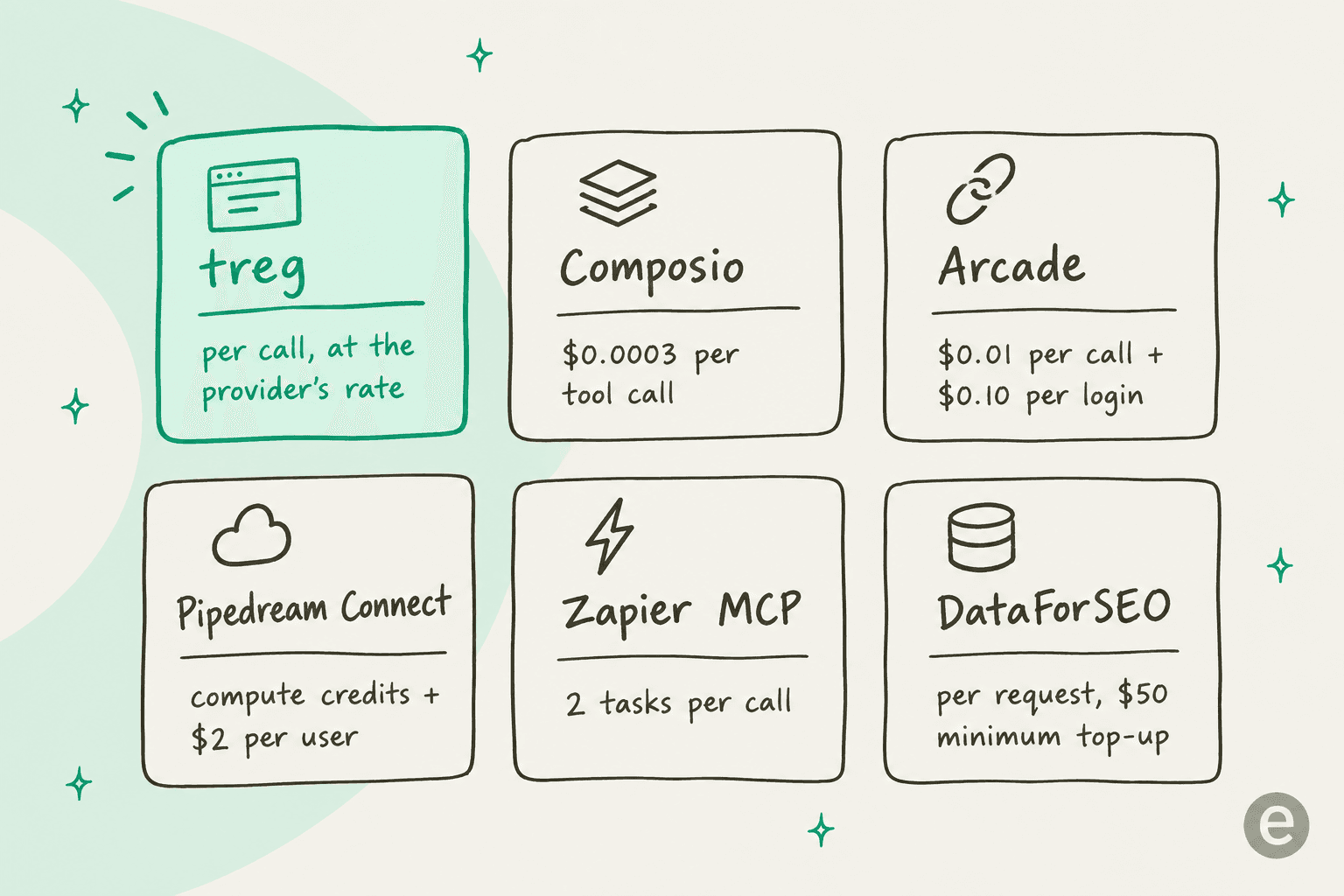
Every tool on this list bills a different thing, which is why the "paid from" column only tells half the story. Here's what the meter actually counts:
1. Apify
Best for: agents that need web, social or e-commerce data at scale, from a marketplace with real reviews behind it.
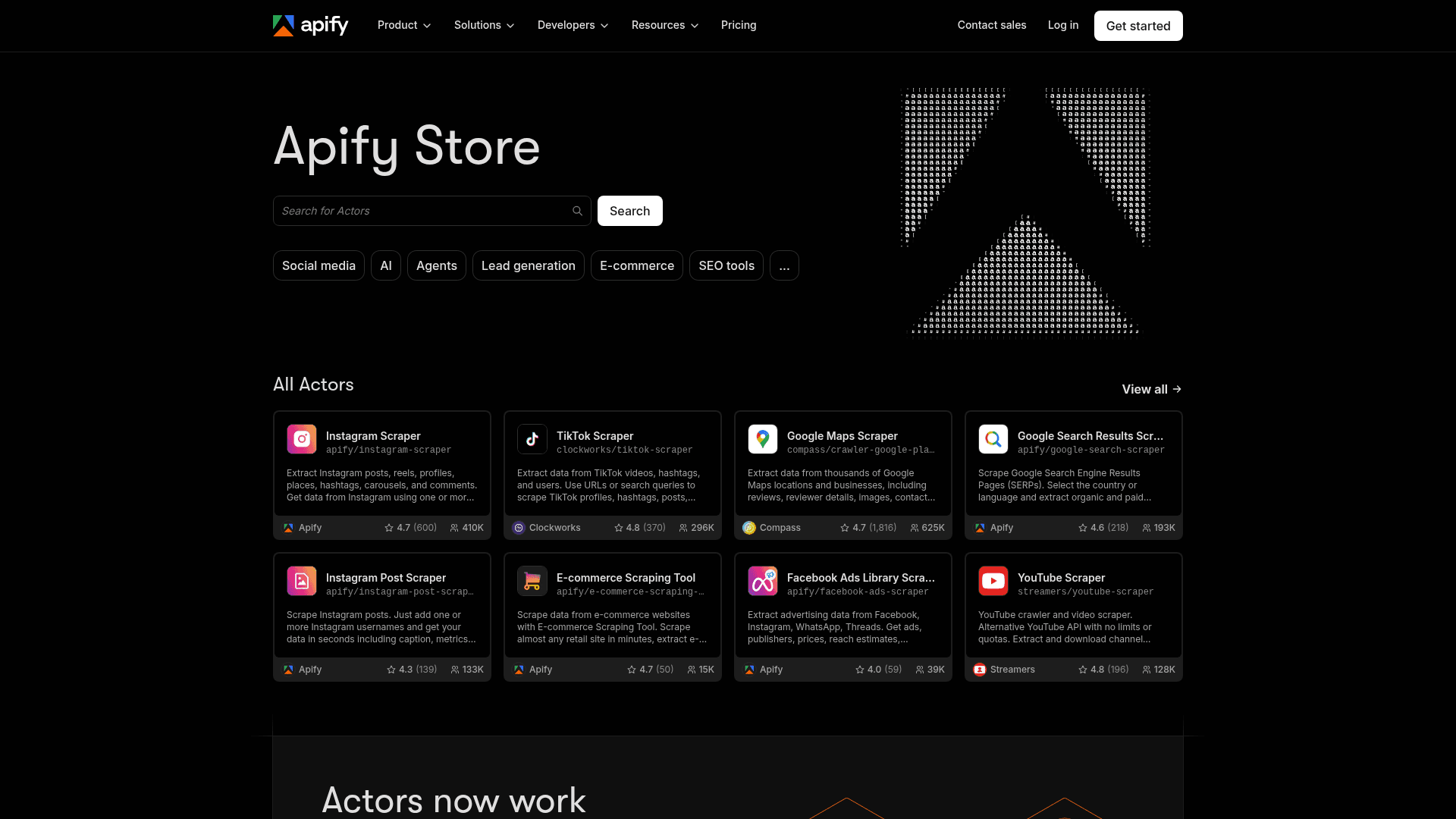
If Treg's social and scraping categories are what you use most, Apify is the closest thing to a like-for-like swap. It's a cloud platform built around the Apify Store, a marketplace of "Actors," which are small cloud programs that scrape a site or automate a web task. Its MCP page says agents can reach "77K+ tools," and the popular ones have serious usage: the Google Maps Scraper shows 625K users and a 4.7 rating from 1,816 reviews.
The MCP server lets an agent search the Store and run an Actor without any setup. There's also a detail I didn't expect: an agent with a crypto wallet can pay per request through x402 at agi.apify.com, with no account at all. That's the most Treg-like payment model on this list. If you're weighing it against Firecrawl, my Firecrawl vs Apify comparison goes deeper.
Pricing
| Plan | Price | Included usage | Compute unit rate | Max concurrent runs |
|---|---|---|---|---|
| Free | $0 | $5/mo | $0.20 | 5 |
| Starter | $19/mo | $19/mo | $0.20 | 32 |
| Scale | $199/mo | $199/mo | $0.16 | 128 |
| Business | $999/mo | $999/mo | $0.13 | 256 |
| Enterprise | Custom | Custom | Custom | Custom |
A compute unit is 1 GB of RAM for one hour, per Apify's pricing. On top of that, each Actor sets its own model: pay per event (a price per result) or pay per usage (you only pay platform compute). Annual billing is 10% off, and unused credit expires each month.
Pros
- Huge catalog with ratings and user counts on every Actor, so you can judge quality before you run one.
- Pay-per-event Actors let you set a maximum charge per run.
- Strong reviews: 4.7 on G2 (640 reviews) and 4.8 on Trustpilot (764).
Cons
- Two pricing layers: your plan's credit plus each Actor's own event price.
- Community-built Actors vary in quality, and they can break when a site changes.
- The MCP
call-actortool waits at most 45 seconds, then your agent has to fetch results separately.
One Trustpilot reviewer put the quality point plainly:
"One star off for the third-party actors. Quality follows whoever published them. A LinkedIn search actor returned 48% duplicate posts and billed me for the duplicates, so I dedupe on my side now."

My take: pick Apify if scraping and social data are most of your Treg bill, and you want a mature marketplace with reviews on every tool. Skip it if you need one flat price per call, because Apify's cost depends on which Actor you run.
2. DataForSEO (going direct)
Best for: agents that only need SEO data and will spend more than $50 on it.
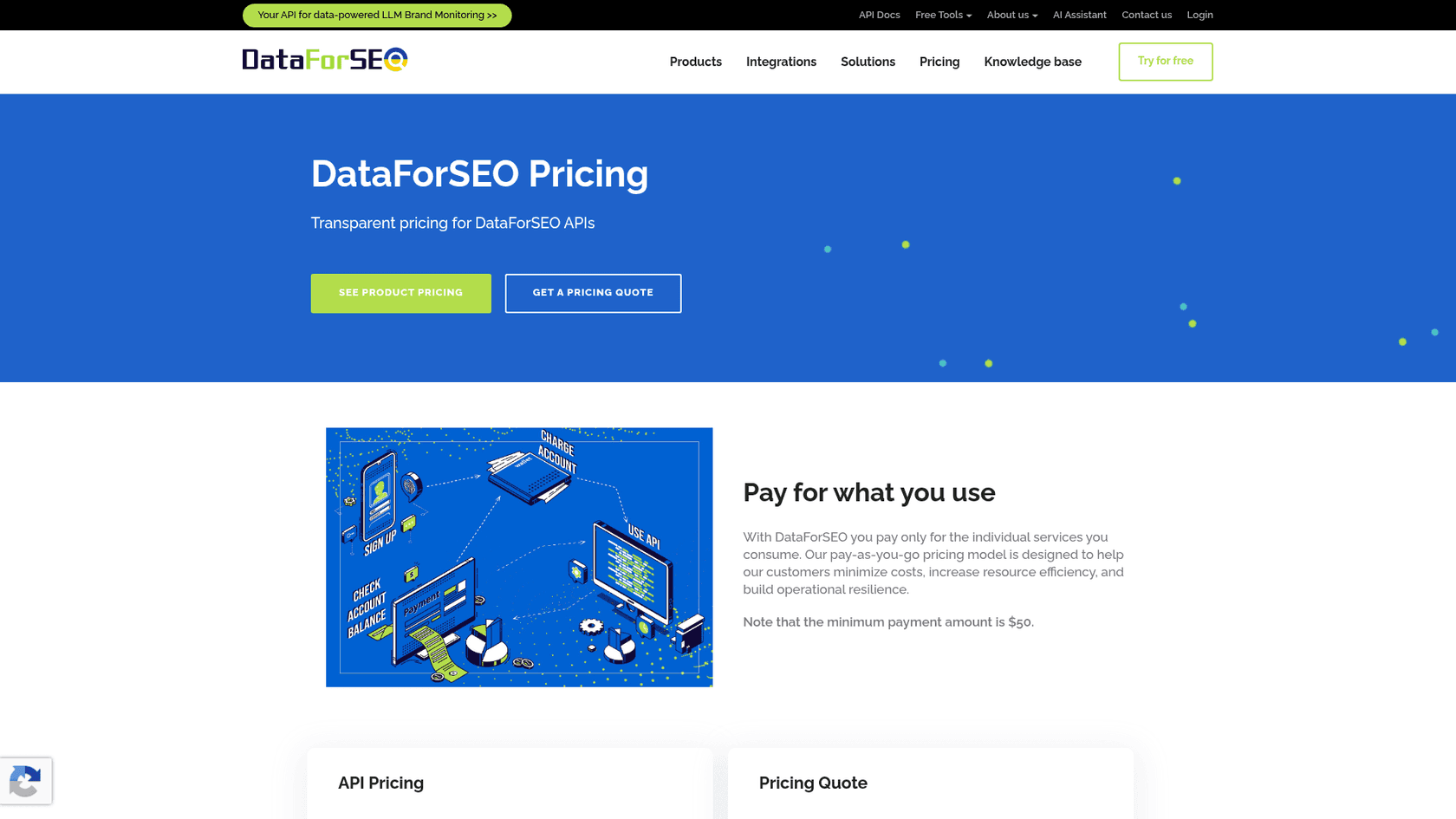
This one is less an alternative than a shortcut. Treg's published keyword research run ran entirely on DataForSEO, and cost $0.11. DataForSEO is the upstream API, and it bills from a prepaid balance with no subscription. The catch is the one a Treg user named on X:
"For example DFS you need to buy minimum $50 credits to use platform, but with Treg I can pay per api call."
That's fair. But if your agent runs SEO automation every week, you'll clear $50, and then going direct removes a middle layer. DataForSEO also ships its own MCP server, remote at mcp.dataforseo.com/v3/mcp or local through npx, with setup guides for Claude Code, Cursor and ChatGPT. It exposes 8 APIs, including SERP, keywords, backlinks and on-page.
Pricing
| API | Mode | Price |
|---|---|---|
| Google organic SERP | Standard queue (~5 min average) | $0.0006 per SERP |
| Google organic SERP | Priority queue (~1 min) | $0.0012 per SERP |
| Google organic SERP | Live (~6 seconds) | $0.002 per SERP |
| Google Ads search volume | Standard (1 to 3 hours) | $0.06 per task, up to 1,000 keywords |
| Google Ads search volume | Live (~7 seconds) | $0.09 per task, up to 1,000 keywords |
| Backlinks | Live only | $0.024 per request + $0.000036 per row |
Prices are from DataForSEO's SERP pricing and its Google Ads pricing. Two recent changes matter: on July 1, 2026 the $100 monthly minimum for the Backlinks API was removed, and prices on eight other APIs rose about 20%, per its announcement. The SERP API wasn't part of that rise.
Pros
- SERPs from $0.0006 each, with no seat and no subscription.
- First-party MCP server, so there's no proxy between your agent and the data.
- Good ratings: 4.5 on Trustpilot (57 reviews) and 4.8 on Capterra (15).
Cons
- $50 minimum top-up, and the trial is a one-time $1 credit.
- SEO and marketing data only. No social, no enrichment.
- Cheap queues are slow. Live mode costs 3.3x more for SERPs.
My take: pick DataForSEO if SEO data is 80% of what your agent calls and you're past the $50 threshold. Skip it if you need a few dollars of calls across ten vendors, which is exactly where Treg's no-minimum balance wins. For the dashboard side of SEO, my Semrush alternatives list covers the seat-based tools.
3. Composio
Best for: agents that take actions in your team's apps, with a free tier big enough that most teams never pay.
Composio sits on the other side of the map. It's a hosted tool and auth layer that connects an agent to 1,500+ apps, handling OAuth consent, token storage and refresh, triggers and a sandbox. It sells two ways: a developer platform with SDKs, and a no-code path that plugs straight into Claude, ChatGPT, Codex, Cursor and Hermes.
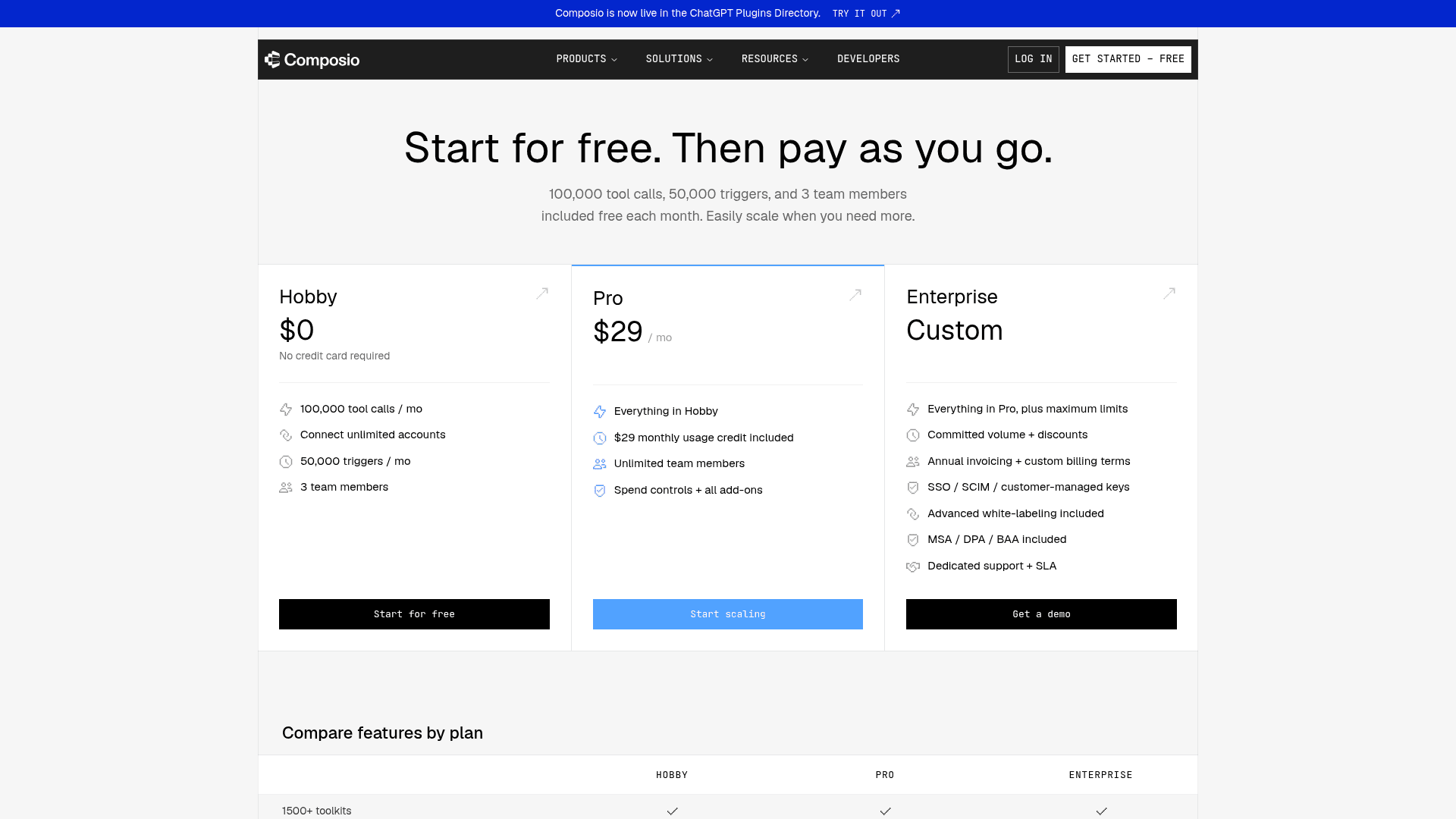
Composio's free tier is the most generous thing in this whole roundup. 100,000 tool calls a month for $0, plus 50,000 trigger events, and connected accounts are unlimited. One Hacker News user described the practical upside:
"Composio is a tool to help integration of LLM tool calling / MCPs. It really helped me streamline setting up some MCPs with Claude desktop."

Pricing
| Plan | Price | Included | Overage | Team |
|---|---|---|---|---|
| Hobby | $0 | 100,000 tool calls, 50,000 triggers | Hard cap, no overage | 3 members |
| Pro | $29/mo | $29 usage credit (no rollover) | $0.0003 per tool call, $0.003 per trigger | Unlimited |
| Enterprise | Custom | Committed volume | Custom | Unlimited, SSO/SCIM |
Per Composio's pricing, those rates apply when you use your own OAuth app or keys. Composio's shared OAuth apps only get 20,000 of the free calls, then $0.0005 each. Paid third-party tools like Browser Use or SerpAPI run on Composio's credentials at provider cost plus 5%, so it does sell some data, just with a small margin where Treg takes none.
Pros
- One of the lowest per-call prices here, with a free tier most teams never outgrow.
- SOC 2 Type II and ISO 27001:2022, with HIPAA available as a Pro add-on.
- Add your own custom MCP servers for free on every plan.
Cons
- Only 7 reviews on G2 (4.9/5), all from 2024 and early 2025, so there's little independent signal on the current product.
- SSO, SCIM and customer-managed keys are Enterprise only.
- The pricing page has no self-host tier. The homepage lists "bring your own cloud," but without plan or price details.
My take: pick Composio if your agent needs to send emails, update records and read Slack, and you want the widest catalog for the least money. Skip it as a Treg replacement if what you actually need is keyword volume or enrichment data, because that's not what you're paying Composio for.
4. Arcade
Best for: teams where the agent must act as a specific signed-in user, with policy checks on every action.
Arcade calls itself an "actions runtime," and the difference from Composio is where the auth lives. Arcade authenticates against your identity provider, so each action runs as the signed-in user, never through a shared service account. You can add hooks before and after each tool call to block actions or strip personal data. Its docs list 7,500+ tools across 81 MCP servers (the homepage says 8,000+).
Arcade also got bigger this year. It acquired Smithery, announced August 5, 2026, so the MCP directory at #7 on this list now belongs to it.
Pricing
| Plan | Price | Auth events | Tool calls | Hosting |
|---|---|---|---|---|
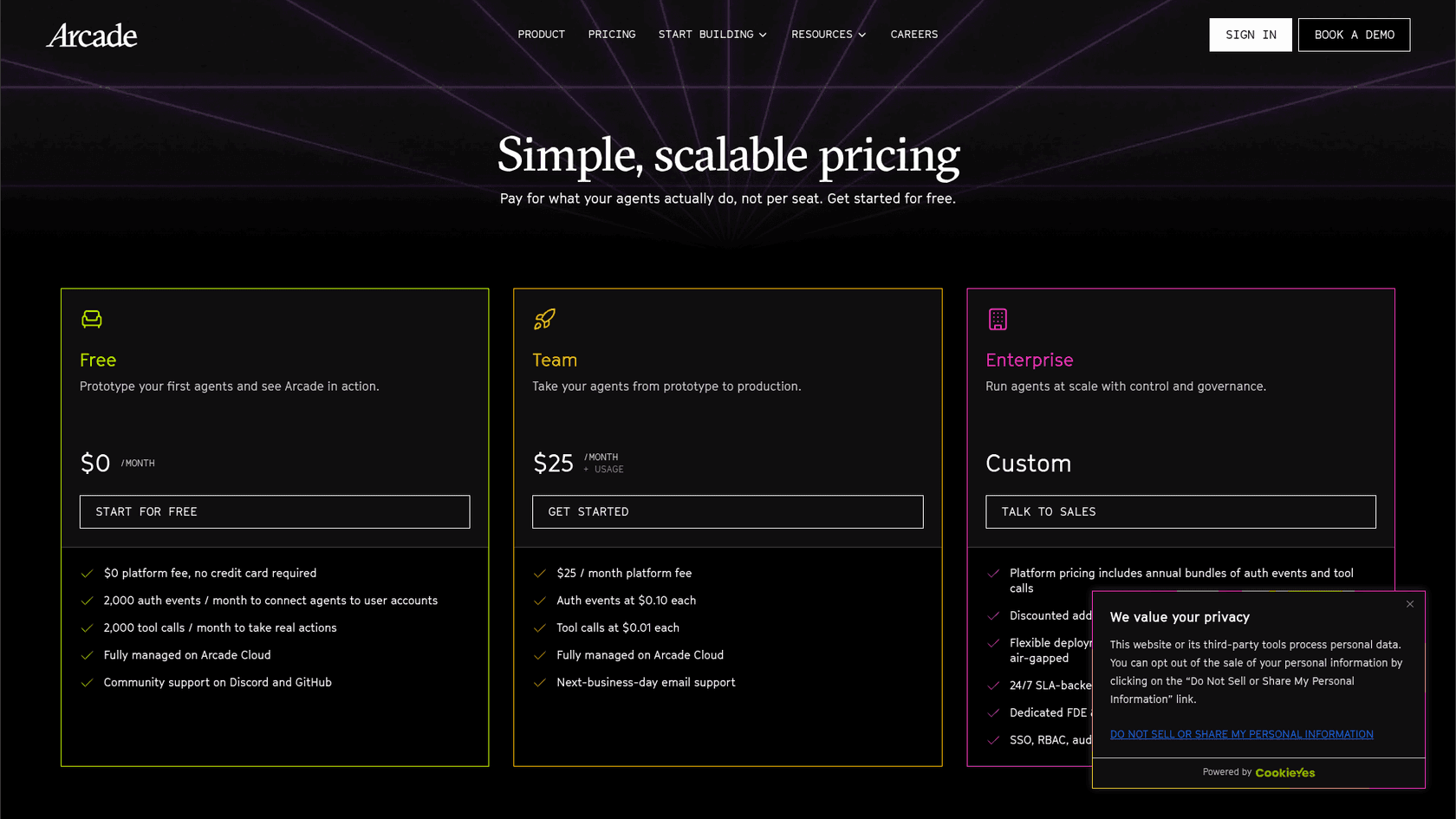
| Free | $0 | 2,000/mo | 2,000/mo | Arcade Cloud |
| Team | $25/mo + usage | $0.10 each | $0.01 each | Arcade Cloud |
| Enterprise | Custom | Annual bundles | Annual bundles | Cloud, your VPC, or air-gapped |
Figures are from Arcade's pricing page. An auth event is a user connecting an account, and on Team it costs 10x a tool call. So if thousands of your users connect accounts once and then make a few calls each, most of your bill is auth.
Pros
- User-level permissions enforced outside the model, where a prompt can't undo them.
- Build custom MCP servers with its Python or JavaScript SDK, or govern third-party servers alongside its own.
- The only tool here with an air-gapped deployment option.
Cons
- $0.01 per tool call on Team is about 33x Composio's overage rate.
- SSO, RBAC, audit logs and self-hosting sit on Enterprise.
- Almost no public reviews yet: the G2 listing has zero.
My take: pick Arcade if you're shipping agents into a company where security review decides everything, and per-user permissions matter more than per-call price. Skip it if you're a small team wiring one agent to your own accounts, where Composio does the same job for less.
5. Pipedream Connect
Best for: SaaS products that let their own customers connect accounts to an in-app agent.
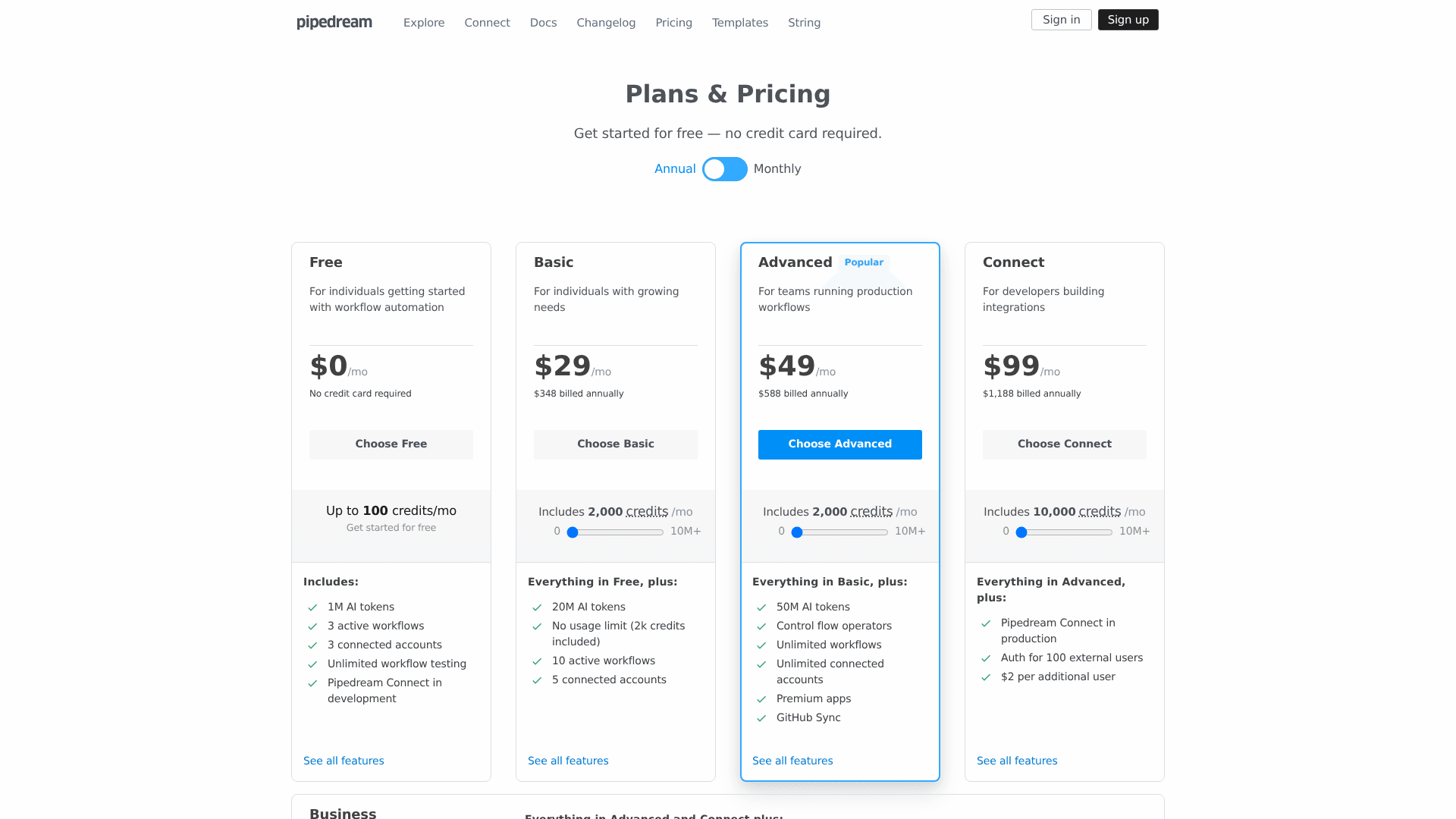
Pipedream started as a workflow builder, and Pipedream Connect is its layer for agents: managed auth plus 10,000+ tools across 3,000+ APIs, callable as prebuilt tools, through a proxy or over MCP. It has one MCP server per app, and using those hosted servers for your own work is free.
It's also owned by Workday now. Workday announced the deal on November 19, 2025, and its FY2026 annual report lists the acquisition as done. Pipedream still sells its own plans.
Pricing
| Plan | Price (annual rate) | Credits | Connect |
|---|---|---|---|
| Free | $0 | 100/mo | Development only |
| Basic | $29/mo | 2,000/mo | Not in production |
| Advanced | $49/mo | 2,000/mo | Not in production |
| Connect | $99/mo | 10,000/mo | Production, 100 external users, then $2 each |
| Business | Custom | Custom | Volume pricing, HIPAA, uptime SLAs |
One credit is 30 seconds of compute, per Pipedream's pricing docs, and MCP tool calls use credits. The per-user fee is the part to model: 1,000 end users on Connect works out to $99 + (900 x $2) = $1,899 a month before any extra credits.
Pros
- Build and test for free in development mode, no card needed.
- Bring your own OAuth clients, with tokens never exposed to your app or the model.
- SOC 2 Type II and GDPR, with HIPAA on the Business plan.
Cons
- Cost scales with your end users, not just your calls.
- The price of extra credits isn't published.
- When running for a user, it uses only one account per app (the most recent).
My take: pick Pipedream Connect if you're building a product where hundreds of customers each connect their own tools. Skip it for a single internal agent, because the $99 production floor buys you features built for multi-tenant apps.
6. Zapier MCP
Best for: teams who don't code and already have a Zapier account.
Zapier MCP turns your Zapier account into an MCP server, so Claude, ChatGPT, Cursor and 30-odd other clients can take actions across 9,000+ apps. There's no separate MCP bill. It draws from the same task allowance as your Zaps, which makes it the easiest thing on this list to try if your company already pays for Zapier. My Zapier AI guide covers the rest of the AI side.
The early reaction was strong:
"Claude + Zapier MCP just became the world's most diligent employee: "Help me catch up on emails" "Write a report on last month's P&L" "Follow-up with Sam re: X" "Status update on X project" Works with any app that has a Zapier API (Gmail, Xero, Hubspot, etc). SO USEFUL"
Pricing
| Plan | Price | Tasks | MCP calls included |
|---|---|---|---|
| Free | $0 | 100/mo | 50 |
| Professional | From $19.99/mo | From 750/mo | From 375 |
| Team | From $69/mo | Selectable tiers | Depends on tier, 25 users, SAML SSO |
| Enterprise | Custom | Annual limits | MCP-specific task quotas |
Per Zapier's usage docs, each successful tool call costs 2 tasks and failed calls cost nothing. On paid plans, pay-per-task overage is capped at 3x your plan's tasks.
Pros
- Nothing new to buy if you already pay for Zapier.
- Zapier holds every credential, so the AI client never sees an API key.
- SOC 2 Type II and SOC 3, with an audit log of every tool call.
Cons
- The catalog is closed: you can't bring third-party tools or data APIs in.
- 2 tasks per call adds up fast on the Free plan's 100 tasks.
- Data lives only in AWS US-East 1, with no private cloud option.
My take: pick Zapier MCP if your team lives in Zapier and wants an agent to act in the apps it already connects. Skip it if your agent needs SEO or enrichment data, since that's not in Zapier's catalog. If you're comparing automation platforms more broadly, see Make vs Zapier.
7. Smithery
Best for: finding, testing and hosting MCP servers when you're happy to bring your own vendor keys.
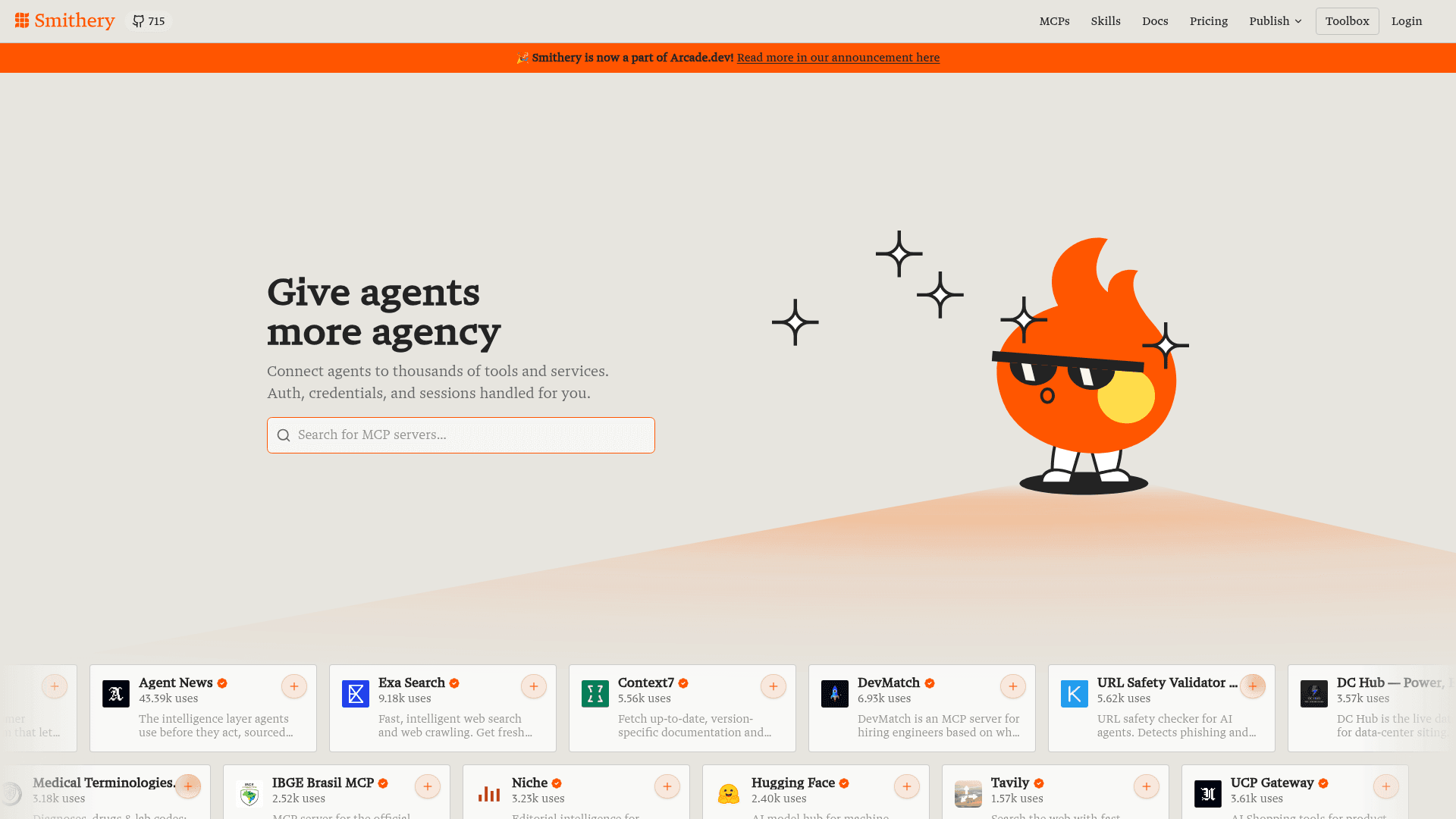
Smithery is a public directory and hosting layer for MCP servers. Its registry listed 17,800 servers on September 30, 2026, and it handles OAuth and token refresh so your agent can connect to them. Stored credentials are encrypted and write-only, meaning they can be used but never read back.
The key difference from Treg is who pays for the tool. Smithery charges you for call volume, and servers that need an API key take your own key and bill you directly. There's no resale of vendor data.
Pricing
| Plan | Price | Calls | Namespaces |
|---|---|---|---|
| Hobby | $0 | 50,000/mo | 3 |
| Pay as you go | $10/mo | 100,000/mo, then $0.10 per 1,000 | 100 |
| Custom | Contact sales | Custom | Custom, with SLA |
Figures are from Smithery's pricing.
Pros
- The biggest open directory of MCP servers, with a public registry API.
- Managed OAuth with no redirect URIs or client IDs to configure.
- Cheap: $0.10 per 1,000 calls past the included volume.
Cons
- Server quality varies. One Hacker News user scanned the top 100 servers and flagged 22.
- No published security certifications that I could find.
- You still sign up for every vendor that needs a key, which is the chore Treg removes.
"100 servers scanned.22 had at least one finding. 28 findings total. 4 CRITICAL, 24 HIGH. That's 1 in 5 servers flagging something. Some genuine, some probably FPs and I'll be specific."
My take: pick Smithery if you want to browse and host MCP servers cheaply and you already hold the vendor keys. Skip it if the whole point was to stop managing vendor accounts, because Smithery hands that job back to you.
8. RapidAPI (Nokia API Hub)
Best for: one key across a large marketplace of REST APIs, when you can live with per-API billing.
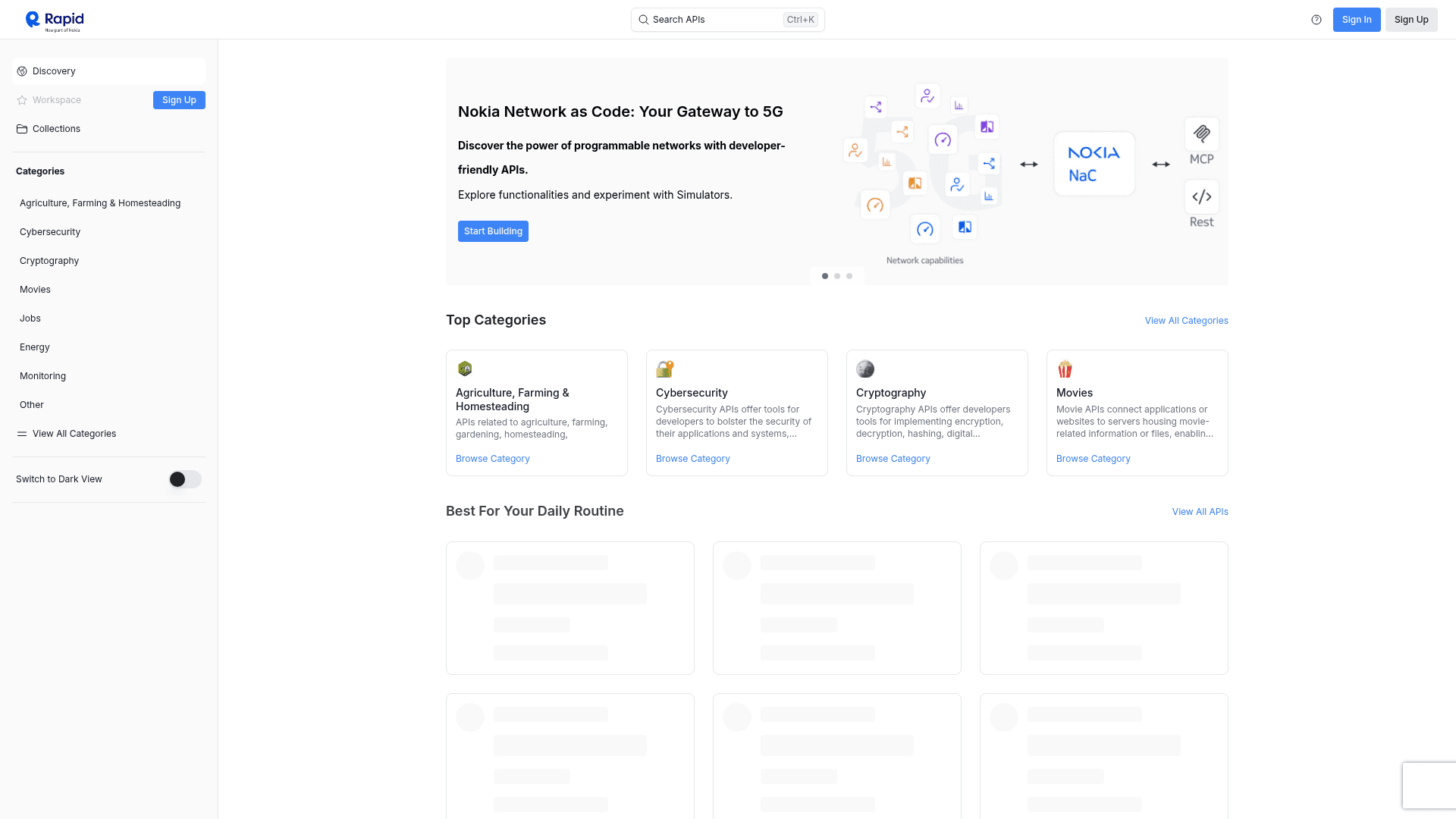
RapidAPI was the "one key for many APIs" idea long before agents. Nokia bought its technology and R&D team in November 2024, and the hub now lists 20,000+ APIs. Each app gets one X-RapidAPI-Key, and API providers can switch on MCP so each endpoint becomes a tool at mcp.rapidapi.com, per its docs.
The model is very different from Treg's, though. There's no platform plan. You subscribe to each API separately, on tiers the provider sets, and overages run unless the provider set a hard cap. A G2 reviewer liked the single key:
"Managing Multiple API Keys & Accounts: RapidAPI provides a unified API key so it is very easy to manage multiple APIs without using a new key for every API."

Pricing
Every API sets its own plans (free, pay per use, freemium or paid), usually in up to four tiers. RapidAPI's suggested tiers are Basic (free), Pro ($25), Ultra ($75) and Mega ($150), per its monetization docs. RapidAPI takes 25% of every payment from the provider side.
Pros
- One key and one bill across thousands of APIs.
- MCP access on APIs whose providers have enabled it.
- Many niche data APIs you won't find in newer catalogs.
Cons
- Spend control depends on each provider, and overage complaints are common in reviews.
- Support often routes billing questions back to the provider.
- Low ratings: 2.1 on Trustpilot (168 reviews) and 3.5 on G2 (19).
"I was not expecting or knowingly approving hundreds of dollars of additional usage. I believed the API would stop when the included quota was exhausted unless I chose to upgrade"
My take: pick RapidAPI if a specific niche API you need only lives there. Skip it as a general Treg replacement for an autonomous agent, since per-call spend ceilings like Treg's X-Treg-Route-Max-Cost header are exactly the safety net RapidAPI leaves to each provider.
How to choose the right Treg alternative
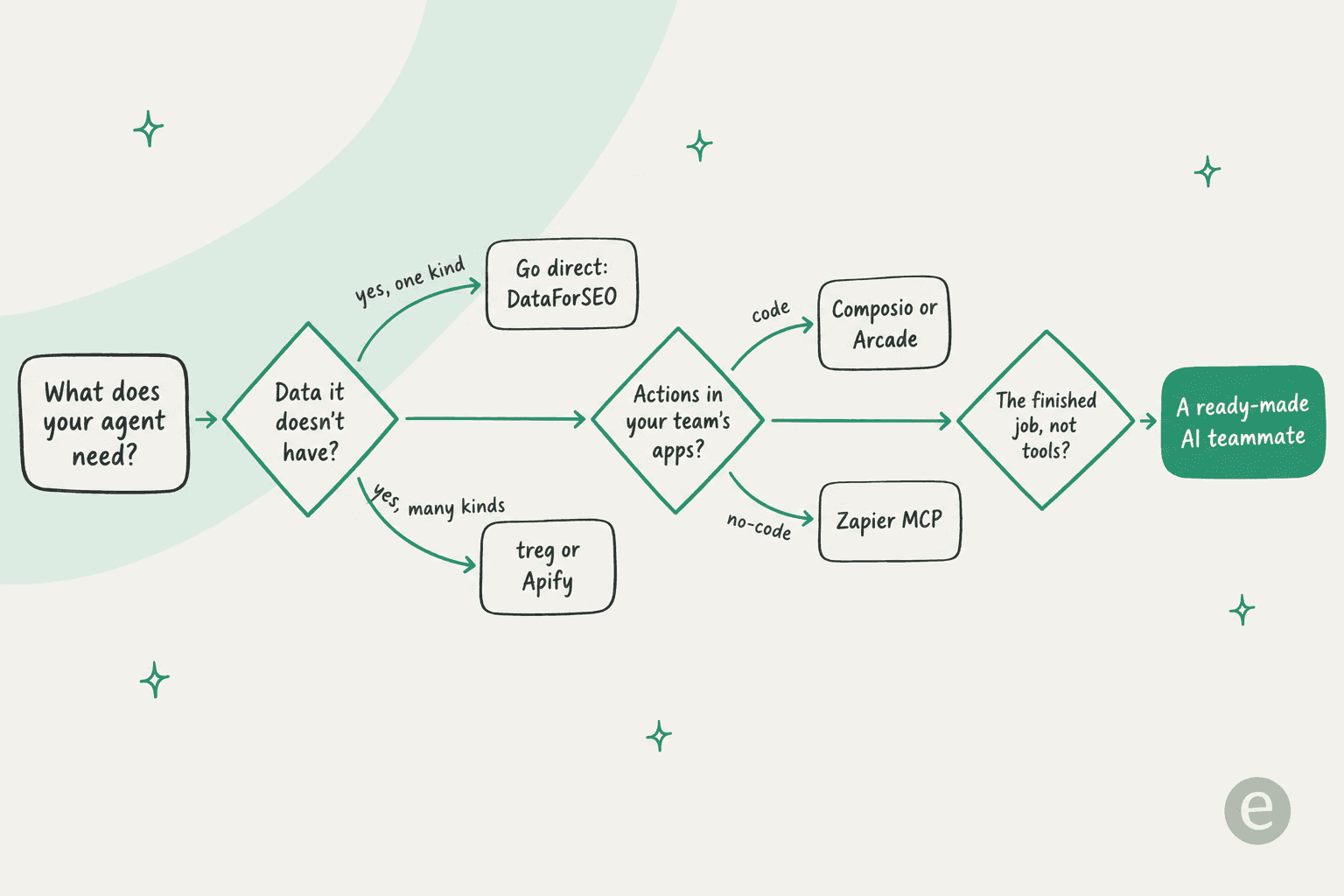
If you skimmed to here, this is the whole post in one picture:
A few scenarios where I'd make a different call from the obvious one:
- "I want Treg but with an SLA." No self-serve plan here comes with one. For data, Apify has the longest track record, with 640 reviews on G2. For actions, the uptime SLAs live on Arcade Enterprise and Pipedream Business, so budget for a sales call.
- "I'm building a GTM agent that enriches leads and then emails them." That's both halves of the map. Most teams I've seen would pair a data source (Treg or Apify) with an action layer (Composio), not pick one. A lead generation agent usually needs both, as does anything like Clay.
- "I just want my agent to read Search Console and GA4." Those are your own accounts, which puts you on the "acts in your apps" side of the map. Treg already runs them free on your own account, so there's no data bill to shop around.
- "My agent runs unattended in CI." For any Claude Code automation, put hard spend caps first. Composio's Hobby plan hard-stops at the cap, and Treg's max-cost header refuses expensive calls. RapidAPI's overages are the risk to avoid.
For the wider context on how these servers plug into agents, my guides to MCP apps and subagent tools are a good next read.
When you don't need a tool gateway at all
Here's the uncomfortable part for every tool on this list, Treg included. These are infrastructure. They give an agent hands. You still bring the agent (my best AI agents roundup covers those), the prompts, the review loop and the judgment about what's worth doing. For a builder, that's the fun part. For a content team that just wants SEO posts shipped, even a well-built AI SEO agent is a lot of plumbing between you and the thing you wanted.
That's the gap eesel fills. Instead of a generalist agent plus a toolbelt, eesel gives you ready-to-work AI teammates for specific jobs. For SEO and content, that's the AI blog writer: it already knows how to research a keyword, study what ranks, pull real sources, build the visuals and draft in your voice. One SEO content lead on Webflow uses it to publish 360+ posts a month, about 12 a day, with a bulk review step before anything goes live.
It isn't a closed box for builders, either. eesel ships a real CLI, @eesel/cli, that drives the same teammate you'd use in the dashboard. Every command prints JSON, write commands support --dry-run so you see the exact server call before it's sent, and headless auth works through environment variables, so it fits in scripts and CI like any agentic coding CLI. Each eesel workspace is also an MCP server: npx @eesel/cli mcp token prints a ready-to-paste claude mcp add command, so Claude Code, Codex or Cursor can hand a whole post to the blog writer the same way they'd call Treg for one keyword. You can run both.
Try eesel for SEO content
If you came here to swap one data gateway for another, the list above has you covered. If you came because your agent keeps producing research instead of posts, try the eesel AI blog writer. Give it your site and a keyword, and it comes back with a researched, cited draft with visuals and FAQs, ready for you to approve. It's free to start, and my AI blog writer cost breakdown shows how it compares with doing it by hand. For other options, see my SEO blog writer roundup.
Frequently Asked Questions
What are the best Treg alternatives?
Is there a free alternative to Treg?
Is Composio a Treg alternative?
Should I use DataForSEO directly instead of Treg?
Which Treg alternative is best for no-code teams?
Which Treg alternative has an uptime SLA?
Do I need a tool gateway at all for SEO content?


Article by
Rama Adi
Rama is a software engineer at eesel AI with two years of experience writing about B2B SaaS, AI tools, and customer support technology. Based in Bali, Indonesia, he brings a developer's perspective to product comparisons — cutting through marketing copy to what the integrations and APIs actually do.