


What I reviewed, and how
I'm a software engineer at eesel, and most of my week is going into the part of the product that Treg competes with, at least on the concept level: getting credentials, APIs and rate limits right, so an AI agent can call third-party tools without it leaking a key or burning the budget. So I read Treg the way I would read a pull request.
For this Treg review I went through the setup docs, the integration guide, the pricing page and terms, the live catalog API, the published run receipts, the GitHub repo and its LICENSE file, and every independent user voice I could find on X, LinkedIn, Product Hunt and Reddit. Everything here is as of September 29, 2026. In case you want a plain explainer of what the product is, my Treg overview covers that part. This post is more the verdict.
Put in one line, Treg is an "OpenRouter, but for agent tools." Your agent calls a single /call/ endpoint with an X-Treg-Token header, then Treg injects the right credential on the server side and the upstream response comes back unchanged. It plugs into Claude Code, Codex, Cursor, ChatGPT and more.
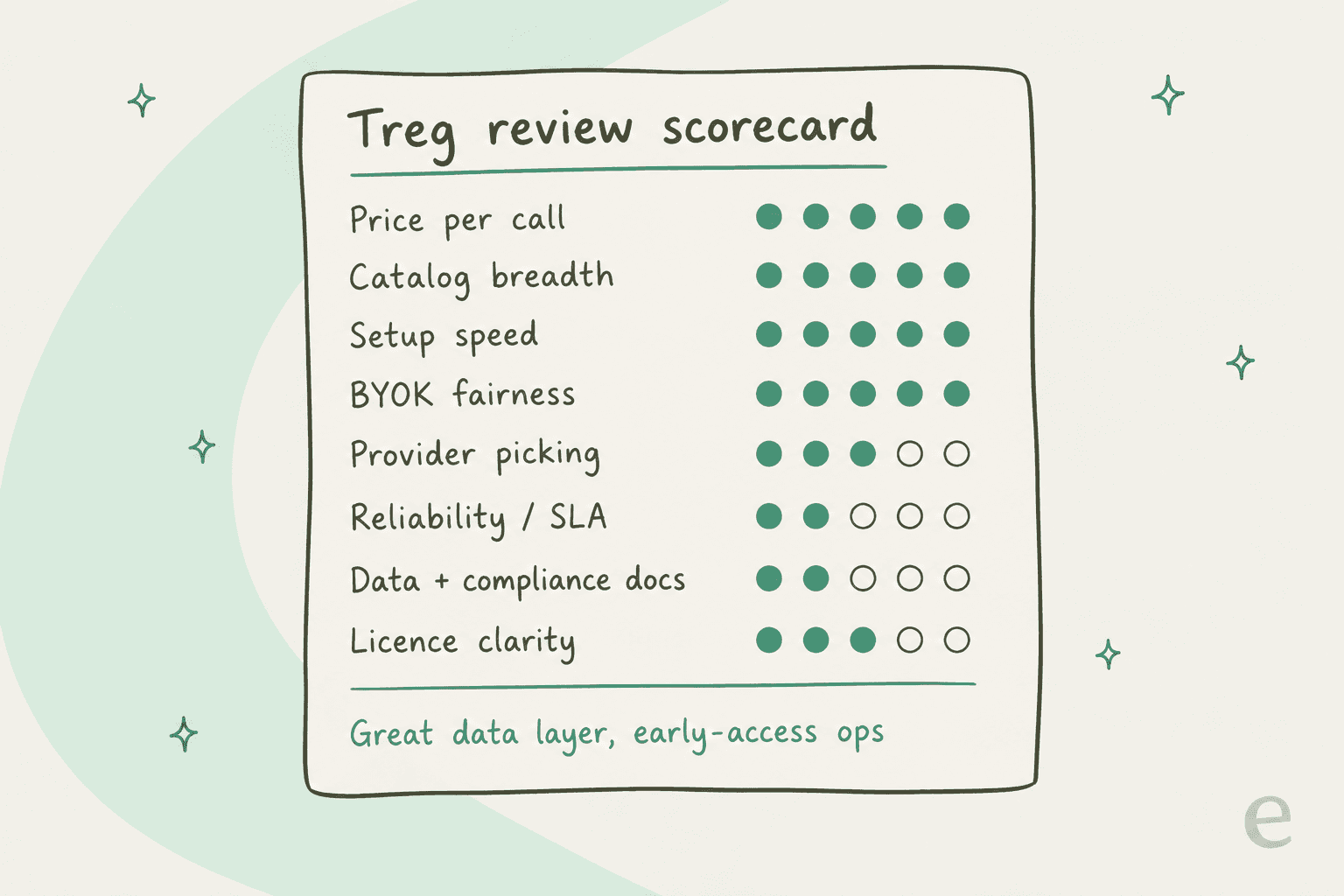
Treg review verdict at a glance
Here is the same scorecard in a table form, with the one fact behind each score, so you can disagree with me on the specifics.
| Area | Score | Why |
|---|---|---|
| Price per call | 5/5 | Provider's own rate, 0% markup, price shown before the call |
| Catalog breadth | 5/5 | 3,700+ endpoints claimed, 3,338 in the catalog API, 2,096 verified |
| Setup speed | 5/5 | One claude mcp add command, or paste one line into your agent |
| BYOK fairness | 5/5 | Your own key always wins and is never metered |
| Provider picking | 3/5 | Great comparison pages, but the agent picks by default |
| Reliability / SLA | 2/5 | Early access, no uptime or support commitment |
| Data and compliance docs | 2/5 | No public retention or GDPR answer found |
| Licence clarity | 3/5 | Footer says AGPL, LICENSE says Apache 2.0 plus restrictions |
The pattern here is pretty clear. The product design is excellent and the operational promises are thin. For an 11-week-old repo that is normal, and it also tells you quite exactly how to use it today.
What Treg gets right
The billing model is the most honest in the category
Most of the tool gateways I've looked at make their money on a markup that you can't see. Treg's pricing page is quite plain about it: "A prepaid balance, metered per call at the provider's own rate, with no markup." The homepage says it earns "on volume pricing with vendors - not on you."
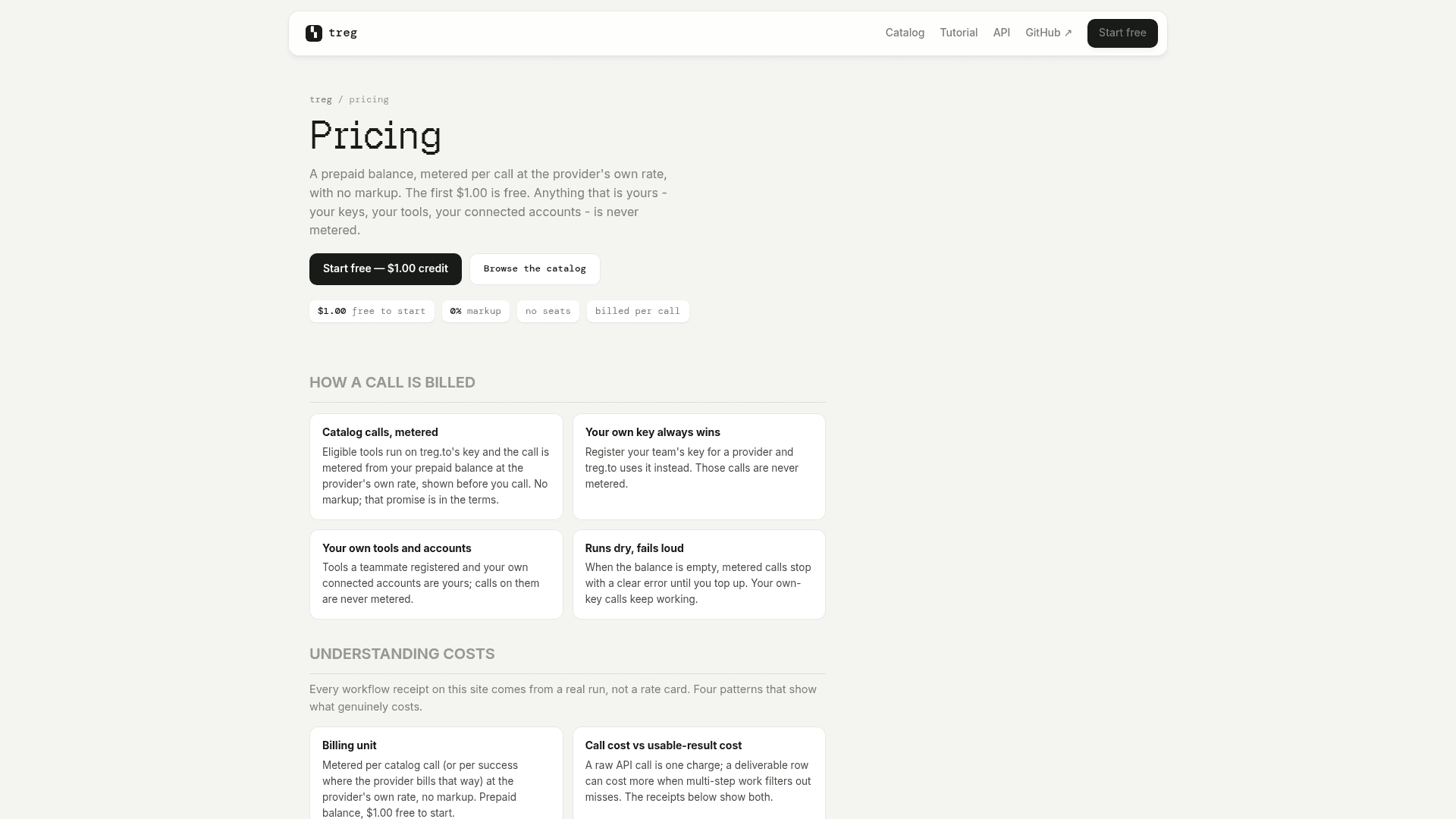
For me as an engineer, the details are what sold it:
- Price before the call.
treg catalog get <id>shows the rate, and the real charge comes back in anX-Treg-Cost-Microheader. - A hard per-call ceiling. Send
X-Treg-Route-Max-Costand Treg refuses anything above it, charging nothing. - Failures aren't billed. Provider errors, timeouts and Treg's own 503s cost $0, and a miss on a per-success tool settles at $0.00.
- Fails loud. An empty balance returns a 402 together with a top-up URL, while calls on your own keys keep working.
That last one matters more than how it sounds. I've debugged enough AI agent API integrations to know a silent quota failure costs more in engineering time than the API itself does.
Bring-your-own-key is done properly
For each call Treg walks down a credential ladder. First is your team's own tool, then your own provider key, then a free verified public route, and only after those comes Treg's key, which is also the only step that is metered.
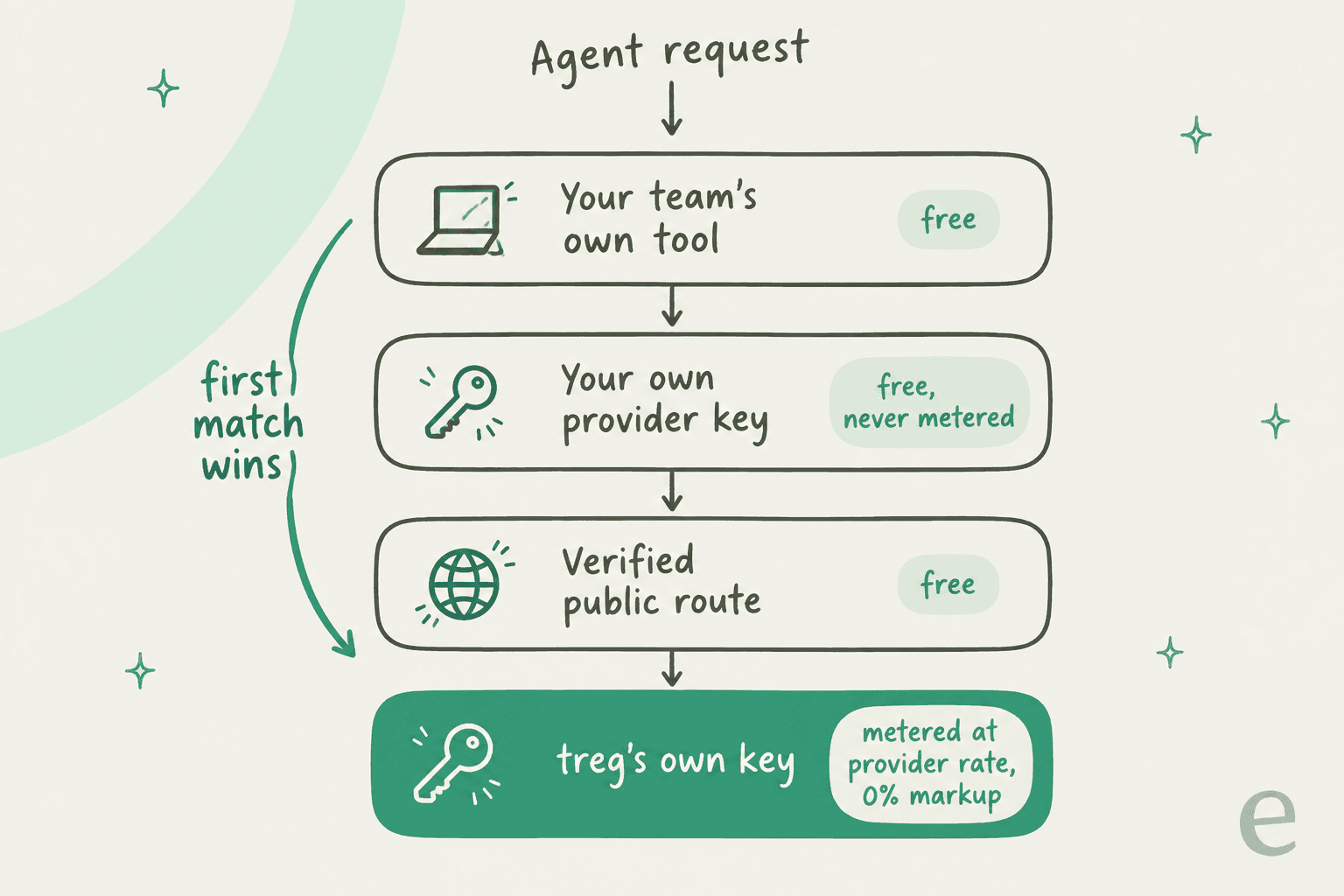
In the docs' words, "Your own key always wins over treg's, and those calls are never metered." So if you already are paying for Firecrawl or Apify, connecting that key doesn't double-bill you, Treg just becomes one front door plus a pay-as-you-go fallback. There is one carve-out you should know about: an X connection made through Treg's own X app is metered per call, because X bills the app owner.
The use-case pages show real price spreads
Each use-case page lists every provider that does one job, with its price and inputs, a 30-day success rate taken from Treg's own traffic, and also the last verification date. The spreads between them are large. For a backlink summary, Serpstat is $0.0025 per call and Moz is about $0.0133. For finding a work email, QuickEnrich is $0.00483 with a 100% success rate over 600,414 calls, while Hunter is $0.0245 on the same page.
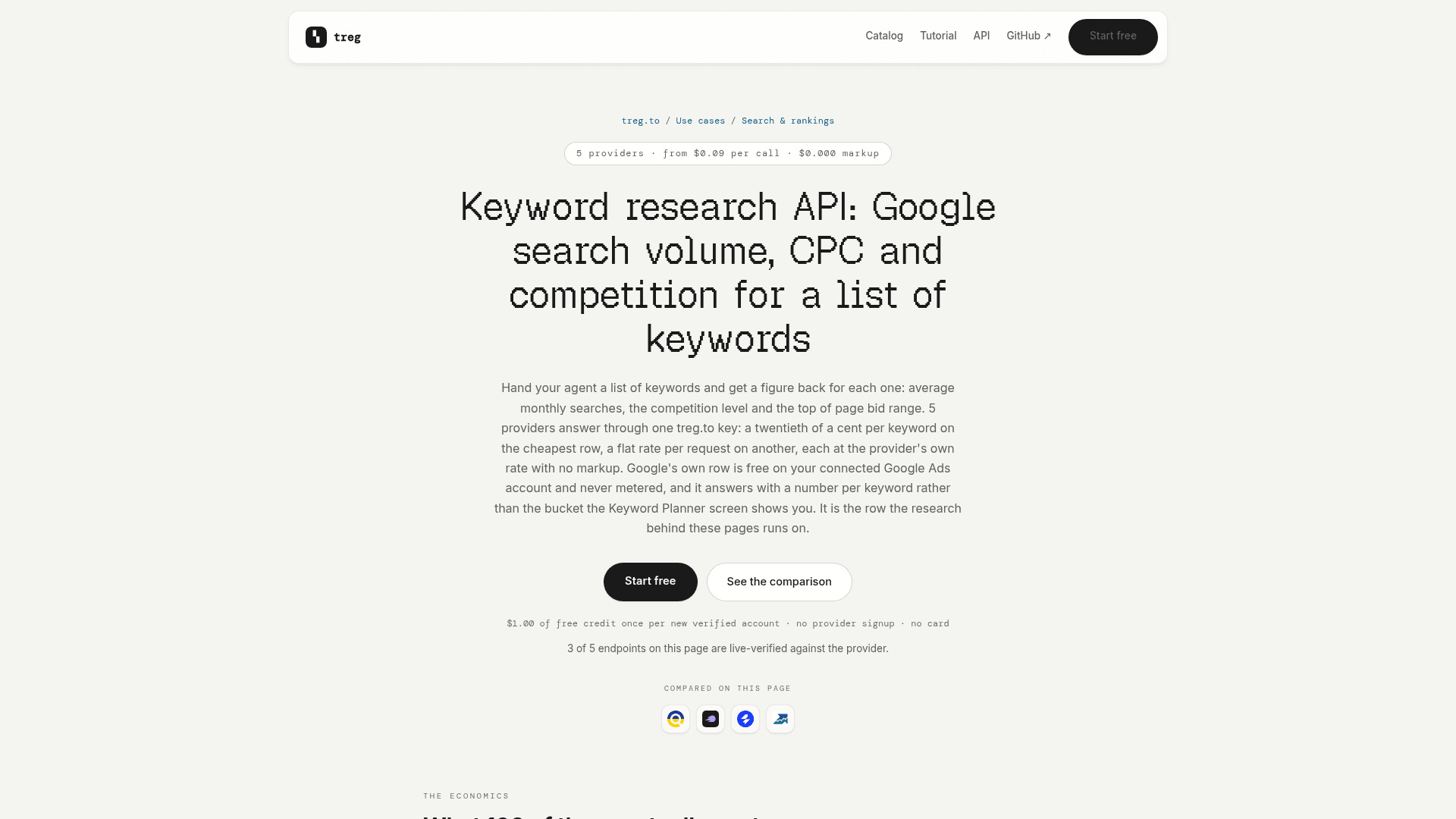
Something I also like is that the pages say what they don't cover. The backlink page states "Ahrefs is not among them," and the keyword page flags that only 3 of 5 endpoints are live-verified. This kind of honesty you don't see much on vendor pages.
Setup takes about a minute
For Claude Code MCP tools, it is only one command: claude mcp add --transport http treg https://treg.to/mcp. There's also a Claude Code plugin, a custom-connector URL for ChatGPT and Claude.ai, a CLI whose treg mcp install step registers Cursor, Codex and opencode, and a skill install for Gemini CLI and Windsurf. Or you can just paste set up treg - https://treg.to/llms.txt into your agent and let it do the rest of the work.
Admin controls that fit a team
Admins can mint scoped agent tokens limited to certain tools and a daily call count, like treg org agent-new ci-bot --tools stripe,gh --cap 500, and pin a job to one vendor for the whole team with treg org pin. Secrets are Fernet-encrypted and roles run from viewer to owner, plus every call gets logged. It's the same team-scoped model that most MCP apps are moving toward, too.
Where Treg falls short
No SLA during early access
The terms say the hosted service has "no uptime commitment and no support commitment." That is honest, and for experiments it's fine. But if a nightly lead generation agent is feeding your sales team, you need a fallback path for the day when Treg is down, or when a provider on its key runs out of capacity. Even the published lead-list receipt notes that Tomba was out of capacity in the middle of the run.
Data passing through the proxy isn't documented
A proxy sees the request and response bodies as well as the auth token. During the Product Hunt launch, one commenter asked about GDPR and EU AI Act compliance and another one asked about the logging and retention of that traffic. I couldn't find a public answer for either one. Treg's own integration guide also notes that audit rows are "shed under load," which means the billing ledger is the reliable record and the call log is not. If your agent is pushing customer or contact data through enrichment calls, better to get this in writing first.
The agent has to choose the provider
Treg's method note says "treg.to does not choose for you," apart from a routed email-finder endpoint. It's a defensible design, but it does move the hard decision onto your agent. The one Product Hunt review said the same thing, from practice:
"When a task maps to more than one provider (a few different SEO backlink tools, for example), the search results don't make it obvious upfront which one is actually cheaper or more reliable for that specific call"
Treg's September 10 "Enrich Arena" launch looks like a direct answer to that, letting 60+ enrichment vendors compete on the price and hit rate. It is a step forward, though a waterfall tool like Clay still does more of this for you out of the box.
The licence isn't what the footer says
The treg.to footer reads "100% open source · AGPL," but the repo's LICENSE file is Apache 2.0 with added terms that bar offering it as a hosted service to third parties without written permission. Self-hosting it for your own org is fine. For an agency or a SaaS that wants to resell it as a service though, that restriction matters a lot.
The "$371/mo of seats" line compares jobs, not vendors
The homepage panel adds up Semrush, Moz, Crunchbase and Hunter seats to "$371/mo of seats → cents per call." When I checked in the live catalog, Semrush and Crunchbase only run on your own key, and Hunter's own email find is $0.0245, not $0.004. The cheap numbers are coming from other providers that do a similar job. Which is fine, but if your team trusts Semrush numbers specifically, you will keep paying for Semrush anyway.
What Treg actually costs
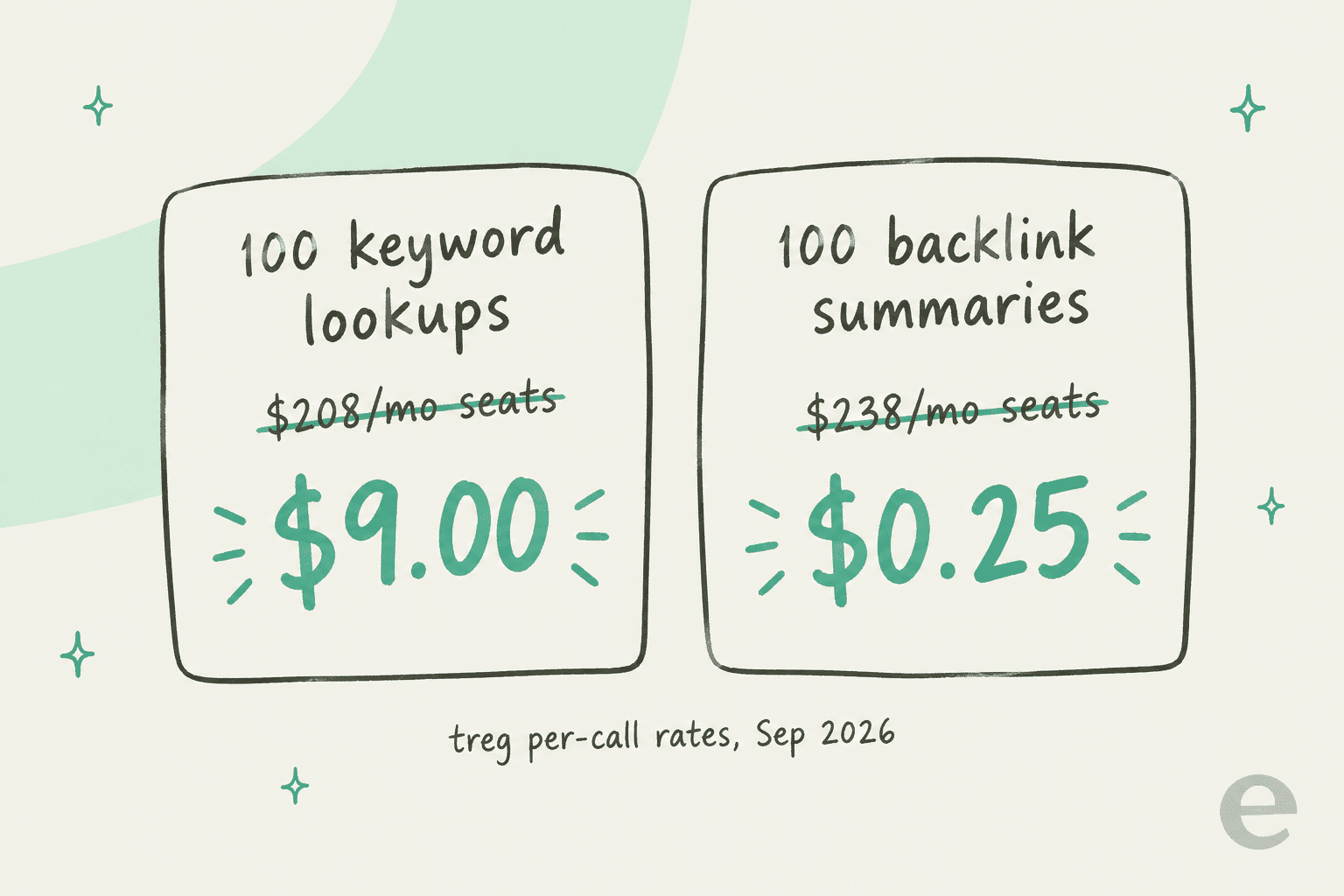
This is the part of any Treg review that readers come for, so here are the numbers which Treg publishes itself. On the keyword page, 100 keyword-volume requests on DataForSEO cost $9.00, against $208/mo for Semrush plus Serpstat at list. On the backlink page, 100 backlink summaries on Serpstat cost $0.25, against $238/mo for Semrush plus Moz.
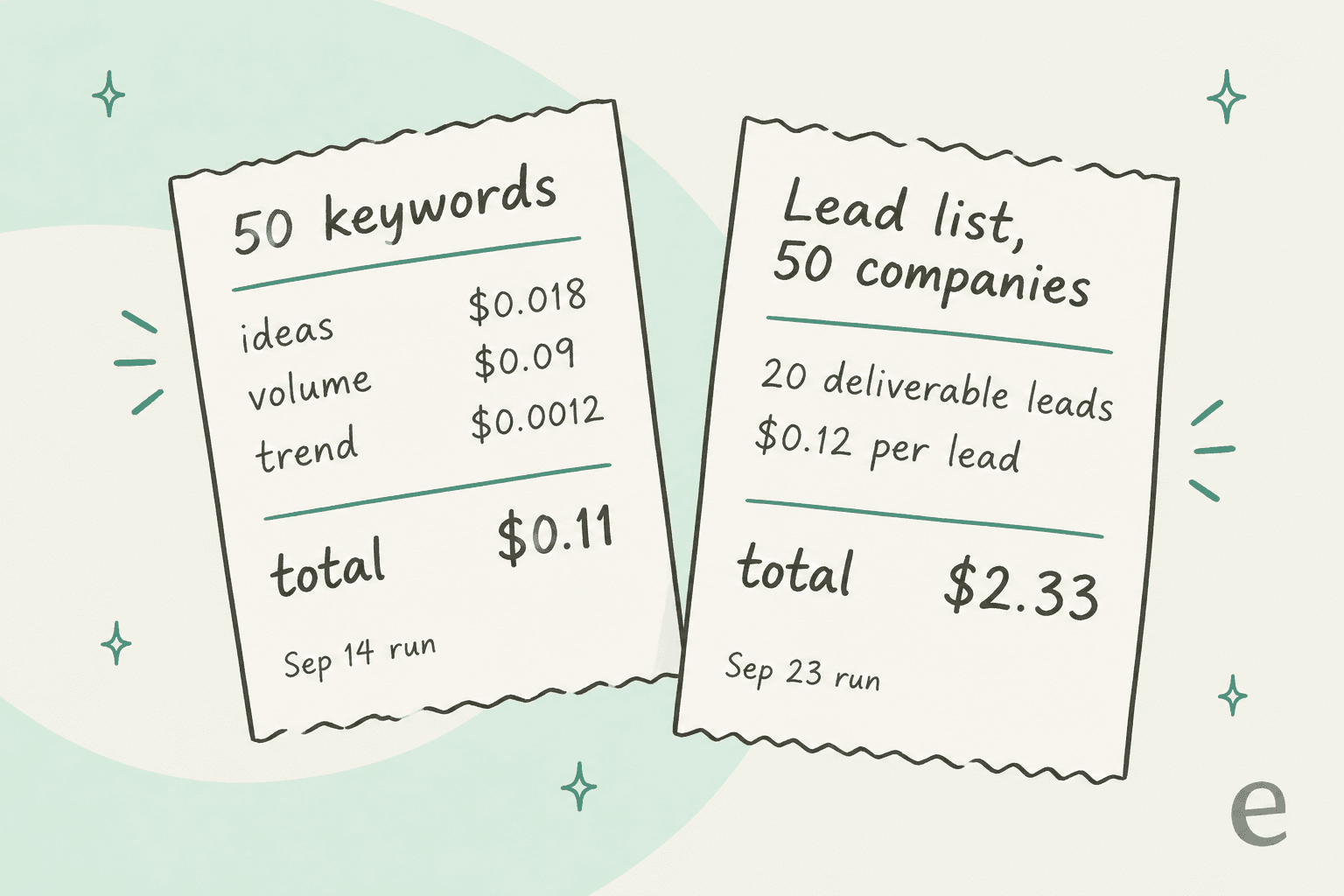
The real receipts on the workflows page back this up too. A 50-keyword research run cost $0.11. A lead-list run that turned 50 companies into 20 verified leads cost $2.33, or about $0.12 per lead, and to its credit the receipt admits that only 4 of 19 generated openers scored "decent or better."
The more useful question is not "is it cheaper," since at low volume it obviously is. It's "at what volume does a seat win back." You can plug your own monthly volumes into the calculator below. The rates there are the cheapest verified rows from Treg's use-case pages, and the seat prices are the same list figures that Treg's own pages use.
For keyword data the break-even lands at around 1,544 requests a month, while backlinks and emails are so cheap per call that seats almost never win on them. Most small teams will spend single-digit dollars a month. Heavy users are better to keep their subscription and connect that key through Treg, where it never gets metered.
What users say about Treg
Treg is still young, so the independent voice is thin, and most of it lives on X with a strong lean toward GTM and lead-gen. There is no Hacker News thread yet, and no G2, Capterra or Trustpilot listing either. The most detailed independent post I found came from someone who ran a full outbound build with Claude Fable 5.1:
"Defined my ICP in plain English to Fable 5.1 with a link to my VSL page & it used Treg to source the companies, found the contacts, verified emails across 5 services, loaded into Instantly with dynamic variables, copywriting done, and an A/B test"
The pricing model is what people keep on praising, especially when compared against the credit minimums on raw APIs. One agency operator described running it over seven VMs:
"For example DFS you need to buy minimum $50 credits to use platform, but with Treg I can pay per api call."
Nick Vasilescu, who wrote that his post was "not sponsored in anyway," called it "like openrouter for lead gen" and said that you could run a whole GTM motion just by giving a Hermes agent access to it. Over on LinkedIn, the praise was more about the setup time than the price:
"Realistically, connecting tools to your agents and signing up to all these providers is still one of the few manual tasks that can take some time when setting up an agent environment."

The skeptical takes are questions rather than complaints. One reply asked how Treg handles deduplication when the same contact is coming from several sources, another one asked if refreshing an existing contact costs the same. And this one put the whole debate into one sentence:
"2,800 data sources is the easy part. a CMO also decides which signals to ignore. curious how this handles that"
One caution when reading the buzz. The founder has posted that "6 grok bots brought us 1M+ views on X," and several accounts posted the launch copy word for word, so I'd give the handful of independent posts above more weight than the raw volume.
Who should use Treg, and who should skip it
Two questions decide it: are you already running an agent, and does the pipeline need an SLA?
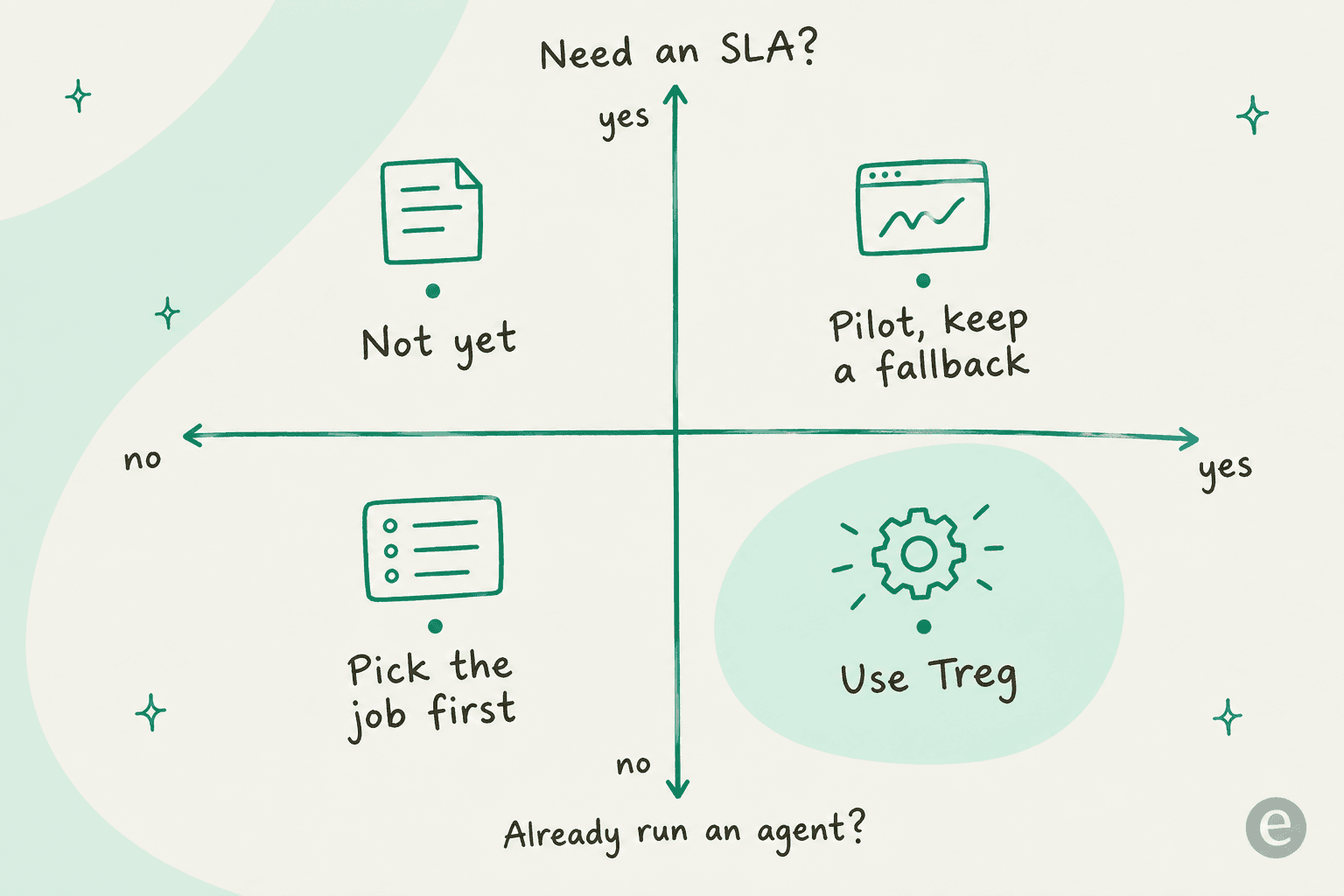
Use Treg if:
- You already run an agent in Claude Code, Cursor or OpenClaw, and it keeps hitting "I don't have access to that data."
- You need a few hundred lookups a month across many vendors. That's exactly where a $139 seat makes no sense.
- You're building an AI SEO agent and want volume, SERP and AI-visibility checks without a seat per tool.
- You want one place for revoking every key your agents are holding.
Pilot with a fallback if the pipeline feeds revenue. Keep your own provider keys connected through Treg, so in case the hosted service hiccups, you can still call those vendors directly.
Skip it for now if:
- Your team works inside the Ahrefs or Semrush dashboards daily. Ahrefs isn't in the catalog, and Semrush is bring-your-own-key only.
- You need a signed DPA or GDPR answers before any contact data moves.
- You don't have an agent yet, or a clear job for one. Start from a roundup of the best AI agents, or skip the build and hire the job done.
Treg vs hiring the job done
Treg is infrastructure. What it does is give your agent hands, and it's one of the cleanest versions of that layer I have read through. You still need to bring the agent and the prompts, also the review loop and the strategy. For builders who like the wiring-up part, that's the right trade.
For content teams, though, the data was never the expensive part, the 50-keyword run cost $0.11. Picking the angle, writing the content brief, studying what ranks and writing something worth citing is the other 95%. That is the gap which eesel fills with ready-to-work AI teammates for specific jobs, and for SEO the teammate is the AI blog writer. It researches the keyword, pulls real sources, builds the visuals and drafts in your brand voice, and one SEO content lead on Webflow uses it to publish 360+ posts a month with bulk review before anything goes live.
For builders it's not a closed box either. The eesel CLI, @eesel/cli, drives the same teammate you'd use in the dashboard: every command prints JSON, writes support a --dry-run flag that shows the exact server call before sending, and headless auth works through environment variables, so it fits in scripts and CI. Each workspace is also an MCP server, and npx @eesel/cli mcp token prints a ready-to-paste claude mcp add command. That means your coding agent can call Treg for the raw lookups and then hand the finished-post job to eesel, all in the same session. If you'd like to see the mechanics, I would start with how an AI blog writer works, then the AI blog writer cost breakdown.
Try eesel for your SEO content
If this Treg review convinced you the data layer is cheap and the judgment is the real work, the eesel AI blog writer is the teammate that does that work. Give it your site and a keyword, and it comes back with a researched and cited draft, with visuals and FAQs, ready for you to approve. It's free to start, and my SEO blog writer roundup shows how it compares against the other options.
Frequently Asked Questions
Is Treg worth it?
Is Treg legit or a scam?
How much does Treg cost in practice?
What are the downsides of Treg?
Does Treg work with Claude Code and Codex?
Can Treg replace an AI SEO tool?
Is Treg safe for customer data?


Article by
Rama Adi
Rama is a software engineer at eesel AI with two years of experience writing about B2B SaaS, AI tools, and customer support technology. Based in Bali, Indonesia, he brings a developer's perspective to product comparisons — cutting through marketing copy to what the integrations and APIs actually do.