
What Treg is
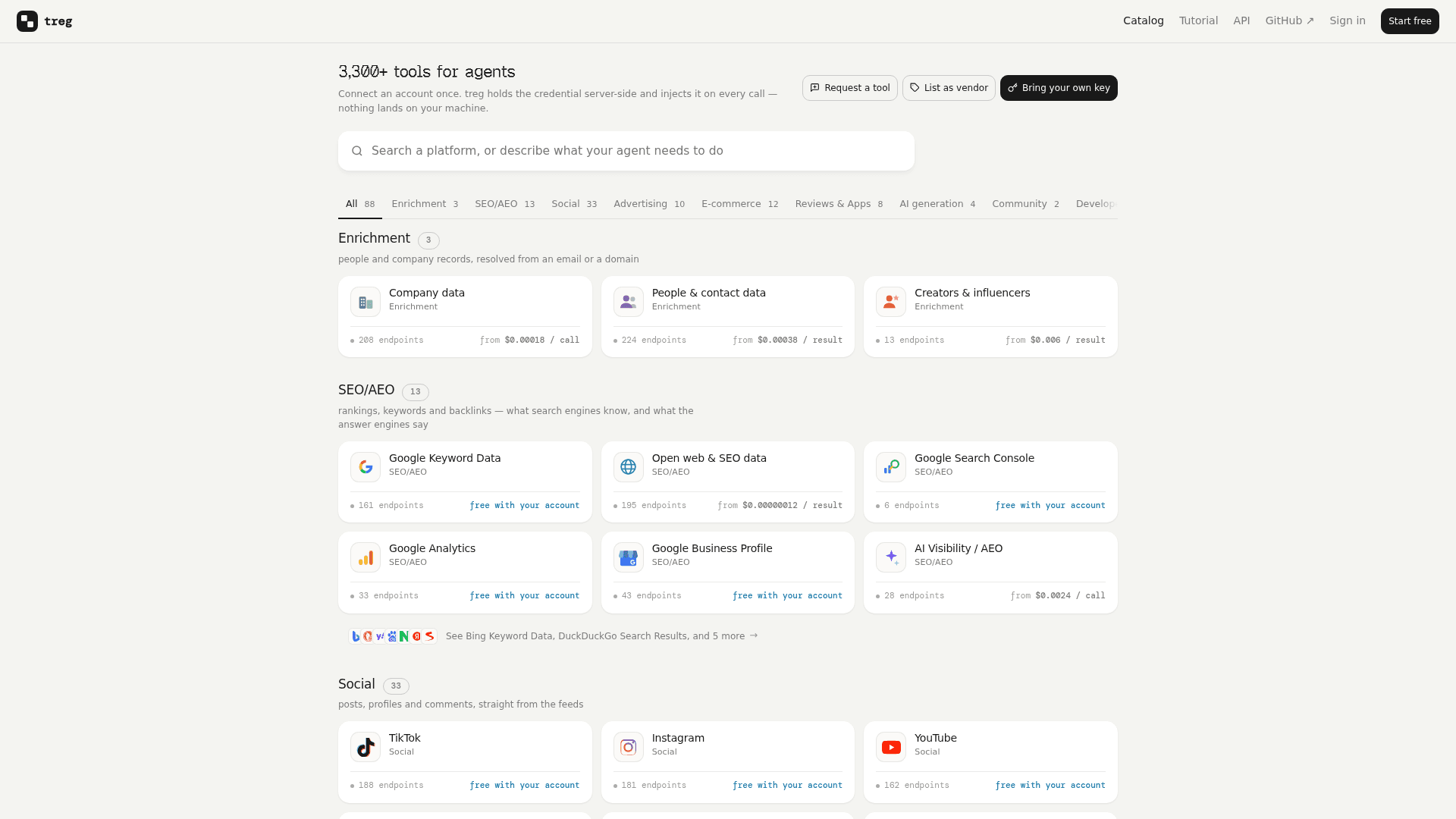
Treg's own docs describe it as "OpenRouter, but for agent tools instead of models." If you have used OpenRouter before, the idea clicks pretty fast, because OpenRouter is basically one key for hundreds of language models. Treg gives your agent one key for thousands of tools: SEO and SERP data, backlinks, social feeds, people and company enrichment, ad platforms, scraping, and image, video and voice generation.
You can think of it as the tools-side cousin of every AI agent MCP server that showed up this year, only with thousands of vendors sitting behind the one door.
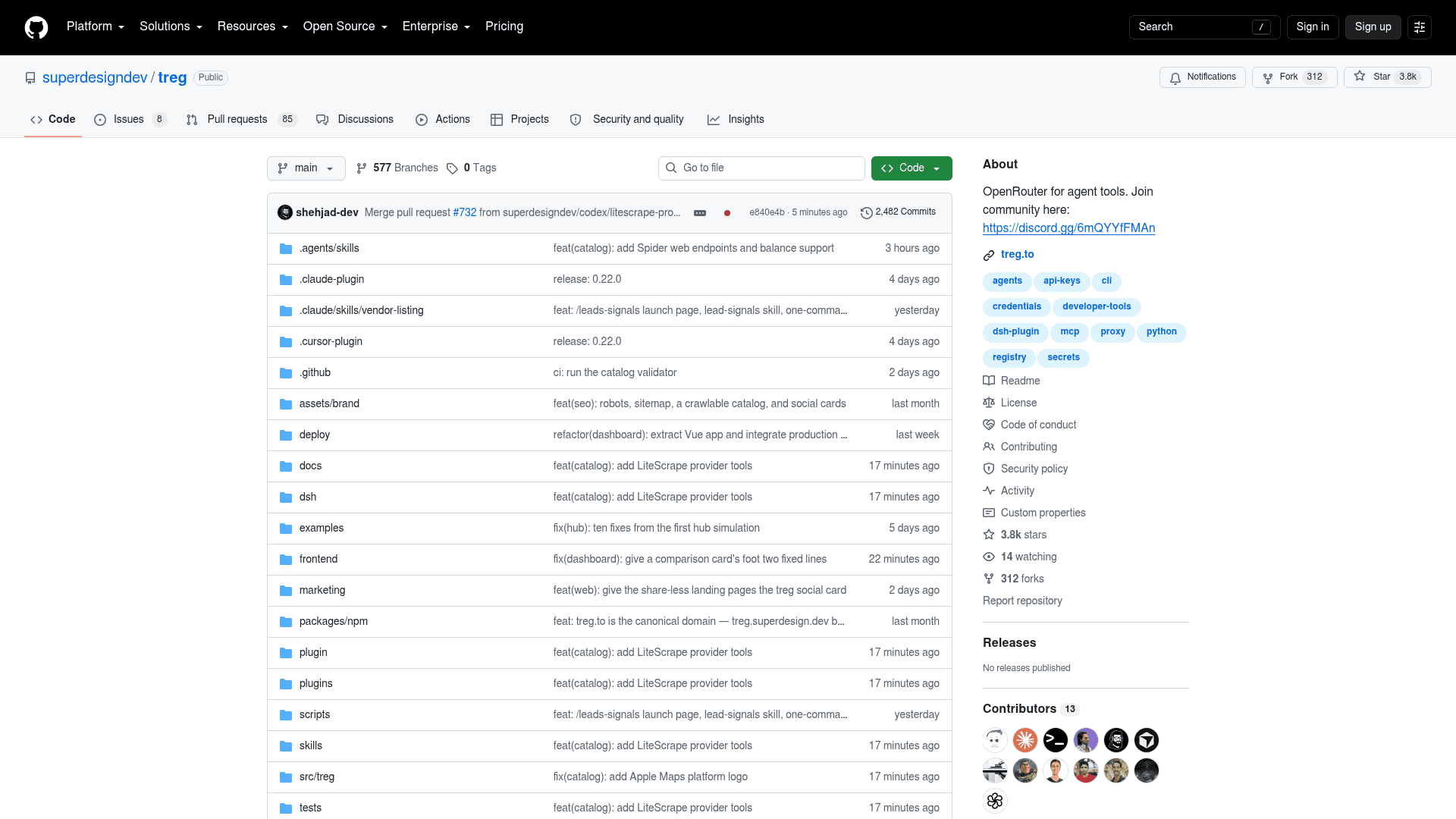
The builder is Superdesign, which is the team behind an AI product-design agent, and the top committer on the treg repo is founder Jason Zhou. The repo was created on July 15, 2026 and had 3,805 stars and 312 forks by September 29, with more than 2,400 commits in about 11 weeks.
Treg launched on Product Hunt on August 17, 2026 and finished #7 of the day with 160 upvotes.
I write about SEO for a living, so this pitch hits a nerve that I know quite well. The tools an agent needs for real SEO automation sit behind subscriptions, and nobody buys a subscription just for one run. Treg's own docs name them: "Semrush $139/mo, Moz $99/mo, Crunchbase $99/mo, Apollo $59/seat." What Treg does is carry those accounts (or cheaper providers doing the same job) and then bill you fractions of a cent per call instead.
How Treg works
Everything runs through a single endpoint, /call/. Your agent sends a request with an X-Treg-Token header, then Treg injects the right credential on its own servers and forwards the request, and the provider's response gets relayed back unchanged. The setup docs spell out the promise: "nothing sensitive lands on the agent's machine, and every call is audited."
There are two ways to call it:
- A catalog endpoint by ID, like
tikhub.tiktok.user.profile. Treg picks the credential. - One of your own tools, by prefixing the real upstream URL, like
https://treg.to/call/https://api.stripe.com/v1/charges. Treg looks up the key your team registered for that host and injects it.
The design choice I find most interesting is how Treg decides whose key pays for a call. It walks down a ladder, and whichever match comes first wins.
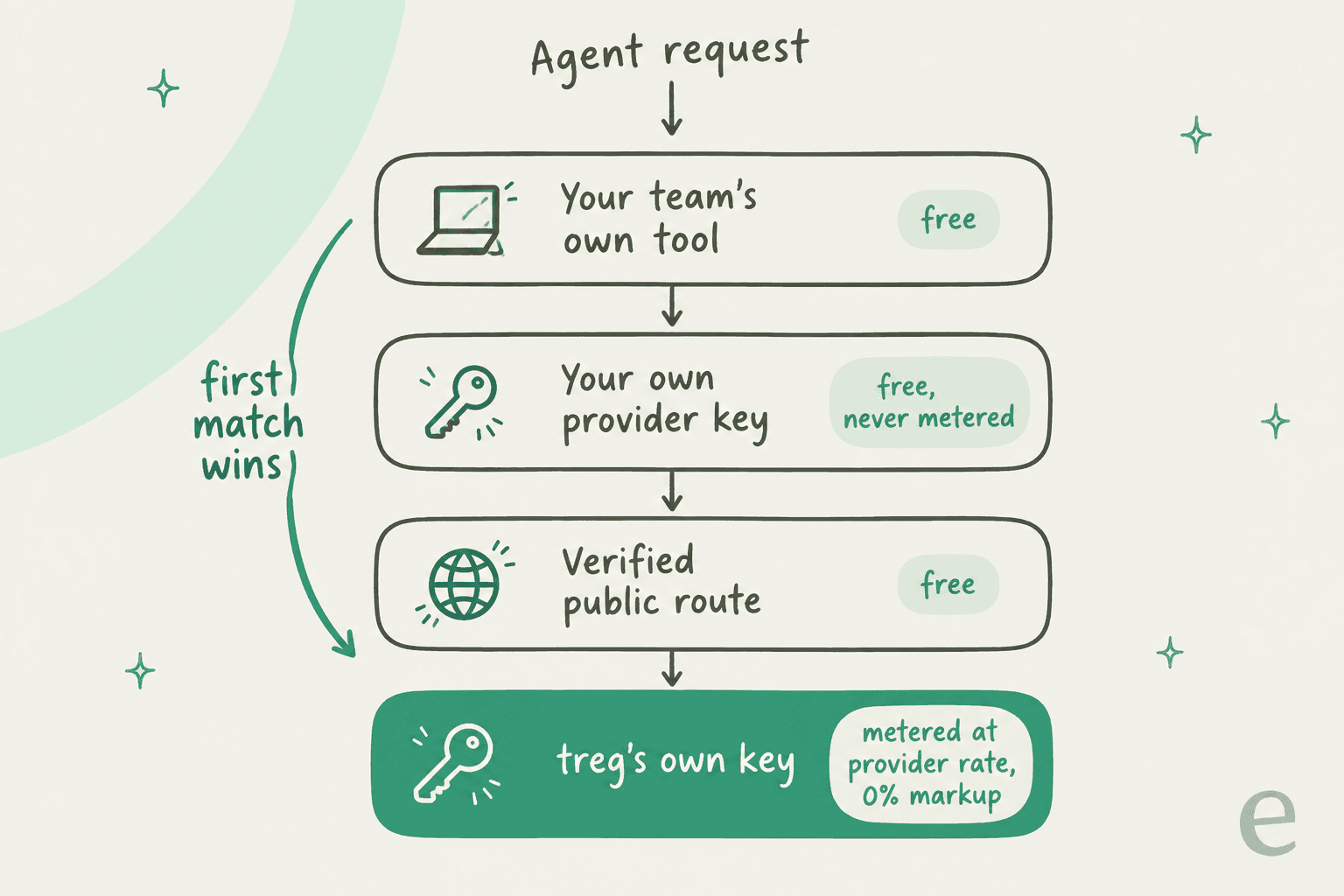
If you are evaluating it, this is the detail I would underline. In Treg's words, "Your own key always wins over treg's, and those calls are never metered." So in case you already pay for Firecrawl or Apify, connecting that key won't double-bill you. Treg then works as a single front door to the tools you already own, with a pay-as-you-go fallback for the ones you don't have, and honestly that is a fairer deal than most gateways offer.
A few other mechanics that are worth knowing about:
- Price before the call.
treg catalog get <id>shows the rate, and the actual charge comes back in anX-Treg-Cost-Microheader. - Hard spend ceiling. Send
X-Treg-Route-Max-Costand Treg refuses any call that would cost more, charging nothing. - No concurrency limit. The docs say there's "no per-token or per-team concurrency limit," so an agent can fire calls in parallel.
- Scoped agent tokens. Admins can mint a token limited to certain tools and a daily call count, like
treg org agent-new ci-bot --tools stripe,gh --cap 500.
What's in the Treg catalog
In a lot of ways the catalog is the product. Platforms are grouped under 10 categories, and each card shows how many endpoints it carries and the cheapest price per call. Here's the shape of it as of September 29, 2026, from the live catalog:
| Category | What's inside | Example floor price |
|---|---|---|
| SEO/AEO | Keyword data, open web and SERP data, Search Console, GA4, Google Business Profile, AI visibility | AI Visibility from $0.0024/call |
| Social | TikTok (188 endpoints), Instagram (181), X (163), YouTube (162), LinkedIn (107), Reddit (46) | X from $0.0001/success |
| Enrichment | Company data (208), people and contact data (224), creators | People data from $0.00038/result |
| Advertising | Google Ads, Meta Ads, TikTok, Pinterest, Snapchat and Microsoft Ads | Own account, free |
| E-commerce | Amazon, TikTok Shop, Walmart, eBay, Taobao, JD.com | Amazon from $0.0015/result |
| AI generation | Video (103 rows), image (70), voice (3), AI judgment (1) | Image from $0.012/success |
| Other | Reviews and app stores, Slack, Telegram, GitHub, crypto and stock data | Stocks from $0.001/call |
One caveat worth flagging is that Treg's own pages don't agree on the headline number. The homepage says 3,700+ endpoints across 102 providers, /catalog says 3,200+ tools, and the catalog's JSON API counts 3,338 endpoints, 2,096 of them with a verified stamp. Since the catalog grows daily, I'd treat any single number as just a snapshot.
The comparison pages are the real feature
What makes Treg more than a key vault is the way it shows your agent all the options for a job side by side. Each use-case page lists every provider that does one task, with price in the provider's own unit, the inputs it accepts, a 30-day success rate from Treg's own traffic, and the date Treg last verified it end to end.
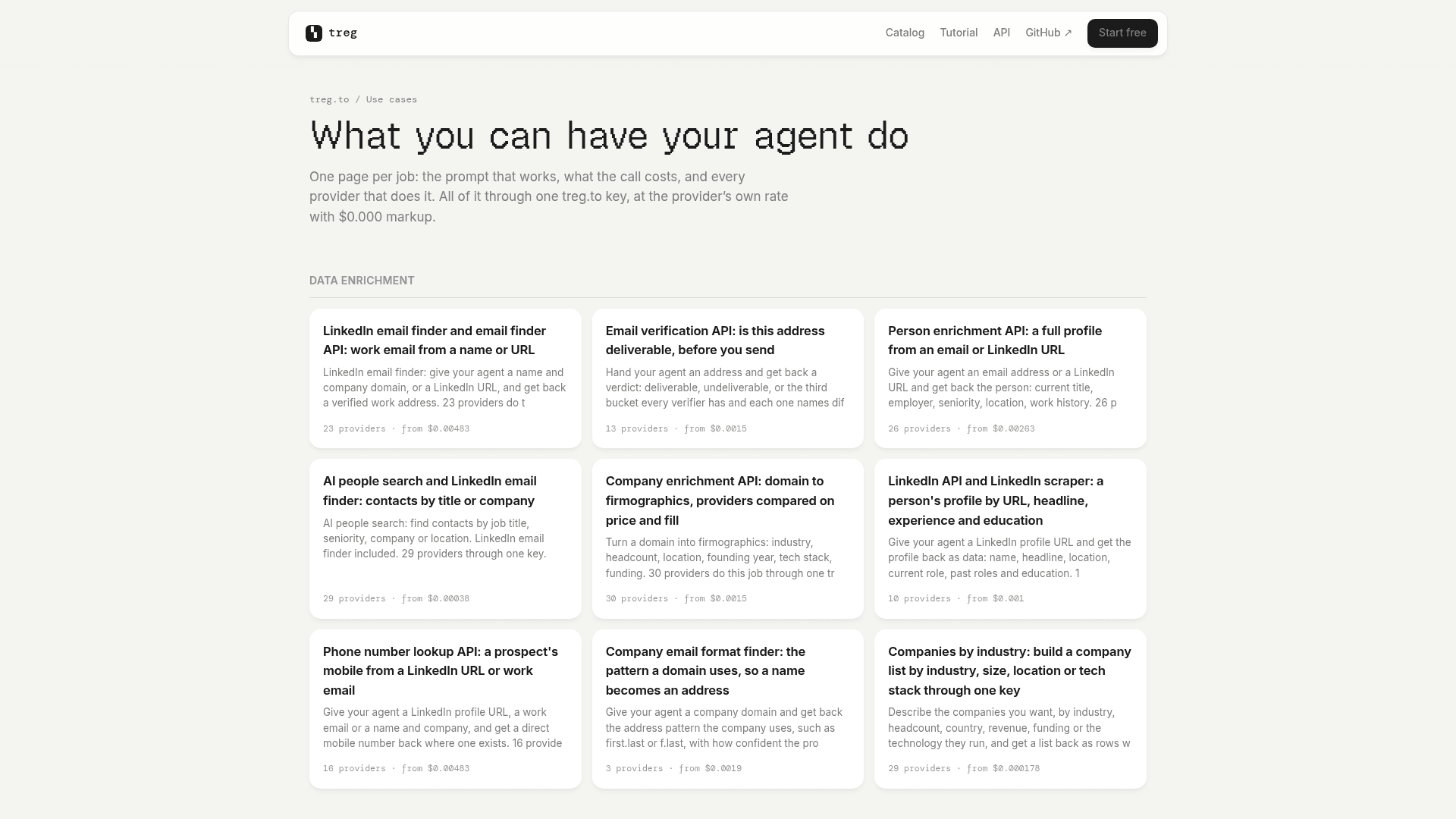
The price spreads here are pretty wild. For finding a work email (the bread and butter of any lead generation agent), QuickEnrich costs $0.00483 per found address with a 100% success rate over 600,414 calls, while Hunter on the same page is $0.0245 and Wiza is $0.075. For a backlink summary, Serpstat is $0.0025 per call and Moz is about $0.0133 (my Moz vs Ahrefs comparison covers what you get from each at full price). The docs even say it plainly: "Spreads inside one capability reach 200×."
Treg doesn't choose for you by default, though, unlike a routing layer such as Clay that bakes waterfall logic into the product. Its method note says "treg.to does not choose for you," and it leaves the pick to the agent (the one exception today is a routed email-finder endpoint). Admins can lock a job to one vendor for the whole team with treg org pin. That is a sensible default, but it does mean your agent's judgment matters a lot, since a cheap provider with 8 calls of history isn't the same bet as one with 600,000.
Treg pricing: what you actually pay
Treg's pricing page boils down to one sentence: "A prepaid balance, metered per call at the provider's own rate, with no markup." There are no seats and no subscription, and also no monthly minimum. New verified accounts get $1.00 of free credit, once.
What gets metered and what doesn't is the part that matters more than the headline:
| Call type | Billed? |
|---|---|
| Catalog endpoint on Treg's own provider key | Yes, at the provider's rate, 0% markup |
| Catalog endpoint through a verified public route | No, free |
| Any endpoint where your team connected its own key | No, never metered |
| Your own registered tools, skills and CLIs | No |
| Your connected accounts (GA4, Search Console, Google Ads) | No |
| An X connection made through Treg's own X app | Yes, per call, because X bills the app owner |
| A repeat question served from cache | 10% of the price on Treg's key |
| Failed provider calls, or Treg returning a 503 | Not billed |
How does Treg make money at zero markup? The homepage answers: "we earn on volume pricing with vendors - not on you." In practice it buys provider capacity at volume rates, then bills you the list rate. For a few vendors that only sell subscriptions, Treg sets its own per-call rate and says it reviews those monthly.
Read the "$371/mo" line carefully
The homepage has a tidy panel: Keyword volume at $0.006/call instead of Semrush at $139/mo, backlinks at $0.012 instead of Moz at $99/mo, funding data at $0.020 instead of Crunchbase at $99/mo, and work email at $0.004 instead of Hunter at $34/mo. Total: "$371/mo of seats → cents per call."
It's a fair illustration of the idea, but it compares jobs, not vendors. When I checked the live catalog, Semrush and Crunchbase can't run on Treg's key at all. Both are bring-your-own-key only, so the cheap keyword and funding numbers come from other providers doing a similar job. Hunter's own email find on Treg is $0.0245, not $0.004. None of that is a trick, it just means "replace your Semrush seat" really means "replace what you used Semrush for, with a different data source." If your team trusts Semrush numbers specifically, that difference matters. (If you're shopping for a cheaper seat instead, my list of Semrush alternatives covers the dashboard route.)
What real runs cost
Treg publishes receipts from actual runs on its workflows page, which is something I wish more vendors did. Two of them are worth a closer look:
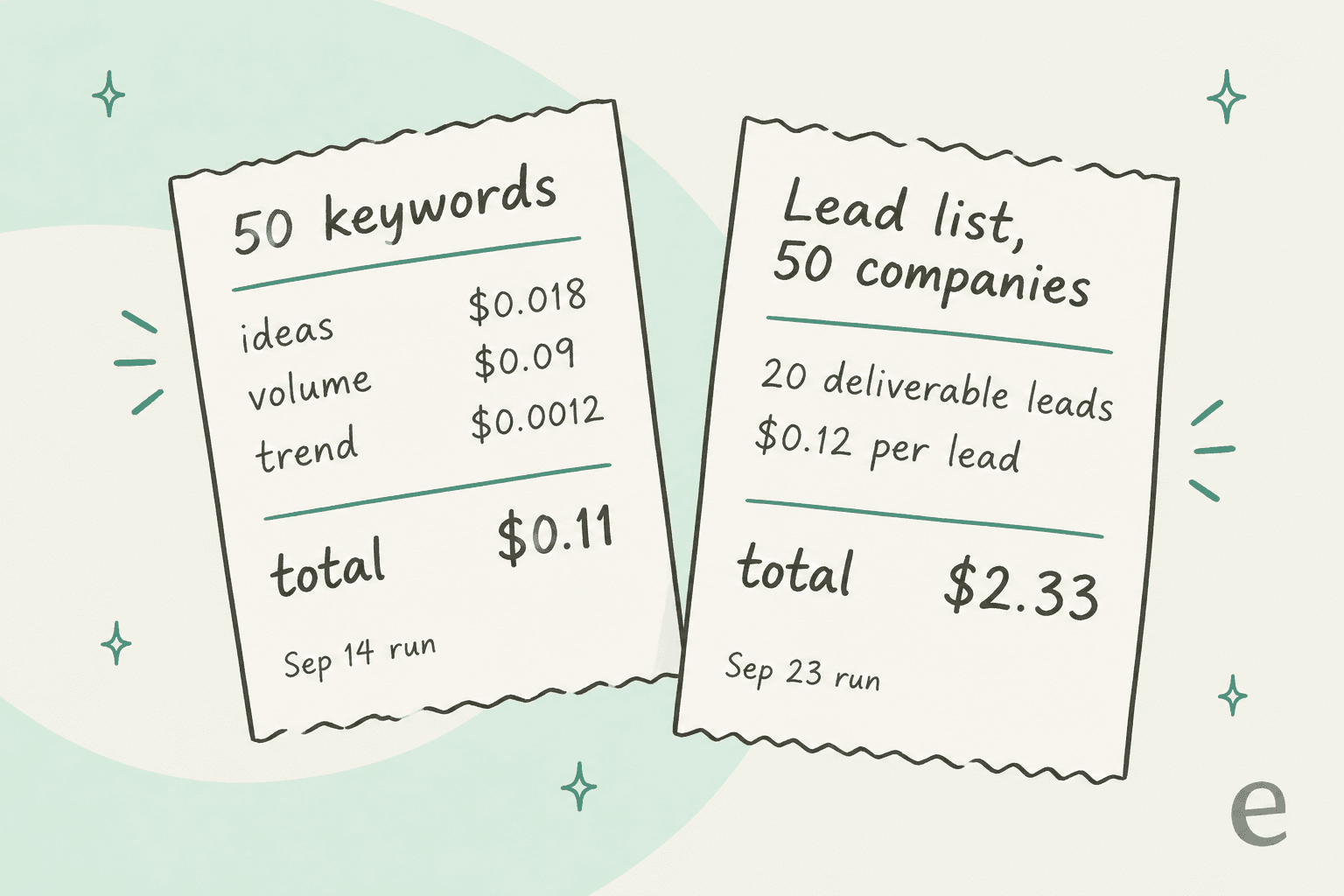
The keyword run expanded a seed, pulled volume for 50 keywords and checked trends, all on DataForSEO, for $0.11. It found 742,970 monthly searches across the list. The lead-list run chained Apollo, an AI filter, Findymail, Tomba and LeadMagic to turn 50 companies into 20 verified leads for $2.33. What I like is that the receipt admits to its own flaws: Tomba was out of capacity, Findymail misses were billed anyway, and only 4 of 19 generated openers scored "decent or better."
That last number is the whole story in miniature. The data cost pennies. The part that needed judgment mostly didn't land.
How to set up Treg
Setup is fast, and it's designed so the agents can do it themselves. Treg's homepage literally tells you to paste this into your agent: set up treg - https://treg.to/llms.txt. From there the agent reads the instructions and wires itself up. If you'd rather do it by hand, just pick the route that matches your tool:
- Claude Code, as an MCP server:
claude mcp add --transport http treg https://treg.to/mcp. If you're new to this, my guide to Claude Code MCP tools covers how remote servers work. - Claude Code, as a plugin:
/plugin marketplace add superdesigndev/treg, then/plugin install treg@treg. - ChatGPT, Claude.ai or Claude Desktop: add
https://treg.to/mcp/as a custom connector and approve the OAuth screen. Nothing to install. - The CLI:
curl -fsSL https://treg.to/install.sh | sh, thentreg login.treg mcp installregisters the server in Cursor, Codex and opencode too. - Other agents:
npx skills add superdesigndev/treg -s treginstalls it as a skill for tools like Gemini CLI, Windsurf and Cline.
If you want the background on why terminal-first agents like this are taking off, my piece on the agentic coding CLI covers it. The CLI also has treg claude and treg codex, which start those agents with your team's shared keys already loaded. For teams running Hermes or OpenClaw, the installer detects those as well.
Security, licence and the early-access fine print
Any tool that holds every API key your agents use is a big ask in terms of trust, so I think this section deserves more than a footnote.
The security model is thoughtful. Stored secrets are Fernet-encrypted, with the key kept outside the repo and the database. Everything is scoped to a team (the same model most MCP apps are moving toward), with four roles (viewer, member, admin, owner) and per-member tool allow-lists. Local CLI runs can execute as a separate sandboxed user with an egress allow-list, and every call is logged with who, which tool and the status code. One caveat from Treg's own integration guide: audit rows are "shed under load," so the billing ledger is the reliable record, not the call log.
Your request and response bodies pass through Treg. That is simply how a proxy works, but it is still worth saying out loud. A Product Hunt commenter asked about data retention and GDPR during launch, and I couldn't find a public answer. If your agent moves customer data through enrichment calls, I'd ask about this before you ship.
It's early access. The terms say the hosted service has "no uptime commitment and no support commitment." That's honest, and for experiments it's fine, but for a production pipeline that your revenue depends on it's a harder sell.
The licence isn't what the footer says. The treg.to footer reads "100% open source · AGPL," but the repo's LICENSE file is Apache 2.0 with additional terms that take precedence. You can use, modify and self-host it for your own organisation, but you can't offer it as a hosted service to third parties without written permission. That makes it source-available, not open source in the OSI sense. For most teams that's no problem at all, although for an agency that wants to resell it, it is.
Self-hosting is a real option too, by the way. The README walks through running it with uv and supports SQLite or Postgres, and there's also a Render blueprint shipped with it. It also warns that losing your TREG_SECRET_KEY makes every stored secret unrecoverable, so back that up.
What people are saying about Treg
Treg is only about 11 weeks old, so the community voice is still young and it mostly lives on X. It is also loud in one quite specific direction, which is GTM and lead generation. The strongest post I found came from someone who ran a full outbound build through it:
"Defined my ICP in plain English to Fable 5.1 with a link to my VSL page & it used Treg to source the companies, found the contacts, verified emails across 5 services, loaded into Instantly with dynamic variables, copywriting done, and an A/B test"
The post pairs Treg with Claude Fable 5.1 and Instantly, and that was the pattern I saw the most: a strong model doing the reasoning, with Treg for the data. The thing people keep coming back to is the pricing model, especially versus credit minimums on the raw APIs:
"For example DFS you need to buy minimum $50 credits to use platform, but with Treg I can pay per api call."
On LinkedIn, the framing was less about price and more about setup time, which I think is the underrated half of the pitch:
"Realistically, connecting tools to your agents and signing up to all these providers is still one of the few manual tasks that can take some time when setting up an agent environment."

Nobody has published a negative review so far, but the open questions say a lot. The one Product Hunt review (4.0 stars) said that when several providers do the same job, the listing didn't make it obvious which was cheaper or more reliable, so the reviewer ran test calls to compare. And the sharpest reply I found under a launch post put the whole debate in one line:
"2,800 data sources is the easy part. a CMO also decides which signals to ignore. curious how this handles that"
I would also discount some of the volume a little. Several of the loudest launch posts came from accounts tied to the founder or reposting the launch copy word for word. The independent voices above are positive, but there aren't many of them yet.
Where Treg fits, and where it doesn't
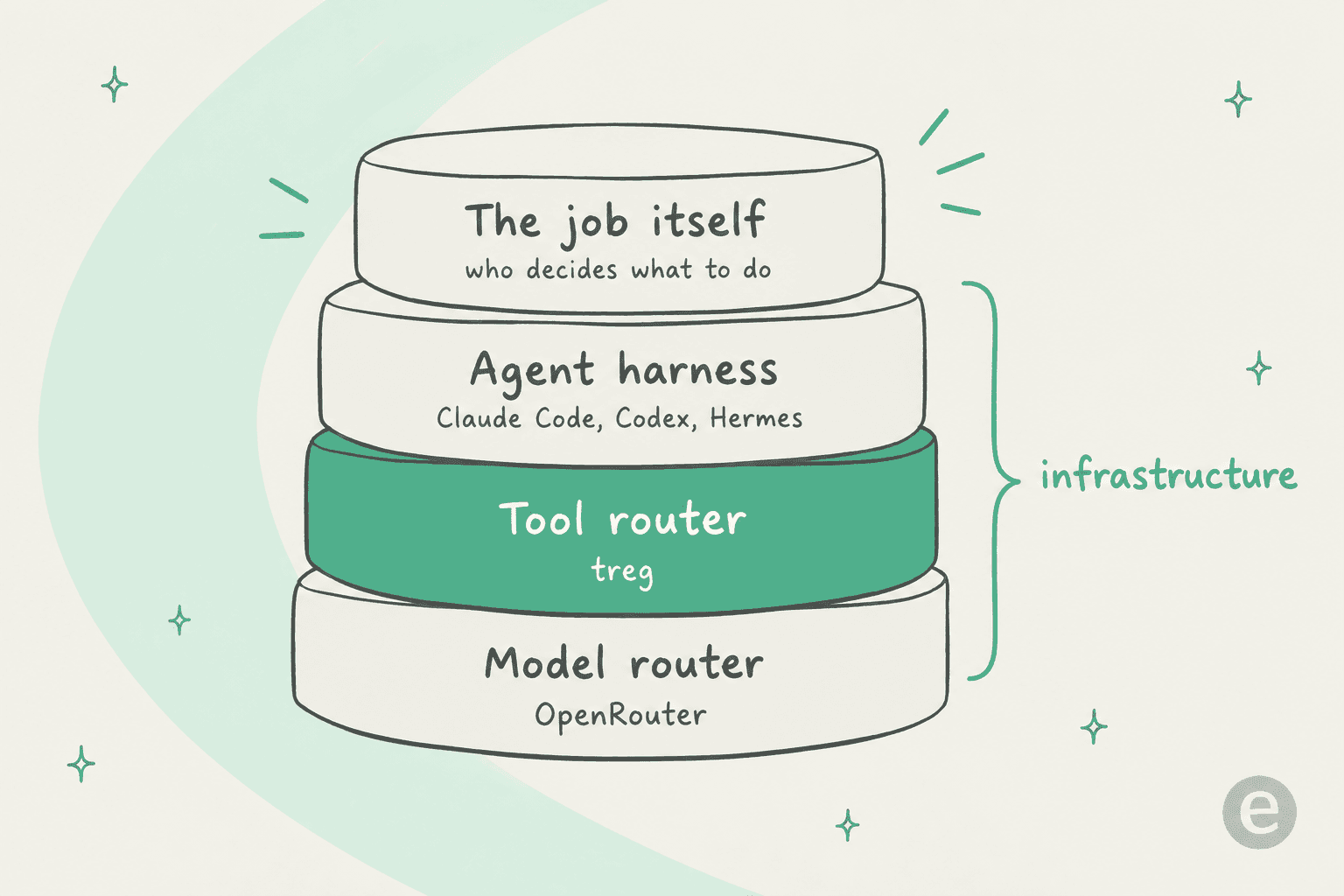
The cleanest way to place Treg is to look at where it sits in the stack, which is one layer above the model router and one layer below the agent that actually does the work.
Treg is a great fit when:
- You already run an agent in Claude Code, Cursor or Hermes, and it keeps hitting "I don't have access to that data."
- You need a few hundred lookups a month across many vendors, not thousands from one. That's exactly where a $139 seat makes no sense.
- You're wiring up an AI SEO agent and want it to check volume, SERPs and AI Overview citations without a seat per tool.
- You're building a product that resells data. Treg's docs say reselling is "allowed and encouraged," with per-customer usage tags for invoicing.
- You want one place to revoke every key your agents hold.
Treg is a weaker fit when:
- Your team lives inside the Ahrefs or Semrush dashboards all day. Ahrefs isn't in the catalog and Semrush is bring-your-own-key only, so you'd keep those seats anyway.
- You need an SLA. Early access with no uptime commitment is a real constraint.
- You don't have an agent or a strategy yet. If that's you, start with a roundup of the best AI agents first. Treg gives an agent hands. It doesn't tell it what to build.
That last point is where I'd push back on the "run your whole GTM from the terminal" hype. The tools were never the hard part of SEO. I've spent two years on search work, and the $0.11 keyword pull is the easy 5% of the job. The other 95% is choosing the angle, building the content brief, knowing what already ranks, writing something worth citing, and linking it into the rest of your site. An agent with Treg can do the research calls, but someone still has to own the post.
Treg vs a ready-made AI teammate
If you're reading this because you want your agent doing SEO or content work, it helps to name the choice clearly up front. Treg is infrastructure: a clean, cheap data layer. You bring the agent, the prompts, the review loop and the strategy. That's the right call for builders who enjoy wiring things up, and Treg is one of the nicest versions of that layer I've seen.
The other path is to hire the job done. That's the bet eesel makes, and it's the one I'd make for most content teams. Instead of a generalist agent plus a toolbelt, eesel gives you ready-to-work AI teammates for specific jobs, and one of them is the AI blog writer. It already knows how to research a keyword, study what ranks, pull real sources, build the visuals and draft in your brand voice.
If you want the mechanics, I wrote up how an AI blog writer works. Your part is to review and approve. eesel's own blog runs through it, and one SEO content lead on Webflow uses it to scale to 360+ posts a month, about 12 a day, with bulk review before publishing.
It's also not a closed box for builders. eesel ships a real CLI, @eesel/cli, that drives the same teammate you'd use in the dashboard. Every command prints JSON, writes have a --dry-run flag that shows the exact server call before sending it, and headless auth works through environment variables, so it fits in scripts and CI. Every eesel workspace is also an MCP server: npx @eesel/cli mcp token prints a ready-to-paste claude mcp add command, so Claude Code, Codex or Cursor can hand work to the blog writer the same way they'd call Treg. You can even run both: Treg for raw lookups, eesel for the job that turns them into a finished post.
Try eesel for SEO content
If Treg made you realise the data was never the bottleneck, the eesel AI blog writer is the part that turns a keyword into a researched, cited, on-brand post you'd actually publish. It works like a new hire for your content calendar: give it your site and a keyword, and it comes back with a full draft, visuals and FAQs for you to approve. It's free to start, no card needed, and my AI blog writer cost breakdown shows how it compares with doing it by hand. For how it stacks up against other tools, see my SEO blog writer roundup.

Frequently Asked Questions
What is Treg?
How much does Treg cost?
Is Treg open source?
Does Treg work with Claude Code, Codex and ChatGPT?
Is Treg a replacement for Semrush or Ahrefs?
Is Treg safe to use with my API keys?
What's the difference between Treg and an AI SEO tool?


Article by
Kurnia Kharisma
Kurnia is a software engineer and writer at eesel AI with two years of SEO experience, writing about AI tools, helpdesk software, and customer support. He pairs a developer's understanding of how these products are built with search-driven research into what actually ranks and resonates with the people searching for them.