SEO is filled with repetitive tasks. Keyword research, site audits, rank tracking, and reporting all eat up time that could be spent on actual strategy. If you're still pulling data by hand and building spreadsheets, you're slowing down your own growth.
The good news is that automation can take care of most of that manual work. At eesel AI, we relied on automation to grow our daily search impressions from 700 to over 750,000 in just three months. It’s about working smarter, not harder.
This article shares our list of the best SEO automation tools we've tested that save time and get real results. The main driver of our own growth was automating high-quality content creation, and we used our own tool, the eesel AI blog writer, to do it. We’ll cover that and six other platforms that help streamline the entire SEO workflow.
What are SEO automation tools?
SEO automation tools are platforms that use software and AI to handle the repetitive, manual parts of your job.
This isn't about setting your SEO strategy on autopilot or letting robots take over completely. It’s about handing off the tedious work so you can focus on bigger things, like analyzing data, figuring out user intent, and improving the user experience. Automation handles the "what," which frees you up to focus on the "why."
Here are a few examples of tasks you can automate with the right tools:
- Keyword research and clustering
- Generating content briefs and outlines
- Creating full-draft content
- Running technical site audits and monitoring
- Getting automated backlink alerts
- Implementing on-page code changes automatically
An infographic detailing the main tasks that can be handled by SEO automation tools, including keyword research and content creation.
What to look for in SEO automation tools
When you're looking at different tools, it’s easy to get overwhelmed by long feature lists. Here’s a simple checklist to help you pick the right platform for what you actually need.
First, the tool needs to connect with your existing setup. Look for integrations with platforms like Google Search Console, Google Analytics, your CMS, and any other SEO automation software you already use.
Your decisions are only as good as your data. The tool has to provide reliable, current information you can trust, without having to worry about AI hallucinations or old metrics.
The best tools don't just automate one task; they automate a whole workflow. Instead of a tool that just finds keywords, find one that finds them, groups them, and then helps turn them into a content outline.
A complicated tool can waste more time than it saves. The interface should be simple enough for your team to start using without needing weeks of training.
Finally, the tool should give you more value than it costs. Figure out if the time you save and the results you get are worth more than the subscription fee or the cost of hiring someone to do the same work manually.
The best SEO automation tools at a glance
Here’s a quick overview of the tools we’ll cover.
| Tool | Best For | Key Automation Feature | Starting Price |
|---|---|---|---|
| eesel AI blog writer | AI Content Generation | Turns a single keyword into a publish-ready blog post with assets | Free to try; $99/mo for 50 blogs |
| Gumloop | Custom SEO Workflows | Building no-code AI agents for any repetitive SEO task | Free plan; paid from $37/mo |
| Semrush | All-in-one SEO Management | Scheduled site audits and automated reporting | $165.17/mo (billed annually) |
| Ahrefs | Backlink & Competitor Monitoring | Automated alerts for new, lost, or competitor links | $129/mo |
| Alli AI | On-Page CMS Automation | AI agent makes on-page optimizations directly on your site | $299/mo |
| Surfer | AI-Assisted Writing & AEO | Real-time content scoring and AI search visibility tracking | $99/mo (billed yearly) |
| Screaming Frog | Technical Audit Automation | Scheduled crawls and custom data extraction via command line | $279/year |
A closer look at the 7 best SEO automation tools
Here are the tools we've personally tested and found to be the most effective for streamlining our SEO efforts.
1. eesel AI blog writer
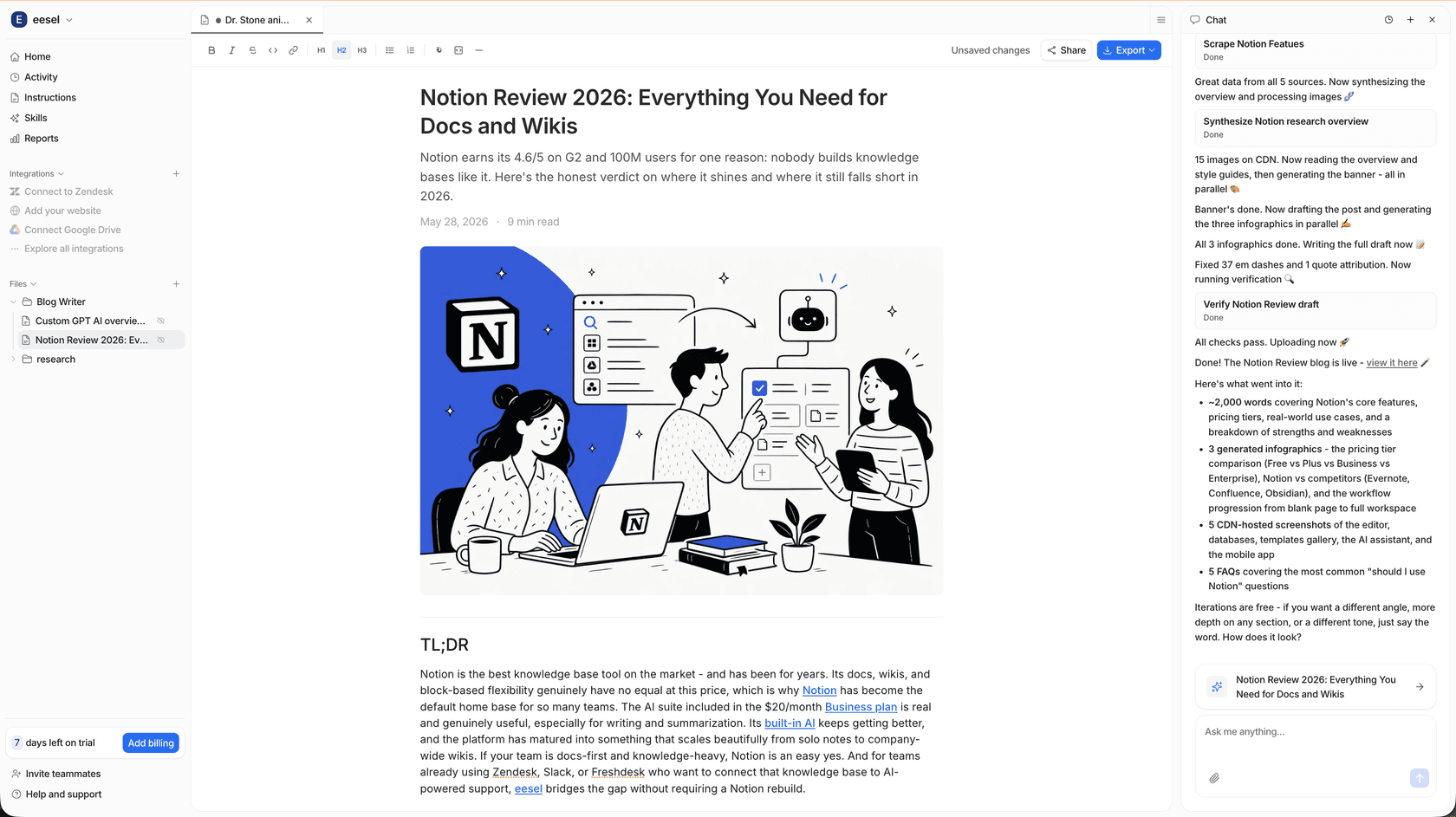
It does more than just create a simple draft. You give it a keyword, and it does deep, context-aware research to produce a complete article with media. For example, it automatically finds pricing data for comparison posts and adds internal links based on your existing site content.
Pros: It generates content with a human-like tone. It also automatically includes assets like AI-generated images, infographics, and tables. To add some real-world perspective, it embeds relevant YouTube videos and actual Reddit quotes. The final post is also optimized for AI Answer Engines (AEO) to help you appear in Google’s AI Overviews.
Cons: It's very focused on content generation. You'll need other tools for technical audits, rank tracking, or deep backlink analysis.
Pricing:
- Completely free to try.
- Early Bird plan: $99/month for 50 monthly blog generations.
2. Gumloop
Gumloop is a no-code platform that lets you build custom AI agents for almost any task. If you can map out a manual SEO process, you can probably automate it with Gumloop. It's like Zapier but with a powerful AI layer built in.
For instance, you could build an AI agent that scrapes the search results for a keyword, pulls SEO data for each URL using a tool like Semrush, and then puts everything into a Google Sheet, all on its own.
Pros: It’s very flexible, letting you build just about any SEO automation you can imagine. You can connect it to different LLMs like ChatGPT or Claude and over 125 other applications.
Cons: Even though it's a no-code tool, building complex workflows has a bit of a learning curve compared to using a pre-built, single-purpose tool.
Pricing:
- Free: Up to 2,000 credits/month.
- Solo: Starts at $37/month for 10,000+ credits.
- Team: Starts at $244/month for 60,000+ credits.
3. Semrush
Semrush is a well-known, all-in-one SEO platform. It automates a wide range of tasks, from rank tracking and technical audits to competitor analysis, all using its huge database of over 26 billion keywords.
Its core automation features are what make it so useful. You can schedule site audits to run automatically and find technical problems, track keyword positions with daily updates sent to your email, and build automated reports that can be branded and sent to clients on a regular schedule.
Pros: The complete set of tools lets you manage most of your SEO work from one place. Its AI Visibility tool also helps you track how your brand is mentioned in LLMs.
Cons: The price can be high for freelancers or small businesses. And while its tools are solid, a dedicated crawler like Screaming Frog might find deeper technical issues.
Pricing:
- Starter: Starts at $165.17/month (billed annually).
- Pro+: Starts at $248.17/month (billed annually).
4. Ahrefs
Ahrefs is another top-tier, all-in-one SEO platform, famous for its backlink analysis. Its web crawler is one of the most active online, providing fresh data from an index of over 35 trillion live backlinks.
The platform is great at automated competitor research. You can set up alerts to be notified about new and lost backlinks for any domain you’re tracking. The Content Gap tool automatically finds keywords your competitors rank for that you don't, giving you a ready-made content plan.
Pros: The backlink data is incredibly valuable for link building and seeing what competitors are up to. Automated alerts save hours of manual research. It also offers a free Site Audit for websites you own, which is a great place to start.
Cons: While it has gotten better, its built-in reporting features are still catching up to competitors. You might need to use tools like Looker Studio for fully customized client reports.
Pricing:
- Lite: $129/month.
- Standard: $249/month.
- Advanced: $449/month.
5. Alli AI

Alli AI has a unique take on on-page SEO. Instead of just giving you recommendations, its AI agent can implement code and content changes directly on your site, no matter what CMS you use.
You install a single piece of JavaScript on your site. Alli AI then audits your pages and gives you recommendations for titles, meta descriptions, and schema markup. You review the suggestions in a dashboard and approve them to go live right away. It can even make modern JavaScript sites built with frameworks like React or Vue visible to AI crawlers like GPTBot.
Pros: It's a huge time-saver, especially for teams without developers or those on locked-down platforms. It can automate thousands of on-page fixes that would otherwise take months to do.
Cons: Because it works with a JavaScript snippet, some teams might worry about site performance or losing direct control over their code. Pricing is based on sites and pages, which can get expensive for large websites.
Pricing:
- Business: $299/month for 5 sites.
- Agency: $599/month for 15 sites.
6. Surfer
Surfer is a tool built to automate the content optimization process. It analyzes the top-ranking pages for a target keyword and creates a data-driven brief that tells you exactly how to write content that can compete.
Its real-time Content Editor is the main feature. As you write, it gives you a content score and suggests terms to include, which automates the process of making sure your content is on topic. More recently, its AI Tracker lets you monitor how often your brand gets mentioned in AI search tools like ChatGPT and Google AI Overviews.
Pros: The real-time feedback makes SEO optimization a clear, almost game-like process for writers. It also integrates directly with Google Docs and WordPress, fitting into existing workflows easily.
Cons: It's heavily focused on on-page and content SEO. It doesn't offer features for technical audits or backlink analysis, so it's more of a specialized tool than an all-in-one solution.
Pricing:
- Standard: $99/month (billed yearly).
- Pro: $182/month (billed yearly).
7. Screaming Frog
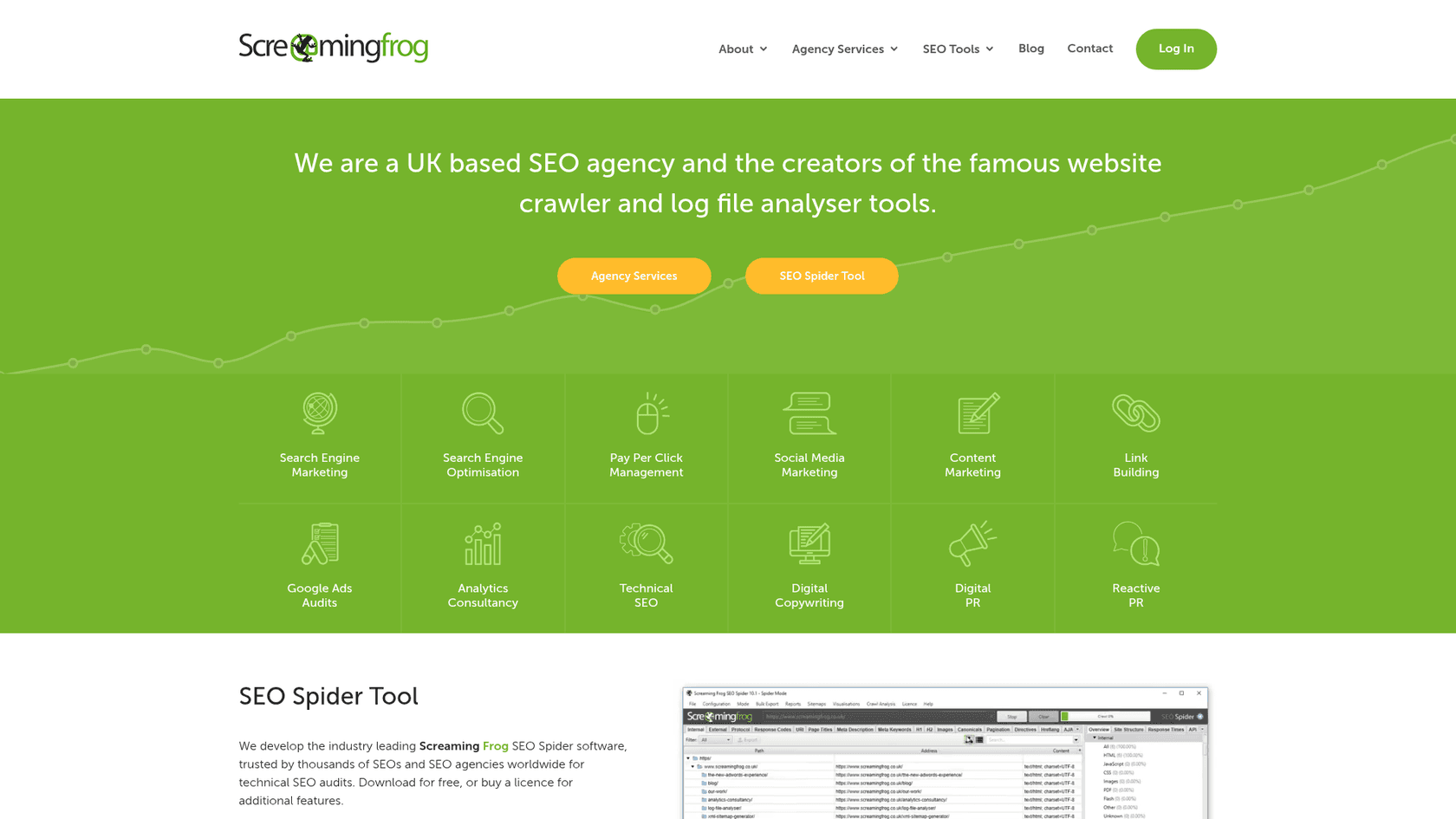
The Screaming Frog SEO Spider is the standard desktop crawler for technical SEO. While it’s a desktop app, its ability to automate deep audits is unmatched.
You can schedule crawls to run automatically through the command-line interface (CLI), export specific data, and connect with APIs like Google Analytics, PageSpeed Insights, and even AI models like OpenAI and Gemini to add more data to your crawl.
Pros: It provides the most detailed technical data you can get, finding issues that other tools often miss. It's highly customizable, and the one-time yearly fee is a good deal since you can run unlimited crawls on your own computer.
Cons: It has a steep learning curve and isn't for beginners. The interface is packed with data, and you have to export everything to create any kind of client-ready report.
Pricing:
- Free version (crawls up to 500 URLs).
- Paid license: $279/year.
For a more hands-on look at how these automation workflows can be implemented, this video offers practical examples that can help you scale your efforts and drive more traffic to your website.
How to choose the right SEO automation tools for you
With so many options, the right choice comes down to your main goal. Here’s a quick guide to help you decide.
- For Content-Focused Teams: If scaling high-quality content production is your biggest challenge, a tool like eesel AI blog writer is a good option for generating complete posts from scratch. Surfer is a great choice for optimizing existing drafts.
- For Agencies and All-Rounders: If you need one platform to manage multiple clients and campaigns, an all-in-one suite like Semrush or Ahrefs is the most practical option.
- For Technical SEOs: If your work involves site migrations, large-scale audits, and deep technical analysis, Screaming Frog is a must-have.
- For On-Page Specialists: If you need to make on-page changes quickly without waiting for a developer, Alli AI is uniquely set up to automate that process.
- For DIY Automators: If you want to build your own custom solutions without writing code, Gumloop offers the most flexibility.
A flowchart designed to help users select the best SEO automation tools based on their specific goals and team type.
The key is to automate the work, not the thinking
SEO automation tools are powerful, but they should be used to free up your time for strategy, not to replace it.
Automation is best at handling repetitive, data-heavy tasks like collection, monitoring, and initial drafting. The human element—strategy, creativity, and a real understanding of what users want—is what drives success. Use these tools to handle the grunt work so you can focus on the thinking.
For many teams, the most time-consuming task is content creation. If that's you, automating it is the perfect place to start. The eesel AI blog writer is completely free to try, so you can see the quality for yourself and generate your first full blog post in minutes.
Ready to stop drafting and start publishing? Generate your first SEO-optimized blog post with eesel AI for free.