SEO has evolved from manual keyword stuffing to using smart tools for audits and analysis. The next phase involves agent-driven processes.
Good SEO involves a significant amount of repetitive work. Keyword research, competitor analysis, technical audits, backlink tracking, and content creation all take time and resources. AI SEO agents are presented as the solution, promising to automate entire workflows, not just individual tasks. The concept is that they can connect to live data, analyze it, and execute multi-step processes autonomously.
This guide explains what these agents are, what they can do, where they fall short, and how to select one that fits your needs. While some agents are multi-purpose, specialized tools like the eesel AI blog writer are built to handle a critical part of SEO: creating high-quality content that gains visibility.
What exactly are AI SEO agents?
Think of them as AI-powered assistants that can handle a sequence of related SEO tasks without requiring manual intervention at every step. They are designed to act on data, not just present it.
The main difference is that they automate workflows, not just single tasks. A standard rank tracker, for example, automates one job. It provides data, but you must determine the next step. An AI SEO agent could extend this process by finding a target keyword, analyzing top-ranking competitors, drafting an optimized article outline, and suggesting relevant internal links in a single operation.
This also distinguishes them from general AI chatbots like ChatGPT. A chatbot provides answers based on its static training data, which can be outdated. It cannot access real-time online information. An AI SEO agent, in contrast, connects to live data from sources like Google Search Console or live SERPs, utilizes third-party tools, and acts on current information. It is the difference between getting a quick summary and having an assistant perform research and compile a full report.
An infographic comparing standard SEO tools, general AI chatbots, and AI SEO agents, highlighting their different capabilities and data sources.
Core capabilities of modern AI SEO agents
The capabilities of modern AI SEO agents cover the entire SEO lifecycle, from research and strategy to performance monitoring and optimization.
Automated research and analysis
This is an area where agents excel, sifting through large amounts of data to find insights that might take a human analyst days to uncover.
Keyword research & SERP analysis: Agents can analyze massive datasets to identify valuable keywords, spot long-tail opportunities, and group them into topic clusters. They can also scrape search engine results pages (SERPs) to analyze the structure, headings, and key themes of top-ranking content, providing a clear blueprint for what is effective.
Technical SEO audits: An agent can crawl your entire website to automatically identify technical issues like broken links, slow pages, redirect chains, and schema errors. Some advanced platforms, like Writesonic, claim they can suggest or implement fixes automatically, which could eliminate the need for a developer for minor adjustments.
Generative Engine Optimization (GEO): This is an emerging field focused on how your brand appears in AI search engines like ChatGPT and Perplexity. Tools are now available that track your brand’s visibility in these AI-generated answers, helping you optimize how AI discusses your brand.
Autonomous content and on-page optimization
Following the research phase, some agents can move to execution, handling content creation and the technical aspects of on-page SEO.
Content generation: Using SERP analysis and keyword research, agents can generate content outlines or even complete first drafts. The quality of this output, however, varies significantly between generalist platforms and tools built specifically for content.
On-page SEO implementation: Some agents can automatically apply on-page fixes. For instance, Jasper's Optimization Agent can optimize headlines and meta descriptions across your site. Others can identify opportunities for structured data and add the necessary schema markup to help you earn rich snippets in search results.
Internal linking: By analyzing your site's content, an agent can suggest relevant internal links to help build topical authority, improve link equity, and enhance user navigation.
Here’s a simple breakdown of how an agent automates tasks that are usually done by hand:
Task
Manual Process
AI SEO Agent Automation
Title Tag
Manually write a compelling, keyword-focused title.
Generates and implements an optimized title based on SERP data.
Meta Description
Craft a unique description to improve click-through rates.
Writes and applies a unique meta description for each page.
Schema Markup
Use a generator or code it manually.
Identifies opportunities and generates or implements the code.
Internal Linking
Manually search for relevant pages on your site to link to.
Scans content and suggests or automatically adds relevant internal links.
Performance monitoring and reporting
Finally, agents can track performance over time, identifying new opportunities or potential issues.
Continuous rank tracking: Agents can monitor your keyword rankings 24/7, alerting you to significant drops or gains in both traditional search engines and AI answer engines.
Performance analysis: By connecting with tools like Google Search Console, agents can analyze click-through rates, impressions, and traffic to identify underperforming pages that need an update.
Link building & citation opportunities: Some agents can find link-building opportunities by analyzing your competitors' backlinks or finding unlinked mentions of your brand. For example, an agent could find websites that mention your competitors but not you and flag them as potential outreach targets.
Limitations of today's AI SEO agents
While the promise is exciting, the current reality is that AI SEO agents have some significant limitations. Understanding these is key to using these tools effectively without negatively impacting your site's performance.
Lack of strategic nuance: An agent can identify a keyword with high search volume, but it cannot determine if that keyword aligns with your brand's voice, product, or business objectives. It follows instructions; it does not create the strategy. Human judgment is still needed to ensure the automated work is the correct work.
Risk of negative impact: Giving a fully autonomous agent complete control is risky. A single incorrect action, like a flawed schema implementation or an over-optimized page, could cause more harm than good. Human oversight is critical, especially for any agent that can make direct changes to your live site.
Inconsistent content quality: This can be a significant challenge with all-in-one agents. They may be proficient at data analysis, but many produce content that can sound robotic and unengaging. User reviews for some all-in-one tools, like Writesonic, sometimes mention that the generated content requires significant editing to achieve a humanlike quality and pass AI detection.
The specialist approach: AI blog writers vs. generalist agents
While generalist agents attempt to cover a wide range of tasks, a specialist agent is built to solve one problem very well. For many businesses, the primary SEO bottleneck is consistently creating high-quality content. This is where a specialized AI blog writer can be particularly effective.
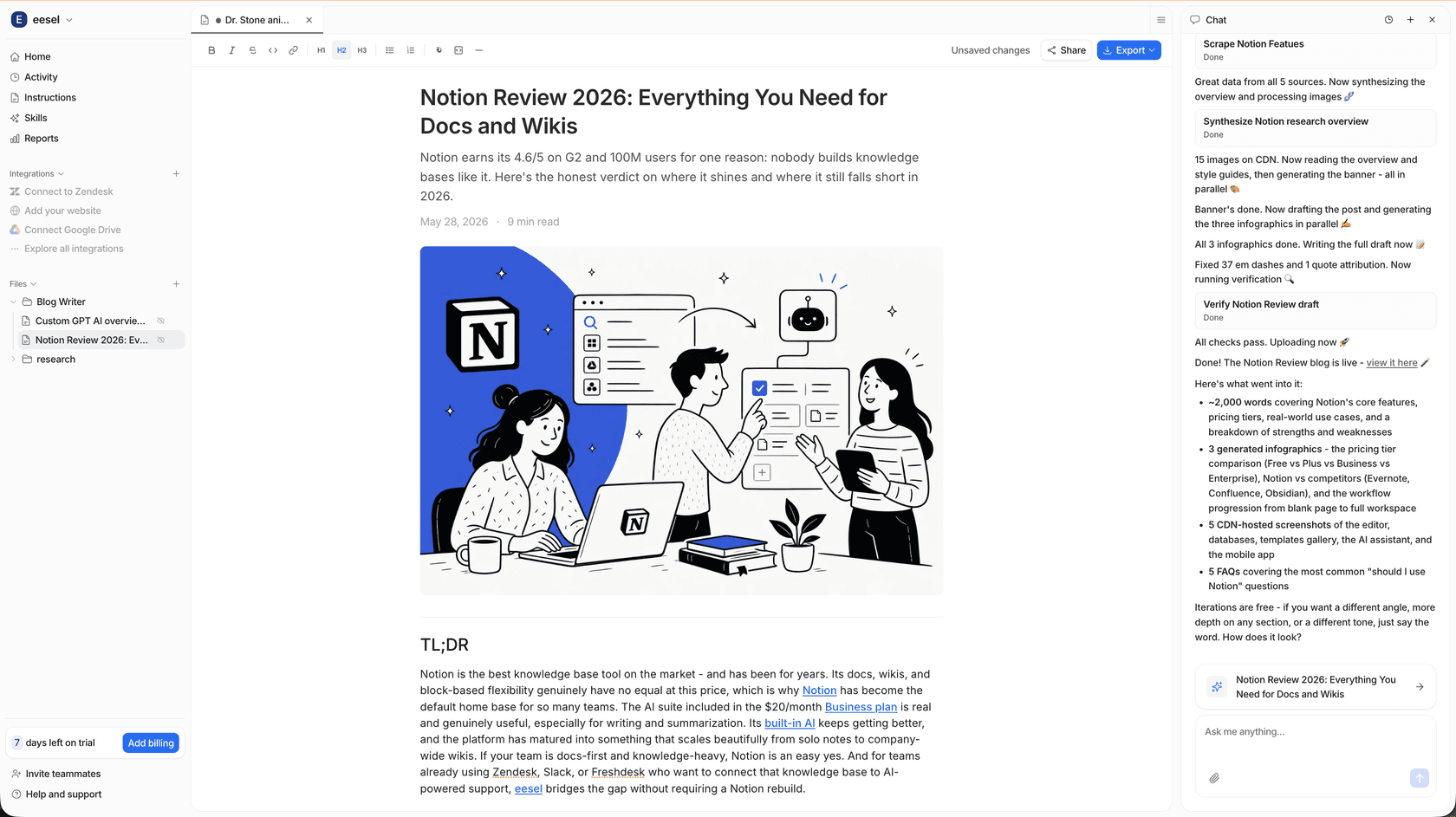
The eesel AI blog writer is an AI agent designed for one purpose: turning a single keyword into a complete, SEO-optimized, and publish-ready blog post. It’s the same tool we used to grow our own organic traffic at eesel AI, taking our blog from 700 to 750,000 daily impressions in just three months.
The eesel AI blog writer interface, a specialized tool among AI SEO agents for generating complete, publish-ready blog content.
It is designed to address common content quality challenges by focusing on:
Beyond the draft: It generates a complete, structured article with headings, well-researched insights, and a tone that sounds human.
Automatic asset generation: It creates and inserts relevant images, tables, and infographics directly into the post, saving hours of manual work.
Built-in social proof: To add authority, it automatically finds and embeds relevant YouTube videos and real Reddit quotes, making the content more engaging for readers.
The market for AI SEO agents is growing, with several key players offering different approaches.
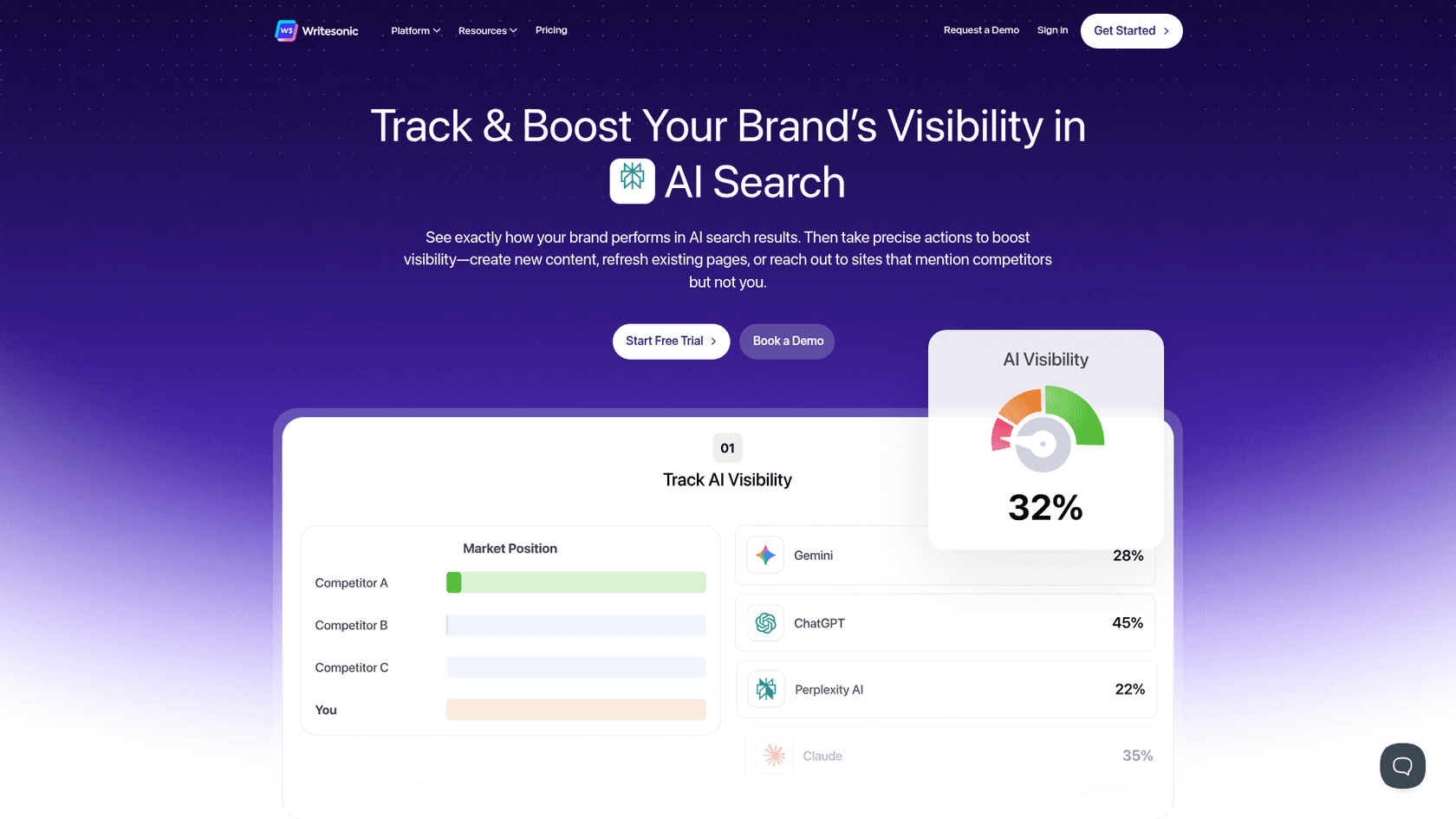
Writesonic SEO AI Agent:
A screenshot of the Writesonic website's main page, an example of AI SEO agents with generative engine optimization features.
_ Focus: Writesonic offers a broad platform for both traditional SEO and Generative Engine Optimization (GEO). Its features include the ability to track brand visibility in AI search, run technical audits, and analyze competitors.
_ Limitations: As an all-in-one tool, content generation is one of several features. Some user reviews note that its long-form content may require heavy editing to sound natural, and some have mentioned the credit system.
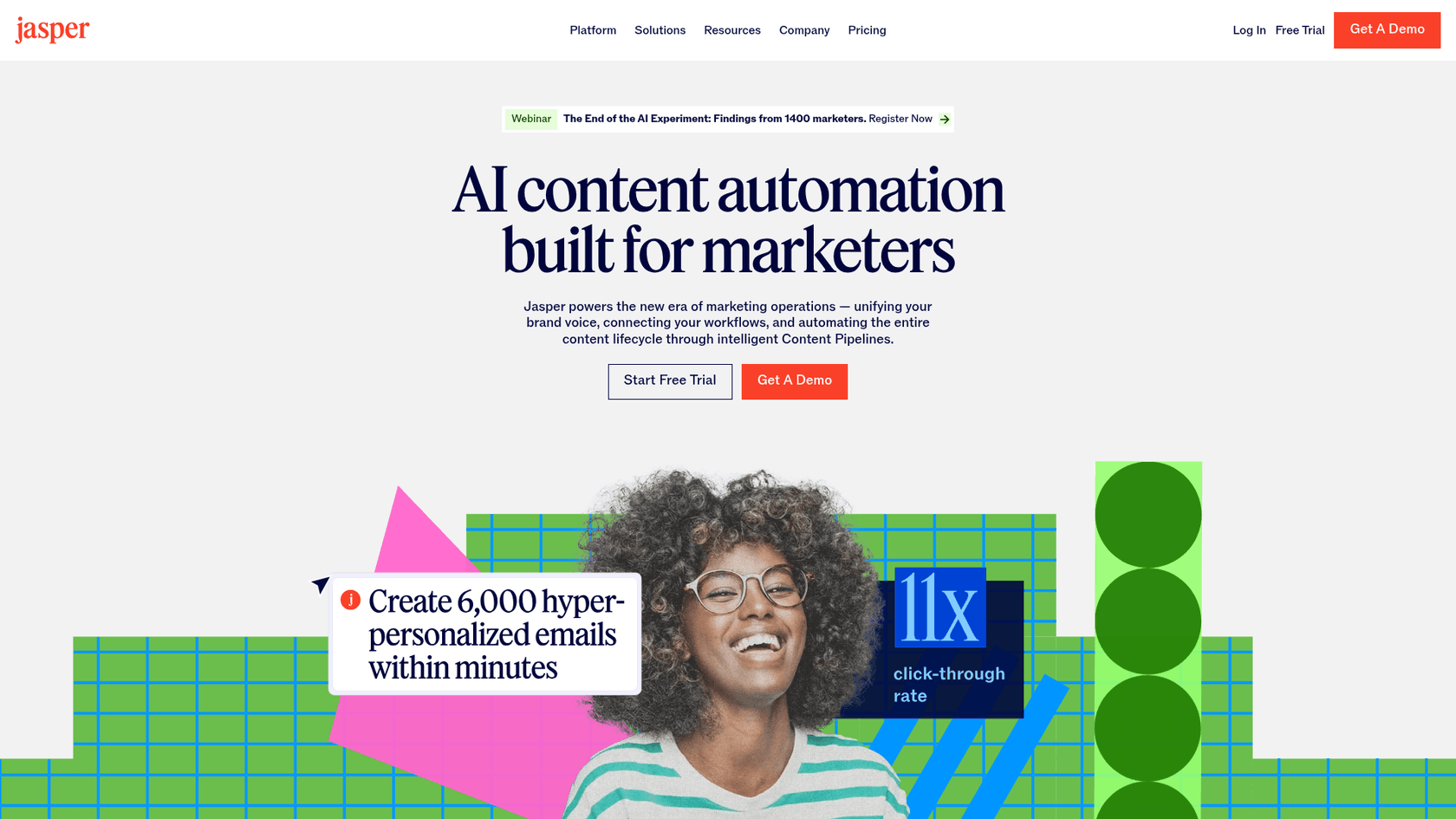
Jasper Agents:
A screenshot of the Jasper AI website's landing page, showcasing its platform which includes customizable AI SEO agents.
_ Focus: Jasper is a wide-ranging AI marketing platform that allows users to build custom agent workflows. Its Optimization Agent can be configured to autonomously optimize headlines and internal links across a website.
_ Limitations: As Jasper is a generalist platform, its SEO agent is one of many features, making it less specialized for creating complete, media-rich blog posts compared to a dedicated tool. The Agents feature is available on its custom-priced Business plan.
How to choose the right AI SEO agents for your business
Choosing the right tool comes down to understanding your specific needs.
A workflow infographic outlining the three steps to select the best AI SEO agents for your business needs: identifying bottlenecks, defining autonomy, and prioritizing quality.
Identify your biggest bottleneck: Determine what slows you down the most. Is it technical audits, keyword research, or the continuous need for new content? Address your most significant pain point first.
Decide on your desired autonomy level: Consider whether you are comfortable with a fully autonomous agent making changes to your site, or if you prefer a "copilot" that provides recommendations for you to review. It is almost always safer to start with a copilot.
Prioritize content quality: For any strategy that relies on content, a specialized tool can often provide higher-quality output than a generalist one. Writing is a difficult part of SEO to automate well, so it is important to invest in a tool that handles it effectively.
A practical way to start is with a tool like the eesel AI blog writer to solve the content problem first. Once you have a scalable content process, you can explore other agents to automate technical or research tasks.
To see how these complex workflows are built and executed in a real-world scenario, the following video demonstrates how to create an automated SEO content system using AI agents, providing a practical look at their capabilities.
A YouTube video from Creator Magic explaining how to use AI SEO agents to build an automated content system.
Final thoughts on AI SEO agents
AI SEO agents are useful tools for automating workflows, but they are not a substitute for human strategy. They have clear limitations, especially when it comes to creating the kind of high-quality content that connects with people.
The most effective approach is a hybrid one: use human expertise for high-level strategy and final reviews, while using specialized AI agents to handle specific, time-consuming tasks. This allows you to combine human insight with the speed of a machine.
The primary benefit is automating entire workflows, not just single tasks. AI SEO agents can handle multi-step processes like keyword research, competitor analysis, and content outlining, which saves a significant amount of time and resources.
Can AI SEO agents replace human SEO strategists?
Not entirely. AI SEO agents are excellent at executing tasks and analyzing data, but they lack strategic nuance. They can't align SEO activities with your broader business goals or brand voice. Human oversight is still essential for strategy, planning, and final approval.
Are there risks involved with using fully autonomous AI SEO agents?
Yes, there are risks. A fully autonomous agent could make a mistake, like implementing a bad schema fix or over-optimizing a page, which could harm your site's performance. It's much safer to use them in a "copilot" capacity where a human reviews and approves their actions.
How do specialized AI SEO agents for content creation differ from all-in-one platforms?
Specialized agents, like an AI blog writer, are built to excel at a single function. This focus often results in higher-quality, more human-sounding content compared to generalist platforms where content creation is one of many features.
What should I look for when choosing between different AI SEO agents?
First, identify your biggest SEO bottleneck, whether it's research, technical audits, or content creation. Then, decide if you want a fully autonomous tool or a copilot. Most importantly, for any content-driven strategy, prioritize the quality of the output, as this is the hardest part to automate effectively.
Stevia Putri is a marketing generalist at eesel AI, where she helps turn powerful AI tools into stories that resonate. She’s driven by curiosity, clarity, and the human side of technology.