

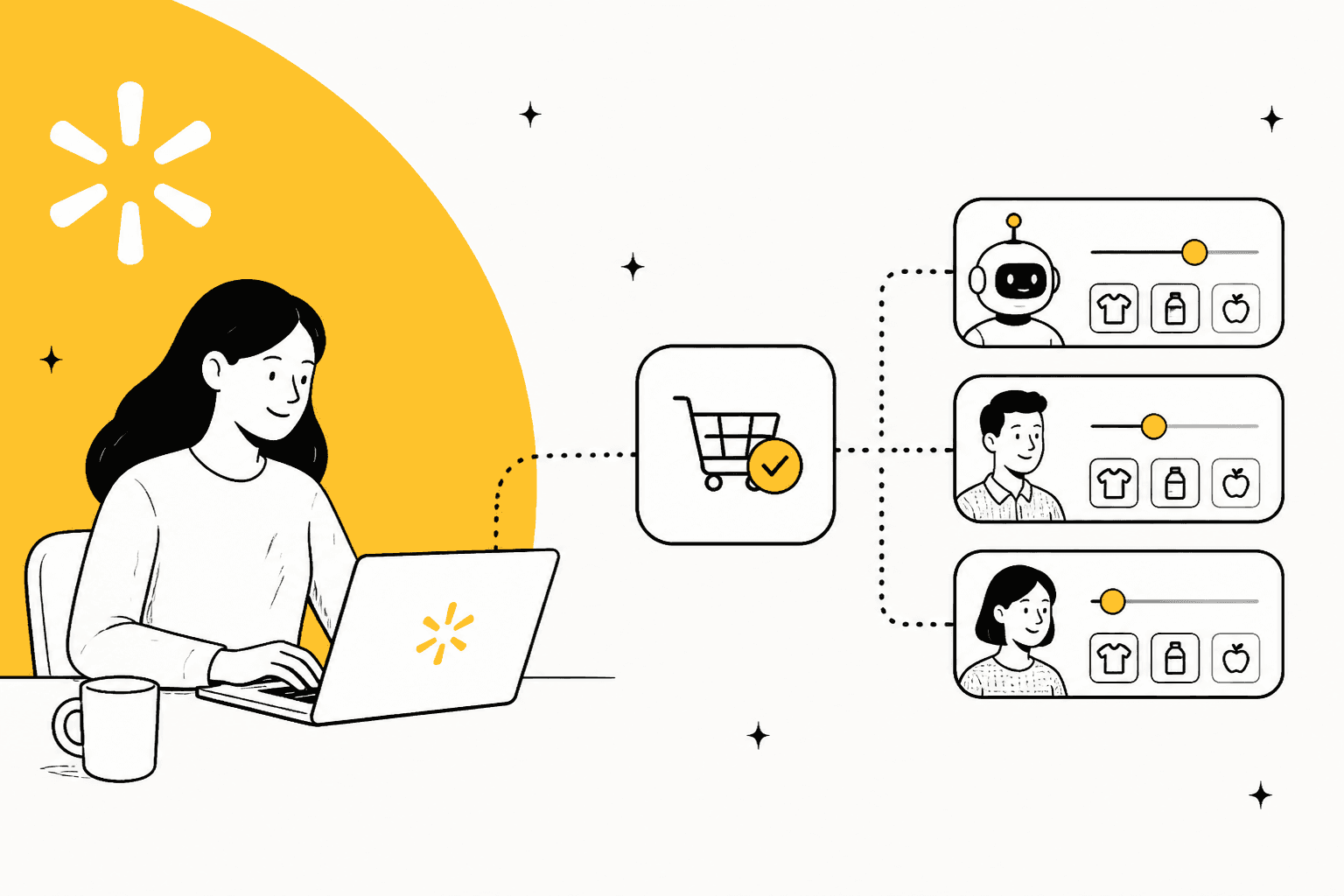
Walmart Agent Gateway is an invite-only beta, announced on October 21, 2026, that lets approved AI agents shop Walmart and Sam's Club over MCP by talking to Walmart's own assistant, Sparky, instead of clicking through the website. It ships with two companion pieces: Agent Profiles, which give each agent its own identity in your account with approval on every purchase or a spending cap like $50, $100 or $200, and a set of legal terms that block agents from seeing your card, overriding your intent, or training models on Walmart's data.
The part most coverage misses: only Gateway agents get to check out on their own. Any other agent, including the browser agents you can run today, hits a "Human Consent Gate" before every checkout. So this is less "Walmart opens the doors" and more Walmart builds one supervised door and locks the rest. There are no public docs, no price, and no general-availability date yet.
If you run an online store, the bit to plan for is what happens after the order. Walmart says its returns process applies "including if an agent doesn't act as intended", and every agent-made order eventually becomes a support ticket somewhere. That's the job eesel's AI helpdesk teammate does today: at Question Beauty it handled 990 Gorgias tickets in a month and looked up 290 Shopify orders before answering.
What is Walmart Agent Gateway?
Walmart Agent Gateway is a connection layer that lets outside AI agents shop Walmart through a structured protocol rather than a web browser. Walmart's announcement describes it as a way to give agents "a faster, more reliable way to shop by using an MCP". (The release spells MCP out as "model text protocol"; the standard name is Model Context Protocol.)
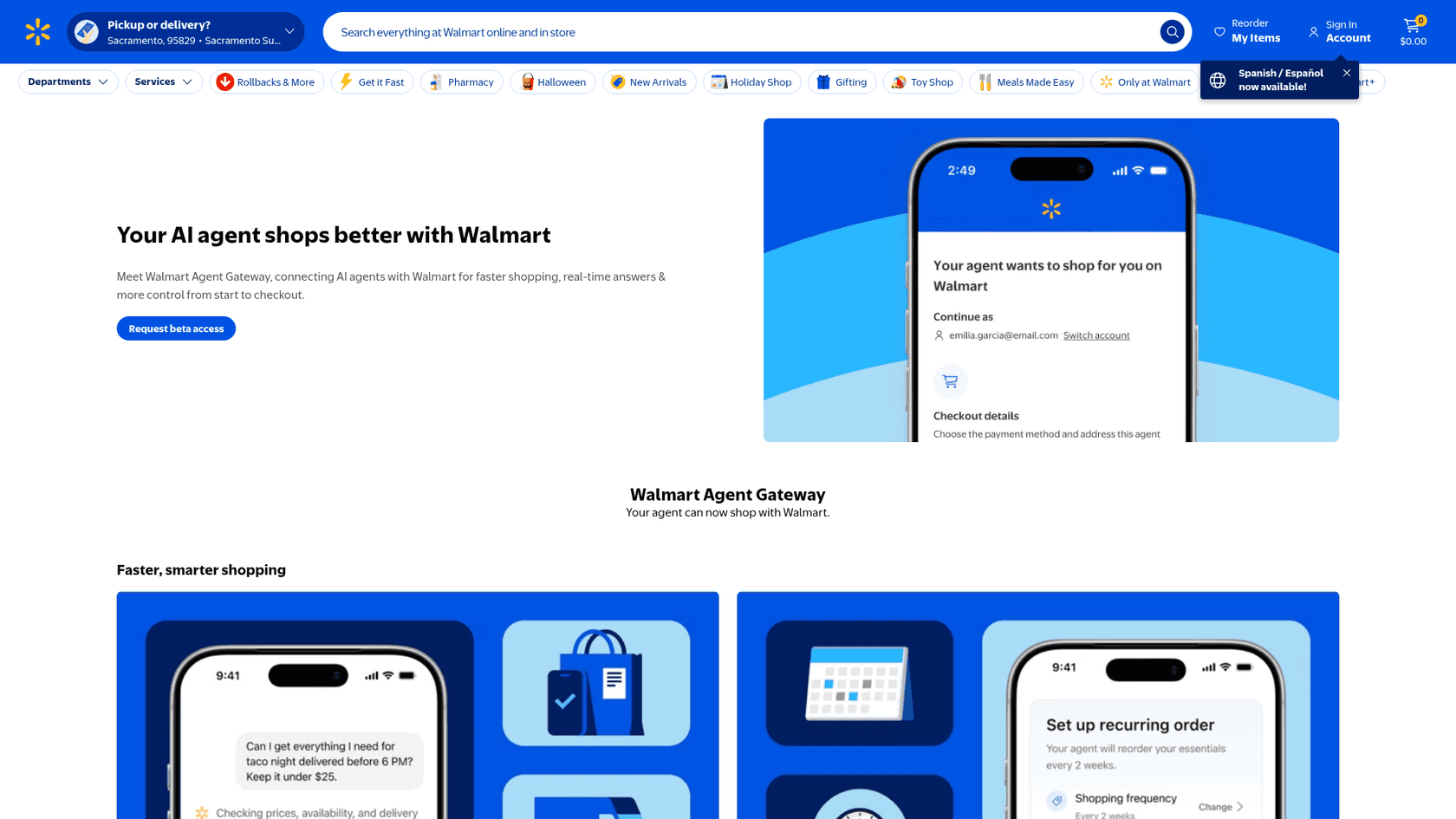
The problem it solves is plain enough. Walmart says that today agents "may shop on Walmart's site through a web browser, following steps designed for people", which "can be slow and error-prone". I've built enough integrations to know the feeling: a browser agent reading a checkout page is a bit like ordering takeout by describing the menu to a friend over the phone. It works, until the page changes.
Three things launched together:
| Piece | What it does | Status |
|---|---|---|
| Walmart Agent Gateway | MCP connection for agents, routed through Sparky | Beta, "by invitation only" (Walmart) |
| Agent Profiles | One profile per agent inside your account, with approvals and spending limits | "Launching in the next month" from Oct 21, 2026 |
| Agentic Access Terms | Legal rules every agent, and the company behind it, must follow | Live, October 21, 2026 version |
The detail that matters most for understanding it sits in one line on the beta page: the Gateway "connects AI agents through Sparky". Your agent doesn't get raw access to Walmart's catalog and checkout. It has a conversation with Walmart's agent. The terms call this "agent-to-agent shopping with Walmart's agent, Sparky."
How does Walmart Agent Gateway work?
The Gateway works as an agent-to-agent handoff: your agent sends the request, Sparky does the shopping on Walmart's side, and Walmart checks the agent's permissions before anything is charged. Walmart hasn't published an endpoint or tool list, so this is pieced together from the announcement, the beta page and the terms' Addendum 1, which spells out the mechanics.
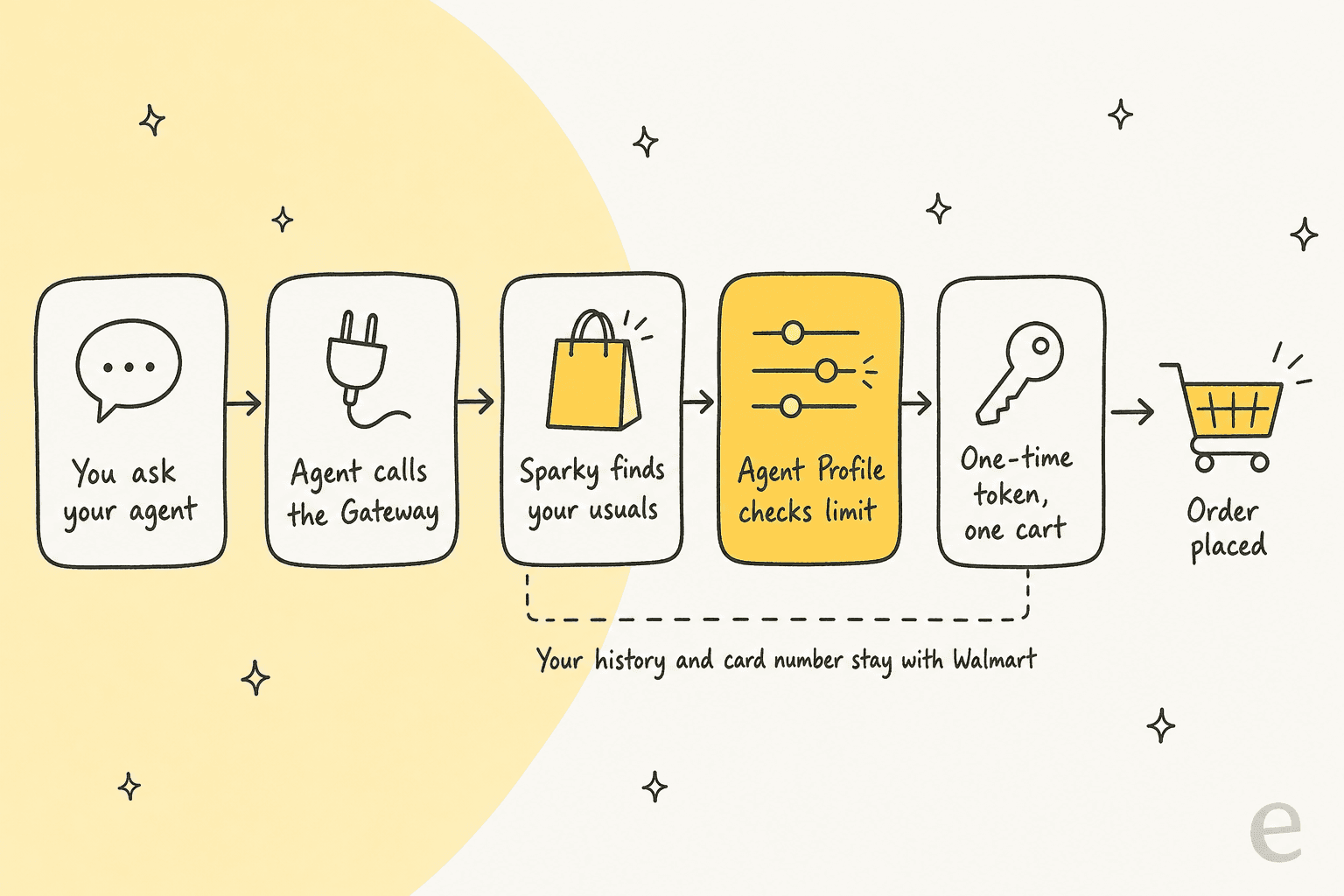
Here's the flow as I read it:
- You ask your agent for something. Walmart's own example on the beta page is "Can I get everything I need for taco night delivered before 6 PM? Keep it under $25."
- The agent connects through the Gateway. The first time it does, Walmart automatically creates an Agent Profile for it, and you link that profile by signing in to your Walmart account. Walmart notes "Only Walmart sees this."
- Sparky finds your usual items without handing over your history. Walmart's example: if you "tend to buy sourdough bread or a particular brand of milk, Walmart will help the agent find those usual items for the customer without sharing the customer's broader shopping history."
- Your guardrail is checked on Walmart's server. The terms call it a "User-Defined Guardrail": per-transaction spend limits, category or department restrictions, and how often the agent can buy.
- Checkout uses a one-time token. Each purchase gets a "Scoped Access Token", described as "a short-lived cryptographic credential bound to a specific merchant, cart, amount, and session", plus a signed "Agent Mandate" recording what you asked for.
If the order falls outside your limits, the terms say Walmart may trigger a Human Consent Gate "rather than rejecting the Agent outright". So the agent pauses and asks you, instead of failing. That signed-instruction idea isn't unique to Walmart. Google's Agent Payments Protocol uses "cryptographically-signed digital contracts" with price limits set upfront, and OpenAI's Agentic Commerce Protocol uses Stripe payment tokens "only authorized for specific amounts and specific merchants".
For developers, the beta page lists the benefits in plain terms: "No more website scraping", fewer "unnecessary requests, latency & token usage", "verified identities, controlled permissions & observable actions", and safeguards including "category restrictions, rate limits & compliance guardrails". If you've ever wired an agent to a helpdesk through an MCP server, the shape will feel familiar.
One thing to not mix up: Walmart also runs a Marketplace MCP server at developer.walmart.com/mcp, launched October 14, 2026. That one gives coding assistants access to seller API docs. It isn't the shopping Gateway.
What are Walmart Agent Profiles?
Agent Profiles give each AI agent its own identity inside your Walmart account, so you can see what it bought and cap what it can spend. Walmart frames the problem bluntly: today, when you use an agent, "it signs in using a customer's account", so "all purchases – whether made by the customer or the agent – appear together, without any differentiation."
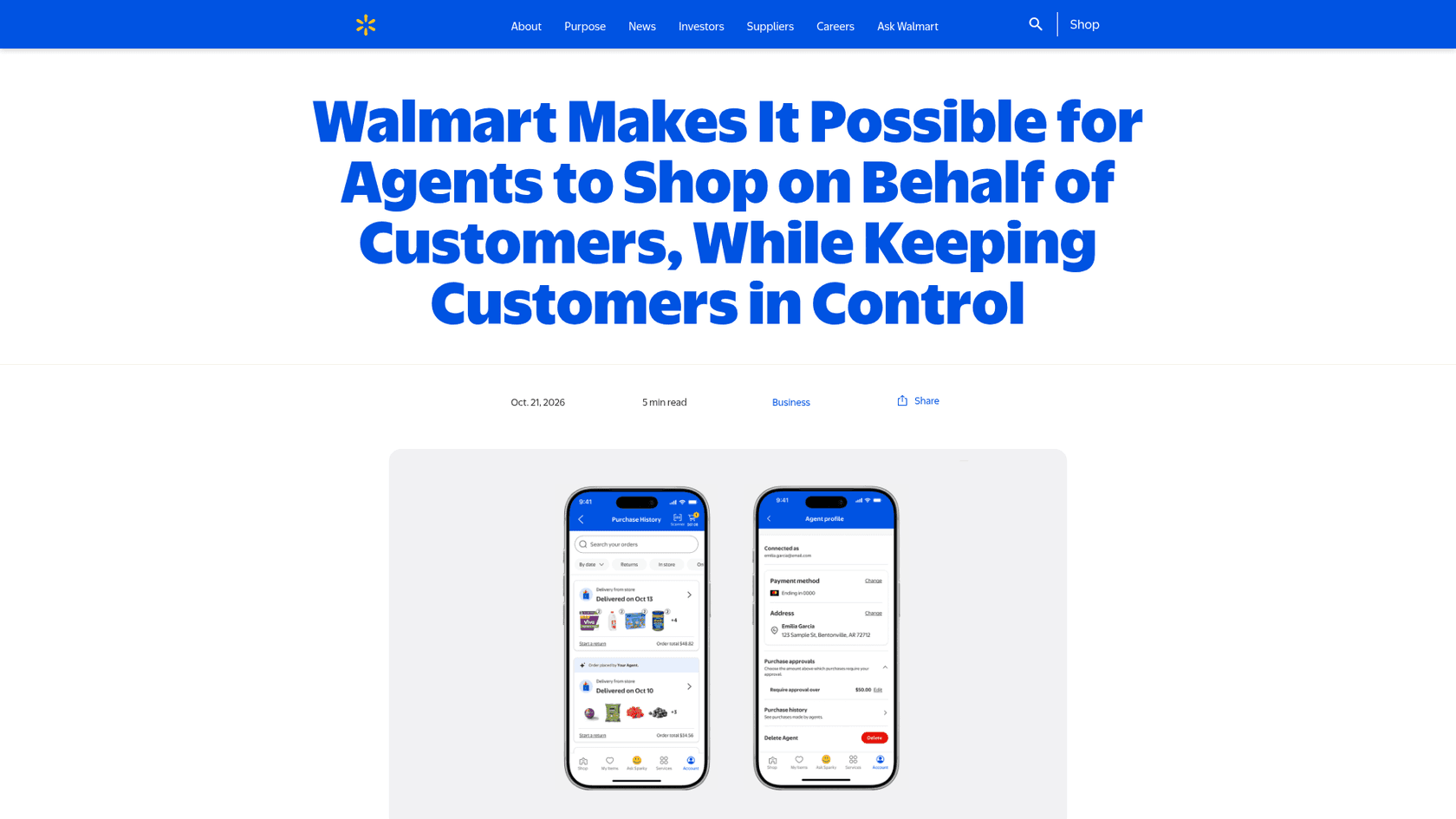
What you can set, per agent:
- Approval mode. "Require approval for every purchase or provide permission for the agent to make purchases within a spending limit they set – for example, $50, $100 or $200."
- A separate purchase history. The agent's orders show apart from yours. The mockup above labels them "Order placed by Your Agent".
- A kill switch. You can delete an Agent Profile at any time.
Walmart's own analogy is "adding someone as a cardholder on your credit card". I think that's the right mental model, with one upgrade: the card limit lives on Walmart's side, not in the agent's instructions. Prasenjit Sarkar put the point well:
"The spend limit on most internal agents today lives inside a system prompt, which makes it a suggestion, not a control. Walmart shipped what an actual control looks like this week, and it has nothing to do with retail specifically."
That lesson travels well beyond shopping. It's the same reason eesel's CLI has an eesel approvals command: when the helpdesk teammate wants to take a sensitive action, it holds it for a person to approve or deny, instead of trusting a sentence in a prompt to stop it.
What can AI agents do and not do on Walmart?
Walmart's Agentic Access Terms apply to any agent on Walmart's sites, and they split agents into two lanes. Browser agents can still shop, but they need you at every checkout. Only Gateway agents get to check out on their own, inside your limits.
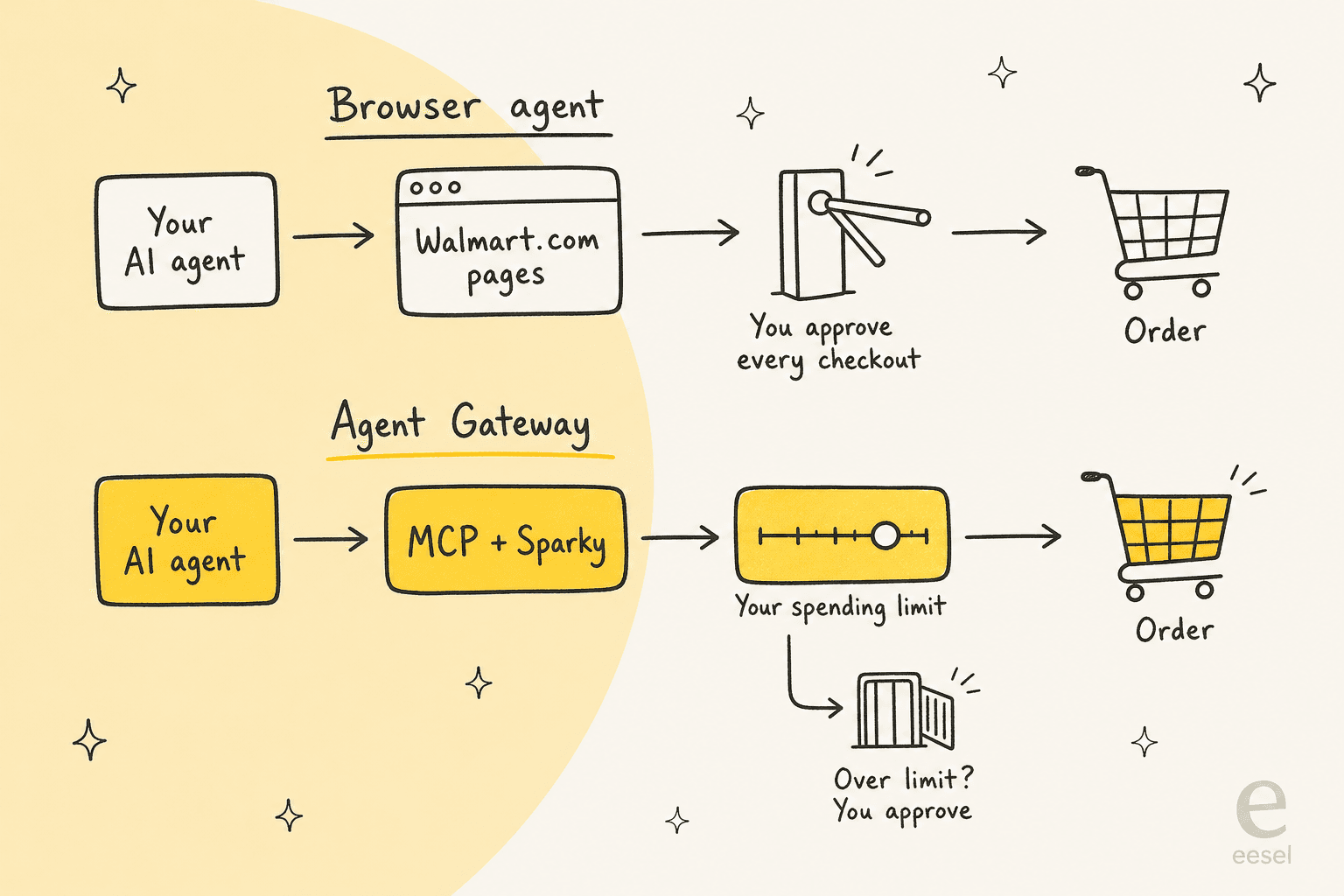
The exact wording: "Except for transactions utilizing the Walmart Agent Gateway, Walmart will require a Human Consent Gate to confirm the Authorizing Customer's approval of Agent actions before every checkout." And: "Agents may not check out autonomously unless they comply with the requirements for the Walmart Agent Gateway."
The rules that matter most, in plain words:
| Rule in the terms | What it means in practice |
|---|---|
| Agents must identify themselves and their company on request | No pretending to be a person, including "copying the timing or rhythm of human actions" |
| Agents "must not take actions beyond what the shopper intends" | Substitutes and recommendations must be labelled as such |
| Agents "don't receive customers' payment-card information" | They also can't add or change a payment method |
| Agents access "only the information needed for the task" | No bulk scraping; no using Walmart data to "train models" or "target advertising" |
| The company behind the agent is bound too | Repeated or systematic access counts as knowing the terms |
| Walmart's liability is capped at $50 | Walmart "IS NOT LIABLE FOR DECISIONS MADE BY AN AGENT" |
| Your return rights stay intact | "Walmart's returns process applies – including if an agent doesn't act as intended" |
| Non-compliant agents get blocked | "Agents that do not follow these terms will be blocked from Walmart's site" |
Two clauses caught my eye as someone who builds integrations. First, "An Agent must retrieve the current version of these terms before initiating a session," which means the rules are versioned and checked at runtime, not signed once and forgotten. Second, "No Agent instruction or Deployer configuration can waive a Human Consent Gate." Walmart can always step in and ask you, even inside your limit.
Who can use Walmart Agent Gateway today?
Right now, almost nobody outside a small beta group. The beta page says it's "an early beta program. Access is limited, available by invitation only, and may be suspended at any time." Companies and developers can request access through Walmart's request form.
What's still missing as of October 28, 2026:
- Developer docs. No public endpoint, tool list, SDK or API reference for the shopping Gateway on Walmart's developer portal.
- A price. Walmart hasn't published any fee for agents or developers.
- A list of approved agents. The announcement mentions existing "conversational commerce integrations with Muse, ChatGPT, Gemini and others" (see ChatGPT agents and Gemini agent), but doesn't say which ones are on the Gateway.
- A general-availability date. Only Agent Profiles have a rough timeline, "in the next month".
On the shopper side, a few things are clear. Walmart says "the prices that an AI agent sees are the same prices that a human would see on Walmart.com, with applicable offers and fees shown before purchase." And none of Walmart's pages list a Walmart+ requirement.
How is it different from Amazon, ChatGPT and Google?
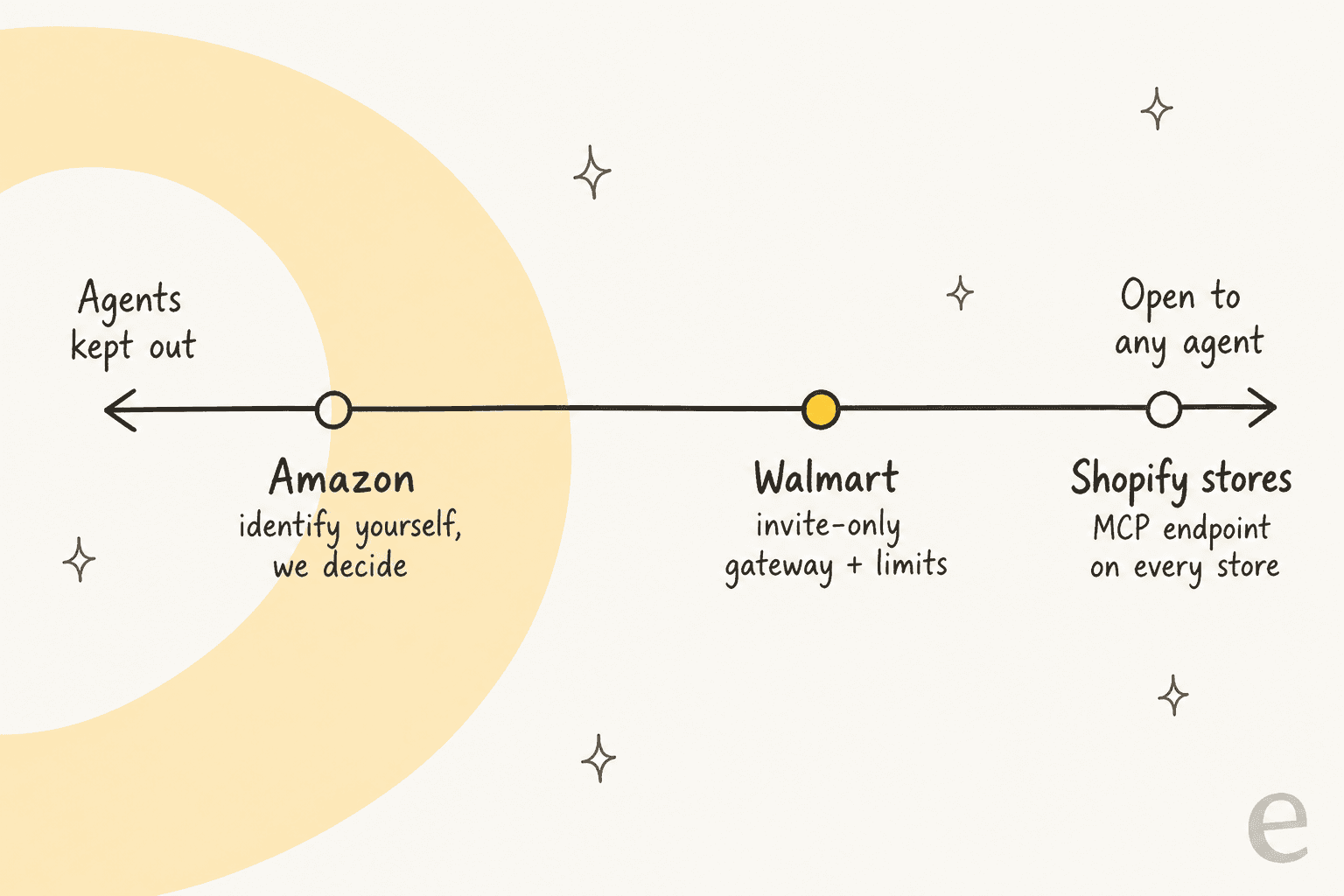
Walmart's move sits in the middle of a spectrum. Amazon keeps outside agents on a short leash, Shopify puts an open MCP endpoint on every store, and Walmart built one supervised, invite-only door.
| Company | How outside AI agents shop there | Key date |
|---|---|---|
| Amazon | Conditions of Use require agents to identify themselves; Amazon "may limit" agent access "At our sole discretion" | Perplexity statement, Nov 4, 2025 |
| Walmart | Invite-only MCP Gateway through Sparky, Agent Profiles with limits | Oct 21, 2026 |
| ChatGPT | Instant Checkout on the Agentic Commerce Protocol, now discovery-first with merchants' own checkout | Launched Sep 29, 2025; changed Mar 24, 2026 |
| Universal Commerce Protocol, co-developed with Walmart, Shopify, Etsy, Wayfair and Target | Jan 11, 2026 | |
| Shopify stores | Storefront MCP at https://{shop}/api/ucp/mcp; agents send an agent profile with every request | Live now |
The Amazon contrast is the one the headlines ran with. In its statement on Perplexity, Amazon said agents that buy for customers should "operate openly and respect service provider decisions whether or not to participate." Meanwhile Amazon's own Buy for Me agent buys from other brands' websites. Walmart's answer is different in shape: it accepts outside agents, but on its own rails. (For the browser-agent side of that fight, there's a 30-day Perplexity Comet review.)
The ChatGPT history explains why Walmart wants its own rails. Walmart partnered with OpenAI for Instant Checkout in October 2025. Then in March 2026 OpenAI said "the initial version of Instant Checkout did not offer the level of flexibility that we aspire to provide", and moved merchants to their own checkout experiences. Walmart moved to its own app inside ChatGPT. The ChatGPT checkout breakdown covers that shift for merchants. The Gateway is the same lesson applied to every agent at once: keep checkout, account and data on Walmart's side.
What are people saying about Walmart Agent Gateway?
The reaction splits into two camps: people who see a good permission model worth copying, and people who see Walmart keeping the customer relationship for itself. Both have a point.
The sharpest skeptical take came from analyst Eric Seufert, in the most-liked post on the topic I found:
"Walmart's MCP server is generally misunderstood; it doesn't provide carte blanche catalog / transaction access and, if anything, is further support for the idea that Agentic Commerce is a Mirage."
His argument is that outside agents connect to Sparky, so Walmart keeps the purchase data, the recommendations and the ad economics. I think that's accurate as a description. Whether it's a problem depends on who you are. For a shopper, a $50 cap enforced by Walmart is reassuring. For an agent company hoping to own the shopping relationship, it's a fence.
A month before the launch, when Amazon was blocking agents, a Hacker News commenter described almost exactly what Walmart went on to ship:
"The right way to do this is to create an API or MCP or whatever catering to bots, and implement corresponding terms in your legal agreements (i.e. after approving a bot to interact with us, you're responsible for purchases it makes), along with some limits to prevent runaway shopping when Muse decides to binge."

And the practical worry, from the same thread, is the one support teams should take seriously:
"The return rate for AI-purchased products is probably much higher than when a human reviews the page and makes the decision."
What does Walmart Agent Gateway mean for ecommerce support teams?
It means more orders placed by software and the same number of humans answering for them. Walmart's own terms acknowledge it: the returns process applies "including if an agent doesn't act as intended". Every retailer that follows Walmart's lead, and the agentic commerce direction suggests many will, inherits the same new ticket types.
Here's what I'd expect to land in a support queue first:
- "My agent bought the wrong thing." A substitute the customer didn't want, or the right product in the wrong size. These are returns and refund requests, just with a new opening line.
- "Where's the order my agent placed?" Customers who didn't place the order themselves are less likely to know it exists or where to track it. Plain where-is-my-order tickets, but more of them, and the reason AI order tracking is worth setting up now.
- "I didn't order this." Without per-agent profiles, an agent's order and a person's order look identical. That's exactly the problem Walmart built Agent Profiles to solve.
- Agent-to-agent support. The other side of the coin: shoppers' agents asking your store questions. Google pitches its commerce protocol as covering "post-purchase support", and Shopify already exposes an Order MCP for tracking.
The fix isn't a bigger team. It's an agent that can do the lookup work. In the eesel rollouts I've worked on, the first thing an ecommerce support agent has to get right is checking the order before it says anything about it. Take STIL Classics, a planner and stationery brand on Gorgias and Shopify: in one month, eesel prepared 320 tickets and looked up 230 Shopify orders "before a single line was drafted", checking delivery status and the 30-day return window, while a person sends every reply. At Question Beauty, the teammate answers order questions with tracking details itself and hands refund and return decisions to a person, with 280 tickets closed in a month without anyone on the team touching them.
That split is the same one Walmart drew: the routine lookups run on their own, and anything that costs money goes to a human. It's also the honest answer to whether AI can handle refunds. If you're comparing options for this, the best AI helpdesk for Shopify and best AI for ecommerce support roundups go deeper.
For developers, there's a parallel worth noting. Walmart's terms require agents to identify themselves and act through a scoped, auditable channel. eesel's helpdesk teammate works the same way from the other direction: every workspace is an MCP server, and the eesel CLI (@eesel/cli) lets a person, a script, or a coding agent like Claude Code drive the same teammate. Commands return JSON, --dry-run lets you test before acting, and eesel approvals holds sensitive actions for a human, which is the Agent Profile idea applied to support. The customer support CLI post walks through it.
Try eesel for agent-era order support
Walmart's Gateway will put more orders in the hands of software, and those orders still come back as tickets. eesel's AI helpdesk teammate plugs into Gorgias, Zendesk or Freshdesk, looks up the Shopify order and return window before it replies, and hands refunds to your team. It's tested against your past tickets before it answers anyone, and you can see how Question Beauty runs it across email, chat and Messenger.