


The short answer: Metatext is free
I test a lot of AI tools, and most "how much does it cost" posts get to bury a real price under three paragraphs of preamble. This one cannot, because there is no price to bury. The Metatext homepage states it plainly: the directory is free, open, and continuously updated. You do not create an account, you do not hit a paywall, and every section is browsable in full.
That is the whole product you can use today. Metatext sits in the discovery layer of the AI stack: it helps you find and compare models, MCP servers and skills. It does not run anything for you, and it does not charge you for looking. The three surfaces below are the entire Metatext pricing story, and only one of them is a real, near-term paid product.
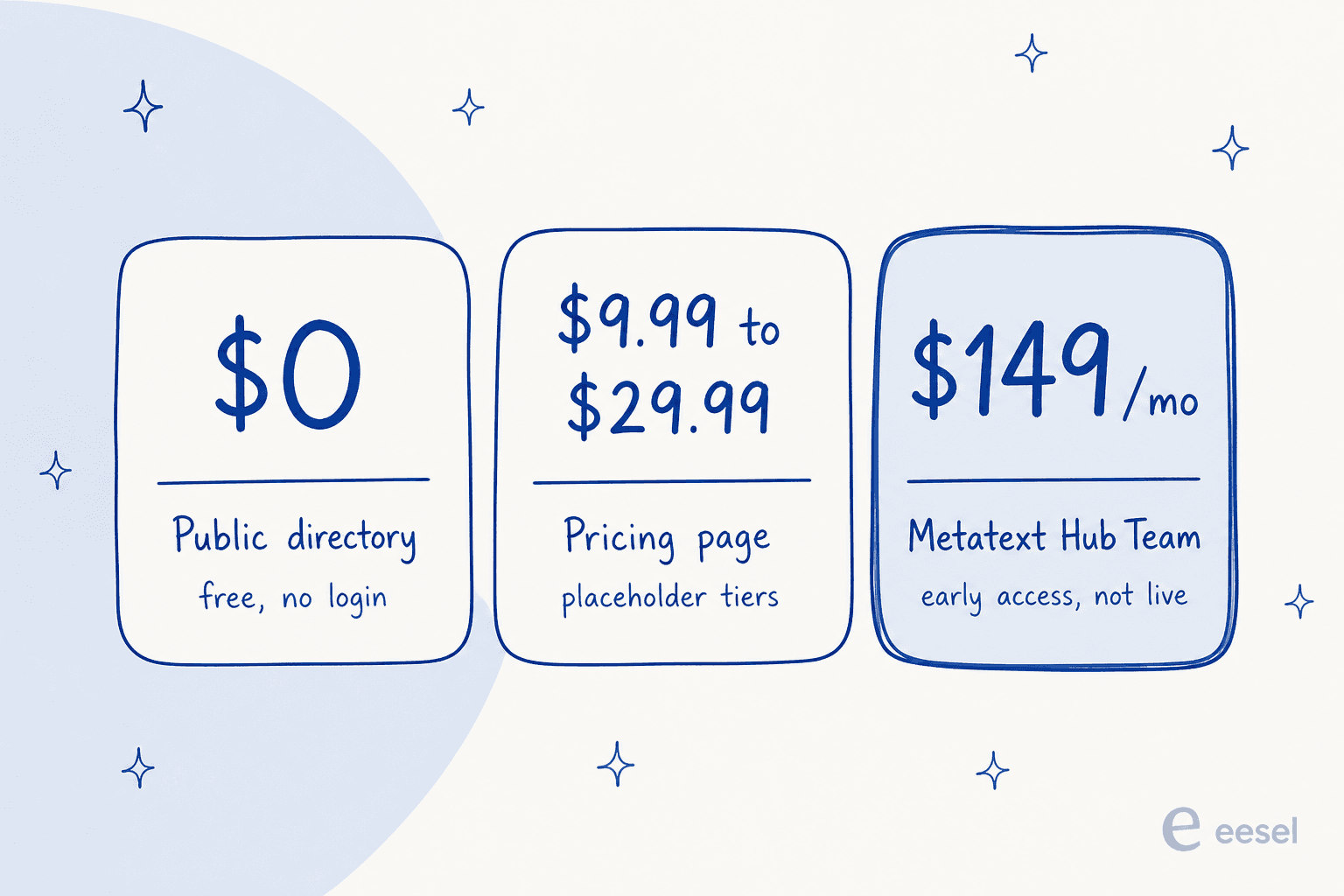
What $0 gets you: the free directory
The free tier is not a trimmed-down teaser. It is the actual product, and it is broad. Here is what you get without paying anything or signing in.
- LLM price comparison across 89 providers, with input cost, output cost and context window in one sortable table.
- Benchmark leaderboards aggregating LMArena Elo, LiveBench, SWE-bench Verified and Aider Polyglot.
- Best-LLM-by-use-case pages for cheapest, longest context, open weights, coding and cheapest frontier.
- A models directory of 7,967 models and a datasets directory of 5,413 datasets.
- MCP servers and agent skills: 19,622 servers and 30,701 skills, plus a jobs board.
The LLM pricing table is the part I would actually bookmark. You can see in seconds that DeepSeek V4 Flash sits at $0.14 input and $0.28 output on a 1M context window, or that Amazon Nova Micro comes in at $0.04 / $0.14. The advertised floor is a model at $0.03 per million output tokens. For a developer scoping model cost, that lookup alone justifies the free directory.
One honest caveat on those free prices: because the same base model is listed once per provider, the table is heavy with duplicates, and a block of rows read $0.00 / $0.00 for free-tier or credit routes rather than truly free inference. It rewards a reader who already knows what they are looking at. Useful, free, and a little raw.
The pricing page: $9.99 to $29.99, but placeholders
Here is where a lot of "Metatext pricing" searches will land, and where they will get confused. Metatext has a pricing page with a monthly-or-yearly toggle and three cards:
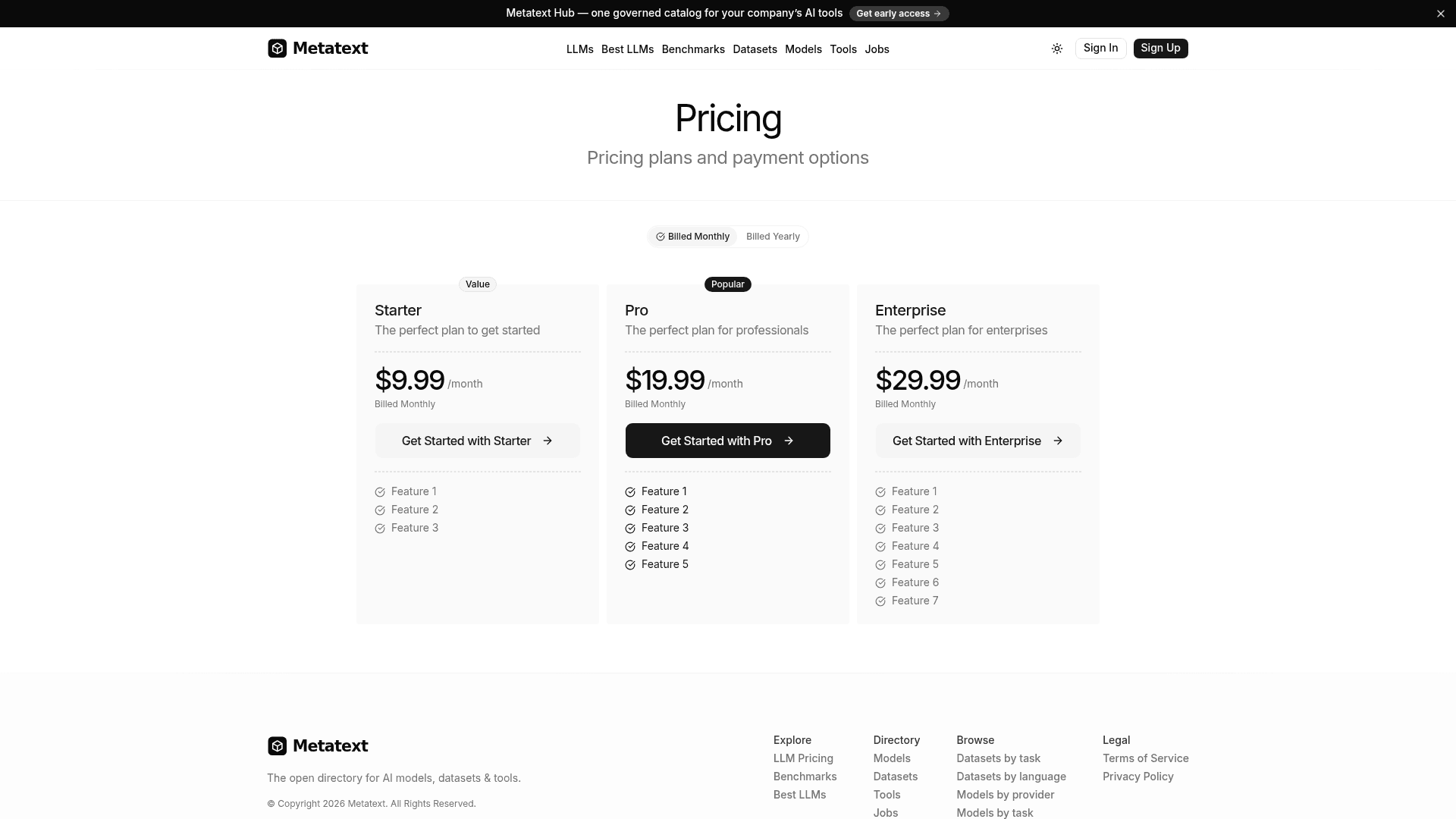
| Plan | Price | Positioning | What the features say |
|---|---|---|---|
| Starter (tagged "Value") | $9.99/mo | "The perfect plan to get started" | Feature 1, Feature 2, Feature 3 |
| Pro (tagged "Popular") | $19.99/mo | "The perfect plan for professionals" | Feature 1 through Feature 5 |
| Enterprise | $29.99/mo | "The perfect plan for enterprises" | Feature 1 through Feature 7 |
Look at that last column. Every bullet on every tier literally reads "Feature 1", "Feature 2", and so on. There is no way to tell what a paid plan unlocks, because the feature copy was never written. This is almost certainly default content from a SaaS starter template that nobody filled in, and the $29.99 "Enterprise" price, far below any real enterprise SaaS, points the same way.
The one working part is the plumbing: each "Get Started" button routes to a sign-up with a Stripe-style checkout parameter, so the billing rails exist even though the plans do not. My read, as someone who has seen this pattern on a dozen half-built sites: do not treat these three tiers as real, buyable plans. They are scaffolding, and the actual commercial product lives elsewhere.
So which price actually applies to you?
The three surfaces trip people up, so here is a quick way to land on the number that applies to your situation.
I want to compare model prices or find an MCP server
Your price: $0. The whole public directory, LLM pricing, benchmarks, datasets, MCP servers and skills, is free with no login. This is what most people searching "Metatext pricing" actually want.
I saw the $9.99 to $29.99 plans and want to buy one
Hold off. Those tiers list only "Feature 1", "Feature 2" placeholders, so you cannot tell what you would be paying for. They look like unfinished template content, not a live offering.
I need to govern my team's AI tools
That is Metatext Hub, from $0 to $149/mo (indicative). The Team plan is $149/mo for 5 users plus $9 per extra seat, but Hub is not launched yet, so this is a waitlist, not a checkout.
I want AI actually doing a job, like answering support tickets
A directory will not get you there. That is a different layer of the stack. An AI teammate like eesel plugs into your helpdesk and runs the work; it is free to try on your own tickets first.
Metatext Hub: the part they plan to charge for
The free directory is the shop window. Metatext Hub is the product Metatext is building to charge for, and to its credit, the page is upfront that it is not built yet: it says plainly, "In development, we're talking to platform and security teams before we build it."
The problem Hub targets is real: teams adopted MCP servers and agent skills in months, and none of the review, approval and inventory that normal software gets came with them. Hub's answer is a private catalog where every model, server and skill has an owner, a version and an approval stage, gets a security scan before anyone installs it, and then pushes to clients like Claude Code and Cursor with one command. It is built on the Apache-2.0 agentregistry project, so the openness claim has substance.
The pricing is explicitly labelled indicative, not final, but it gives you the shape of what paid Metatext will look like.
| Plan | Price | Who it is for | Key limits |
|---|---|---|---|
| Free | $0/mo | One developer's own machines | 1 user; up to 5 MCP servers and 5 skills; install to every client |
| Team | $149/mo | A team that needs governance | 5 users included, $9 per extra seat; security scans; roles, toolkits, per-user credentials; 90-day audit log |
| Enterprise | Custom | Larger orgs | SSO/SAML and SCIM; managed deployments and gateway; registry in your own VPC; unlimited audit retention |
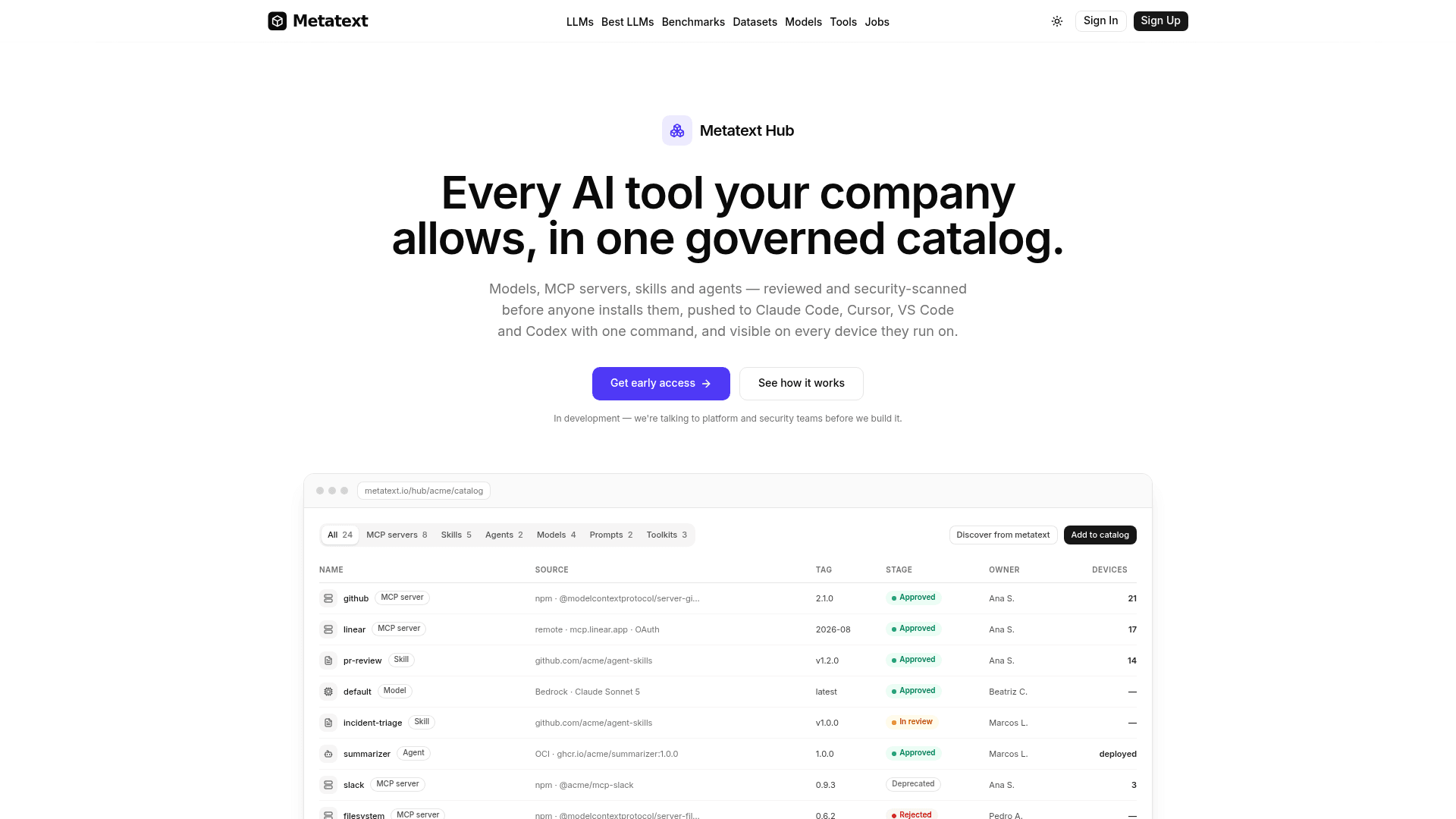
My take: Hub is the more interesting half of the company, and the honesty about it being pre-launch is a good sign. But you cannot buy or rely on it today. So for pricing purposes, the accurate summary stays simple: the directory is free, and Hub is a $149/mo idea on a waitlist.
The price that a directory can't quote
There is a cost Metatext does not show on any page, because it is not the kind of thing a directory can price: the cost of actually getting AI to do a job. Comparing 5,206 model prices does not build you an agent, any more than reading a spec sheet for every engine on the market builds you a car. At some point you stop comparing parts and hire something that does the work.
That is the layer above the directory, and it is a different question from token pricing. When I spec a support automation, the number that matters is not $0.14 per million tokens; it is how the whole system behaves on real tickets: how many it resolves, how often it is right, and what it does when it is unsure. No comparison table answers that. Two years of doing SEO and watching teams shop for AI has taught me that the "cheapest model" search and the "working agent" search look identical in a keyword tool and could not be more different in practice.
Try eesel
If you have been on Metatext comparing model prices because you want AI doing a real job, this is the part that closes the loop. Metatext is infrastructure and discovery; eesel is the employee. Instead of assembling models, servers and skills yourself, you hire a ready-to-work teammate for a specific job: the AI helpdesk teammate joins your existing support queue and learns from your past tickets, and the AI blog writer researches and drafts posts in your voice. Each arrives with the integrations and context its role needs, so setup is minutes, not a procurement project.
The concrete differentiator is pricing you can actually trust, because you see the value before you pay: eesel simulates every rollout against your own historical tickets first. We have spent years running AI on live support queues, and we have watched confident bots give wrong answers, so eesel shows you how the teammate would have handled thousands of your real past conversations before it touches a live one.
And if you found Metatext because you live in the terminal, eesel speaks that language too. The eesel CLI drives the same teammate as the dashboard from the command line: chat with it, connect a helpdesk, upload knowledge, or approve held actions, all without a browser. Every command returns JSON, and each workspace doubles as an MCP server, so coding agents like Claude Code, Cursor and Codex can operate it directly. Metatext helps you find an MCP server; eesel is one you can put to work. You can try it free and watch it answer your real tickets before committing.
Frequently Asked Questions
How much does Metatext cost?
The public metatext.ai directory is free, with no account required. That covers LLM price comparison, benchmarks, datasets, MCP servers, agent skills and the jobs board. The only paid product is Metatext Hub, a team governance catalog that is still in early access, with indicative pricing of Free, Team at $149/mo, and custom Enterprise.
Is Metatext free to use?
Yes. The homepage brands the directory as free, open, and continuously updated, and you can browse every section without signing in. Metatext pricing only enters the picture with the in-development Hub product. For a support use case, the more useful free step is testing a real agent on your own tickets, which you can do with eesel.
What are the $9.99, $19.99 and $29.99 Metatext plans?
The Metatext pricing page shows three tiers, Starter at $9.99/mo, Pro at $19.99/mo and Enterprise at $29.99/mo, but every feature bullet reads literally Feature 1, Feature 2, and so on. They are unfinished template placeholders, so it is impossible to tell what they unlock. Treat them as inactive scaffolding rather than real, purchasable plans.
How much does Metatext Hub cost?
Metatext Hub lists indicative tiers: a Free plan at $0 for one developer, a Team plan at $149/mo with 5 users included and $9 per extra seat, and a custom Enterprise plan. The page labels this pricing indicative only, nothing is on sale yet, because Hub has not launched. See our guide to MCP apps for the wider tooling picture.
Does the Metatext LLM directory cost anything to use?
No. The LLM pricing directory is free to browse and compares input cost, output cost and context window across 89 providers. It shows the price of the models, but the directory itself charges nothing. For choosing a model to actually ship, our note on LLM optimization covers what matters beyond the sticker price.
Is Metatext pricing the same as the old no-code NLP tool?
No. Metatext started as a no-code NLP text classifier sold as an AppSumo lifetime deal, then pivoted to the directory you see today. Those old lifetime prices no longer apply, and the legacy product is retired. If you are comparing AI agents, only the current site matters.
Is Metatext worth paying for?
For now there is nothing to pay for. The directory is free and actually useful for a quick price-and-context lookup or for finding an MCP server. The paid bet, Hub, is pre-launch, so you cannot buy or rely on it yet. If your goal is to put AI on your support queue, that is a different job that an AI teammate does, not a directory.


Article by
Kurnia Kharisma Agung Samiadjie
Kurnia is a software engineer and writer at eesel AI with two years of SEO experience, writing about AI tools, helpdesk software, and customer support. He pairs a developer's understanding of how these products are built with search-driven research into what actually ranks and resonates with the people searching for them.