Model Context Protocol (MCP)
An open standard that defines how AI applications connect to external tools and data sources through a consistent interface.
What Model Context Protocol means
The Model Context Protocol (MCP) is an open standard that defines how AI applications connect to external tools and data sources through a consistent interface. Introduced by Anthropic in late 2024, it gives a model a common way to discover what a tool can do, request data, and invoke actions, so the same protocol works across many different systems. The usual analogy is a universal port: instead of a custom cable for every device, one standard connector handles them all.
The reason this matters comes down to integration cost. An AI system is only as useful as the tools and data it can reach, and before a shared standard, connecting a model to each new system meant building a one-off integration. In customer support, that connectivity is the whole game: an agent that cannot reach your helpdesk, order system, or knowledge base can only talk, not act. MCP is one of the ways an agent gets that reach.
Why MCP matters
- It replaces bespoke connectors. A common protocol means a tool built once works with any MCP-compatible client, instead of a new integration per model and per app.
- It separates capability from connection. The model handles reasoning, MCP handles the plumbing to tools and data, which keeps each part simpler.
- It standardizes tool discovery. An agent can ask an MCP server what it offers and how to call it, rather than having every action hard-coded in advance.
- It covers both data and actions. The same protocol lets an agent read from a knowledge source and perform an action in a live system, like updating a record.
- It is open and shared. Because the standard is public, tool builders and AI builders can interoperate without coordinating private contracts for every pairing.
Picture the wiring an agent needs to reach a support stack, and the shift MCP brings comes into focus.
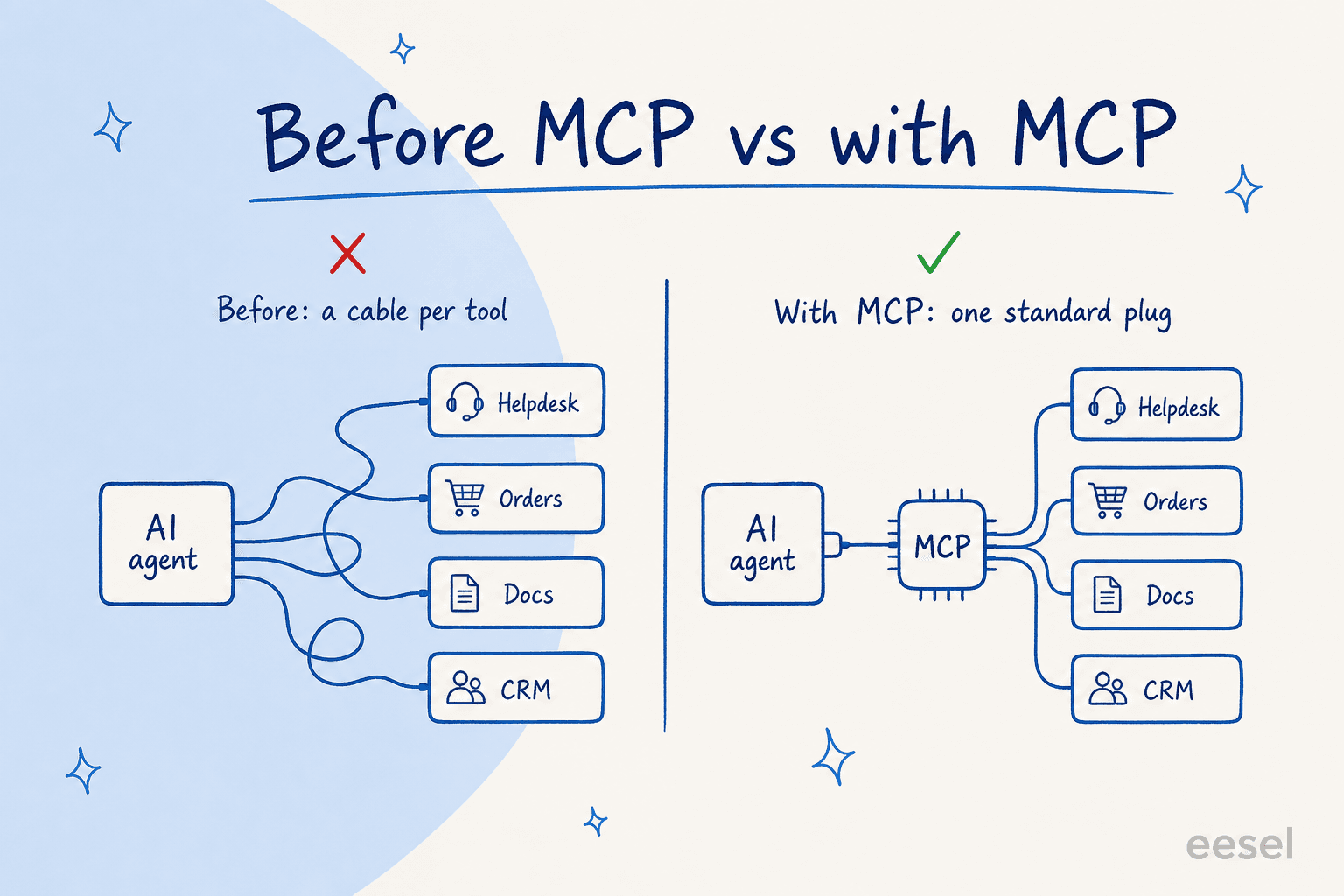
On the left, every tool needs its own bespoke connector, so each new system means another fragile integration to build and maintain. On the right, one MCP connector fans out to all of them, which is why the standard is often described as a universal plug between an agent and the tools and data it acts on.
How MCP works
MCP follows a client-server shape:
- A server exposes a tool or data source. It describes what it can do, for example "search the knowledge base" or "update a ticket," in a way any client can read.
- The AI client connects. The application hosting the model speaks MCP to that server and learns the available capabilities.
- The model requests an action. During a task, the agent decides it needs something, like fetching an order or retrieving a doc, and the client calls the matching MCP capability.
- The server runs it and returns the result. The data or action result flows back to the model, which uses it to continue the task.
A support agent like eesel AI needs exactly this kind of connectivity to be useful: it has to reach your helpdesk, your documentation, and your past tickets to ground its answers, and reach action endpoints to actually resolve a ticket. A standard like MCP is one way that wiring gets built without a fragile custom connector for every system in the stack.
MCP in practice
MCP is plumbing, and that is the point: it is most valuable when nobody has to think about it. The honest framing for support teams is that MCP lowers the cost of connecting an AI to more of their tools over time, but it does not by itself make the AI safe or accurate. The connection only delivers value when the agent on top of it is grounded in trusted knowledge and bounded by clear permissions, so adding tool access through any standard should go hand in hand with deciding what the agent is actually allowed to do with that access.
Connect an AI agent to your stack
eesel AI plugs into your helpdesk, docs, and tools so it can act on real systems, not just answer questions.