


Gemini 3.6 Flash is a genuinely good workhorse model, cheaper and more efficient than the 3.5 Flash it replaces. But "good workhorse" is a job, not a monopoly, and depending on what you actually need, a few rivals beat it on the exact axis you care about.
The short version: GPT-5.6 Luna is the surprise value pick, cheaper than Gemini 3.6 Flash on both input and output while winning the hardest coding and knowledge benchmarks. Claude Sonnet 5 is the quality leader if you can stomach the price. Grok 4.5 edges the coding crown. Flash-Lite is the budget king. And Gemini 3.1 Pro or Kimi K3 fill the "I need more reasoning" and "I want open weights" corners.
One thing to hold onto if the reason you're comparing models is customer support: the model is the easy part. I build the layer that turns any of these into a live AI helpdesk agent, and almost none of that work is the model. More on that at the end.
Why look past Gemini 3.6 Flash at all
First, credit where it's due. Gemini 3.6 Flash launched on July 21, 2026 and it's a real upgrade: it uses 17% fewer output tokens than 3.5 Flash and drops the output price from $9.00 to $7.50 per 1M. It's excellent at computer use, chart reasoning, and long-context recall, all at a fraction of a frontier model's price. If you're already on Gemini Flash, you should just take the upgrade.
So why does anyone shop around? A few real reasons keep coming up:
- Google didn't ship a new flagship. The launch came with no Gemini 3.5 Pro, which product lead Logan Kilpatrick says is still "testing with partners" after reportedly missing internal goals. If you need frontier reasoning from Google this week, it isn't there.
- It's a mid-price model, not a cheap one. At $7.50 output, it's pricier than a couple of rivals that also happen to score higher on the hardest tests.
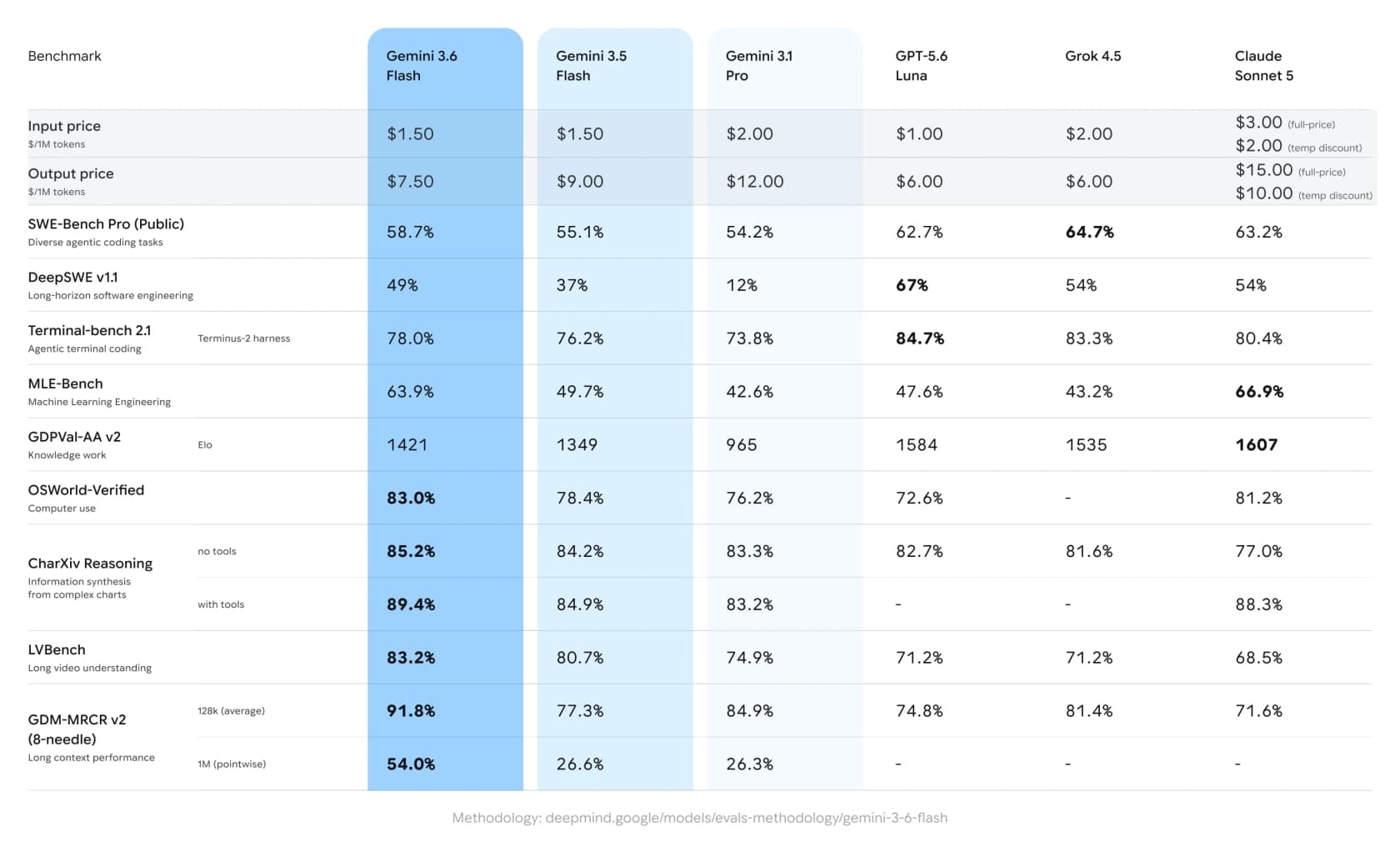
- On the hardest coding and knowledge work, it trails. Google's own comparison table (below) shows GPT-5.6 Luna and Claude Sonnet 5 beating it on several benchmarks.
- Free-tier data use and lock-in. On the free tier, your content is used to improve Google's products, and some teams simply want open weights they can host themselves.
None of these makes 3.6 Flash a bad model. They just mean the "best" model is the one that fits your specific job. Here's how the field actually lines up.
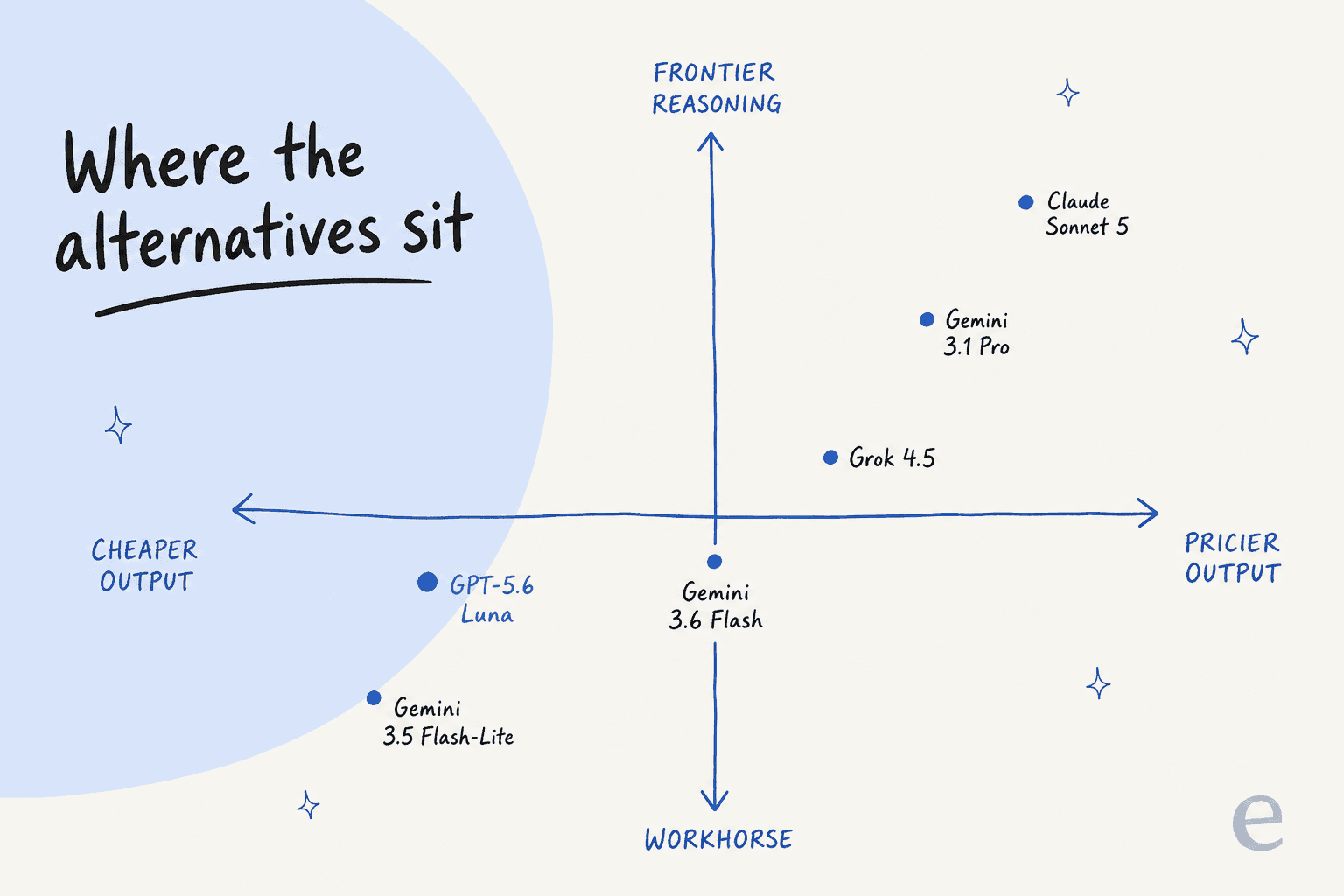
The alternatives at a glance
All prices are per 1M tokens on each vendor's standard paid tier. Benchmark figures come from Google's own published comparison, which, to its credit, doesn't hide where its own model loses.
| Model | Input | Output | SWE-Bench Pro (coding) | GDPval-AA v2 (knowledge) | Best for |
|---|---|---|---|---|---|
| Gemini 3.6 Flash (baseline) | $1.50 | $7.50 | 58.7% | 1421 | The all-round workhorse |
| GPT-5.6 Luna | $1.00 | $6.00 | 62.7% | 1584 | Best value + hard reasoning |
| Claude Sonnet 5 | $3.00 | $15.00 | 63.2% | 1607 | Top answer quality |
| Grok 4.5 | $2.00 | $6.00 | 64.7% | 1535 | Coding crown |
| Gemini 3.5 Flash-Lite | $0.30 | $2.50 | n/a | n/a | Cheapest at high volume |
| Gemini 3.1 Pro | $2.00 | $12.00 | 54.2% | 965 | More Gemini reasoning, today |
| Kimi K3 | ~$3.00 | ~$15.00 | n/a | n/a | Open weights / self-host |
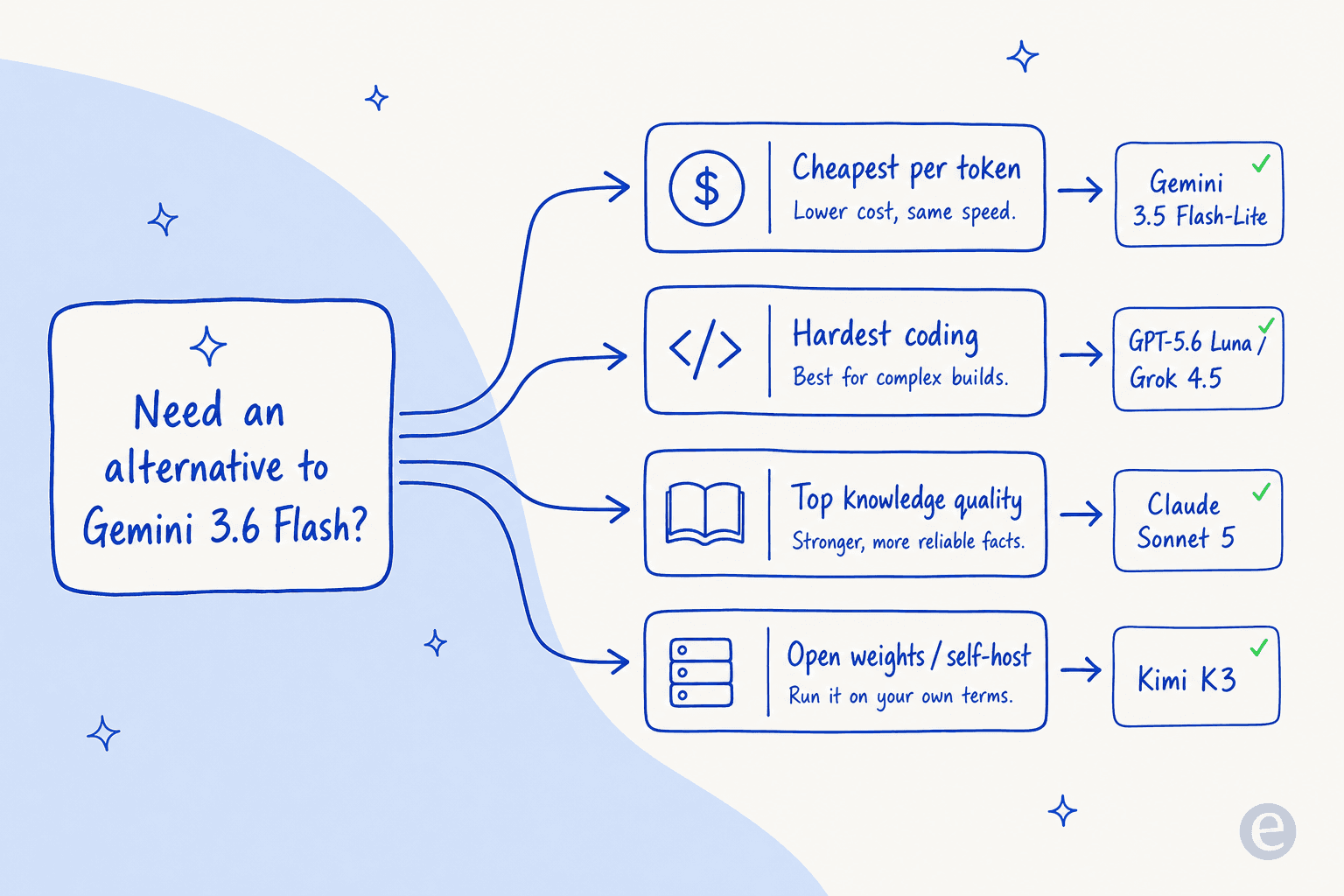
If you want the one-glance answer to "which one is for me," this flow covers most cases:
And if you'd rather plug in your own volume and see the monthly bill, this does the arithmetic on the part that actually scales, output tokens:
1. GPT-5.6 Luna, best for value and hard reasoning
Best for: teams that want the strongest coding and knowledge work and a lower bill than Gemini 3.6 Flash.
This is the pick that reshuffles the whole comparison. OpenAI's GPT-5.6 Luna costs $1.00 input / $6.00 output per 1M tokens, which undercuts Gemini 3.6 Flash on both sides. Usually "cheaper" means "worse," so the interesting part is that it isn't: on Google's own table it posts 67% on DeepSWE against 3.6 Flash's 49%, 84.7% on Terminal-bench against 78.0%, and a 1584 knowledge-work Elo against 1421.
Where it wins: long-horizon software engineering, terminal coding, and general knowledge work. If your agent writes or edits real code, this is the more capable engine, for less money.
Where it trails: it loses to Gemini 3.6 Flash on the multimodal and long-context dimensions, computer use (72.6% vs 83.0% on OSWorld), chart reasoning, long video, and 1M-token recall. If your workload is document- and screen-heavy rather than code-heavy, Gemini keeps the edge.
Pricing: $1.00 in / $6.00 out per 1M tokens.
Verdict: for most agent builders weighing a switch, GPT-5.6 Luna is the first alternative to try. It's the rare case where the cheaper option is also the more capable one on the benchmarks people fight over. The catch is it's not the multimodal or long-context champion, so match it to a text-and-code workload.
2. Claude Sonnet 5, best for answer quality
Best for: teams where a wrong answer is expensive and quality beats cost.
Anthropic's Claude Sonnet 5 is the priciest model here at $3.00 input / $15.00 output per 1M tokens (currently running a temporary discount to $2.00 / $10.00). You pay for it because it tops the two benchmarks that map to "does it give a genuinely good answer": 1607 on GDPval-AA v2 knowledge work (the highest in the group) and 66.9% on MLE-Bench machine-learning engineering. It's also strong on agentic coding at 63.2% SWE-Bench Pro.
Where it wins: nuanced reasoning, knowledge work, careful writing, and safety. When the output is customer-facing or high-stakes, Sonnet 5's answer quality is worth the premium.
Where it trails: it's roughly 2x the output price of Gemini 3.6 Flash and well behind it on the multimodal and long-context tests, computer use, chart reasoning, long video, and 1M recall all favor Gemini. At volume, that price gap gets loud fast.
Pricing: $3.00 in / $15.00 out per 1M tokens ($2.00 / $10.00 during the current discount).
Verdict: pick Sonnet 5 when quality is the whole point and the volume is manageable. For a high-throughput agent counting tokens, it's a hard sell against GPT-5.6 Luna or Gemini itself. See our Claude vs ChatGPT breakdown for the wider frontier picture.
3. Grok 4.5, best for coding
Best for: teams that want the top agentic-coding score and don't mind mid-tier pricing.
xAI's Grok 4.5 takes the single highest coding number in the group: 64.7% on SWE-Bench Pro, ahead of Claude Sonnet 5 (63.2%) and GPT-5.6 Luna (62.7%). At $2.00 input / $6.00 output, it's priced between GPT-5.6 Luna and Gemini 3.6 Flash, cheaper than Gemini on output.
Where it wins: diverse agentic coding tasks, where it narrowly leads everyone. It's also competitive on terminal coding at 83.3%.
Where it trails: it doesn't post a computer-use or 1M-context number on Google's table, and its knowledge-work Elo (1535) sits below GPT-5.6 Luna and Claude Sonnet 5. It's a coding specialist first.
Pricing: $2.00 in / $6.00 out per 1M tokens.
Verdict: if agentic coding is the specific job and you're benchmark-shopping for the top SWE-Bench number, Grok 4.5 has it. For everything else, GPT-5.6 Luna is the more well-rounded pick at a lower input price.
4. Gemini 3.5 Flash-Lite, best for the lowest bill
Best for: high-volume, lower-reasoning work like classification, routing, and tagging.
If your problem with Gemini 3.6 Flash is purely the price, the answer is often one row down in the same family. Gemini 3.5 Flash-Lite launched alongside 3.6 Flash at $0.30 input / $2.50 output per 1M tokens, roughly 5x cheaper input and 3x cheaper output. Google says it now comfortably beats the older 3.1 Flash-Lite on terminal coding and knowledge work while staying fast enough for high-throughput jobs.
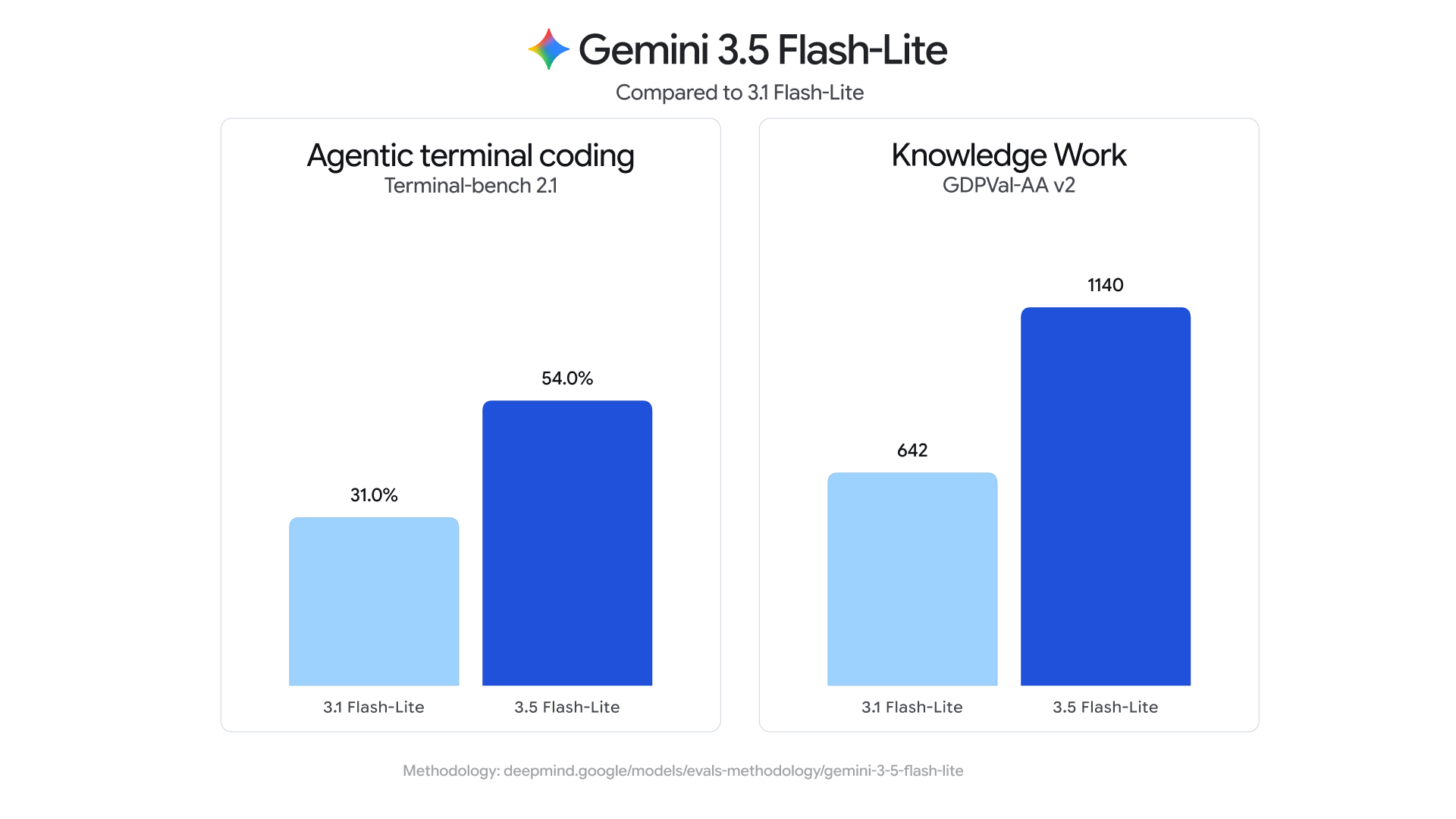
Where it wins: cost per token, and latency at scale. For classifying a ticket, routing it, or extracting a field, you don't need a workhorse, you need cheap and fast.
Where it trails: it's not built for hard reasoning or long, complex agent chains. Ask it to do 3.6 Flash's job and you'll feel the gap.
Pricing: $0.30 in / $2.50 out per 1M tokens.
Verdict: the smart pattern isn't Flash or Flash-Lite, it's both, routing simple steps to Flash-Lite and only escalating the hard ones. That's exactly how a well-built AI agent keeps its bill down.
5. Gemini 3.1 Pro, best for more Gemini reasoning today
Best for: teams committed to Gemini who need more reasoning than Flash and can't wait for 3.5 Pro.
With Gemini 3.5 Pro still in testing, the current top-reasoning Gemini you can actually call is 3.1 Pro, at $2.00 input / $12.00 output per 1M tokens. It's the "step up without leaving Google" option.
Where it wins: it stays inside the Gemini ecosystem, tooling, grounding, and Vertex/AI Studio setup, while giving you a heavier model than Flash for the occasional hard task.
Where it trails: here's the honest part. On Google's own table, 3.1 Pro actually loses to the newer 3.6 Flash on most agentic benchmarks (DeepSWE 12% vs 49%, knowledge-work Elo 965 vs 1421) while costing more. It's an older flagship being lapped by the new workhorse.
Pricing: $2.00 in / $12.00 out per 1M tokens.
Verdict: only reach for 3.1 Pro if you specifically need its behavior and are locked into Gemini. For most people, 3.6 Flash is both cheaper and better, and the real Pro-tier answer is "wait for 3.5 Pro or use a rival flagship now."
6. Kimi K3, best for open weights
Best for: teams that need to self-host, control data residency, or avoid vendor lock-in.
Everything above is a closed API. If that's a dealbreaker, Moonshot AI's Kimi K3 is the open-weights option with a serious 1M-token context window and Sonnet-tier capability. It priced its hosted API around $3 input / $15 output per 1M tokens, so it's not a budget play, the reason to pick it is control, not cost.
Where it wins: you can run it on your own infrastructure, keep data in-house, and avoid being tied to one vendor's roadmap or free-tier data policies.
Where it trails: you take on the hosting, scaling, and reliability work that a managed API hides. And at Sonnet-tier hosted pricing, the "open means cheap" assumption doesn't hold.
Pricing: roughly $3 in / $15 out per 1M tokens on the hosted API; free to self-host if you have the GPUs.
Verdict: the right pick when open weights or data control is a hard requirement. If it isn't, one of the closed APIs above will be less work for the same or better results.
A model is not a support agent
Here's the twist most of these comparisons miss, and it's the one I care about most, because I build the thing that sits on top of these models. If the reason you landed on "Gemini 3.6 Flash alternatives" is that you want to automate a support queue, you're optimizing the wrong layer.
The model is the commodity at the bottom of the stack. Everything that makes an AI agent actually safe to point at real customers sits above it.
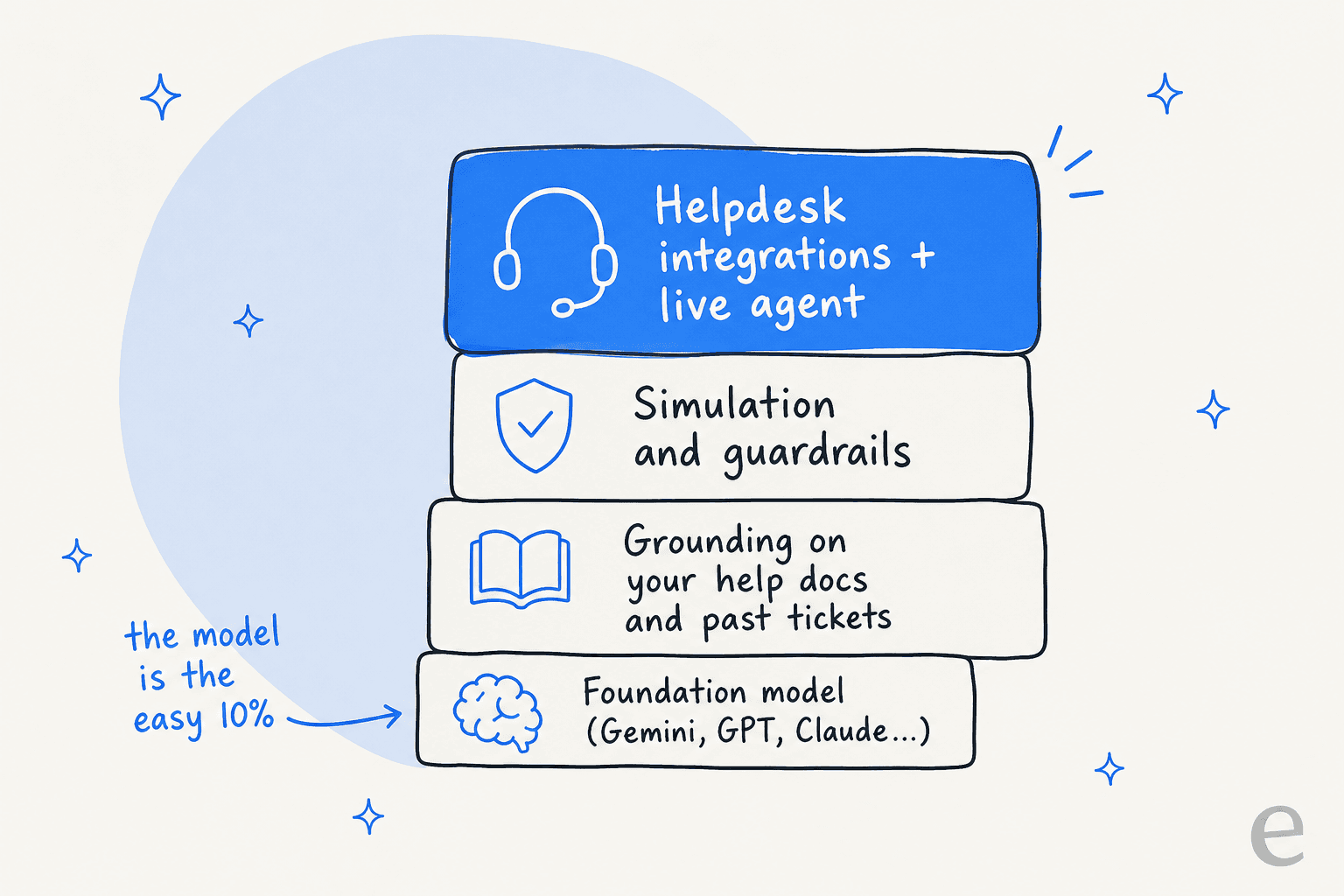
I've watched a confident-sounding model hand a customer a clean, well-written, completely wrong answer. That failure has nothing to do with which model you picked and everything to do with the layer around it. It's why every eesel rollout is simulated against your historical tickets before it replies to a single real person, so you see coverage and accuracy per topic and fix the gaps first. It's also why low-confidence answers become drafts, not autopilot replies.
That layer is what turns "a fast model exists" into a live agent resolving a real chunk of your tickets. None of it is the model, it's the grounding on your help docs and past tickets, the simulation, the guardrails, and the helpdesk integrations around it.
The genuinely good news if you go this route: because a good AI helpdesk agent is model-agnostic, this whole comparison stops being your problem. When a cheaper, better model ships, you get the win without a migration or a decision.
Stop picking models, start resolving tickets
If the model itself is the product you're shipping, pick from the six above by the job: GPT-5.6 Luna for value, Sonnet 5 for quality, Grok for coding, Flash-Lite for volume.
But if the goal is automated support, eesel is the 90% of the project that isn't the model. It learns from your past tickets and help docs, simulates the rollout on your real history so you know the resolution numbers before going live, and plugs into Zendesk, Freshdesk, Gorgias and 100+ tools in minutes.

Because it's model-agnostic, launches like Gemini 3.6 Flash land as a quiet cost win rather than a migration you have to run. Pricing is one fixed monthly price, from $299/month for 500 credits (1 credit per ticket or chat) with no per-seat fees, and there's a free plan with 100 credits, no card. If you'd rather see it work on your own tickets than read another benchmark chart, that's exactly what the simulation is for. Try eesel.