The 60-second table
Every number below is from the vendor's own published pages, checked August 3, 2026. Where a field is not published I have said so rather than borrowing a figure from an aggregator.
| Qwen 3.8 Max | Kimi K3 | |
|---|---|---|
| Model ID | qwen3.8-max | kimi-k3 |
| Lab | Alibaba | Moonshot AI |
| Released | Aug 2, 2026 (GA) | Jul 16, 2026 |
| Total parameters | 2.4T | 2.8T |
| Active parameters | 95B | Not published |
| Input / 1M | $2.00 | $3.00 |
| Output / 1M | $6.00 | $15.00 |
| Cached input / 1M | $0.25 implicit, $0.17 explicit read | $0.30 |
| Context window | 1,000,000 | 1,048,576 |
| Long-context surcharge | None | None |
| Max output | 131,072 | Not published |
| Max reasoning budget | 262,144 | Not published |
| Input modalities | Text, image, video | Text, image, video |
| Reasoning control | low / medium / xhigh, xhigh default | max only |
| Open weights | Promised, not shipped | Shipped Jul 27, 2026 |
| License | Not published | Listed as "other" |
| Model card | None | On Hugging Face |
| Knowledge cutoff | Not published | Not published |
| Rate limit (top tier) | 15K RPM / 2M TPM | Not published |
| Consumer chat | Qwen Studio, free | Kimi.com, free to $199/mo |
Three rows do most of the work. Qwen publishes an active-parameter count and Moonshot does not, which matters because active parameters set your latency and your bill, not total ones. Qwen is cheaper on every meter. And Kimi is the only one of the two you can actually download.
What Qwen 3.8 Max is
Qwen is Alibaba's model family, and Max is the proprietary flagship line above the cheaper Plus and Turbo tiers. Qwen 3.8 Max shipped in two acts: a July 19 preview at the World AI Conference with a spoken frontier claim and no published numbers, then a 5,000-word launch post on August 2 carrying everything the preview withheld.
The architecture as Alibaba states it: 2.4 trillion total parameters with 95 billion active, a sparse Mixture-of-Experts design built on the Qwen 3.5 foundation. The wider family history is in my Qwen review, and the Qwen overview covers the older tiers.
Reasoning is controlled with reasoning_effort, which takes low, medium and xhigh, with xhigh as the default. Alibaba also enables preserve_thinking by default "for best out-of-the-box experience." Hold that detail, because it reappears as a cost problem further down.
What Kimi K3 is
Kimi K3 is Moonshot AI's flagship, and the technical story is more unusual than Qwen's. It is 2.8 trillion total parameters, which Moonshot describes as activating 16 of 896 experts under a Stable LatentMoE framework, on top of two novel pieces: Kimi Delta Attention, a hybrid linear attention mechanism, and Attention Residuals, a drop-in replacement for standard residual connections that Moonshot open-sourced separately. It claims roughly 2.5x better scaling efficiency than Kimi K2.5.
Moonshot is unusually candid in its own launch post about where it lands:
"While its overall performance still trails the most powerful proprietary models, Claude Fable 5 and GPT 5.6 Sol, Kimi K3 demonstrated frontier-level performance across our evaluation suite, consistently outperforming other tested models."
Compare that to Alibaba's preview positioning, which reached for "second only to Fable 5" before publishing a single score. Two labs, two very different comfort levels with their own evidence. My deeper reads sit in the Kimi K3 review and the Qwen 3.8 Max review.
One thing K3 does not give you is a reasoning dial. reasoning_effort accepts max and nothing else, with low and high listed as coming soon. There is no cheaper non-thinking SKU. One model, one price, always thinking.
Benchmarks: neither lab measured the other
This is where most head-to-heads quietly cheat. Alibaba published a sixteen-panel chart on August 2. Moonshot published its own in July. Neither chart contains the other model.
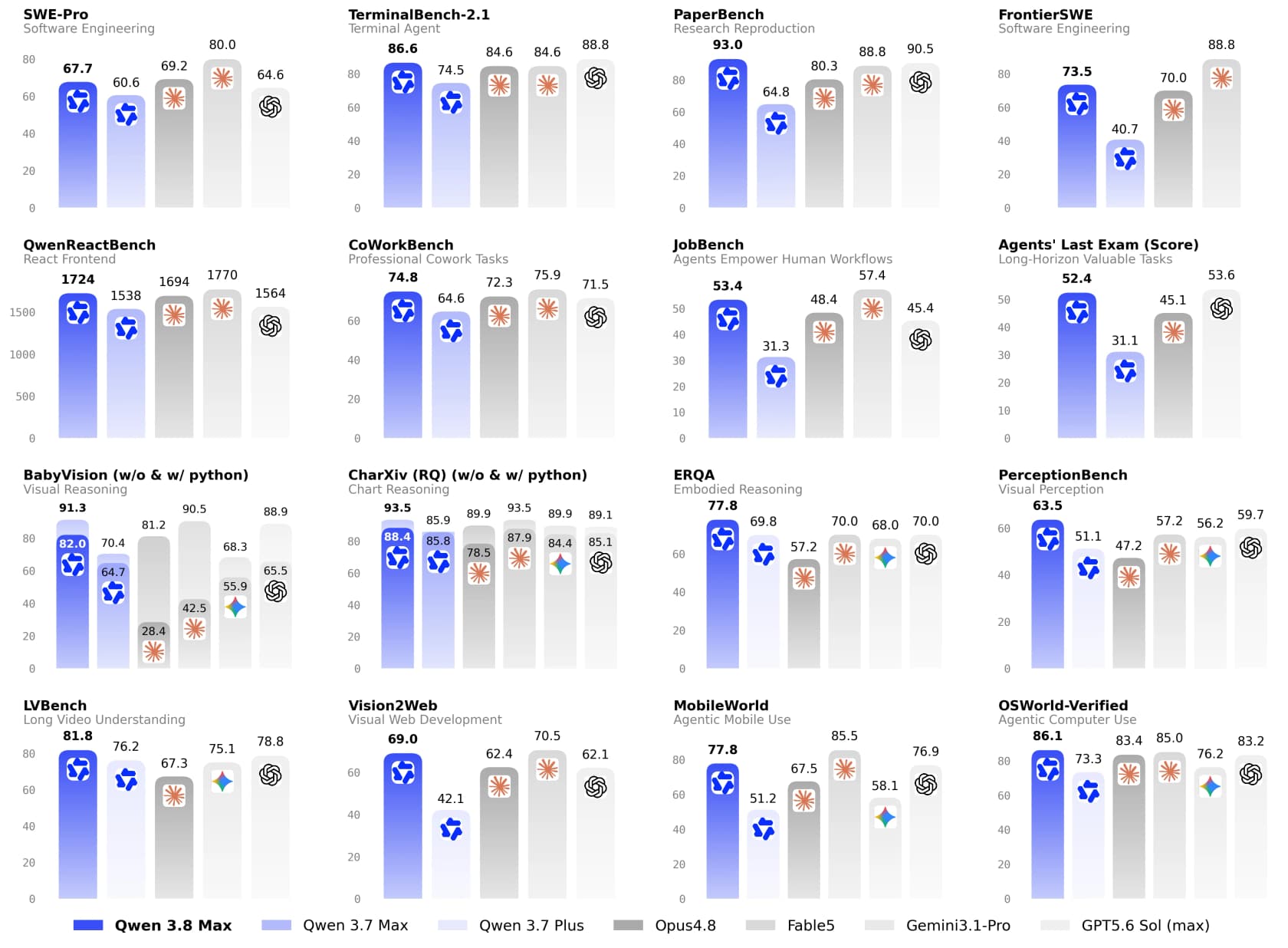
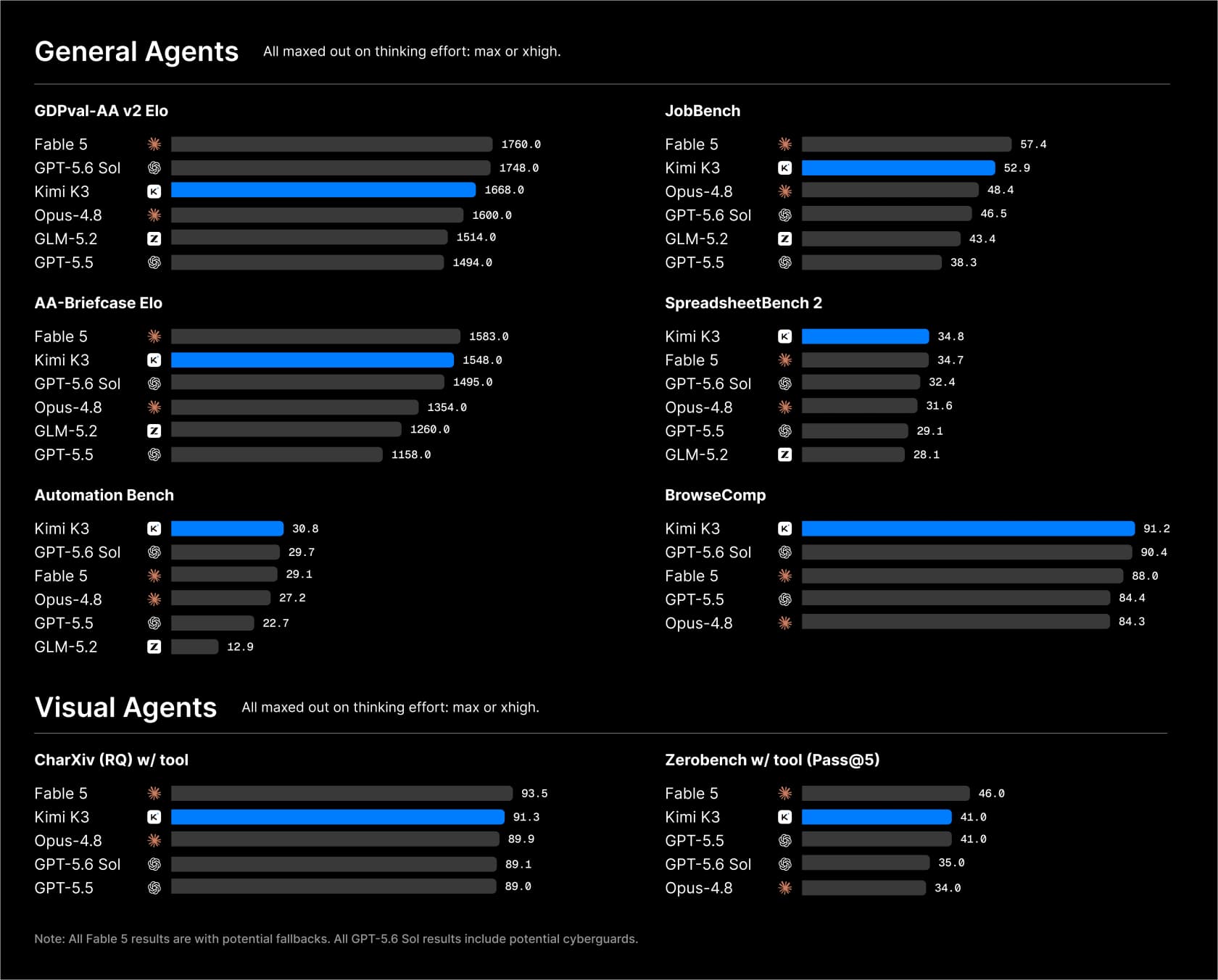
There is a way to bridge them, though, and almost nobody bothers. Both charts carry the same reference models: Claude Fable 5, Claude Opus 4.8, GPT-5.6 Sol. So where both labs report the same score for the same reference model on the same benchmark, the two harnesses are behaving alike and their own numbers can be compared. Where the reference scores disagree, they cannot.
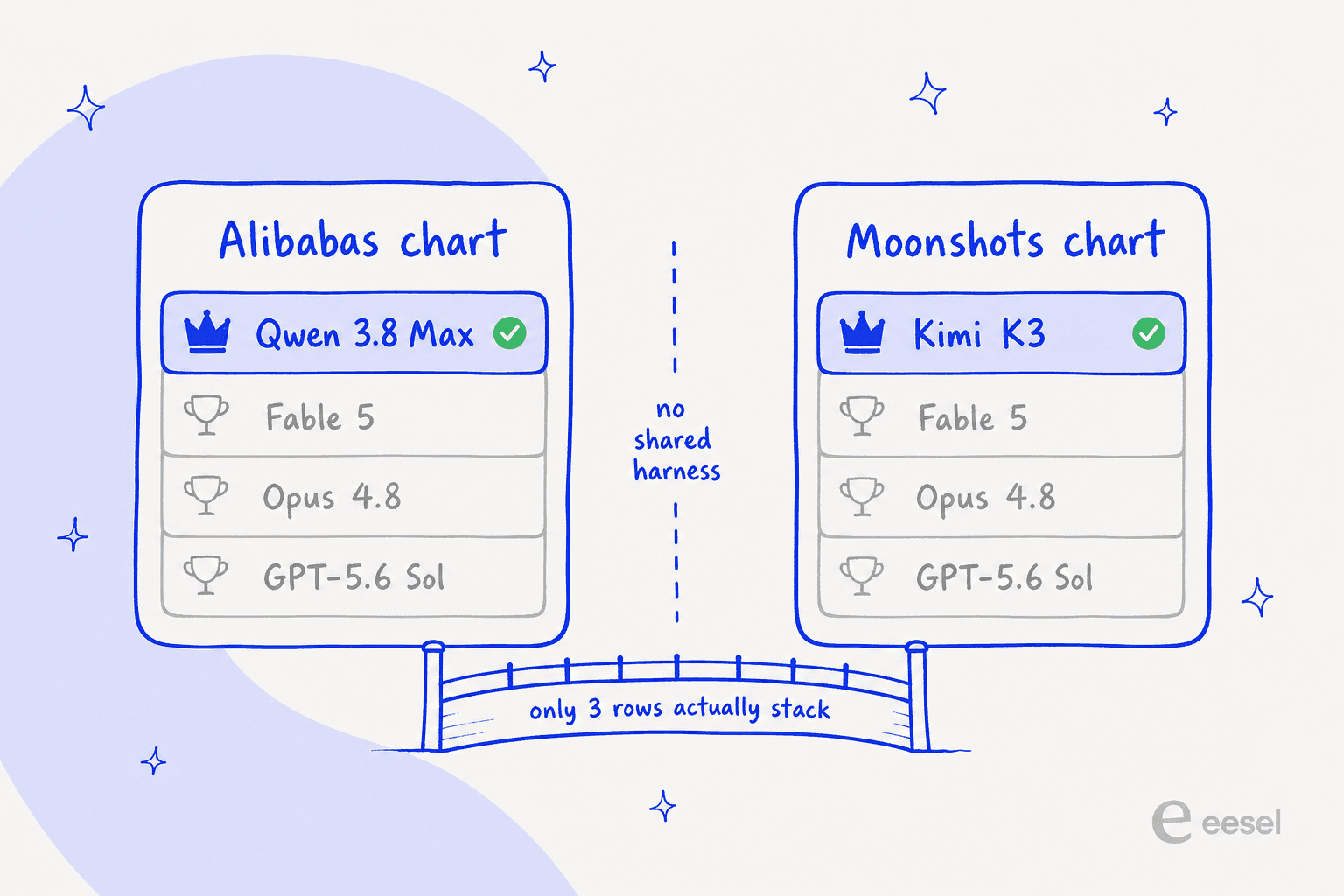
Run that test across both charts and exactly three rows survive:
| Benchmark | Shared reference agreement | Qwen 3.8 Max | Kimi K3 | Winner |
|---|---|---|---|---|
| TerminalBench-2.1 | Fable 5 84.6, Opus 4.8 84.6, Sol 88.8 in both | 86.6 | 88.3 | Kimi, by 1.7 |
| CharXiv (RQ, with Python) | Fable 5 93.5, Opus 4.8 89.9, Sol 89.1 in both | 93.5 | 91.3 | Qwen, by 2.2 |
| JobBench | Fable 5 57.4, Opus 4.8 48.4 in both; Sol 45.4 vs 46.5 | 53.4 | 52.9 | Qwen, by 0.5 |
So: one clean win each on a coding-adjacent eval and a chart-reasoning eval, and a statistical tie on agentic knowledge work. That is the entire defensible head-to-head. Anyone showing you a fifteen-row table declaring a winner has stacked numbers from two different harnesses.
And the reason to be strict about it is right there in the fourth row I had to throw out. On FrontierSWE, Alibaba's chart puts GPT-5.6 Sol at 88.8; Moonshot's puts it at 71.3. Same model, same benchmark, a 17.5-point spread. Whichever chart is right, one of them is measuring something the other is not, and that gap is bigger than either lab's claimed margin over the other.
Alibaba's footnotes are worth reading too. It discloses that six of its coding benchmarks are in-house and unpublished, that competitor scores were pulled from mixed harnesses rather than rerun, that Fable 5's results "may involve fallbacks," and that several rows are graded by rival models: gemini-3.1-pro-preview judges PLawBench, Claude Opus 4.6 judges PaperBench. Moonshot's chart carries its own version of the same caveat.
The one independent read available is Artificial Analysis, which scored Kimi K3 at 57 on its Intelligence Index, fourth of 189 models evaluated, with an output speed around 62 tokens per second. On its private long-horizon knowledge-work eval, K3 reached an Elo of 1547, which the same summary puts +732 over Kimi K2.6.
The rate card says Qwen. The bill says draw.
Qwen is cheaper on every published meter. Input is a third less, output is 60% less, and its implicit cache read is $0.25 against Kimi's $0.30 cache-hit rate. At identical token counts there is no argument.
Token counts are not identical. A developer who ran the same web-app build through both models, each in its vendor's own harness, posted the accounting:
"* Kimi K3: 9532k input (9172k cached), 114k output - cost $5.5
Qwen 3.8 Max: 18020k input (17836k cached), 114k output - cost $6.3"

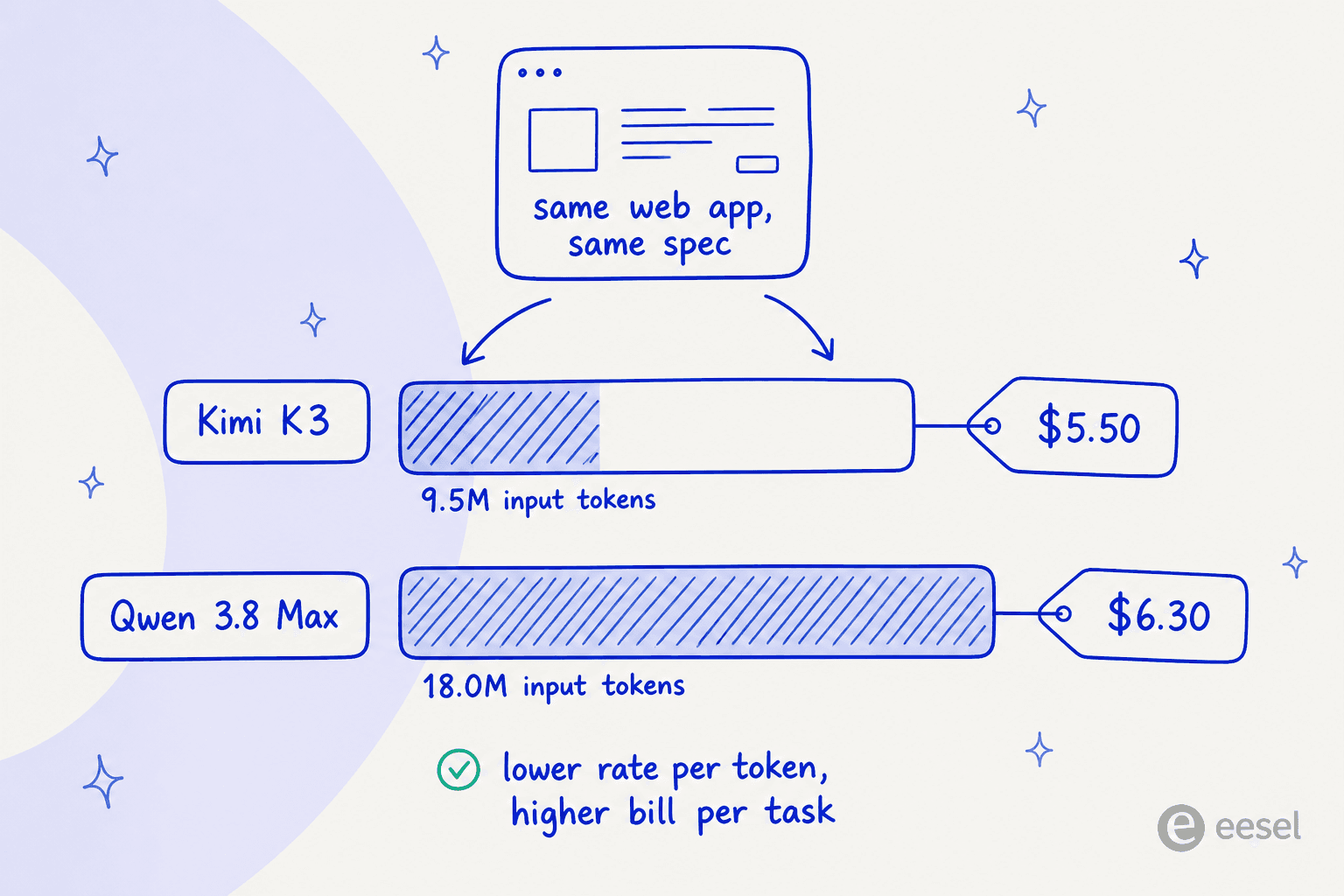
That $6.30 predates general availability, so it was billed on preview terms rather than the card published August 2. Rerun those exact token counts through today's rates and Qwen comes to about $5.51 (0.184M uncached input at $2, 17.836M cached at $0.25, 0.114M output at $6). Kimi comes to $5.54. A 60% cheaper output rate, cancelled almost to the cent by needing 1.9x the input tokens.
This is the number that actually decides your bill, and it is not on either pricing page. Qwen ships xhigh reasoning on by default with preserve_thinking enabled, and reasoning tokens bill as output. Kimi is always-on-max too, and its own community was blunt about the consequence:
"The shift from "value" models to "intelligent, huge and slow" models coming from China is an interesting change in strategy. My main issue with GLM 5.2 and Kimi 3 is that they're extremely token hungry and thus feel slow(er) to use."
Neither of these is the budget option any more. Both sit in Claude Sonnet's price band, and DeepSeek V3.2 is still an order of magnitude below both. The cheap-Chinese-model framing belongs to the previous generation.
Plug in your own volumes, including how much of your input is cached and how much more verbose you expect Qwen to be:
Move the verbosity slider past 1.9x and Kimi wins on cost despite charging more than twice as much per output token. That crossover, not the sticker price, is what your finance team will be looking at in three months.
Open weights: the one clean difference
Both models were announced as open. Only one is.
Moonshot said the weights would be up by July 27, 2026, and they were. The Kimi K3 repository shows a checkpoint last modified July 27, with a safetensors index totalling 2,779,931,837,184 parameters, which confirms the 2.8T claim from the outside rather than from a press release. It has since passed 837,000 downloads and 9,700 likes, and community quantisations already exist. The license is listed only as "other," so read it before you build a business on it.
Qwen 3.8 Max is still waiting. Alibaba's launch post promises the weights on Hugging Face and ModelScope "next week" three separate times, the qwen.ai homepage tags the release "Open-Source," and there is no repo, no license and no date. From August 2, "next week" means the week of August 9.
Two caveats before anyone gets excited. First, an 8-bit 2.78-trillion-parameter checkpoint is a datacenter artefact, not something you run on a workstation, so "open" here means auditable and self-hostable at scale rather than local. If local is your actual requirement, small language models are the honest category. Second, the local-model crowd on Hacker News was clear that it read the Qwen announcement as a scheduling response:
"I assume that this announcement has been prompted by that of Moonshot AI, which has just announced a 2.8T parameter open-weights LLM, Kimi K3, to be published on Huggingface by 27 July. Now the response of Alibaba is that they will also publish soon a big open weights LLM, the 2.4T parameter Qwen 3.8."
What developers who ran both actually say
Benchmarks measure capability. Production measures capability divided by patience. Across the launch threads, the hands-on reports lean Kimi, and almost none of them are about intelligence.
The sharpest line in the Qwen preview thread was a direct comparison:
"The few tests I ran were by no means comprehensive, but while kimi felt like the real deal qwen seems a bit of a benchmark princess."
A developer who ran four frontier models side by side over several days landed somewhere more even-handed:
"Having tested K3, Qwen 3.8 max preview, Fable and Sol for the past few days, I partially agree. Don't trust the benchmarks, and the Chinese models really are slow and token-inefficient. However they do seem very close to SOTA [...] if I had to find an alternative, I could live with both K3 and Qwen3.8 just fine."
And one report went further than I would on the strength of one workload, but it is the most-repeated verdict in the thread and worth reading as a data point rather than a conclusion:
"In my limited anecdotal experience, Kimi K3 is a bit better than Opus 4.8 and Qwen3.8 Max is disastrously bad. It can reason fine, but the moment it tries to do something it gets stuck into long second-guessing loops with no progress."
Worth balancing that against the Kimi side, where the enthusiasm ran high on release day and one developer could not separate it from Anthropic's flagship in a blind test:
"I've been playing around with it for the past few hours, and I think it's an amazing model. I'm not sure I could tell the difference between this and Fable in a blind test."
If the spread bothers you, the safer route is a shortlist rather than a single pick. Mine for this side of the bracket is Qwen alternatives. The Kimi K3 alternatives roundup covers it from the other direction, and there is a narrower Qwen 3.8 Max alternatives list for this model alone.
A few things simply are not published for either model. No knowledge cutoff. No system card. No safety evaluation on the Qwen side at all, and no architecture paper on the Kimi side until the technical report lands. If procurement asks, the answer today is that it does not exist.
Where a frontier model stops and support work begins
This is the part I care about most, because it is where I watch teams lose a quarter.
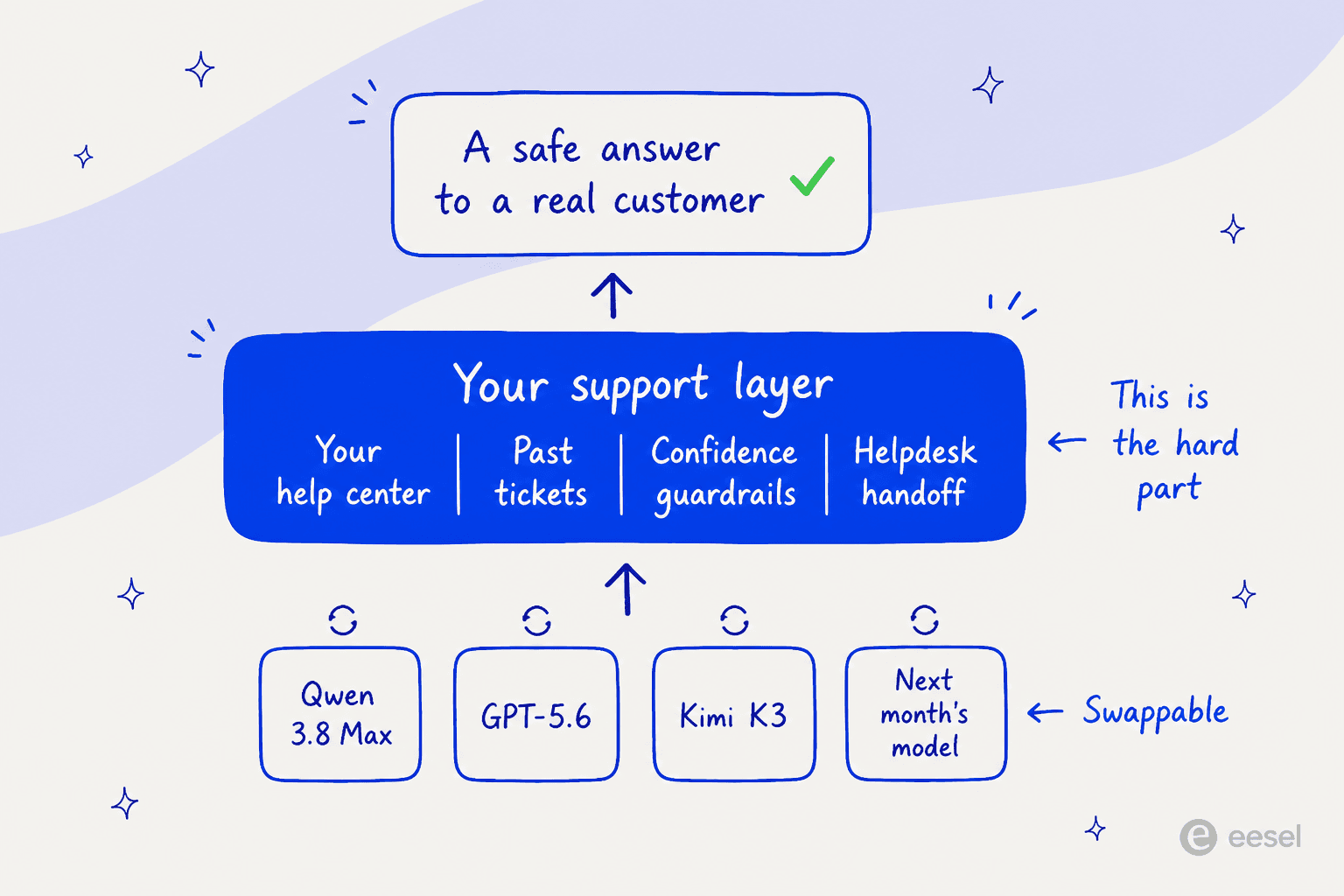
Neither of these models knows your refund policy. Neither has read your last 7,000 tickets. Neither knows the customer emailing you is on an enterprise plan and has escalated twice already. A benchmark score is not a support agent, and the distance between those two things is where most AI support automation projects quietly stall.
It is also why choosing an AI helpdesk is a different exercise from choosing a model, and why ticket automation lives or dies on retrieval rather than raw reasoning.
I have spent my time at eesel building the agent layer, and the failure mode I keep seeing is worse than "the AI does not know." It is confident invention. The car-brand story from the top of this post is the cleanest example I have: the model was not wrong about language, it was wrong about scope, because the help center said "we support all models" and it took that literally. That team's own summary of getting the setup right was "trial and error in the beginning." A 2.8-trillion-parameter model would have made the same claim, more fluently.
The control that fixes it came up in a call with a support lead running 7,000 tickets a month, and it has nothing to do with model choice:
"The AI will never be able to answer 100% of the questions, but if it tries and just answers 'sorry I don't know this,' I cannot go and check all my 7,000 tickets to see if the AI actually made a good answer. I need an AI who is only handling the tickets that it's confident to handle and all the other ones, leave them alone."
a CX lead at a 7,000-ticket-a-month DTC brand
That is a product decision, not a model decision. It is why eesel AI runs a simulation on historical tickets before anything goes live, so you see the resolution rate and the real replies on real past conversations first.
It is also why answers route by confidence, drafting for a human or escalating instead of guessing, and why ticket classification runs as its own step rather than being folded into one giant prompt.
Which makes the strategic read on this comparison a little anticlimactic: build so you can swap the engine. The model layer gets better and cheaper every few weeks. Kimi K3 landed seventeen days before Qwen, GPT-5.6 cut its cheapest tier by 80% in a single afternoon, and whatever tops the chart in September is not on either chart today.
That is the same reason I would not hard-wire to Gemini either, however good this month's numbers look. It applies just as much to Grok. GLM 5.2 is the other Chinese flagship sitting in this exact bracket, and I would read its business case with the same shrug.
So which one should you pick?
If you are shipping something and want one answer:
- Long agent loops where token efficiency decides the bill: Kimi K3. It did the same job on roughly half the input tokens, and that gap outweighs its higher rate card.
- Chart, document and video-heavy work: Qwen 3.8 Max. It takes CharXiv on a comparable harness, and Alibaba documents video input with concrete ceilings that Moonshot does not match in its own launch material.
- Anything you need to self-host or audit: Kimi K3, and it is not a debate. The weights exist, the parameter count checks out from the checkpoint, and Qwen's are still a promise.
- A reasoning dial you can turn down: Qwen 3.8 Max, which is the only one of the two with
lowandmediumeffort levels. Kimi runs at max or not at all. - Lowest cost per token, full stop: Qwen, on every meter. Just measure cost per finished task before you plan a budget around it.
- Anything customer-facing: neither, on its own. Pick the layer first and let it pick the model. The maths is in my agent cost breakdown, and the shortlist is in best AI agents.
What I would not do is treat either chart as settled. Three rows is the entire honest overlap between them, six of Alibaba's coding benchmarks are its own unpublished evals, and no third party has rerun any of it.
Expect both rate cards to move before independent numbers land. I keep the Kimi K3 pricing breakdown as a living page for that reason, and the same goes for Qwen 3.8 Max pricing. The Qwen 3.8 Max vs GPT-5.6 comparison will need redoing along with this one.
Try eesel
If you got here because you want a model that closes tickets rather than wins charts, that is the whole point of eesel AI. It plugs into Zendesk, Freshdesk, Gorgias and 100+ other tools, learns from your help center and your past tickets, and starts drafting within minutes.

The differentiator is the trust ramp, not the engine. Simulate against your real ticket history, read the numbers, start in draft mode, and go autonomous only once you like what you see. You inherit every frontier gain, whether that turns out to be Kimi, Qwen or whatever ships in September, without re-plumbing anything. Try eesel free, no credit card needed.
Frequently Asked Questions
Is Qwen 3.8 Max better than Kimi K3?
Which is cheaper, Qwen 3.8 Max or Kimi K3?
Is Kimi K3 open source and are the Qwen 3.8 Max weights out?
What is the context window on Qwen 3.8 Max vs Kimi K3?
Which is better for coding, Qwen 3.8 Max or Kimi K3?
Can I run Qwen 3.8 Max or Kimi K3 locally?
Do Qwen 3.8 Max and Kimi K3 support vision?
Can I use Qwen 3.8 Max or Kimi K3 for customer support?


Article by
Alicia Kirana Utomo
Kira is a writer at eesel AI with a Computer Science background and over a year of hands-on experience evaluating AI-powered customer service tools. She focuses on breaking down how helpdesk platforms and AI agents actually work so that support teams can make better buying decisions.