

What Sakana Fugu Max actually is
Most model launches give you a bigger model. Sakana did something stranger: Fugu Max is a model that calls other models.
That sounds like marketing until you look at the mechanism. Sakana AI is a Tokyo research lab founded in 2023 by three ex-Google figures, including CTO Llion Jones, one of the eight authors of the original "Attention Is All You Need" transformer paper. The lab's whole bet is that the future of AI is "a vast collection of small AI systems" coordinating like a school of fish, rather than one giant monolith. Fugu is that thesis turned into a product.
Fugu Max is the fourth model in the family, and switching between them is a one-line parameter change on the same API:
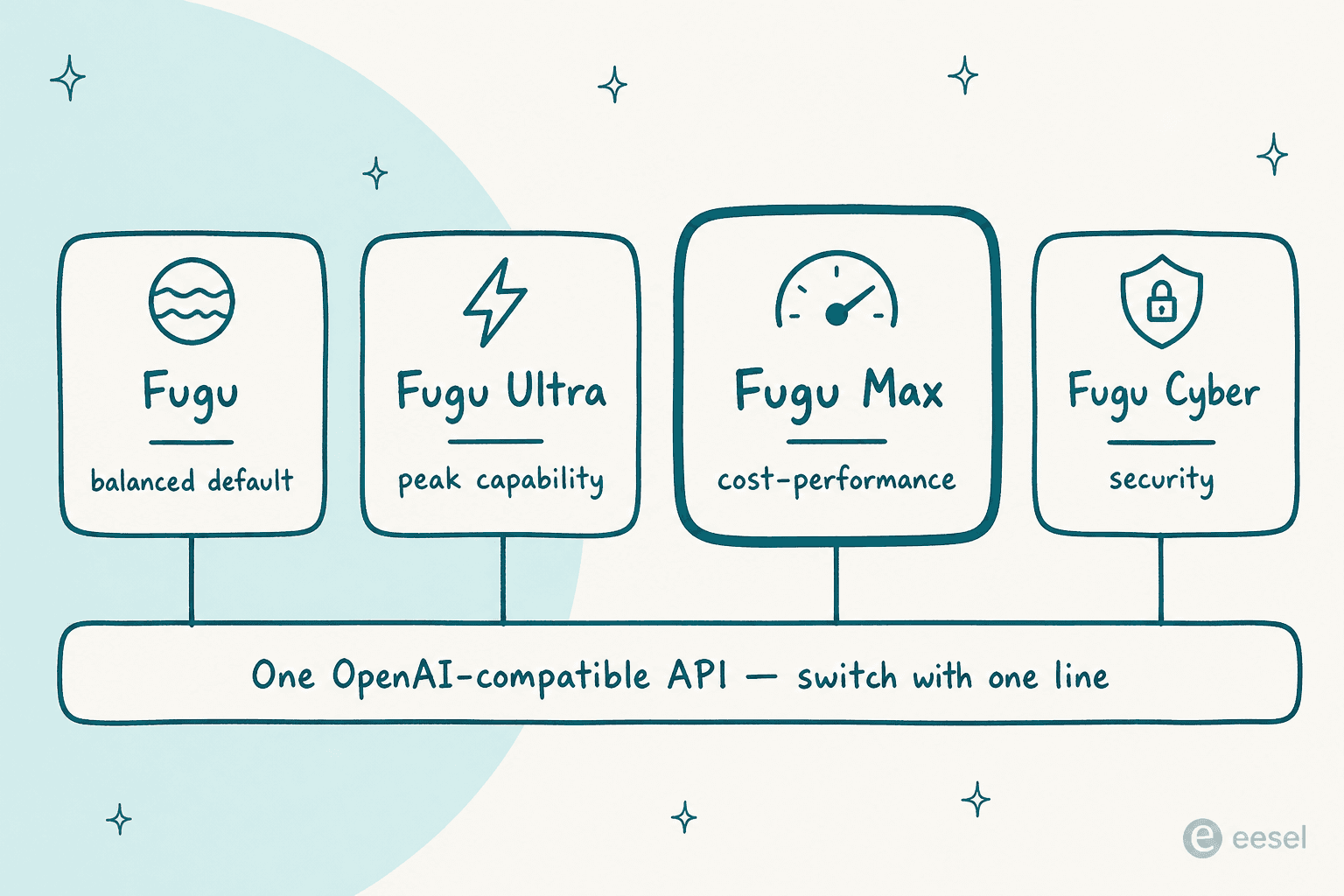
- Fugu balances performance and latency, the everyday default.
- Fugu Ultra (now v2) is tuned for peak answer quality on hard, high-stakes problems.
- Fugu Max is tuned for cost-performance, orchestrating the largest pool in the family.
- Fugu Cyber is specialized for security work like vulnerability research.
The release post frames Fugu Max with one question: "What is the best possible output we can deliver at the lowest possible cost?" It answers that by expanding the pool of models it can route to, folding in "an unprecedented number of open-weights and specialized models," and then sending each sub-task to the cheapest model that can actually handle it. Sakana calls Max and Ultra v2 "not separate products" but "the same core orchestration architecture optimized for two distinct missions": Max pushes the bill down, Ultra pushes the ceiling up.
How the orchestration actually works
Here is the part I find genuinely clever. When you call Fugu Max, you are not talking to one network of weights. You are talking to a coordinator that decides, per request, who should do the work.
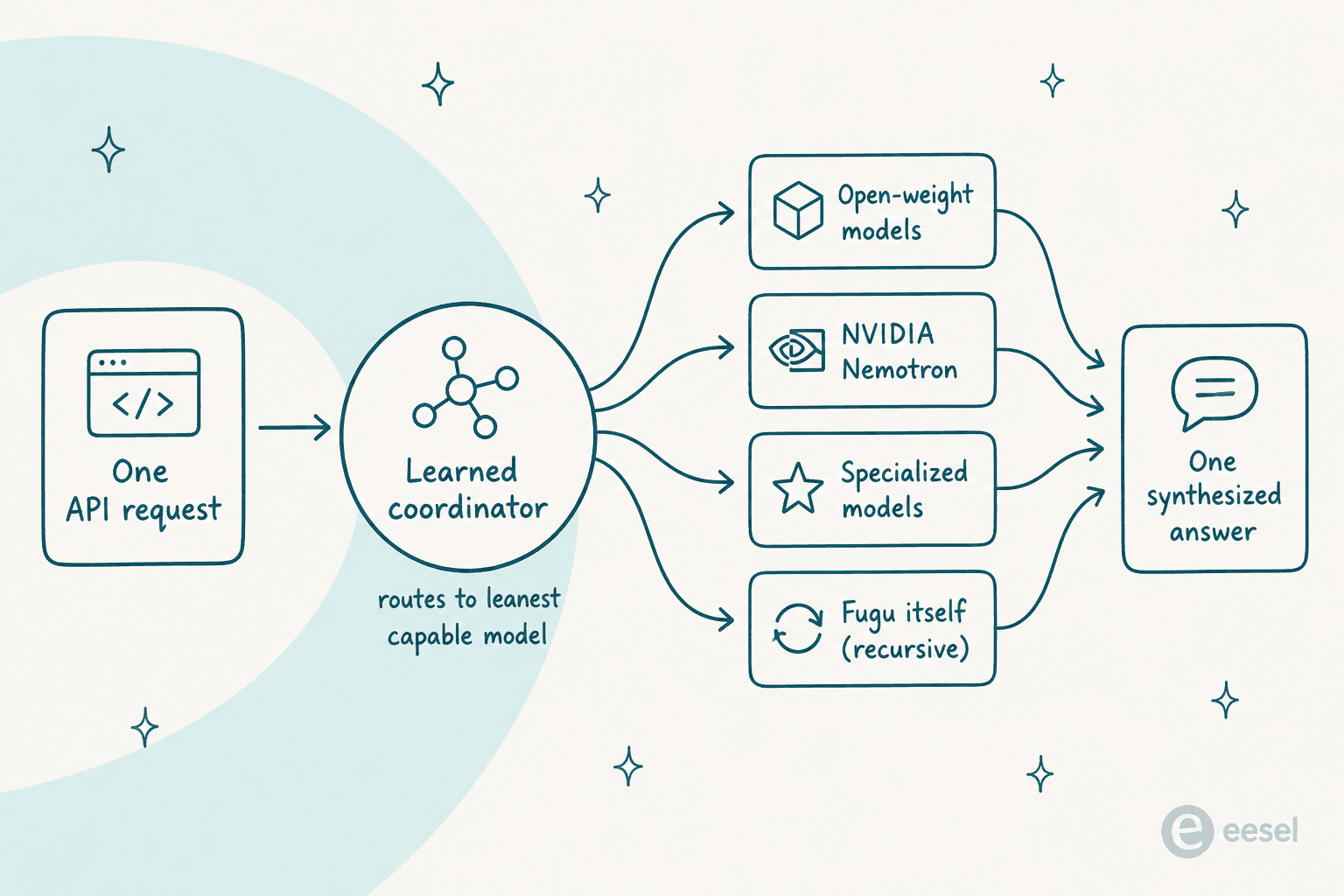
The coordinator itself is a small model trained to orchestrate, grounded in two ICLR 2026 papers. TRINITY is an evolved coordinator that assigns Thinker, Worker, and Verifier roles across a set of LLMs over several turns. The Conductor is trained with reinforcement learning to discover natural-language coordination strategies so a diverse pool beats any single worker. In plain terms: the system learned how to delegate rather than following a hand-written pipeline, and it can even call instances of itself recursively.
The Sakana architecture diagram lays out the same idea, from request to routing to a synthesized answer:
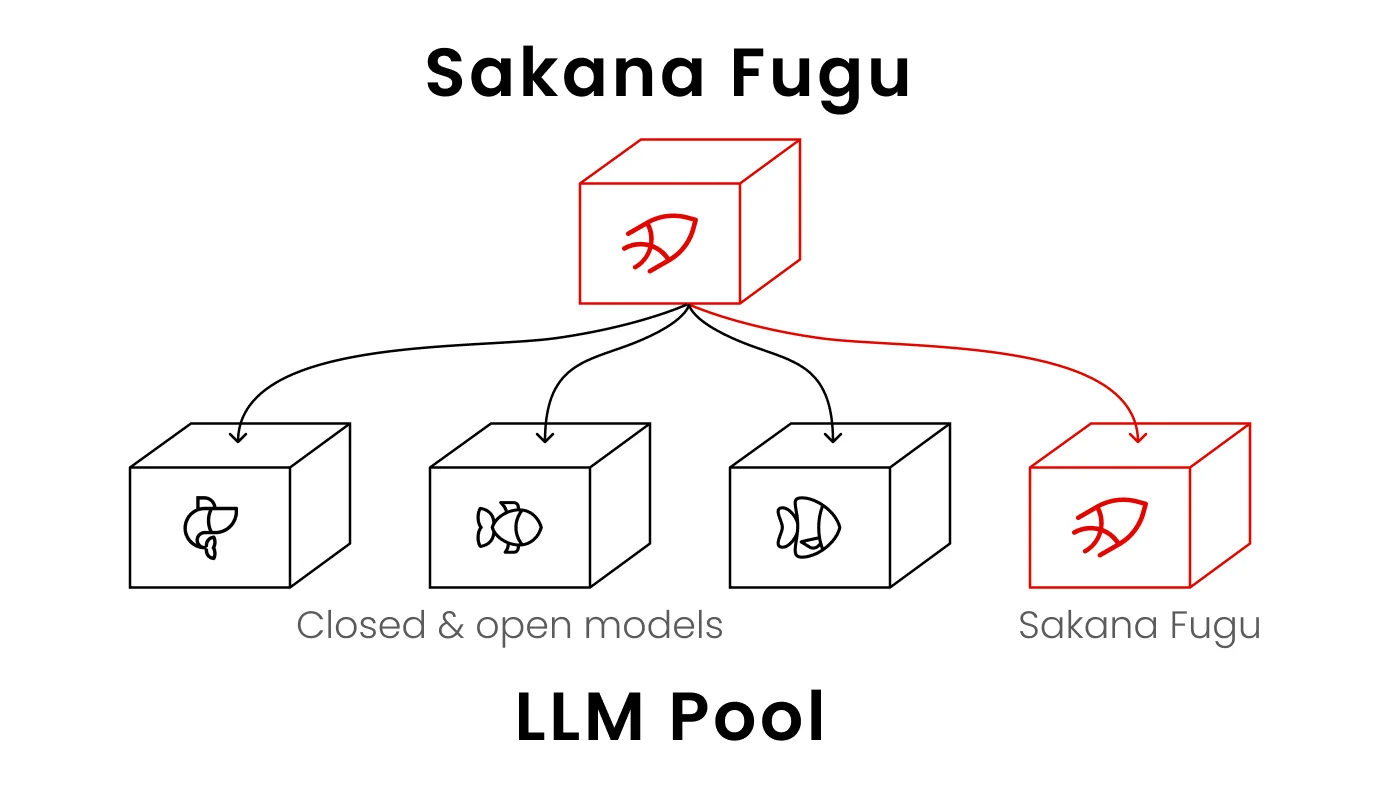
For a developer, the appeal is that all of this hides behind one endpoint. You get the upside of a multi-agent system, expert models routed by task, without hand-building and maintaining that system yourself. It is a real echo of how good AI agents are supposed to work: pick the right tool for the step, not force one model to do everything.
A few specifics worth knowing about the Max variant, from the OpenRouter model page:
- 1 million token context, with text, image, and PDF inputs and text output.
- Configurable reasoning effort at high, xhigh, and max.
- Function calling, structured outputs, and built-in web search and fetch.
- The agent pool is fixed. Unlike the base Fugu model, you cannot opt specific models in or out of Fugu Max from the console.
- Orchestration tokens are billed as normal tokens. The internal traffic between agents lands on your meter, which matters for the cost math below.
The benchmarks, and how to read them
Sakana's headline claims for Fugu Max are strong, and they are all vendor-reported, so I would treat them as the vendor's best foot forward rather than independent proof.
Per the release post, Fugu Max achieves the best overall score on six benchmarks (Terminal Bench 2.1, GPQAD, AA-LCR, GDP.pdf, AutomationBench, and SWEFish) and "expands the cost-performance Pareto frontier on seven out of ten benchmarks." The efficiency framing is the real story: performance close to elite models at "two to six times lower cost."
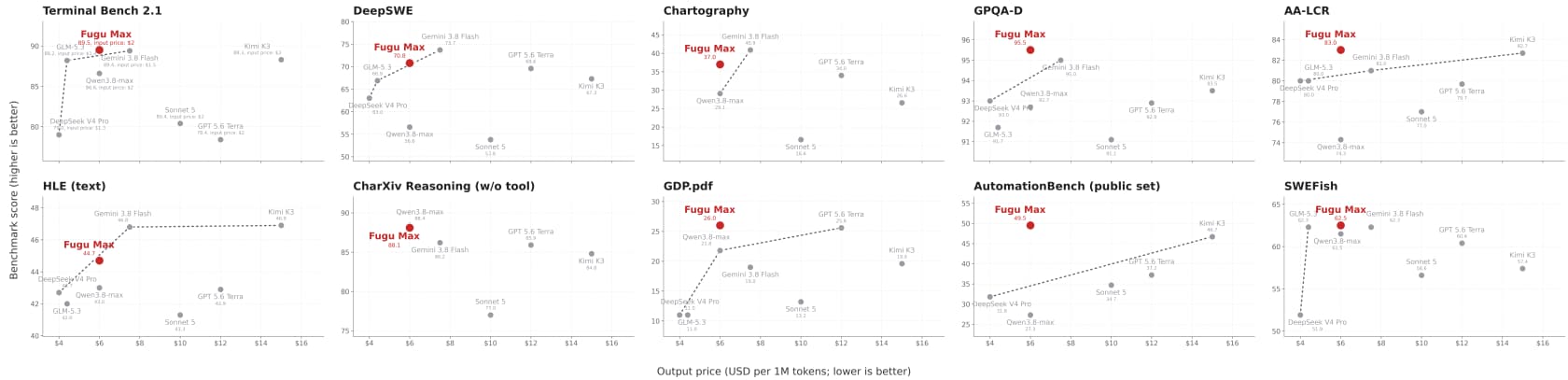
Its sibling, Fugu Ultra v2, launched the same day with harder numbers. On Chartography, a visual-reasoning benchmark, Ultra v2 scores 48.3 against Opus 5 at 27.3 and Fable 5 at 29.5. On DeepSWE, a real-world software-engineering benchmark, it hits 74.3, which Sakana says beats models costing three to five times more per token.
Three caveats keep the picture honest, and Sakana states all of them:
- SWEFish is Sakana's own internal benchmark, reflecting its own coding challenges, not a third-party test.
- The strongest proprietary models are not in the pool. Sakana is explicit that Fable 5, Fable 5.1, and GPT-6-Astra are not among the models Fugu orchestrates. Beating frontier models without them in the mix is the point they are making, but it also means the pool is built from open and mid-tier models.
- Routing is opaque by design. Sakana does not tell you which underlying models answered a given query, so you cannot audit the mix per request.
That last one is a real trade for anyone in a regulated or safety-sensitive setting, and it is the same reason testing on real data beats trusting a benchmark grid.
Pricing: the actual numbers
Fugu Max's pricing is public and, refreshingly, flat. Here is the full picture, with Fugu Ultra v2 alongside for contrast.
| Meter | Fugu Max (v1.0) | Fugu Ultra v2 (standard) | Fugu Ultra v2 (>272K) |
|---|---|---|---|
| Input / 1M tokens | $2.00 | $5.00 | $10.00 |
| Output / 1M tokens | $6.00 | $30.00 | $45.00 |
| Cached input / 1M | $0.25 | $0.50 | $1.00 |
| Context surcharge | None (flat) | Above 272K tokens | Applied |
| Web search / fetch | $0.007 per call | $0.007 per call | $0.007 per call |
The flat-rate design is Fugu Max's cleanest selling point: per Sakana, the $2/$6 rate holds "regardless of context length," so a 900K-token prompt costs the same per token as a short one. That is unusual, and useful if you throw large documents at it.
If subscriptions fit better, there are three, and every tier includes access to all Fugu models:
| Plan | Price | Allowance |
|---|---|---|
| Standard | $20/month | Baseline |
| Pro | $100/month | 10x Standard |
| Max | $200/month | 20x Standard |
One naming trap: the "Max Plan" subscription is not the same as the "Fugu Max" model. The $200 plan is a usage bucket that includes every model; Fugu Max is one of the models inside it.
Two footnotes change the real cost. First, because orchestration tokens are metered, a request that fans out to several agents burns more tokens than a single-model call would, so the low per-token rate does not always mean a low per-answer bill. Sakana softens this by promising it "never stacks fees" and charges "a single rate based on the top-tier model involved." Second, caching does a lot of heavy lifting in practice: on OpenRouter's live panel in Fugu Max's first days, the weighted-average effective input price came in around $0.61 per million against the $2 list, driven by a 79.4% cache-hit rate, at roughly 29 tokens per second.
What people are actually saying
The Fugu Max launch itself was quiet online, but the debate around Fugu's whole orchestration approach has been loud since the June general-availability launch. It is worth reading, because the critiques apply just as much to Max. (These are reactions to Fugu's orchestration model generally, not the Max variant specifically.)
The dominant critique is "why pay for a router." One of the top comments on the Hacker News GA thread captured the mood:
"You pay $200/month to Anthropic, $200/month to OpenAI, $200/month to Cursor, $200/month to Google, and seeing that it didn't come to a nice round $1024/month, you pay $200/month to Sakana to coordinate it all, because why not."

That is the real question for anyone technical: if I can wire up cheap open models and an orchestrator myself, what am I buying? For a lot of the thread, the answer was "not enough." But there was a fair counterpoint too, and I think it is the honest read:
"Kind of shocking - a model comes out that beats mythos and offers a reasonable price and it ... gets downvoted? ... it's a genuine accomplishment to hit those benchmarks and offer a reasonable plan?"
And at least one user reported a real, working setup, pairing Fugu Ultra as an advisor with a faster driver model:
"Happy user here, pairing it with Composer 2.5, with Fugu Ultra as advisor and Fugu as planner... Worth it if your harness can split advisor from worker."
My take: Fugu Max is a legitimately smart piece of engineering, and the "buy managed orchestration instead of building it" pitch is real for teams that do not want to maintain a routing layer. Whether it is worth a separate bill on top of your existing model spend depends entirely on how much orchestration you would otherwise build yourself.
Where a model ends and the job begins
Here is the distinction I keep coming back to, because it is easy to blur. Fugu Max is infrastructure. It is an engine, not an employee.
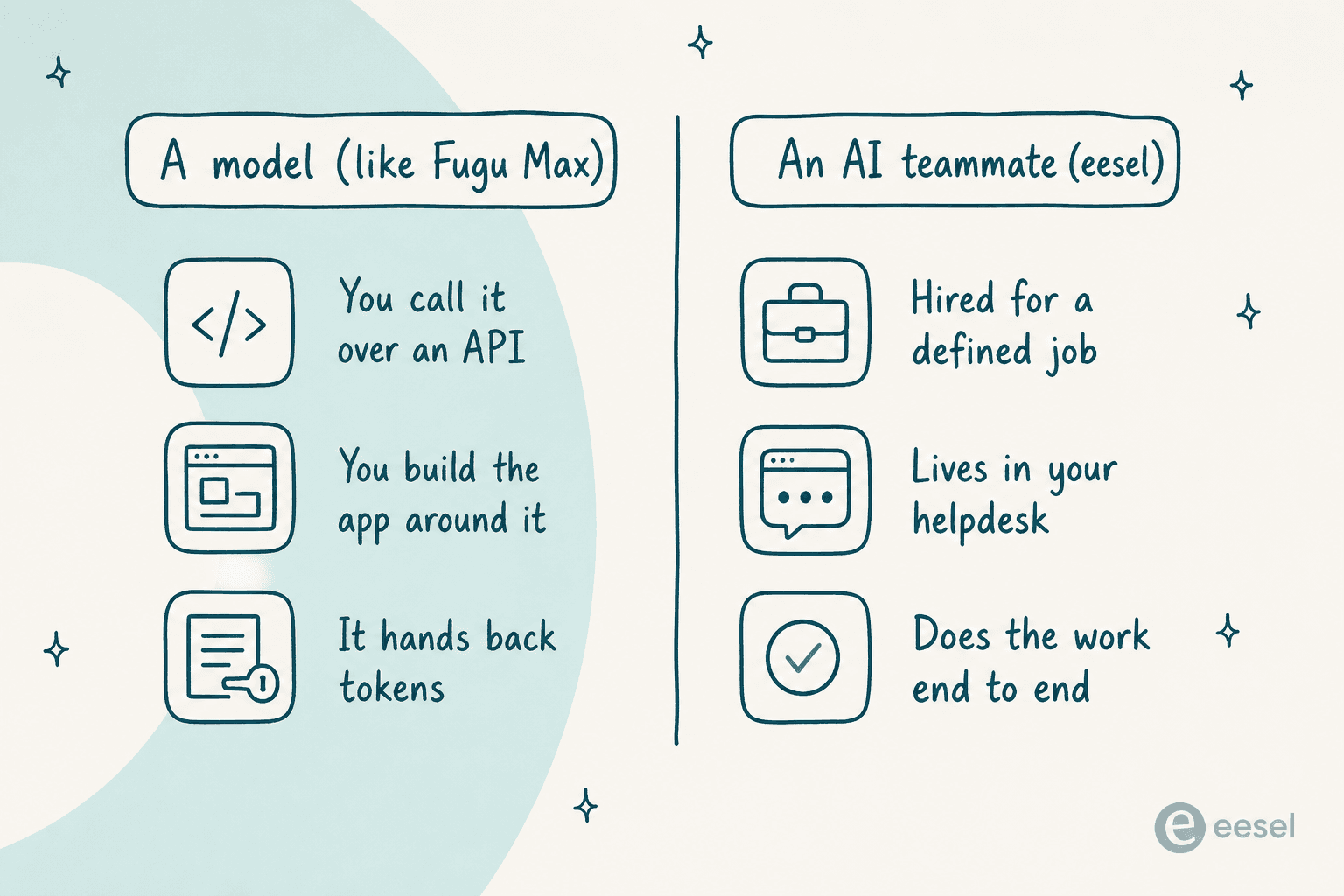
A model, however clever its routing, hands you back tokens. To turn that into resolved support tickets, you still have to connect it to your helpdesk, teach it your product and policies, give it permission to look up an order or tag a ticket, decide when it escalates to a human, and prove it is safe before it touches a real customer. That gap between "a capable model" and "a teammate that does the work" is most of the actual project, and it is the part benchmarks never measure.
This is exactly the tradeoff behind Fugu's own success: most teams do not want to build the multi-agent plumbing themselves. The same logic applies one level up. For customer support, you probably do not want to build the whole employee around a model either.
Try eesel: the teammate, not the engine
That is the gap eesel fills. eesel is an AI teammate platform: you hire ready-to-work teammates for specific jobs, and each one arrives with the skills, integrations, and company context for its role. The AI helpdesk teammate joins your existing queue, looks up orders and records, tags tickets, and drafts or sends replies, all inside the helpdesk you already run.
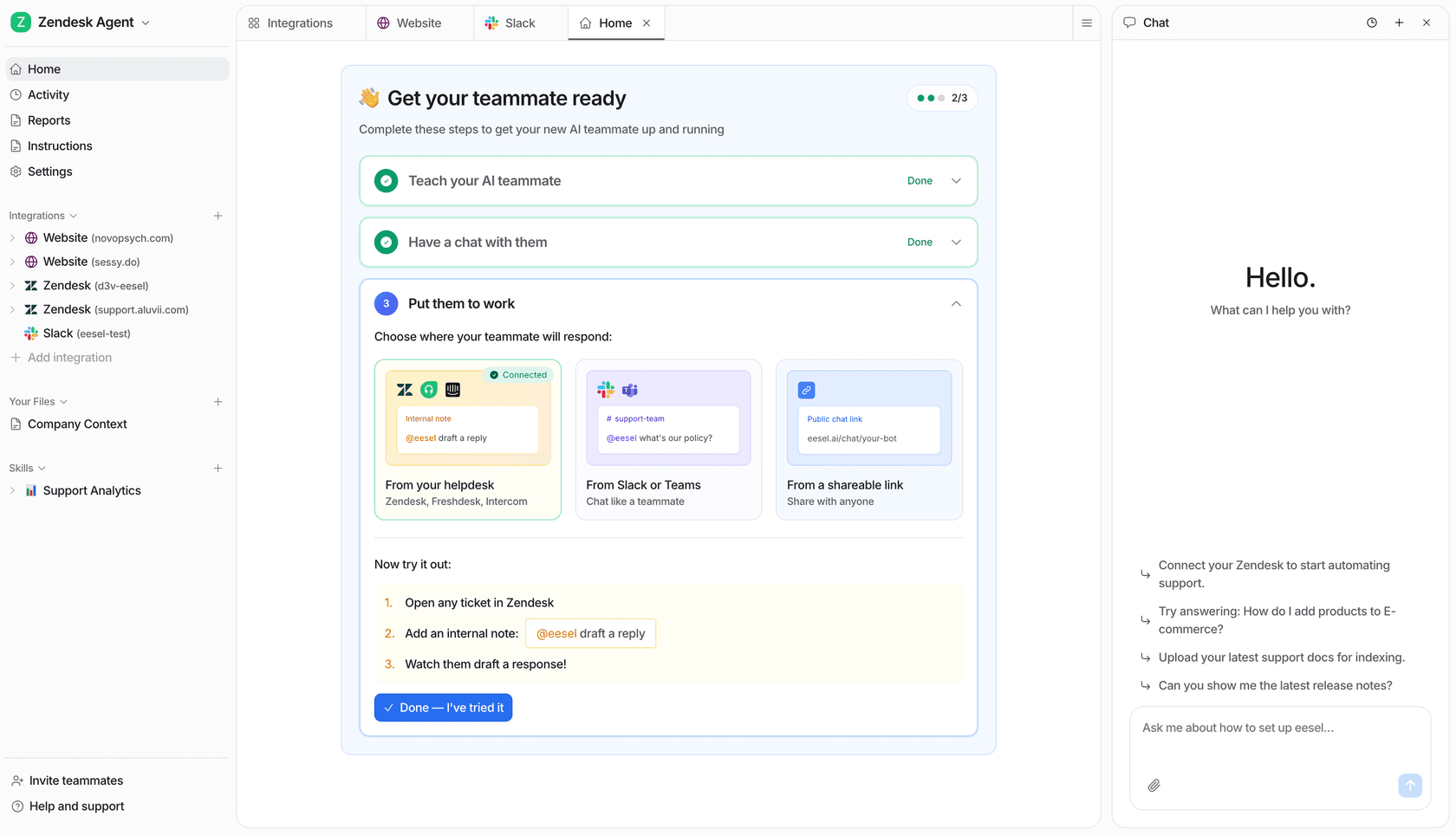
The relevant part for a model post: you never have to pick the model. eesel runs on frontier models under the hood and handles that choice for you, so the decision is not "Fugu Max or Sonnet 5," it is "do I want tickets resolved." It trains on your past tickets and help center, plugs into 1000+ tools like Zendesk, Freshdesk, and Gorgias, and, crucially, lets you simulate on historical tickets before it ever answers a customer, the dry run Fugu's opaque routing cannot give you.
If you live in a terminal, eesel also exposes a real programmable surface. The eesel CLI (@eesel/cli) and its MCP server let a person, a script, or a coding agent like Claude Code drive the same teammate and workspace as the dashboard. You can connect integrations, edit the teammate's standing instructions, run eesel activity to inspect every run, and approve or deny actions with a human in the loop, all as JSON, with a --dry-run flag that prints the exact call a write would make before sending it.
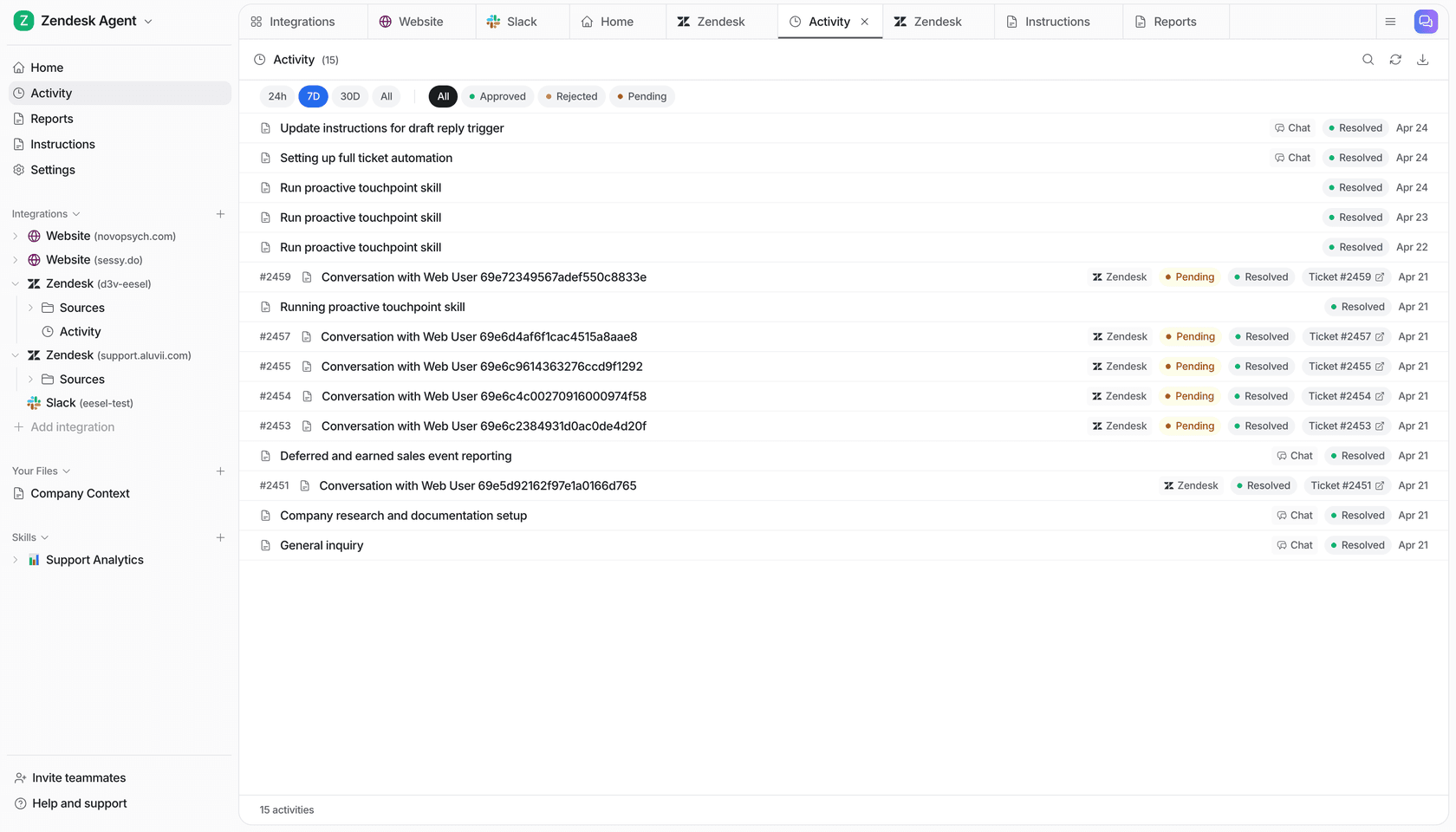
Fugu Max is a great answer to "which model should power my app." If your question is "how do I actually resolve more tickets," you can try eesel free, no credit card and no sales call, and have a teammate live in minutes.
Frequently Asked Questions
What is Sakana Fugu Max?
Sakana Fugu Max is a cost-performance AI model released on September 11, 2026. Instead of answering on its own, it uses a learned coordinator to route each request across a pool of open-weight and specialized models behind one OpenAI-compatible API. It sits alongside Fugu, Fugu Ultra, and Fugu Cyber in the Sakana Fugu family.
How much does Sakana Fugu Max cost?
Fugu Max is priced at $2 per million input tokens, $6 per million output tokens, and $0.25 per million cached input tokens, flat regardless of context length, per Sakana's FAQ. Web search and web fetch calls are $0.007 each. Subscriptions run $20 (Standard), $100 (Pro), and $200 (Max) per month.
Is Fugu Max better than a single frontier model?
Sakana reports Fugu Max as best overall on six benchmarks and 40-60% cheaper on output than Sonnet 5, GPT 5.6 Terra, and Kimi K3. Those are vendor-reported figures, and top proprietary models like Fable 5 are not in its pool, so treat the claims as a starting point and test on your own tasks. If your goal is resolving support tickets, an AI teammate that handles the whole job usually matters more than the raw model.
Where can I access Sakana Fugu Max?
It is a hosted API only, available through console.sakana.ai, OpenRouter, the Vercel AI Gateway, and opencode. It is not available in the EU or EEA while Sakana works toward compliance.
Do I need a model like Fugu Max to automate customer support?
No. A model is raw infrastructure you build on. For support, an AI teammate like eesel already handles model choice, knowledge, and actions, plugs into your existing helpdesk, and lets you simulate on past tickets before going live. See how it compares to a rule-based chatbot.


Article by
Alicia Kirana Utomo
Kira is a writer at eesel AI with a Computer Science background and over a year of hands-on experience evaluating AI-powered customer service tools. She focuses on breaking down how helpdesk platforms and AI agents actually work so that support teams can make better buying decisions.