

What Google's AI co-scientist actually is
Start with what it is not. It is not a chatbot, and it is not a literature-search tool that hands you a tidy summary. Google is specific on this point: the co-scientist is intended to uncover new knowledge and formulate "demonstrably novel research hypotheses and proposals," not to rephrase what is already known.
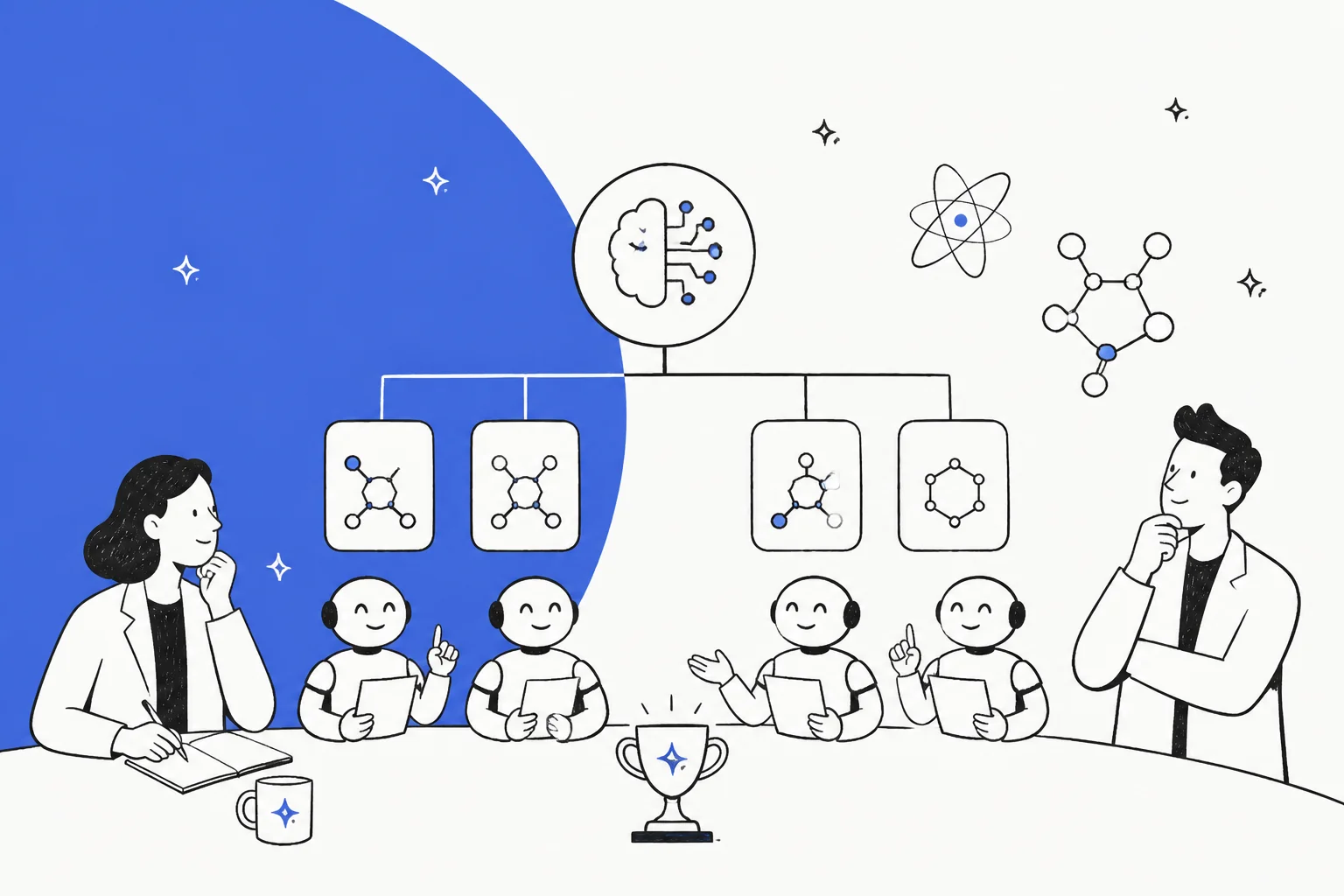
Under the hood it is a coalition of agents running on Gemini. You give it a goal in natural language, something like "propose repurposing candidates for acute myeloid leukemia," and the system spins up specialised agents that each play a role from the scientific method: one proposes ideas, one critiques them like a peer reviewer, one ranks them, one refines the survivors. The output is a ranked set of hypotheses and a research overview you could actually take into a lab.
The project has a real pedigree. It was first shared by Google Research in February 2025, led by Juraj Gottweis and Vivek Natarajan, then published in Nature in May 2026 after being tested with more than 100 institutions. That is the arc worth noticing: demo, then a year of real lab validation, then a peer-reviewed paper, which is a much higher bar than the usual "we built a cool agent" blog post.
How the multi-agent system works
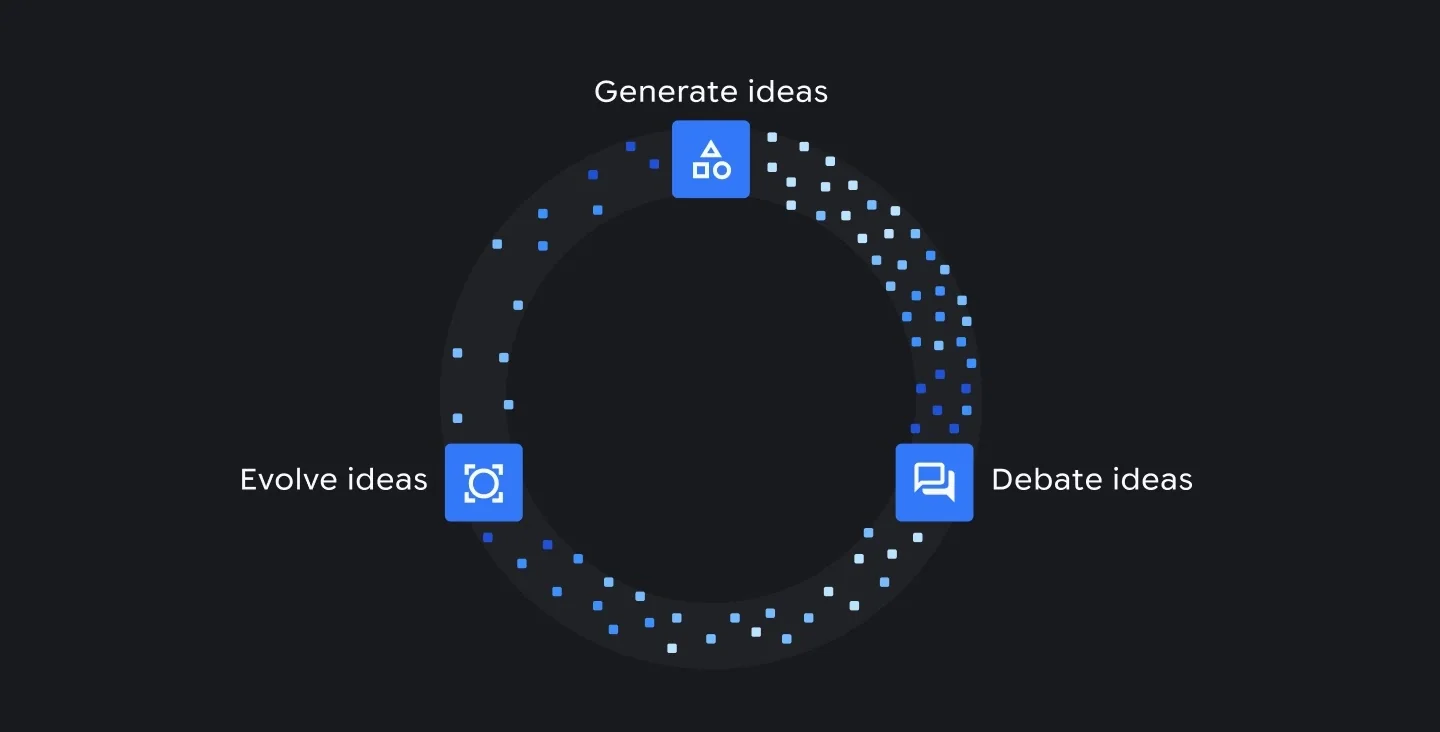
The easiest way to picture it is a three-beat rhythm: generate ideas, debate them, evolve them, on repeat.
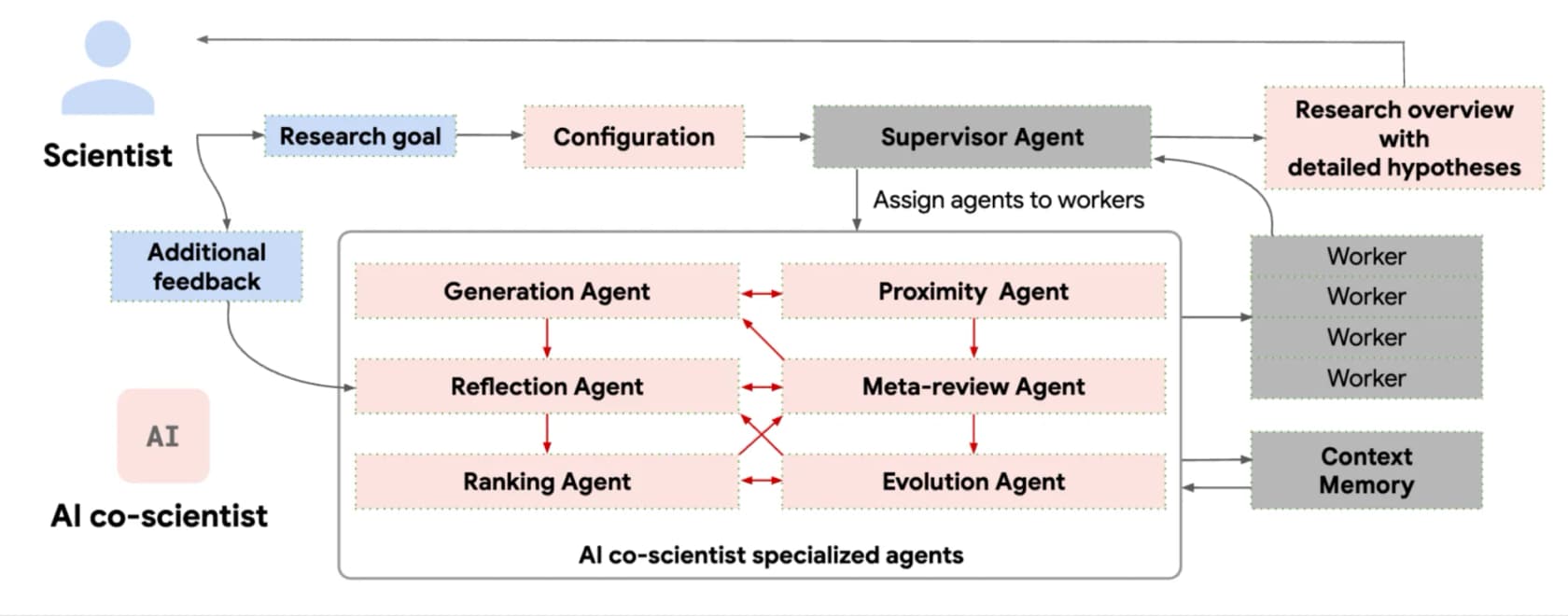
Six specialised agents split that work, and a seventh sits above them. The Nature write-up from DeepMind names them clearly:
- Generation proposes focus areas and initial hypotheses, grounded in the literature.
- Proximity clusters and deduplicates ideas so the system explores widely instead of circling one answer.
- Reflection acts as a virtual peer reviewer, checking each hypothesis for correctness and novelty.
- Ranking runs an "idea tournament," comparing hypotheses head to head.
- Evolution refines and recombines the top-ranked ideas.
- Meta-review synthesises everything into the final research roadmap.
Above all of them, a Supervisor agent parses your goal into a plan and assigns the specialised agents to a worker queue, which is how the system scales compute up or down. This is the piece that makes it a genuine multi-agent system rather than one model in a trench coat: the agents run in parallel and feed each other, exploring several avenues at once.
If you have read about the architecture behind Agentforce deep research, enterprise agent platforms like OpenAI Frontier, or research tools like Hebbia, this pattern will feel familiar: break a big fuzzy task into roles, let specialists handle each, and orchestrate them. The co-scientist is that idea pushed toward the hardest possible job, open scientific questions.
The idea tournament, and why most of the compute goes to checking
The competitive part is the clever bit. The Ranking agent runs an Elo-based tournament where hypotheses face off in simulated scientific debates, borrowing the self-play idea from AlphaGo and AlphaStar. Higher-rated hypotheses get promoted, weaker ones drop out, and the survivors get evolved further.
Here is the detail most coverage skips: Google says the majority of the system's computation goes into verifying hypotheses, not generating them. Claims get cross-checked against the literature and databases like ChEMBL and UniProt for grounding and factual accuracy. That emphasis on checking over brainstorming is the single most important design choice, and it is the same lesson that shows up in business AI, where the hard part is never generating an answer but making sure it is right before it ships. Anyone who has wrestled with AI hallucinations will recognise the instinct.
Does the tournament actually track quality? Google tested whether its internal Elo score lined up with real accuracy on the GPQA "diamond" set, a set of PhD-level science questions.
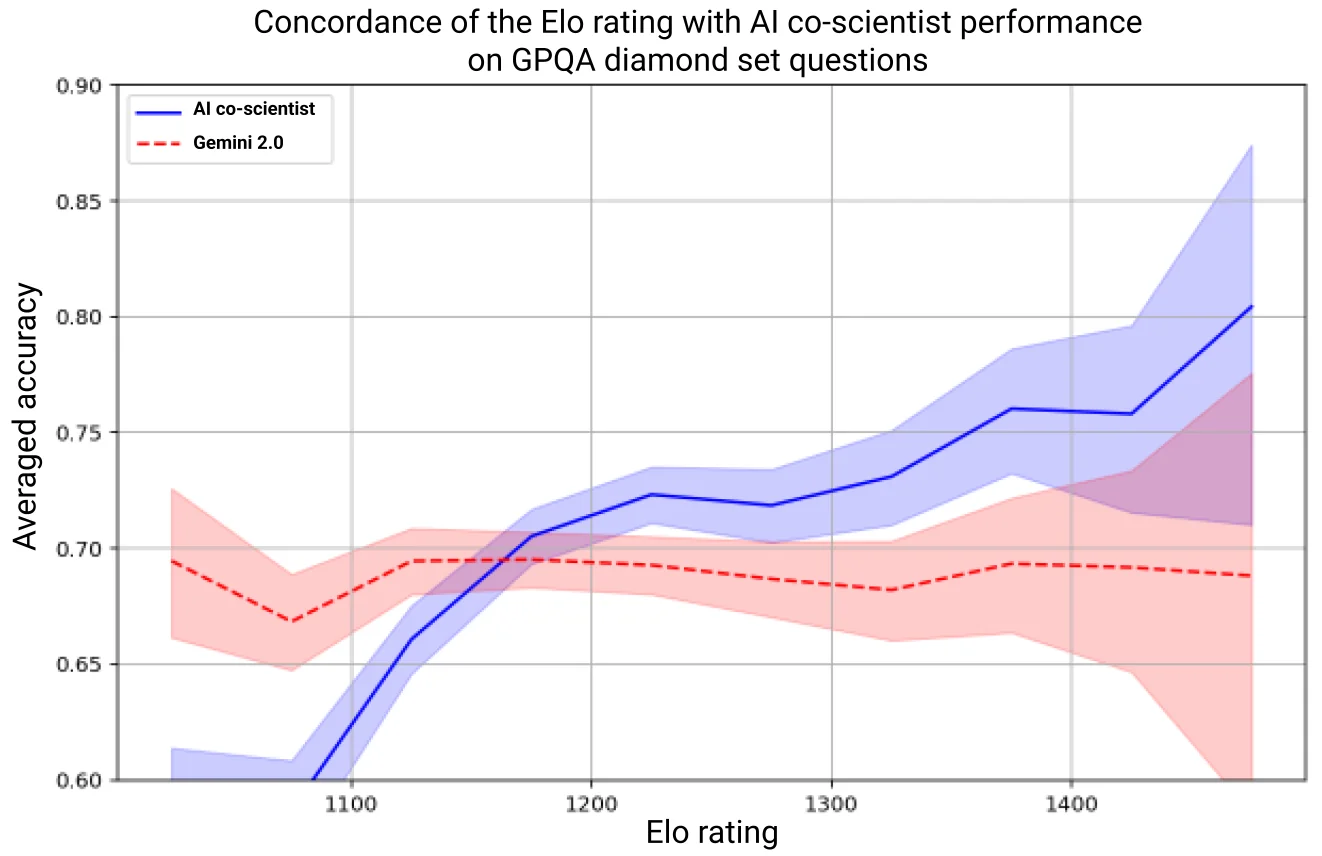
The blue line climbs: higher self-rated Elo really did correlate with a higher chance of being correct, and the co-scientist pulled clear of the raw Gemini 2.0 baseline as it spent more time reasoning. It is not independent ground truth, and Google says as much, but it is a real signal that the "think longer, debate more" approach buys you something.
The superbug story everyone quotes
Now the moment that made this famous. Google pointed the co-scientist at a question in antimicrobial resistance: how do capsid-forming phage-inducible chromosomal islands (cf-PICIs) spread across so many bacterial species? Professor José Penadés's team at Imperial College London had spent roughly a decade working this out and had not yet published the answer.
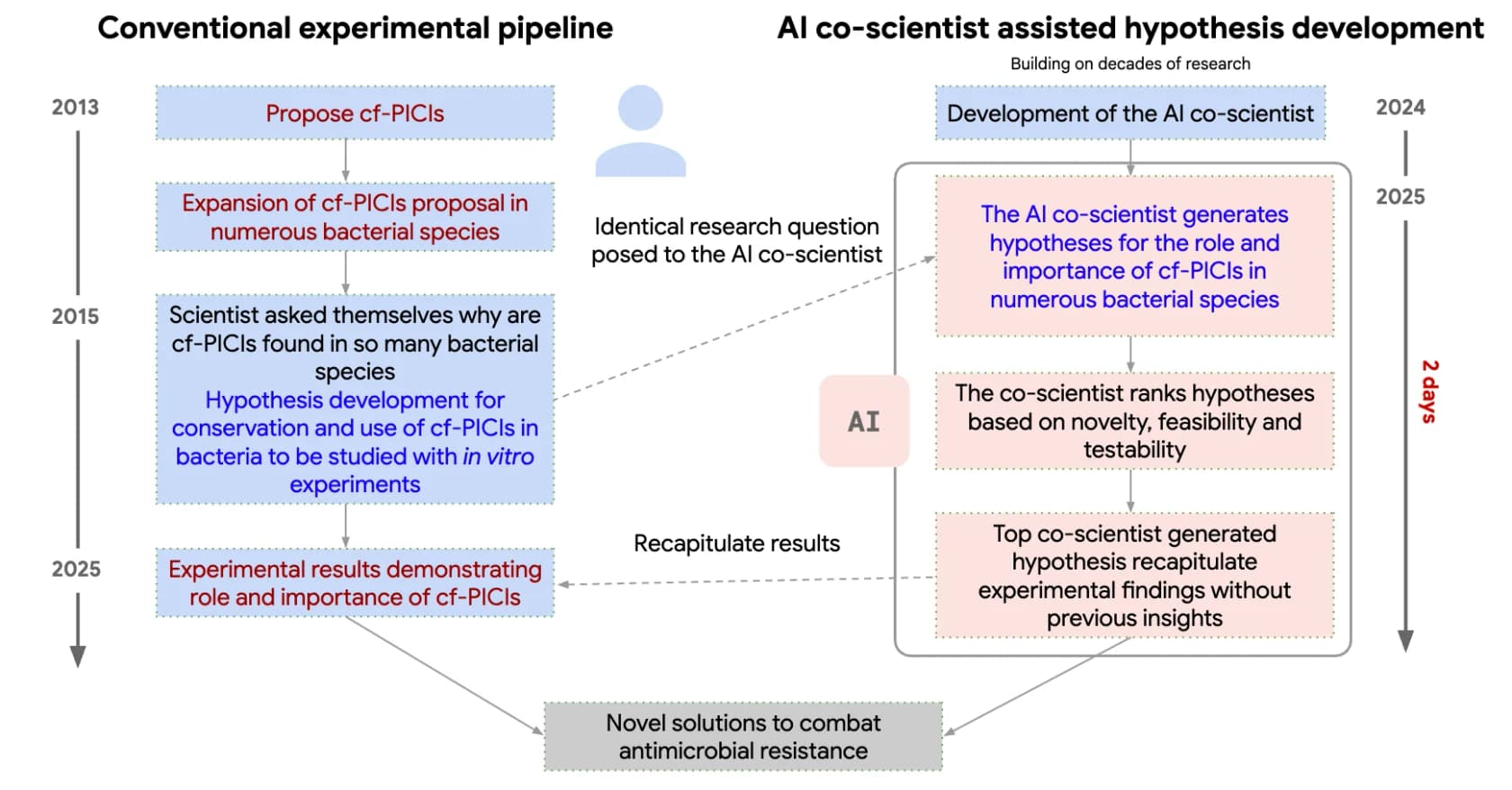
Given the same question, the system landed on the team's core hypothesis in about two days. Penadés was, understandably, floored, and it was more than a single lucky guess:
"It's not just that the top hypothesis they provide was the right one. It's that they provide another four, and all of them made sense. And for one of them, we never thought about it, and we're now working on that."

That "four more hypotheses, one we'd never considered" line is the exciting part, and the discovery was later published in Cell.
But the story got compressed into "AI cracks superbug problem in two days," and that framing set off a sharp debate. The most-upvoted Hacker News thread on it made the counter-case bluntly:
"The point isn't that it's bad, the point is that the AI did not discover the solution to the problem independently, as news headlines had implied."
The technical objection is fair. The co-scientist reads the published literature, and adjacent work by the same group was already out there, so a scientist who wrote the earlier papers might unconsciously phrase the prompt using the same framing that led to the answer. As one commenter put it, it was closer to "a search engine for information from its training data" than discovery from scratch.
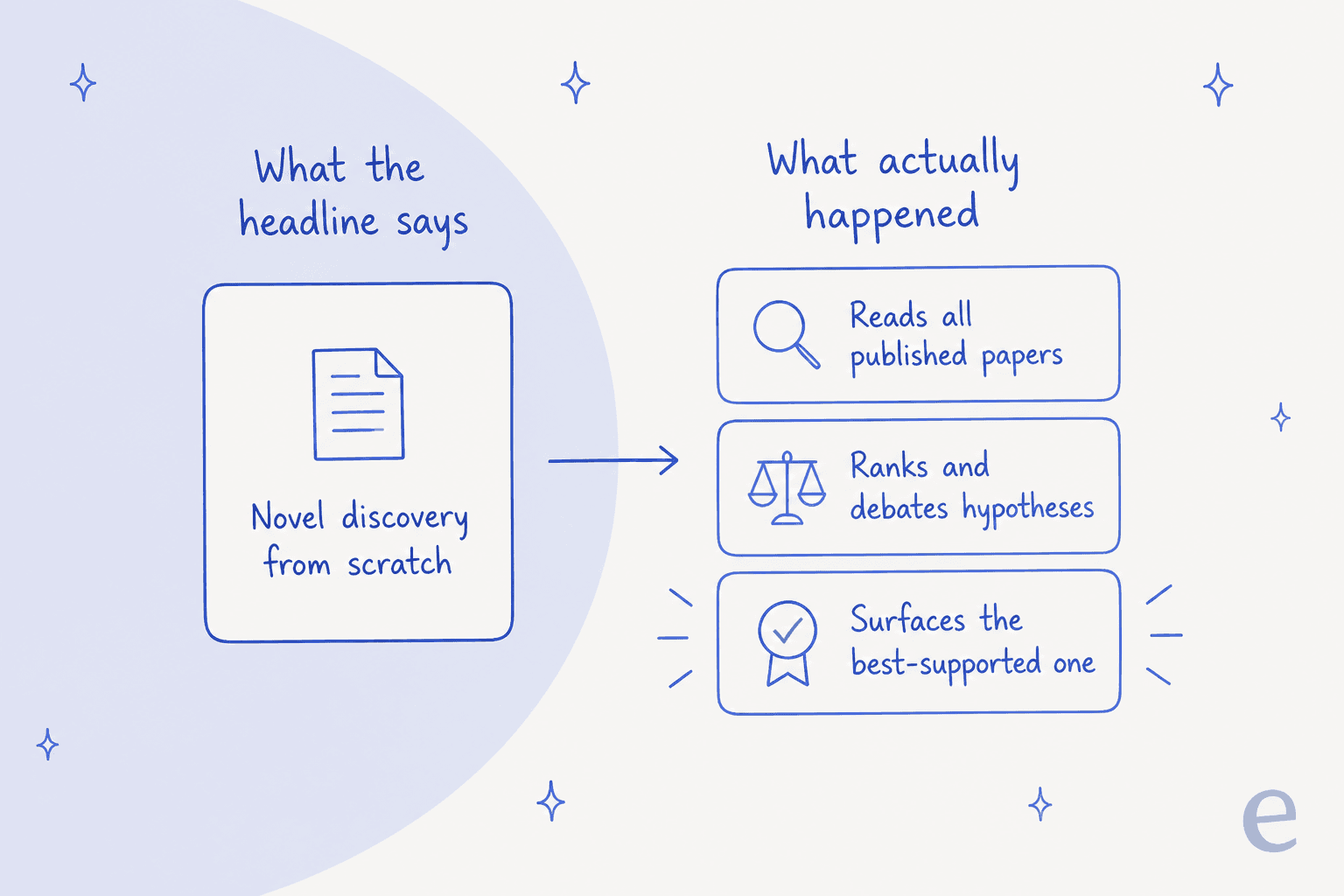
So which is it, breakthrough or hype? The most useful take on that same thread refused both extremes:
"'Knowing all of the relevant literature' is a great first step for solving a problem! ... 'This paper from a lower-tier journal two years ago suggests you should look at X' is a very valuable thing to have!"
That is the honest verdict. The co-scientist is not a synthetic Einstein having original insights in the shower. It is the fastest, most exhaustive literature synthesiser anyone has built, one that can hold every relevant paper in view at once and connect a finding buried in an obscure journal to your exact question. Reframed that way, the two-day story is still remarkable, it is just not the story the headline told.
What it is actually good at: three lab results
Beyond the superbug case, Google ran the system through end-to-end lab experiments across three biomedical problems of increasing difficulty.
| Application | Drug repurposing | Novel target discovery | Explain a mechanism |
|---|---|---|---|
| Example | Acute myeloid leukemia | Liver fibrosis | Antimicrobial resistance |
| Challenge | Combinatorial search | Identifying novel targets | Understanding complex systems |
| Difficulty | Medium | High | Very high |
| Result | Drugs inhibited tumor cells at clinical doses | Candidates blocked a scarring response, p<0.01 | Recapitulated the cf-PICI mechanism |
The drug-repurposing case is the most concrete. The co-scientist proposed existing drugs that might work against acute myeloid leukemia, and follow-up lab tests confirmed that the suggested compounds inhibit tumor viability at clinically relevant concentrations across multiple cell lines.
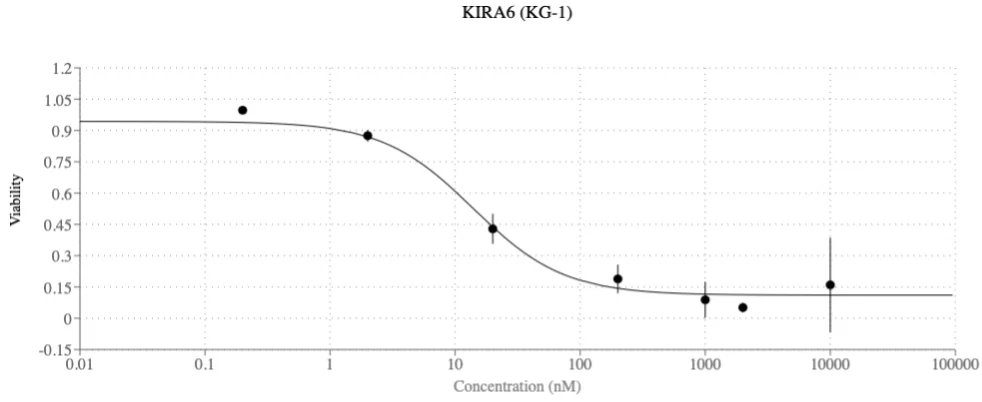
The liver fibrosis work, run with a team at Stanford and published in Advanced Science, went further into novel territory, surfacing a repurposing candidate that blocked 91% of a scarring-linked response in the lab. The scientists who used it describe the value in a consistent way, less "it did my job" and more "it caught what I would have missed":
"Co-Scientist feels like a collaborator that's read everything available about biomedical science, with the reasoning capabilities to find the connections that we're currently missing."
Notice how careful the framing is from the people closest to it. It structures thinking, catches gaps, and prioritises, but the human still asks the questions and runs the experiments. That is the same human-in-the-loop pattern that separates a useful AI agent from an overconfident one.
Where you can actually use it today
Here is the practical reality check: for most people, you cannot just log in and use it.
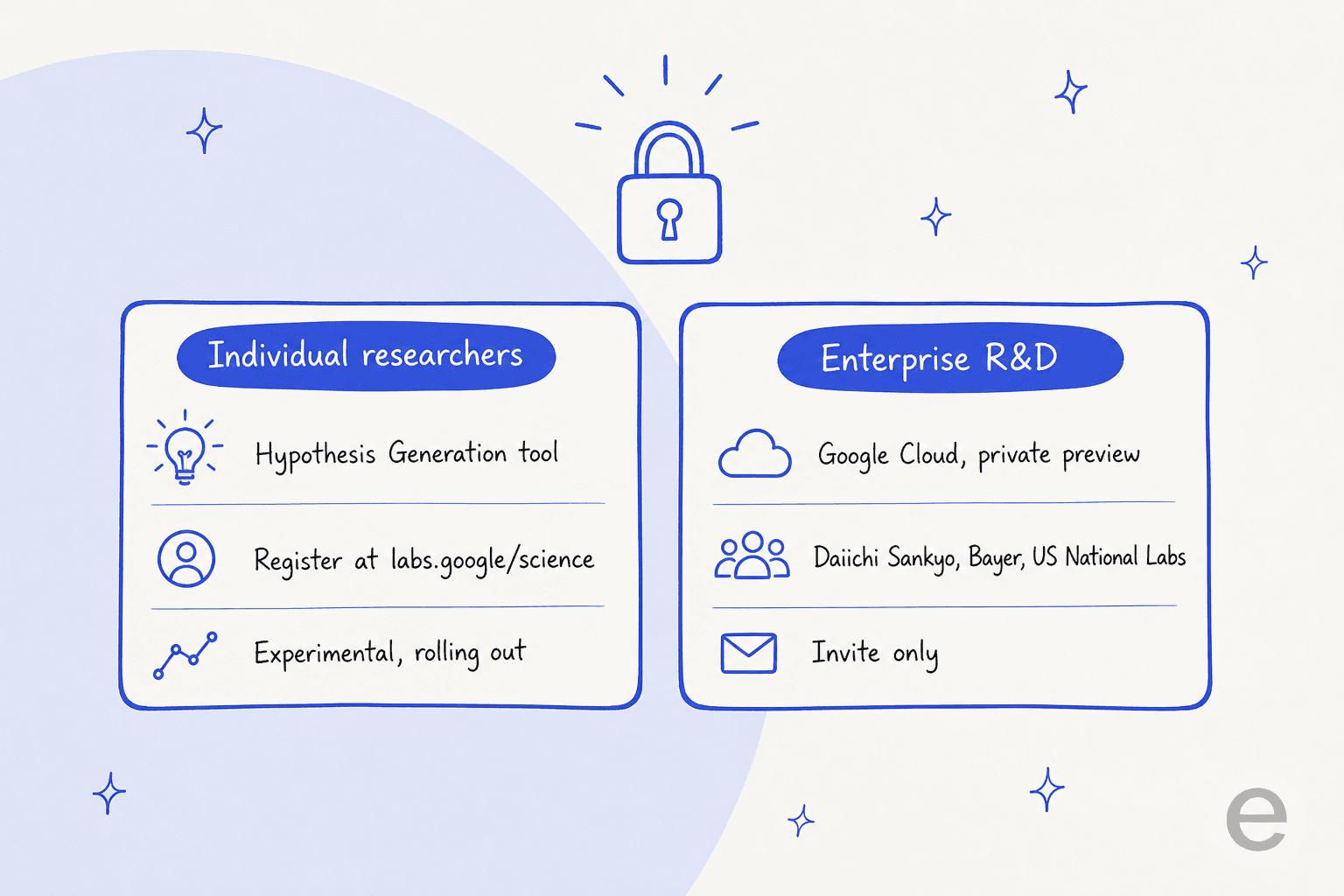
There are two routes, and both are gated. Individual researchers can register interest at labs.google/science for the experimental Hypothesis Generation tool, which Google is opening up gradually. Enterprise R&D teams get an enterprise-grade version through Google Cloud, currently in private preview with partners including Daiichi Sankyo, Bayer Crop Science, and the US National Laboratories.
Two honest caveats. Google has not published any per-use pricing, quotas, or usage limits for the co-scientist, so cost is an open question. And the tool is heavily biomedical: the marquee results are all drug repurposing, target discovery, and disease mechanisms, so if you work in, say, materials science or economics, the fit is far less proven. It is early, it is invite-driven, and it is aimed squarely at life sciences for now.
What this means if you don't run a research lab
Most people reading this will never point an agent at a cancer cell line. So why does the co-scientist matter to a support lead or a marketer? Because it is the clearest, highest-stakes proof of a pattern that is quietly reshaping ordinary work: a specialist AI teammate hired for one clearly defined job, arriving with the skills and context to do it.
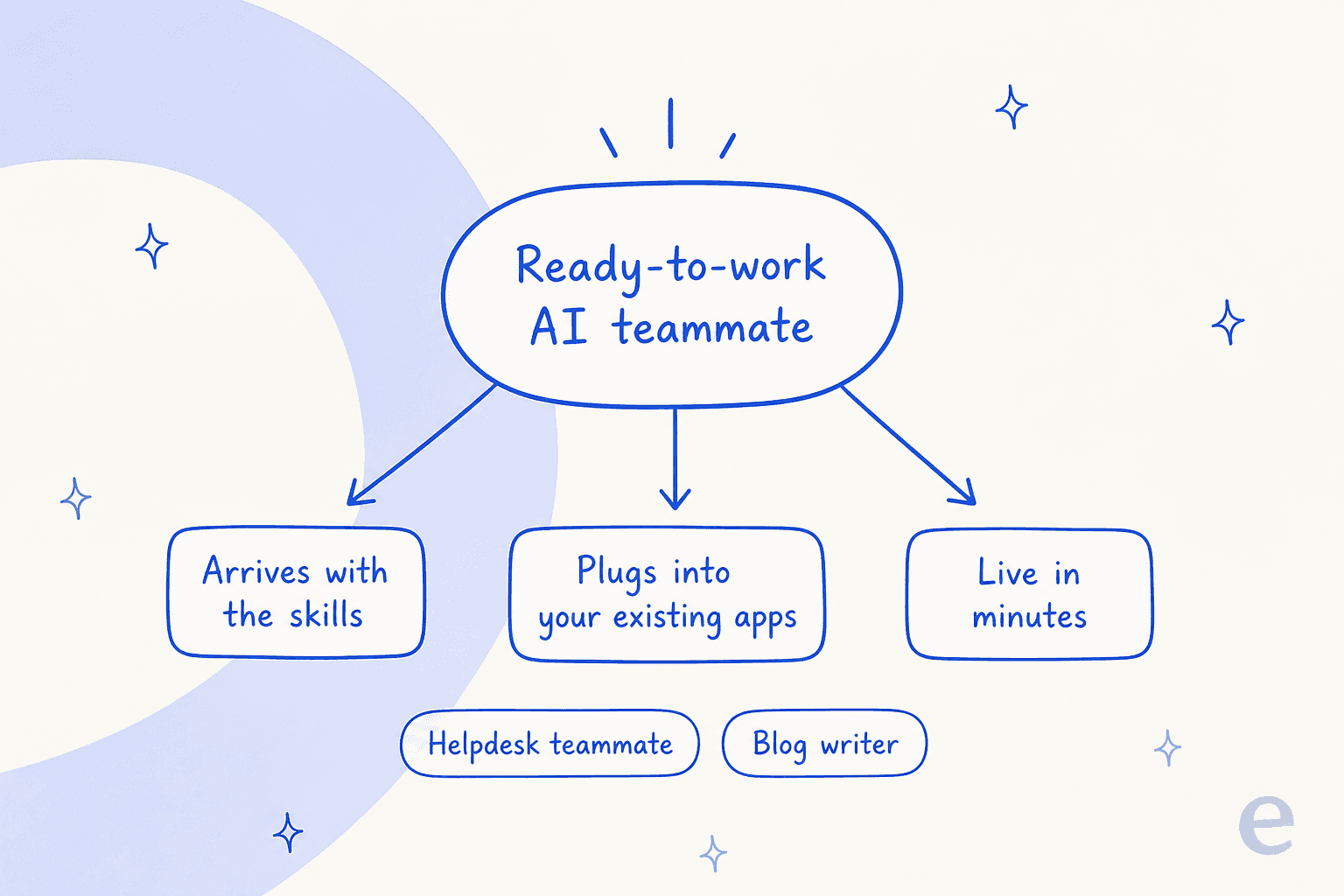
Strip away the biology and the co-scientist is a template: give it a goal, let a coalition of agents do the reasoning, spend most of the effort verifying before you trust the output, and keep a human in charge of the final call. That is the exact recipe a good business agent follows, whether it is answering a ticket or drafting a post. The difference is that Google's version is a research preview, and the business version is something you can turn on this afternoon, often at a fraction of the cost of a human agent.
Try eesel
Google built a co-scientist for the lab. eesel builds ready-to-work AI teammates for the jobs your team actually runs, and you can hire one in minutes instead of joining a waitlist.
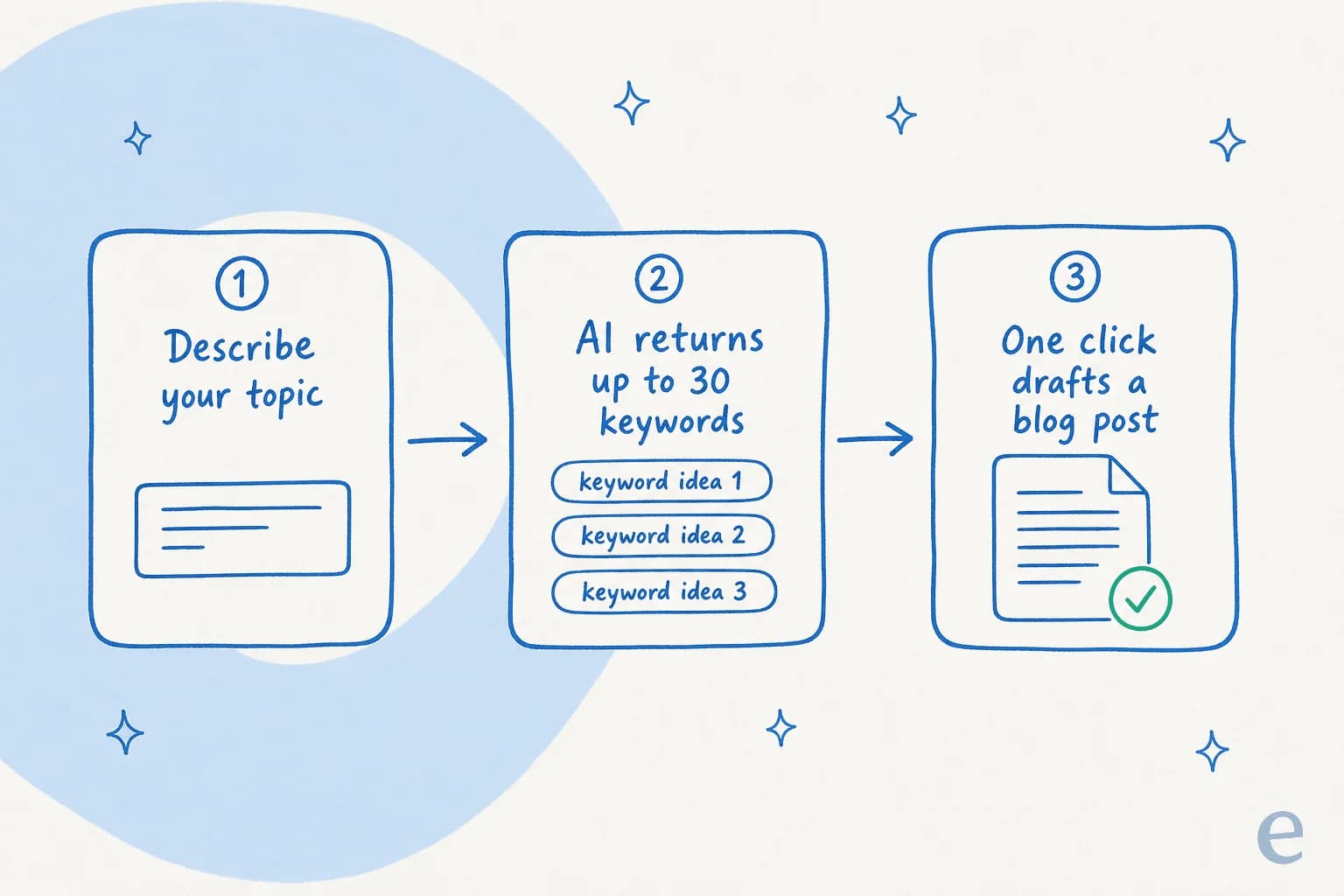
The idea is the same one that makes the co-scientist work, just pointed at support and content. The AI helpdesk teammate joins your existing queue, learns from your past tickets and help center, and drafts or sends replies, and you can simulate it against real historical tickets before it ever touches a live customer. The AI blog writer does the research-and-draft loop end to end. Both run under one account, plug into the tools you already use, and go live in minutes. It is free to start, no sales call required. See how the teammates work.