


What Genspark AI costs at a glance
Genspark is an all-in-one AI workspace built around a "Super Agent", made by MainFunc, the Palo Alto startup that went from launch to a $1B+ valuation and a reported $100M+ in revenue faster than almost any AI product before it. It bundles slides, sheets, docs, code, dashboards, image, video, music, and AI phone calls into one product, and it bills all of them from a single credit pool.
Here are the public tiers. Both Plus and Pro actually have multiple credit sub-tiers, so the published price is the entry point ("starting from") and you can buy a bigger credit bucket for more.
| Plan | Monthly | Annual (~20% off) | Credits | Storage | Notes |
|---|---|---|---|---|---|
| Free | $0 | $0 | ~100 credits/day (refreshed every 24h) | 1 GB | Basic Super Agent + Sparkpages, standard features |
| Plus | $24.99/mo | $19.99/mo | From 10,000 credits/mo | 50 GB | All models; AI Slides, Code + all agents; commercial use; unlimited core chat + image at zero credit cost |
| Pro | $249.99/mo | $199.99/mo | From 125,000 credits/mo | 1 TB | Everything in Plus + priority speed, early access, exclusive high-end image models |
| Team / Enterprise | Not public | Not public | Not public | - | SSO sign-in required |
Plan structure, credit amounts, and storage are from Genspark's own Help Center. The exact dollar figures above the entry tier are login-gated, so treat the sub-tier prices as "starting from."
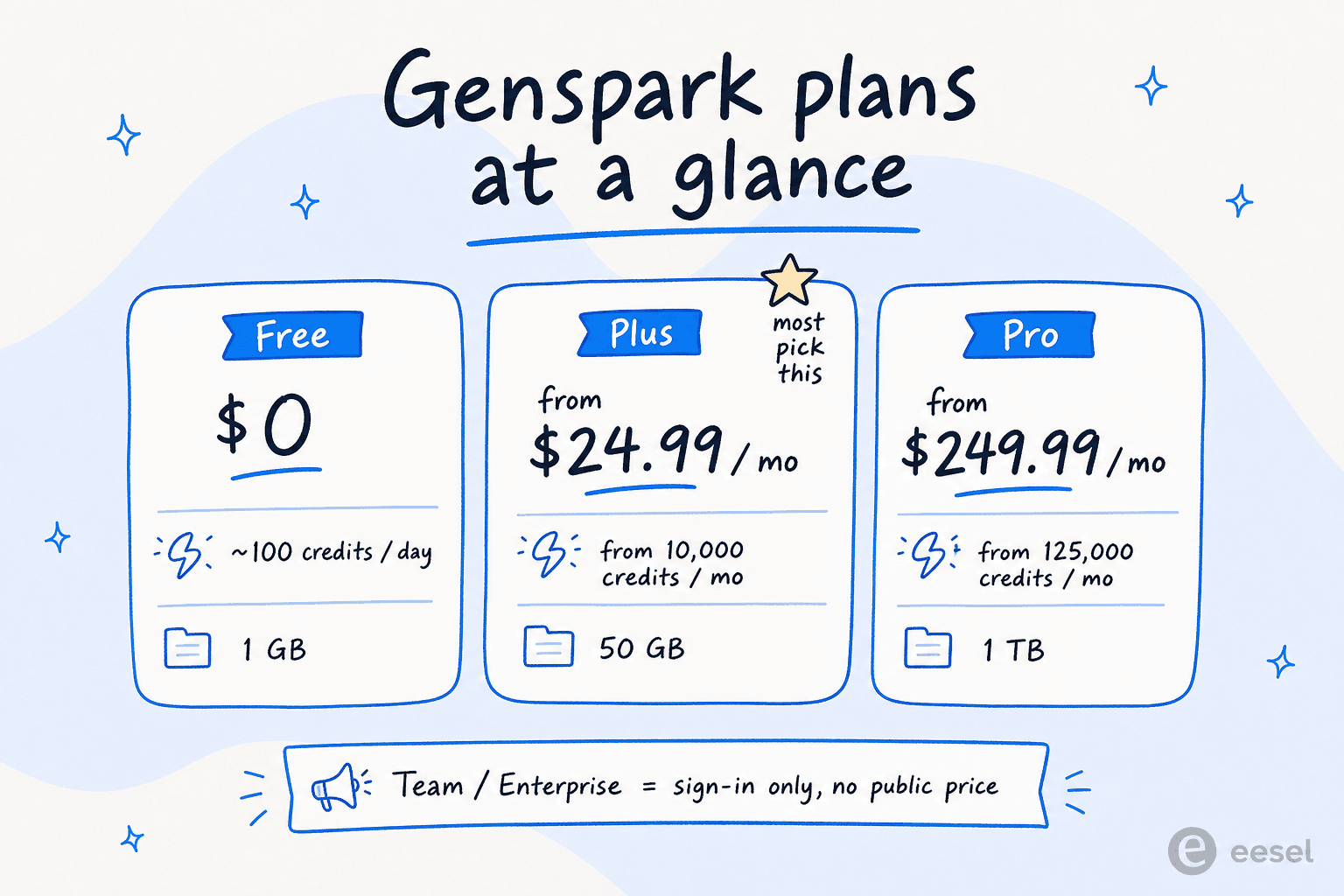
The jump from Plus to Pro is a 10x price increase for a 12.5x credit increase, plus faster speeds and a few exclusive high-end image models. That maths only works if you're actually burning through Plus every month, which brings us to the part that matters.
The credit system is the real price
Here's the thing to internalise: in Genspark, the plan name is almost a distraction. The credit is the price. Every task you run draws from your pool, and the rates are wildly uneven.
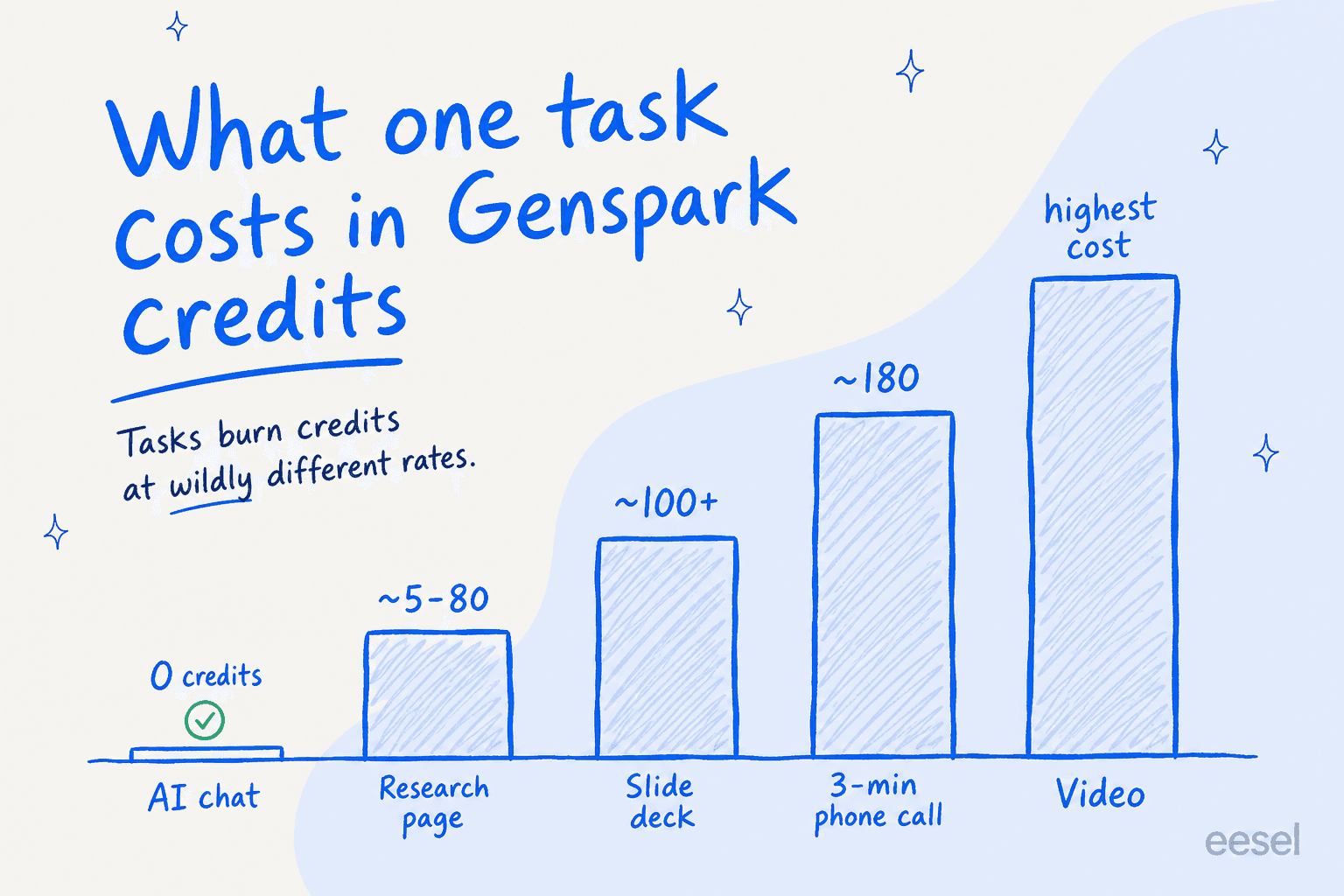
Rough per-task costs, based on Genspark's own help docs and community testing:
| Task | Approx. credit cost |
|---|---|
| AI chat (core) | 0 credits on paid plans (promo through Dec 31, 2026) |
| AI image generation | 0 credits on paid plans (promo through Dec 31, 2026) |
| Speakly voice dictation | 0 credits (unlimited on paid) |
| Research Sparkpage | ~5 to 80 credits (depends on depth) |
| AI Slides (full deck) | ~100+ credits |
| AI phone call ("Call for Me") | ~1 credit/second (~180 for a 3-min call) |
| Video generation | Highest-cost task per run |
Notice what that does to your 10,000 Plus credits. If you live in chat, you effectively never run out, because chat is zero-rated. But a video-heavy month tells a different story entirely, and it's why one Pro subscriber reported their pool lasting a single day:
"Genspark definitely burns through credits faster this year. consumes 300 a 600 credits easy. consumed way less. I get 10k credits per month."

The most extreme reports are worse than that:
"Genspark burned 10K credits on one command."
If you do run dry mid-cycle, Genspark sells top-up packs (community reports put them at roughly $20 for 10,000 credits and $40 for 20,000, each valid about three months). Upgrades apply immediately with a prorated charge and supplemental credits; downgrades wait until the next cycle and reset your balance rather than carrying it over.
Two worked examples
Sticker prices lie about consumption pricing, so let's cost out two realistic users on the same $24.99 Plus plan.
The light user (decks and chat). You use Genspark for unlimited Claude and GPT-class chat all day, generate a handful of images, and build maybe two or three slide decks a week. Chat and image are zero-credit, and a dozen decks a month at ~100+ credits each is only ~1,200 to 1,500 credits. You finish the month having barely dented your 10,000. For this person, Plus is genuinely great value, which is exactly why the fans are so loud, they're getting near-unlimited premium chat for the price of one ChatGPT subscription.
The heavy user (video and calls). You lean into the features Genspark is famous for: AI video for social clips, and the "Call for Me" phone agent for bookings and outreach. A single three-minute call is ~180 credits, so 40 calls is already ~7,200. Add a week of video generation, the single most expensive task, and you're topped out before month's end, staring at a top-up prompt. This is the user filling the Reddit threads, and the one for whom the real monthly cost is $24.99 plus whatever top-ups the tasks demand.
The lesson isn't that Genspark is expensive or cheap. It's that your bill is set by your task mix, not your plan, and the two can differ by 10x on the same tier. If you're weighing it against the other big general agent, the Manus credit system works the same way and carries the same warning.
The gotchas the sticker price hides
Consumption pricing always has fine print, and Genspark's has bitten enough paying users that it's a visible pattern rather than a handful of outliers.
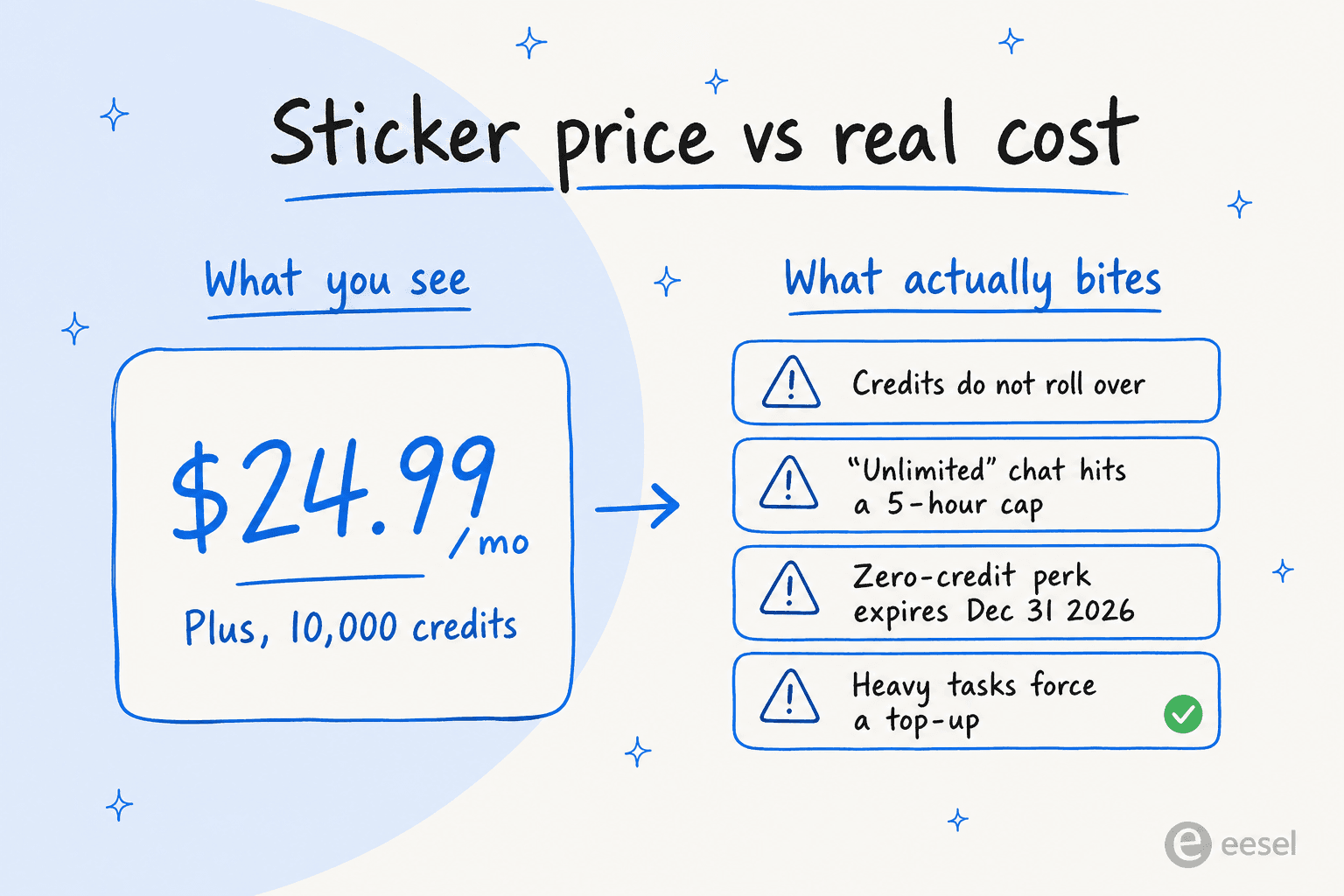
- Credits don't roll over. Anything you don't spend in the cycle is gone. On annual billing you pay the whole year upfront, but credits still drip out monthly, so you can't front-load a big project.
- "Unlimited" has an asterisk. The zero-credit chat and image perk is real, but users report it hitting a session rate limit that resets roughly every five hours, and some report credits draining on features advertised as unlimited.
"Genspark Plus was promised "unlimited chat and image creation" GenSpark is constantly giving me 5-hour session limits. This is extremely ..."
- The zero-credit perk is promotional. Free chat and image are only guaranteed through December 31, 2026. After that, the two tasks most likely to make Plus feel unlimited could start drawing your pool.
- You can be charged for failures. This is the recurring theme on Trustpilot, where Genspark sits at roughly 1.5 to 1.9 out of 5 across ~112 reviews, about 84% of them one star.
"You are charged for the privilege of watching tasks fail - credits are debited on failed attempts, retries, and incomplete outputs."

None of this makes Genspark a scam, and the "is it a scam" threads mostly conclude it's a real (if frustrating) product. But it does mean the honest price of Genspark is "$24.99 or $249.99, plus whatever your task mix and the fine print add on top." Budget for the pool, not the plan.
Is Genspark worth the price?
For the right user, yes, and it's worth saying so plainly before the pivot. If you're an individual or a small team doing lumpy, one-off knowledge work, Plus at $24.99 is a legitimate steal: near-unlimited premium chat, fast slide decks, and an agent that genuinely impresses on a first run. The fans on Reddit calling it a "hidden gem" for the price aren't wrong.
Where the pricing model breaks down is repetitive, high-volume, business-critical work with the same shape every day. Credit pricing is built for spiky, unpredictable use, which is the opposite of what a customer support queue looks like. A queue is the same task ten thousand times, and you can't run a budget on a unit that swings 10x depending on the task. This is the same problem that shows up across general AI agents when people try to point them at operational work: the economics of AI versus a human agent only work if the cost per resolution is predictable.
I've spent a couple of years watching what happens when teams point AI at live support, and the pattern is consistent: a general agent that dazzles on a one-off is a liability on a queue, both because a wrong answer goes to a real customer and because the bill becomes impossible to forecast. That's the gap a purpose-built support AI fills, and it's why the pricing model matters as much as the capability.
Genspark vs eesel for support pricing
If the work you actually need to automate is customer support, the pricing question flips. You don't want a credit meter spinning at an unknown rate on every ticket, you want to know your cost per ticket before you commit. That's the whole design of eesel AI: one fixed monthly price, from $299/month for 500 credits, where 1 credit is always one ticket or chat however long it runs, with no per-seat fees. It scales with the work rather than your headcount, and if you run out, you can turn on optional overage with a cap you set.
The other half is fit. A super agent doesn't know your refund policy, your past tickets, or your escalation rules. eesel trains on your solved tickets and help docs, plugs into Zendesk, Freshdesk, HubSpot, Gorgias, and Front in minutes, and routes low-confidence answers to a human instead of guessing. Before you go live, you can run it in simulation mode against thousands of your past tickets to see exactly what it would have answered, and what it would have cost, which is how Gridwise resolved 73% of its tier-1 requests in the first month.

Genspark will happily book your dinner reservation and burn credits doing it. For the queue that never empties, try eesel instead, where one credit is one ticket.