
How much does Eleven v4 cost?
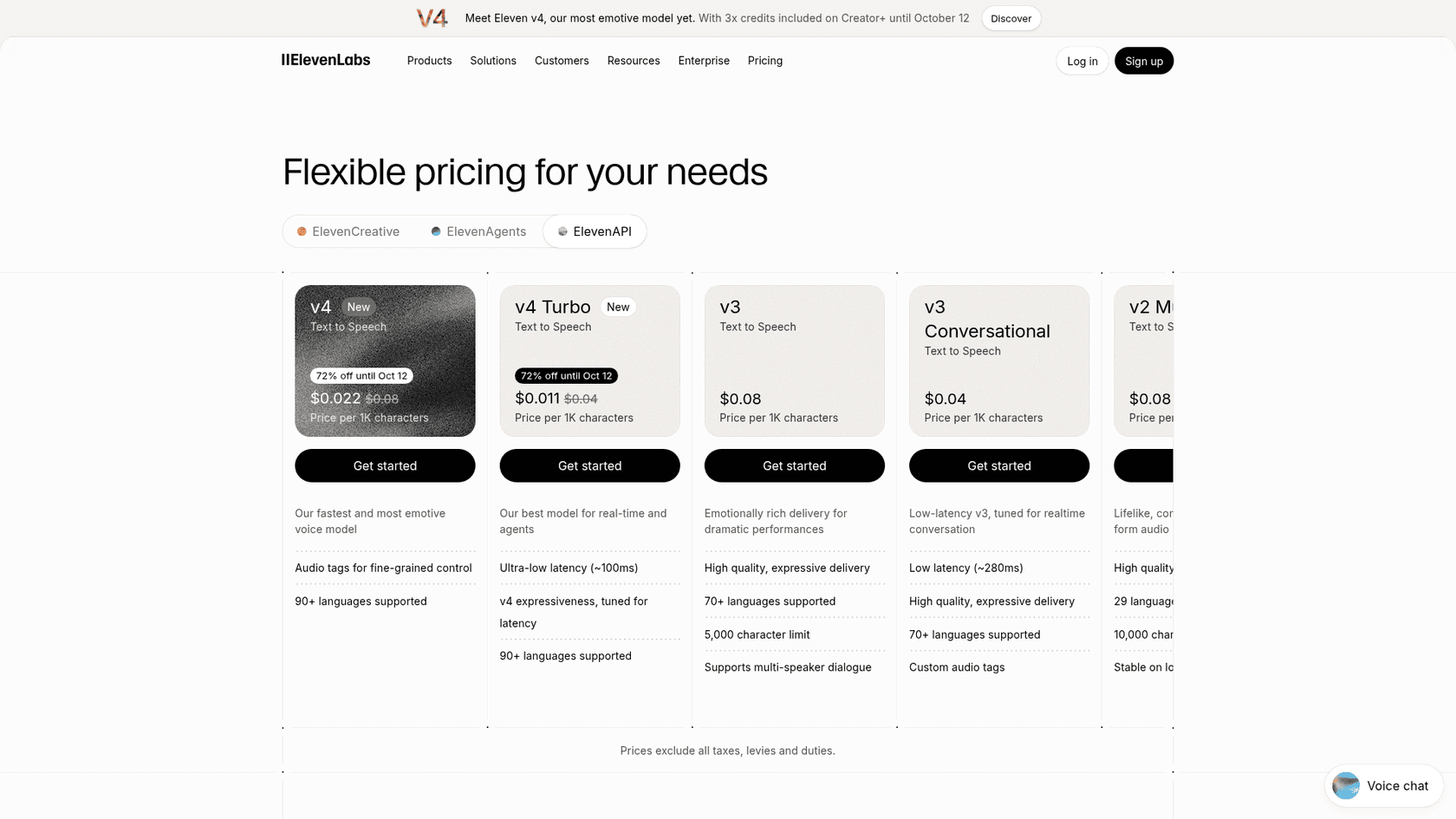
I spend a lot of my time at eesel looking at what people type into Google before they buy. "Eleven v4 pricing" is a good example: the first answer you find is technically true and practically misleading. The API pricing page leads with the launch price, and the launch price has an expiry date. Here's the full picture as of October 7, 2026.
| Model | List price per 1K characters | Launch price (until Oct 12) | Approx. cost per minute at list | Latency | Character limit |
|---|---|---|---|---|---|
| Eleven v4 | $0.08 | $0.022 | $0.08 | Not real-time | 10,000 |
| Eleven v4 Turbo | $0.04 | $0.011 | $0.04 | ~100ms | Streaming |
| Eleven v3 | $0.08 | n/a | $0.08 | Not real-time | 5,000 |
| Eleven v3 Conversational | $0.04 | n/a | $0.04 | ~280ms | Streaming |
| v2 Multilingual | $0.08 | n/a | $0.08 | Not real-time | 10,000 |
| Flash / Turbo (v2.5) | $0.04 | n/a | $0.04 | ~75ms | 40,000 |
The billable unit is the character you send, not the audio you keep. The pricing FAQ says credits are "charged per generation request, not per download," so every re-take of a line costs you again, apart from a limited number of free regenerations when the text and settings don't change.
Laid out like this, two things stand out. First, ElevenLabs didn't raise prices for the new model: v4 slots into v3's $0.08 tier and Turbo into the $0.04 tier, per the Eleven v4 landing page, which says v4 "uses the same credit pricing as our other Text to Speech models." Second, Turbo at $0.04 is the cheapest way to get v4 quality, and on the Artificial Analysis leaderboard it actually edges the full model in blind votes (1334 Elo vs 1321).
I covered that result in more depth in my Eleven v4 breakdown, and the company behind it in my ElevenLabs overview.
What happens when the launch discount ends?
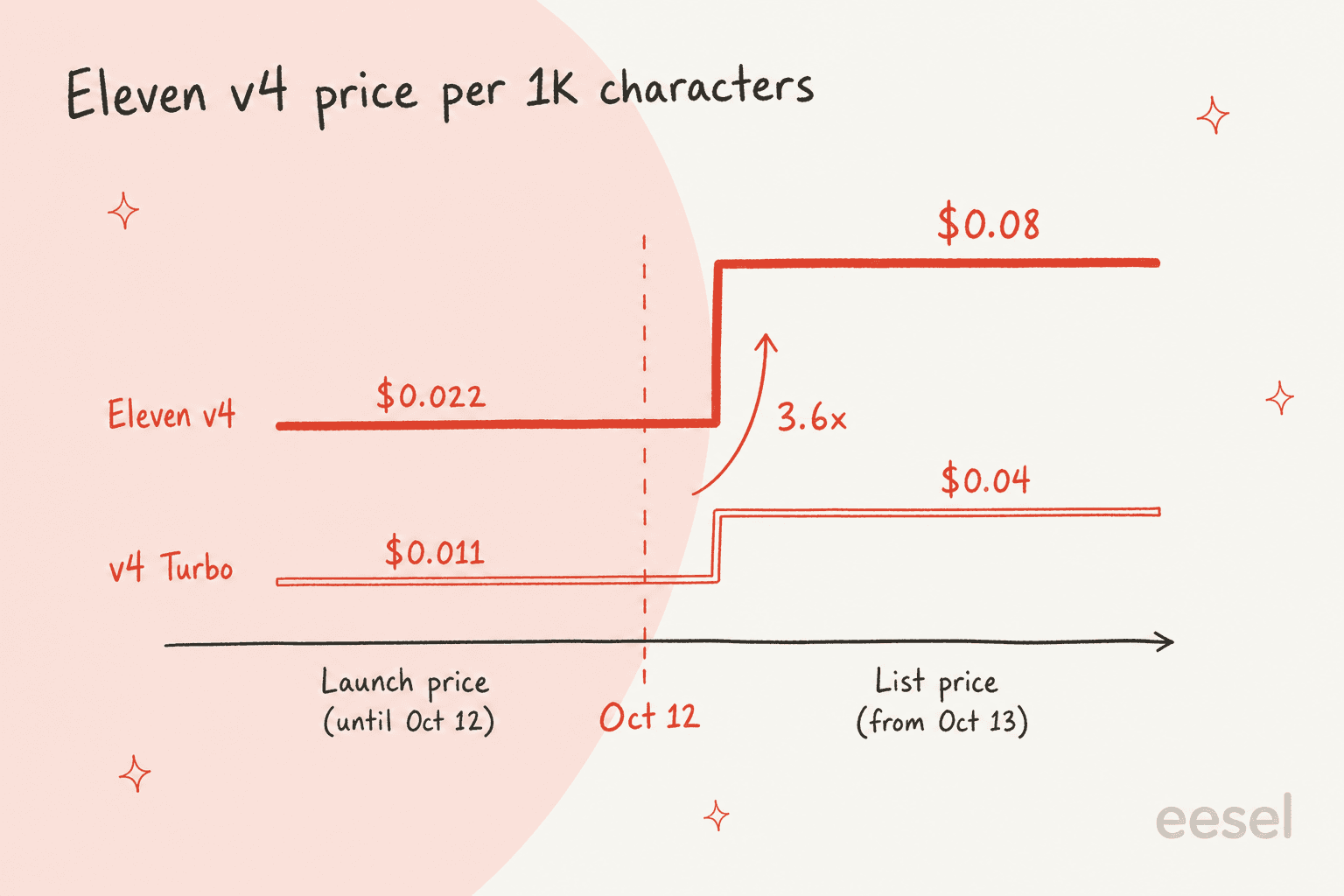
The discount is 72% off until October 12, and the pricing page doesn't hide that. The part that's easy to miss is how it feeds into the plan tables. The API page lists "characters included" per plan, and today those numbers are calculated at the discounted rate.
| API plan | Monthly price | v4 characters included today | v4 characters at list price | v4 Turbo characters at list |
|---|---|---|---|---|
| Free | $0 | 10,000 | 10,000 | 20,000 |
| Starter | $6 | 273,000 | 75,000 | 150,000 |
| Creator | $22 | 1,000,000 | 275,000 | 550,000 |
| Pro | $99 | 4,500,000 | 1,238,000 | 2,475,000 |
| Scale | $299 | 13,591,000 | 3,738,000 | 7,475,000 |
| Business | $990 | 45,000,000 | 12,375,000 | 24,750,000 |
The "today" column comes straight from the API pricing page. The list column is what v3 shows for the same plans on the same page, which is also what v4 costs once the promo ends. So a Pro plan that looks like 4.5 million v4 characters is really 1.24 million from October 13 onward.
Testing v4 this week? Use the discount. Just don't size a production plan on it. The person who signs up for Pro expecting 4,500 minutes of v4 narration a month is going to get about 1,238.
How do app credits work for Eleven v4?
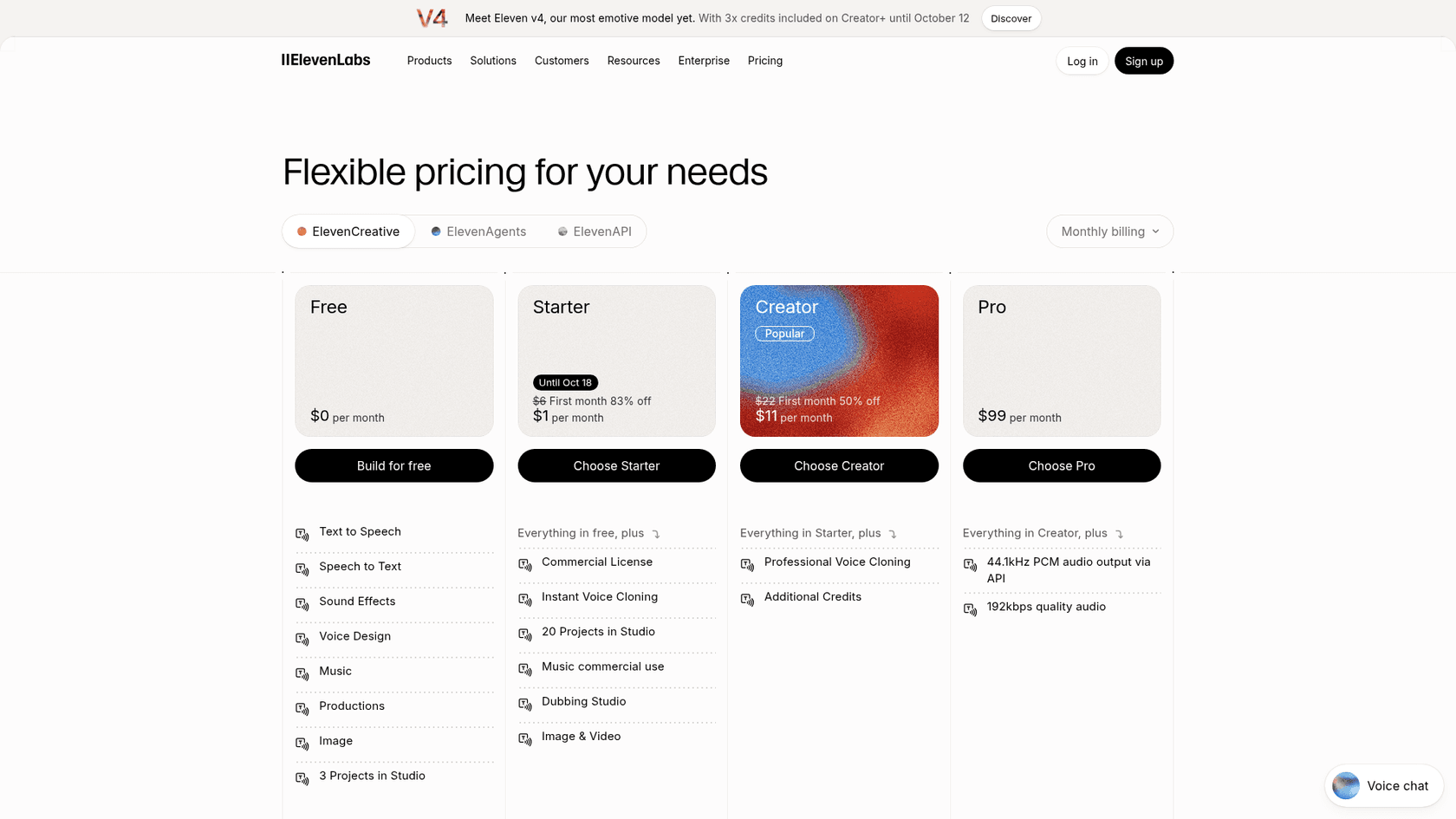
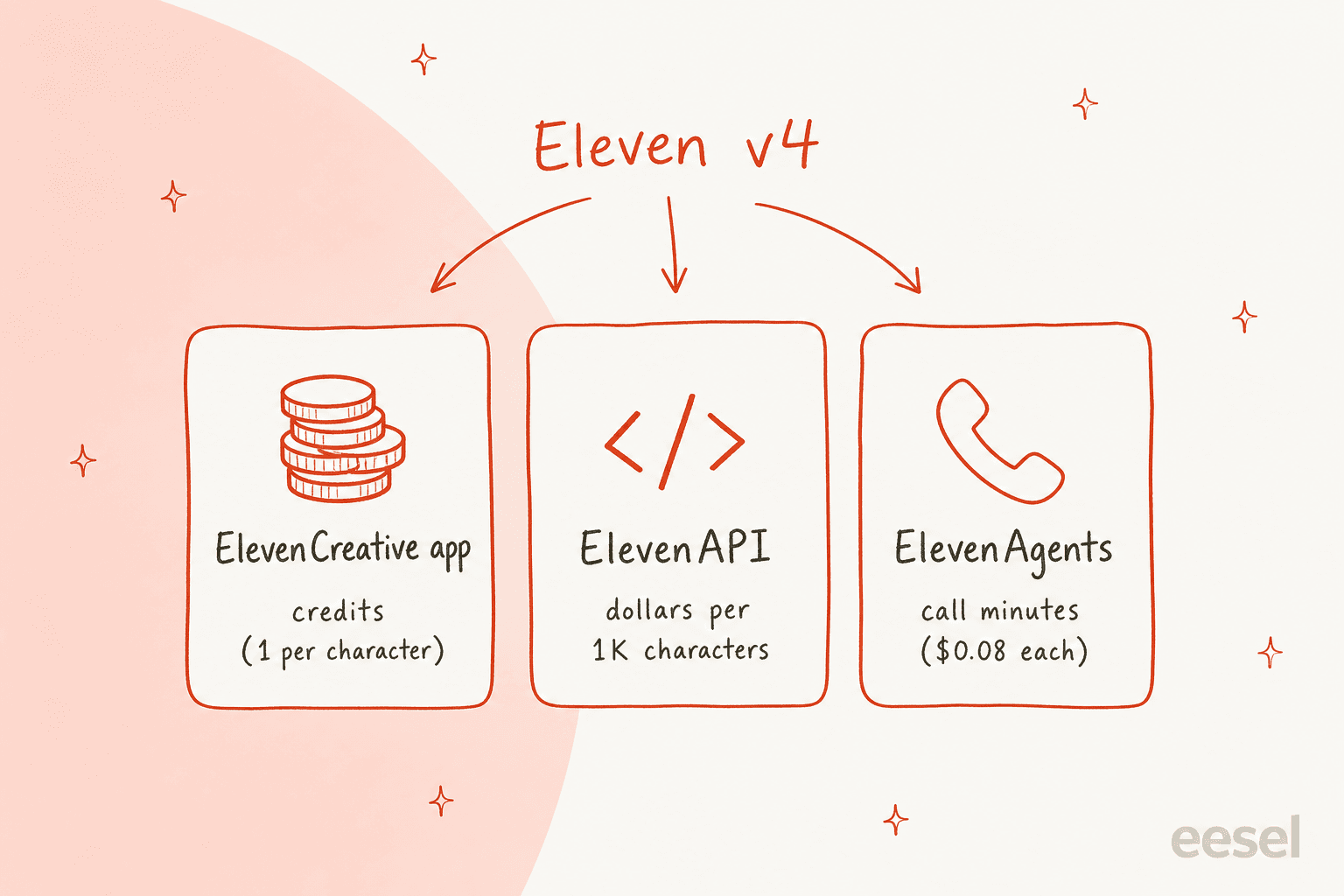
If you use v4 in the web or mobile app (ElevenCreative) rather than through code, you're on a different meter. The Creative pricing page sells monthly credit pools, and Text to Speech costs roughly 1 credit per character. The same pool also pays for speech to text (330 credits a minute), music (900 a minute), dubbing, and sound effects, so heavy users of other tools have less left for v4.
| App plan | Monthly price | Credits per month | Approx. v4 minutes | Extra minute | Workspace seats | Professional Voice Clones |
|---|---|---|---|---|---|---|
| Free | $0 | 10,000 | ~10 | n/a | Not listed | 0 |
| Starter | $6 ($1 first month) | 30,000 | ~30 | ~$0.20 | Not listed | 0 |
| Creator | $22 ($11 first month) | 121,000 | ~121 | ~$0.18 | Not listed | 1 |
| Pro | $99 | 600,000 | ~600 | ~$0.17 | Not listed | 1 |
| Scale | $299 | 1,800,000 | ~1,800 | ~$0.17 | 3 | 3 |
| Business | $990 | 6,000,000 | ~6,000 | ~$0.17 | 10 | 10 |
| Enterprise | Custom | Custom | Custom | Custom | Custom | Custom |
A few billing rules from the same FAQ are worth knowing before you commit:
- Rollover is capped. Unused credits roll over for up to two months, so your balance tops out at 3x your monthly quota. Downgrade or cancel and the unused paid credits expire.
- Annual billing is two months free. You pay 10 months up front, which puts Creator at $18.33 a month and Pro at $82.50.
- Commercial use starts at Starter. The free plan has no commercial license.
- The Starter intro deal runs to October 18. It's $1 for the first month, a separate offer from the v4 launch promo.
There's also a v4 promo in the app itself. The pricing page section says that on Creator plans and up, "up to 2x your monthly TTS credits used on v4 won't count against your balance," in the web and mobile apps only. The banner at the top of the same page says "3x credits included on Creator+ until October 12." I couldn't find anything that settles which one is right, so check your own balance after a test generation instead of planning around either.
This next comparison surprised me most. Spend $99 on the Pro app plan and you get 600,000 credits, about 600 minutes of v4. Spend $99 on the Pro API plan and you get 1,238,000 v4 characters at list, about 1,238 minutes. Per character, the API is roughly twice as cheap as the app. The app gets you Studio, projects, voice tools, and the rest of the creative suite, and that's worth paying for if you live there. For audio generated from a script or a pipeline, the API wins. (If you're weighing APIs more broadly, my Realtime vs TTS API comparison covers OpenAI's side.)
Do bigger plans make Eleven v4 cheaper?
On the API, no. Divide any self-serve plan's price by its included list-price characters and you get the same $0.08 per 1,000 for v4: $6 for 75,000, $99 for 1,238,000, $990 for 12,375,000. ElevenAgents works the same way, with $22 buying 275 minutes and $990 buying 12,375, both $0.08 a minute.
So the tiers aren't volume discounts. They're prepaid buckets at one rate. Bigger buckets add everything around the characters: more concurrency, workspace seats, more Professional Voice Clones, and 44.1kHz PCM output over the API from Pro up. Real per-unit discounts only show up on Enterprise, which the pricing page describes as "significant discounts at scale," along with custom DPAs, SLAs, and BAAs for HIPAA customers.
That changes how I'd pick a plan. Choose the smallest tier whose features you need, not the one whose character count looks generous, and let pay-as-you-go absorb the rest. The app is the exception, since its extra-minute rate falls from about $0.20 on Starter to about $0.17 from Pro up.
Early-stage teams have one more option. The Startup Grants program gives qualifying startups 12 months free with 33,000,000 characters, plus higher concurrency limits.
What will you actually pay? Three worked examples
A price table means more once you've put your own numbers through it. Here are three common setups at list price, followed by a calculator for yours.
1. An 8-hour audiobook. The v4 FAQ pegs 10,000 credits at about 10 minutes of audio, so 8 hours is roughly 480,000 characters.
- Eleven v4 on the API at list: 480 × $0.08 = $38.40
- Eleven v4 at the launch price: 480 × $0.022 = $10.56
- Eleven v4 Turbo at list: 480 × $0.04 = $19.20
- In the app: about 480,000 credits, which fits the Pro plan's 600,000 at $99 a month
For long narration, the full v4 model is the one I'd pay for, because a chapter needs the 10,000 character limit per request and the steadier request stitching.
2. An app reading 2 million characters a month aloud. A news or learning app with real-time playback should run on Turbo: 2,000 × $0.04 = $80 a month pay-as-you-go. A $99 Pro API plan covers it too, with 2,475,000 Turbo characters, if you want 44.1kHz PCM output and higher concurrency.
3. A support voice agent handling 5,000 minutes a month. This one isn't billed per character at all, and that's the next section.
How much does Eleven v4 Turbo cost in a voice agent?
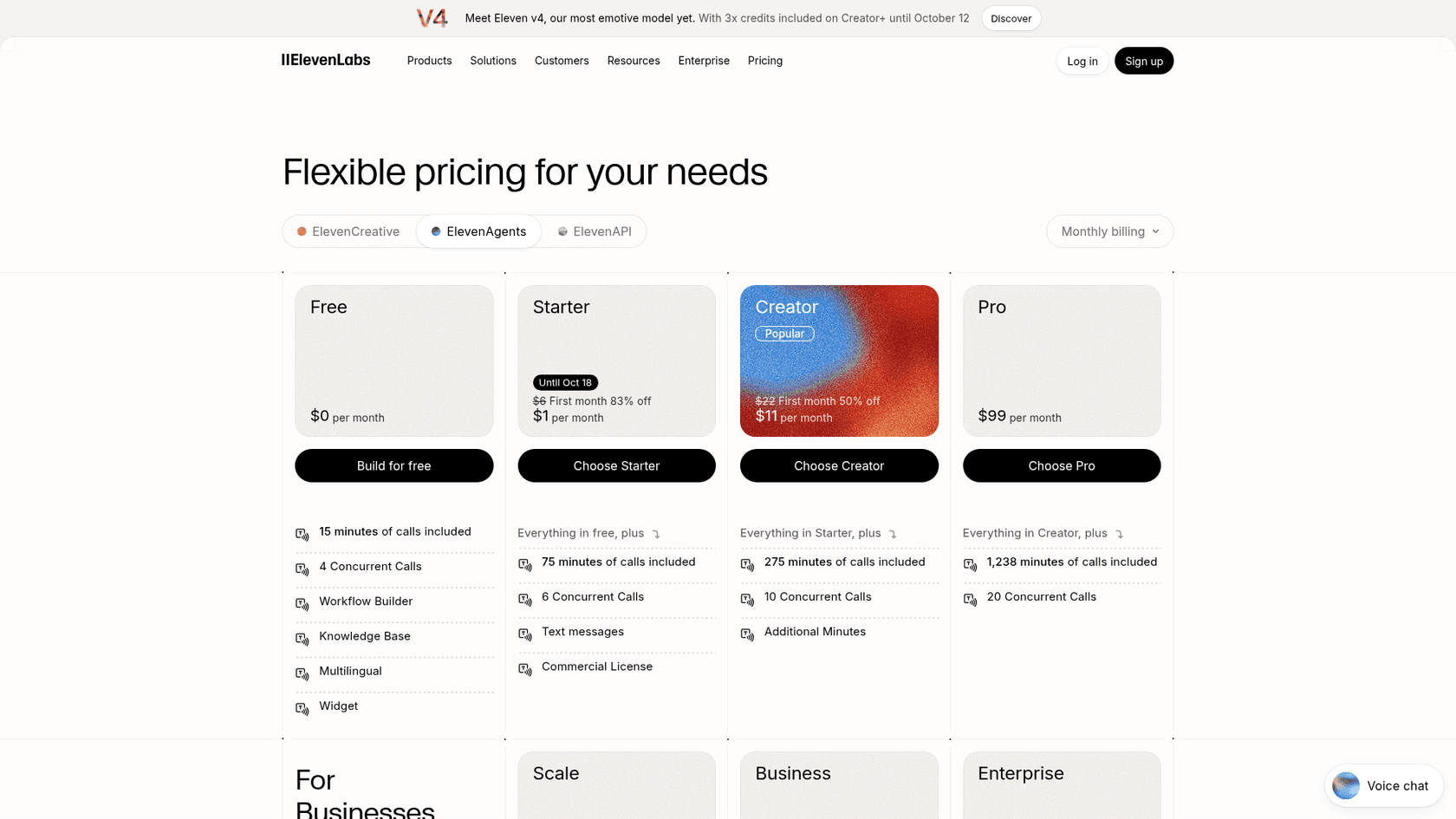
Turbo is the model ElevenLabs built for agents, and the ElevenAgents launch post puts it inside the agent platform. Inside it, you stop counting characters. The ElevenAgents pricing page bills by call minute:
| Agents plan | Monthly price | Call minutes included | Concurrent calls |
|---|---|---|---|
| Free | $0 | 15 | 4 |
| Starter | $6 | 75 | 6 |
| Creator | $22 | 275 | 10 |
| Pro | $99 | 1,238 | 20 |
| Scale | $299 | 3,738 | 30 |
| Business | $990 | 12,375 | 40 |
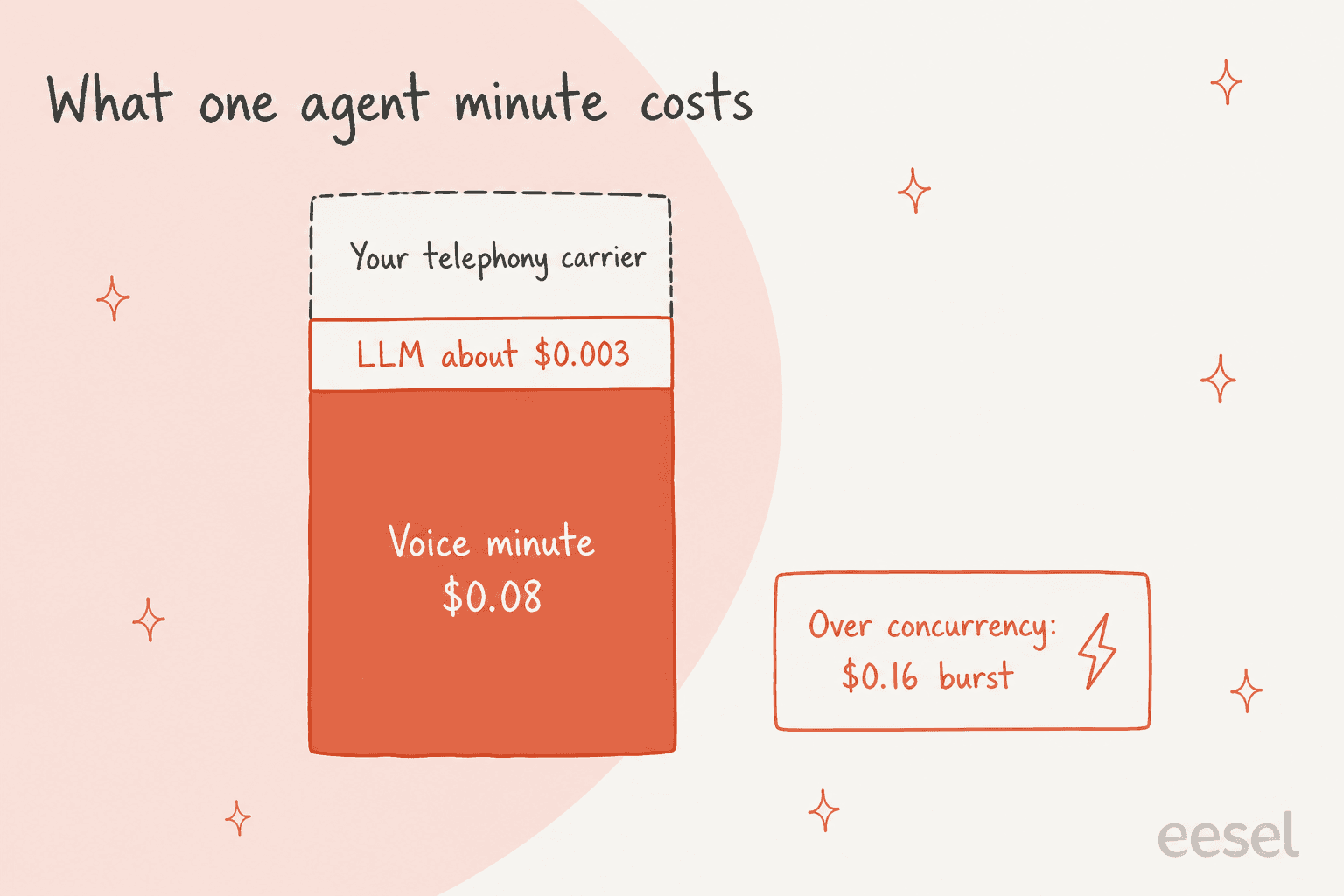
Beyond that, extra minutes are $0.08 each and text messages $0.003. Burst pricing lets agents take up to 3x your concurrency limit at double the rate, $0.16 a minute. The LLM is billed separately, deducted from your credits, and the page's own estimate for Gemini 2.5 Flash is $0.0029 a minute. ElevenLabs adds no telephony fee, but your carrier (Twilio or a SIP trunk) bills you for its side of the call.
Back to example three, 5,000 agent minutes a month:
- Scale plan: $299 for 3,738 minutes, plus 1,262 extra minutes × $0.08 = $100.96
- Gemini 2.5 Flash at $0.0029 a minute: about $14.50
- Total: about $414 a month, before your carrier's charges and any burst minutes
Moving up to Business only pays off at 12,375 minutes, which is exactly where Scale plus overage reaches $990. Same rate, again. If you're comparing agent platforms, start with Retell AI pricing, which bills per minute too. OpenAI's speech-to-speech rates are in my GPT-Live-1 pricing post. xAI's are in the Grok Voice pricing breakdown.
How does Eleven v4 pricing compare with other TTS models?
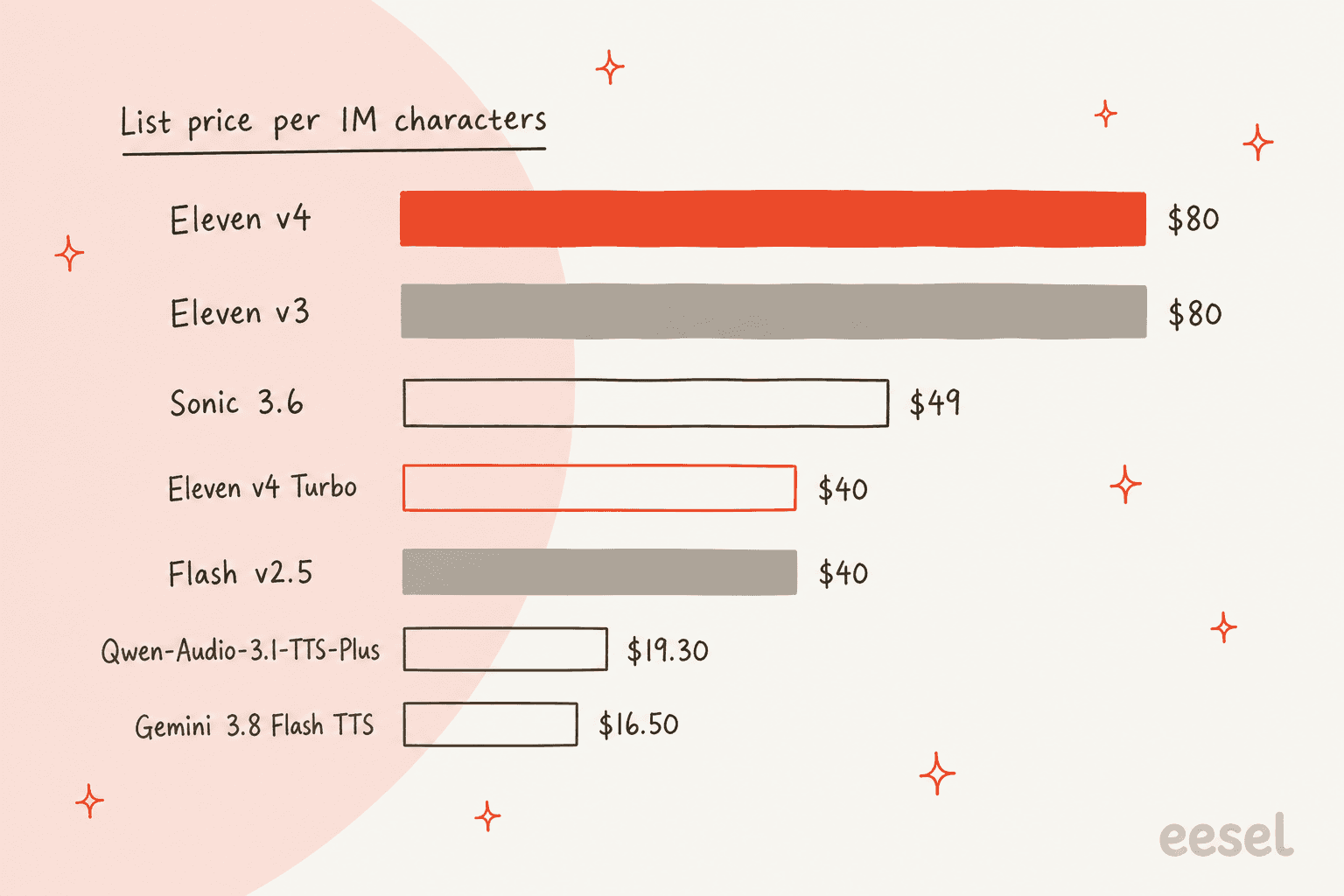
ElevenLabs is still the premium option. On the same Artificial Analysis leaderboard that ranks v4 Turbo first, here's how list prices per million characters stack up for the models right behind it:
| Model | Arena Elo | List price per 1M characters |
|---|---|---|
| Eleven v4 Turbo | 1334 | $40 |
| Eleven v4 | 1321 | $80 |
| Qwen-Audio-3.1-TTS-Plus | 1292 | $19.30 |
| Cartesia Sonic 3.6 | 1278 | $49 |
| Gemini 3.8 Flash TTS | 1275 | $16.50 |
| Eleven v3 | 1174 | $80 |
Read that table from the bottom up and the case for v4 is easy. If you were already paying $80 per million for v3, v4 is a big quality jump for the same money, and Turbo is a bigger one for half. Read it from the top down and the case for shopping around is just as clear: Gemini 3.8 Flash TTS sits 59 Elo points behind Turbo at well under half its price.
My take: Turbo is the right default inside ElevenLabs, and the full v4 model is worth $0.08 only for long narration. If cost per character is the main thing you're optimizing, test Gemini 3.8 Flash TTS first. Cartesia is the other close rival, and my Sonic 3 pricing post has its full rate card.
For expressive voices outside ElevenLabs, I've also broken down Hume AI pricing. Game and character studios should look at Inworld AI pricing too.
OpenAI's own speech API is an option if you're already on its platform. The wider field is in my list of AI voice companies.
Which Eleven v4 plan should you choose?
Here's how I'd match plans to the most common situations, assuming list prices from October 13:
- Trying it out: Free. 10,000 credits gets you about 10 minutes of v4 in the app, enough to hear whether your voices survive the migration.
- Solo creator making videos or short clips: Creator in the app at $22, mostly for the Professional Voice Clone and the 121,000 credits.
- Audiobook or long narration through a script: pay-as-you-go v4 on the API, or Pro at $99 if you need 44.1kHz PCM output.
- Developer shipping real-time playback: v4 Turbo on the API. At $0.04, a $99 Pro plan covers about 2.5 million characters.
- Support voice agent: ElevenAgents with Turbo. Size the plan by concurrency, since minutes cost $0.08 at every tier.
The ElevenLabs pricing guide covers the rest of the catalog (dubbing, music, Scribe), and the ElevenLabs alternatives roundup is the place to start if none of these fit. For how the company has handled billing and quality over time, I'd also skim my ElevenLabs reviews post.
What a TTS price doesn't cover on a support line
Most of the voice agent bill above is the voice, and ElevenLabs is clearly aiming Turbo at customer service. It's not alone. Decagon Voice 3 targets the same calls, and so does Zendesk with its voice AI agents.
Salesforce has a voice agent of its own as well. My voice support roundup lines them all up side by side.
None of those line items buys accuracy. At $0.04 per 1,000 characters, a voice confidently reading out the wrong refund window costs exactly as much as one reading the right one. An agent can only say what it knows. In support, that usually means your past tickets. eesel co-founder Amogh Sarda summed up a run of sales calls this way:
"Also - past ticket training strikes again. Classic. People really, really, really want to train on past tickets."
Amogh Sarda, co-founder, eesel
That's the pattern behind every eesel rollout: train on real ticket history, then simulate against it before a customer hears a word. If you're building the voice side with ElevenLabs, my guide to AI call center agents covers how platforms handle knowledge and handoff. The Vapi review goes deeper on one of them.
Callers in more than one language? Read my take on multilingual support too, since v4 changes cloned accents across languages.
Try eesel for the answers behind the voice
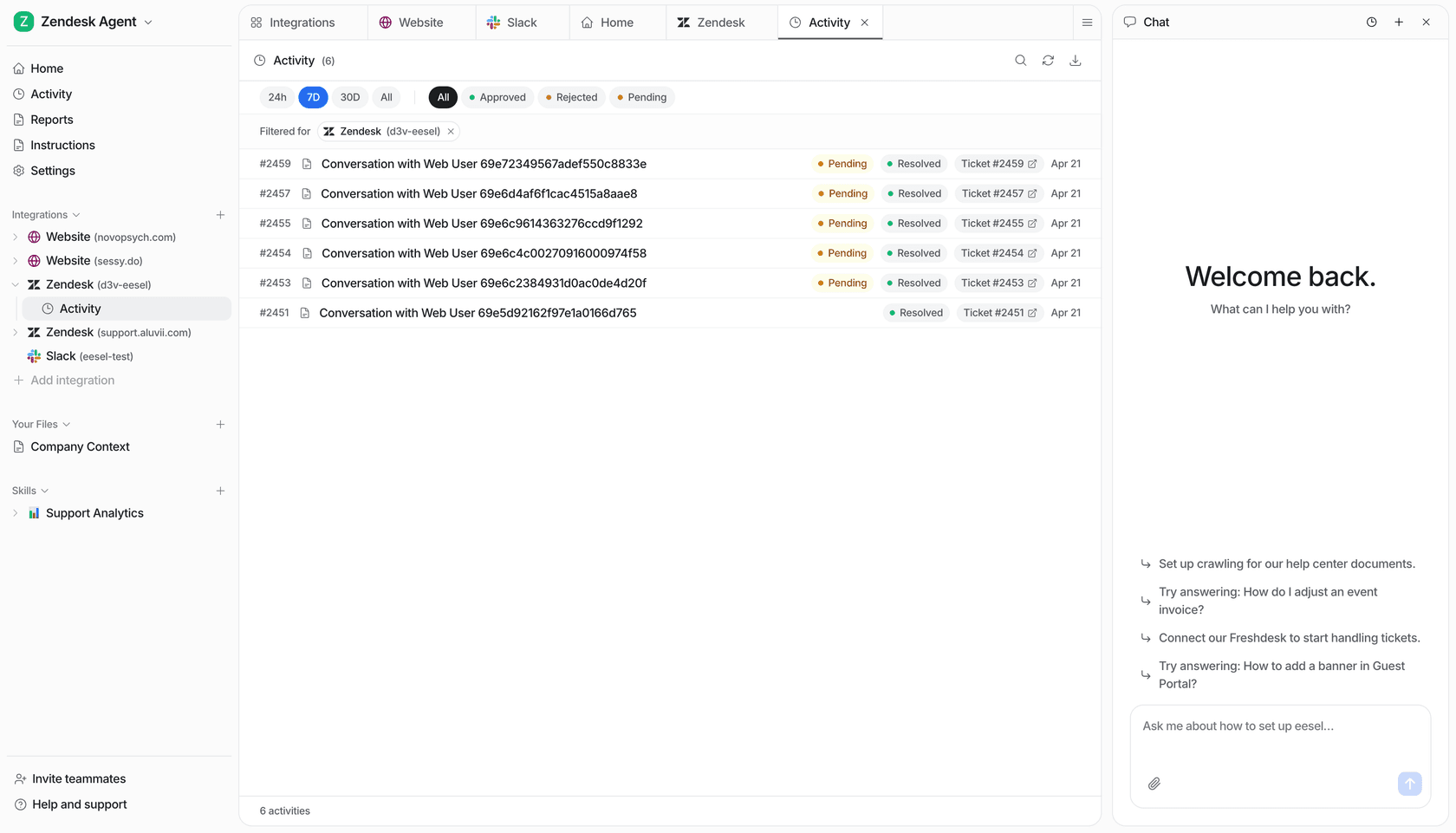
eesel is an AI teammates platform, and its AI helpdesk teammate joins your existing Zendesk, Freshdesk, or Gorgias queue, learns from your past tickets and help center, and drafts or sends replies in your team's tone. You can run it in simulation over historical tickets to see what it would have said before it goes live.
To be clear about scope, eesel works tickets and chat today, not phone audio. It's the AI customer support layer that keeps the knowledge behind your voice agent and your ticket queue the same.
The eesel CLI lets a script or a coding agent like Claude Code update that knowledge and test answers from the terminal (more in this AI agent CLI guide), so a policy change lands in both channels at once. Pricing is just as easy to predict as ElevenLabs': a ticket or a chat is one credit, there's a free plan with 100 credits, and paid plans start at 500 credits for $299 a month on the pricing page.
Try eesel on last month's tickets and see what it would have answered.
Frequently Asked Questions
How much does Eleven v4 cost?
Is Eleven v4 more expensive than Eleven v3?
Is Eleven v4 free to use?
What happens to Eleven v4 pricing after October 12?
How much does Eleven v4 cost per minute of audio?
How is Eleven v4 priced for voice agents?
Is the Eleven v4 API cheaper than the ElevenLabs app?
Is Eleven v4 Turbo worth it over the full model?


Article by
Kurnia Kharisma
Kurnia is a software engineer and writer at eesel AI with two years of SEO experience, writing about AI tools, helpdesk software, and customer support. He pairs a developer's understanding of how these products are built with search-driven research into what actually ranks and resonates with the people searching for them.