


The best Voxtral 3 alternative depends on which part of it you're replacing. For a phone agent on a real number today, OpenAI's GPT-Live-1 at $0.05 a minute or ElevenAgents at $0.08 plus the LLM, because Voxtral 3 keeps SIP calls enterprise-only at launch. For cheap recorded-call transcription, Speechmatics lists $0.12 an hour. For the voice, Cartesia Sonic.
Here's what surprised me after pricing all seven: Voxtral 3 is still the cheapest bundled phone agent here, at $0.04 a minute with Mistral Small 4. People leave it for access, open weights, or live accuracy, not price. Its live transcription is actually mid-pack on cost at $0.48 an hour.
I work eesel's support queue every day, and the speech layer is never what decides whether a caller gets the right answer. Ferry operator Norden-Frisia plans for 10,000 interactions a month in high season, answered from 346 knowledge items. Whichever model hears the caller, something still has to know what they're asking about.
Why are people looking for a Voxtral 3 alternative?
Mostly because of what Voxtral 3 doesn't let you do yet, not because it's bad. I gave it 3.5 out of 5 in my Voxtral 3 review, and the reasons it lost points are the same reasons people go shopping.
Credit first. On Mistral's launch charts, Voxtral Small Transcribe 3 ties Microsoft AI Transcribe 2 at a 4.0% word error rate across 45 languages, and it costs $0.004 a minute. The voice is $13 per 1M characters. The voice agent API is $0.04 a minute with Mistral Small 4. That is a strong launch.
Four things send people looking anyway:
- Phone lines are gated. SIP telephony is enterprise-only at launch. If you want a bot on your support number this month, you need someone else's phone layer.
- The weights are closed. Voxtral 1 and the Voxtral 2 realtime model shipped on Hugging Face. Voxtral 3 is API-only, with on-premises deployment arranged through sales.
- Live accuracy trails Gemini. On Mistral's own 35-language realtime chart, Gemini 3.5 Realtime scores
4.2%and beats every Voxtral latency setting. At the 240 ms setting a snappy phone agent would use, Voxtral sits at7.4%. - Everything is a public preview, and the upgrade from Voxtral 2 removed word timestamps. Teams with a working pipeline have a reason to look around before migrating.
The closed weights got the most heat in the Hacker News launch thread:
"You have to call sales to get access for on-prem deployment and the models If it were open weights, it would be on Huggingface and they would have put a link in the post"

How I picked these seven
I asked ChatGPT the question a support lead would ask ("we're testing Voxtral 3 for transcription, voice and a phone agent, what should we compare it against?") and it shortlisted these seven. That matched what I'd have picked, so I went to each vendor's own pricing page and docs on 28 October 2026 and priced them the same way.
Each one is judged on four things a support line cares about:
- Can it answer a phone number today, natively or through a named partner?
- What does a minute cost, with the billing unit spelled out?
- What does the vendor claim on latency and accuracy, in their own numbers?
- Where is Voxtral 3 still the better pick?
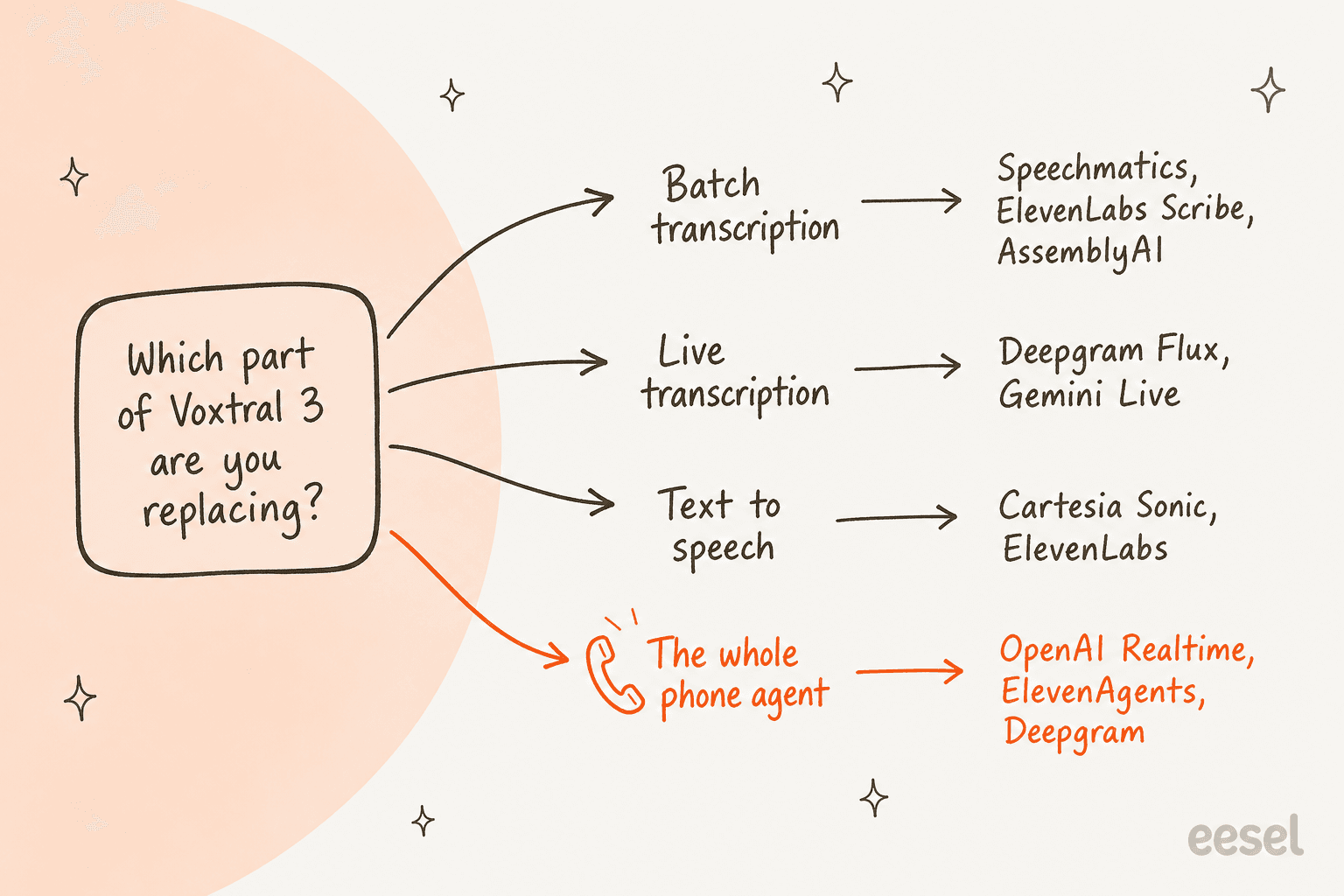
The decision map is the real takeaway. Voxtral 3 is four products in one launch, and nobody beats it at all four. Work out which piece is failing you, and replace only that piece.
Voxtral 3 alternatives compared
Prices are list prices from each vendor's own page, converted to the same unit where the vendor gave a per-minute figure. "Not published" means the vendor doesn't list a price, not that it's free.
| Tool | Batch transcription | Live transcription | Voice (per 1M characters) | Phone agent (per minute) | Phone line | Self-hosting | Compliance listed |
|---|---|---|---|---|---|---|---|
| Voxtral 3 | $0.21-$0.24/hr | $0.48/hr | $13 | $0.04 (Small 4) or $0.08 | SIP enterprise-only at launch | On-prem via sales | Not on launch pages |
| OpenAI | $0.27/hr (GPT-Transcribe) | $1.02/hr (GPT-Live-Transcribe) | No current price, TTS models retire Jan 2027 | $0.05 + backend model (GPT-Live-1) | Native SIP | No | HIPAA BAA, EU residency +10% |
~$0.30/hr (Gemini 3.5 Transcribe) | ~$0.54/hr (Transcribe Live) | $30 (Chirp 3: HD) | ~$0.023 audio in + out (Gemini 3.8 Live) | Partners (Voximplant, LiveKit) | No | Chirp 3 in US and EU regions | |
| Deepgram | $0.26/hr (Nova-3) | $0.39/hr (Flux English) | $30 (Aura-2) | $0.075 (Standard) | Twilio reference build | Enterprise, NVIDIA GPUs | SOC 2 Type 2, HIPAA BAA, GDPR EU endpoint |
| ElevenLabs | $0.22/hr (Scribe v2) | $0.39/hr (Scribe v2 Realtime) | $40 (v4 Turbo) | $0.08 + LLM | Native SIP trunk, Twilio | No | SOC 2, HIPAA BAA, EU residency on Enterprise |
| Cartesia | Streaming only | $0.39/hr (Ink-2, Scale plan) | $38-$65 overage | $0.06 + $0.014 number | Own numbers, SIP on enterprise | Enterprise, on-prem or VPC | SOC 2 Type II, HIPAA-eligible, GDPR |
| AssemblyAI | $0.21/hr (Universal-3.5 Pro) | $0.45/hr (Universal-3.6 Pro Realtime) | $15 | Not published | Twilio SIP trunk | Self-hosted option | SOC 2 Type 2, BAA |
| Speechmatics | $0.12/hr (Melia 1) | $0.30/hr (Linden 1, agents) | $11 (English, preview) | Not published | Partners (Vapi, LiveKit, Pipecat) | Enterprise containers | SOC 2 Type II, ISO 27001, GDPR, HIPAA |
Two things jump out of that table. Voxtral 3's batch price is good but not the lowest, and its live transcription sits mid-pack. Its voice and its bundled agent are where it's hard to beat.
What does a support phone line cost on each one?
To compare per-minute, per-token and per-character prices, I priced one buyer: 10,000 five-minute calls a month, so 50,000 minutes. Phone carrier fees are left out unless the vendor sells the number itself.
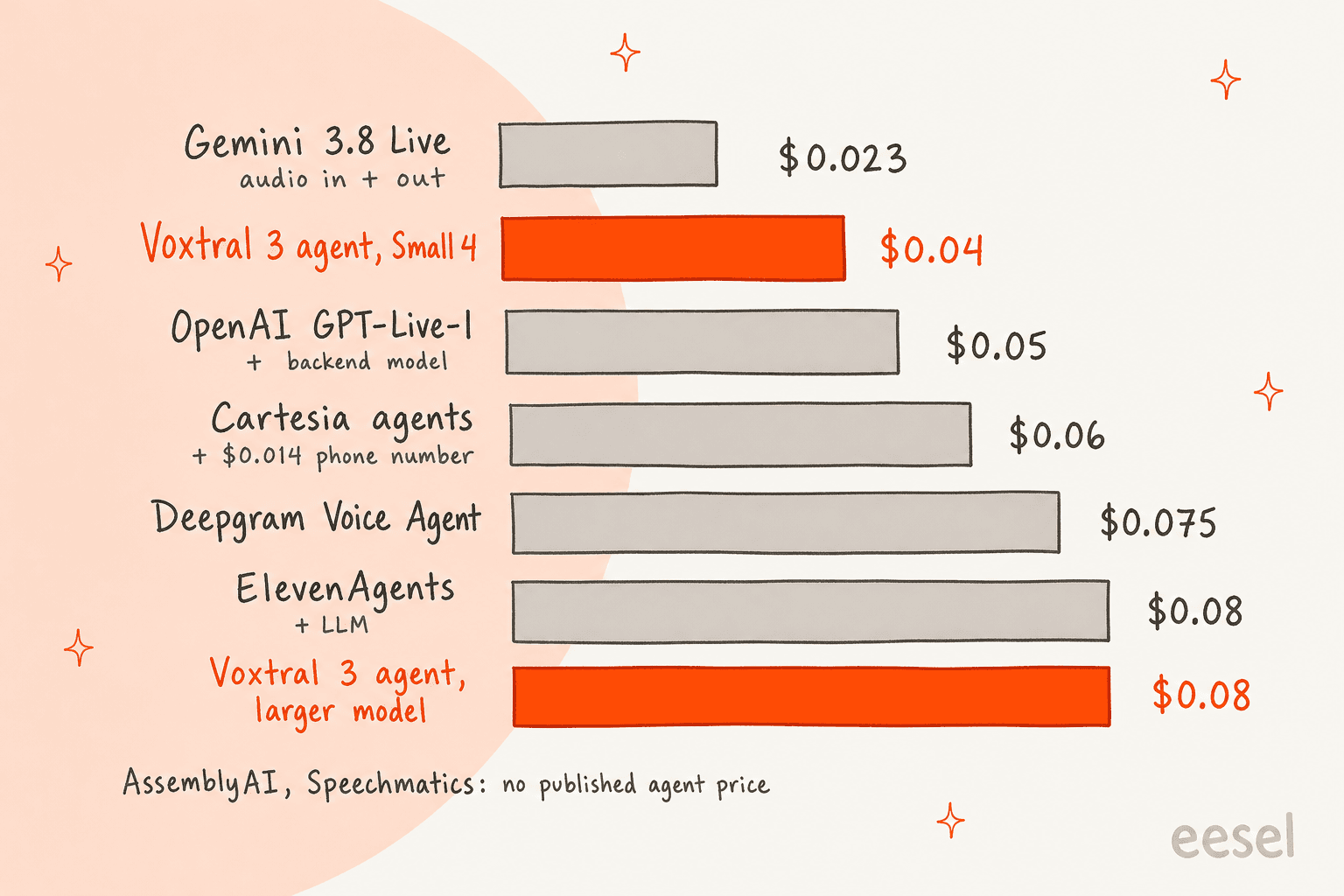
| Option | The maths | Monthly cost | What's not included |
|---|---|---|---|
| Voxtral 3 agent, Mistral Small 4 | 50,000 × $0.04 | $2,000 | SIP access (enterprise) |
| Voxtral 3 agent, larger model | 50,000 × $0.08 | $4,000 | SIP access (enterprise) |
| Gemini 3.8 Live | 50,000 × ($0.005 in + $0.018 out) | $1,150 at most for audio | Text and thinking tokens, telephony partner |
| OpenAI GPT-Live-1 | 50,000 × $0.05 | $2,500 | Backend model, tools, SIP trunk |
| Cartesia agents | 50,000 × ($0.06 + $0.014) | $3,700 | LLM, once the free period ends |
| Deepgram Voice Agent, Standard | 50,000 × $0.075 | $3,750 ($3,400 on Growth) | Carrier |
| ElevenAgents | 50,000 × $0.08 + LLM at $0.0029 | about $4,145 | Carrier |
| AssemblyAI | 833 hours × $0.45 for listening | $375 + voice + LLM | No bundled agent price |
| Speechmatics | 833 hours × $0.30 for listening | $250 + voice + LLM + platform | No bundled agent price |
The Gemini number is a ceiling for audio only: it assumes both sides are speaking the full minute, which never happens, and it leaves out the text and thinking tokens that do the actual reasoning. Treat it as "probably the cheapest", not as a quote.
Voxtral's $2,000 is the line to beat, and only Gemini clearly does. The catch is you can't point a phone number at Voxtral without an enterprise deal yet, which is why I'd read this table as "what you pay for access", not "what you pay for speech". If you'd rather not own any of this, my best AI for phone support roundup covers the managed platforms, and voice customer support tools covers the helpdesk-native ones.
1. OpenAI Realtime API
Best for: teams that want a speech-to-speech agent on a phone number this week.
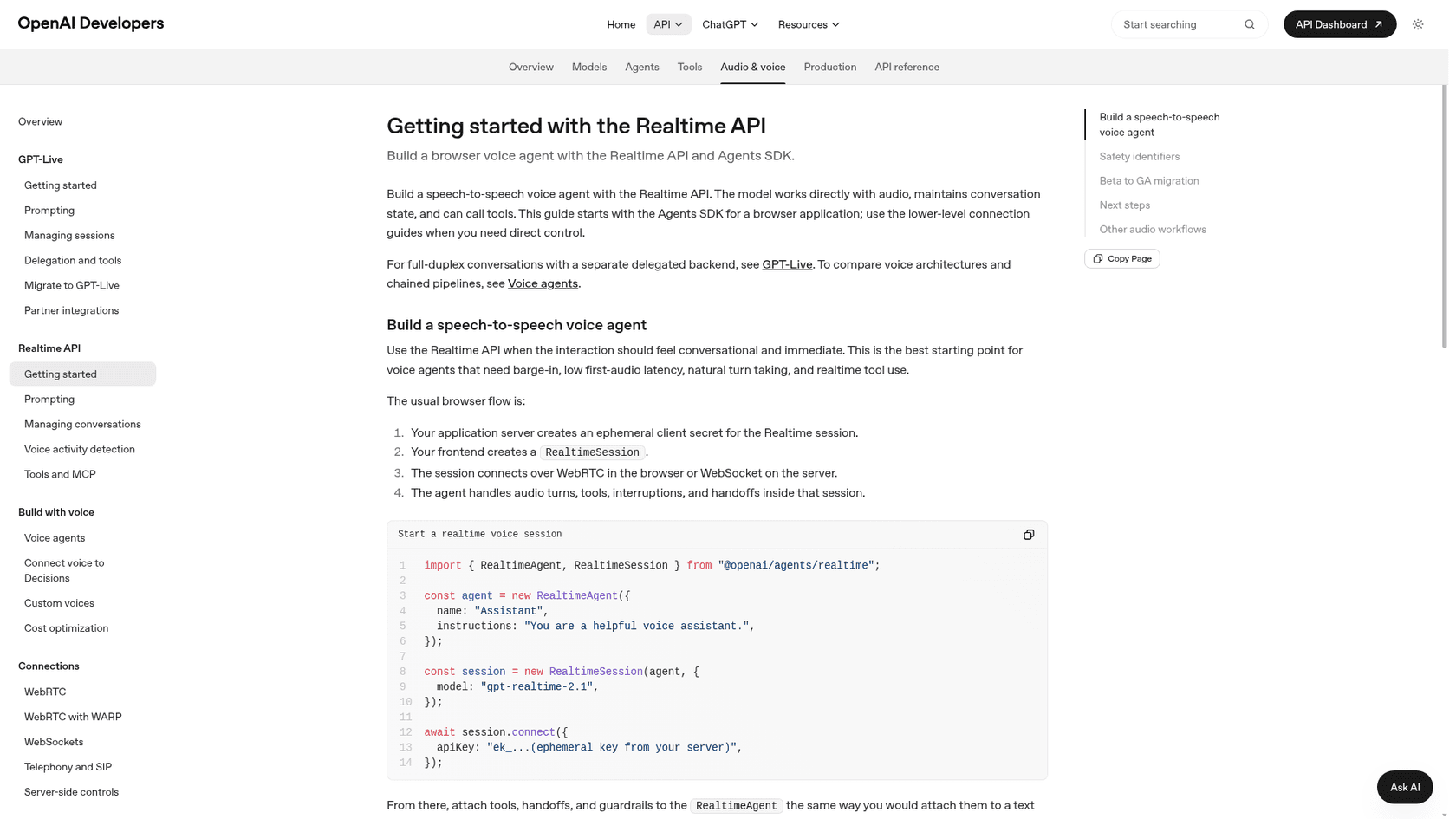
What it is. OpenAI's voice stack has two agent models now. GPT-Realtime-2.1 does speech, reasoning and tool calls in one session. GPT-Live-1 is full duplex, meaning it listens while it talks, and hands the thinking to a separate backend model you choose. Transcription is GPT-Transcribe for recordings and GPT-Live-Transcribe for live audio. I've covered the older generation in my GPT Realtime post.
Pricing. GPT-Live-1 is $0.05 a minute, billed per second, with the backend model and tools charged separately. GPT-Realtime-2.1 is token-priced: $32 per 1M audio input tokens and $64 per 1M audio output. The mini version is $10 and $20. GPT-Transcribe is $0.0045 a minute, GPT-Live-Transcribe $0.017. EU data residency adds 10%. The full OpenAI API pricing breakdown covers the text models you'd pair with it.
Where it beats Voxtral 3. The phone. You point a SIP trunk at sip.api.openai.com, OpenAI sends your backend a webhook, and you accept, transfer or hang up the call, per the SIP guide. There's an EU endpoint too. Turn detection comes in two flavours: silence-based, or semantic_vad, where the model judges whether the caller has finished their thought.
Where Voxtral 3 still wins. Transcription accuracy and voice price. On Mistral's chart, GPT Transcribe scores 5.6% against Voxtral Small's 4.0%, and GPT Live Transcribe 8.4% against Voxtral Realtime's 7.4% at its fastest setting. OpenAI's standalone voice models (tts-1, tts-1-hd, gpt-4o-mini-tts) shut down on 6 January 2027, per the TTS guide, so there's no current per-character voice to compare.
Verdict: pick OpenAI if getting on a phone line fast matters more than shaving a cent a minute. Skip it if you mainly need batch transcription, where it's both pricier and less accurate on Mistral's test.
2. Google Gemini Live and Cloud Speech
Best for: multilingual support lines where live transcription accuracy is the deciding factor.
What it is. Google sells the pieces separately. Gemini 3.8 Live is the audio-to-audio agent model. Gemini 3.5 Transcribe and Transcribe Live handle speech-to-text through the Gemini API, with Cloud Speech-to-Text (Chirp 3) as the older cloud product. Voices come from Cloud Text-to-Speech, including Chirp 3: HD and the Gemini TTS models I covered in Gemini 3.8 Flash TTS.
Pricing. Gemini 3.8 Live is $0.005 a minute for audio in and $0.018 a minute for audio out, plus text and thinking tokens at $0.75 and $4.50 per 1M. Gemini 3.5 Transcribe works out to about $0.005 a minute blended, Transcribe Live about $0.009. Chirp 3: HD voices are $30 per 1M characters after the first 1M free each month, per the TTS pricing page. Gemini 3.8 Flash TTS is cheaper on audio output but doubles in price on 1 January 2027.
Where it beats Voxtral 3. Live accuracy, on Mistral's own chart. Gemini 3.5 Transcribe in its realtime form scores a 4.2% error rate, which beats Voxtral Realtime 3 at every latency setting, including its slowest, most careful one (5.7%). It's also likely the cheapest live agent here. Gemini 3.8 Live supports asynchronous function calls, so the agent can keep talking while a refund lookup runs.
Where Voxtral 3 still wins. The phone and the session length. Google documents no SIP endpoint for the Live API; you go through partners like Voximplant, LiveKit or Pipecat. Audio-only sessions cap at 15 minutes by default unless you add session management. Google's two Live API pages also disagree on language count (70 vs 99), so test your languages.
Verdict: pick Gemini if your callers switch languages and you have engineers to wire up telephony. It pairs well with the rest of a multilingual support setup. Skip it if you want a single vendor to answer the phone.
3. Deepgram
Best for: phone-first teams who want low-latency turn-taking and published concurrency limits.
What it is. Deepgram is a speech company first. Flux is its streaming speech-to-text model built for voice agents, with end-of-turn detection inside the model. Nova-3 handles general transcription, Aura-2 is the voice, and the Voice Agent API bundles listening, an LLM and speaking over one WebSocket.
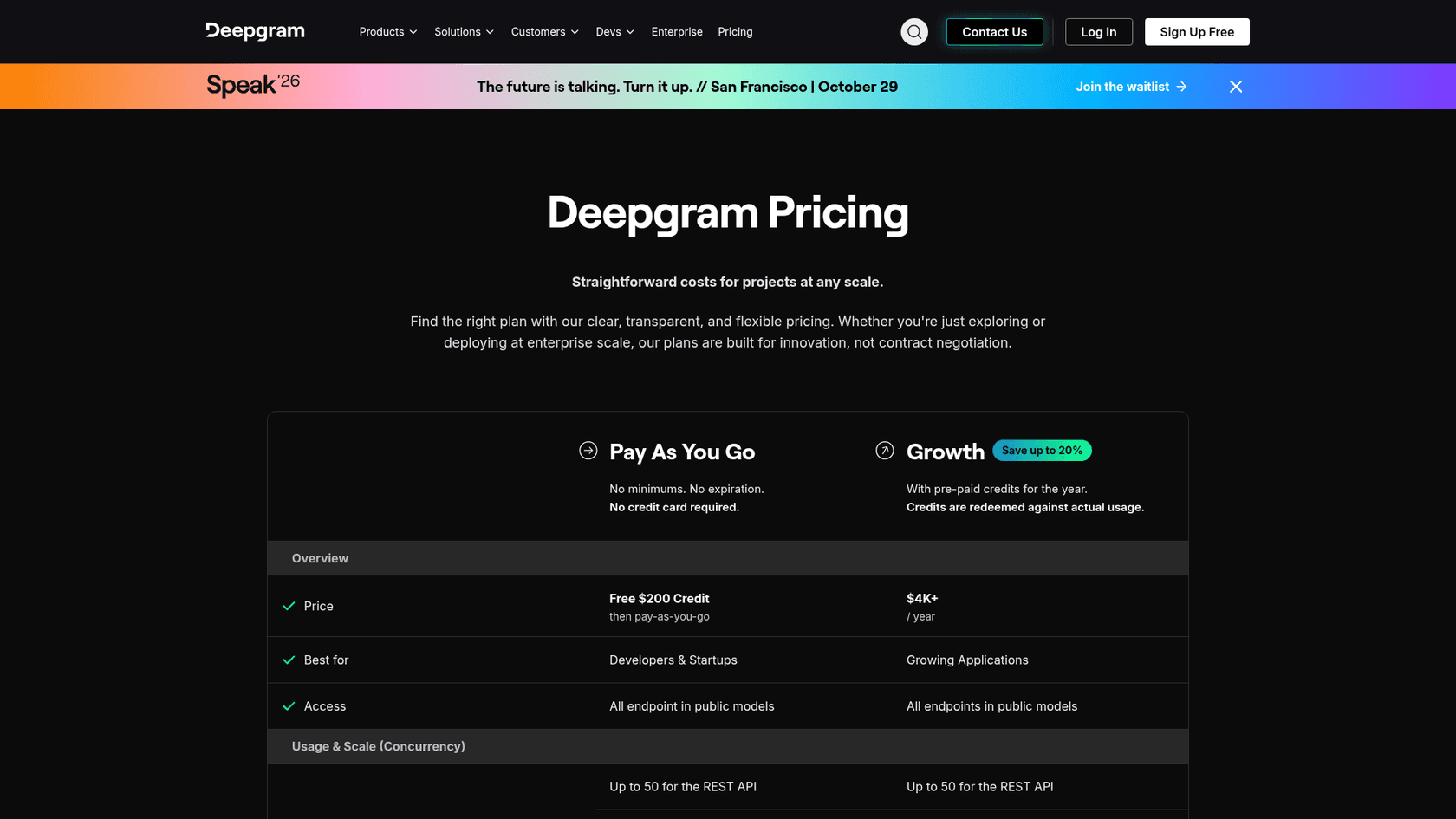
Pricing. The Voice Agent API Standard tier is $0.075 a minute on Pay As You Go, or $0.068 on Growth (from $4,000 a year prepaid), billed on WebSocket connection time. Bring your own LLM and voice and it drops to $0.050. Flux English is $0.0065 a minute, Nova-3 recorded audio $0.0043, and Aura-2 $0.030 per 1,000 characters. New accounts get $200 in credit with no card.
Where it beats Voxtral 3. Phone plumbing and the knobs. Deepgram claims about 260ms end-of-turn detection, plus an "eager" signal that lets your LLM start drafting a reply before the caller has quite finished. Concurrency is published: 45 agent sessions on Pay As You Go, 60 on Growth. Flux accepts 8 kHz mulaw phone audio directly, and the inbound telephony guide walks through a Twilio build. Compliance is spelled out: SOC 2 Type 2, HIPAA with a BAA on Enterprise, and a dedicated EU endpoint.
Where Voxtral 3 still wins. Languages and price. Flux Multilingual covers 10 languages, against Voxtral Realtime's 35-plus. Aura voices cover 7. And Voxtral's agent is roughly half the price per minute.
Verdict: pick Deepgram if you're building a phone agent in English or a major European language and want concurrency and compliance in writing. Skip it for a wide language mix.
4. ElevenLabs
Best for: support lines where the voice itself is part of the brand, and teams who want a no-code agent builder.
What it is. ElevenAgents (previously Conversational AI) wraps a speech-to-text model, the LLM you pick, a voice, and a turn-taking model into one agent platform, with a knowledge base, workflow builder and evals. Scribe v2 is the transcription model, and the voices run from Flash v2.5 up to the new Eleven v4. My ElevenLabs pricing post has every plan.
Pricing. Agent minutes are $0.08 each beyond your plan, plus LLM usage (the calculator showed Gemini 2.5 Flash at $0.0029 a minute). The Business plan is $990 a month for 12,375 minutes and 40 concurrent calls. ElevenLabs charges no telephony fee; your carrier bills you. Scribe v2 is $0.22 an hour, Scribe v2 Realtime $0.39. Voices are $0.04 to $0.08 per 1,000 characters, so $40 to $80 per 1M, per the API pricing page.
Where it beats Voxtral 3. The phone and the product around it. Native SIP trunking with inbound and outbound calls, a Twilio integration, batch outbound calls, and settings for how eagerly the agent takes its turn. Voxtral's agent SDK is code-first on LiveKit; ElevenAgents is something a support lead can configure.
Where Voxtral 3 still wins. Accuracy and price. Mistral's chart puts Scribe v2 at 4.9% against Voxtral Small's 4.0%, and Scribe v2 Realtime at 8.7%, last of the realtime models in that chart. Voxtral's voice is a third of the price of v4 Turbo. Data residency outside the US is an Enterprise feature at ElevenLabs.
Latency is the complaint I see most from builders, and it usually comes from the LLM, not the voice:
"The agents are taking 4000ms to answer anything. This is without RAG which shouldn't take anywhere near that long."

That thread is on an older model generation, so treat it as a test to run, not a verdict. The ElevenLabs reviews round-up has the wider picture.
Verdict: pick ElevenLabs if the voice is what callers will judge you on, or if no one on your team wants to write orchestration code. Skip it if per-minute cost is the deciding line.
5. Cartesia
Best for: teams whose agent sounds fine but starts talking too late.
What it is. Cartesia built its name on Sonic, a fast voice model now on version 3.6, and has added Ink-2 for streaming transcription and Managed Agents that combine the two with an LLM of your choice. I tested an earlier version in my Cartesia Sonic 3 review.
Pricing. Plans run Free, Pro $5, Startup $49 and Scale $299 a month, sold as credits where one character of speech is one credit. Overage is $38 to $65 per 1M credits depending on plan. Agents are $0.06 a minute on every self-serve plan, plus $0.014 a minute on a Cartesia phone number. LLM usage for agents built in the UI is free "for a limited time", per the pricing page. Ink-2 works out to $0.39 an hour on Scale.
Where it beats Voxtral 3. Speed claims and phone numbers you can buy today. Sonic claims first audio in about 90ms, the same figure Mistral gives for Voxtral's voice, and Ink claims 88ms to a final transcript. Ink-2 marks turns by meaning, not silence, and Cartesia sells the phone number itself. Sonic covers 44 languages.
Where Voxtral 3 still wins. Transcription breadth and voice price. Ink-2 covers five languages (English, Spanish, French, Hindi and Japanese). Sonic's overage at $38 or more per 1M characters is about three times Voxtral's $13. The free LLM period will end, and the agent price will rise when it does.
Verdict: pick Cartesia for the voice in an English or Spanish phone agent where every millisecond of silence hurts. Skip it if you need transcription in more than five languages.
6. AssemblyAI
Best for: transcription-led teams who care about getting order numbers, emails and names right.
What it is. AssemblyAI is best known for transcription, and now sells a Voice Agent API that bundles its speech models with an LLM and its own voice. You can bring Claude through its gateway or any OpenAI-compatible model.
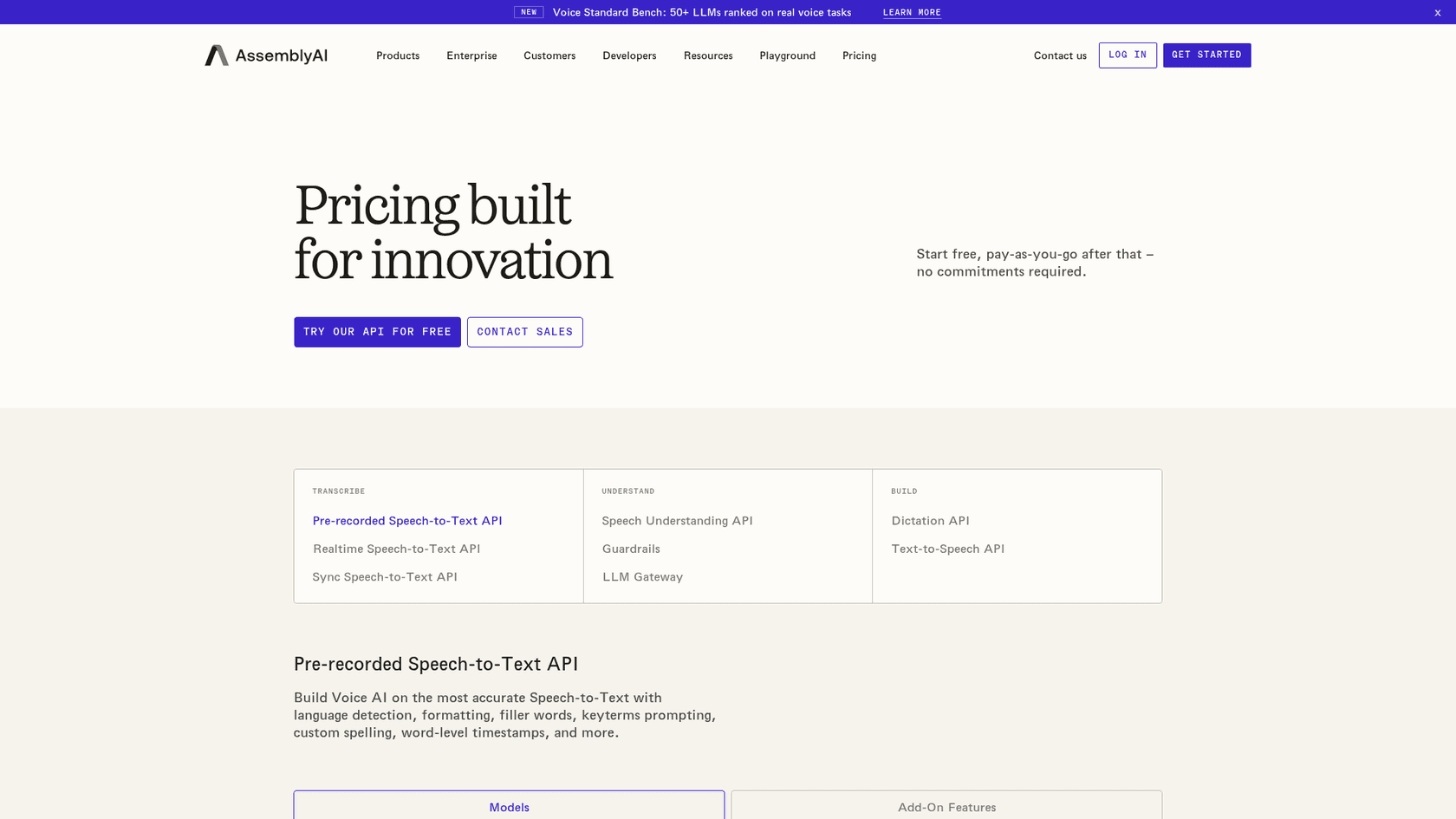
Pricing. Universal-3.6 Pro Realtime is $0.45 an hour across 32 languages, and the cheaper Universal-Streaming is $0.15. Recorded audio is $0.21 an hour on Universal-3.5 Pro. The voice, AssemblyAI-TTS-1, is $15 per 1M characters, the same price in the US or EU. The Voice Agent API itself has no published per-minute price, so a full call cost depends on what you pair it with.
Where it beats Voxtral 3. The details that wreck support calls. Its turn detection waits on purpose while a caller reads out a phone number, email or date, and its barge-in ignores "uh-huh" but stops on "wait, stop". A dtmf starter agent takes card numbers on the keypad, kept out of the transcript, logs and model. On AssemblyAI's own benchmarks, it ranks first of 22 systems on voice-agent entity errors (14.41%), a test that includes Voxtral Mini. SIP works through a Twilio trunk, and a self-hosted option exists.
Where Voxtral 3 still wins. Language coverage and a known price. The same benchmark page ranks AssemblyAI fifth on multilingual FLEURS (8.44% over 18 languages). The vendor also notes its spoken-digit cleanup is "best-effort, not guaranteed", so test long account numbers.
Verdict: pick AssemblyAI if callers spend half the call spelling things out. Skip it if you need a price you can put in a budget before you build.
7. Speechmatics
Best for: cheap, accurate transcription of recorded calls, with accents and mid-sentence language switching.
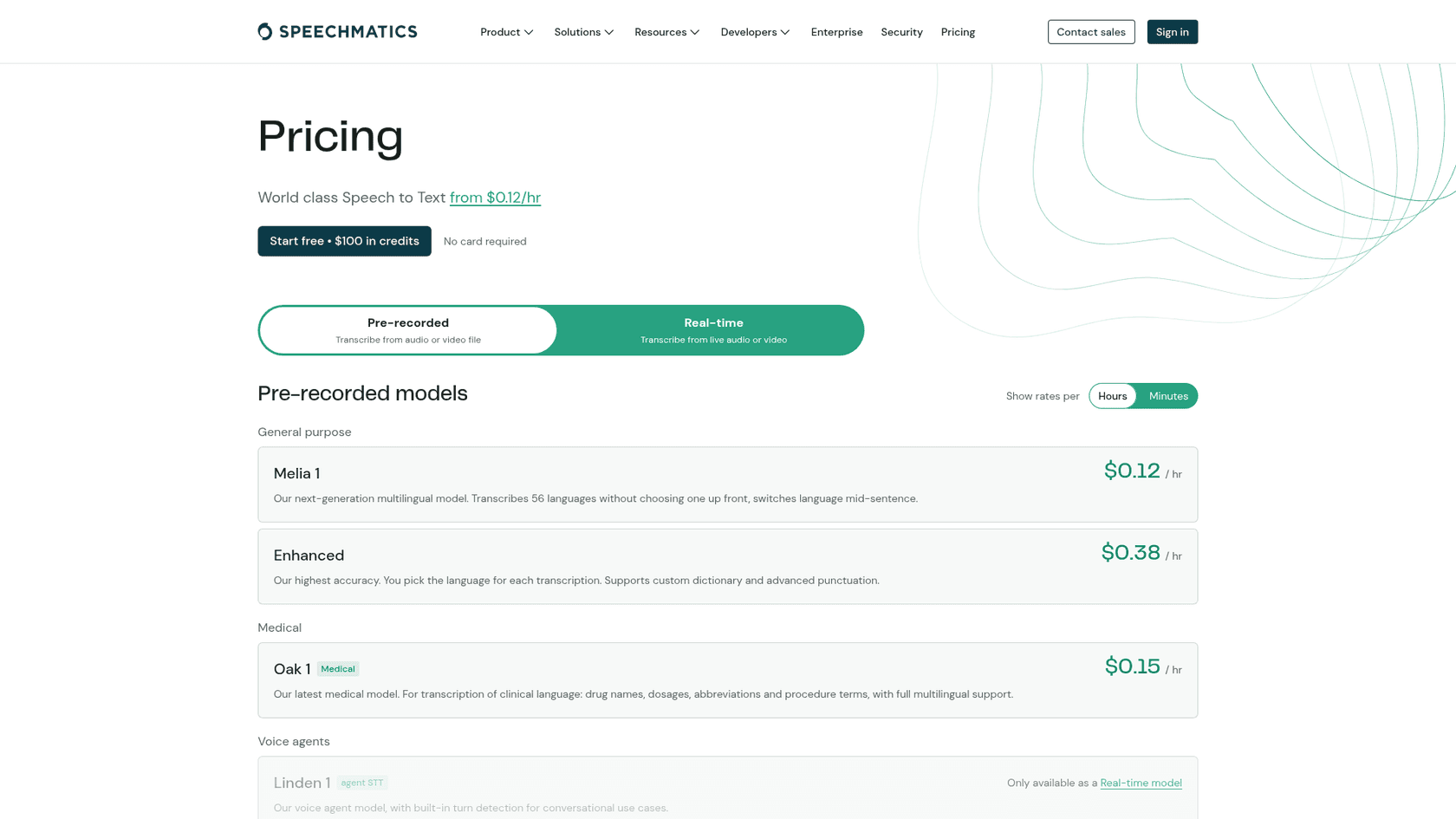
What it is. Speechmatics sells the speech layer, not the agent. Melia 1 is its multilingual model (56 languages, switching mid-sentence), Linden 1 is the speech-to-text model for voice agents, and a text to speech product is in preview. You bring the LLM and the orchestration, through Vapi, LiveKit or Pipecat.
Pricing. Melia 1 is $0.12 an hour on the pricing page, though the site's calculator shows $0.24, so confirm before you budget. Linden 1 for agents is $0.30 an hour at list, down to $0.15 with volume. The voice is $0.011 per 1,000 characters ($11 per 1M), with the first 1M free. New accounts get $100 in credit.
Where it beats Voxtral 3. Price on recorded audio and compliance paperwork. $0.12 an hour is the lowest batch price in this list, against Voxtral Mini's $0.21. Speechmatics lists SOC 2 Type II, ISO 27001, GDPR and HIPAA, with EU, US or Australian processing. Linden claims final transcripts in 350ms, with speaker labels included.
Where Voxtral 3 still wins. Everything past transcription. The voice is English-only with four voices in preview, the Voice Agent API is an early-access preview that "should not be used for live production traffic", and turn detection is silence-driven for now, with semantic detection "coming soon", per the voice agents page.
Verdict: pick Speechmatics to transcribe recorded calls for quality assurance at scale. Skip it for anything you need to talk back.
What if you wanted Voxtral for the open weights?
Then none of these seven replace it, and I'd rather say that plainly. Every option here is a hosted API. Deepgram, Cartesia, AssemblyAI and Speechmatics all offer self-hosting, but on enterprise contracts, which is the same deal Mistral now offers for Voxtral 3.
The Hacker News thread had plenty of builders who run speech on their own hardware, and their pick was NVIDIA's Parakeet, not another hosted API:
"I do think Parakeet is pretty amazing, though, so some of these product announcements have limited interest to me, especially since it's cloud and costs per hour, even if it's a low cost."
If you're already on the open Voxtral 2 realtime model, the practical move is to stay on it until Mistral says more about Voxtral 3 weights, and benchmark Parakeet on your own audio meanwhile. The Mistral AI reviews post tracks how the company has handled open releases.
What none of these seven fix on a support line
Every tool above solves the same half of the problem: hearing the caller and talking back. None of them knows your refund policy, what an order status means in your shop, or which questions your team always hands to a person.
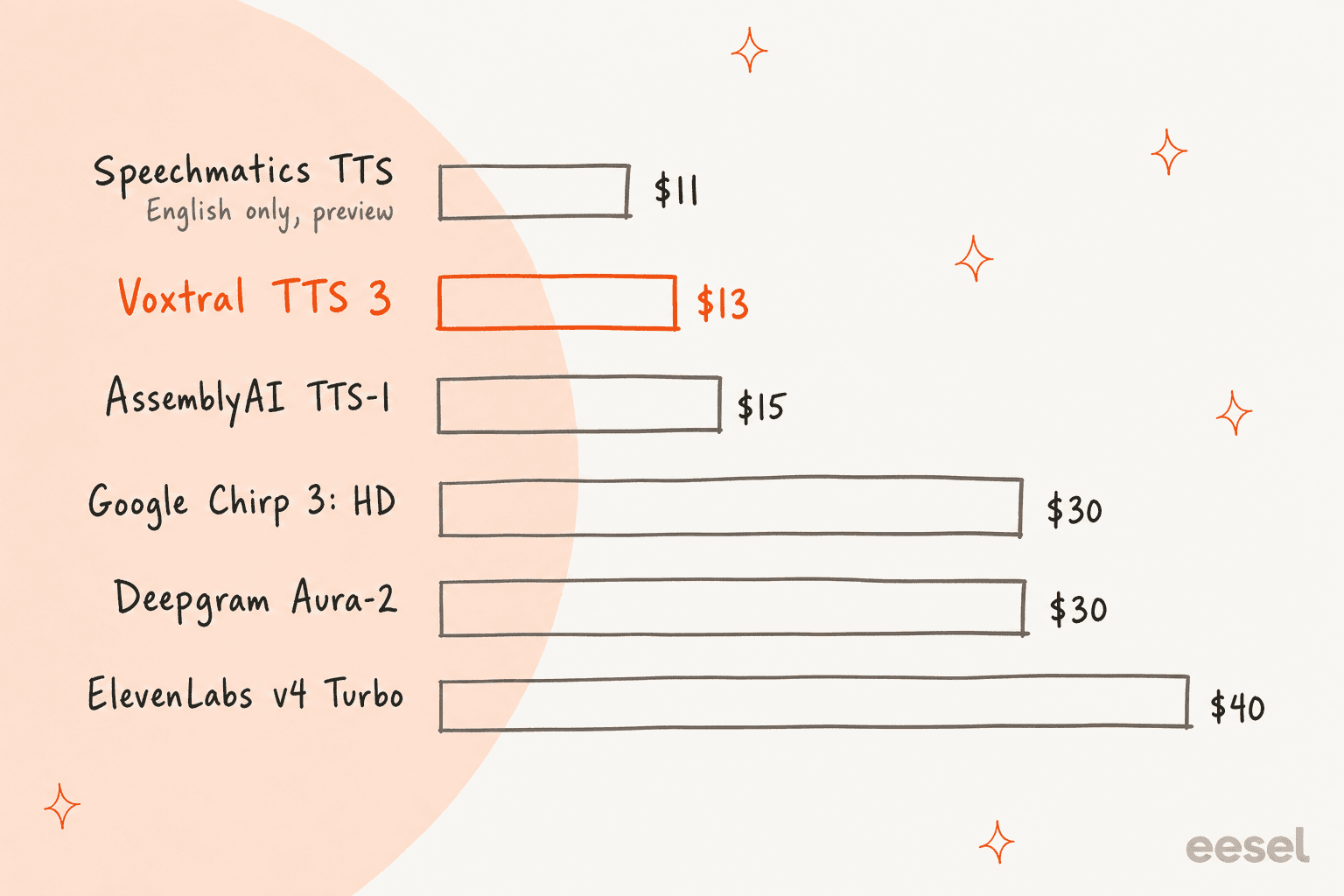
That chart is the kind of comparison speech launches compete on, and the spread is real: $11 to $40 per 1M characters. On a support line it's also the smallest number in the bill. At 750 to 800 characters per spoken minute (Cartesia's own rule of thumb), even the priciest voice here costs about 3 cents a minute. A wrong answer costs a repeat call and a ticket.
From the queue, the calls that go badly are rarely about a misheard word. They're about an agent, human or AI, that doesn't have the answer. Which is why I'd pick the speech layer last and sort out the knowledge first, the same way you'd set up AI agent handoff before you go live. The Grok voice comparison I wrote hit the same wall: in my Grok Voice alternatives post, the best model resolved 56.5% of simulated calls.
For most teams, the order that works is to automate the text channels first, where the same knowledge gets tested on thousands of tickets, and then bring it to the phone. My guide on how to automate phone support walks through that sequence, and AI call center agent covers what changes once you're on voice.
If your helpdesk already has a voice product, start with Zendesk voice AI agents or Freshcaller voice agents.
Try eesel for the questions behind the calls
These seven tools are infrastructure, and eesel is the employee. eesel's AI helpdesk teammate joins Zendesk or Freshdesk, learns from your past tickets, macros and help center, and answers the questions callers keep asking in the channels where they already write in.
Norden-Frisia, a German ferry company, runs its CaptAIn bot in Zendesk, its website chat and a public chat link, answering timetable, car and bike questions from 346 knowledge items, with a plan for 10,000 interactions a month in high season. Innr, a Dutch smart lighting brand, gets Freshdesk replies drafted in whichever language the customer wrote in, from 1,500 help articles and past tickets. That's the knowledge a Voxtral, Gemini or ElevenLabs agent would need on day one. Try eesel on your helpdesk first, and your phone agent will have something worth saying.