


Voxtral 3 is the best-value speech stack you can buy from a European lab right now, and I'd score it 3.5 out of 5: excellent for batch transcription, promising but early as a phone agent. Voxtral Small Transcribe 3 ties Microsoft AI Transcribe 2 at a 4.0% word error rate on Mistral's 45-language test and costs $0.004 a minute. The voice costs $13 per 1M characters, and the all-in voice agent API is $0.04 a minute.
Three things hold it back. Every model is a public preview, the weights are closed this time (Voxtral 1 and 2 were open), and phone calls over SIP are enterprise-only at launch. Mistral's own chart also shows Gemini 3.5 Realtime ahead on live transcription at every latency setting.
If you run support, the speech layer is the easy half. At eesel we answer 27,000 Zendesk tickets a month in German for smava, and what makes that work is training on past tickets, not a better microphone. A voice model gives your agent ears and a voice; it still needs to know your business.
What is Voxtral 3?
Voxtral 3 is Mistral's speech family, launched on October 20, 2026. It bundles three things that used to be separate shopping trips: speech-to-text models, a text-to-speech model, and a voice agent SDK that chains them together with a chat model in the middle.
I build integrations and APIs for a living, so I read this launch the way I'd read any vendor's docs: what does each model ID actually do, what does it cost per unit, and what breaks when I wire it up? Here is the lineup:
| Model | Job | Price | Notes |
|---|---|---|---|
| Voxtral Small Transcribe 3 | Batch transcription, flagship | $0.004/min | 50 languages, diarization, also does translation and speech Q&A |
| Voxtral Mini Transcribe 3 | Batch transcription, budget | $0.0035/min | 4B parameters, small enough for constrained hardware |
| Voxtral Mini Transcribe Realtime 3 | Live transcription | $0.008/min | Latency dial from 80 ms to 2,400 ms, end-of-turn detection |
| Voxtral TTS 3 | Text to speech | $13/1M chars | 35+ languages, 50+ dialects, voice cloning |
| Voice agent API (Mistral Small 4) | Full call pipeline | $0.04/min | Speech in, reasoning, speech out |
| Voice agent API (larger model) | Full call pipeline | $0.08/min | Same, with a bigger reasoning model |
Prices are from the launch post and each model's docs page, such as the Voxtral Small Transcribe 3 card. Every one of those pages labels the model Public Preview, which matters more than it sounds if you are planning a production rollout this quarter.
How accurate is Voxtral 3 transcription?
Very, for recorded audio. This is the part of the launch I'd trust most, because the numbers hold up even when you read Mistral's charts more carefully than Mistral's copy.
On the FLEURS benchmark across 45 languages, Voxtral Small Transcribe 3 scores 4.0% word error rate when it detects the language itself. Here is how the seven models in Mistral's chart line up:
| Model | Error rate, language given | Error rate, language detected |
|---|---|---|
| Voxtral Small Transcribe 3 | 4.1% | 4.0% |
| Microsoft AI Transcribe 2 | 4.1% | 4.0% |
| Voxtral Mini Transcribe 3 | 4.6% | 4.5% |
| Gemini 3.5 Transcribe | 6.1% | 4.5% |
| Scribe v2 | 4.9% | 4.9% |
| GPT Transcribe | 6.3% | 5.6% |
| Whisper large-v3 | 16.0% | 14.9% |
Notice the top row is a tie. The launch copy says Small "outperforms Whisper, Scribe v2 and Gemini 3.5 Transcribe", which is true, and it leaves out Microsoft AI Transcribe 2, which matches it to the decimal. On Mistral's own chart of the Artificial Analysis word error index, Voxtral Small Transcribe 3 is listed third, behind Fun-Realtime-ASR-preview and Microsoft AI Transcribe 2. That's a great result. It's just not the clean sweep the headline implies.
The Mini model is the quiet winner here. At 4.5% it matches Gemini 3.5 Transcribe on detected-language audio, and the Mini model card says it is small enough for resource-constrained deployments. If you transcribe recorded calls for quality assurance, Mini at $0.0035 a minute is the line I'd start with.
Who said what: diarization
Diarization (labeling which speaker said each line) is where Voxtral leads its chart. On Mistral's combined diarization benchmark, which mixes meeting recordings and phone calls, the error rates run:
- Voxtral Small Transcribe 3:
18.4% - Voxtral Mini Transcribe 3:
18.6% - Pyannote Orchestrator:
19.0% - Microsoft AI Transcribe 2:
20.3% - Scribe v2:
23.0% - Voxtral Mini Transcribe 2:
30.9% - Gemini 3.5 Transcribe:
38.4%
That jump from 30.9% on the old Mini to 18.6% on the new one is the biggest single improvement in the launch. For support teams, diarization is what turns a call recording into a usable transcript: you need to know which lines were the customer and which were the agent before you can score the call or pull out the complaint. It also matters if you plan to redact personal data from transcripts, since redaction rules often differ by speaker.
Product names and jargon: context biasing
Context biasing lets you hand the model a list of terms (product names, SKUs, people) so it spells them right. On the Earnings-22 keyphrase test, Voxtral Small hits 94.6% recall with context and 81.4% without. Scribe v2 scores 94.3% with context and 84.0% without.
So with a term list the two are level, and without one, Scribe v2 actually recalls more keyphrases. The practical read: if you use Voxtral, always send a term list. The migration guide adds that entries can now be multi-word phrases, but they share the context window with the audio, so a long list can trigger a 400 error.
Is Voxtral 3 good for live calls?
Good, not best. This is where my verdict softens, and it's Mistral's own chart that softens it.
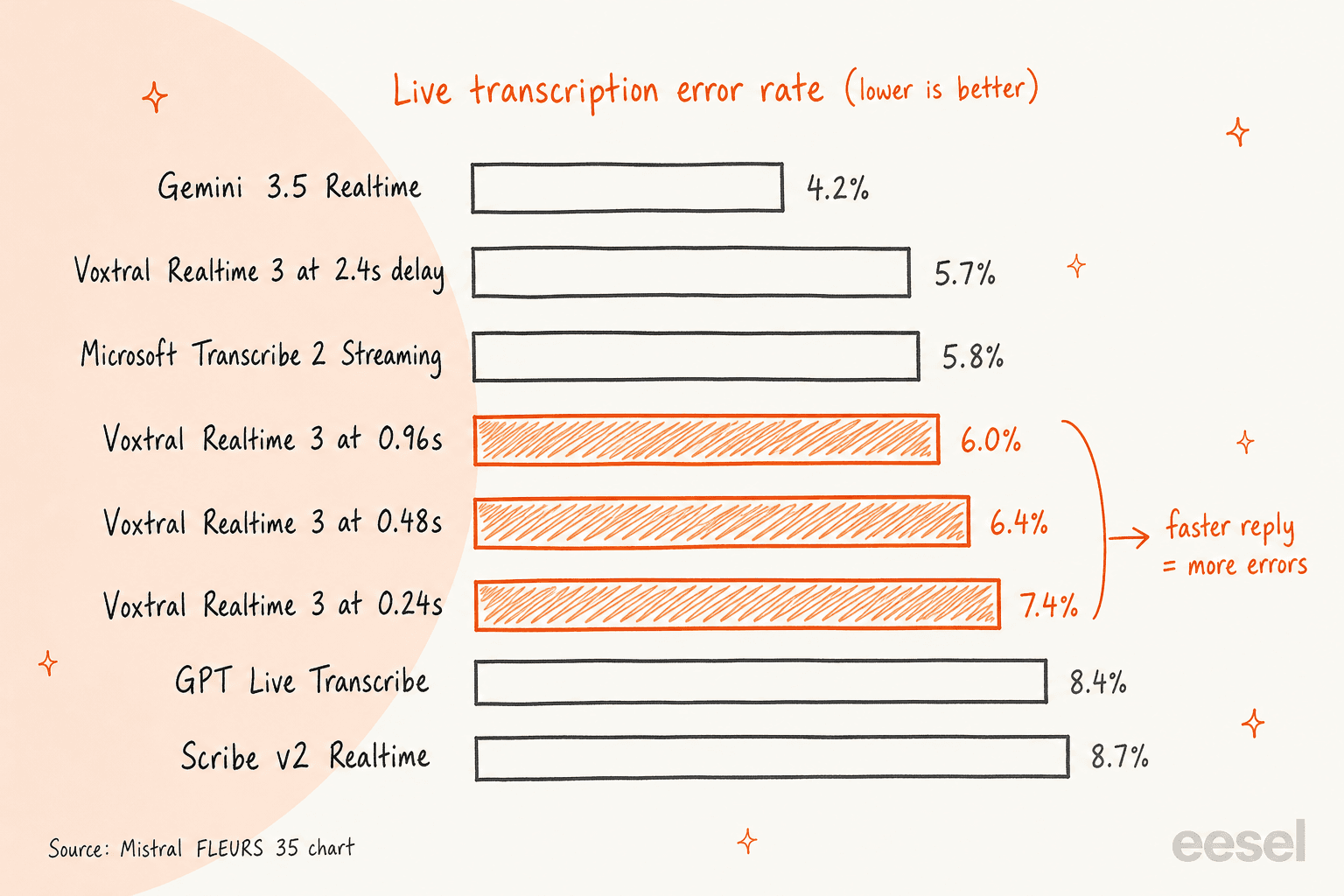
Voxtral Mini Transcribe Realtime 3 has a latency dial: you pick how long it waits before committing to words, anywhere from 80 ms to 2,400 ms. Waiting longer means more context and fewer errors. On Mistral's 35-language realtime test:
| Setting | Error rate |
|---|---|
| Gemini 3.5 Realtime Transcribe | 4.2% |
| Voxtral Realtime 3 at 2,400 ms | 5.7% |
| Microsoft AI Transcribe 2 Streaming | 5.8% |
| Voxtral Realtime 3 at 960 ms | 6.0% |
| Voxtral Realtime 3 at 480 ms | 6.4% |
| Voxtral Realtime 3 at 240 ms | 7.4% |
| GPT Live Transcribe | 8.4% |
| Scribe v2 Realtime | 8.7% |
Two things stand out. First, Gemini 3.5 Realtime beats every Voxtral setting in Mistral's own chart. Second, the setting you'd actually use for a snappy phone agent (around 240 to 480 ms) is where Voxtral gives up the most accuracy. It still beats GPT Live Transcribe and Scribe v2 Realtime at every setting, so it is a solid choice. Just not the most accurate one.
One small thing I'd check before you build on it: Mistral's pages don't agree on how many languages the realtime model covers. The launch post says over 35, the pricing card says 40+, and the chart tests 35. Test your exact languages rather than trusting the larger number.
The good news is end-of-turn detection. The realtime model predicts when a caller has finished speaking using both the sound and the meaning of what they said, which is what stops a voice agent from talking over someone who paused mid-sentence. Anyone who has sat through a bot that jumps in while you're reading out a card number knows why that matters.
How natural does the Voxtral 3 voice sound?
Natural enough, and very cheap for what you get. Voxtral TTS 3 is the piece that improved the most in feel, if not in a single headline number.
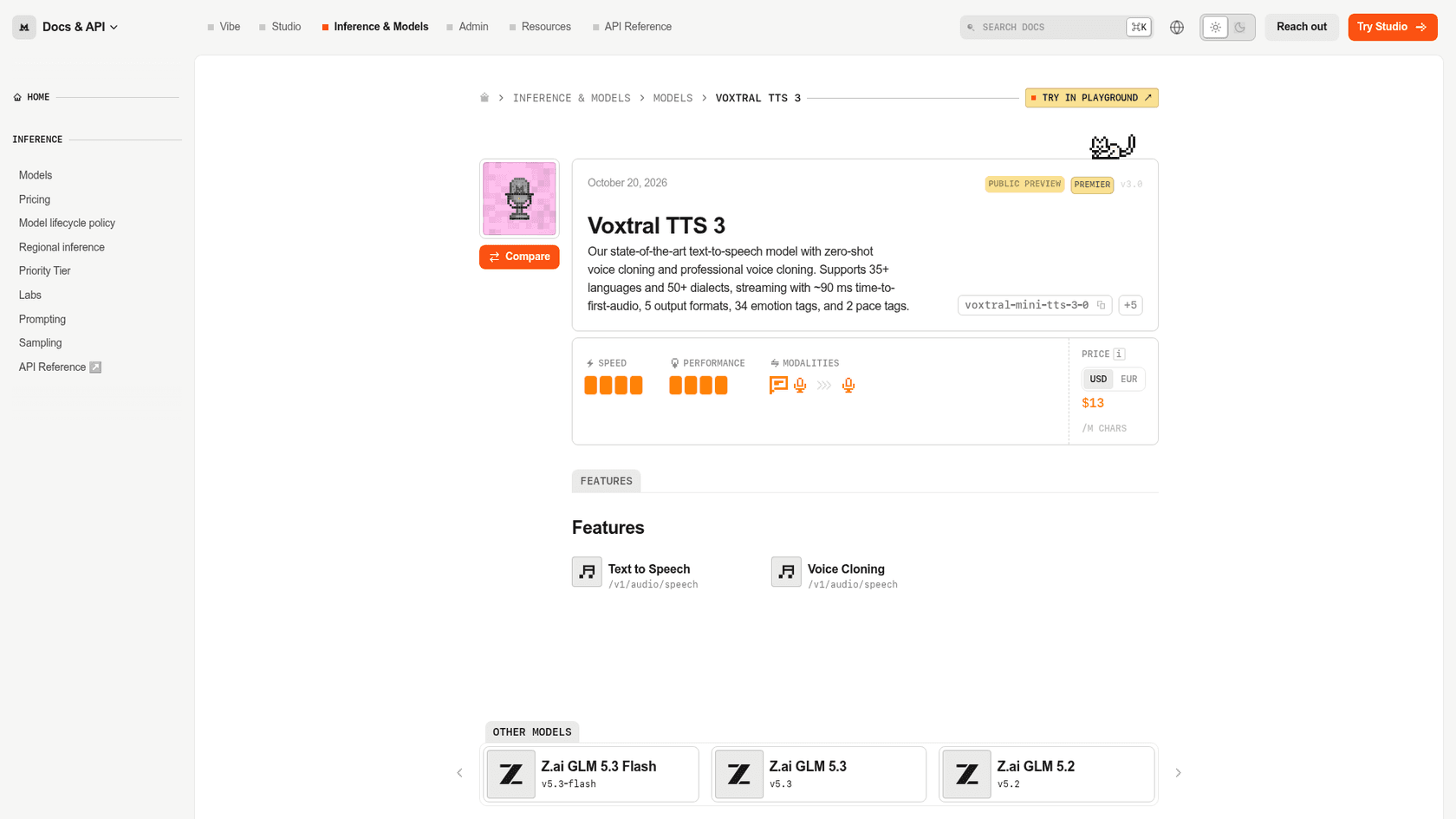
The spec sheet from the model card:
- 35+ languages and 50+ dialects, with preset voices in 18 languages
- About
90 mstime-to-first-audio when streaming - 34 emotion tags and 2 pace tags you can drop inline, like
[emotion=...] - Zero-shot voice cloning, plus a "Pro Voice" option trained on about 30 minutes of audio
- 5 output formats
The examples on the launch page are worth a listen, because they target exactly where support voices fail. In one, Voxtral 1 reads a flight time as "21,000pm on 10 over 10". Voxtral 3 reads it as "21pm on October 10th". Another reads an email address back to a caller cleanly. Those are the moments where a cheap voice embarrasses you on a support line.
On price, Mistral claims $13 per 1M characters costs less to run than OpenAI TTS-1, Deepgram, ElevenLabs Flash and Gemini Flash, and its quality-per-dollar charts (built on BeSimple AI's Voice Code Bench, which tests numbers and unusual names in support scripts) place Voxtral TTS at the cheap end of the field. Those are vendor-run charts with a Gemini model as the judge, so treat them as a shortlist, not a verdict. If you're comparing seriously, put it next to ElevenLabs, Cartesia Sonic 3 and Gemini 3.8 Flash TTS with your own scripts, or browse the ElevenLabs alternatives list.
One note from the migration guide: style instructions, the free-text "say this warmly" control, are marked as not available at launch. You get emotion and pace tags today.
How does the Voxtral 3 voice agent SDK work?
The SDK is the most interesting part of the launch for anyone building a voice agent for customer support, and the most gated.
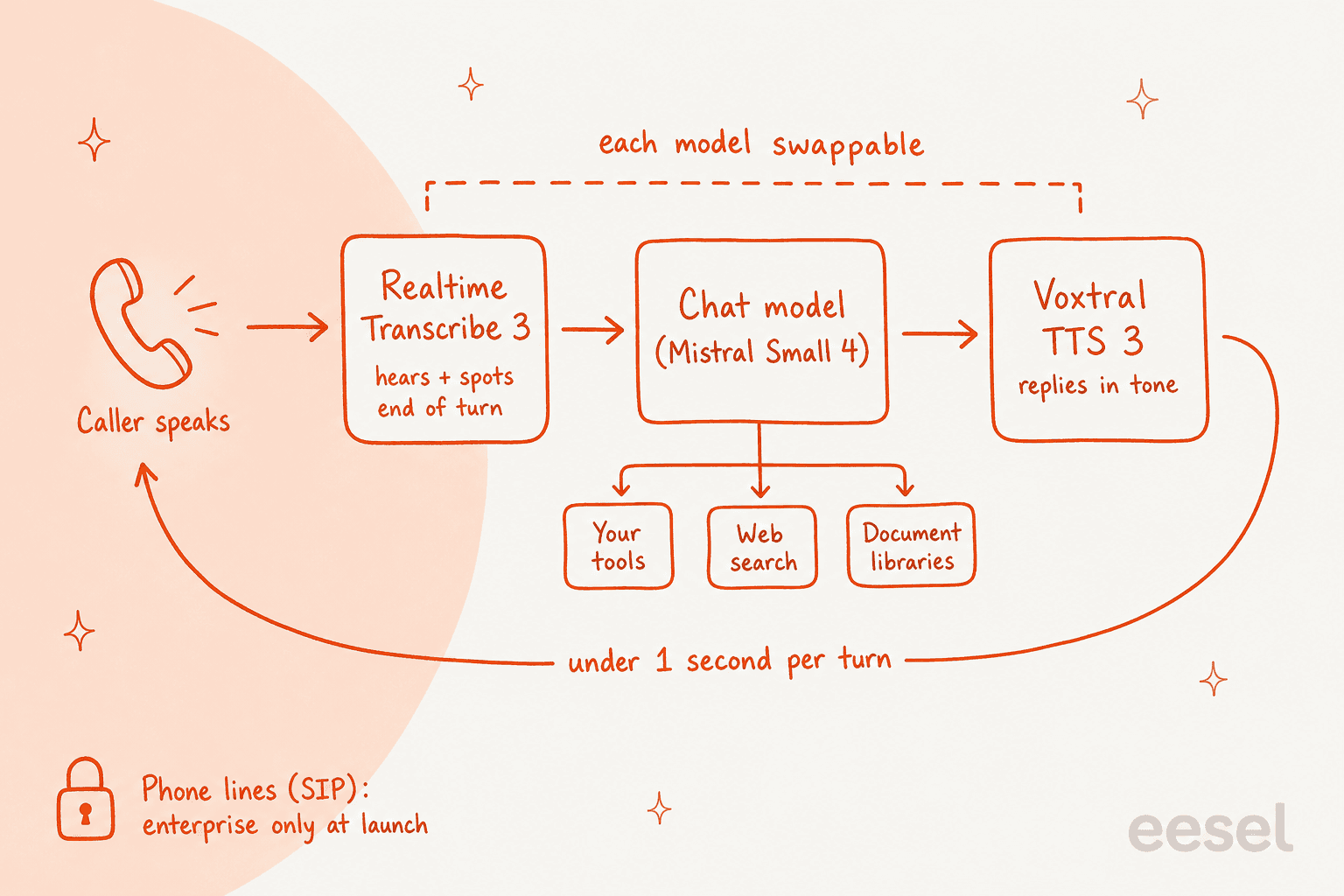
Per the voice agents docs, each turn of a conversation runs through three stages: the realtime model transcribes and spots the end of the turn, a chat model like Mistral Small 4 writes the answer and calls tools, and Voxtral TTS speaks it. Mistral says the stages stream into each other, so each turn completes in under one second, and the caller can interrupt.
What I like as a builder:
- Each stage is a separate model. You can swap the reasoning model for a bigger one, or change the voice or language, without rewriting the agent.
- Agents are versioned. You save an agent config, every change creates a new version, and you can pin production to a known version while testing the next. That's the right design for anything customers talk to.
- Webhooks fire when a call starts, ends or fails, so you can store every transcript in your own system of record.
- It's built on LiveKit for audio transport, with Python and TypeScript bindings, but you don't need to know LiveKit to use it.
What gives me pause:
- Phone lines are enterprise-only at launch. The docs say telephony over SIP is "available to enterprise customers at launch, through your account team." Browser and app voice (over WebRTC) is open to everyone. For a support team whose customers call a phone number, that's the deciding line.
- Client-side tools fail on phone calls. The docs spell out that on a phone line no code of yours runs in the call, so anything a phone agent needs (look up an order, check a bill) has to be a server-side tool.
- The tools are web search, document libraries, workspace connectors and your own functions. There's no built-in notion of your helpdesk or your past tickets. Across our sales calls at eesel, the single most requested capability is training on past tickets, because that's where a company's real answers live. With Voxtral, that's integration work you'd do yourself.
There's also the security question a Hacker News commenter raised on the launch thread, which hit 770 points and 202 comments. A voice agent wired into internal systems is a prompt-injection target that anyone with a phone can reach:
"I see companies hooking this up direct to the company intranet, and then users calling up and saying "Can you check this website for me?""

That's not a Voxtral flaw so much as the job description of any tool-calling voice agent. But it's a good reason to keep phone agents on narrow, server-side tools with clear limits on what they can change. If you're mapping out what a call center AI agent should and shouldn't be allowed to do, start there.
What does Voxtral 3 cost in practice?
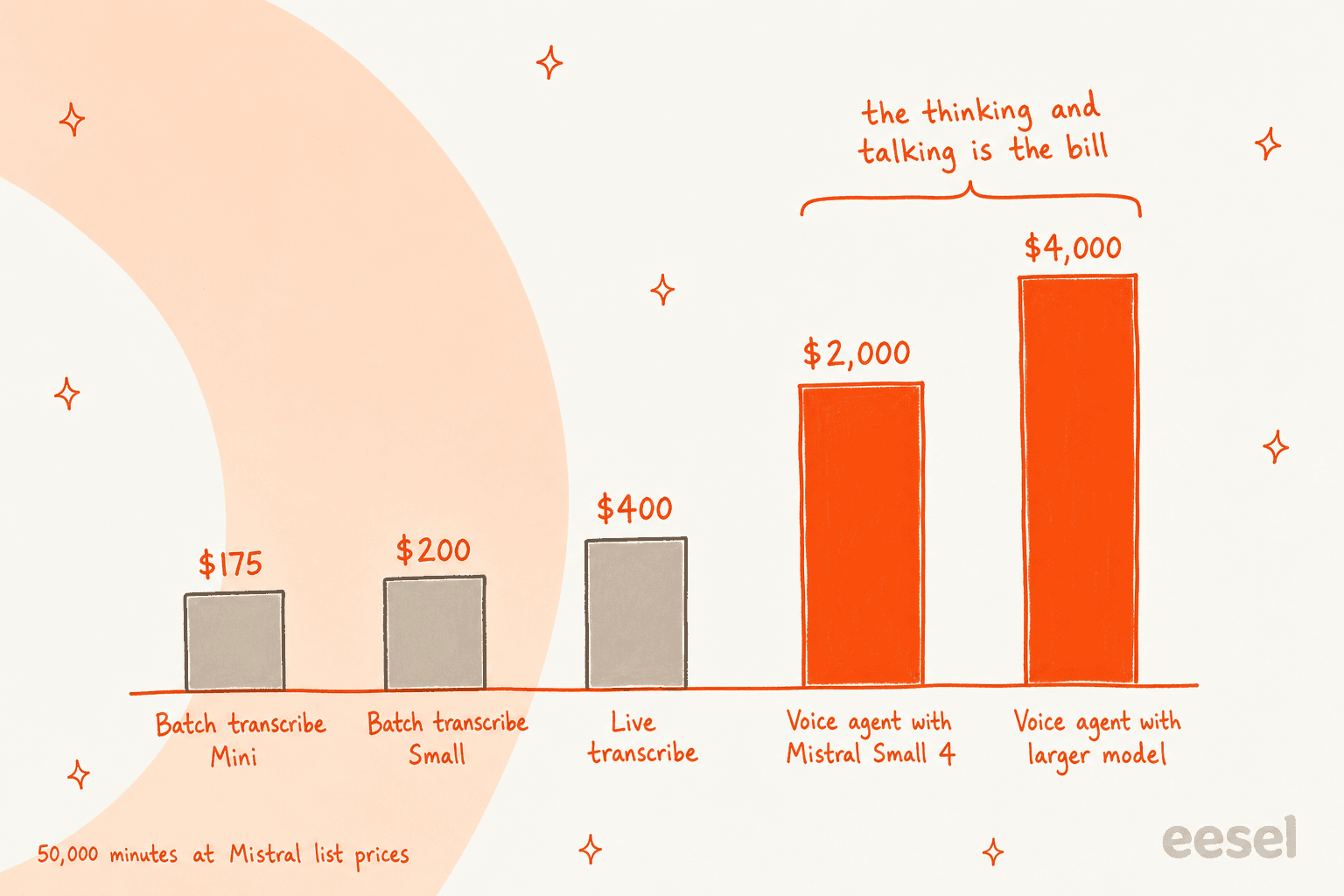
The per-minute prices are tiny until you add the thinking. Here's what 10,000 five-minute calls (50,000 minutes) cost at Mistral's list prices:
| What you run | Rate | 50,000 minutes |
|---|---|---|
| Batch transcription, Mini | $0.0035/min | $175 |
| Batch transcription, Small | $0.004/min | $200 |
| Live transcription | $0.008/min | $400 |
| Voice agent API with Mistral Small 4 | $0.04/min | $2,000 |
| Voice agent API with a larger model | $0.08/min | $4,000 |
The pattern is the useful part. Transcribing every call you already take for QA costs a few hundred dollars a month. Having an AI agent actually answer those calls costs 10 to 20 times more, because the reasoning and the speech are the bill. A single five-minute support call through the agent API comes to $0.20 with Mistral Small 4. That's the number to plug into your call center ROI model, not the $0.004.
The $0.04 agent rate is also competitive on its face. For context, my Grok Voice review in August covered a rival priced at $0.08 a minute. Check the latest rates on each vendor's page before you commit, since voice pricing has moved fast this year. The full Mistral AI pricing breakdown covers the chat models that sit behind the agent.
Why are the Voxtral 3 weights closed?
This is the change that got the loudest reaction, and it's a fair one. The first Voxtral models (Mini 3B and Small 24B, July 2025) and the Voxtral Mini 4B Realtime model from January 2026 all shipped open weights on Hugging Face. That realtime model alone shows over 2 million downloads. Voxtral 3 has no public weights.
The launch says Voxtral 3 is available "for self-deployment on your own infrastructure", which confused readers until a commenter clarified it:
"You have to call sales to get access for on-prem deployment and the models. If it were open weights, it would be on Huggingface and they would have put a link in the post"
The top comment on the thread put the disappointment plainly:
"Closed model unfortunately, continues the theme of TTS / STT being really not great for local deployments."
To be fair to Mistral, it hasn't stopped open releases altogether, as its run of new models shows. Commenters pointed to Timestral the week before and to the promised weights for Mistral Large 4. And one practitioner made the commercial case: good speech models with diarization are scarcer than good text models, and buyers pay a premium for them. For an enterprise support team, closed weights plus on-prem by contract is a normal procurement path. For a hobbyist building a home assistant, it's a dead end.
What breaks if you're on Voxtral 2?
If you already call Voxtral 2, read the migration guide before you swap model IDs. It's well written and honest about what breaks.
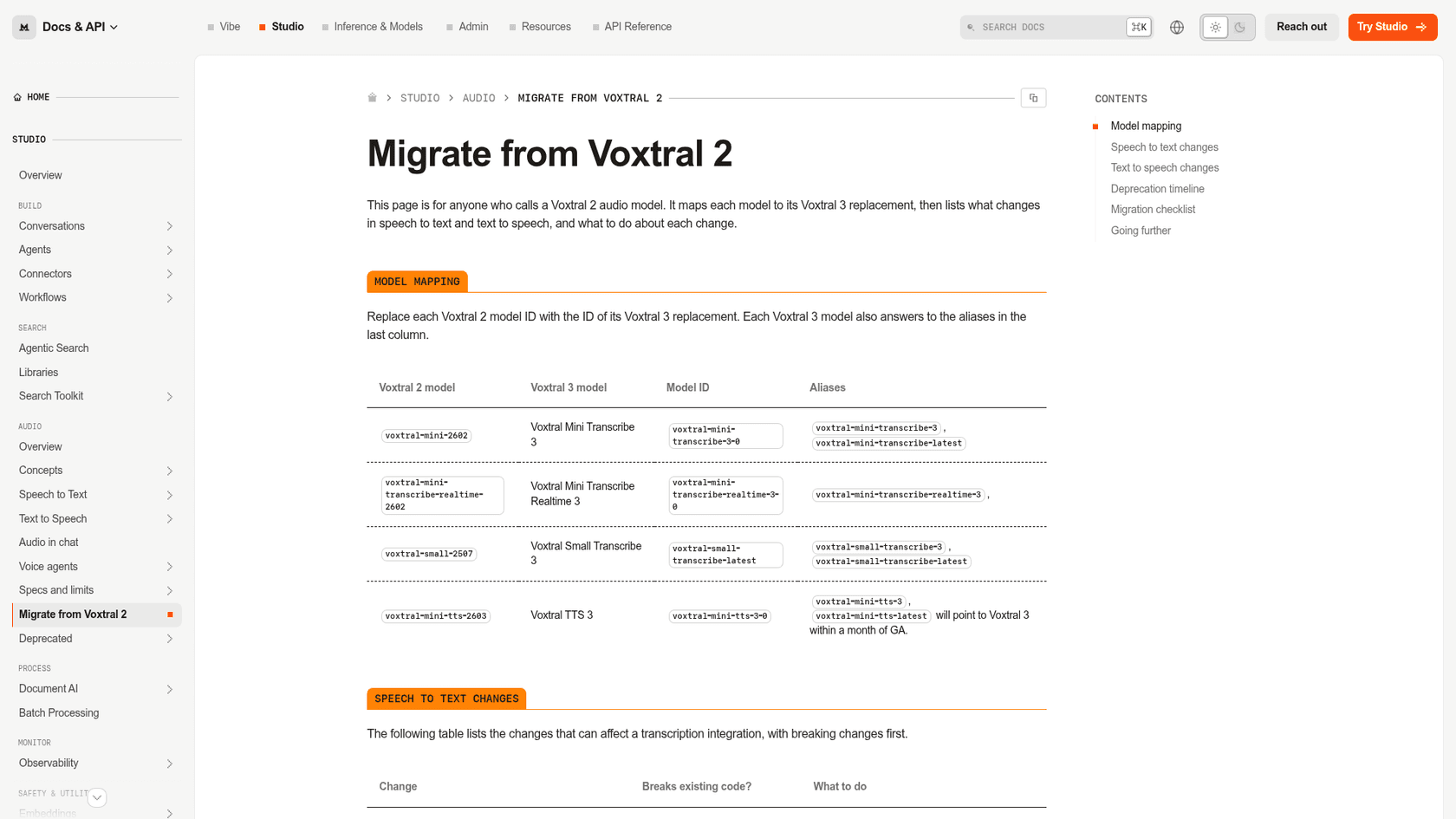
The breaking changes, in the order I'd check them:
- Word timestamps are gone.
timestamp_granularitiesonly acceptssegment; asking forwordreturns a400error. If you highlight words as audio plays, this one hurts. - Realtime sessions lock their settings when the first audio chunk arrives. A later
session.updatereturns an error, so send every setting up front. - Diarized segments can now overlap when two people talk at once. If your display assumes they never do, it'll need a fix.
The TTS side is gentler: old preset voices like gb_jane_sad still work, and ref_audio cloning still works. The voxtral-mini-tts-latest alias will move to Voxtral 3 within a month of general availability, so pin explicit model IDs if you don't want a surprise.
Who should use Voxtral 3?
Here's where I land, by buyer:
| If you are... | Verdict |
|---|---|
| Transcribing recorded calls for QA or analytics | Yes. Near-top accuracy, the best diarization in its chart, and $0.0035 to $0.004 a minute. |
| An EU team that needs audio processed in Europe | Yes. EU-hosted API and on-prem by contract. Pair it with a read of the EU AI Act rules for support. |
| Building a browser or in-app voice assistant | Probably. The SDK is well designed and the agent price is low, but it's a preview. |
| Putting an AI on your support phone line this month | Not yet, unless you're an enterprise customer. SIP is gated for AI phone support, and you'll build the helpdesk integration yourself. |
| Wanting weights to run locally | No. Look at the Mistral alternatives or the older open Voxtral models. |
Overall I'd give Voxtral 3 3.5 out of 5. The transcription models are a 4.5, the voice is a 4, and the agent SDK is a promising 3 held back by preview status and phone gating. If Mistral opens SIP to everyone and the models leave preview at these prices, that score goes up.
If you're comparing it with the wider market, my roundup of the best AI for voice support and the list of AI voice companies cover the other options. And if you're still deciding whether phone support is worth automating at all, call center automation is the place to start.
Where eesel fits next to Voxtral 3
Voxtral 3 is infrastructure: very good ears and a cheap, expressive voice. eesel is the employee. Our AI helpdesk teammate joins the helpdesk you already run (Zendesk, Freshdesk, Gorgias and others), learns from your past tickets, help center and macros, and gets tested against your real ticket history before it answers a single customer.
That's the half of support Voxtral leaves to you. smava, a German loan comparison site, has eesel handle 27,000 Zendesk tickets a month in German, categorizing 14,600 of them and drafting 15,300 replies from 820 macros and help center articles. Koffer.ch, a Swiss luggage store, has it draft Freshdesk replies in German, French, English or Italian, whichever language the customer wrote in, with Swiss spelling. That's multilingual support without a translation step. Neither needed a speech model to get there, and both would need exactly that ticket knowledge if they ever put an agent on the phone.
If your queue is email and chat today, that's where I'd automate first. Try eesel on your own past tickets, free, and see what it would have answered.