

Voxtral 3 is Mistral's full speech stack in one release: three models that turn speech into text, one that turns text into speech, and a voice agent SDK that wires them to a chat model so an AI can hold a phone or browser conversation. It launched on October 20, 2026, and every model is still a public preview.
The prices are low. Transcription runs $0.0035 to $0.008 a minute, the voice costs $13 per 1M characters, and the whole agent pipeline is $0.04 a minute with Mistral Small 4 doing the thinking. Two catches: the weights are closed this time, and phone lines over SIP are enterprise-only at launch.
For support teams, the takeaway is that Voxtral solves hearing and speaking, not knowing. At eesel, I build the AI agents that answer real tickets, and the work that makes them useful is learning a company's past answers, like the 27,000 German Zendesk tickets a month we handle for smava. Voxtral gives an agent ears and a voice. The answers still have to come from somewhere.
What is Voxtral 3?
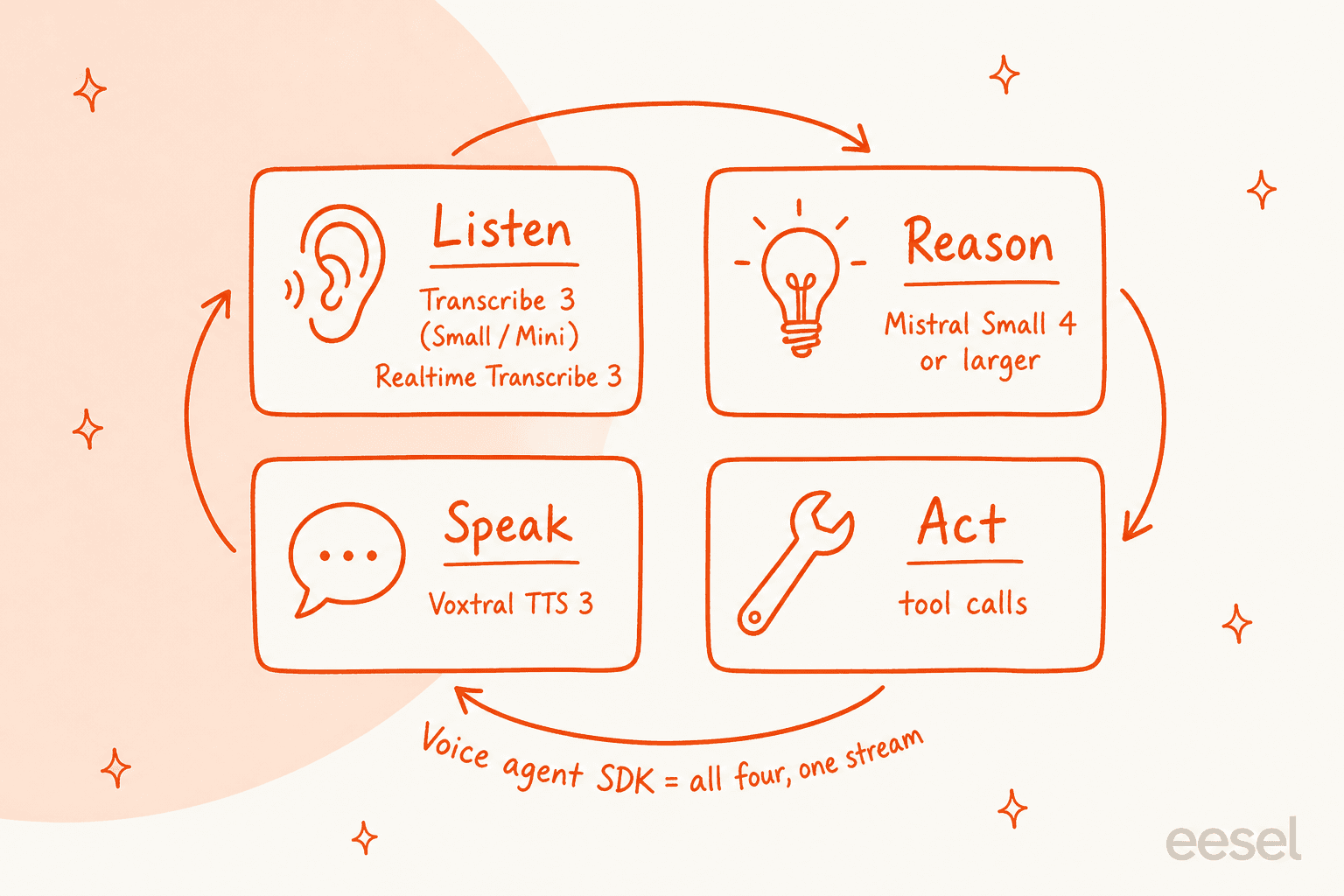
Voxtral 3 is a family of speech models from Mistral AI, the Paris-based lab behind the Mistral and Magistral chat models. Mistral's pitch is that a working voice agent has to do four jobs at once: listen accurately, reason about what the caller means, speak naturally, and take action in other systems. Voxtral 3 is the first Voxtral release that ships a piece for each one.
I work on how eesel's agents actually run under the hood, so the part of this launch I find most interesting isn't any single benchmark. It's that Mistral split the job into separate models you can swap, rather than one model that does everything. That choice explains most of what's good and most of what's awkward about Voxtral 3.
What models are in Voxtral 3?
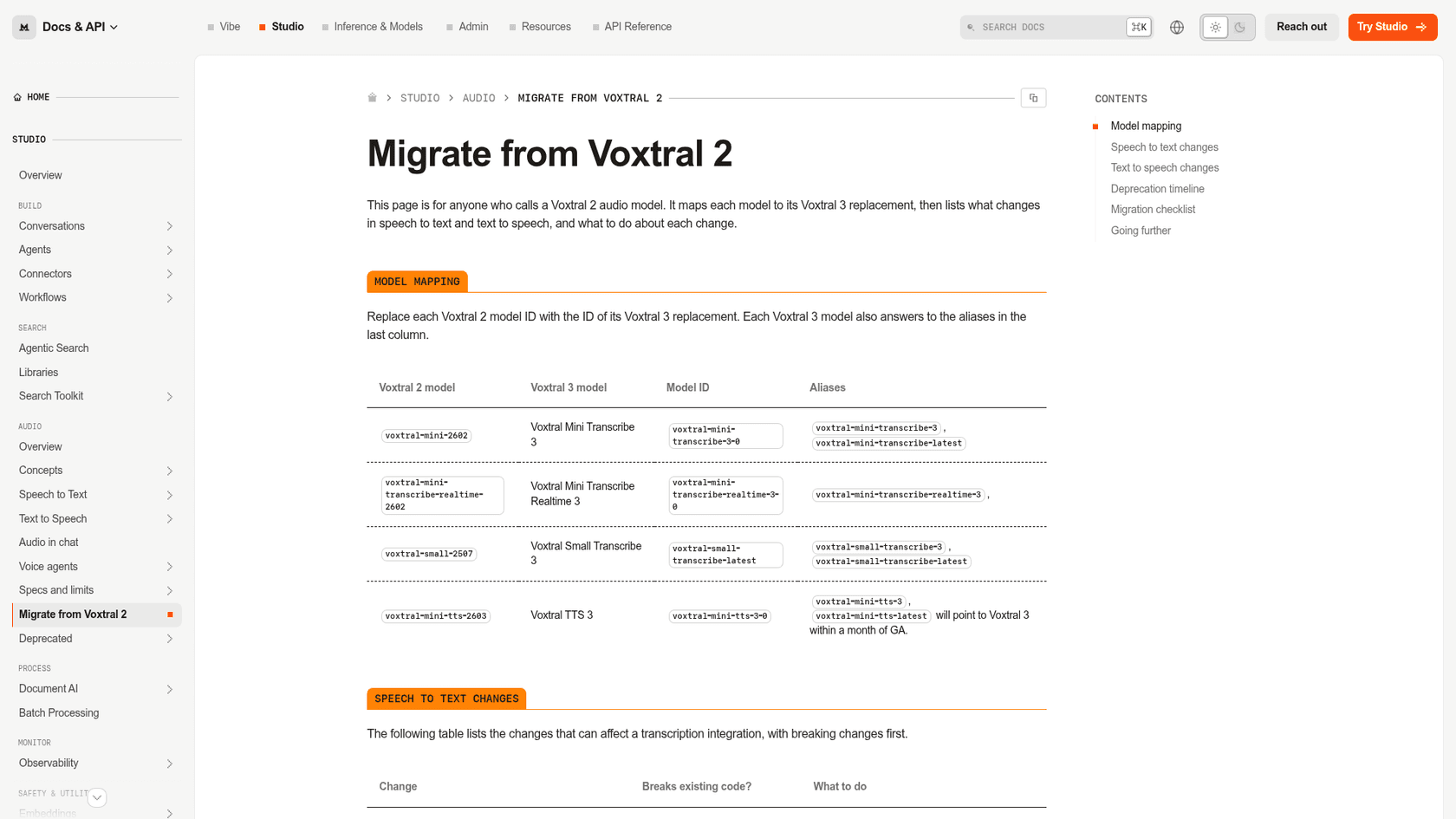
There are four models and one API product. Here's the lineup with the model IDs you'd actually call, taken from the migration guide and the launch pricing:
| Model | Model ID | What it does | Price |
|---|---|---|---|
| Voxtral Small Transcribe 3 | voxtral-small-transcribe-3-0 | Flagship batch transcription, diarization, translation, speech Q&A | $0.004/min |
| Voxtral Mini Transcribe 3 | voxtral-mini-transcribe-3-0 | Smaller 4B batch transcription model | $0.0035/min |
| Voxtral Mini Transcribe Realtime 3 | voxtral-mini-transcribe-realtime-3-0 | Live transcription with end-of-turn detection | $0.008/min |
| Voxtral Mini TTS 3 | voxtral-mini-tts-3-0 | Text to speech, 35+ languages, voice cloning | $13/1M chars |
| Voice agent API | n/a | Realtime transcription + chat model + TTS in one stream | $0.04/min (Mistral Small 4), $0.08/min (larger model) |
Each model has short aliases too, like voxtral-mini-transcribe-latest. One thing to watch: Mistral says the voxtral-mini-tts-latest alias will only move to Voxtral 3 within a month of general availability. If you want predictable behavior, pin the full model ID.
All of it is available through Mistral's API on European, US and global endpoints, and you can try transcription, speech and voice agents in the Studio playground before writing code.
The transcription models
Voxtral Small Transcribe 3 is the one to know. Mistral calls it its flagship transcription and diarization model (diarization means labeling who said each line). It handles 50 languages, including the 24 official EU languages (handy for multilingual support), and its model card says it also does translation, summarization and function calling from audio. The context window is 32k tokens.
On Mistral's 45-language FLEURS test, Small scores a 4.0% word error rate when it detects the language itself, tied with Microsoft AI Transcribe 2 and far ahead of Whisper large-v3 at 14.9%. The Mini model scores 4.5% for slightly less money. I break down every chart, including where Voxtral is not on top, in my Voxtral 3 review.
Both batch models support context biasing: you send a list of terms (product names, people, SKUs) and the model spells them correctly without any fine-tuning. On Mistral's keyphrase test, that list lifts Small's recall from 81.4% to 94.6%, so treat it as a default, not an extra.
The realtime model is the one a live agent uses. You choose how long it waits before committing to words, and longer waits mean fewer errors. It also predicts when a speaker has finished, using both the sound and the meaning of the words, which is what stops a voice bot from cutting someone off mid-sentence. That matters for AI phone support, where callers pause to read out order numbers.
The voice model
Voxtral Mini TTS 3 turns text into speech in 35+ languages and 50+ dialects, with preset voices in 18 languages. The model card lists about 90 ms to first audio when streaming, 34 emotion tags and 2 pace tags you write inline, and voice cloning from a short clip. For brand voices, "Pro Voice" builds a closer copy from about 30 minutes of audio.
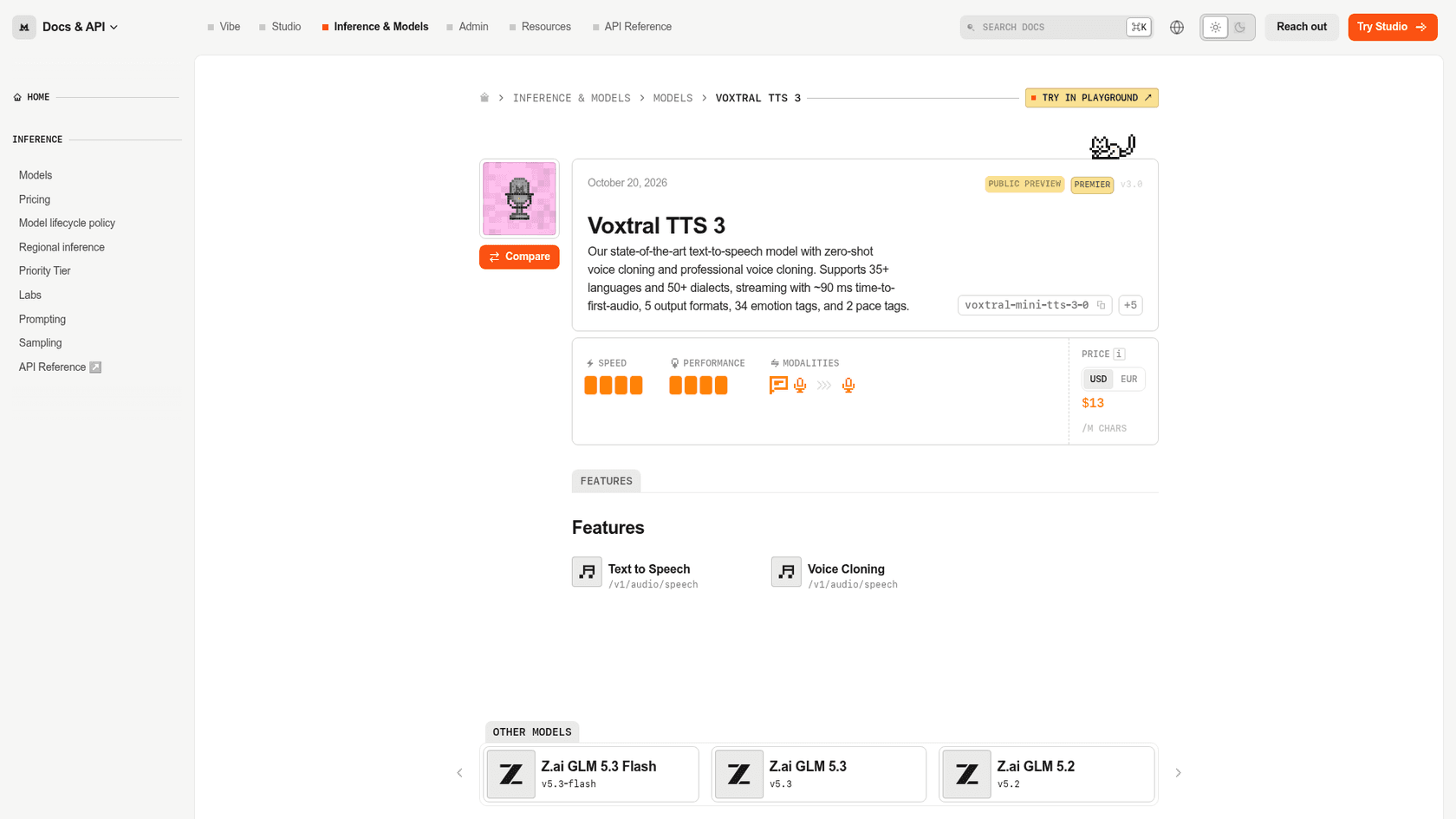
The launch page's sound samples target the exact things that trip up support voices: reading back an email address, a flight time, a price in pounds. Mistral also claims $13 per 1M characters undercuts ElevenLabs Flash, OpenAI TTS-1, Deepgram and Gemini Flash. Not everyone loves the new sound, though:
"The examples they give of how they "improved" the voices aren't great. Version 1 sounded like actual people, while this version sounds like generic AI slop voice."

That's one listener, and voice taste is personal. It's still a good reason to generate samples with your own scripts before you pick a voice.
How does the Voxtral 3 voice agent work?
The voice agent runs a three-stage loop for every turn of the conversation. Per the voice agents docs, the realtime model transcribes the caller and spots when they've stopped, a chat model such as Mistral Small 4 decides what to say and calls any tools, and Voxtral TTS speaks the reply. The stages stream into each other rather than waiting, so Mistral says each turn finishes in under one second, and the agent stops talking when the caller interrupts.
During a call the agent can use function calling, web search, document libraries and your own functions, for example to verify a caller or book an appointment. It runs in browsers and apps over WebRTC, and on phone lines over SIP. The SDK sits on LiveKit for audio transport.
A Hacker News commenter put their finger on why this is the interesting part of the release:
"I think the special sauce of this isn't the STT/TSS (although it does appear to be quite good) - it's the integration of a real-time reasoning model to actually do something with the raw text of the conversation, and whatever they're doing to hide tool call latency if the model needs to search for something."
I agree, and it's also where the work lands on you. The tools are generic: there's no built-in idea of your helpdesk, your order system or your past tickets. On our sales calls at eesel, the most requested thing by far is an agent that learns from past tickets, because that's where a company's real answers live. With Voxtral, connecting that is integration work you'd own. If you're mapping what a call center AI agent should be allowed to touch, decide that before you wire up tools.
Two launch limits matter most for support. Phone calls over SIP are enterprise-only at launch, arranged through Mistral's account team, while web and app voice is open to everyone. And tools that run in the user's browser don't work on phone calls, so anything a phone agent needs has to run on your server.
What's new compared with Voxtral 2?
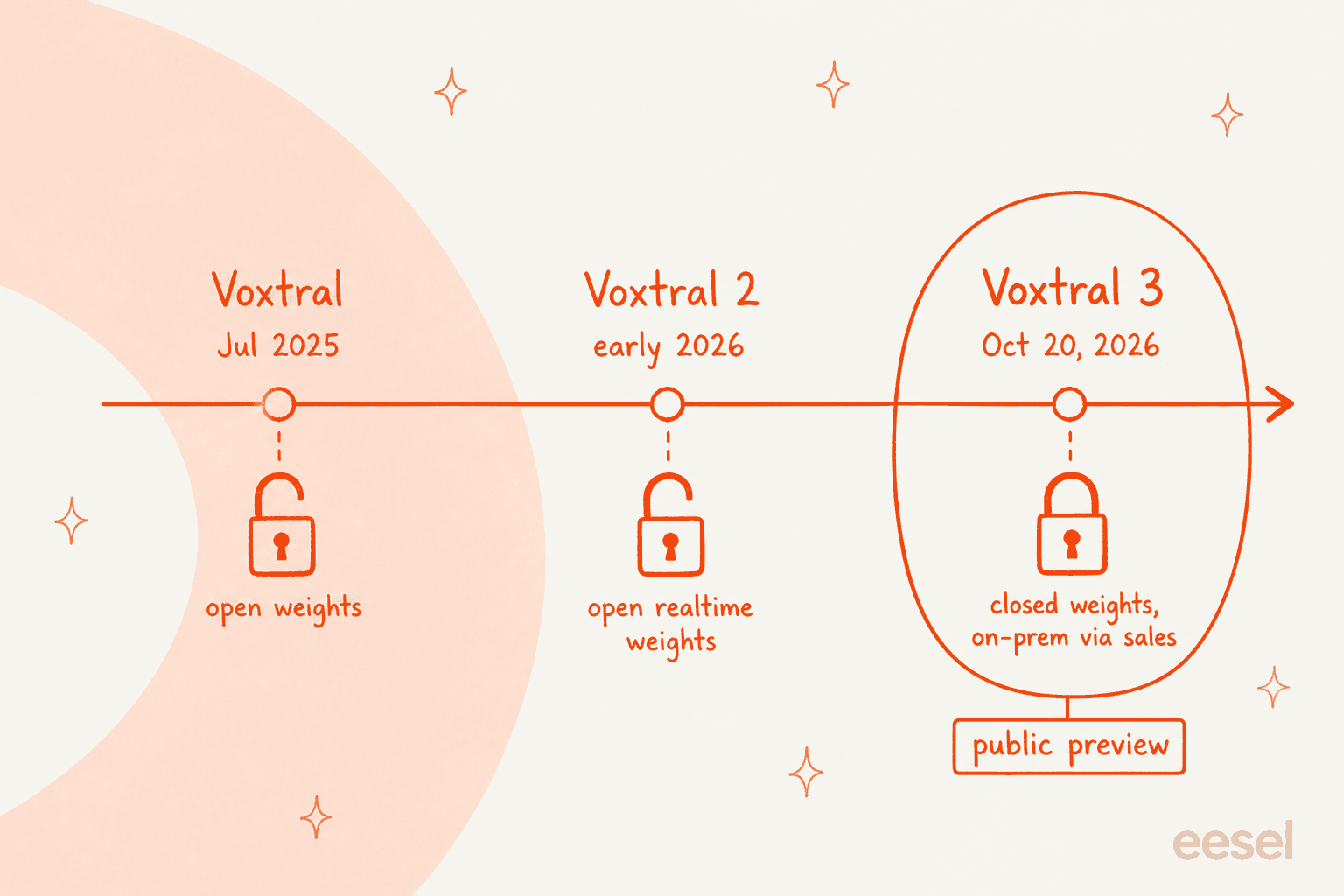
The short version: more languages, much better diarization, a new agent layer, and closed weights.
What improved:
- Diarization. The Mini model's error rate on Mistral's diarization benchmark dropped from
30.9%on Voxtral Mini Transcribe 2 to18.6%on Mini Transcribe 3. For call recordings, knowing which lines were the customer's is half the value. - Languages. Batch transcription now covers 50 languages, with low-resource Asian and Indic languages added.
- Context biasing. Terms can now be multi-word phrases, and a free-form context sentence works offline.
- Realtime features. Diarization, speaker references and turn detection now work in realtime sessions.
- Voice control. Emotion moves from separate preset voices (like
gb_jane_sad) to inline[emotion=...]tags, and cloned voices can be saved once and reused by ID.
What breaks, per the migration guide:
- Word timestamps are gone. Asking for
wordgranularity returns a400error, so switch to segment timestamps. - Realtime sessions lock their settings at the first audio chunk, so send every setting up front.
- Diarized segments can overlap when two people talk at once.
One feature is listed but not shipped: style instructions, the free-text "say this warmly" control, are struck through in the docs as not available at launch.
Why the closed weights matter
The first Voxtral models in July 2025 and the Voxtral Mini 4B Realtime model were open weights on Hugging Face. Voxtral 3 is not. The launch mentions "self-deployment", but that means a contract: on-prem and private cloud setups go through Mistral's sales team.
"You have to call sales to get access for on-prem deployment and the models. If it were open weights, it would be on Huggingface and they would have put a link in the post"
For a hobbyist running speech on a laptop, that's a real loss. For an enterprise support team, an EU-hosted API plus on-prem by contract is normal procurement, and arguably the safer path for call audio under the EU AI Act. Mistral still releases open models elsewhere, as its Mistral Large 4 plans show.
How much does Voxtral 3 cost?
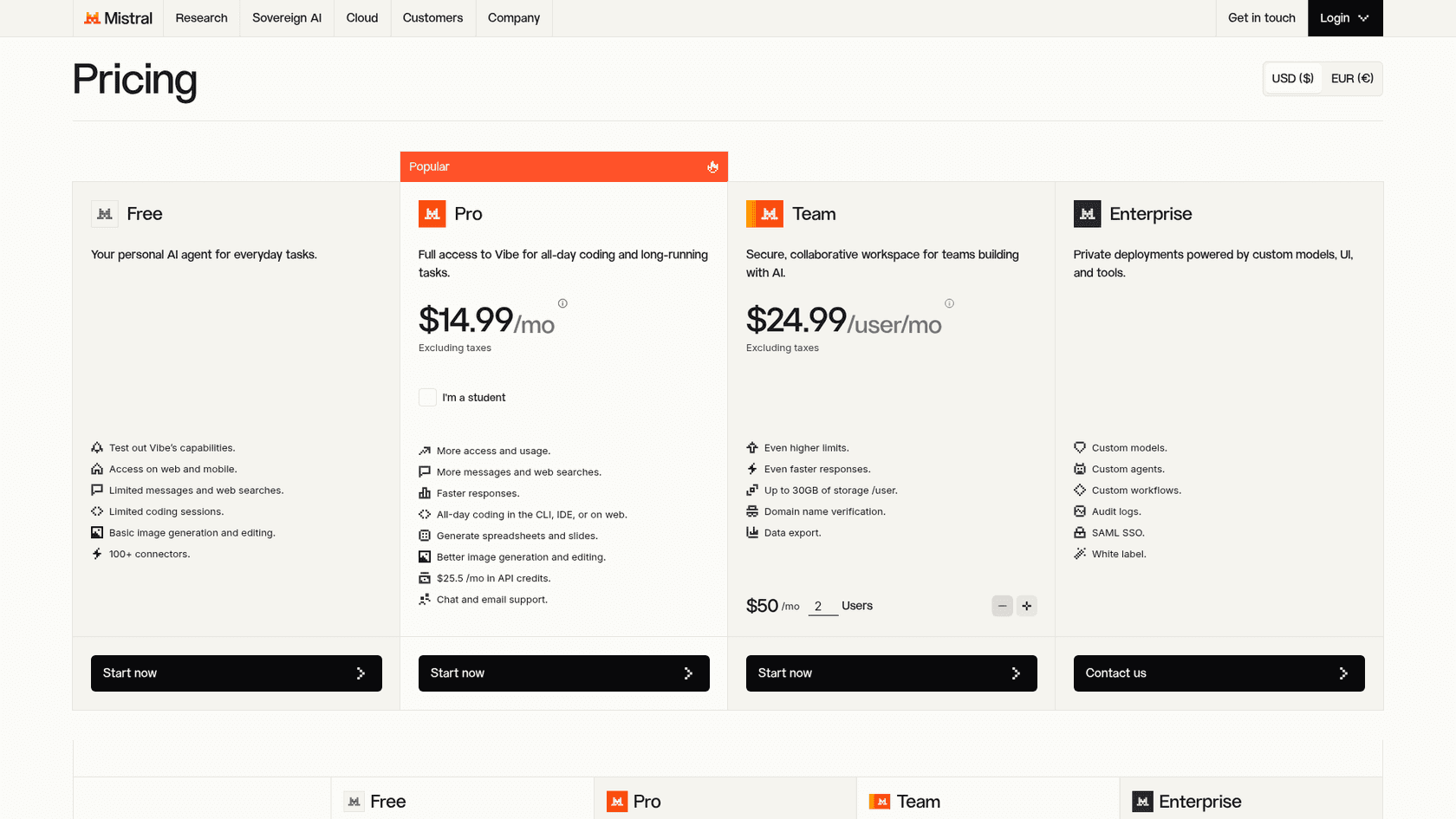
Voxtral 3 is priced per minute of audio for transcription and the agent, and per character for the voice. These are Mistral's launch list prices:
| Workload | Rate | 1,000 five-minute calls |
|---|---|---|
| Transcribe recordings with Mini | $0.0035/min | $17.50 |
| Transcribe recordings with Small | $0.004/min | $20 |
| Live transcription | $0.008/min | $40 |
| Voice agent with Mistral Small 4 | $0.04/min | $200 |
| Voice agent with a larger model | $0.08/min | $400 |
The pattern is the useful part. Transcribing every call you already take for quality assurance costs pocket change. Having an AI take the calls costs 10 to 20 times more, because reasoning and speech are where the bill sits. A five-minute call through the agent API comes to $0.20. That's the figure to put into your call center ROI maths.
For a deeper cost breakdown of the chat models behind the agent, see Mistral AI pricing. For context on rival voice stacks, compare GPT Realtime and Grok Voice Think Fast 2 on their own vendor pages, since voice pricing has moved fast this year.
Which Voxtral 3 model should you use?
Pick by job, not by the biggest model. Here's how I'd map it:
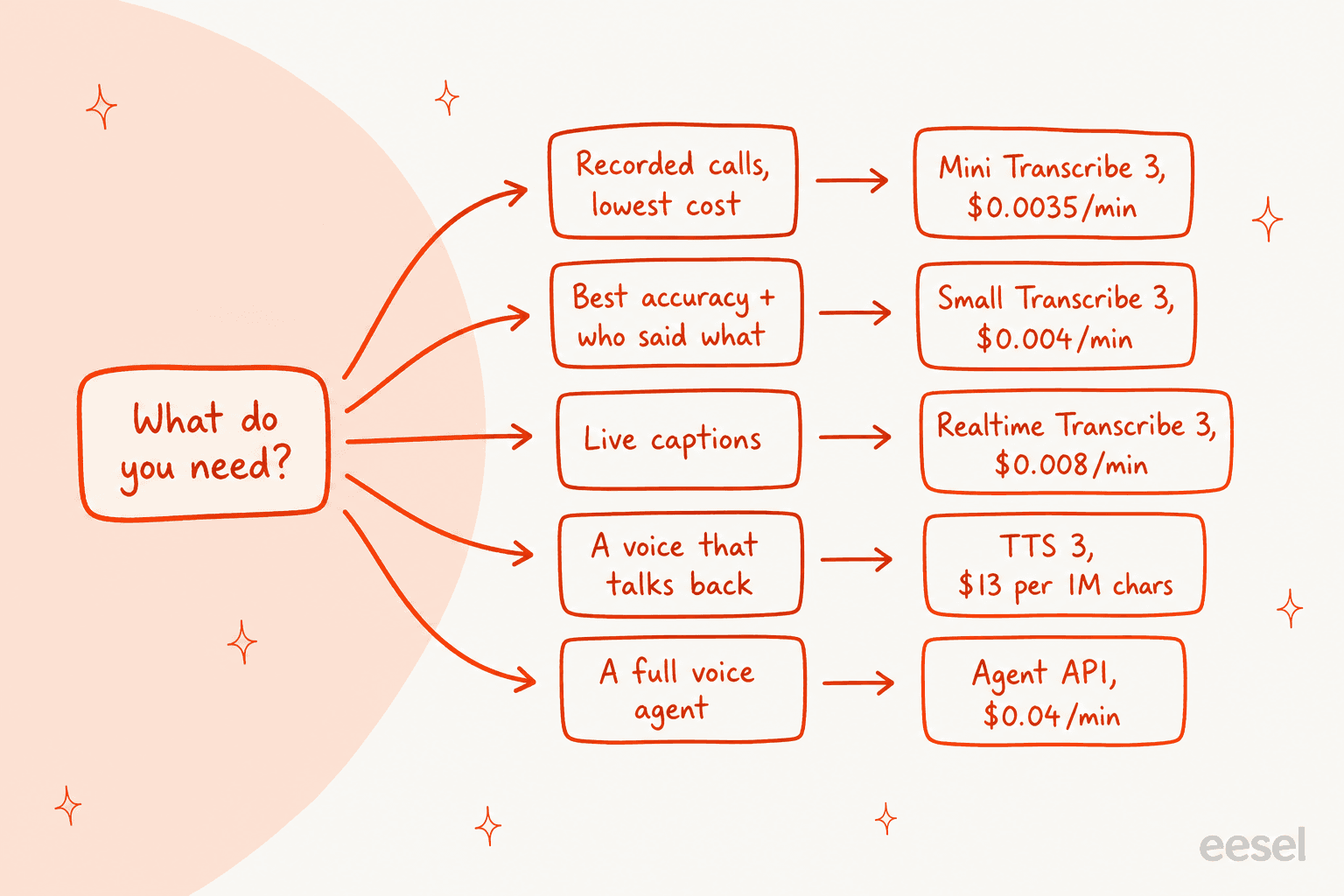
- Call analytics and QA: Mini Transcribe 3. It's within half a point of Small on Mistral's test and the cheapest line on the list. Pair it with PII redaction before transcripts go anywhere shared.
- Meetings and multi-speaker recordings: Small Transcribe 3, for the best diarization in Mistral's chart.
- A browser or in-app voice assistant: the voice agent API. It's well designed, but plan around preview status.
- An AI on your support phone number: wait, unless you're an enterprise customer who can get SIP access, and budget for building the helpdesk integration.
- Local, offline speech: not Voxtral 3. Look at the Mistral alternatives or older open Voxtral weights.
If you're comparing Voxtral with other speech models, Gemini 3.5 Transcribe, MAI-Transcribe 2 and Cartesia Sonic 3 are the closest matches.
For full products rather than models, my roundups of AI voice companies and the best AI for voice support cover the field.
What Voxtral 3 means for support teams
Voxtral 3 makes the speech part of a support agent cheap and good. It doesn't make the agent know your business. That gap is where most voice projects stall: the bot hears the caller perfectly and then gives a confident, wrong answer about the refund policy.
At eesel we've spent years putting AI agents on live support queues, and the lesson repeats on every rollout. Accuracy comes from what the agent learns (past tickets, help center articles, macros) and from testing it against real conversations before it talks to a customer. That's why every eesel rollout is simulated on historical tickets first. A better microphone doesn't change that order of work.
So if you're planning call center automation, I'd sequence it like this: automate the written channels first with an AI agent for customer support, where the answers get built and tested, then give that same knowledge a voice. Voxtral 3 is a strong candidate for the voice layer once SIP opens up.
Try eesel for the answers behind the voice
Voxtral is infrastructure; eesel is the employee. Our AI helpdesk teammate joins the helpdesk you already use, such as Zendesk or Freshdesk, learns from your past tickets, and replies in whatever language the customer wrote in.
That multilingual piece is the part Voxtral's language list can't do on its own. Koffer.ch, a Swiss luggage store, has eesel draft Freshdesk replies in German, French, English or Italian, matching the customer, with Swiss spelling. smava runs it on 27,000 German Zendesk tickets a month.
If your support runs on email and chat today, start there. Try eesel free on your own past tickets and see what it would have answered.