
What MAI-Transcribe-2 actually is
MAI-Transcribe-2 is a speech-to-text model built in-house by Microsoft AI, the same group behind the MAI-Voice and MAI-1 models. The pitch is refreshingly narrow: it does one thing, which is turn audio into text, and it does that across languages in a single model rather than making you pick a per-language engine.
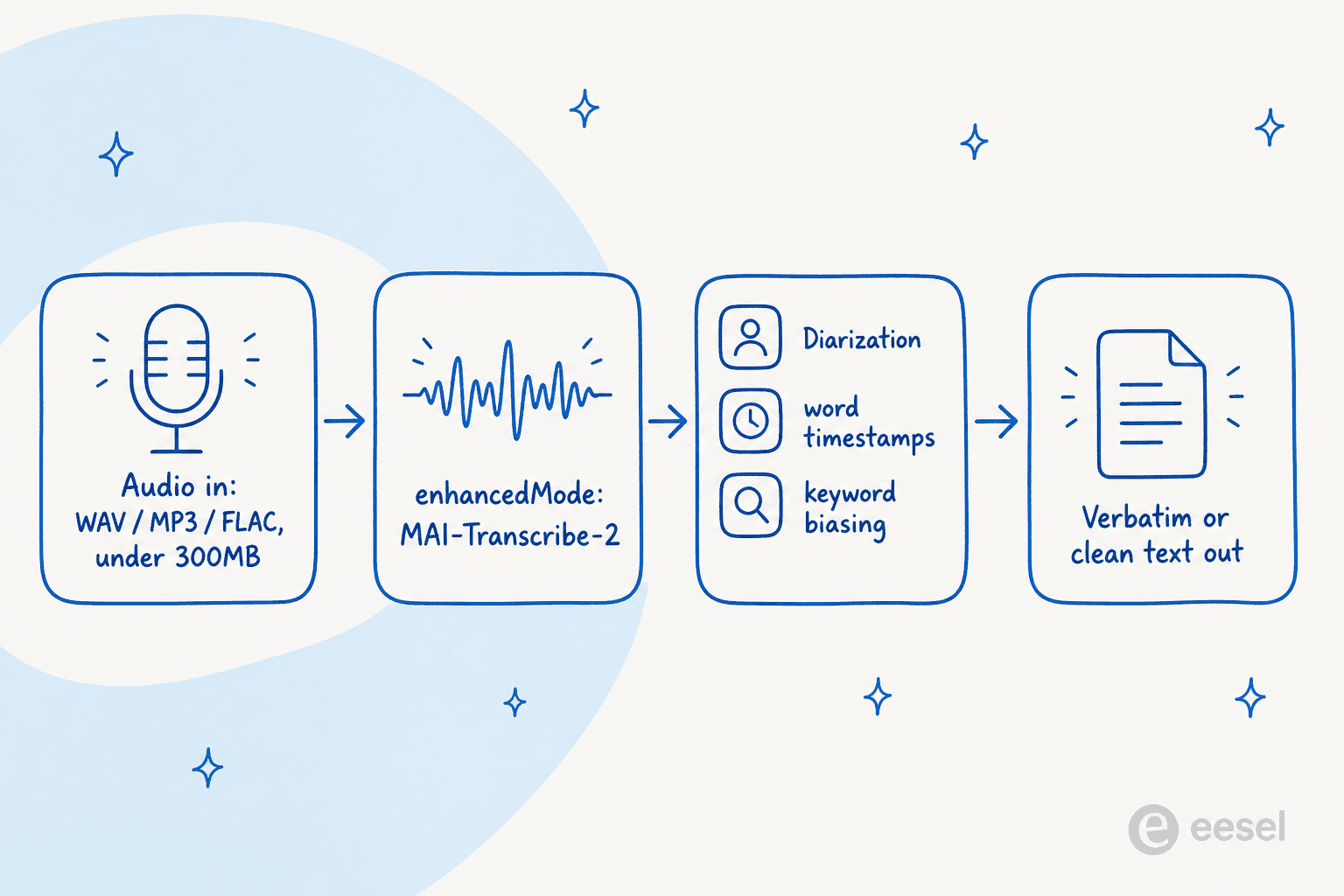
What you get out of it is more than a raw string. The model handles speaker diarization (labelling who spoke when), word-level timestamps, keyword biasing so it favours your product names and jargon, and a choice between a "verbatim" style that keeps every filler and false start for compliance work and a "clean" style that formats readable captions. It succeeds MAI-Transcribe-1.5 and MAI-Transcribe-1, which the Azure Speech docs mark as deprecated since August 20, 2026.
The honest framing here: this is a Microsoft AI model, so it is very much part of the Azure Speech ecosystem rather than a standalone consumer app. You reach it through an API, a developer playground, or third-party routers, not a polished end-user product. If you were hoping for a Otter-style meeting app, this is the layer underneath that, not the app itself.
The headline: fastest, most accurate, and cheapest
Microsoft did not hedge. The launch post calls MAI-Transcribe-2 "the fastest, most accurate and cheapest speech recognition model in the world," which is the kind of triple claim that usually falls apart on the second leg. This one mostly holds, with a couple of asterisks.
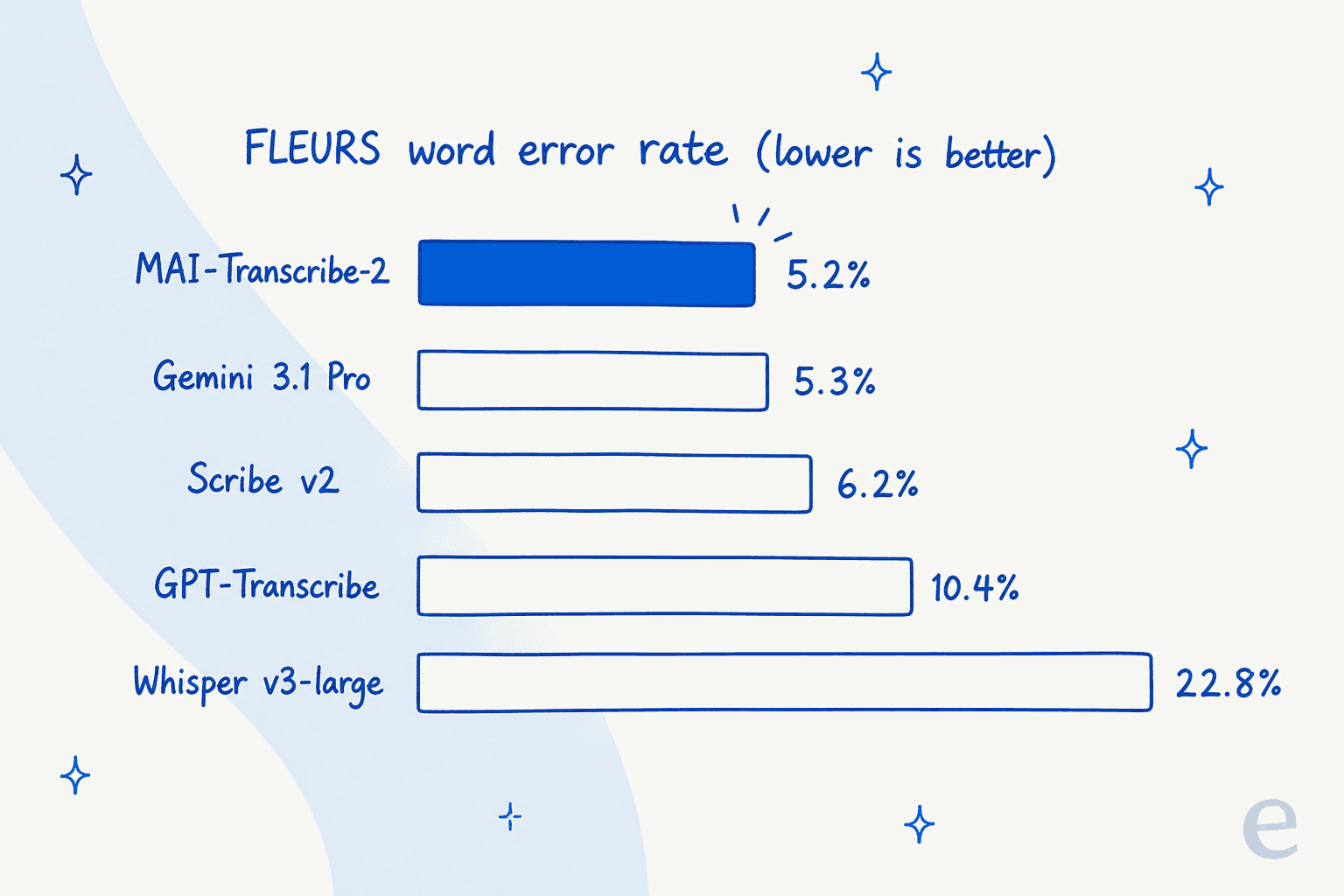
On accuracy, the model posts a 5.2% average word error rate on the FLEURS benchmark across 60 languages, which Microsoft says is #1 on FLEURS and second on the Artificial Analysis word-error-rate leaderboard. On the top-25 FLEURS languages it drops to 3.4%. Here is how the model page stacks it against the field (lower is better):
| Model | FLEURS 60-language WER (forced) |
|---|---|
| MAI-Transcribe-2 | 5.2% |
| Gemini 3.1 Pro | 5.3% |
| Scribe v2 (ElevenLabs) | 6.2% |
| Gemini 3.5 Transcribe | 5.9% |
| GPT-Transcribe (OpenAI) | 10.4% |
| Whisper v3-large (OpenAI) | 22.8% |
The gap over the older open Whisper v3-large is huge, and the margin over Gemini 3.5 Transcribe and GPT-Transcribe is real. The margin over Gemini 3.1 Pro, though, is a tenth of a point, so "most accurate" is true but by a whisker at the top of the table.
On speed, the numbers are genuinely striking. Microsoft clocks one hour of audio at about 10 seconds of model inference, and its launch benchmarks show it 10x faster than GPT-Transcribe, 7x faster than ElevenLabs Scribe v2, and 5x faster than Gemini 3.5 Transcribe, all while landing on the accuracy-latency Pareto frontier. One HN commenter who tried it summed the framing up plainly:
"According to Artificial Analysis it is on the pareto frontier."

The one thing to keep in your head reading all of this: these are Microsoft's own benchmark numbers and Microsoft's own choice of comparison points. That does not make them wrong, and the independent early tests so far line up with the direction. It just means "best in the world" is the vendor's framing, and being second on Artificial Analysis' overall board is the more measured read.
How you actually use it
This is where my builder brain kicked in, and where the model gets more interesting than the leaderboard. MAI-Transcribe-2 runs through the Azure Speech Fast Transcription API, and you switch it on with an enhancedMode flag rather than a whole new endpoint. A minimal call looks like this:
curl --location 'https://YourResourceName.cognitiveservices.azure.com/speechtotext/transcriptions:transcribe?api-version=2025-10-15' \
--header 'Content-Type: multipart/form-data' \
--header 'Ocp-Apim-Subscription-Key: <YourSpeechResourceKey>' \
--form 'audio=@"YourAudioFile.wav"' \
--form 'definition={
  "enhancedMode": {
    "enabled": true,
    "model": "MAI-Transcribe-2"
  }
}'
From there the parameters are clean: diarization.enabled for speaker labels, phraseList.phrases for keyword biasing, modelOptions.transcribeStyle to pick verbatim or clean, and locales if you want to skip auto-detection. Files go up as WAV, MP3, or FLAC and cap at 300 MB. It is a straightforward batch upload, which is a good and a bad thing depending on what you are building.
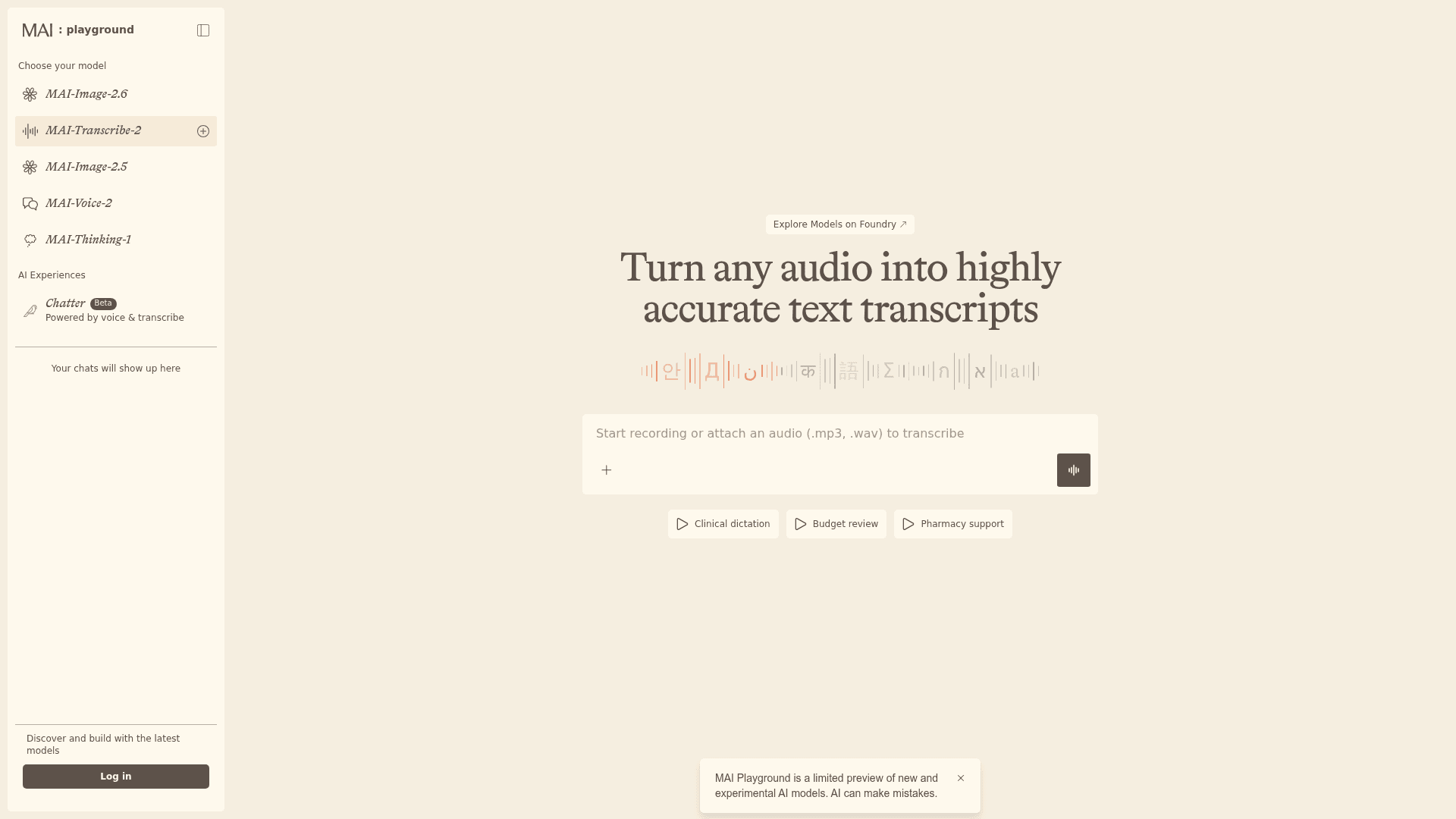
If you would rather click than curl, there are two easier doors. The MAI Playground lets you drop in an MP3 or record straight from the browser, with sample prompts for clinical dictation and support-style calls, and the model is also listed on OpenRouter and in the Azure AI Foundry catalog.
Where it is genuinely good, and where the catches are
Let me give MAI-Transcribe-2 its due first. The strongest independent reaction I found was not a spec-sheet repost. Vojtech Rinik, the indie developer behind the Whisper Memos app, ran a hard real-world clip through it:
"I tried running a church homily with lots of echo in Slovak language through this... It did much better than ElevenLabs at 45% of the price."
Noisy, echoey, non-English audio is exactly the case that breaks lesser models, so a builder choosing it over a tool he already ships on tells you something the benchmark table cannot.
Now the catches, because they matter if you are putting this into production. The $0.10 per hour price is a launch promo that runs "until the end of the year," and Microsoft has not published what happens after. For reference the model page still lists MAI-Transcribe-1.5 at $0.36 per hour, so the standard v2 rate landing somewhere in that range would not be a surprise. A Hacker News commenter asked the two questions Microsoft left open at launch:
"is this usable for streaming or only batch? do they give the price after the launch-discount (till end of year) goes away?"
The streaming half has an answer, and it is a fiddly one: the Fast Transcription API is batch only, and for live audio you have to wire the model in as the input transcription model in the separate Voice Live API. It is doable, but it is not the same call, so plan for it. It is also still a public preview shipped without an SLA, which Microsoft explicitly flags as not for production.
Integration shape is the other thing to check. Because it is a pure transcription model, it does not slot into chat-completions tooling the way a general LLM does. Developers on Reddit hit this early:
"OpenRouter requires a dedicated endpoint (
/api/v1/audio/transcriptions) for pure transcription models like MAI-Transcribe-2."

None of these are dealbreakers. They are the normal texture of a week-old preview model, and worth naming so you are not surprised.
The part the benchmark chart does not show
Here is the reframe I kept coming back to. Transcription used to be the hard, expensive part. MAI-Transcribe-2, alongside Gemini 3.5 Transcribe and ElevenLabs Scribe, has quietly turned it into a fast, cheap, near-solved commodity layer. That is great news, but it also means the value has moved. An accurate transcript is not the thing anyone actually wanted; it is the raw material for the thing they wanted.
Nowhere is that clearer than in customer support. A transcription model can turn a support call or a voicemail into flawless, diarized, timestamped text in about ten seconds. And then what? The text still has to be read, the answer still has to be found in your docs and past tickets, and the reply still has to be written and the ticket resolved. The model gives you the ears. It does not give you the teammate.
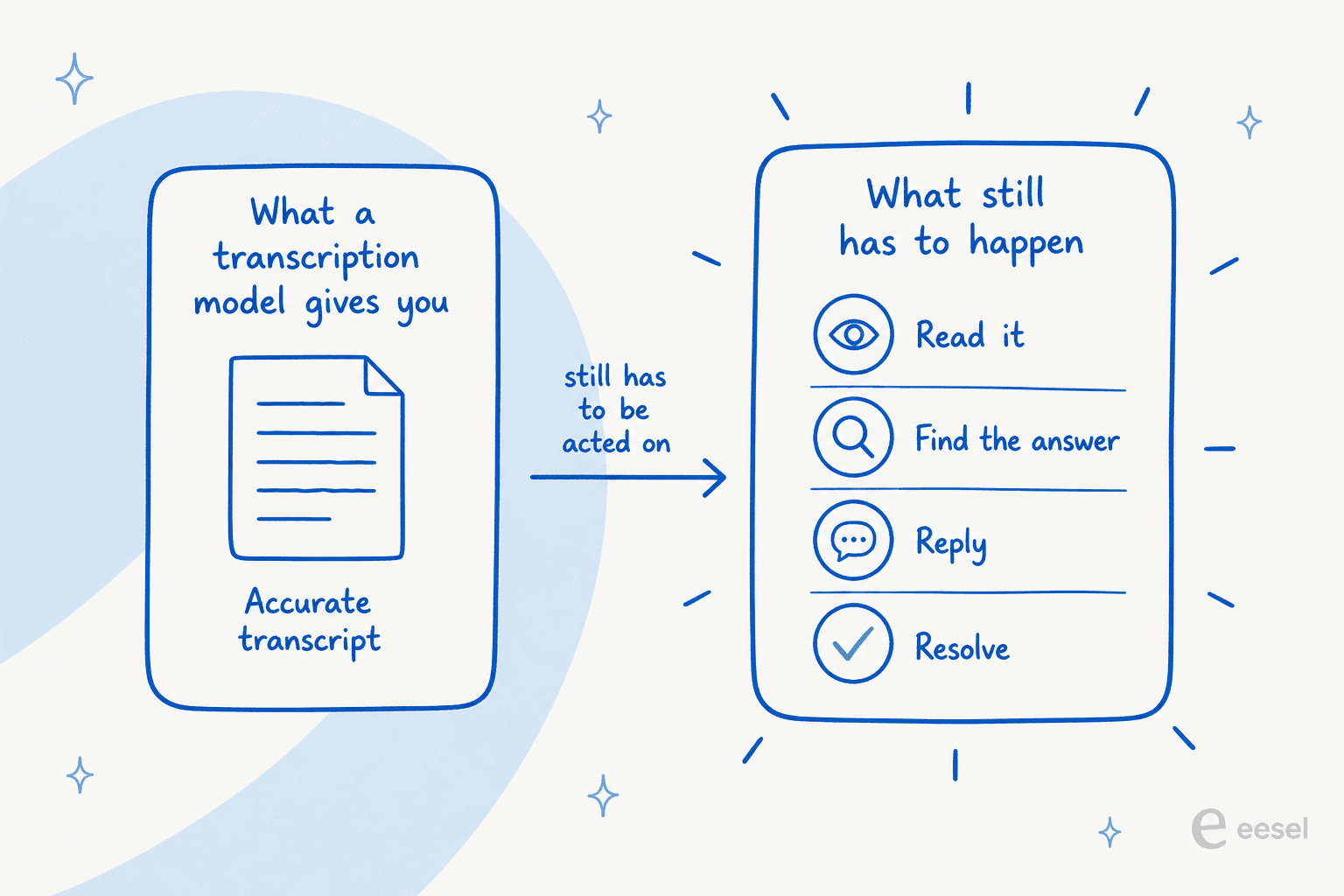
This is the honest boundary of a model like MAI-Transcribe-2, and it is not a knock on it. It is doing its job extremely well. It is just a different job from resolving the conversation, and if you are a support team the second job is the one that actually moves your numbers.
Where eesel fits
MAI-Transcribe-2 is infrastructure. eesel is the employee that works on top of it. We build AI teammates you hire for a specific job, and the AI helpdesk teammate is the one that picks up where a transcription model stops: it reads the text, pulls the answer from your help center and past tickets, and drafts or sends the reply right inside Zendesk, Freshdesk, or Slack. Pair the two and a transcribed voice ticket becomes a resolved one, not just a tidy paragraph.
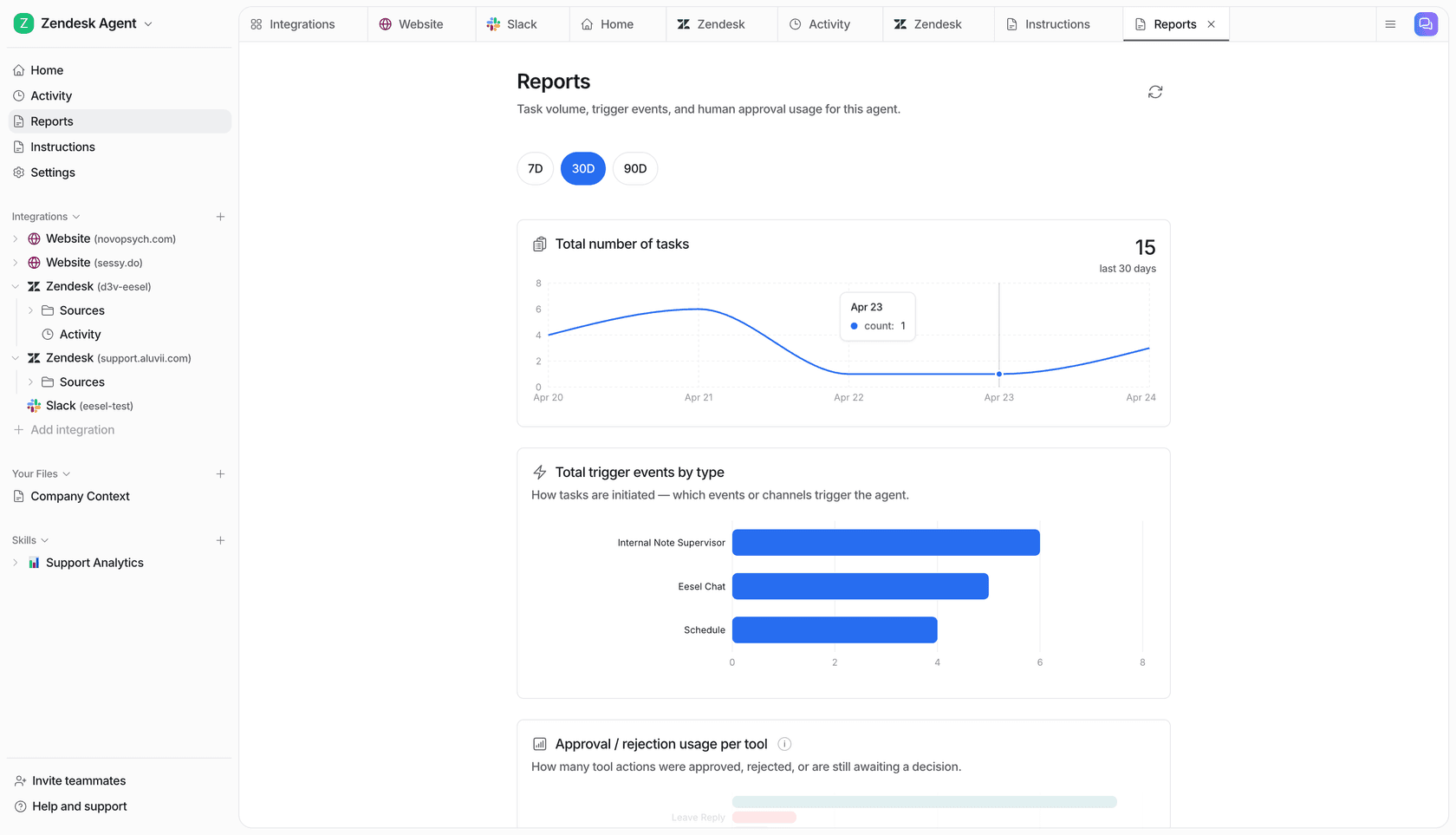
And because MAI-Transcribe-2 is an API-first model, the developers reaching for it tend to want that same control over their support automation. eesel has a public CLI for exactly that: it drives the same teammate and workspace from a terminal, so a person can run it by hand, a script can automate it, and coding agents like Claude Code or Cursor can operate it headlessly, no dashboard required. You can wire transcription into the front of that pipeline and eesel into the resolving end of it. It is free to try, it plugs into your helpdesk in a few minutes, and it simulates against your real past tickets before it ever replies to a customer, so you see how it would have handled your queue before you turn it loose.
Frequently Asked Questions
What is MAI-Transcribe-2?
How much does MAI-Transcribe-2 cost?
Is MAI-Transcribe-2 more accurate than Whisper or Gemini?
Does MAI-Transcribe-2 support real-time streaming?
How does MAI-Transcribe-2 fit into a customer support workflow?


Article by
Rama Adi Nugraha
Rama is a software engineer at eesel AI with two years of experience writing about B2B SaaS, AI tools, and customer support technology. Based in Bali, Indonesia, he brings a developer's perspective to product comparisons — cutting through marketing copy to what the integrations and APIs actually do.