Subvocal is a pair of glasses from a Y Combinator startup that turns words you mouth silently into text, aimed at people who dictate to AI tools but can't talk out loud at work. A $199 refundable deposit reserves a $499 pair that should ship in Q1 2027. The pitch is real, but the proof isn't there yet: no accuracy figure, no specs, cloud-only, English-only. Reserve it if you want a front-row seat and can wait. If your real bottleneck is writing support replies, an AI teammate like eesel that drafts them for you is the bigger time saver.
What is Subvocal?
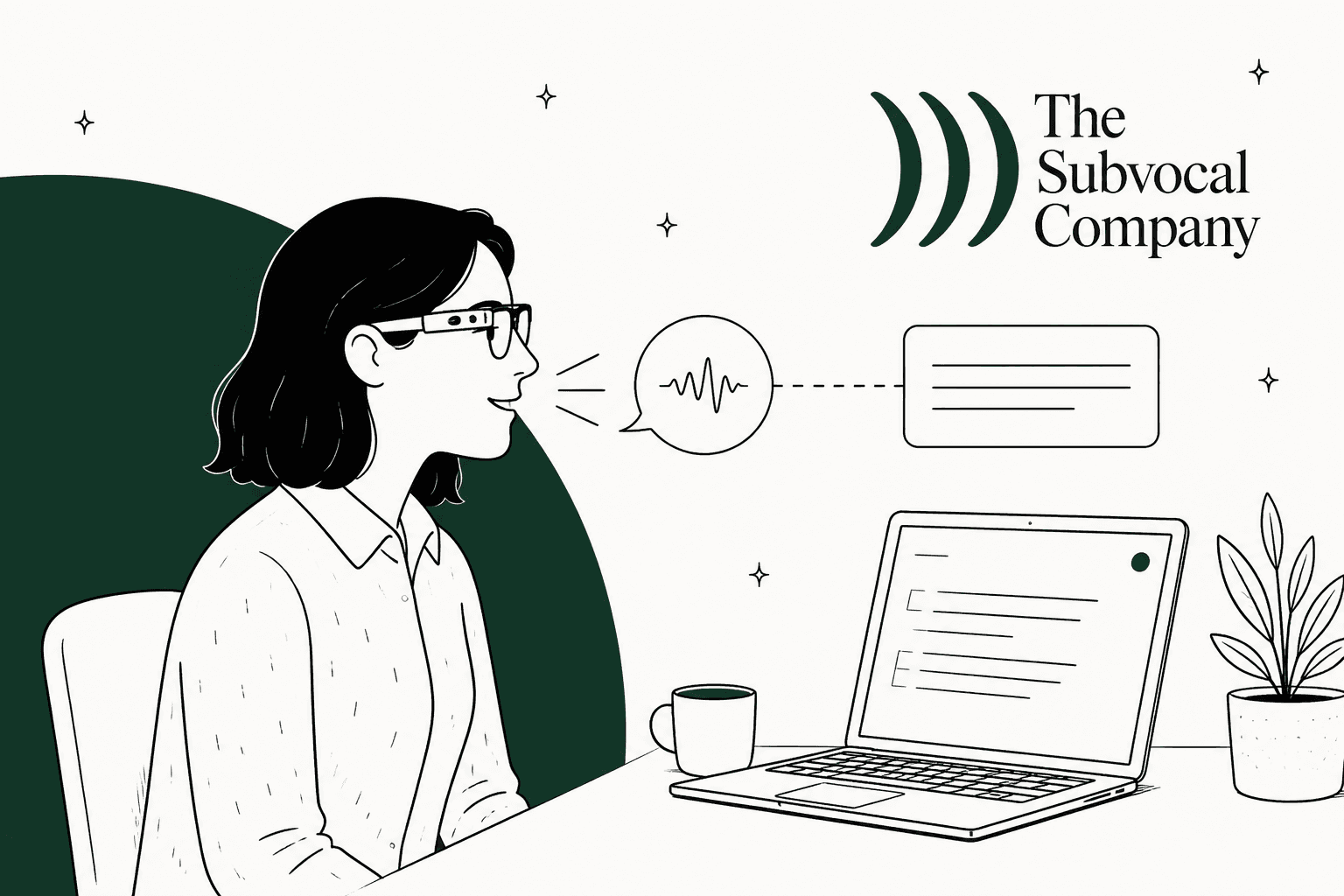
Subvocal is a silent speech wearable, a new kind of multimodal AI input, from The Subvocal Company, a three-person San Francisco startup in Y Combinator's Fall 2026 batch. You wear the glasses, mouth words without making a sound, and the text shows up on your computer. Its tagline on the YC company page is "Talk to your computer without talking."
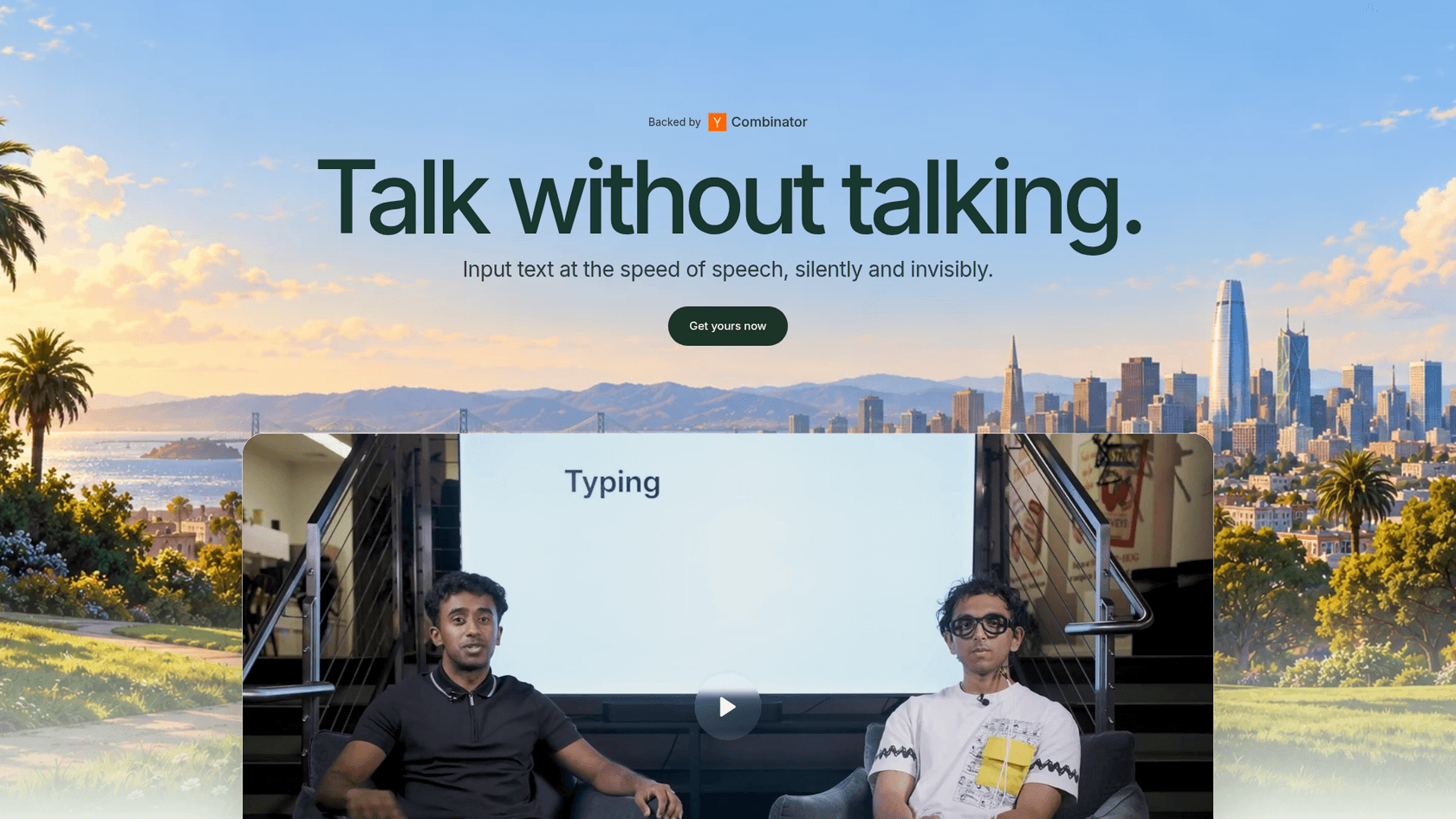
The launch went loud. CEO Aarush Yadav's announcement on X on 30 October picked up 26,277 likes and roughly 12 million views, and the Show HN thread a few days later reached about 497 points and 270 comments. In the same post, Yadav said the company has raised $1.3M from YC and Afore Capital.
The two founders are Aarush Yadav (CEO) and Arnav Kumar (CTO), both computer science students at Georgia Tech. A Georgia Tech honors program profile says Yadav started the work after Stanford's TreeHacks hackathon in February 2026 and raised a first $500k from Afore within weeks.
I build product at eesel, so I read launch pages the way I'd read a spec: what's committed, what's a goal, and what's a demo. Subvocal is honest about which is which, if you read the fine print. The YC launch post says outright that "the hardware currently looks a lot worse than the product we intend to ship."
One detail worth knowing: the product has changed shape fast. That April 2026 Georgia Tech profile describes "a wearable that sits behind your ear" with a letter-level prototype at 30 words per minute. Six months later it's glasses claiming 200+. That's normal for a hardware startup this early, and it's also why the final product may differ again.
How does Subvocal work?
Subvocal reads the muscles you use to speak, not your voice and not your face on camera. Per the YC launch post, "We send low-power radio waves through the face and measure how they change as your muscles move. Our models then decode those signals directly into text."
The founder added more detail on Hacker News:
"They emit radio waves, similar to Bluetooth, that pass through your face. As they cross the tongue, lips and soft palate, they're modulated by silent mouthing. We train foundation models on this data to decode these perturbations to text."

A few facts from Subvocal's own pages shape what using it would be like:
- No cameras. The homepage FAQ says "There's no video or camera-based lip reading."
- You have to mean it. It "only decodes words you intentionally articulate", so it is not reading your thoughts and is not always on.
- Calibration first. Setup includes "a short personal calibration process." In the demo video with YC's Dave, that meant reading 20 sentences.
- Cloud required. Asked whether it works offline, the founder replied on Hacker News: "Yes, it requires internet access."
- English only. Other languages are planned "after shipping", per another founder reply.
Why radio and not a camera? The founder's answer is the most useful technical line in the whole launch: "Speech has 40 phonemes, but only about 12 to 15 visemes," meaning many sounds look identical from outside (P and B, for example). As the founder put it, camera lip reading hits an error rate "too high to be product ready but just low enough to make for a good demo." Reading the tongue and soft palate from the inside is the bet that gets around that limit.
The exact hardware isn't public. Subvocal's Head of Sensing job post lists RF sensing, EMG, EEG and mmWave as the design space and says, "For competitive and IP reasons, we are not publicly disclosing the exact architecture of our current system yet." Subvocal's own pages never use the word radar. They say "RF sensing" and "radio waves."
How fast is Subvocal, really?
Subvocal claims 200+ words per minute. The homepage says it "decodes almost-invisible subtle, silent mouthing into text at 200+ WPM," and that's the number every headline repeated.
For context, the founder put typing and talking side by side on Hacker News: "Most people type at 40-50 WPM. Developers can often type at 70-100 WPM. Meanwhile, most people can talk at 120-200 WPM."
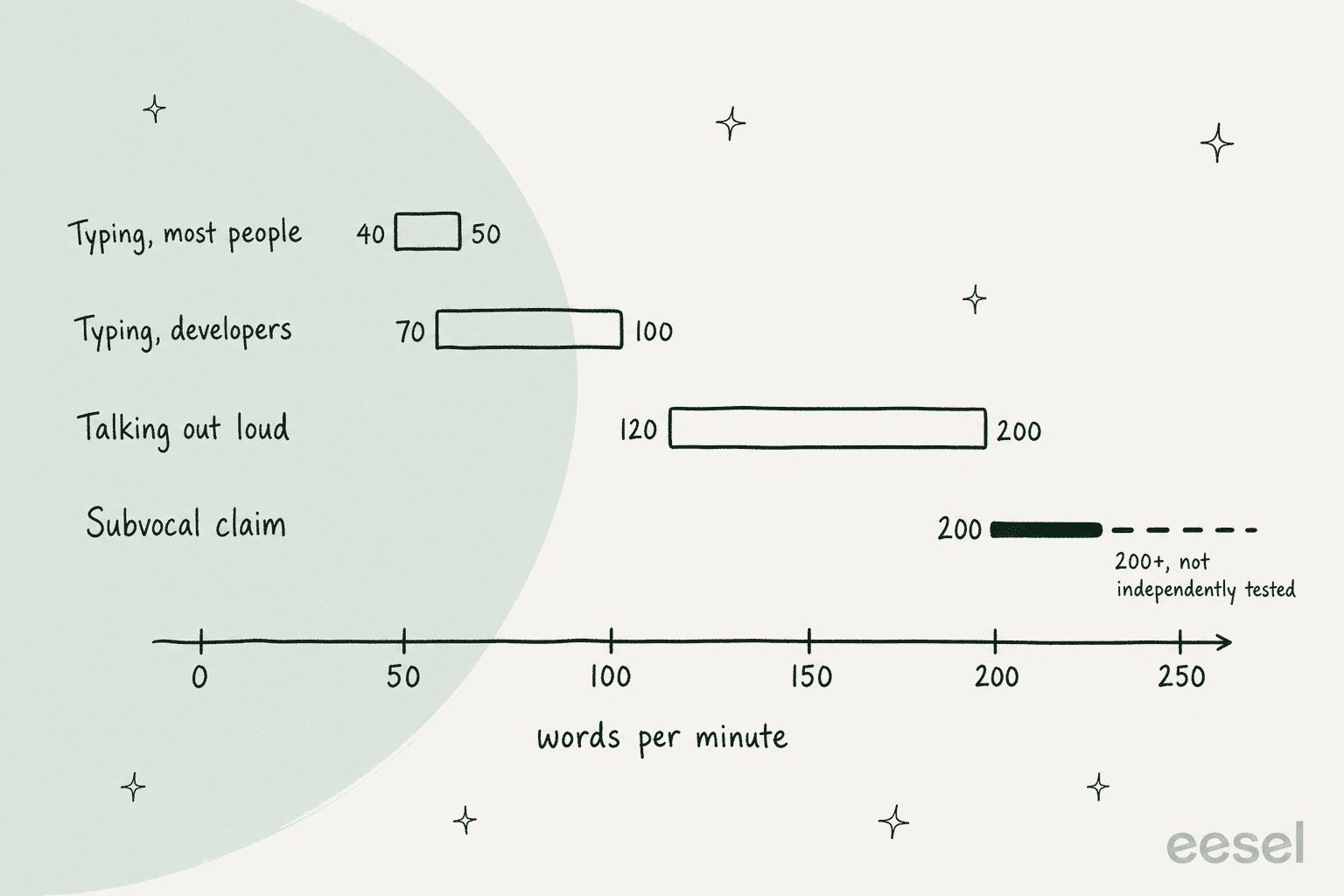
Put that way, the claim is that silent mouthing runs at the top of normal speech, which is a bold place to land on a prototype. Speed also means nothing without accuracy, and that's the gap. Subvocal has published no error rate. The homepage says "it can occasionally get something wrong," and the launch post says "a reasonably low error rate even at a small dataset scale." The only number in circulation came from a viewer of the demo video:
"I am so glad to see an unpolished early look and an honest evaluation of about five percent error rate in the YouTube video."
That's one person's estimate from one demo, so treat it as a rough read rather than a benchmark. Compare it with speech-to-text models such as Nemotron 3.5 Transcribe or Voxtral 3, which come with public word error rate numbers you can check.
The biggest subthread on Hacker News wasn't about accuracy at all. It was whether talking is even faster for everyone:
"Do most people talk faster than they can type? It's the opposite for me - I also read aloud slower than I can read in my head."
My read: if you already dictate a lot with Wispr Flow or ChatGPT voice, you know whether speech is faster for you. If you don't, Subvocal probably won't convert you.
How much does Subvocal cost?
Subvocal costs $499 per pair at the Early Bird price, reserved with a $199 refundable deposit. The preorder page shows the $499 against a struck-through $699, and the YC launch post calls it "a special $200 early bird discount on the final price."
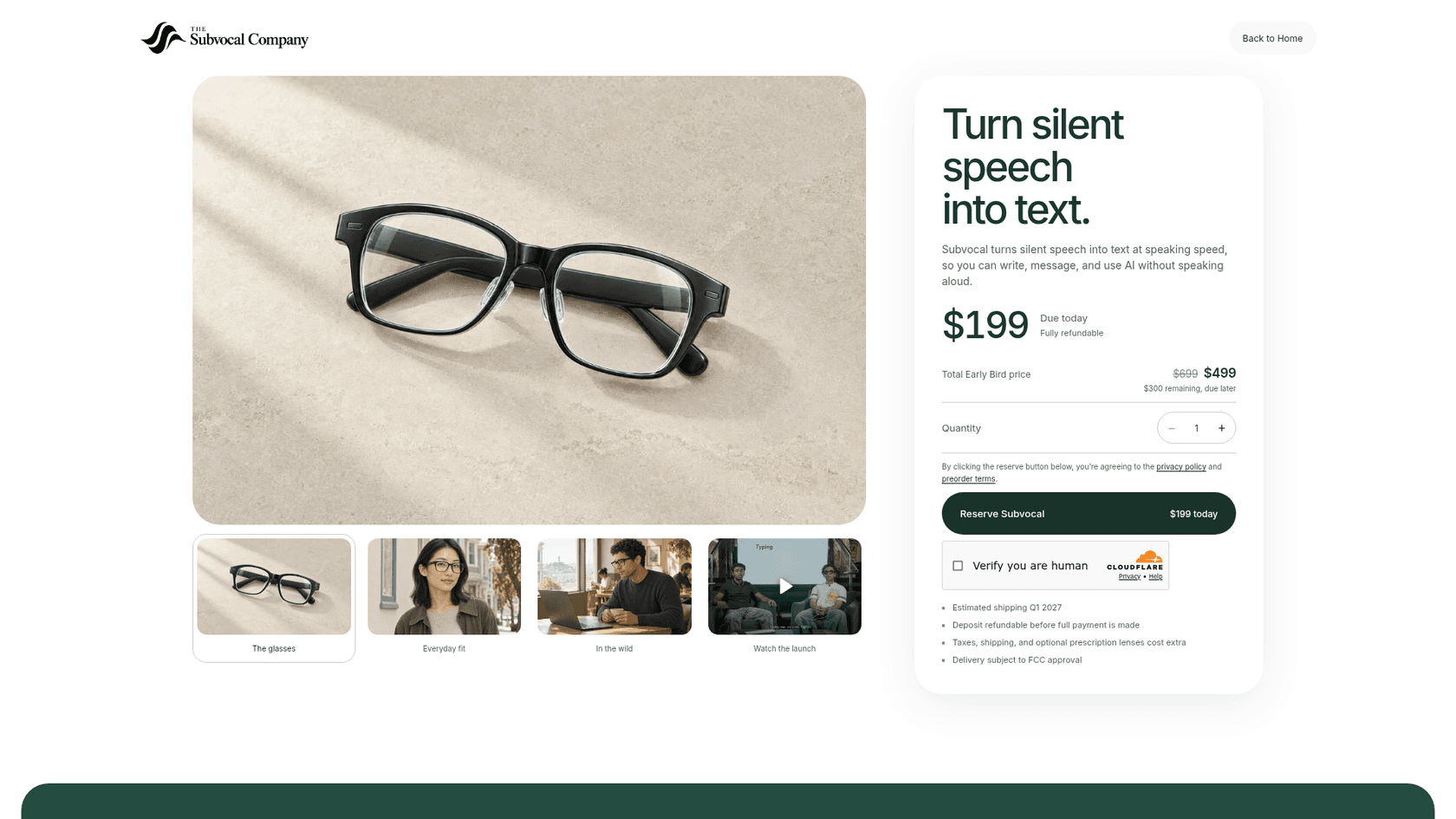
Here's everything the preorder terms commit to:
| Item | What Subvocal says |
|---|---|
| Deposit today | $199 per pair, fully refundable before final payment |
| Early Bird price | $499 per pair ($699 shown struck through) |
| Balance due later | $300 per pair |
| How the balance is charged | Never automatically. You get an email and 30 days to pay |
| Not included | Tax, shipping, prescription lenses, optional accessories |
| Refunds | Any time before final payment, no cancellation fee, started within 7 business days |
| Referral credit | $100 off your balance if 3 people reserve through your link |
| Shipping estimate | Q1 2027, "not a guaranteed delivery date", subject to FCC approval |
| Who can order | US delivery addresses only, buyers 18+ |
| Specs | Not published. "Final specifications are still being developed" |
| Return policy and warranty | Not published yet, disclosed before final payment |
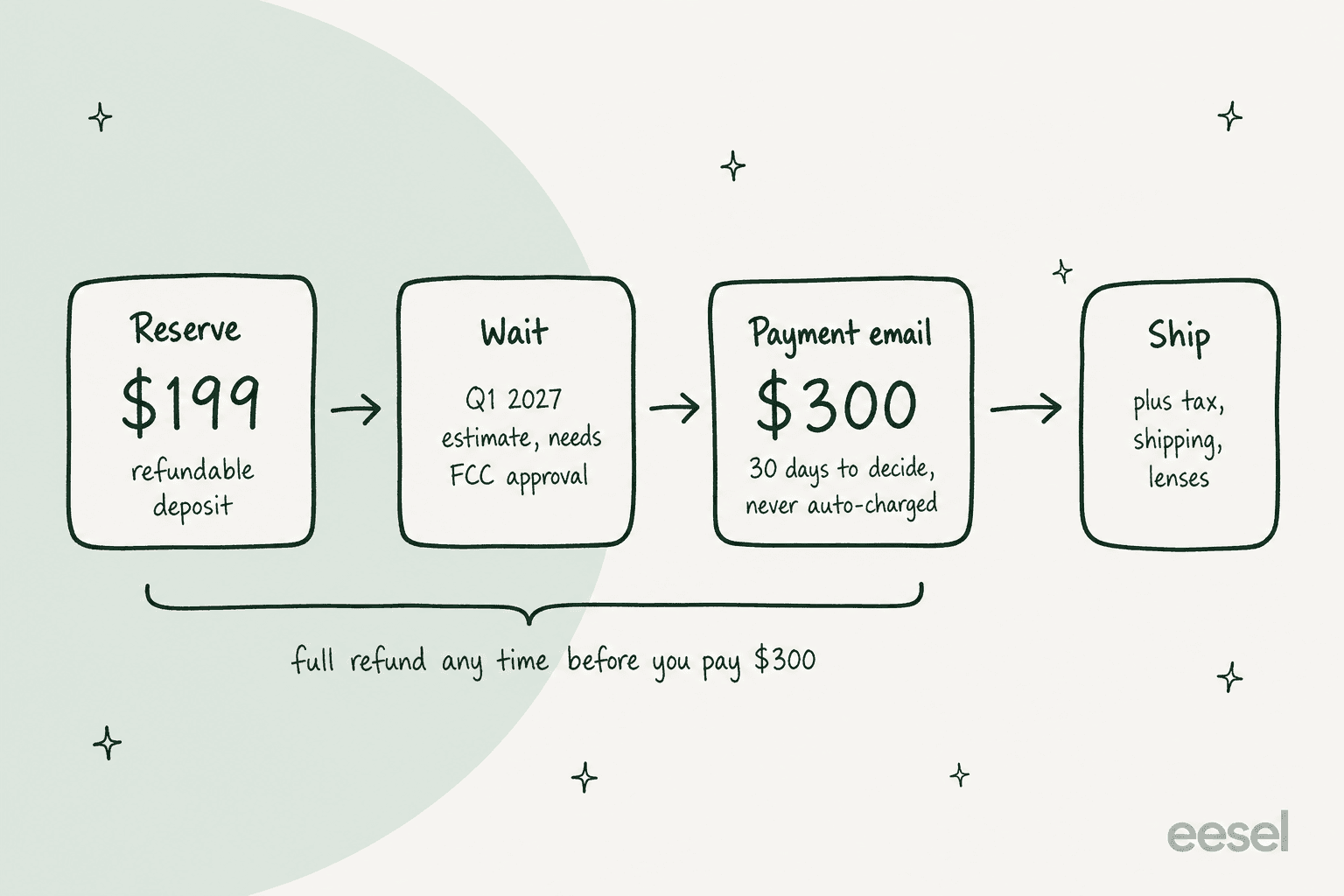
The terms are more buyer-friendly than most hardware preorders I've read. Nothing gets charged without you choosing to pay, and if Subvocal changes the product in a material way, you can cancel for your deposit back. The real cost of reserving is that $199 sits with a startup for a few months, and you're betting the final product matches the demo.
What's missing from the page matters as much: no battery life, no weight, no compatibility list. The FAQ says it's being built for "ChatGPT, Claude, Cursor, Slack, email, documents, messaging, and anywhere else you'd normally type," but that's the goal rather than a tested list.
How is Subvocal different from AlterEgo, EchoSpeech and Meta's Neural Band?
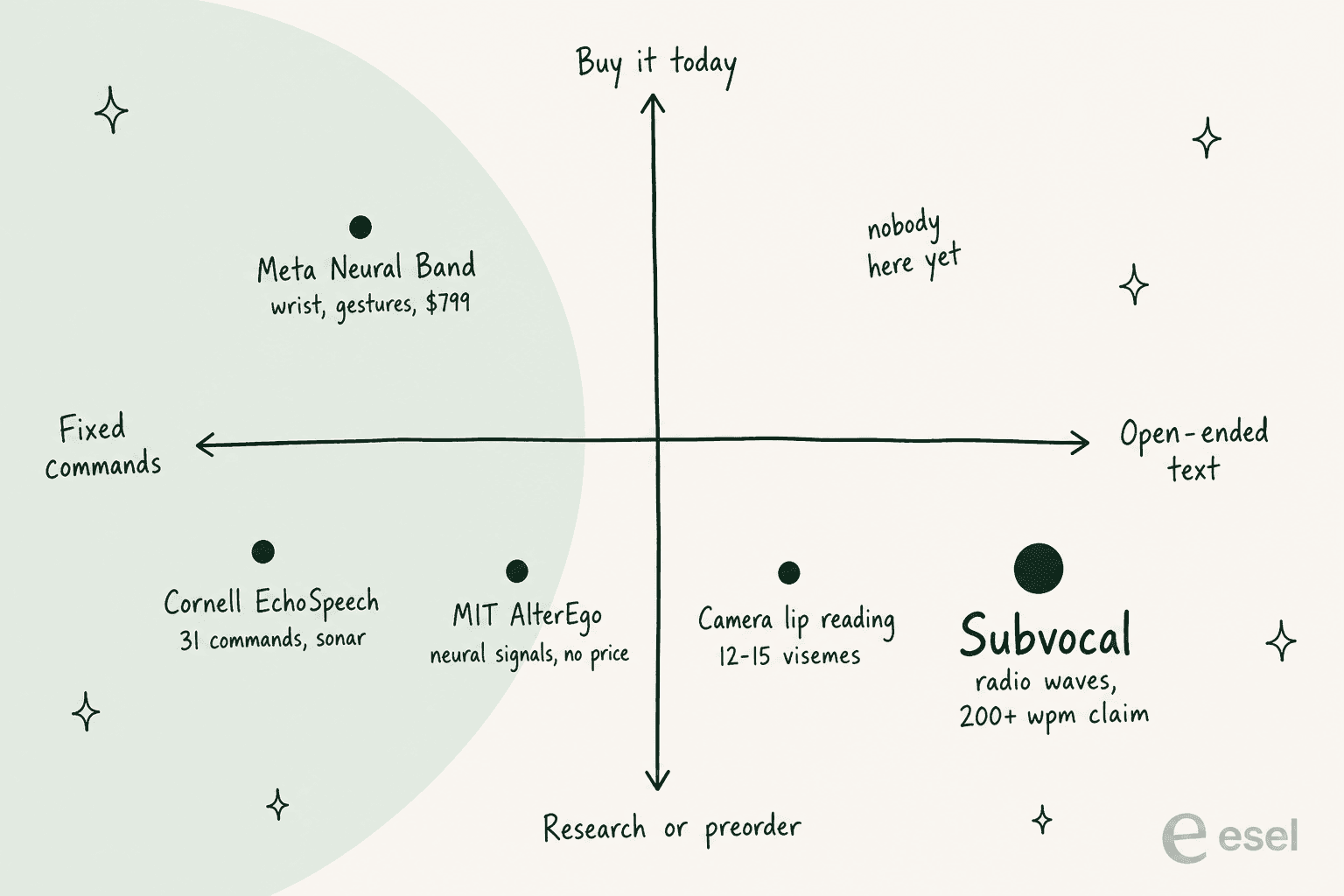
Subvocal isn't the first silent input device, and the "this already exists" replies came fast. The difference is that it's going after open-ended text in a pair of normal-looking glasses, which none of the others sell today.
| Product | How it senses | What it outputs | Can you buy it? |
|---|---|---|---|
| Subvocal | Radio waves through the face, from glasses | Open-ended text, 200+ wpm claimed | Preorder, $499, Q1 2027 estimate |
| MIT AlterEgo | Neural signals from internal articulation | Silent speech, no visible movement claimed | No. Spun out in early 2025, alterego.io has a signup only |
| Cornell EchoSpeech | Sonar from tiny speakers and mics on glasses | Up to 31 commands at about 95% accuracy | No. Research prototype from 2023 |
| Meta Ray-Ban Display + Neural Band | EMG wristband reading finger muscles | Gestures, with handwriting announced for later | Yes, from $799 at launch |
The closest relative is Cornell's EchoSpeech, which also lives in a glasses frame and also skips the camera. Its limits are the point of comparison: it recognized a fixed set of 31 commands, though it ran on your phone without the cloud and lasted about 10 hours on a charge.

AlterEgo goes further on discretion, claiming no externally visible movement at all, while Subvocal's own FAQ says someone up close "may notice slight movement." Meta's band is the only one you can buy, but it reads your fingers, not your mouth. It's part of a wider push across Meta's AI products into wearables. So Subvocal's real competition today isn't another silent-speech device. It's dictation software and your keyboard.
What are people saying about Subvocal?
The reaction split three ways: excitement from people who dictate to AI all day, doubt about whether the product is real, and unease about wearing it in public.
The excited camp is mostly people who already talk to coding agents like Claude Code and Codex and hit the same wall Subvocal's homepage describes, "control your coding agents without annoying your coworker":
"I already dictate a lot of my agent instructions. The problem is that you can't do that in an office or on a plane. This could fix it."
The doubters had two arguments. One was that the product shots look generated, and a moderator stepped in to separate the two questions:
"They're taking pre-orders. Obviously the product doesn't exist yet. The tech is real."
The other was that it's easy to copy. A post by Joe Blau saying "I recreated subvocal in 9 minutes with one prompt for AirPods Pro 3" got 10,199 likes. In a founder reply on Hacker News, Yadav said approaches like that only get you to something like "a 5 word classifier", which is roughly where EchoSpeech's fixed-command research sits too.
Then the human side. Silent mouthing sounds simple until you try it:
"For the ones thinking this is great, have you actually tried to talk without making sounds? I don't think it is an intuitive action at all and I became self-conscious about not making a sound rather than talking like I normally would."
Privacy came up as well, mostly because the decoding runs in the cloud:
"Can this be made to work offline, without a cloud server? I wouldn't want my words to be passed through an API"
And the most hopeful thread was about accessibility, from people who can't type or speak comfortably:
"This is also neat thing to have with people struggling with typing (RSI, injuries, disabilities)... people find they're hurting their vocal chords pretty quickly."
I think that last group is where Subvocal could matter most, and it's also the group that most needs a published accuracy number before spending $499.
Should you preorder Subvocal?
Preorder Subvocal if you dictate to AI tools every day, work somewhere you can't talk out loud, and are fine waiting until at least Q1 2027. The $199 is refundable until you choose to pay the rest, so your downside is time, not money.
Skip it for now if:
- You need it to work on day one. No specs, no warranty terms and no accuracy number are public yet.
- You live outside the US. Paid preorders are US-only.
- You handle sensitive text. It needs the cloud, and the sensor-data privacy notice hasn't been published. The current privacy policy covers the website and preorders only.
- You don't dictate today. Try free dictation or Wispr Flow first. If speaking out loud doesn't speed you up, speaking silently won't either.
Hardware from a three-person team has a long road from demo to shelf, as earlier AI gadgets like the Rabbit R1 have shown. Subvocal's terms, at least, are written so that if that road gets longer, you can walk away with your deposit.
Does typing speed matter for support teams?
Less than you'd think. Subvocal is a faster way to put words into a computer, and the founders frame it around the shift to AI agents, where "our job moves upstream, to structured and detailed prompting." Call it prompt engineering by another name. It's a fair read of where knowledge work is going. For a support agent, though, typing isn't the slow part of a reply. Finding the order, the policy and the last conversation is, and that's what drives average handle time up.
That's the gap an AI helpdesk teammate fills. It works like agent assist taken one step further, doing the lookup and writing the draft before a person opens the ticket. Lesson Pro, a family of private-lesson brands on Zendesk, runs eesel this way: in one month it worked about 1,900 tickets, left about 1,700 internal notes with context and next steps, and drafted about 560 replies for a person to approve and send. Nobody on that team needs to type at 200 words per minute, because the first draft is already written.
The same pattern shows up outside support. SamCart runs one eesel agent on Freshdesk tickets and another on its website chat, each answering from its 280 help center articles. If you're curious about the broader idea, here's how AI teammates differ from tools you have to drive yourself, and what an AI employee actually does day to day.
And if you like the Subvocal vision of talking to coding agents, eesel has a CLI built for exactly that kind of user. It puts the same eesel teammate in your terminal: you can chat with it, connect your helpdesk, upload knowledge, wire up automations and approve held actions without opening the dashboard. Every command prints JSON, so a coding agent like Claude Code, Cursor or Codex can run the whole setup for you, and anything set up there shows up in the dashboard too. Whether you type the instruction, say it, or one day mouth it, the work lands with a teammate that already knows your help center.
Try eesel
Subvocal makes writing faster. eesel cuts down how much your team has to write. Its AI helpdesk teammate joins Zendesk, Freshdesk and other helpdesks, learns from your past tickets and help center, and drafts or sends replies depending on how much you trust it. You can simulate it on your own historical tickets before it touches a live customer. Try eesel free and see how many of your replies it would have written.