


Why I'm comparing these two
I build integrations at eesel, so most of my week is OAuth scopes, draft-versus-send permissions, and what an AI is allowed to read. Assistants like these are, to me, a pile of permissions with a chat window on top.
The question buyers ask us first is rarely "how smart is it." On one sales call, a technical evaluator at a hardware company asked whether our agent falls back to some other ChatGPT when it doesn't know the answer, and whether that could be turned off. What it learns from, and what it does on its own, are the two questions that decide whether anyone trusts an agent.
Those are exactly the two questions where Orchid and Instinct made opposite calls. Even Hacker News has noticed how crowded this corner got:
"Instinct, Town, Orchid, Pally, Poke, folk, it's a never ending list."

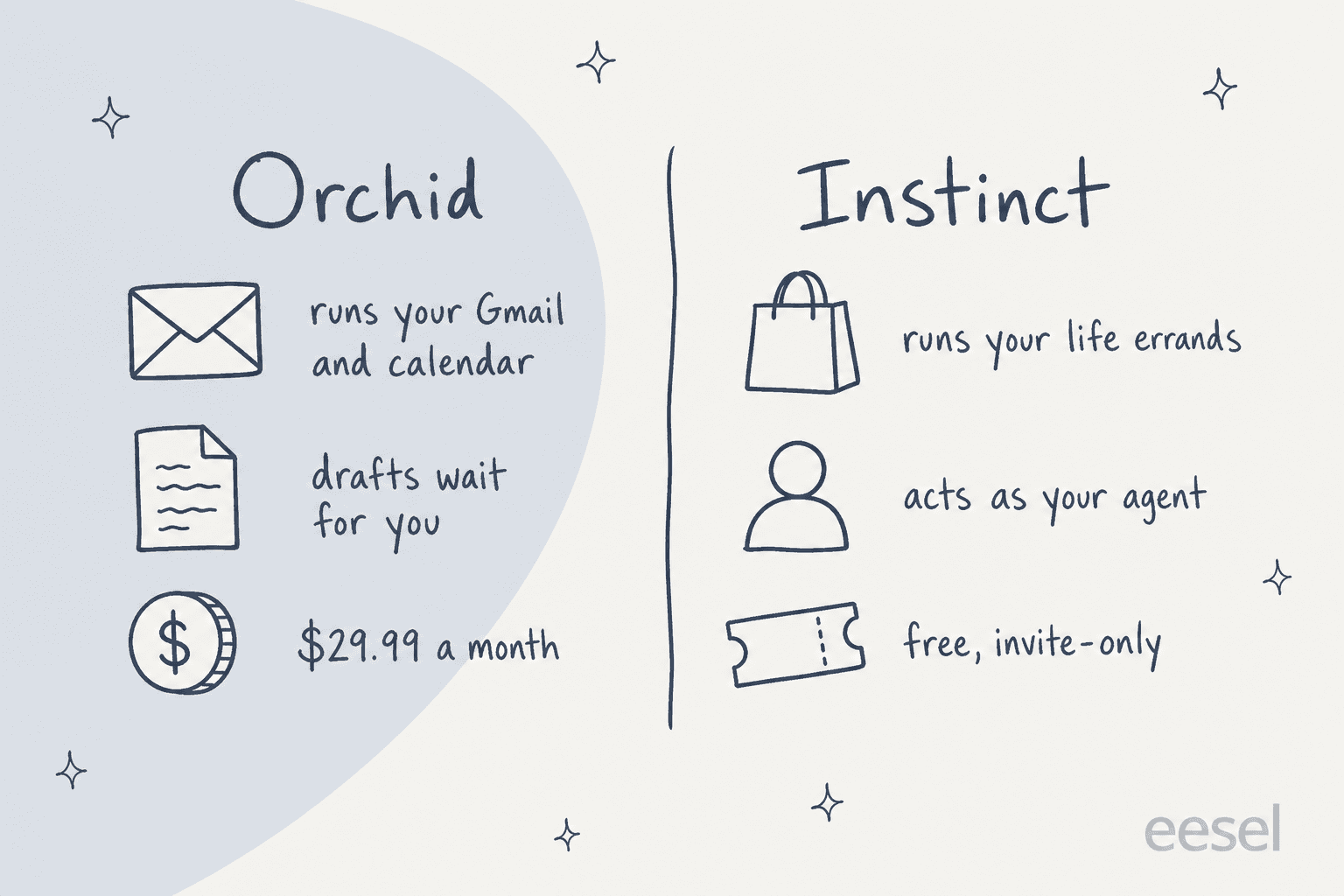
Orchid vs Instinct at a glance
| Orchid | Instinct | |
|---|---|---|
| Maker | Zero Email, Inc. (YC) | Spear Street Technology, Inc. d/b/a Instinct |
| Founders | Nizar Abi Zaher, Adam Wazzan | Noah Shinn |
| How you reach it | iMessage and SMS, plus a web app for settings | iMessage, WhatsApp, phone calls, a Mac app |
| Built for | Email, calendar, meeting prep | Errands, purchases, calls, group plans |
| Connects to today | Gmail and Google Calendar (plus Drive, Granola) | Your email, messages, screen, location and accounts |
| Default autonomy | Drafts and holds wait for your OK | Acts as your agent; you set limits in chat |
| Price | From $29.99/month, flat | No published price |
| Access | Open sign-up | Invite-only early access |
| Free option | None; 30-day refund | Free during early access |
| Liability cap | Greater of 12 months of fees or $100 | $100 |
| Disputes | AAA arbitration | JAMS arbitration, 30-day opt-out |
| Compliance certs | None published | None published |
Sources for every row are linked in the sections below.
What is Orchid?
Orchid is "a personal assistant that helps you stay organized, find information, and get things done. All through messages," per orchid.ai. You text a number, it texts back, and there's no app to install.
The team went through Y Combinator building Zero, an open-source AI email client, and you can still see that past. YC's listing calls it "A personal EA in your iMessage" that "texts you your day each morning, drafts your replies, and books your meetings." The founders are Nizar Abi Zaher and CTO Adam Wazzan.
The homepage sells a "second brain" with habits, reminders and a hundred tools. The FAQ is more precise: "Today, Orchid works with Gmail and Google Calendar," with Outlook, Slack, Notion and Linear "on the way." It says Orchid is built for "founders, investors, lawyers, agents, and agency owners," which tells you where its head is: your work inbox and your calendar.
The features I'd turn on first are the morning digest and meeting prep, which texts you a brief before each call. My guide to Orchid for email management walks through how its triage decides what needs you.
What is Instinct?
Instinct is a personal assistant you text or call. Its pitch on instinct.com is that "there are no new interfaces" and that it "can use a phone and computer in the same way that humans do."
The homepage examples are life admin: dispute a bill, send birthday gifts, order groceries, schedule a doctor, plan a weekend away. The founder, Noah Shinn, was an early Sierra employee and first author of the Reflexion paper on self-correcting agents.
Instinct ships fast. In the last week alone:
- Flights were rebuilt on October 7 after more than 20% of users had Instinct help with their flights last month. It now books with one tap and handles lost bags, missed connections and cancellations (Noah Shinn, X).
- Customer service through partnerships with Sierra and Decagon, so your Instinct can work things out with a company's AI agent without a phone call (Noah Shinn, X).
- Group chats from October 5, where one Instinct works for the whole group and your friends don't need Instinct to join (Noah Shinn, X).
My Instinct AI review covers the earlier releases, including the credential Vault and one-time cards for purchases.
What each one connects to
As the integrations person, this is the section I'd read first.
Orchid connects narrowly and says so. Gmail and Google Calendar per the FAQ, plus Google Drive and Granola in the site footer. The privacy policy asks for "minimum Gmail scopes required to perform the actions you've enabled" and lists read, organize, draft and send. Tools outside Google go through Composio as an OAuth broker. If you're on Outlook, Orchid isn't for you yet.
Instinct connects broadly and acts like a person. It reads your email, messages, screen, location and accounts, and keeps logins in a Vault. Instead of an API for every merchant, it uses a phone and a computer the way you would, and calls businesses through Instinct Concierge when there's no better path. That breadth is why it can book a flight and dispute a bill in the same thread.
The trade-off is plain. Orchid's narrow list is easy to reason about: you know exactly which two accounts it touches. Instinct's breadth is what makes it useful for errands, and it's also more surface to think about before you connect it.
Who presses send?
This is the real dividing line.
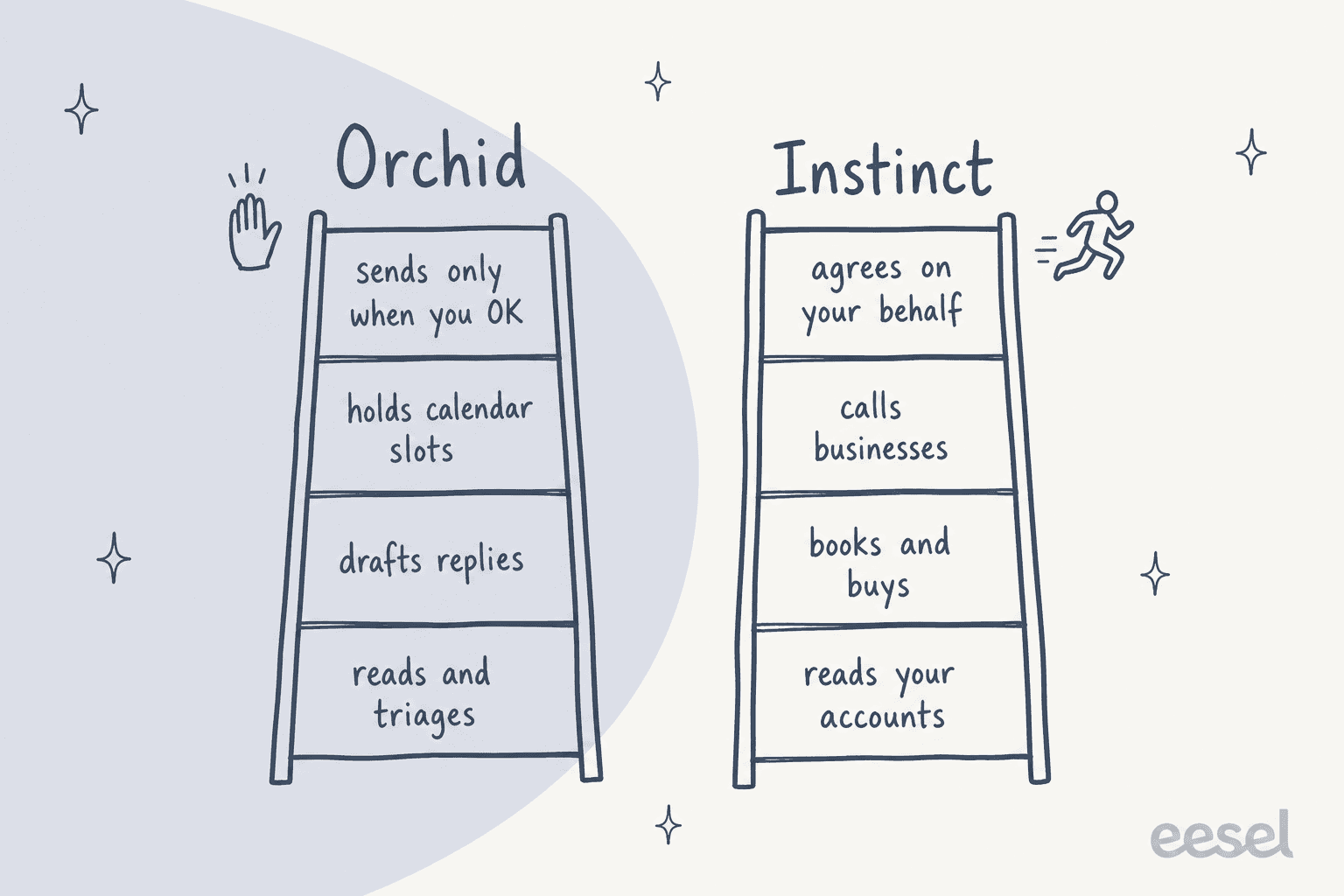
Orchid waits for you. The FAQ is direct: "Replies stay as drafts until you hit send, and calendar holds happen only with your approval." Even purchases follow that pattern. The homepage demo finds a $240-a-night villa and $380 flights, then hands you an Expedia pay link to tap yourself. Orchid's terms contain no clause about the agent buying things for you at all.
One honest caveat from the builder's side: the privacy policy lists "send" among the Gmail actions, so the approval step is a product setting, not a technical wall. You can widen it, for example by letting Orchid confirm meetings with people you name.
Instinct acts for you. Its terms appoint it "as your agent to enter into agreements, commitments or transactions on your behalf," binding on you. It "may implement safeguards, confirmation requirements, or other controls," without promising a fixed approval step. In practice, you set limits by telling it, such as "check with me before you buy anything."
Nathan Baschez named why that feels magical: Instinct is willing to take more risk and let the agent do more without step-by-step permission. Brad Groux described what he'd want instead, and it reads a lot like Orchid's default:
"I'd want to connect an inbox with read-only access, then approve specific permissions as needed. Sending emails, sharing files, making purchases, or accepting terms should require my approval through a control the agent can't bypass."
My read: Orchid suits work email, where one wrong send costs a client. Instinct suits errands, where a human checking every step defeats the point. The same draft-first logic is how support teams roll out AI too, starting as a copilot and earning autonomy later.
Pricing: $29.99 flat vs free and invite-only
Orchid's pricing page renders empty, so the only public number lives in its pricing post: "Orchid is paid, from $29.99/mo, flat, with no free tier and no meter on your messages."

Instinct has no plans to compare. After interviewing the founder, Patrick O'Shaughnessy wrote that "Instinct plans to take a cut of what users buy," and that Shinn's "personal goal is to keep Instinct free for everyone for life" (Patrick O'Shaughnessy, X). Users who buy through Instinct spend over $1,300 a month, per Shinn.
| Orchid | Instinct | |
|---|---|---|
| Sticker price | From $29.99/month, flat | $0 during early access |
| Free tier | None | Free while invite-only |
| Trial or refund | 30-day money-back guarantee | Not applicable |
| Discounts | Students 3 months free; YC founders 3 months free; Notion Mail switchers 1 month free | None published |
| Likely business model | Subscription | Cut of what users buy (reported) |
| What you really pay | The subscription | What it spends for you |
So the honest version: Orchid costs a known $29.99, and the 30-day refund works as a free trial. Instinct costs $0, and the number to watch is your card statement. My Orchid AI pricing and Instinct AI pricing posts have the full math.
Privacy and the fine print
Both companies wrote their marketing and their legal pages at different moments, and the legal page is the one that binds.
| Orchid | Instinct | |
|---|---|---|
| Model training | FAQ says never; privacy policy says it "may train your personal model on your data. Only yours." | On by default; opt out at app.instinct.com/settings, going forward only |
| Model providers | Named: Google Vertex AI, OpenAI, Anthropic via OpenRouter | Not named |
| Credentials | Google sign-in; Composio for other tools | Vault, never used for training |
| Deleting | Tokens revoked within 72 hours, data out of production within 30 days | Disconnecting doesn't delete what was indexed |
| Allowed use | Pitched at founders, lawyers and agency owners | Personal use only |
| Liability cap | Greater of 12 months of fees or $100, covering agent actions | $100 |
Orchid's rows come from its privacy policy and terms.
Instinct's rows come from its privacy policy and terms.
Orchid documents more: every subprocessor is listed by name, and a per-user model is a reasonable way to learn your voice, even if "never" on the FAQ overstates it. Instinct's paperwork reads like a consumer product in early access. If you connect it, switch training off on day one and request deletion in your workspace if you ever leave.
Neither publishes a SOC 2. That's normal for this stage, and it's a reason to keep client data out of both for now. This primer on AI agent data privacy has a useful checklist.
What users say about each
Neither has a G2 or Capterra listing yet, so the voices live on X, Reddit and Hacker News.
Instinct gets credit for simply getting errands done:
"I use Instinct and I'm very happy with it so far. It has booked some restaurants for me, replied to some personal admin-related emails, and updates my progressive workout spreadsheet when i go to the gym. No real complaints so far."
Orchid's hands-on voice is thinner, because most public posts are about its July launch ad, not the product. One Reddit tester called it "More executive-assistant-like than chatbot-like" with an "Approval-before-sending flow" that "makes sense for work," per a roundup in r/AskVibecoders. Executive assistants themselves were skeptical:
"I think these are tools that EAs will use but they are too cumbersome to be a complete replacement. Learning to navigate, identify hallucinations (which will always be the case), etc etc with these AI platforms is what will transform the role."

Instinct has had one public scare. On September 23 a user thought it had shown someone else's financial document, and Shinn responded the same day that it was a hallucination, "not a data breach," and that the team built a detection layer in 48 hours. Neither company publishes an accuracy number.
Which one should you pick?
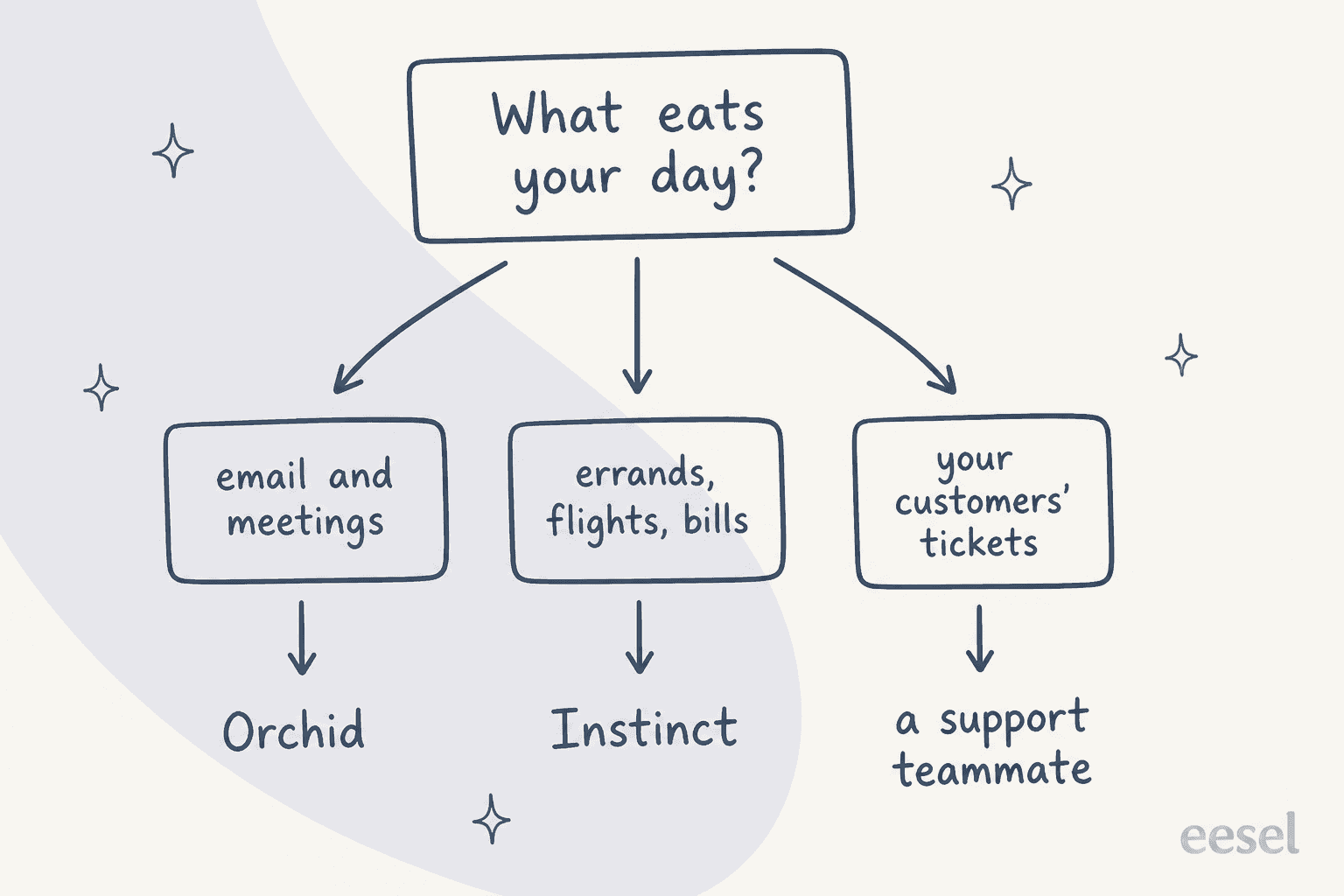
Pick Orchid if you live in Gmail and Google Calendar and drown in scheduling. Connect your inbox, keep the default approvals, turn on meeting prep, and set a reminder for day 28 so the refund stays an option. My Orchid for client follow-ups guide shows its conditional reminders in practice.
Pick Instinct if you want a human-feeling assistant for your own life: rebook a cancelled flight, chase a confusing bill, plan a trip in the group chat. You'll need an invite. Opt out of training and tell it to check with you before any purchase.
Use both if you'd hire two assistants anyway. They barely overlap: Orchid for the work inbox, Instinct for the personal phone. Just keep work email out of Instinct, since its terms allow personal use only.
Look elsewhere if you're on Outlook or want something else. Town learns your work email and supports Outlook, Meta Muse lets you watch the agent work, and folk is another texting assistant.
My Instinct AI vs Town AI and Instinct AI vs Meta Muse posts cover those matchups, and the best AI assistants roundup has the wider field.
What this means for a support team
These two sit at different points of a support conversation, and that's the part I find most interesting.
Instinct sits on the customer's side. The tasks Shinn listed for the Sierra and Decagon partnership are classic tickets: a delayed package, a bill that went up, a confusing return policy. Decagon built a personal agent gateway for exactly these messages, and my guide to Instinct for customer support covers how to answer them well.
Orchid sits on one person's side. Its team saw that gap too, and built Keiki, a separate, usage-priced builder for customer-facing agents. Orchid itself drafts for one Gmail inbox. For a shared inbox, that means every agent runs their own assistant and still clicks send on every reply.
That gap is what eesel is for. eesel is an AI teammate platform where you hire ready-to-work teammates for specific jobs. The AI helpdesk teammate joins the helpdesk you already use, like Zendesk, Freshdesk or Gorgias, once for the whole team.
It learns from your knowledge base and past tickets, and answers only from knowledge you approved, which is the answer to that hardware evaluator's question at the top.
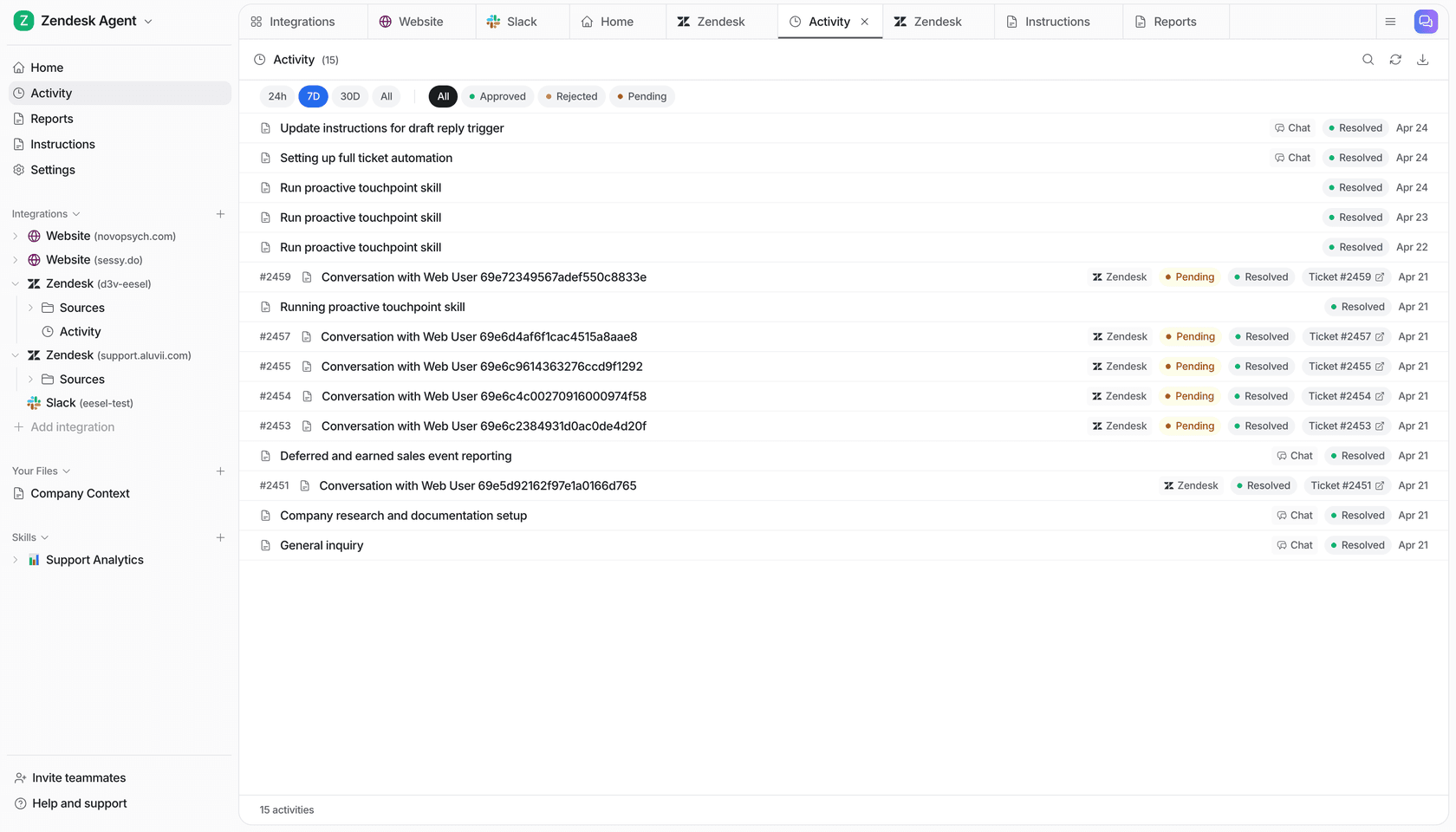
It also borrows the best of both assistants. Like Orchid, you can start it on drafts that wait for a human. Like Instinct, you can let it act on the easy tickets once you trust it, after running it against historical tickets to see its resolution rate first. If your team works in a terminal, the same teammate is reachable through the eesel CLI: eesel approvals list shows what's waiting on a person, eesel activity shows what it did, and write commands take --dry-run, so Claude Code or Cursor can drive it safely. My post on AI agent CLIs explains why that matters.
Try eesel
Orchid is a careful assistant for your own inbox, and Instinct is a bold errand runner for your life. If the inbox you need handled is your customers', eesel's AI helpdesk teammate plugs into your helpdesk in minutes, drafts or answers from your docs and past tickets for the whole team, and shows you how it would have replied on old tickets before it touches a live one. Plans are public on the pricing page, with a free plan to start. Try eesel.
Frequently Asked Questions
What is the difference between Orchid AI and Instinct AI?
Is Orchid AI or Instinct AI cheaper?
Which is safer, Orchid AI or Instinct AI?
Does Orchid AI or Instinct AI work with Outlook?
Can Orchid AI or Instinct AI handle email for work?
Can Orchid AI or Instinct AI answer customer support emails?
What are the best alternatives to Orchid AI and Instinct AI?


Article by
Rama Adi
Rama is a software engineer at eesel AI with two years of experience writing about B2B SaaS, AI tools, and customer support technology. Based in Bali, Indonesia, he brings a developer's perspective to product comparisons — cutting through marketing copy to what the integrations and APIs actually do.