

Why I'm comparing these two
I work eesel's support queue every day, so I look at personal AI assistants from the other end of the conversation. Every errand an assistant runs for its owner (a refund, a cancelled order, a "where is my package") turns into a ticket at some company.
Across years of putting AI on live support queues at eesel, the pattern I see most is simple: teams start with AI drafting replies for agents and only move to full automation once they trust it. Trust comes first, then autonomy.
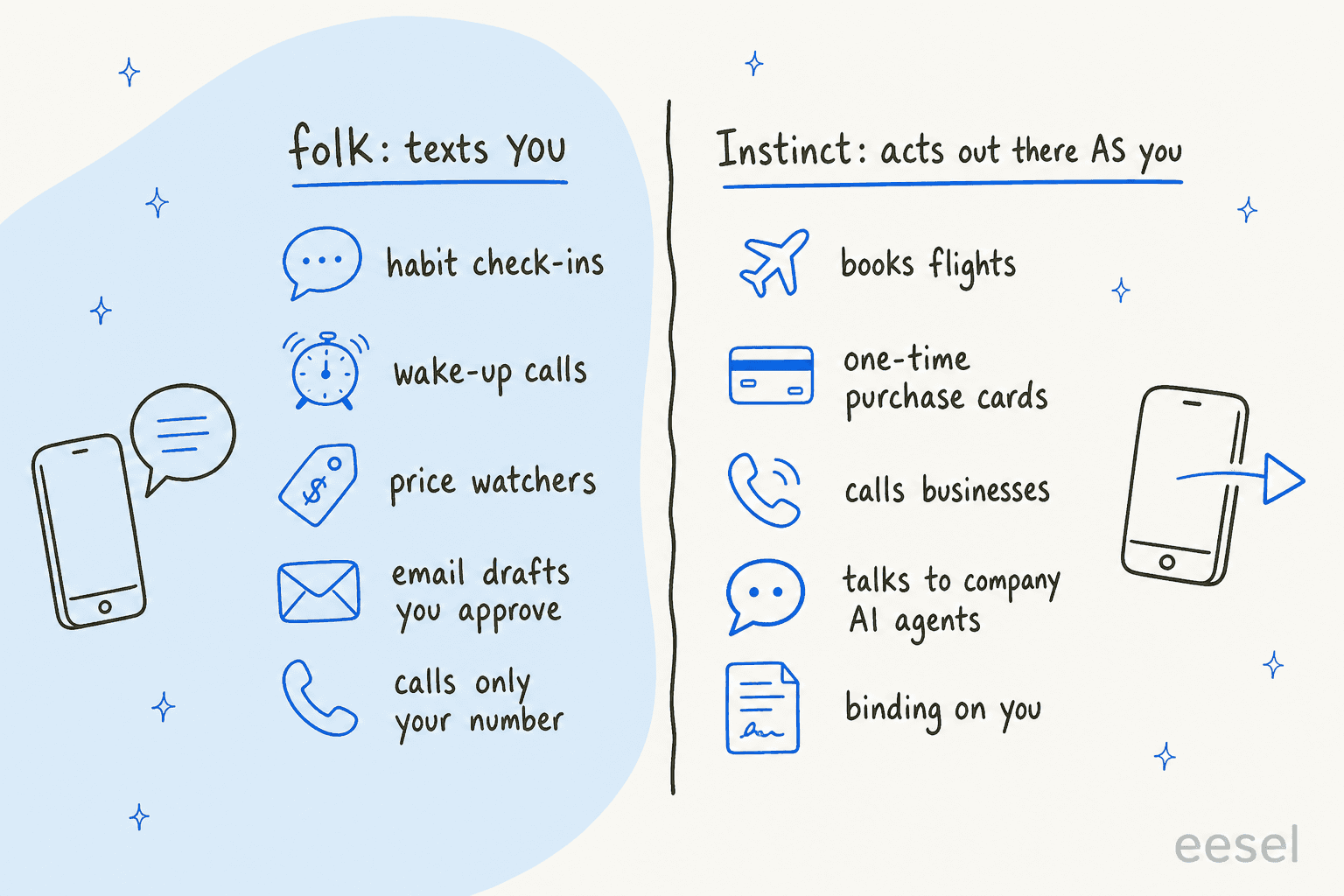
folk and Instinct make opposite bets on that exact question. folk mostly drafts and waits for your "send it". Instinct mostly just does it. That one choice explains almost every other difference between them.
folk vs Instinct at a glance
| folk | Instinct | |
|---|---|---|
| Maker | Nozomio, Inc. | Spear Street Technology, Inc. d/b/a Instinct |
| Founder | Arlan Rakhmetzhanov | Noah Shinn |
| Launched | Beta launch post May 11, 2026 | Public launch post Aug 26, 2026 |
| Where you text it | iMessage, Telegram, WhatsApp | iMessage, WhatsApp, phone calls, a Mac app |
| Built for | Staying on track: habits, reminders, email, watchers | Errands: flights, shopping, bills, plans |
| Access | Open signup, free plan | Invite-only early access |
| Price | Free; Pro $9.99/month or $99.99/year | No published price |
| Phone calls | Calls only your own verified number | Calls businesses for you (Concierge) |
| Default for email | Drafts, you approve, folk sends | Acts on your behalf; you set limits in chat |
| Model training | Never trains on your conversations | On by default, opt-out in settings |
| Allowed use | Personal, with founder and executive use cases | Personal use only |
| Liability cap | Amount you paid in the prior 12 months | $100 |
Sources for every row are linked in the sections below.
What is folk?
folk is a personal assistant that is just a contact in your messages app. Its FAQ calls it "a friend who lives in your texts and keeps you on track," and that's an honest description. You text it on iMessage, Telegram or WhatsApp. There's no app to install, and it runs on its own private cloud computer.
folk is built by Nozomio, a small team led by Arlan Rakhmetzhanov that raised a $6.2M seed led by CRV. The launch post set the tone:
"introducing folk beta the personal ai that lives in your texts and quietly runs your life."
What folk does well, per its own pages:
- It reaches out first. Wake-up calls, streak check-ins, price drops and "your flight moved" texts. "Yes, that's the whole point," says the FAQ.
- It handles email over text. It connects Gmail or Outlook, flags what matters and drafts replies in your voice, and on its email page the flow ends with "you approve; folk sends."
- It runs things in the background. Watchers, routines and briefings keep going while you sleep. Free gets three at a time.
- It plugs into your tools. One-tap connects cover Gmail, Calendar, Drive, Outlook, Teams, Notion, Slack, Linear, Todoist, Strava and your bank, plus a 1,000+ app catalog and any MCP server.
It also joins meetings as a notetaker and can open GitHub pull requests from your phone. My folk for founders guide covers those work-side tricks.
What is Instinct?
Instinct is a personal assistant you text or call. Its homepage says "there are no new interfaces": it uses a phone and a computer the way a person would, connected to your email, messages, screen, location and accounts.
The founder, Noah Shinn, was an early Sierra employee and the first author of the Reflexion paper on self-correcting agents. The homepage examples are pure errands: dispute a bill, send birthday gifts, order groceries, book a doctor, plan a weekend away.
The last two weeks show where it's heading:
- Flights, rebuilt on October 7 after more than 20% of users had Instinct help with their flights last month. It books with one tap and handles lost bags and cancellations (Noah Shinn, X).
- Customer service through Sierra and Decagon. When your Instinct reaches a participating business, "the agents will be able to work together to solve your problem" with no phone call (Noah Shinn, X).
- Group chats from October 5. An Instinct joins the thread and works for the whole group (Noah Shinn, X).
Earlier releases added a credential Vault, one-time Link cards for purchases, a Shopify partnership, and Instinct Concierge for phone calls. My Instinct AI review walks through each.
How they differ: texts you vs acts for you
The cleanest way to tell them apart is to ask who the assistant talks to.
folk mostly talks to you. Its use cases lead with habits, nagging, wake-up calls, sleep and screen time. Even its phone calls point inward: the FAQ says folk "only ever calls your own verified number, never anyone else on your behalf." It watches the world for you and reports back.
Instinct mostly talks to everyone else. Airlines, shops, your bill provider, other people's Instincts, and now company support agents. Users who buy through it spend over $1,300 a month, per the founder. It's built to take an errand off your plate and come back with "done."
Both can sit in a group chat, and the difference shows there too. folk "stays quiet until someone tags it." Instinct joins and works for the whole group, from planning a trip to buying tickets and splitting the cost.
One heavy Instinct user put the trade-off of the single-thread style well:
"while it can maintain context in one thread, i can't lol. my chat has a bunch of diff, unrelated stuff, and it's hard for me to quickly figure out the 'status' of each thing"
folk handles that with a dashboard where you can read and edit everything it remembers about you. It's a small thing, but it matters once an assistant has months of your life in its memory.
Who presses send?
This is the real dividing line, so here's what each one documents.
folk asks first, most of the time. The email FAQ answers "can folk send without my permission?" with a plain no. You can connect Google apps read-only, so folk sees mail and never sends, edits or deletes it. Your bank links read-only through Plaid, and folk "can never move money."
There is one exception I always flag. On folk's refund and cancel pages, if your first message already asked for it ("get me a refund"), that counts as approval, and folk sends from your Gmail in the same turn. My folk email management guide maps all three ways it can end up sending.
Instinct acts as you. Its terms appoint it "as your agent to enter into agreements, commitments or transactions on your behalf," and those agreements are binding on you. The terms say Instinct "may implement safeguards, confirmation requirements, or other controls," with no promise of a fixed approval step. In practice you set limits by telling it, like "always check with me before you buy anything."
Where Instinct does spell out permissions, they're sensible. Purchases can run through one-time Link cards, logins sit in a Vault, and in group chats your Instinct asks before connecting with the group's Instinct and holds replies when someone new joins.
Nathan Baschez named why Instinct feels magic: it's willing to take more risk than most agents. Brad Groux described what he'd want instead, and it reads close to folk's setup:
"I'd want to connect an inbox with read-only access, then approve specific permissions as needed. Sending emails, sharing files, making purchases, or accepting terms should require my approval through a control the agent can't bypass."
My read, from the support side: folk gives you a draft, Instinct gives you a result. Drafts are slower and easier to trust. Results are the whole point of Instinct, and you accept that it'll sometimes act on its own judgment.
Pricing: free plans and a free beta
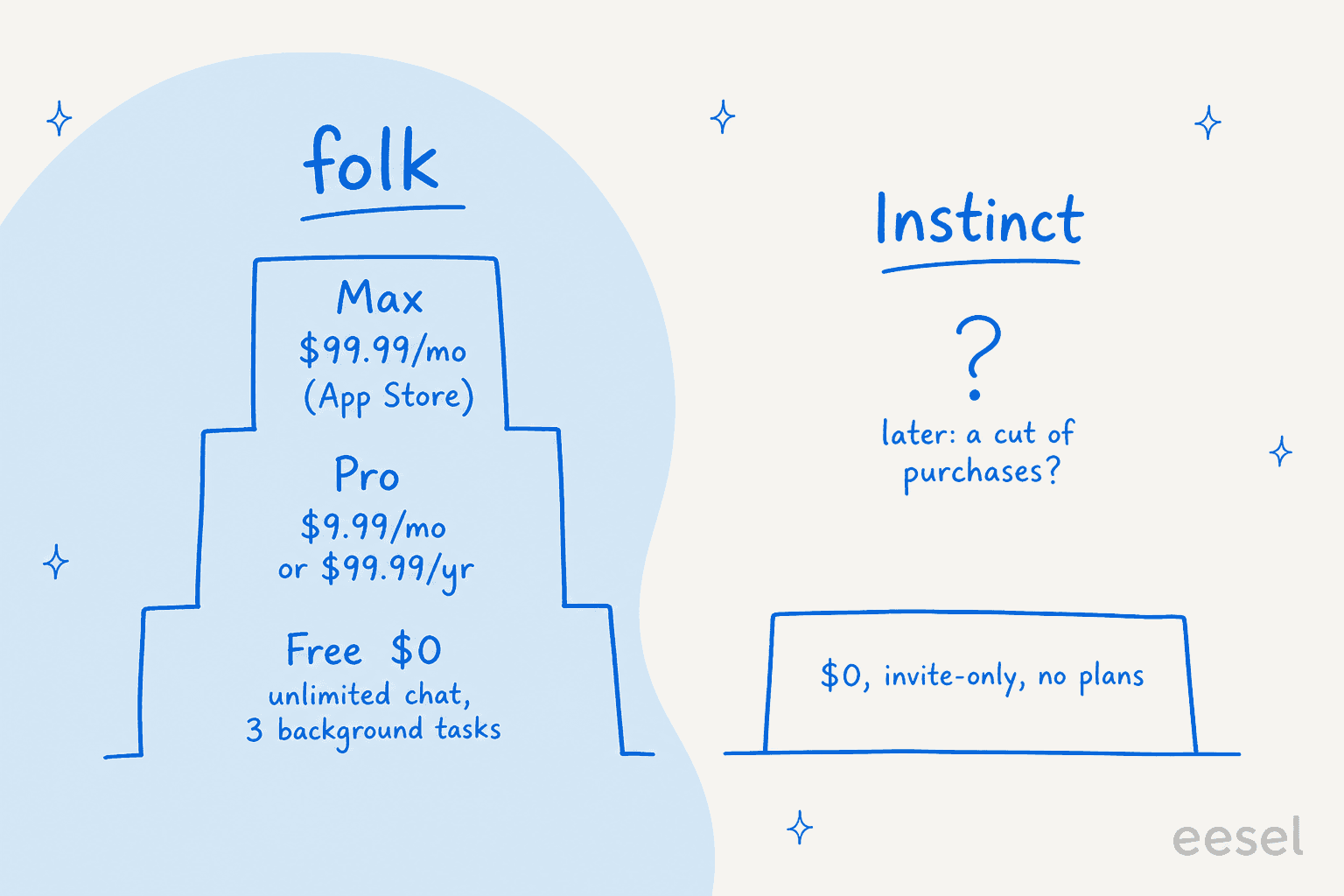
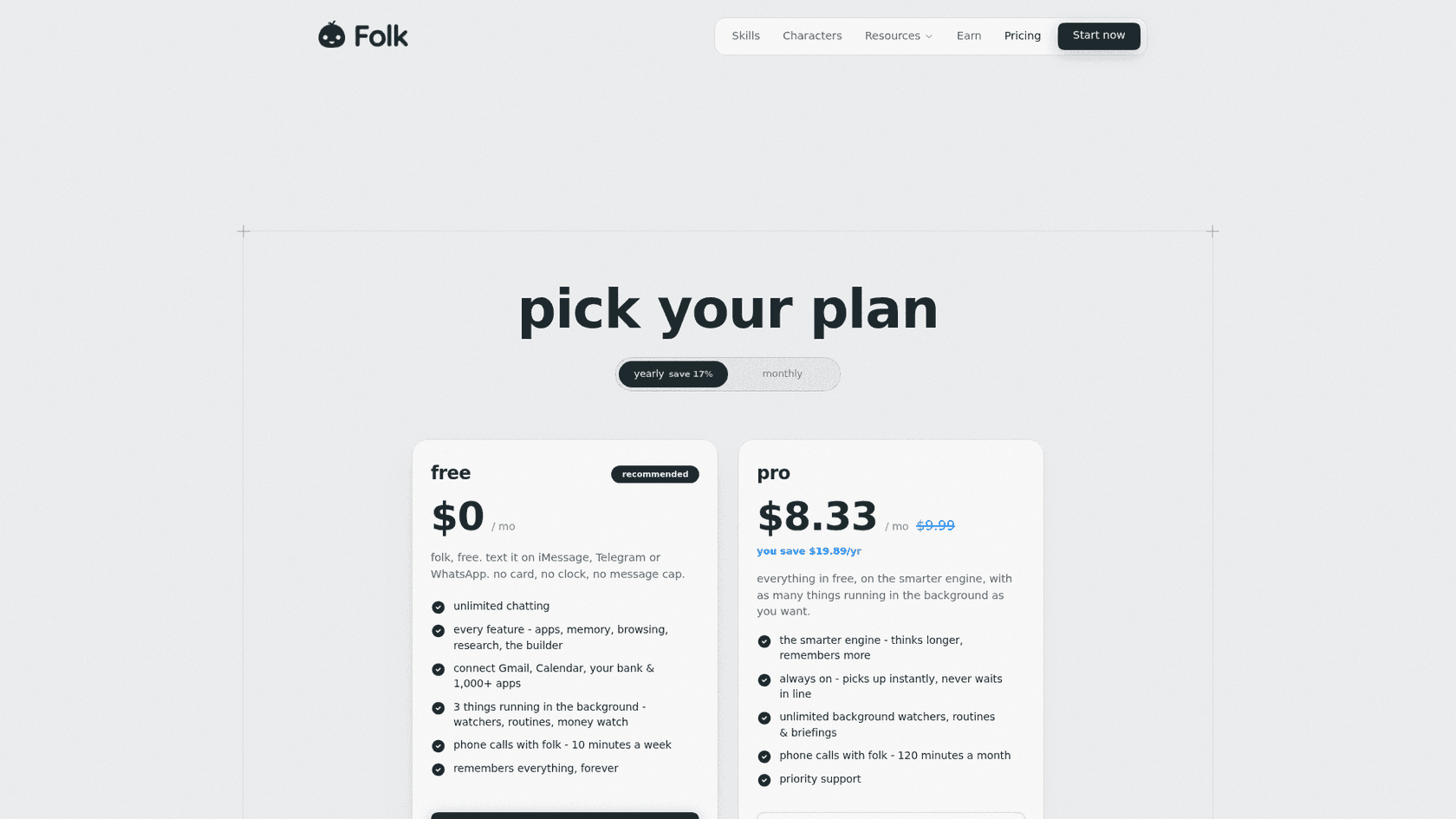
folk's plans are simple. Here's folk's pricing page as of October 8, 2026:
| Plan | Price | What you get |
|---|---|---|
| Free | $0 forever, no card | Unlimited chat, every feature, 3 background tasks, phone calls 10 minutes a week |
| Pro | $9.99/month or $99.99/year | Smarter engine, always on, unlimited background tasks, 120 call minutes a month, priority support |
| Max | $99.99/month | Listed in folk's terms for the US App Store only |
Two details worth knowing. Pro drops to $5 a month in many countries, worked out from your phone number. And folk's own pages disagree on call minutes: the pricing page says 120 a month on Pro, while one FAQ answer says 60. I'd trust the pricing page.
Instinct has nothing to compare against. It's free while invite-only. After interviewing the founder, Patrick O'Shaughnessy wrote that "Instinct plans to take a cut of what users buy," and that Shinn's personal goal is to keep it free for everyone for life (Patrick O'Shaughnessy, X). My Instinct AI pricing post covers what that means.
So the honest version: folk costs $0 or $99.99 a year, and you know the number up front. Instinct costs $0, and the number to watch is what it spends for you.
Privacy and data
| folk | Instinct | |
|---|---|---|
| Model training | Never trains on your conversations | On by default; opt out at app.instinct.com/settings |
| Model providers | OpenAI and Anthropic via OpenRouter | Not named in the privacy policy |
| Read-only options | Google apps and bank (Plaid) can be read-only | Not documented |
| Credentials | Connected apps per account | Vault, never used for training |
| Deleting | Account, chats, memory and apps wiped within seconds | Disconnecting doesn't delete what was indexed |
| Certifications | None published | None published |
Sources: folk's privacy policy and FAQ; Instinct's privacy policy and terms.
On paper, folk documents more limits and a clearer delete button. Instinct is a newer, invite-only product, and its paperwork reads like one. If you connect Instinct, switch training off on day one. If you connect folk, start with read-only Google and move up only when you need drafts.
What users say about each
Neither has a G2 or Capterra footprint yet, so the user voice lives on X and Hacker News, and there's not much of it.
Instinct gets credit for getting errands done:
"I use Instinct and I'm very happy with it so far. It has booked some restaurants for me, replied to some personal admin-related emails, and updates my progressive workout spreadsheet when i go to the gym. No real complaints so far."

folk's early chatter is mostly people sizing it up against the other agents they already run:
"What are the things that can be achieved by folk but cannot be done by OpenClaw or Hermes? If there are a few useful things, I will consider to switch"
That's a fair question, and folk's answer is its own site's comparison pages against Poke and OpenClaw: no setup, a private computer, and memory that keeps growing. The fans are bold about it, too. One early user's bet was that "folk will kill siri" (conor brennan-burke, X).
Instinct has had one public scare. On September 23 a user thought it had shown someone else's financial document, and Shinn responded the same day that it was a hallucination, not a data breach, and that the team built a detection layer in 48 hours. Neither company publishes an accuracy number.
Which one should you pick?
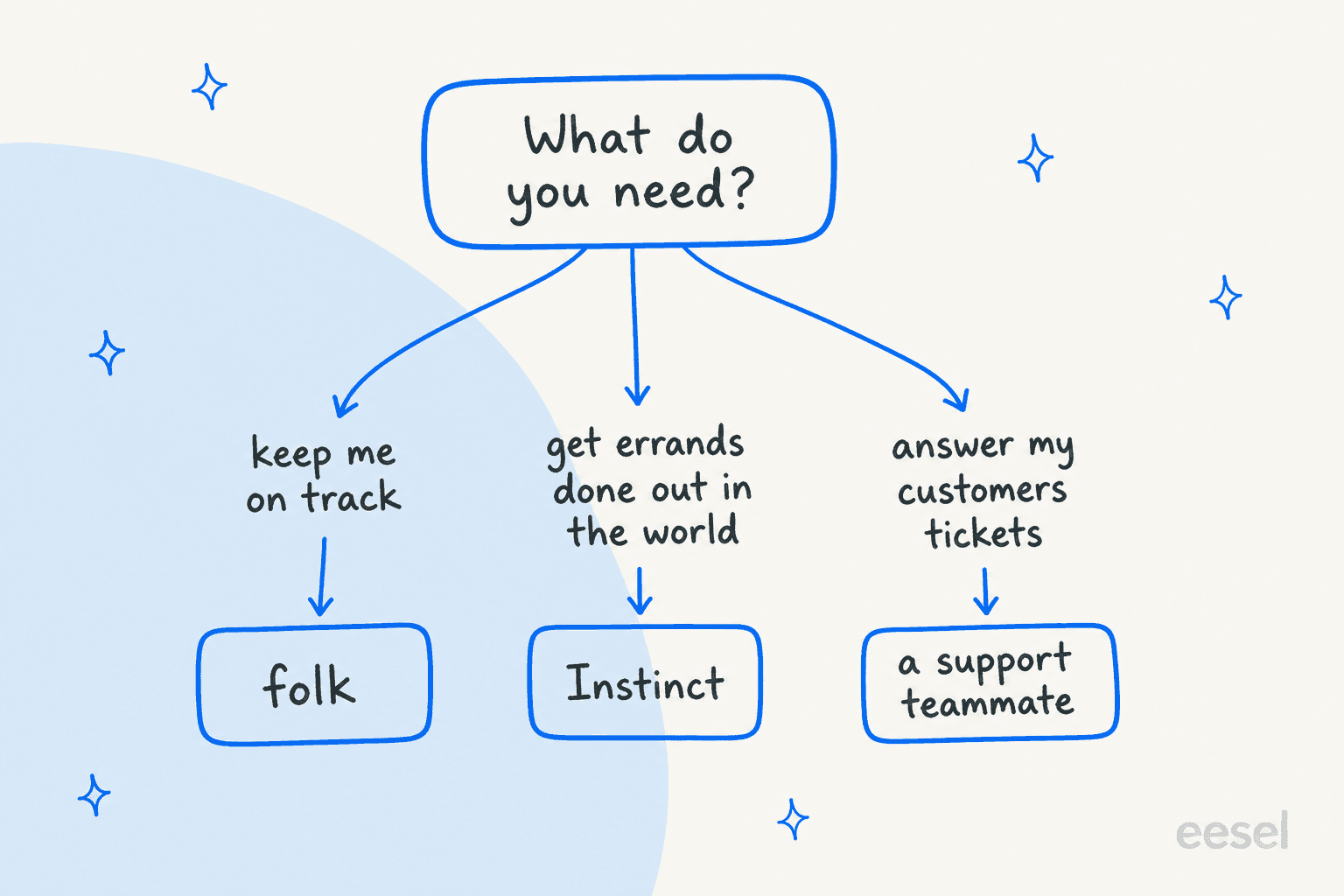
Pick folk if you want an assistant that keeps you on track: habits, wake-ups, price drops, a morning brief, and email drafts you approve with a quick "send it." It's free to start with no card and no invite, and Pro is one of the cheapest paid plans in this category.
Pick Instinct if you want errands off your plate: rebook a cancelled flight, chase a confusing bill, order the groceries, sort the group trip. You'll need an invite. Opt out of training in settings and tell it to check with you before any purchase.
Use both if you like the idea of two assistants with different jobs. They overlap less than you'd think: folk for your routines and inbox, Instinct for the outside world. Just remember Instinct's terms allow personal use only.
Look elsewhere if neither fits. Orchid is another iMessage assistant, Martin leans toward email and calendar, and Meta Muse suits people who want to watch the agent work.
My Orchid AI vs Instinct AI and Instinct AI vs Town AI posts cover those matchups, and the AI personal assistants roundup has the wider field.
What this means for a support team
Here's the part I care most about, because I'm the one reading the tickets.
Both assistants sit on the customer's side of a support conversation. folk drafts refund and cancellation emails from the customer's own Gmail. Instinct calls businesses through Concierge and now hands problems straight to company agents on Sierra and Decagon. The tasks Shinn listed are classic tickets: a delayed package, a bill that went up, a confusing return policy.
Decagon built its personal agent gateway for exactly these messages. If you're not on Sierra or Decagon, they land in your normal inbox, written by an assistant, often clearer and more persistent than the human would be. My guide to Instinct AI for customer support covers how to answer them well.
What changes for a support team is volume and speed. An assistant doesn't get tired of following up, and it asks the exact policy question your help center may be vague about. The teams that handle this best answer from clear docs and their own past replies, every time, at any hour.
That's what eesel is for. eesel is an AI teammate platform where you hire ready-to-work teammates for specific jobs, and the AI helpdesk teammate is the one for this. It plugs into Zendesk, Freshdesk, Gorgias and the other helpdesks you already use, learns from the replies your agents already sent, and answers refund, order status and policy questions for the whole team.
And it follows the same trust path I opened with. You start it on drafts, run it against historical tickets to see how it would have answered, and move the easy tickets to full automation only when you're ready.
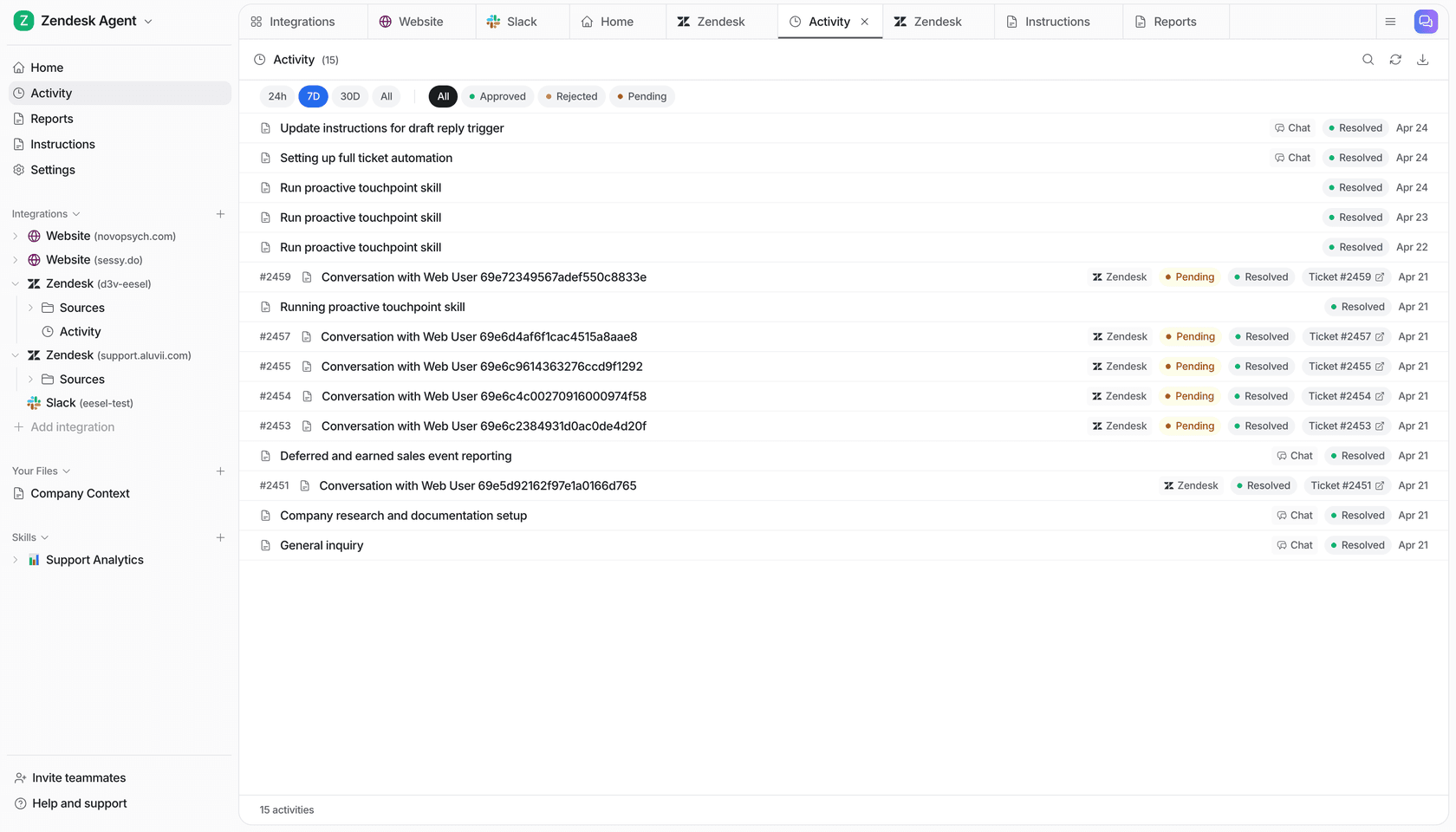
If your team works in a terminal or with coding agents, the same teammate is reachable through the eesel CLI. eesel approvals list shows what's waiting on a human, eesel activity lists what the agent did, and write commands take --dry-run, so Claude Code, Codex or Cursor can drive it safely. My post on AI agent CLIs explains why that matters. For e-commerce teams seeing assistant-driven refund requests, the Shopify AI chatbot guide is a good next read.
Try eesel
folk is a friendly assistant that keeps you on track and asks first. Instinct is a bold errand runner that acts as you. When their messages start landing in your queue, eesel's AI helpdesk teammate plugs into your helpdesk in minutes, answers from your docs and past tickets, and shows you how it would have replied on old tickets before it touches a live one. Try eesel.
Frequently Asked Questions
What is the difference between folk AI assistant and Instinct AI?
Is folk AI assistant or Instinct AI cheaper?
Which is safer, folk or Instinct?
Can folk or Instinct make phone calls for me?
Can I use folk AI assistant or Instinct AI for work?
Can folk or Instinct answer my customers' support tickets?
What are the best alternatives to folk and Instinct?


Article by
Riellvriany Indriawan
Riell is a designer and writer at eesel AI with about two years of experience researching CX platforms, AI chatbots, and helpdesk software. She combines her design background with a sharp eye for how these tools actually look and feel in practice — making her comparisons unusually visual and user-focused.