What Instinct actually is
Instinct is a personal assistant built by Spear Street Technology, Inc., which trades as Instinct, per its privacy policy. The founder is Noah Shinn, and the pitch fits in one line from Instinct's homepage: "there are no new interfaces." You text or call it. It is "trained to use a phone and a computer" the same way people do.
That homepage is, in fact, almost the entire public website. A few sentences, one button, done:
Instinct says it connects to "email, messaging, screen, audio, location, and more," and its core model is tuned for the small stuff of daily life: following up on threads you dropped, calling or texting you proactively, arranging a ride to the airport, booking a handyman. When Shinn announced it in August, he said early users had planned cross-country road trips, bought groceries and concert tickets, and cancelled hundreds of dollars of subscriptions. It is still an invite-only beta "while we're actively bringing up more compute."
It sits in the same new wave as Meta Muse, Grok Bot, and the open-source OpenClaw: agents that do the task rather than describe it.
If you are new to the category, this explainer on AI personal assistants covers the ground.
How it works under the hood
This is the part I find most interesting as someone who builds agents. Instinct's trick is not one clever model. It is a pipeline that keeps the interface boring and puts the complexity in the back.
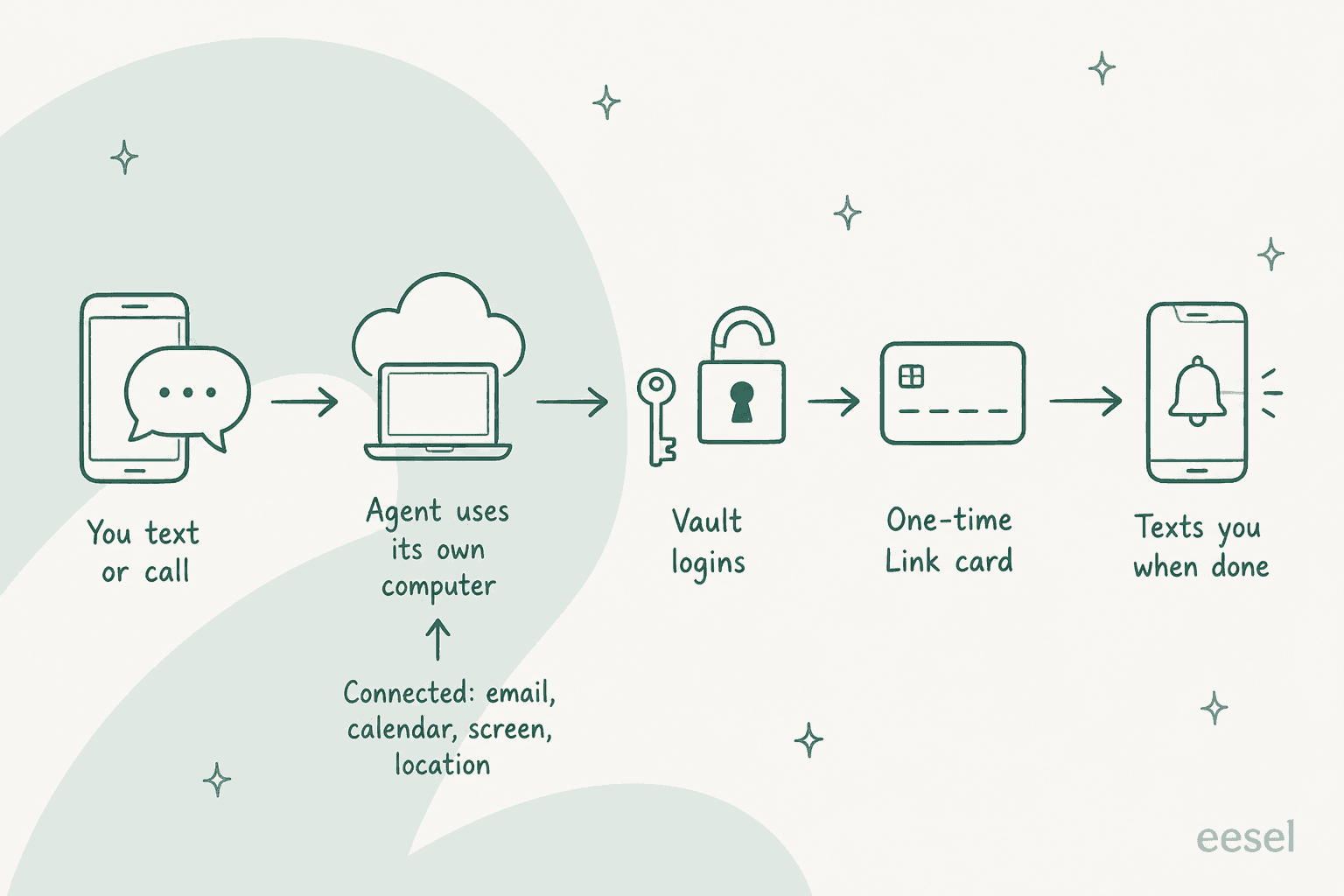
Here is what each step does, from Instinct's own docs and the founder's posts:
- The chat is the whole interface. You message it in iMessage or WhatsApp. There is also a Mac app and a web workspace at app.instinct.com, where you manage connections and settings.
- It acts through your accounts. The terms of service authorize Instinct to "access, copy, collect, and index data" from connected services and take actions on them. Link Google Workspace and it gets Gmail, Calendar, Drive, Docs, Sheets, Slides, and Tasks.
- Logins go in a Vault. Instinct can sign into third-party accounts for you. The terms say anything you add to the Vault is used only to serve you and never used to train AI models.
- Payments go through Stripe Link. Since late August, when Instinct wants to buy something it requests a one-time-use card from Link, authorized for that amount, so the merchant never sees your real card. You "explicitly review and approve the amount Instinct can spend."
- Instincts talk to other Instincts. A trusted-person network lets your agent coordinate with the agents of people you approve. Shinn says Instincts had coordinated over 300k times in the first week, and now swap files encrypted end to end.
The newest piece landed on September 28: a Shopify partnership. Shinn says 35% of users use Instinct for personal shopping, and it can now search Shopify's merchant network and set up a Shop Pay checkout. That puts Instinct right in the middle of agentic commerce, next to ChatGPT shopping.
What users actually say
The reaction on X splits cleanly. People who use it love how proactive it is. People who read the terms get nervous.
On the love side, the recurring word is "proactive." Most AI tools wait for a prompt. Instinct starts the conversation:
"Instinct is the first AI product I've used that is truly proactively helpful. It's already checking me into flights, reminding me about reservations I forgot to cancel, etc"
Even its sharpest critic on the business side rates the product itself highly. Andrew Wilkinson called it "an exceptional product, and the most proactive personal assistant agent I've used," before arguing the company is a "feature not a product" that OpenAI or Anthropic could copy. Nathan Baschez had a sharper theory of why it feels magic: it is willing to take more risk and "let the agent access and do more without step-by-step permissions," the same way Claude Code permissions got skipped in the early days.
That risk shows up in the small complaints. One reply under Saleh's post: "It tried to change my seat while checking me in once. Didn't like that." A heavy user who runs "doc appts, amzn orders, food delivery, movies" through it said the single thread gets hard to follow:
"while it can maintain context in one thread, i can't lol. my chat has a bunch of diff, unrelated stuff, and it's hard for me to quickly figure out the 'status' of each thing"
And with Meta Muse now out, some early fans are drifting. On a September 27 episode of the Get the Check podcast, one host said they were switching and complained that Instinct had "gotten significantly worse at cart checkouts," with a staged cart that "went to zero."
The fine print is the real review
This is where most Instinct coverage stops being useful. I read the full terms and privacy policy, both last revised August 26, 2026. Instinct is upfront about the risks, to its credit. But the balance of who carries them is worth seeing side by side.
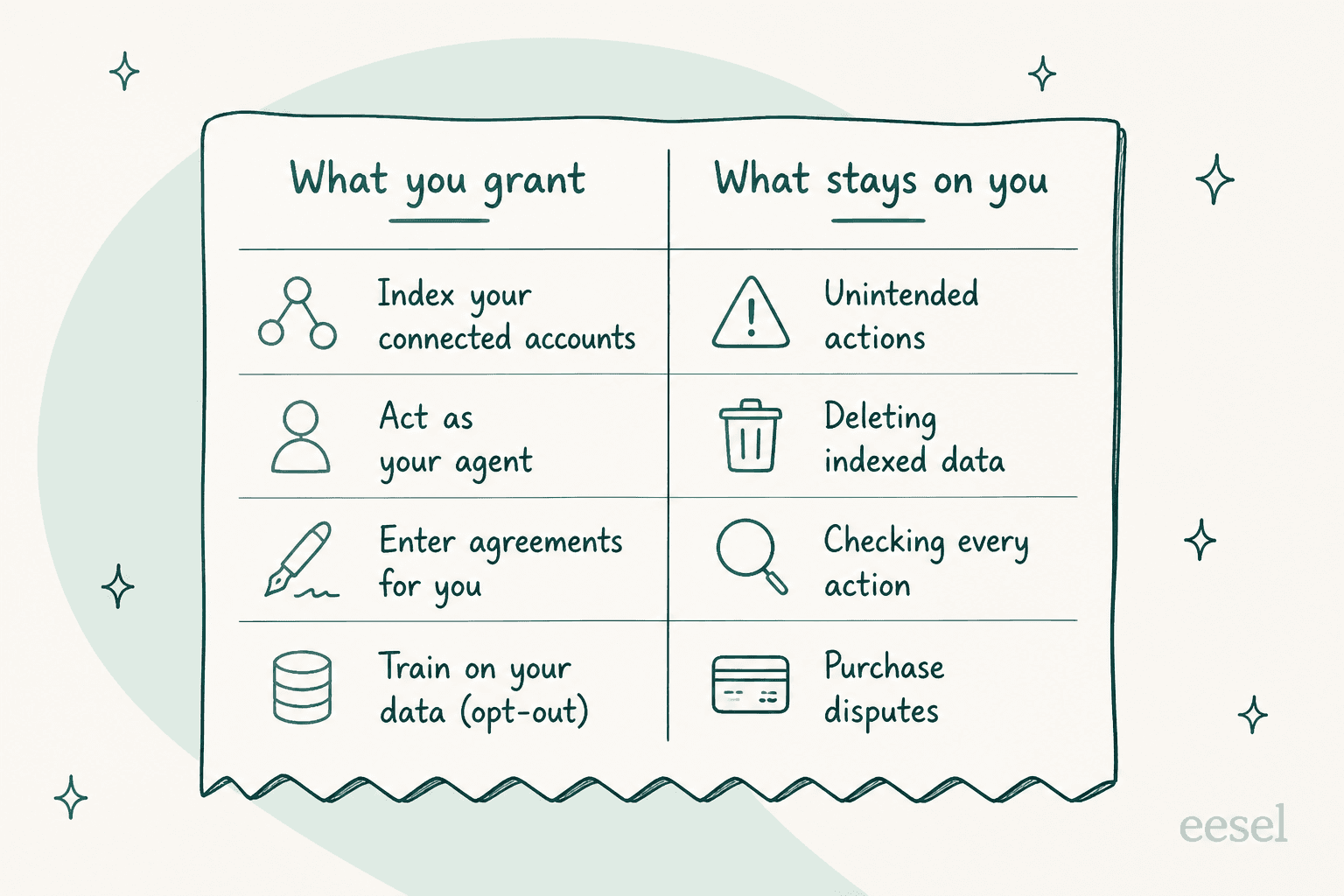
The clauses that matter most:
| Topic | What the terms or privacy policy say |
|---|---|
| Acting for you | You "appoint the Services as your agent to enter into agreements, commitments or transactions on your behalf," and those are "binding on you as if entered into directly by you." |
| Mistakes | Instinct is "not responsible for any unintended Actions," actions "may not always be reversible," and "records of Actions available through the Services may not always be accurate." |
| Purchases | You, not Instinct, are the buyer. Disputes are between you and the merchant. |
| Disconnecting | Disconnecting an account does not delete what was indexed. You have to request deletion at app.instinct.com/workspace. |
| Model training | On by default. Opt out at app.instinct.com/settings, but flagged safety-review data can still be used, and past training is not undone. Google Workspace and Vault data are excluded. |
| What it collects | Connected content, audio if enabled, precise location if shared, and clickstream including keystrokes. |
| Disputes | Binding individual arbitration and a class action waiver, with a 30-day window to opt out by emailing support. |
| Age | 18 or older. |
None of this is unusual for an agent that does real things, and the privacy policy even warns about "interactions with third parties who may include misleading instructions intended to influence autonomous agents," which is a plain-English description of prompt injection. It just means you, not Instinct, carry the risk of a wrong action.
Brad Groux, who works with AI agents, read the same documents and came to a clear line:
"I'd want to connect an inbox with read-only access, then approve specific permissions as needed. Sending emails, sharing files, making purchases, or accepting terms should require my approval through a control the agent can't bypass."
In fairness, the payments piece already works much like that: Link's one-time card needs your approval on the amount. Email, files, and terms-acceptance are where that kind of hard gate is not described in the terms.
Instinct also had its first public scare on September 23, when a user posted that the agent seemed to describe someone else's financial document. Shinn responded the same day that it "was caused by a hallucination (the model fabricated a proper noun)," that "this was not a data breach," and that the team had built a hallucination detection layer in 48 hours. That is a fast, transparent response. It is also a reminder that AI hallucinations look scary to users even when no data moved.
Pricing: there isn't a public one
Instinct publishes no plans and no prices. The terms say you "may be required to pay us fees to access or use certain features," that the company "may, at any time, revise or change the pricing," and that "all payments are non-refundable." Until it leaves invite-only beta, you are using it on whatever terms Instinct sets later.
For comparison, Meta Muse is free up to a weekly token allowance with paid plans above it, and Grok Bot has no free tier at all. The personal-agent market has not settled on a price model yet, so plan for Instinct's to change.
Should you connect your accounts?
Here is how I would decide, account by account. Pick what you are thinking of connecting:
What would you hand to Instinct?
Where a personal agent stops and a work teammate starts
Instinct's whole design points one way: one generalist agent for one person's life. That is the right shape for errands, because personal life is a hundred small, unrelated tasks, and the charm is that it just figures each one out.
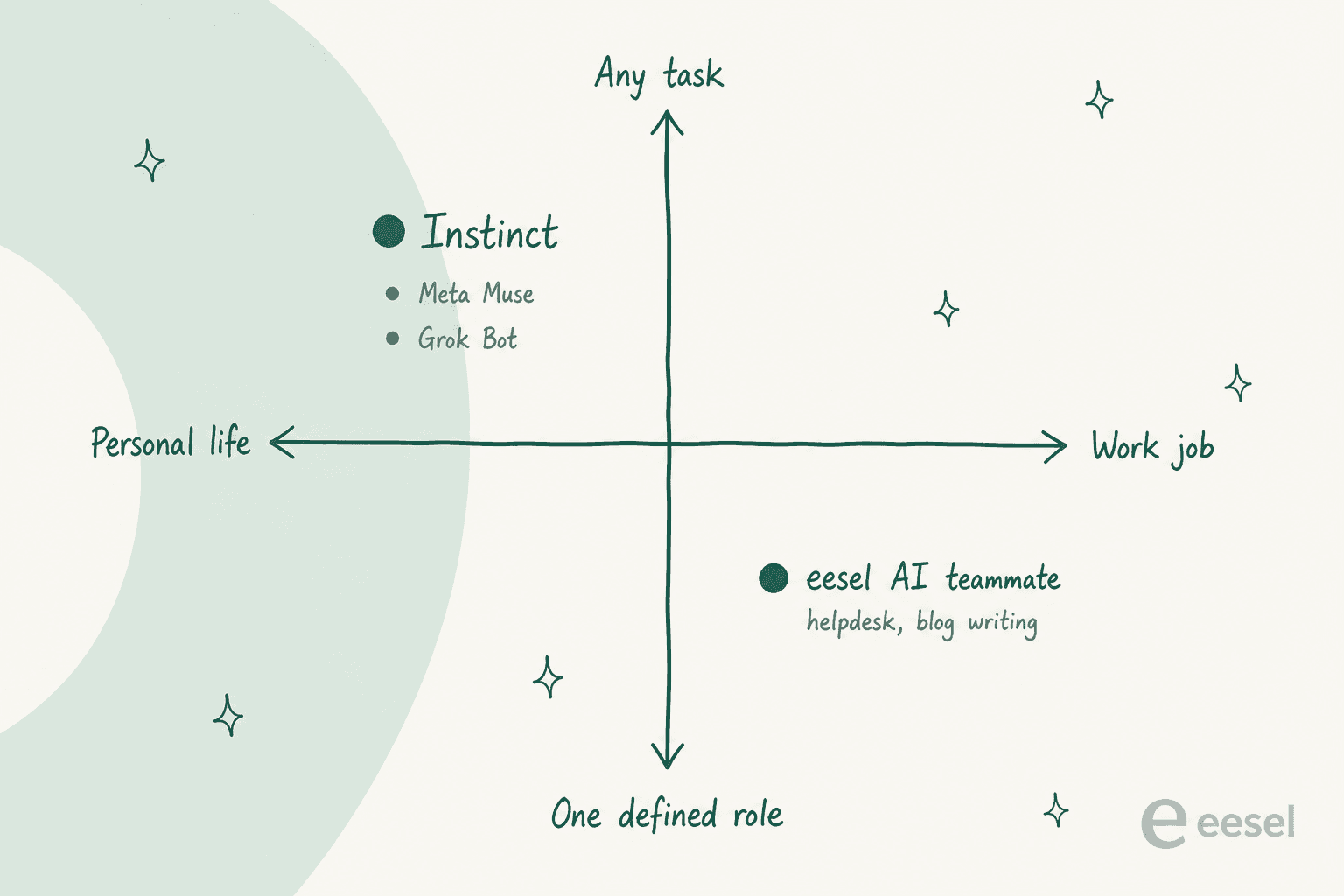
Work is the opposite. A work job is one thing done to a standard, over and over, where a confident wrong answer lands on a customer. That is the 7,000-ticket CX lead's point from the top: you do not want an agent improvising, you want one that knows its lane and leaves the rest alone. It is also why generalist tools like Manus, ChatGPT agents, and Claude Cowork keep landing as personal productivity tools rather than as owners of a business process.
That is how I think about eesel. It is an AI teammate platform where you hire ready-to-work teammates for a defined job: the AI helpdesk teammate and the AI blog writer. Each one arrives with the skills, integrations, and company context for its role, rather than a blank generalist you have to point at everything.
Try eesel
If Instinct got you thinking about agents that act instead of chat, the place that pays off at work is the support queue. eesel's AI helpdesk teammate joins the helpdesk you already use, learns from your knowledge base and past tickets, and answers only from knowledge you approved. Everything else it hands back to your team.
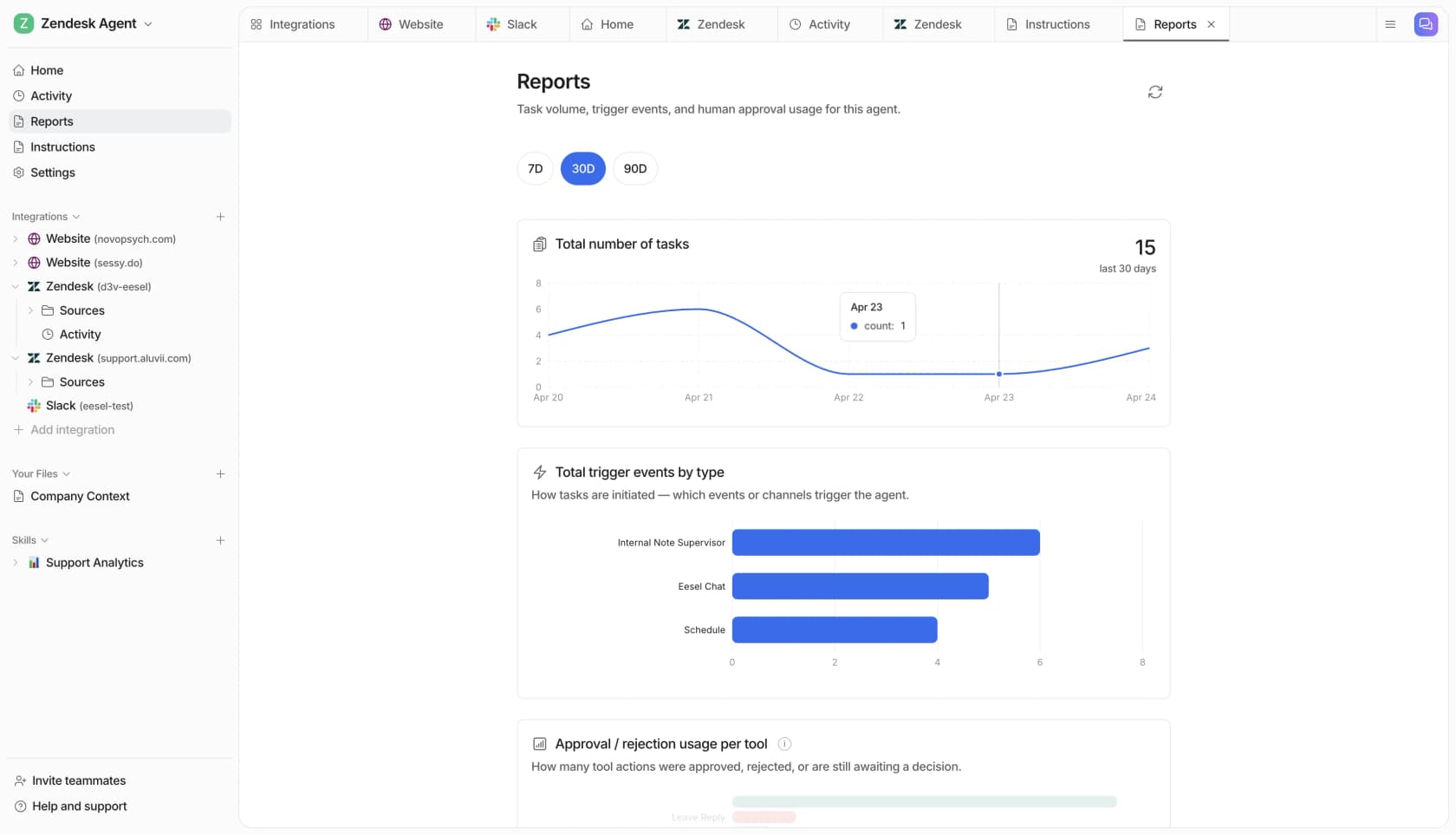
The part Instinct's terms leave to you, eesel builds in. You can simulate the teammate on hundreds of your past tickets and read its resolution rate before a customer sees a single reply, and the reports show every tool action that was approved or rejected. Pricing is public too: a free plan with 100 credits, then fixed monthly plans from $299 for 500 credits, where one ticket or chat is one credit, on the pricing page.
Keep Instinct for your errands. For your customer support, try eesel free and test it against your own ticket history first.
My verdict
Instinct is the most proactive consumer agent I have looked at, and the plain text-thread interface is a smart bet: anyone can use it in 30 seconds. The Link one-time cards, the Vault, and the Shopify checkout show a team moving fast on the right problems, and the founder's public response to the September hallucination scare was quick and clear.
What holds me back is that the terms ask you to carry almost all of the risk of a wrong action, training is opt-out rather than opt-in, and there is still no price. If you are comfortable with that, get an invite, connect your personal calendar and email, opt out of training, and use Link for anything you buy. Let it earn the next account.
Just keep it on your side of the line between life and work. For a job that touches customers, hire something built for the job.
Frequently Asked Questions
What is Instinct AI?
Is Instinct AI free?
Is Instinct AI safe to use?
Does Instinct AI train on my data?
How does Instinct AI compare to Meta Muse and Grok Bot?
How do I get an Instinct AI invite?
Can Instinct AI handle customer support for my business?


Article by
Alicia Kirana Utomo
Kira is a writer at eesel AI with a Computer Science background and over a year of hands-on experience evaluating AI-powered customer service tools. She focuses on breaking down how helpdesk platforms and AI agents actually work so that support teams can make better buying decisions.