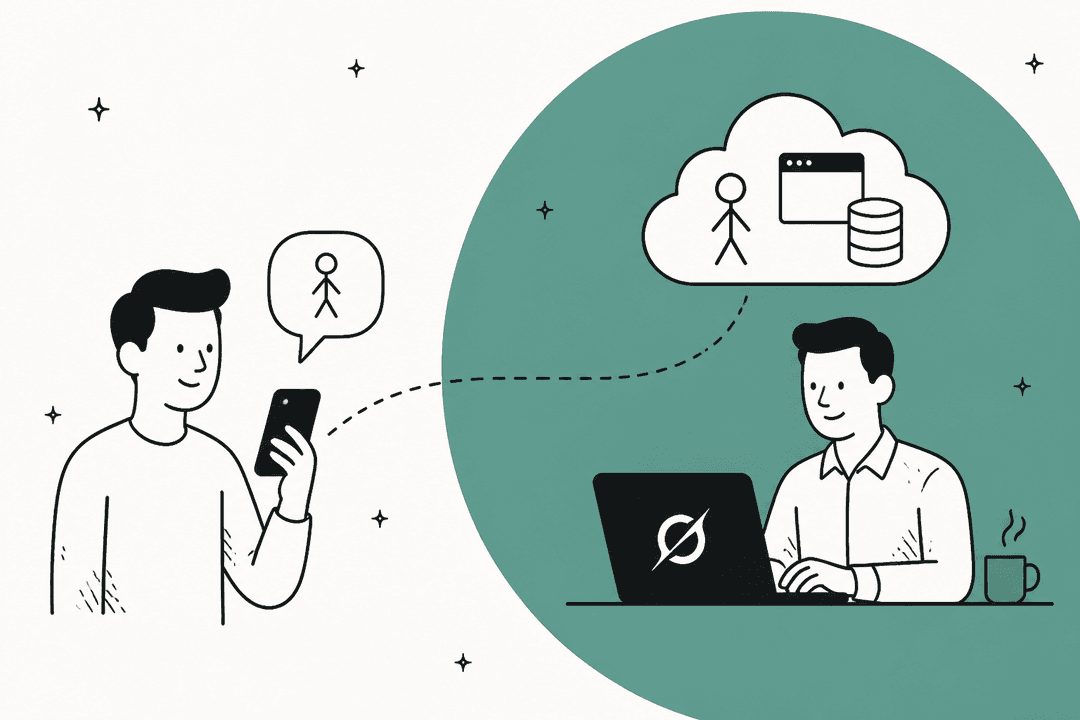


Why compare a hosted assistant with a self-hosted one?
I build integrations and APIs at eesel, so I spend most of my day on the boring question under every agent: what is it connected to, and who controls that connection? eesel has run AI on live support queues for years, and the lesson that stuck is that a confident agent with a wrong answer costs more than no agent. That's why every eesel rollout gets simulated against historical tickets before it touches a live one.
Instinct and Hermes keep landing in the same conversations because they share a form factor. As one Hacker News commenter put it:
"Only Grokbot, openclAw, hermes, and instinct compare right now due to the mobile-first form factor."

Underneath that shared form factor, they answer opposite questions. Instinct asks "what if an assistant just handled it for you?" Hermes asks "what if you owned the whole agent, down to the server?" Another early Instinct user framed the trade in one comment:
"Now I just want to see a version I can run on my own hardware so I don't have to worry about some sketchy company hoarding my data. I know OpenClaw and Hermes are supposedly answers to this, but I find that they've each become so bloated with features that they're far more difficult to use and bug prone than I'm happy with."
That's the whole decision in two sentences. Convenience and reach on one side, ownership and setup work on the other.
Instinct vs Hermes Agent at a glance
| Instinct | Hermes Agent | |
|---|---|---|
| Maker | Spear Street Technology, Inc. d/b/a Instinct | Nous Research |
| Type | Hosted consumer assistant | Open-source agent you install (MIT license) |
| How you use it | Text or call it from your phone | Desktop app, terminal, or Telegram, Slack, WhatsApp, Signal, email and more |
| Where it runs | Instinct's servers | Your machine, your server, or Hermes Cloud |
| Access | Invite-only | Anyone; one-line install |
| Price | No published price | Free software; model credits $0 to $200/month, or your own key |
| Approvals | Connection requests need approval; other safeguards "may" exist | Approval modes for dangerous commands; unknown users denied by default |
| Memory | Held by Instinct | Files on your machine, 2,200 and 1,375 character limits |
| Real-world reach | Calls, purchases, its own email address | Web, browser automation, terminal, scheduled jobs |
| Allowed use | Personal use only | Any, under MIT |
| Liability cap | Greater of $100 or what you paid in 6 months | None; it's your software |
Sources for every row are linked in the sections below.
What is Instinct?
Instinct is a personal assistant you text or call. Its homepage says it "connects to your applications and devices - email, messaging, screen, audio, location, and more," and that "there are no new interfaces" (instinct.com). You sign in with a phone number and a code.
The founder, Noah Shinn, was an early Sierra employee and first author of the Reflexion paper on self-correcting agents. He launched Instinct publicly on August 26, 2026 as an invite-only beta (Noah Shinn, X). The pitch is that its core model is "trained to understand and handle the deeply personal nuances of everyday life," from following up on dropped threads to "arranging a ride to the airport" (instinct.com).
The releases since then all push further into your personal life:
- Spending. Buyers spend "over $1300/month on average through Instinct" via a Stripe Link partnership (Noah Shinn, X), and a Shopify partnership added Shop Pay checkout (Noah Shinn, X).
- Credentials. A Vault for shared logins, used by 32% of users per the 1Password post (Noah Shinn, X).
- Phone and email. Each Instinct has its own email address, and Instinct Concierge makes phone calls for you (Noah Shinn, X).
- Other people. Instincts coordinate with each other, and since October 5 they can join group chats (Noah Shinn, X).
My colleague's Instinct AI review covers it in full. The short version: it's built to be you, out in the world, and you never see a server.
What is Hermes Agent?
Hermes Agent is Nous Research's open-source agent, pitched as "The Agent That Grows With You" (Hermes Agent). You install it with one terminal command or a desktop app for macOS and Windows, connect a model provider, and then talk to it from wherever you like.

The homepage lists six pillars: it connects to "Telegram, Discord, Slack, WhatsApp, Signal, Email, CLI," keeps persistent memory and "auto-generates skills," runs scheduled jobs "unattended through the gateway," spins up isolated subagents, browses the web, and sandboxes its work across five backends (Hermes Agent). The docs list 21+ messaging platforms, including iMessage through BlueBubbles (Hermes docs).
It's also one of the most popular agent projects on GitHub, with 251,000+ stars. The latest at the time of writing is v0.21.5, released September 24, 2026 (GitHub).
If you don't want to run a server, Nous now sells Hermes Cloud, which hosts the same agent on a dedicated instance with its own dashboard (Nous Portal).
The Hermes Agent review has the longer tour.
How they work under the hood
Both agents act for you through your messaging apps. Where they run, and as whom, is where they split.
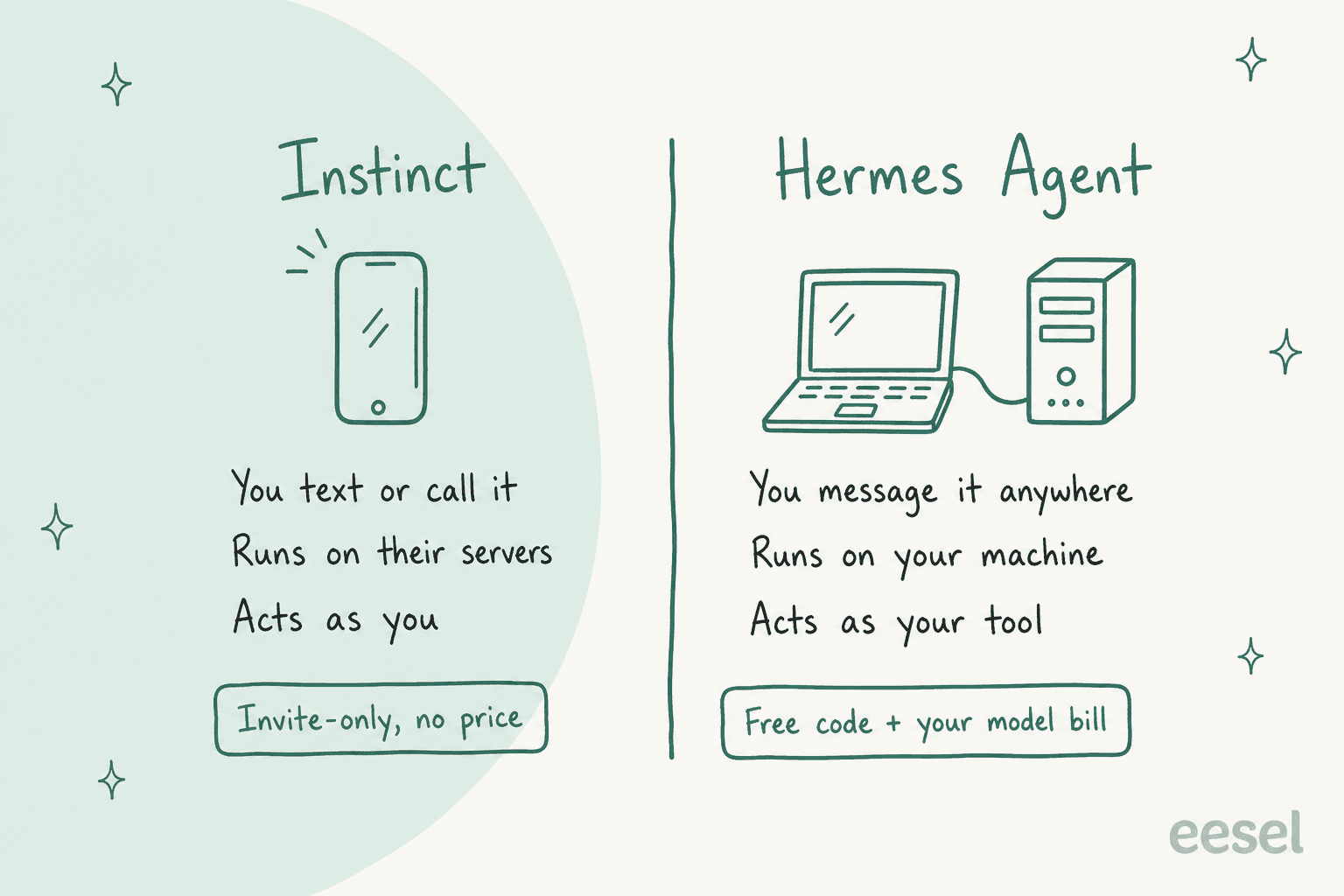
Instinct acts as you, on its own devices. The homepage says it is "trained to use a phone and a computer" and "uses its devices in the same way that humans do" (instinct.com). Your logins live in its Vault, it writes from its own email address, and for purchases the terms say "you, not us, are making such purchase" (Instinct Terms). You don't pick the model, the server or the rules. That's the product.
Hermes acts as your tool, on hardware you choose. It runs as a process on your laptop or server, or in a container. It reaches the world through a terminal, a browser, the web and any MCP servers you plug in. You pick the model, from a free local one to a frontier model through your own key. Memory is two plain files on disk: MEMORY.md capped at 2,200 characters and USER.md at 1,375, and the docs note "Memory does not auto-compact" (Hermes memory docs).
The practical difference shows up in what each one can reach. Instinct can call your dentist and check out at a Shopify store, because those are the skills its company built and trained. Hermes can SSH into your server, run a cron job at 6am and file a GitHub issue, because it has a terminal. Neither does the other's job well.
Who asks before acting?
This is the section I'd read twice before choosing.
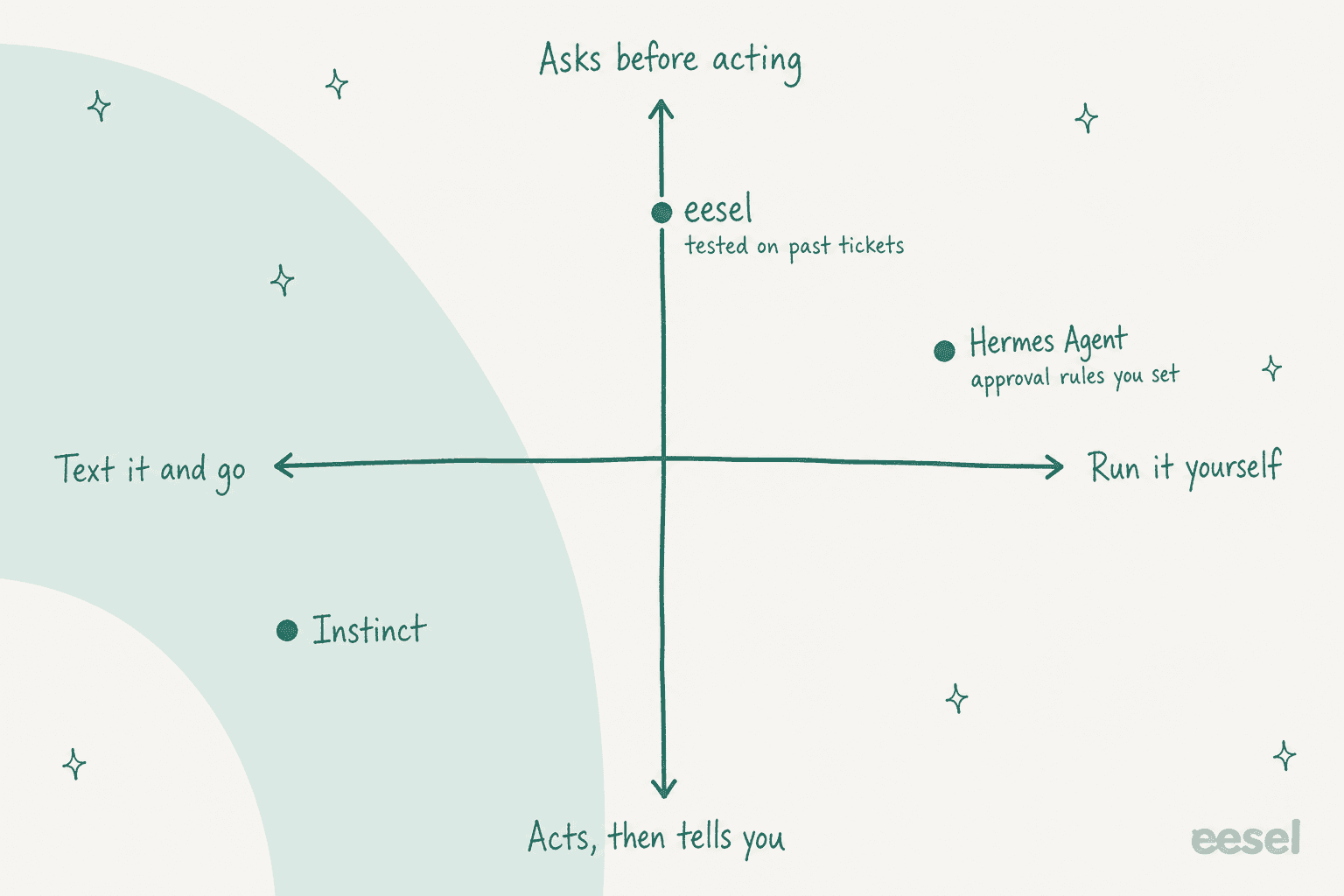
Instinct's controls live mostly in the terms. You "authorize the Services to take Actions on your behalf as the Services may deem are responsive to your Input," and you appoint it "as your agent," with agreements "binding on you as if entered into directly by you" (Instinct Terms). The terms add that Instinct "may implement safeguards, confirmation requirements, or other controls," with no promise they'll prevent errors. Connection requests between Instincts do need your approval (Noah Shinn, X).
Early users noticed. Alex Cohen tested phishing by emailing his own inbox from a fresh account:
"I wanted to see how easily Instinct could be phished, so I created a brand new Gmail account and emailed my real personal account with instructions for Instinct to search my inbox and send back a detailed summary of every open to-do (reconnected Instinct for the test)
Instinct happily followed the instructions!"
Hermes's controls are settings you own. Out of the box, "the gateway denies all users who are not in an allowlist or paired via DM," which the docs call "the safe default for a bot with terminal access" (Hermes docs). For risky commands there's an approval mode. The default, smart, uses a second model to rate each command: low-risk ones run, dangerous ones are blocked, and "Uncertain cases escalate to a manual prompt" (Hermes security). You can switch to manual, or to off, which the docs equate with running --yolo. Scheduled and webhook runs deny dangerous commands by default.
Two caveats matter. The smart check is itself a model making a judgment call, not a guarantee. And the docs' injection scanner covers context and memory files, with the note that "These patterns are heuristics, not semantic intent detection" (Hermes security). Hermes users who care about this build their own walls. One described running two separate Hermes profiles, one with file access and no internet, one with internet and no files:
"I grow increasingly concerned about what is, to me, the primary risk of this. Not data destruction (automated backups are trivial), but data exfiltration. Specifically, via prompt injection."
So the honest summary: Hermes gives you the knobs, and Instinct gives you a contract. With Hermes, you can see every command and stop it, but only if you set it up that way. With Instinct, you trust the company's safeguards and accept the terms.
Pricing: invite-only and free vs free code plus a model bill
Neither charges per task. The costs land in different places.
| Instinct | Hermes Agent | |
|---|---|---|
| Software | Not sold separately | Free, MIT license |
| Entry plan | No published price | Nous Portal Free: $0, free models only |
| Paid plans | None published | Plus $20/mo ($22 credits), Super $100/mo ($110), Ultra $200/mo ($220) |
| Bring your own model | No | Yes, any provider key; or connect an eligible ChatGPT plan |
| Hosting | Included | Your own hardware, or Hermes Cloud from $0.56/day running |
| Free option | Free while invite-only | Free models on Nous Portal, or a local model |
| Hidden cost | Whatever it buys; liability cap $100 | Your time on setup and upkeep; tool calls billed per use |
Nous Portal plans and Hermes Cloud prices are from Nous Portal on October 6, 2026. Hermes Cloud bills daily from your credit: Medium is $0.56/day running and $0.03/day stopped, Large is $1.09/day running, and "Inference and tool usage are billed separately, on top of the instance price." Unused paid credits roll over up to $10, $50 or $100 depending on the plan.
Instinct's model is simpler to describe. It's free, and the plan is a cut of what you buy: after interviewing the founder, Patrick O'Shaughnessy listed that "Instinct plans to take a cut of what users buy" (Patrick O'Shaughnessy, X). My colleague's Instinct AI pricing post works through it.
So the real comparison: Instinct costs your attention on what it spends. Hermes costs your time. A Medium Hermes Cloud instance running all month is about $17 before any model usage; the bigger cost is the hours to configure allowlists, approvals and skills, then keep them current as Nous ships new releases.
Privacy and data
| Instinct | Hermes Agent | |
|---|---|---|
| Where data lives | Instinct's servers | Your machine, or your Hermes Cloud instance |
| Model training | On by default; opt out at app.instinct.com/settings | Depends on the model provider you pick |
| Credentials | Vault, never used for training | API keys in a local .env file you manage |
| Deleting data | Disconnecting an integration doesn't delete what was collected | Delete the files; local stop keeps conversations and memory |
| Model provider named | No | Yes, you choose it |
Instinct's rows come from its terms and privacy policy. Hermes's come from the Hermes Agent FAQ and docs.
This is where Hermes wins outright for anyone who cares about data. You choose the model, so a local model means nothing leaves the box. Instinct is a consumer product with consumer terms: training on by default, arbitration, a $100 cap, and a privacy policy that names no model provider and no retention period.
The flip side is responsibility. Hermes's own email docs warn you to "Use a dedicated email account," because "the agent stores the password in .env and has full inbox access via IMAP" (Hermes email docs). With Hermes, a leaked key or a misconfigured allowlist is your incident, not a vendor's.
What users say about both
The most useful takes come from people who tried several agents in the same month.
"I have tried all of the popular AI assistants (ex Muse, geolock), my take: right now, Grok Bot is for 90% of people, Hermes is for 10%. Instinct is simply too scary with how assertive it is, and how little under the hood operations it exposes."
That "10%" is the key. Hermes's fans are builders who use it as an always-on helper wired into their own tools:
"I've added MCP servers to my internal business tools (Elixir apps) and can chat with the Nous Hermes agent over Telegram about pending orders, inventory level, historical product prices, etc., without having to click/dick around with a web UI."
Its critics focus on bloat and setup. One user who ran it in a container wrote that even "after disabling tons of skills in the setup wizard, there were lots of useless garbage skills enabled, over 10k of context used just to list them all" (andy_xor_andrew, Hacker News).
Instinct's critics focus on the opposite problem: it does too much, too quietly. The most common ask is simply to see it working:
"i want to see where it's working, what it's doing in real time, and be able to step in before it does something i wouldn't have."
My read: Instinct wins on reach and zero setup. It does real-world things, calls and checkouts, that Hermes doesn't try. Hermes wins on ownership and visibility, because the logs, memory and rules are files you can open. Neither publishes a task accuracy number.
Which one should you pick?
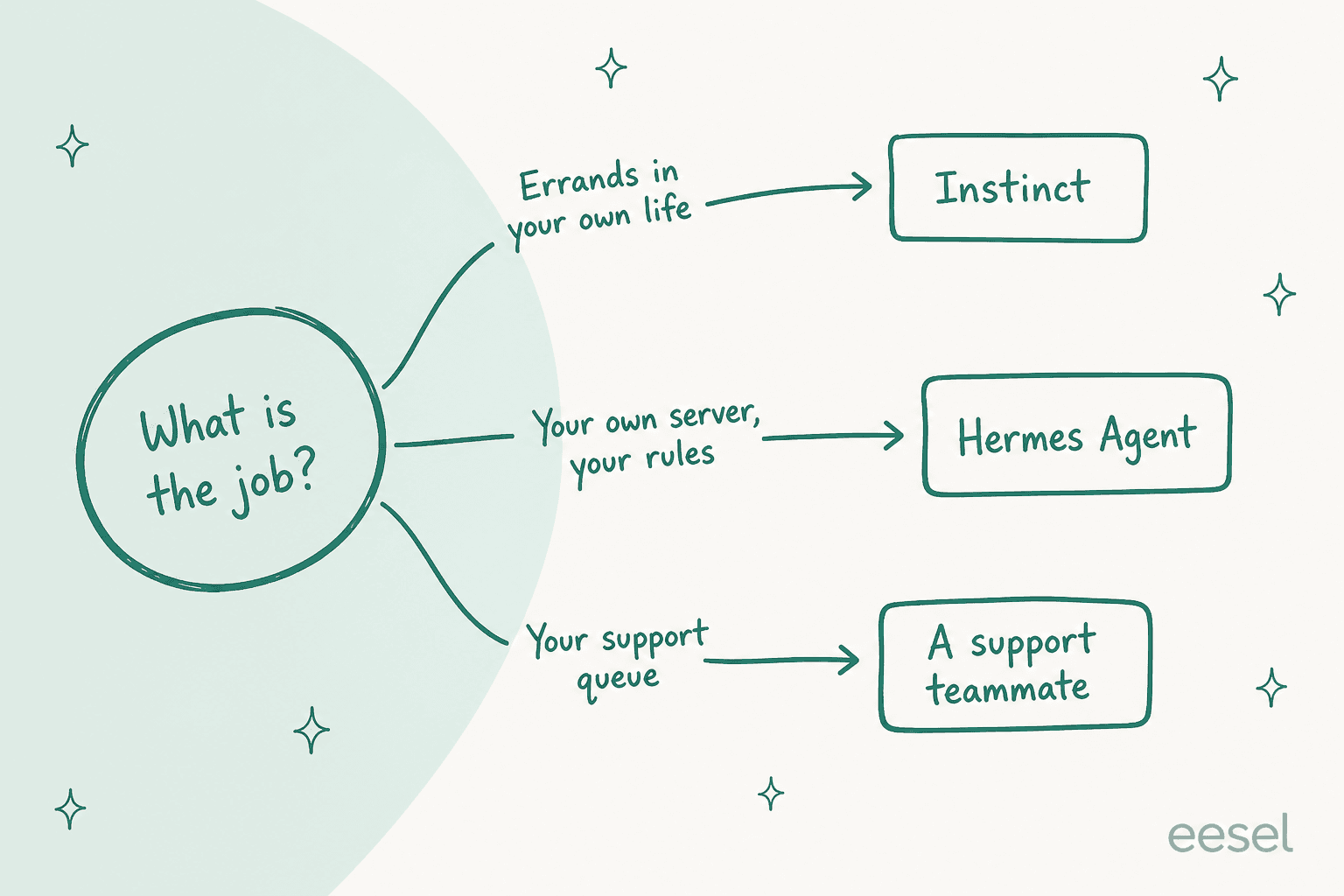
Pick Instinct if you want errands done without touching a config file: returns, bookings, chasing a refund, cancelling a subscription you forgot. Switch training off, set a standing rule to check with you before any purchase, and keep your work inbox out of it. You'll need an invite.
Pick Hermes Agent if you're comfortable in a terminal and want an agent you fully own: morning briefings, server checks, research jobs, a Telegram bot wired to your own tools. Start with approvals.mode: manual, a strict allowlist and the Docker backend, then loosen once you trust it. If you don't want to babysit a box, Hermes Cloud is the middle ground.
Look elsewhere if neither trade appeals. OpenClaw is the other big self-hosted option, while Meta Muse sits closer to Instinct. My comparison of Instinct AI vs Grok Bot covers the work-tools angle.
The Instinct AI alternatives and Hermes Agent alternatives roundups go wider, and the list of best AI agents maps the whole field.
Where neither fits: your customer support queue
Both agents get pitched for support at some point. Hermes's docs even mention "a customer-support bot" as something you might package and share (Hermes docs). I'd hold off, for three reasons that come straight out of this comparison.
- Instinct isn't allowed to. Its terms grant use "for your personal use only" (Instinct Terms). If anything, Instinct turns up on the other side of your queue, writing in on a customer's behalf. My guide to Instinct AI for customer support covers handling those tickets.
- Hermes is built for one trusted operator. Its gateway denies strangers by default, its admin and user split "gates slash commands" only, and memory is one file pair per profile (Hermes docs). Its full docs have no Zendesk, Freshdesk or Gorgias connector. I went through those gaps in Hermes Agent for customer support and Hermes Agent for Freshdesk.
- Neither can rehearse. A support agent should be tested on what customers asked last month before it answers anyone new. Neither tool has a dry run over past tickets.
That last point is the one I hear most on sales calls. A CX lead at a DTC brand handling 7,000 tickets a month put it plainly: "I cannot go and check all my 7,000 tickets to see if the AI actually made a good answer... I need an AI who is only handling the tickets that it's confident to handle." And the DIY urge Hermes appeals to is real too. One mid-market customer who left said they'd "just build our own, which is so possible now with AI," then admitted they'd have stayed if support had been faster. Building is possible. Owning the upkeep is the part that bites.
This is the gap eesel was built for. eesel is an AI teammate platform where you hire ready-to-work teammates for specific jobs, and the AI helpdesk teammate plugs into Zendesk, Freshdesk, Gorgias and other helpdesks in minutes, with no server to run. It learns from your help center and your team's past replies, then runs against your historical tickets so you see how it would have answered before it touches a live one.
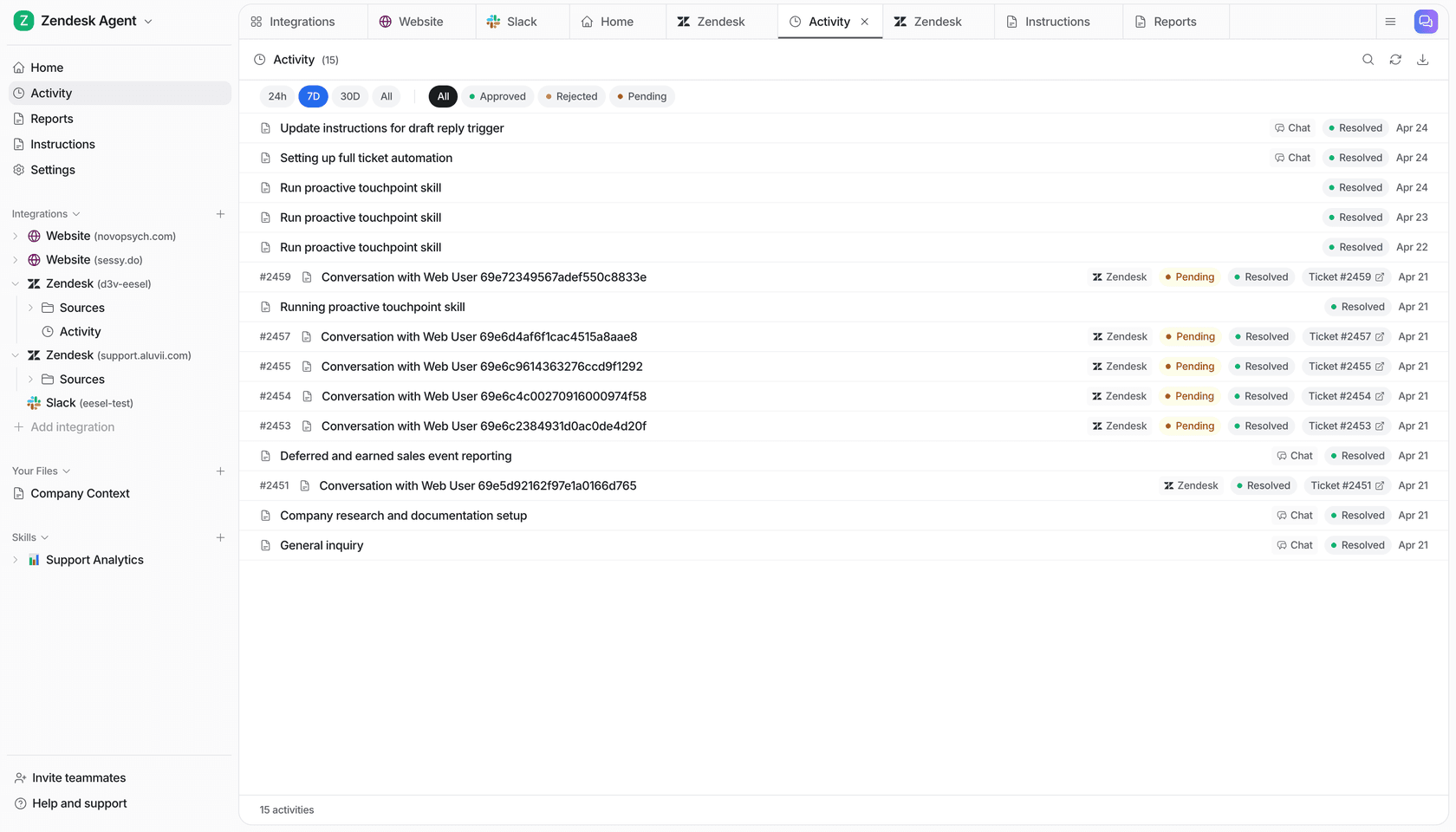
If you like Hermes because you live in a terminal, the eesel CLI gives you the same feel without the hosting. It drives the same eesel teammate and workspace you see in the dashboard. eesel approvals list shows actions waiting on a human, eesel activity lists what the agent did and lets you open any run, and every write command takes --dry-run, which prints the exact call without sending it. Scripts can automate it, and coding agents like Claude Code, Codex or Cursor can drive it the way a person would. You get the scriptable control Hermes users want, on a teammate that already knows how a helpdesk works. My roundup of customer service AI agents covers the wider field.
Try eesel
Instinct is a sharp errand runner for your own life, and Hermes is a capable agent for people who want to own every piece. If what you really want to hand off is the support queue, eesel's AI helpdesk teammate joins your helpdesk in minutes, answers from your docs and past tickets, and hands anything unusual to a person. Run it on last month's tickets first and check every answer before it goes live. There's a free plan to start. Try eesel.
Frequently Asked Questions
What is the difference between Instinct AI and Hermes Agent?
Is Instinct AI or Hermes Agent cheaper?
Is Hermes Agent safer than Instinct AI?
Can Hermes Agent replace Instinct AI?
Can I use Instinct AI or Hermes Agent for work?
Can Instinct AI or Hermes Agent run a customer support queue?
What are the alternatives to Instinct AI and Hermes Agent?


Article by
Rama Adi
Rama is a software engineer at eesel AI with two years of experience writing about B2B SaaS, AI tools, and customer support technology. Based in Bali, Indonesia, he brings a developer's perspective to product comparisons — cutting through marketing copy to what the integrations and APIs actually do.