

How much does Instinct AI cost?
Nothing, if you can get an invite. There is no pricing page on instinct.com, and no FAQ page either: instinct.com/faq returns "This page could not be found." Every public page I checked on September 29 is a short homepage, a sign-in screen, a privacy policy and the terms.
I build integrations and APIs at eesel, the plumbing that lets an agent actually do things inside someone else's software. So when I read agent pricing, I am reading it like a cost sheet, every task an agent runs is burning compute and someone pays for it. On a free product the question is not "how much," it's more "who pays, and when does that change."
That second part matters more than people think. A budget-conscious buyer at a B2B hardware company told eesel's sales team that a previous vendor's price had "more than doubled," and his first ask was a contractual price lock. People remember a price change much longer than the price itself, in my experience.
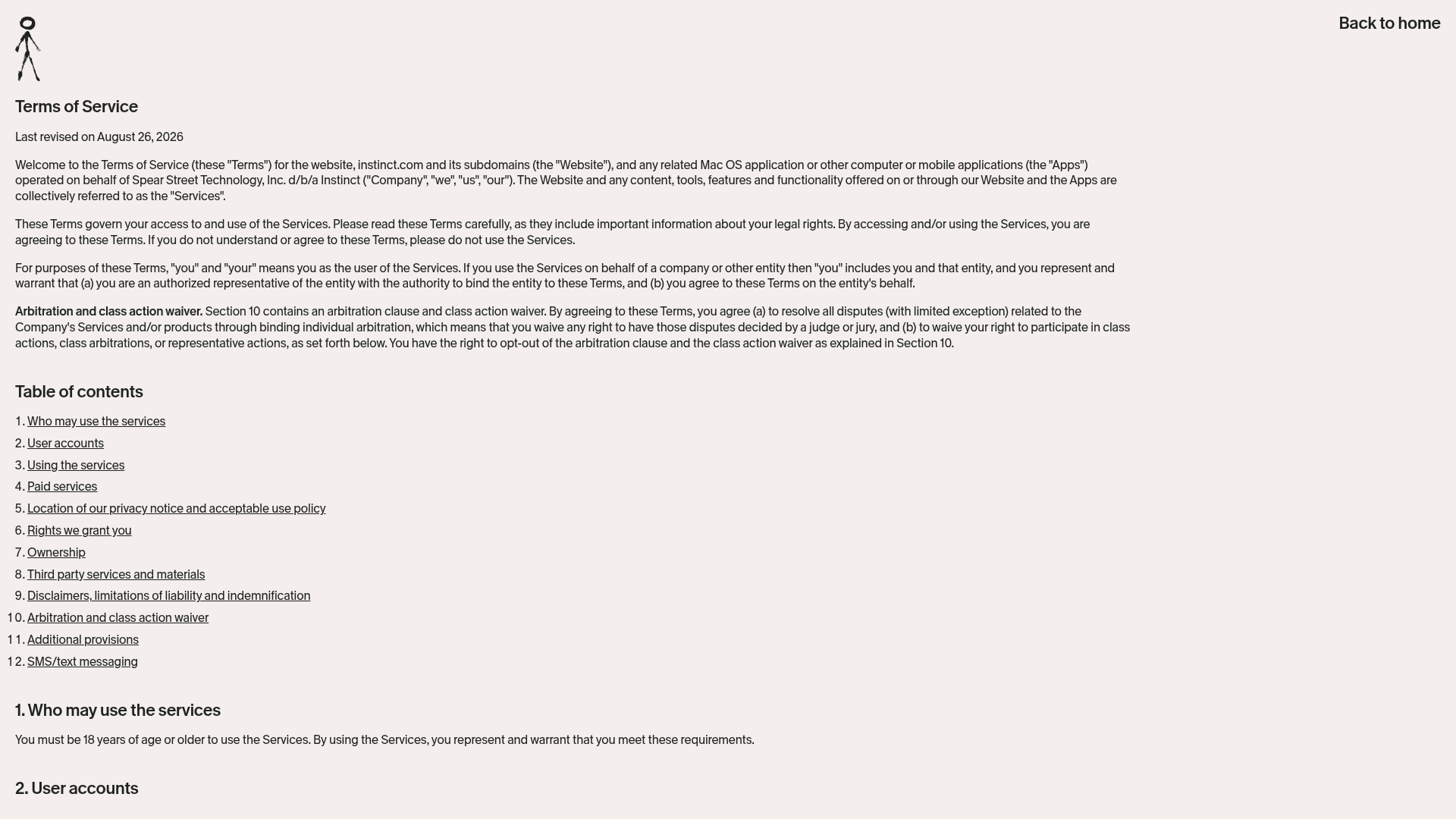
Instinct's terms give you the opposite of a price lock. Here is the whole of section 4, "Paid services," boiled down:
| What section 4 says | What it means for you |
|---|---|
| "You may be required to pay us fees to access or use certain features" | Paid features can arrive later, with no named tier today |
| "The Company may, at any time, revise or change the pricing" | No price is guaranteed, including today's $0 |
| Fees are charged "in U.S. Dollars" to your card or other payment method | A paid tier would bill you directly, not through a store |
| "All payments are non-refundable," except where the law requires | If you pay and it stops fitting, you don't get it back |
The founder framed the invite gate around capacity, not price. At launch on August 26, Noah Shinn said Instinct is "available in an invite-only beta program while we're actively bringing up more compute." Four days later he posted about slower responses from "exploding usage." So this is a product where the cost problem is compute, and the price is still a blank.
If you are new to Instinct itself, the Instinct AI explainer covers what it does and how to set it up, and the Instinct AI review covers whether it is good. This post is only about money.
What you actually pay when the price is $0
The sticker says $0. What changes hands is bigger, and most of it flows from you, not into Instinct.
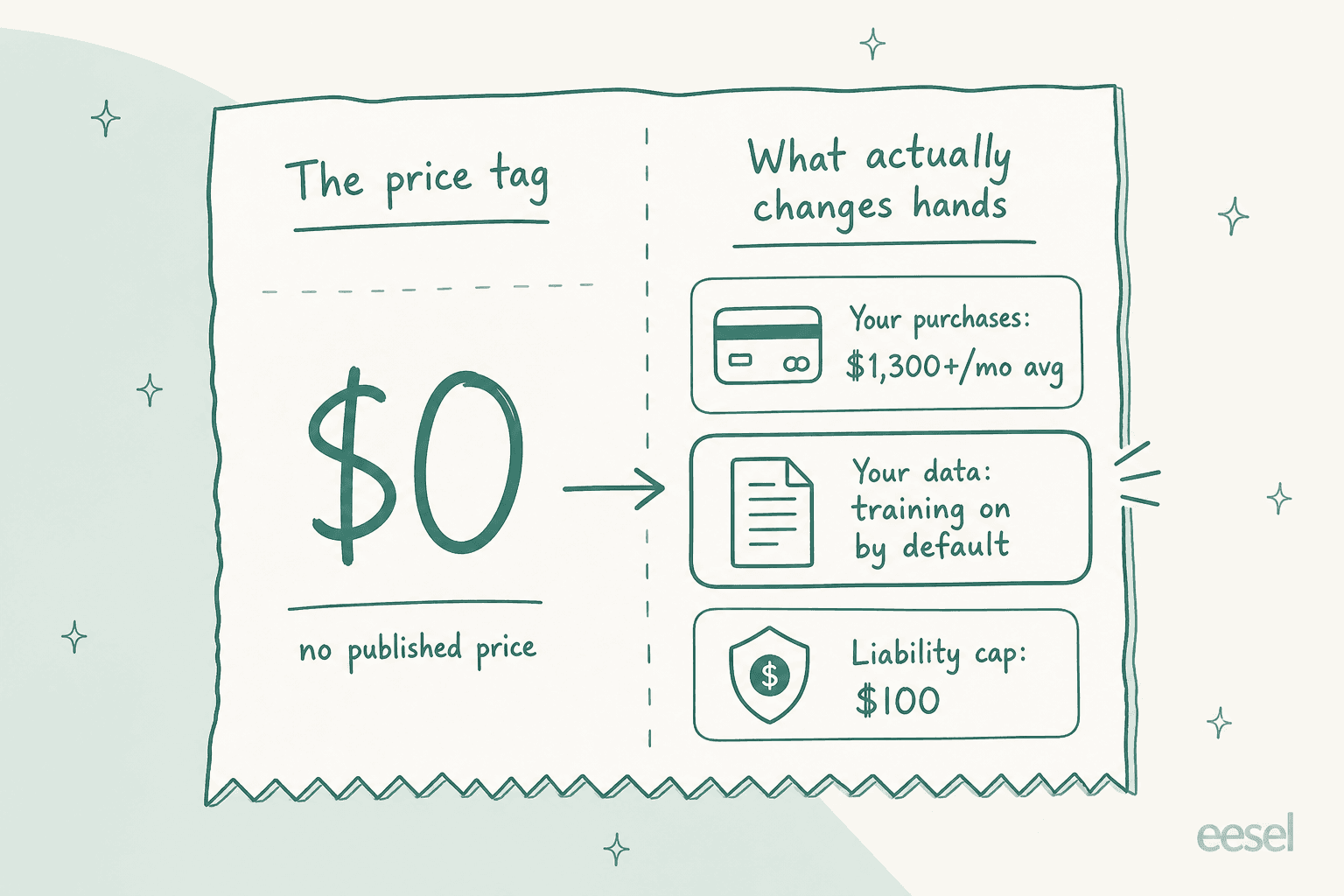
Your purchases. Instinct doesn't charge you, but it spends for you. Shinn said users who make purchases spend over $1,300 a month on average through Instinct. The terms are clear about whose money that is: "you, not us, are making such purchase," Instinct is "not the buyer or seller," and disputes are "between you and the applicable Connected Service provider." In a plain words: if it books the wrong hotel, the fight is between you and the hotel.
The safer way to pay is the Stripe Link integration: Instinct requests a one-time card "authorized for the respective amount," and you "explicitly review and approve the amount Instinct can spend." It is worth using that one before you ever hand over a raw card number.
Your data. Instinct may use what you give it to train AI models, on by default. You can opt out at app.instinct.com/settings, but the terms say the opt-out is go-forward only, models already trained on your data stay, and material "flagged for safety review" can still be used. The one exception is the Vault, which "will not use such Materials to train AI models."
Your recourse. The liability cap is "the greater of one hundred dollars ($100.00), or the amount you paid" in the past six months. At a price of $0, that is $100. Add binding JAMS arbitration with a 30-day window to opt out by email, and the real cost of a bad action sits mostly with you.
Your spot in line. The scarce thing here is the access, not the product. In the stats list Patrick O'Shaughnessy posted after interviewing Shinn, invites have sold on eBay for around $300. That is the only dollar figure anyone has attached to getting in, and it didn't go to Instinct.
None of this is hidden. It is the normal shape of an agentic AI product that acts on your accounts. It only means "free" is describing the invoice and not the trade.
Users noticed the gap too. The most direct version of it came as a one-line post on the Instinct subreddit:
"Is there a subscription to use Instinct? Question in title. Seems too resource intensive to be free?"

And from a fan who clearly doesn't want it to change:
"I certainly hope when they start to charge it's not going to be beyond my meagre little budget because I think it's the most useful app I've ever come across."
What Instinct's pricing will probably look like
I won't guess a number. Nobody outside of the company has one, and the figures you may see quoted elsewhere don't trace back to any Instinct page. What I can do is read the primary signals, and they point in one direction.
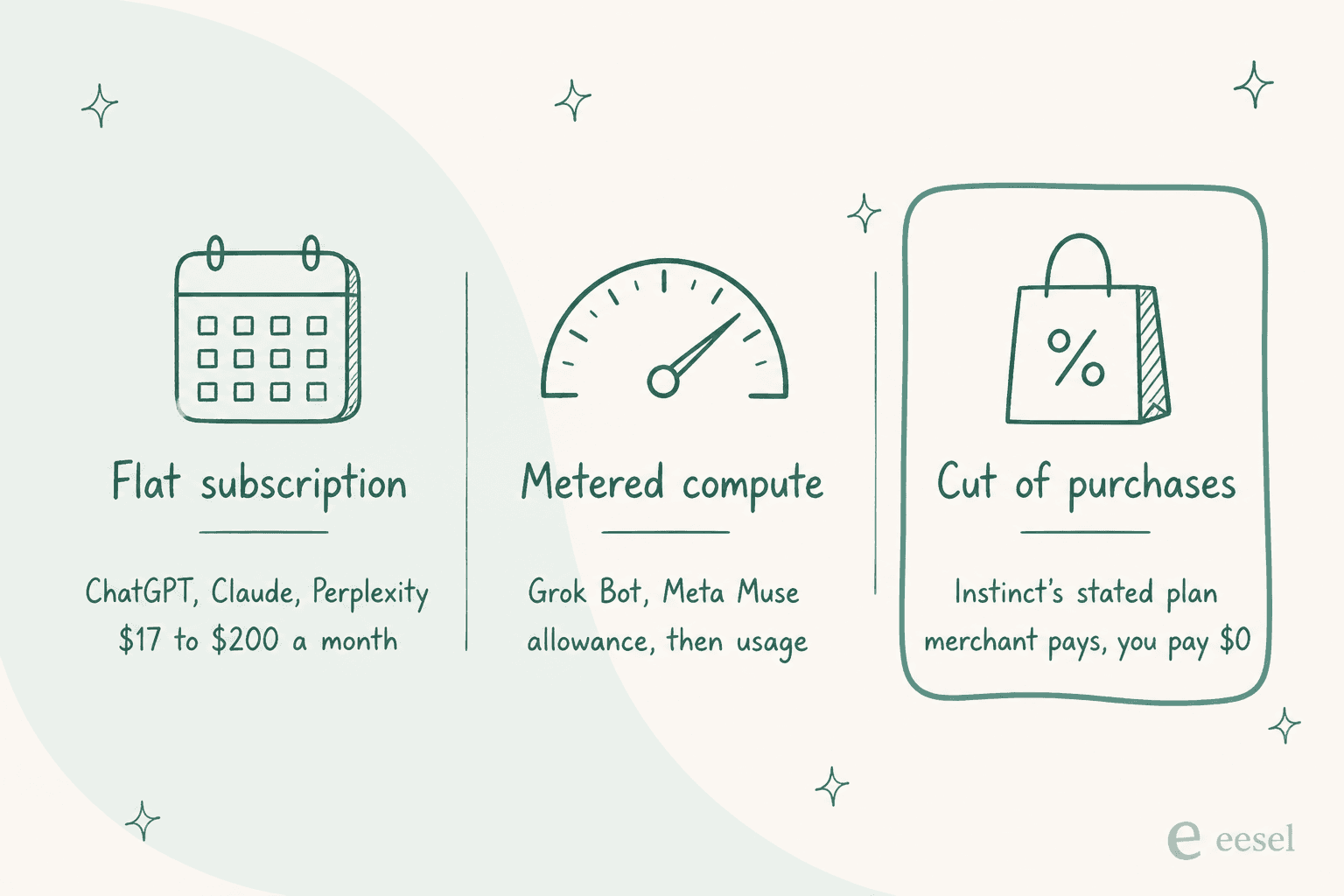
Signal 1: the founder's stated plan is a cut of purchases. The stats list from Shinn's first long-form interview, on Invest Like the Best, is specific:
"Instinct plans to take a cut of what users buy (take rates, Shopify is~2.5-3%, Amazon ~15%, Apple 30%)"
The same list says "Noah's personal goal is to keep Instinct free for everyone for life." Note the wording: a personal goal, reported by the interviewer, not a pricing commitment in the terms.
Signal 2: the plumbing is already in checkout. Instinct didn't start with a paywall. It started with payments: Stripe Link one-time cards in August, then a Shopify partnership on September 28 that lets it search Shopify's merchant network and set up a Shop Pay checkout. Shinn's own figure in that post: 35% of users use Instinct for personal shopping. Patrick's list adds that 50% of Instinct's transaction volume is travel. A take rate is living exactly in there.
Signal 3: compute is the cost it has to cover. The same interview list says compute demand "is doubling roughly every week," "buying compute at the last minute costs 3 to 4x more," and Shinn spends about 40% of his time on compute. A free product with a cost curve like this has to charge users or charge merchants, or else meter the heavy use. The merchant option is the one on the table right now, the others stay possible.
So how much could a take rate earn from one user? More than you would guess. Pick a monthly spend below. The rates are the benchmarks named in the interview, not Instinct's price, and under this model the fee comes out of the merchant's side of the sale.
How much do you expect to buy through a personal agent each month?
| Take rate | Monthly cut | Roughly the price of |
|---|---|---|
| Shopify-like, 3% | $6 | Less than ChatGPT Go at $8 |
| Amazon-like, 15% | $30 | SuperGrok at $30 |
| Apple-like, 30% | $60 | Three ChatGPT Plus plans |
| Take rate | Monthly cut | Roughly the price of |
|---|---|---|
| Shopify-like, 3% | $39 | Two ChatGPT Plus plans |
| Amazon-like, 15% | $195 | Claude Max 20x at $200 |
| Apple-like, 30% | $390 | Two Claude Max 20x plans |
| Take rate | Monthly cut | Roughly the price of |
|---|---|---|
| Shopify-like, 3% | $90 | Just under Claude Max 5x at $100 |
| Amazon-like, 15% | $450 | Two Claude Max 20x plans, plus change |
| Apple-like, 30% | $900 | More than five Perplexity Max plans |
That last note is the part worth sitting with. Under a subscription, the vendor earns the same whether you buy or not. Under a take rate, the agent earns more when you spend more. Patrick's list captures Shinn's view on this: agents could wipe out ad revenue, but "the 30% gets much bigger, because people buy more when buying takes zero effort." That is a fair bet for the company. As a user, it's one more reason for keeping the Link approval step on every purchase.
Two more things could still change the picture. The terms leave room for paid features, and a take rate doesn't cover the errands that involve no purchase at all, like the subscription cancellations early users reported at launch. Meta took a hybrid route with Meta Muse: free up to a weekly allowance, subscriptions above it. I would not be surprised if Instinct adds a paid tier for heavy compute users, on top of the merchant cut.
What comparable personal agents cost
Here is what the agents people compare Instinct with charge today, checked against each vendor's own pricing page on September 29, 2026. Where a plan includes the vendor's agent, I've named the agent.
| Agent | Free option | Entry paid plan | Top individual plan | How usage is billed | Source |
|---|---|---|---|---|---|
| Instinct | Yes, invite-only beta | None published | None published | Stated plan: a cut of purchases | Terms |
| ChatGPT Work | Limited, desktop only | Go $8/mo, Plus $20/mo | Pro from $100/mo | Flat subscription, limits apply | ChatGPT pricing |
| Claude, with Claude in Chrome | Free plan, no Chrome | Pro $20/mo, or $17/mo billed annually | Max 5x $100/mo, Max 20x $200/mo | Flat subscription, usage limits | Max plan |
| Perplexity Computer | Not listed | Pro $17/mo billed annually | Max $167/mo billed annually | Subscription plus monthly credits | Perplexity Max |
| Grok Bot | No | Cursor Pro $20/mo | SuperGrok $30/mo and up | Weekly allowance, then token cost | Grok Bot |
| Meta Muse | Up to 100M tokens a week | Not published | Not published | Free allowance, then subscription | Launch post |
A few details the table can't hold:
- ChatGPT's $200 tier is closed to new buyers. OpenAI's help center says that as of September 10, 2026, it is pausing new sign-ups and upgrades to Pro $200, while Pro $100 is unaffected. Go "may include ads." The ChatGPT pricing guide has the full plan breakdown.
- Claude Pro already includes an agent. The Claude Pro card lists "Hand off and schedule tasks" and "Claude in Chrome and Microsoft 365." The Claude Cowork pricing guide covers its desktop agent.
- Perplexity's Max plan is credit-based. It lists "10,000 monthly credits" and "Maximum Computer usage," on top of a limited-time credit bonus. The Perplexity pricing guide has every tier.
- Grok Bot has no spend ceiling on the page. Its FAQ says subscriptions come with weekly usage included, "with additional usage billed based on token cost." The Grok Bot pricing guide goes deeper.
- Meta Muse leaves paid tiers unnamed. Zuckerberg's post says free up to 100M tokens a week, with "subscription plans for those use who use even more compute." Details in Meta Muse pricing.
The pattern here: every rival shows a number, and every rival is metering usage somewhere. Instinct is the only one in the set with neither.
Outside the table, self-hosted OpenClaw swaps a subscription for your own hosting bill, Manus runs on credits, and the Hermes Agent review covers the open-source route.
For a wider view, the best AI agents roundup covers the field. The AI personal assistant guide explains the category, and the Grok Bot alternatives list compares the closest rivals.
Is free Instinct a good deal?
For personal errands, yes, with two conditions attached. The price can't get lower than $0, and the things it does well, like chasing a refund or rebooking a flight, often pay for the time you would have spent. The conditions are the ones from the ledger above: opt out of training on day one, and pay through Link cards so each purchase has an approval step.
It is a weaker deal if you are the kind of person who wants to know the cost before building a habit. Nothing in the terms protects today's price. If a paid tier arrives, the non-refundable clause applies from the first charge. So treat the free as a trial of unknown length, not as a plan.
And it isn't a deal at all for work, because there is no work plan to buy. The terms say "for your personal use only." Patrick's list mentions that "some small businesses run their entire back office on Instinct," but that is outside what the terms permit, and a business carrying a $100 liability cap on an agent that signs agreements "as if entered into directly by you" is taking on a lot for free.
Where a price tag you can read matters
This is where I come back to the cost sheet. In a support queue, the agent's spending isn't groceries. It's replies and refunds, and also promises made in your company's name, and the bill for one wrong one can be bigger than any subscription. That's the setting where the buyer who asked eesel for a price lock was right: predictable pricing is part of the product.
It is also why eesel sells AI teammates for defined jobs rather than one generalist for everything. Right now that roster is an AI helpdesk teammate and an AI blog writer, each arriving with the skills, integrations and company context for its role.
The best AI teammates roundup and the AI employee pricing guide show how that compares with generalist agents on cost.
In terms of pricing, the model matters here as much as the price. A per-resolution fee, like the outcome-based pricing many helpdesk vendors use, grows as the AI gets better and spikes in your busy season. The Zendesk AI pricing guide shows how that plays out in practice.
Try eesel
If Instinct has you thinking about hiring an agent, the place it pays at work is your customer support queue. eesel's helpdesk teammate plugs into Zendesk, Freshdesk or Gorgias, learns from your help center and past tickets, and lets you set every action to auto, ask or off. That is human-in-the-loop control per action, not a blanket appointment as your agent.
The price is on the page, which is kind of the whole point of this section:
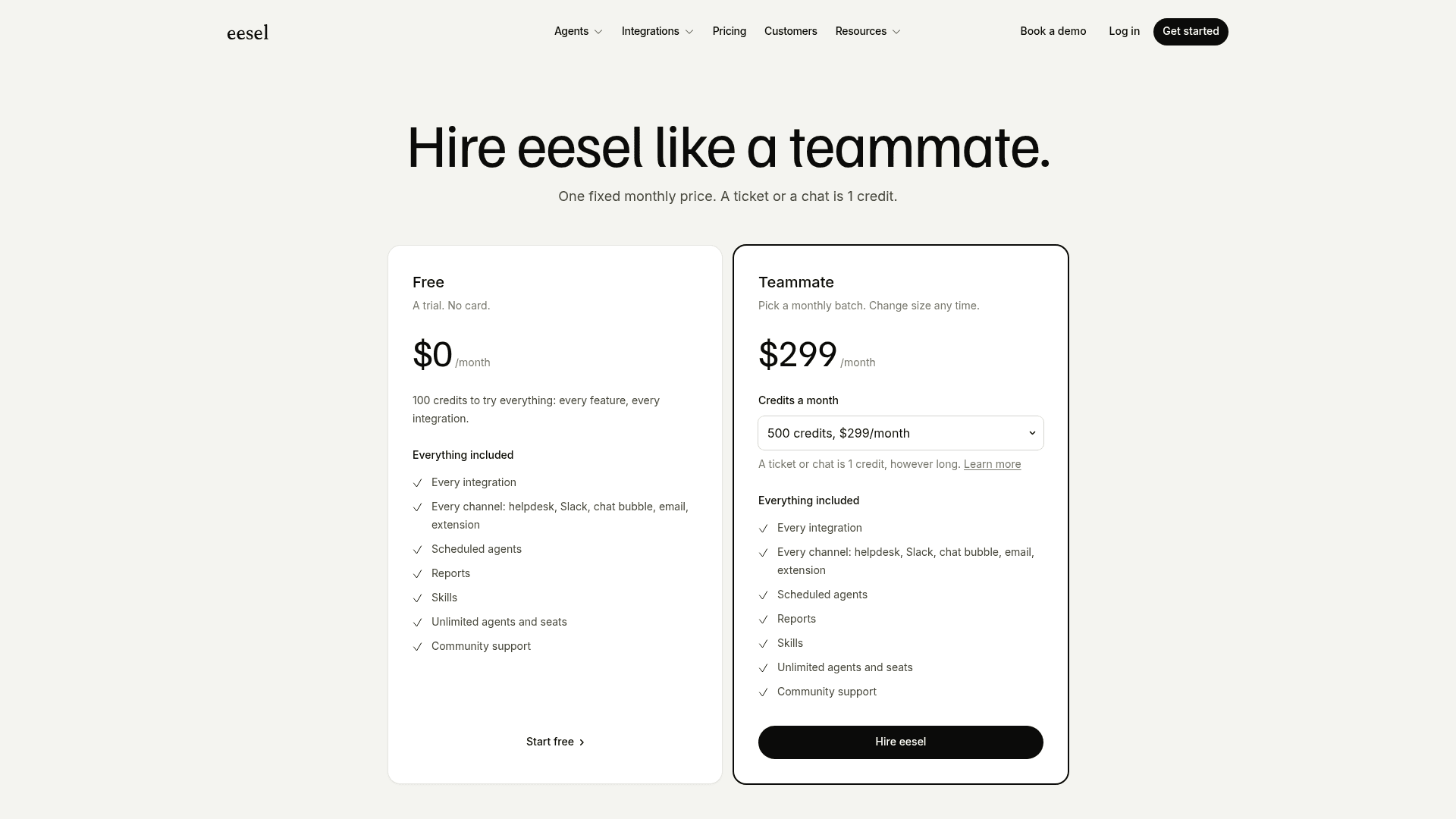
The pricing page lists a free plan with 100 credits and no card, then fixed monthly plans from $299 for 500 credits up to $1,899 for 5,000. A ticket or chat is one credit however long it runs, there is no per-seat fee, and overage is off unless you turn it on with a cap you set. Before any customer sees a reply, you can simulate the teammate on your past tickets and check its resolution rate. The Grok Bot vs eesel comparison shows how that differs from a generalist agent.
Keep Instinct for your errands while it's free. For your support queue, try eesel and know the price before you start.
Frequently Asked Questions
How much does Instinct AI cost?
Is Instinct AI free?
How does Instinct AI plan to make money?
Will Instinct AI charge a subscription later?
What do I actually pay when Instinct buys something for me?
How does Instinct AI pricing compare to ChatGPT and Claude?
Can I pay for Instinct AI for business use?


Article by
Rama Adi Nugraha
Rama is a software engineer at eesel AI with two years of experience writing about B2B SaaS, AI tools, and customer support technology. Based in Bali, Indonesia, he brings a developer's perspective to product comparisons — cutting through marketing copy to what the integrations and APIs actually do.