

What Instinct AI is
I spent two years doing SEO before I started building at eesel, and "Instinct AI" is one of those searches where the keyword tells you exactly what people are unsure about. They have seen the funding headlines and the viral screenshots, and they want to know three things: what is it, how do I get in, and is it safe to hand it my life. This post answers those in that order.
Instinct is built by Spear Street Technology, Inc., which trades as Instinct, per its terms of service. The founder is Noah Shinn, who describes himself as one of the first employees at Sierra.
Shinn is first author of the Reflexion paper on self-correcting language agents, and a co-author of τ-bench, a benchmark for agents that talk to users and call tools in real-world domains. So this is an agent built by someone whose research is about how agents slip up and recover.
The pitch is one line on the Instinct homepage: "there are no new interfaces." You text it or call it, and it is "trained to use a phone and a computer" the same way people are.
That homepage is close to the entire public website. A short block of copy, one button, a privacy policy and terms:
It says it connects to "email, messaging, screen, audio, location, and more," and it names the kind of chores it is tuned for: following up on threads you dropped, calling or texting you first, arranging a ride to the airport, booking a handyman. In Shinn's launch post, he said early users had planned road trips, bought groceries and concert tickets, and cancelled "hundreds of dollars of subscriptions." It shipped as "an invite-only beta program while we're actively bringing up more compute."
Since launch, the updates have come fast. A Stripe Link integration lets it pay with a one-time card authorized for one amount. An Instinct-to-Instinct network lets agents coordinate with each other, which Shinn says happened "300k+ times" in its first week. And on September 28, a Shopify partnership brought product search and Shop Pay checkout into the chat, with Shinn noting that 35% of users use Instinct for personal shopping.
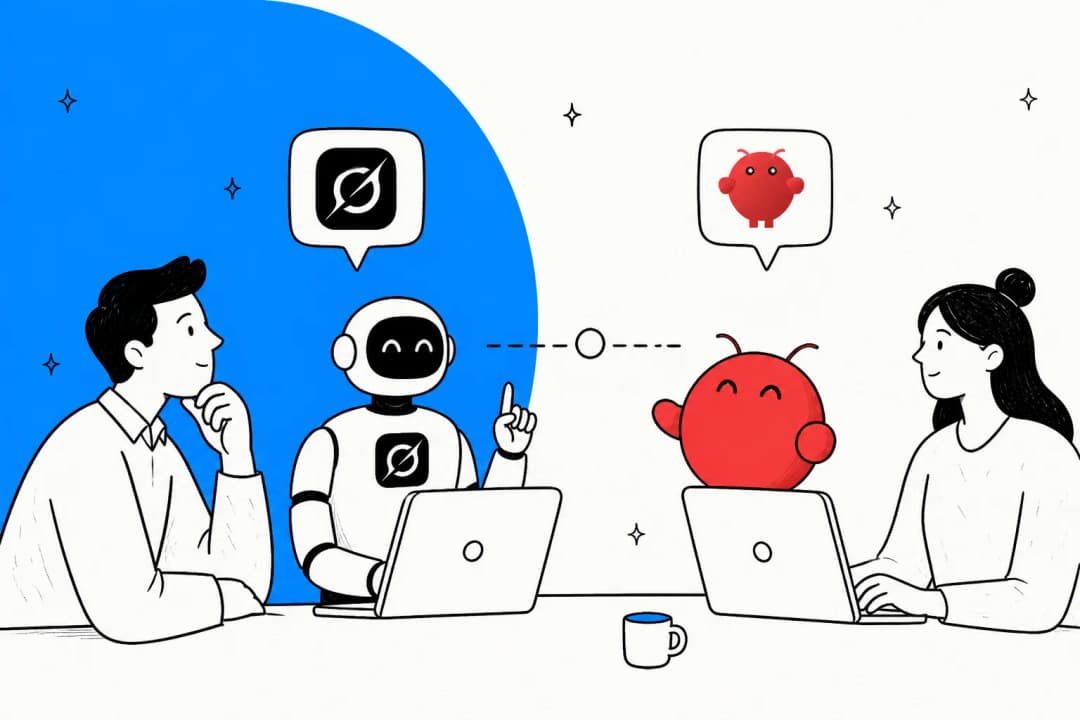
It sits in the same category as Grok Bot, Meta Muse and the open-source OpenClaw: agents that do the task instead of describing it.
If the whole category is new to you, start with what an AI agent is, then the broader guide to AI personal assistants, and come back.
How Instinct AI works
The mechanism is simple to describe and big in scope. You give it inputs, it acts on outputs, and the phone number is the only interface in between.
On the input side, the privacy policy lists what it can collect: the content of messages and emails you make accessible, documents from connected apps, audio and voice if you turn it on, "your username and password for third-party accounts so that the personal assistant can sign into these accounts on your behalf," precise location if you share it, and clickstream data including keystrokes. Google Workspace access covers Gmail, Calendar, Drive, Docs, Sheets, Slides and Tasks.
On the output side, the terms describe "Actions" it takes "on your behalf as the Services may deem are responsive to your Input." That includes texting and calling people, paying with your saved methods, signing into accounts, and accepting third-party terms for you.
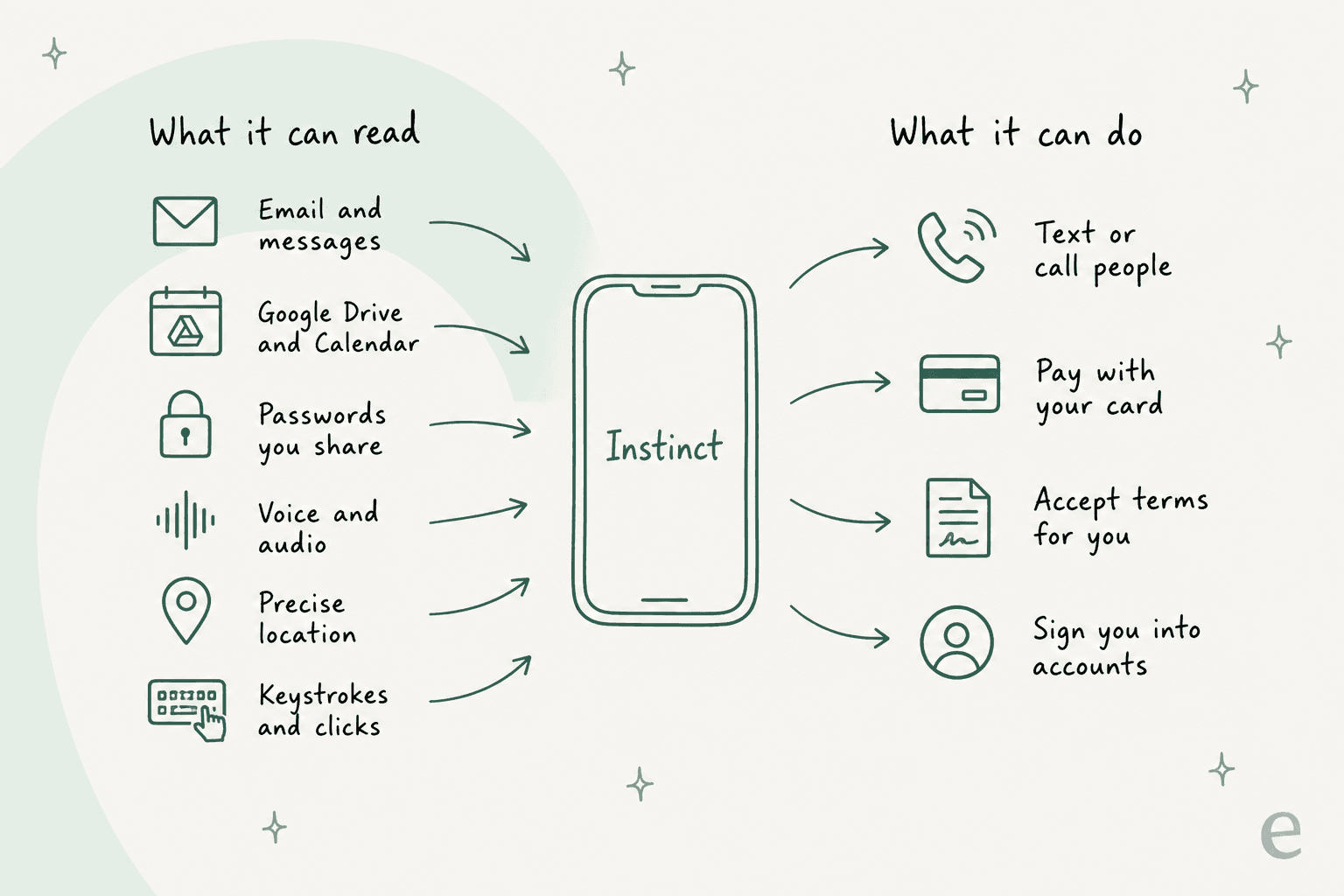
That breadth is the point. It is also why this is an agentic AI product you configure deliberately, not one you connect everything to on day one. Instinct says it has built for this: in a September 23 post, Shinn described "isolated sandboxes," "short-lived local credentials" and "identity-signed tool execution," plus a new hallucination detection layer that "scans and verifies every token." That post followed an incident he attributed to a hallucination, "the model fabricated a proper noun," and he stated it "was not a data breach."
How to get access
Getting in is short:
- Go to app.instinct.com (the "Text Instinct to get started" link on the homepage goes there).
- Enter your phone number. Instinct texts you a code. There is no email, password or social sign-in option on the page.
- By tapping "Send code," you agree to the terms of service and SMS terms, and acknowledge the privacy policy.

Three conditions from the terms apply before you start. You must be 18 or older. You may only hold one account at a time. And the SMS section covers "a welcome text when your spot becomes available, waitlist updates," so expect a queue during the beta. Current users can also share a trusted-network link, which Shinn says "will also serve as a referral link" for people not yet on Instinct.
What people have had it do
The best evidence of what Instinct AI is good at comes from people posting their own results. The pattern: long, boring, multi-step chores where persistence matters more than judgment.
| Task | Who reported it | Source |
|---|---|---|
| Cancelled 4 forgotten subscriptions, about $300 a year | KP | X |
| Sorted ~15,000 Drive files: 1,590 moves, zero deletes | KP | X |
| Got an $88 refund from its first text | Jonny Vaux | |
| Shopped for home insurance, booked a doctor's appointment | Alex Cohen | X |
| Researched ski rentals and contacted property managers for quotes | Clayton Dean | |
| Watched for Dune IMAX tickets every five minutes, with zero connectors | Mike Mallazzo |
The Drive cleanup is my favourite example because the user set the guardrail himself:
"It had ~15,000 files and 500+ GB - 8 years of my life dumped into one folder. I said: don't delete anything, ever. Then I went to bed."
The same traits show up on the other side of the ledger. Emily Lai's list of annoyances includes Instinct "sending me a captcha code to do myself," setting up accounts she then had to reset manually, and being "over confident" after stopping at "the first listicle on top of google." That is overconfidence, a close cousin of AI hallucination.
Its new dedicated email address, a step beyond most AI email assistants, has a cost too: Gergely Orosz found its emails in spam, and Farhan Thawar replied: "Biggest downside of instinct is the email spam issue."
What the terms and privacy policy actually say
You will see a lot of posts claiming Instinct's terms give it a "perpetual and irrevocable" license to everything you upload. The terms live today don't say that. The version on instinct.com/terms, last revised August 26, 2026, states that Instinct "does not claim any ownership in your Materials," and archived copies going back to September 4 carry the same text. If you are going to worry about the contract, worry about the parts that are really there.
| Clause | What it says | Where |
|---|---|---|
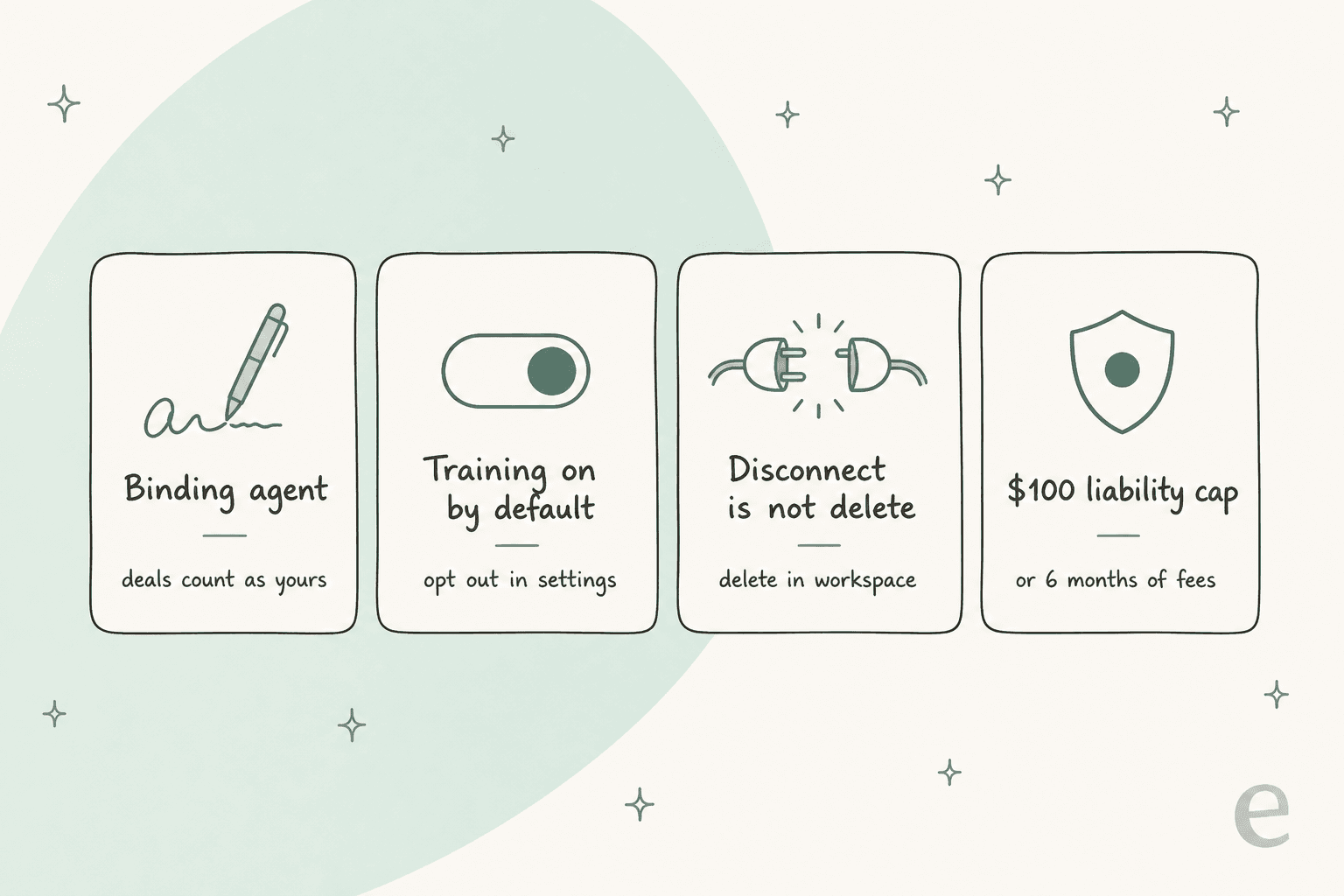
| Agent appointment | "You hereby appoint the Services as your agent to enter into agreements, commitments or transactions on your behalf," and those are "binding on you as if entered into directly by you" | Terms §3 |
| Unintended actions | "Actions may not always be reversible," "We are not responsible for any unintended Actions," and "Records of Actions ... may not always be accurate" | Terms §3 |
| Model training | On by default, opt out at app.instinct.com/settings, forward-only, with an exception for material "flagged for safety review" | Terms §3, privacy policy |
| Vault | Material in the Vault is used only to provide the service and never to train models | Terms §3 |
| Disconnecting | "Disconnecting a third-party integration does not automatically delete data collected from that integration" | Privacy policy |
| Scope | "For your personal use only" | Terms §6 |
| Liability | Capped at the greater of $100 or what you paid in the past six months | Terms §9 |
| Disputes | JAMS arbitration and class-action waiver, opt out by email within 30 days | Terms §10 |
| Pricing | "You may be required to pay us fees," pricing can change "at any time," payments are non-refundable | Terms §4 |
Two gaps are worth knowing. The privacy policy names no AI model provider and no subprocessor list, only the category "Third-party AI model providers who help support the Services." And it has no retention period. Tomer Roizman made the same point for IT teams in a LinkedIn post: no DPA, no subprocessor list, no retention schedule, no trust page.
The agent clause is the one to sit with. Jake Finkelstein summed up the trade in one line:
"That's either a great feature or a terrifying one."

For a deeper verdict on whether the product earns that trust, see the full Instinct AI review. What follows is the practical part: how to set it up so the defaults work for you.
How to set up Instinct AI safely, in 7 steps
None of these take long. Do them in this order, ideally before you connect your first account.
1. Start with zero connectors. Mike Mallazzo signed up without connecting email, passwords or any corporate account and found "there's still a lot you can do with the tool without any connectors." Give it a week of reminders, research and ticket-watching before you give it your inbox.
2. Opt out of model training. Go to app.instinct.com/settings. Know the limits: the opt-out is forward-only, models already trained on your data stay, and safety-flagged material is still usable.
3. Decide on arbitration within 30 days. If you want to keep your right to sue or join a class action, email support@instinct.com within 30 days of signing up. After that window, JAMS arbitration applies.
4. Keep credentials in the Vault, and pay with Link. The Vault is the one place the terms promise is never used for training, and Shinn says 32% of users already share credentials through it. For purchases, the Link integration requests a one-time card "authorized for the respective amount," and you "explicitly review and approve the amount." That is a far smaller blast radius than a saved card number. Here is what the stored-card path can look like instead:
"The near miss: while I was picking a Milan hotel, it charged ~€375 on my stored card with no confirmation and no bank SMS. The booking was exactly what I would have made, but an unapproved €375 charge is a jump scare. New standing rule after that: no payment completes unless my bank texts me first."

5. Keep work accounts out. The terms limit use to "your personal use only." Brad Groux publicly asked Instinct to explain a conflict between what its agent told him and what its terms and privacy policy say. Don't rely on the agent to police its own scope.
6. Treat your inbox as an attack surface. Alex Cohen ran a phishing test: he emailed his own account from a new Gmail address with instructions for Instinct to send back a summary of every open to-do. "Instinct happily followed the instructions!" That is textbook prompt injection, and Instinct's own privacy policy warns of "third parties who may include misleading instructions intended to influence autonomous agents." If you connect email, check its actions often.
7. When you leave, delete, don't just disconnect. Indexed data survives a disconnect. Delete it at app.instinct.com/workspace, and delete your account to remove Google Workspace data.
The theme across all seven: Instinct gives you the dials, but the defaults lean toward acting. As Kanishk put it after a day of heavy use:
"if something can act as me, i need more than a chat bubble telling me it's done."
Instinct AI vs other personal agents
Instinct launched into a crowded month. Here is how it lines up against the agents people compare it to most, summarised from the deep dives linked in the last row.
| Instinct | Grok Bot | Meta Muse | Hermes Agent | |
|---|---|---|---|---|
| Maker | Spear Street Technology | xAI | Meta | Nous Research |
| Where you use it | Text messages and phone calls | Desktop and iOS apps | Muse app and WhatsApp | Self-hosted, 20+ chat channels |
| Price | Not published | Paid plans from $120/seat/month | Not published at launch | Free open-source software, you pay hosting |
| How it logs in | You share credentials, or use the Vault | You type passwords in a screen handoff | Surrogate tokens, never real credentials | You manage credentials yourself |
| Purchases | One-time Link cards | Not documented | One-time Link cards, approved every time | Whatever you wire up |
| Deep dive | Instinct review | Grok Bot review | Muse explainer | Hermes review |
Users who have tried several tend to sort them by temperament. Mike Sapiton's take on X: "Grok Bot is for 90% of people, Hermes is for 10%. Instinct is simply too scary with how assertive it is." Eric Siu uses both: Grok Bot for daily routines, Instinct "when the job needs capabilities the other agents don't have." And Anish Shivdasani called it "the best agentic tool I've used thus far," a big step up from OpenClaw's lengthy setup.
My read: Instinct's edge is assertiveness and zero setup, and its weak spot is the same thing. It keeps going where other agents stop and ask. For a refund or a subscription cancel, that persistence pays. For anything with your name on a contract, you want a stop sign. If you are still shopping the category, the roundups of the best AI agents and best AI assistants go wider, and the Grok Bot alternatives list covers the closest rivals.
Where a personal agent is the wrong tool
Everything above is about your life admin. The same question gets sharper in AI customer support and anywhere else at work, where the agent isn't signing up for tennis tournaments, it is replying to your customers.
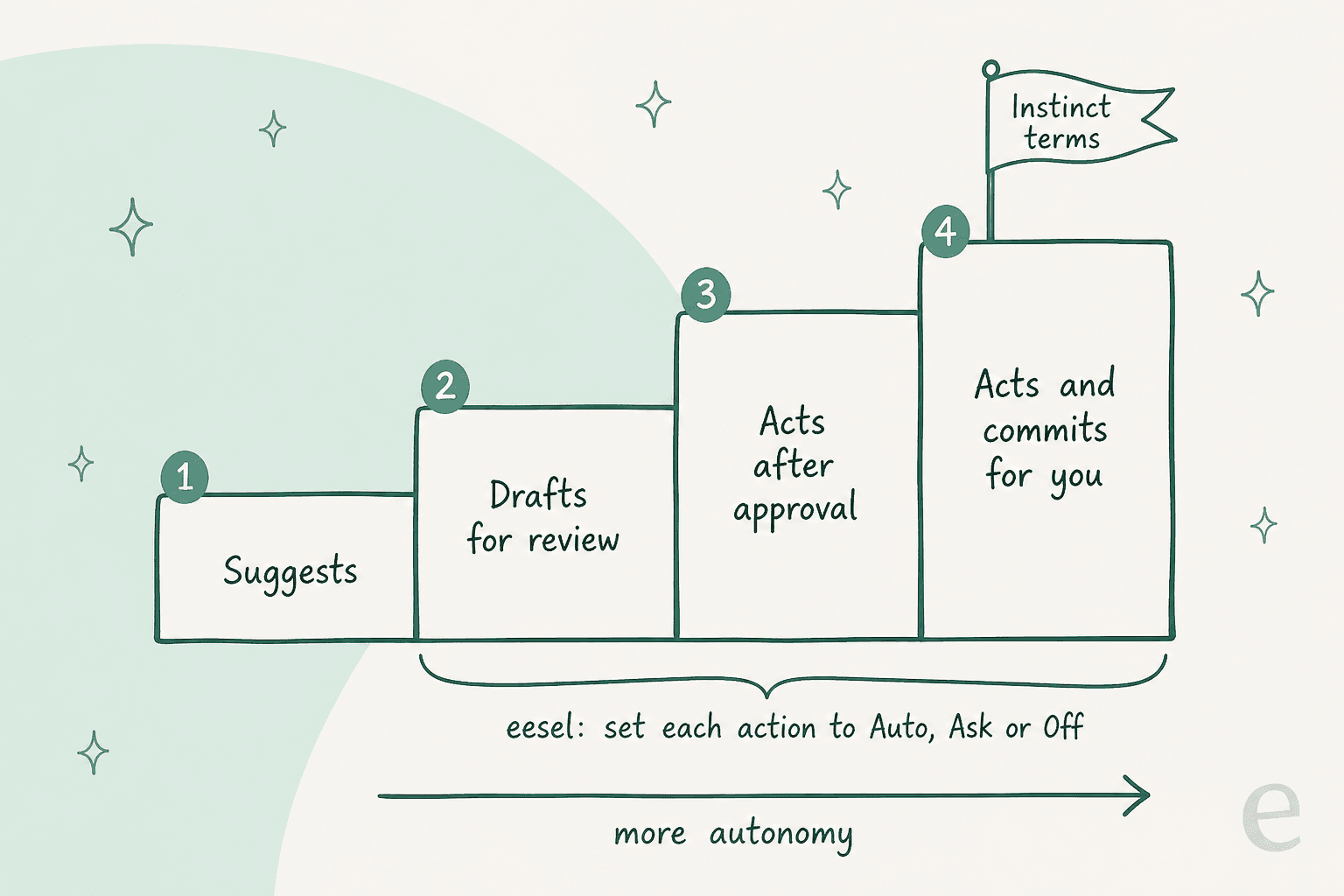
Instinct's terms put it at the top step by default: it acts and commits for you. That's a reasonable design for a personal errand runner. In a support queue it breaks quickly, because every reply is a promise made in your company's name. I've seen that failure up close at eesel, where the team has spent years putting AI on live helpdesk queues. One eCommerce support manager typed this straight into the eesel dashboard chat, to eesel's own agent:
"stop promising customer things we cant do. we cannot guarantee this customer's order to them by friday"
That is the business version of Instinct's agent clause. The fix isn't a smarter model. It's a narrower job, clearer AI guardrails, and a record of what happened.
It is also why eesel sells AI teammates for specific jobs instead of one generalist that does everything: right now an AI helpdesk teammate and an AI blog writer, each arriving with the skills and integrations for its role.
The best AI teammates roundup and the Grok Bot vs eesel comparison show how that differs from a generalist agent.
Try eesel
If the errand you really want to hand off is your support inbox, eesel's AI helpdesk teammate joins your existing Zendesk, Freshdesk or Gorgias queue in minutes and learns from your help center and past tickets.
Instead of one blanket appointment, every action it can take (reply, tag, refund, route) is set to auto, needs approval, or off, per its actions and approvals docs. That is human-in-the-loop control you set per action, not per conversation. Before it replies to anyone, it can be simulated against hundreds of your past tickets.
And the thing Kanishk asked Instinct for, seeing what the agent did, is a built-in screen:
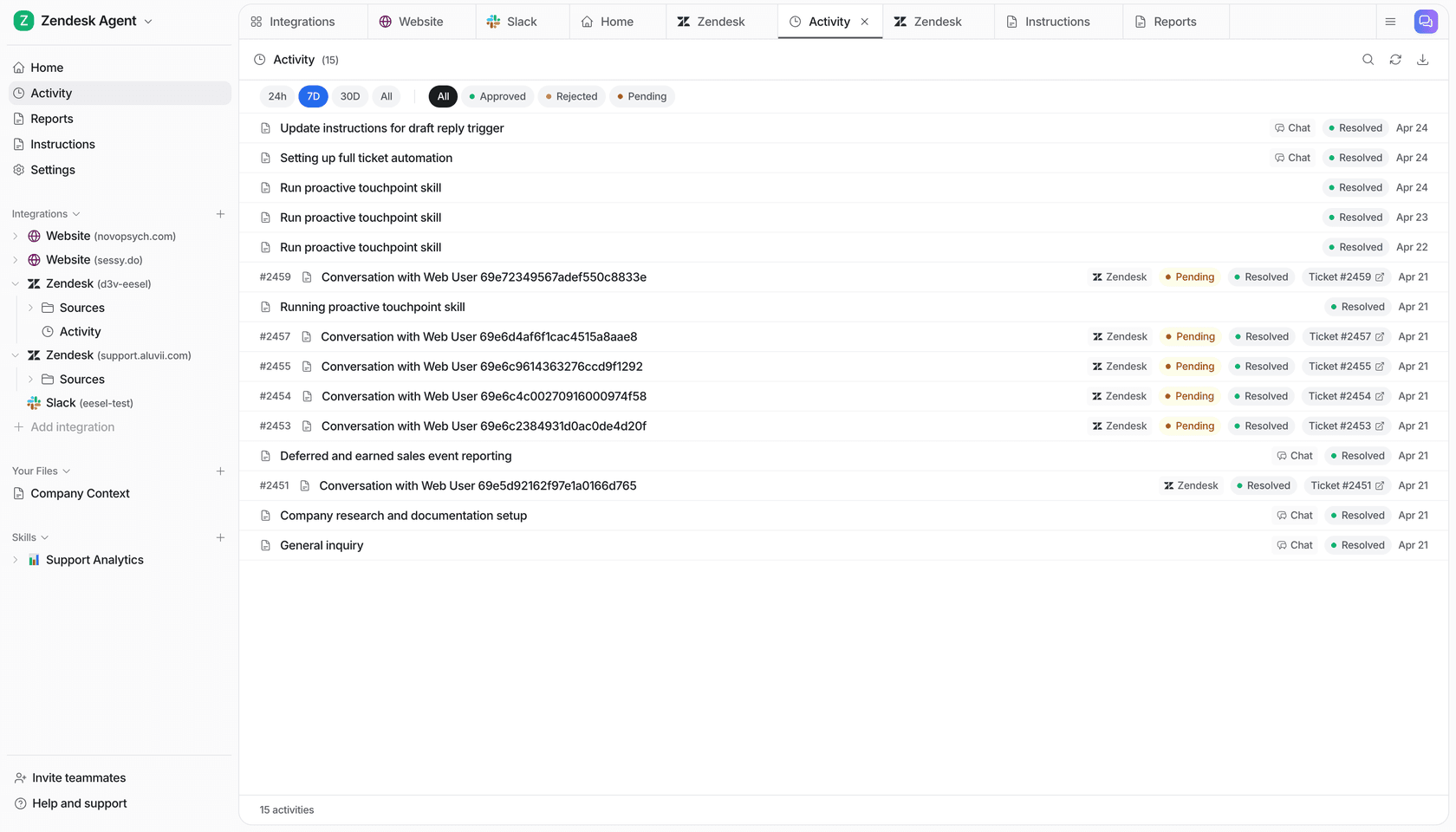
Teams who live in a terminal can drive the same teammate from the eesel CLI, covered in managing agents from a terminal: eesel approvals list shows what is waiting on a human, eesel activity reads back what it did, and --dry-run prints a write before it is sent, which is exactly the kind of check a personal agent doesn't give you.
Pricing starts with a free plan of 100 credits, one ticket or chat per credit, on the pricing page. Try eesel on your own queue and watch its first drafts before you let it send anything.
Frequently Asked Questions
What is Instinct AI?
How do I get access to Instinct AI?
Is Instinct AI free?
Is Instinct AI safe to use?
Does Instinct AI train on my data?
Can I use Instinct AI for work or customer support?
How does Instinct AI compare to Grok Bot and Meta Muse?


Article by
Kurnia Kharisma Agung Samiadjie
Kurnia is a software engineer and writer at eesel AI with two years of SEO experience, writing about AI tools, helpdesk software, and customer support. He pairs a developer's understanding of how these products are built with search-driven research into what actually ranks and resonates with the people searching for them.