
Perplexity Computer represents a significant shift in how we interact with AI. Instead of asking questions and getting answers, you describe an outcome and the system figures out how to achieve it. Launched in February 2026, this tool orchestrates multiple AI models to execute complex workflows that can run for hours or even months while you focus on other work.
For businesses exploring AI teammates, tools like eesel AI offer a different approach: purpose-built AI agents that integrate directly with your help desk to handle customer service autonomously. But Perplexity Computer takes a broader view, aiming to be a general-purpose digital worker for knowledge work across any domain.
Let's break down what it actually does, how it works, and whether it's worth the $200 monthly price tag.
What is Perplexity Computer?
Perplexity Computer is a cloud-based AI system that Perplexity describes as a "general-purpose digital worker." Despite the hardware-sounding name, there's no physical device. It's software that operates the same interfaces you do: browsers, applications, APIs, and file systems.
The product launched on February 25, 2026, with Perplexity positioning it as the next evolution beyond chat interfaces. Where traditional AI tools answer questions, Computer takes action: writing documents, building apps, conducting research, sending emails, and chaining multi-step workflows together.
Here's the short version of the difference: Perplexity's search tool gives you answers. Computer does your work.
The key constraint is access. Computer is available exclusively to Perplexity Max subscribers at $200 per month. There's no free tier, no trial, and no way to test it without committing to the full subscription. This immediately positions it as a tool for professionals and businesses rather than casual users.
How Perplexity Computer works
The technical architecture behind Computer is what sets it apart from other AI assistants. Rather than relying on a single model, it orchestrates multiple frontier AI models, routing each task to the one best suited for the job.
Multi-model orchestration explained
Perplexity Computer doesn't use one AI model. It uses 19+ of them.
The system intelligently routes tasks based on their nature:
- Claude Opus 4.6 handles core reasoning and complex problem-solving
- Gemini tackles extensive deep research tasks
- ChatGPT 5.2 manages long-context recall and broad search operations
- Grok processes lightweight tasks where speed matters
- Nano Banana generates images
- Veo 3.1 produces video content
This approach differs fundamentally from competitors like Claude Cowork, which uses only Anthropic's own models. Perplexity's bet is that no single model excels at everything, so the most capable AI system is one that can deploy the right model for each specific task.
Sub-agent architecture
When you give Computer a task, it doesn't just process your request linearly. It breaks your outcome into subtasks and creates specialized sub-agents to handle each part.
For example, if you ask it to research competitors and create a presentation, one sub-agent might handle the web research while another drafts the slides. A third might format the output while a fourth sets up delivery to your team. The coordination happens automatically.
This matters because it allows parallel execution. While one agent is waiting for data, others can be working on different parts of the project. The result is faster completion of complex, multi-step workflows.
Persistent memory and integrations
Computer maintains context across sessions. It remembers your past work, stores your preferences, and connects to your existing tools through 400+ app integrations.
Supported integrations include Gmail, Outlook, GitHub, Linear, Slack, Notion, Snowflake, Databricks, and Salesforce. This means Computer can read your emails, update your project management tools, query your databases, and post to your communication channels, all as part of a single workflow.
Everything runs in a secure, isolated cloud environment with persistent memory. Your data stays sandboxed, and the system retains context from long conversations automatically.
What you can build with Perplexity Computer
The most concrete evidence of Computer's capabilities comes from early users who have documented their experiences. One reviewer built multiple projects in a single night, including two functioning micro-applications and four comprehensive research packets.
Real use case examples
Micro-applications: Users have generated branded callout box creators, table generators, and data visualization tools. These aren't just prototypes. They're functional web apps with live previews and export capabilities.
Research packets: Computer runs seven parallel search types simultaneously: web, academic, people, image, video, shopping, and social. It reads full source pages rather than just snippets, hits scholarly databases directly, and cross-references findings to identify disagreements between sources.
Data visualizations: One documented example involved creating an interactive bubble chart of S&P 500 companies with revenue on one axis, profit on another, market cap determining bubble size, and color coding for stock performance changes.
Media creation: Users have generated animated GIFs showing Tesla's stock price over a decade, with annotations for major events fading in and out as the timeline progresses.
End-to-end projects: The system can take a concept from initial research through analysis, document creation, and delivery without manual intervention between steps.
Project execution workflow
The typical workflow follows a pattern:
- You describe the outcome you want in natural language
- Computer formulates a strategy and breaks it into subtasks
- It assigns specialized sub-agents to handle each component
- Work proceeds asynchronously, with agents operating in parallel
- You receive checkpoints to review when human input is needed
- The system delivers the finished project
Tasks can run for hours, days, or even weeks. You can also run dozens of Computers simultaneously, each working on different projects.
Practical tips for better results
Early users have found that the best results come from being specific about what you want, not how to get there. Computer is built around task decomposition, so micromanaging the steps actually reduces effectiveness.
Other tips that have emerged:
- Frame requests as clear outcomes rather than step-by-step instructions
- Provide brand guidelines or reference materials upfront
- Run multiple projects in parallel to maximize value
- Let long-running tasks work in the background while you focus elsewhere
Perplexity Computer pricing and access
The pricing structure for Computer is straightforward but significant. There's one way to access it, and it's not inexpensive.
Current availability
Computer is available exclusively through the Perplexity Max subscription. As of March 2026, there is no enterprise tier available, though Perplexity has indicated this is planned.
The Max subscription costs $200 per month when billed monthly, or $2,000 per year (effectively $167 per month) when billed annually. This is in addition to any other Perplexity subscriptions you might have.
Notably, Perplexity Pro subscribers cannot access Computer. They must upgrade to Max. Pro subscribers do get unlimited standard Perplexity searches, but Computer tasks require the higher tier.
Credit system
Beyond the subscription fee, Computer uses a credit-based system for usage:
| Component | Details |
|---|---|
| Monthly credits | 10,000 included with Max subscription |
| Early adopter bonus | 20,000 additional credits (expires after 30 days) |
| Standard searches | Unlimited, don't consume credits |
| Credit consumption | Varies by task complexity |
Source: Perplexity Help Center
You can view your credit balance at perplexity.ai/account/credits, enable auto-refill when your balance drops below 500 credits, and set spending limits to control costs. If you run out of credits, active tasks pause rather than cancel, and resume automatically when credits are available.
Value consideration
At $200 per month plus potential credit overages, Computer is positioned as a tool for professionals making what Perplexity executives have called "GDP-moving decisions." This isn't a casual productivity tool. It's priced for users who can generate significant value from autonomous research, content creation, and application development.
For context, $200 per month is roughly equivalent to hiring a part-time contractor for a few hours of work. If Computer can replace or augment significant research or development tasks, the math can work. But for occasional use, it's difficult to justify the cost.
How Perplexity Computer compares to alternatives
Computer doesn't exist in a vacuum. Several other tools offer overlapping capabilities, each with different trade-offs.
Perplexity Computer vs Claude Cowork
Claude Cowork is Anthropic's competing agentic AI product. Both systems aim to execute complex tasks autonomously, but they differ in important ways.
Model approach: Computer orchestrates 19+ models from multiple providers. Cowork uses only Anthropic's own models. This means Computer can potentially leverage the best model for each specific task, while Cowork offers consistency within a single model ecosystem.
Execution environment: Computer runs entirely in Perplexity's cloud. Cowork runs on your local machine. This has implications for security, data privacy, and what each system can access. Cowork can interact with your local files and applications directly. Computer accesses your data through authenticated integrations.
Use case fit: Based on early user reports, Cowork appears better suited for deep document work and tasks requiring extensive context within a single domain. Computer excels at multi-step research, parallel data gathering, and building applications.
Perplexity Computer vs OpenClaw
OpenClaw (formerly ClawdBot and Moltbot) is an open-source agentic AI tool that gained significant attention with 219,000 GitHub stars. It represents a fundamentally different philosophy from Perplexity's approach.
Architecture: OpenClaw runs locally on your hardware with an open plugin ecosystem. Computer runs in Perplexity's cloud with curated integrations. Ars Technica's analogy is apt: if OpenClaw is the open web, Computer is more like Apple's App Store.
Security profile: OpenClaw's flexibility comes with risks. There have been documented incidents including unauthorized email deletion and security researchers have flagged its attack surface as "near-limitless." Computer's walled garden approach limits what it can do but also limits what can go wrong.
Target user: OpenClaw is for developers comfortable with technical setup who want maximum control. Computer is for users who want outcomes without managing infrastructure.
When to choose which
Choose Perplexity Computer if you want multi-model orchestration, don't mind the $200 monthly cost, and prefer a cloud-based solution with curated integrations.
Choose Claude Cowork if you prefer Anthropic's models specifically, need local execution for data privacy or offline work, and want deep integration with your local environment.
Choose OpenClaw if you're technically proficient, comfortable with open-source software, want maximum flexibility, and can accept the security trade-offs.
Is Perplexity Computer worth it?
Whether Computer justifies its cost depends entirely on your specific workflow and how much value you can extract from autonomous AI execution.
Who should consider it
Computer makes the most sense for:
- Knowledge workers who regularly conduct deep research across multiple sources and formats
- Builders who want to prototype applications and tools without traditional development overhead
- Teams that need to execute multiple projects in parallel and can leverage the ability to run dozens of Computers simultaneously
- Users who value breadth over depth and prefer a system that can handle diverse tasks adequately rather than excelling at a narrow set
Limitations to know
Before subscribing, consider these constraints:
- Price barrier: $200 per month is substantial for individual users
- Platform limitations: Web desktop only. No mobile app, no offline access
- Maturity questions: Perplexity canceled a press demo hours before it was scheduled due to product flaws discovered at the last minute
- Output watermarks: Generated applications include a "Created with Perplexity Computer" watermark, similar to other AI builders
- Limited real-world testing: As a February 2026 launch, there's minimal long-term user feedback
The bottom line
Perplexity Computer represents genuine innovation in multi-model orchestration. The ability to route tasks to specialized AI models and coordinate them into coherent workflows is technically impressive and practically useful.
However, it's not a replacement for specialized tools. It's a powerful generalist. If you need deep expertise in a specific domain, dedicated tools will likely outperform Computer. But if you need to execute diverse knowledge work tasks across research, content creation, and light development, Computer's breadth is hard to match.
The value proposition comes down to utilization. At $200 per month, you need to be using it regularly for substantial tasks to justify the cost. For users who can leverage parallel execution and long-running background tasks, it can be a genuine force multiplier. For occasional use, it's difficult to recommend.
Getting started with AI-powered workflows
Perplexity Computer represents a broader shift in AI tools: the move from systems that generate content to systems that actually do work. This distinction matters. A tool that writes a draft still requires you to review, edit, and publish. A tool that executes an entire workflow from research to delivery changes how you structure your workday.
For businesses looking to implement AI teammates for specific functions, specialized tools often make more sense than general-purpose systems. At eesel AI, we take a different approach: purpose-built AI agents that connect directly to your help desk, learn your business from past tickets and documentation, and handle customer service autonomously or draft replies for human review.
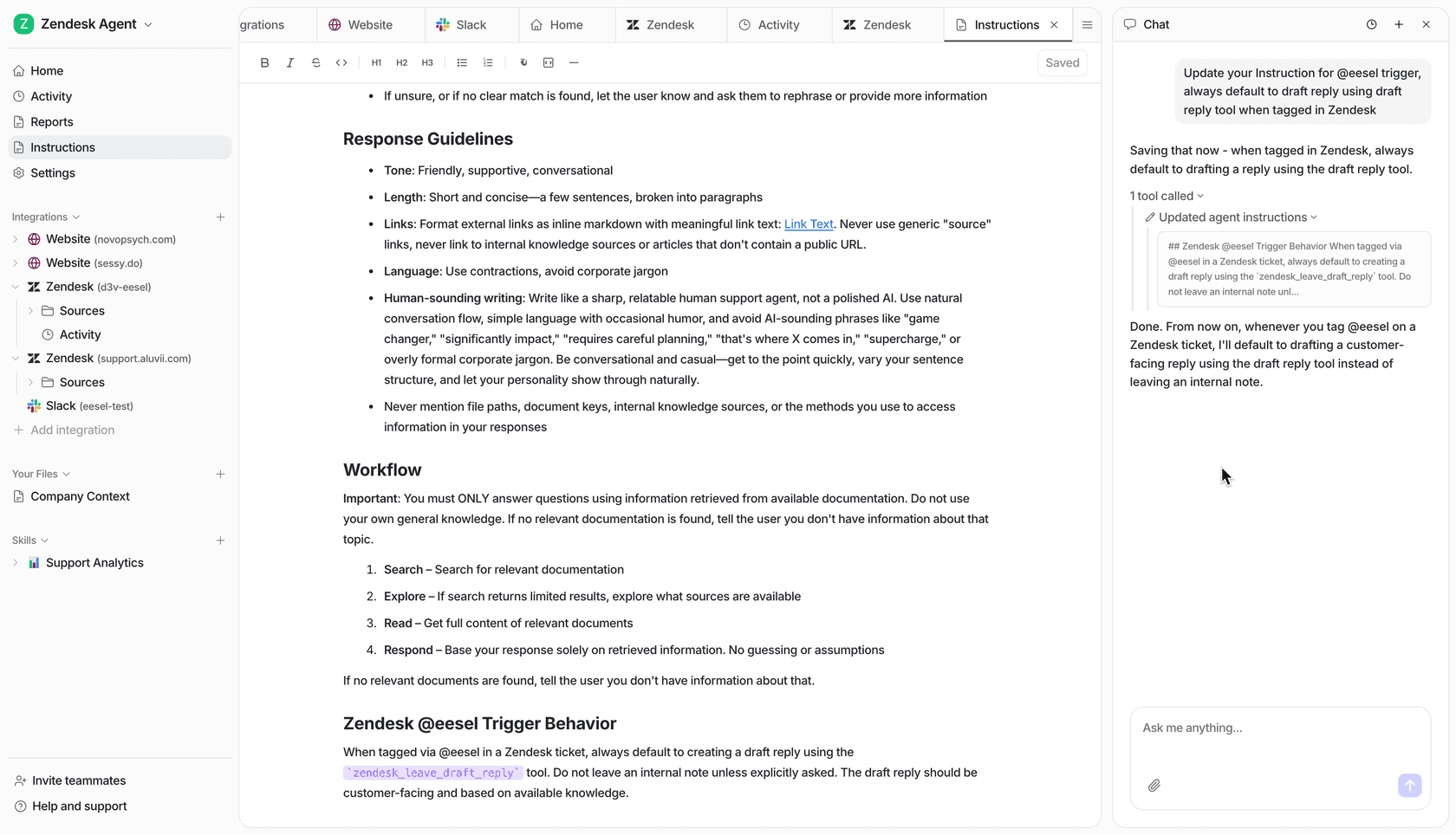
The best AI tool isn't necessarily the most capable one. It's the one that fits your actual workflow. Perplexity Computer excels at general-purpose knowledge work across domains. Tools like eesel AI excel at specific business functions with deep integration into your existing systems.
The key is matching the tool to the job. For research, content creation, and application prototyping across diverse topics, Perplexity Computer is worth evaluating. For customer service, sales, and internal knowledge management, specialized AI teammates will likely deliver better results with less overhead.