
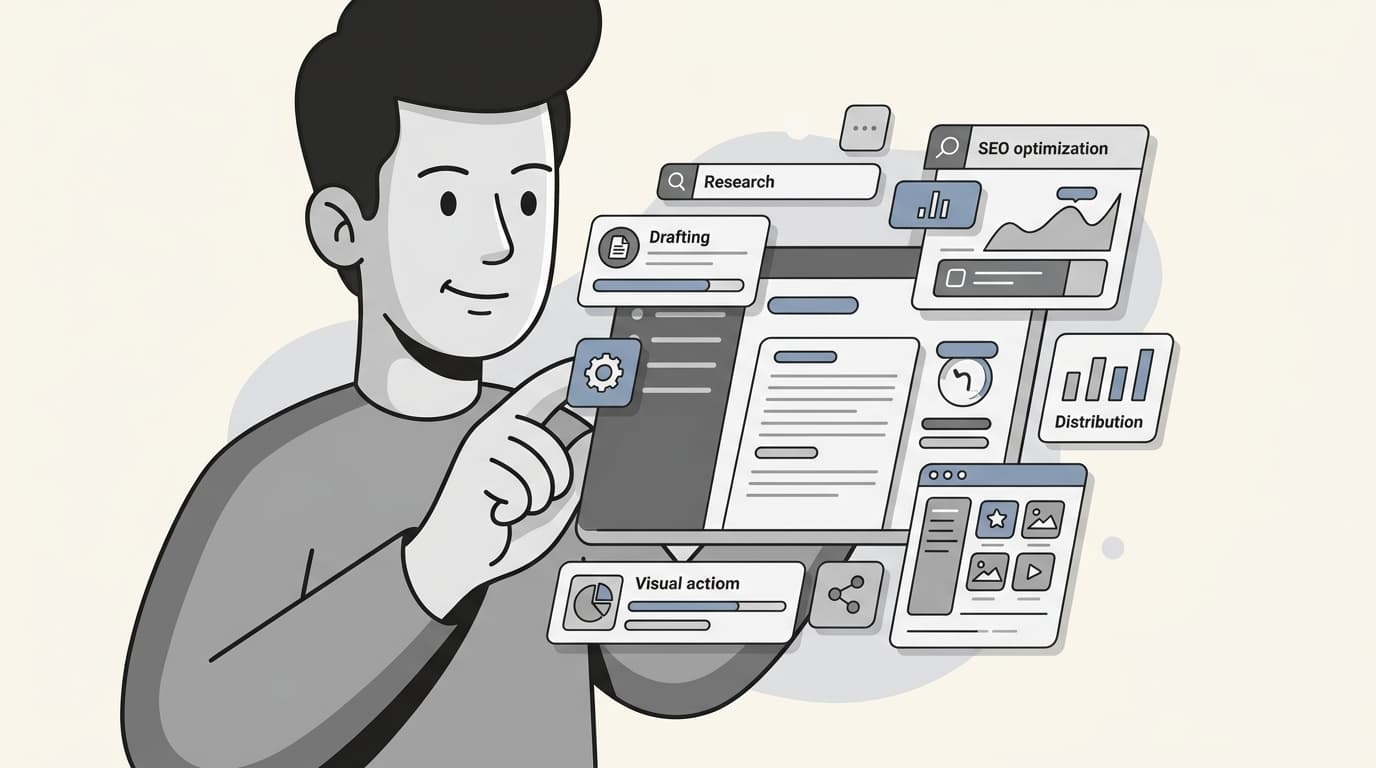
Most content agencies are drowning in AI slop because they rely on a single magic chatbot to do everything. We tested 17 specialized tools through a full agency lifecycle, research, drafting, and distribution, and found the seven that actually hold up. The rest, and the filter we used to pick the winners, below.
The shift in 2026 has been decisive. Agencies that survived the initial AI wave have moved away from all in one platforms that do everything passably and toward a specialized dream team of tools that do one thing exceptionally well. This "specialized stack" approach is the only way to maintain the quality and brand voice governance that clients now demand.
The problem with generic AI content, or "AI slop," is that it fails to rank in modern search engines and, more importantly, fails to convert. Search engines and Answer Engines alike have become experts at filtering out surface level fluff. To scale without increasing headcount, agencies need a workflow that prioritizes subject matter expert (SME) insights and automation orchestration. Here is how we use AI for SEO content writing to ensure every piece we publish actually moves the needle.
Why content agencies need a specialized AI stack in 2026
Content agencies in 2026 are no longer competing on volume. The barrier to entry for "okay" content has dropped to zero, which has ironically made high quality content more valuable than ever. Most agencies are ditching all in one platforms because generic models often struggle with the specific nuances of a client's brand voice.
The shift toward a dream team stack allows agencies to pick the best model for each specific task. You might use one tool for data backed on page optimization and another for capturing the raw human insights that prevent AI slop. As noted by Leaps, the key challenge is scaling without sacrificing the human point of view that makes content worth reading.
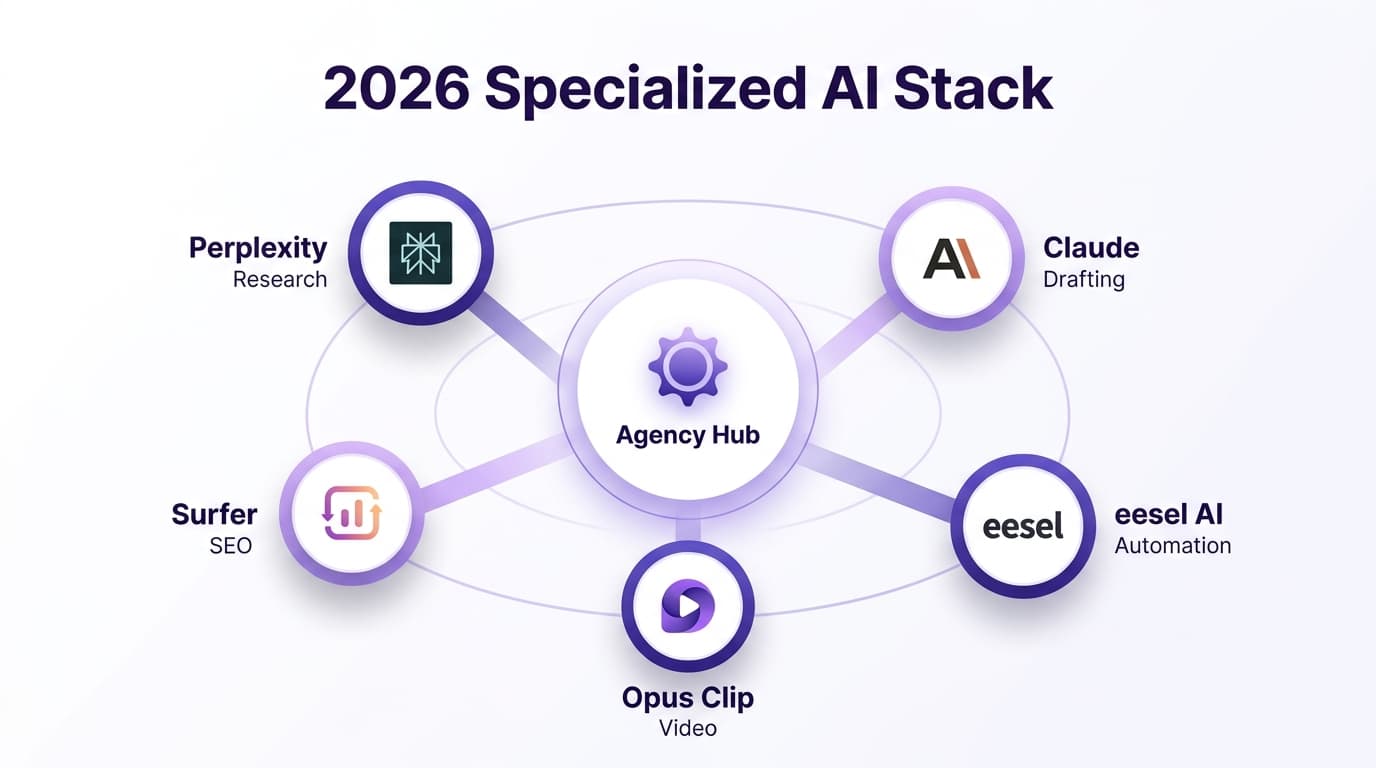
Efficiency is the other side of the coin. Agencies are using automation to handle the "connective tissue" between research, writing, and publishing. This allows teams to 10x their growth by focusing on strategy and expert editing rather than manual formatting and data entry.
Our criteria for selecting the best AI agency tools
To find the winners for this list, we evaluated dozens of platforms against a strict set of AI SEO standards. Here are the four criteria that mattered most:
- Brand voice governance: The tool must have a robust way to maintain consistency across multiple clients, not just a single "persona" setting.
- SME integration: We looked for features that make it easy to capture human insights from subject matter experts to ground AI drafts in reality.
- Automation potential: The platform should connect easily to other tools in the agency stack, acting as a productive teammate rather than an isolated silo.
- Measurability: It must be possible to track visibility not just in Google, but in the Answer Engines like Perplexity and Gemini that now drive significant traffic.
Comparison of the top 7 AI tools for content agencies
| Tool | Primary Use Case | Standout Feature | Starting Price |
|---|---|---|---|
| eesel AI | AI Content Teammate | SME Interview Writer | $0 (100 free credits) |
| Claude | Long-form Drafting | 200k Context Window | $0 (Free tier) |
| Surfer SEO | SEO Optimization | Real-time Content Score | $49/mo (billed annually) |
| Opus Clip | Video Repurposing | Virality Score™ | $0 (Free tier) |
| Gumloop | Workflow Automation | Agentic Node Builder | $0 (Free tier) |
| Notion AI | Knowledge Management | Workspace Q&A | $20/user/mo (Business) |
| Perplexity | Strategic Research | Pro Search Citations | $0 (Free tier) |
1. eesel AI
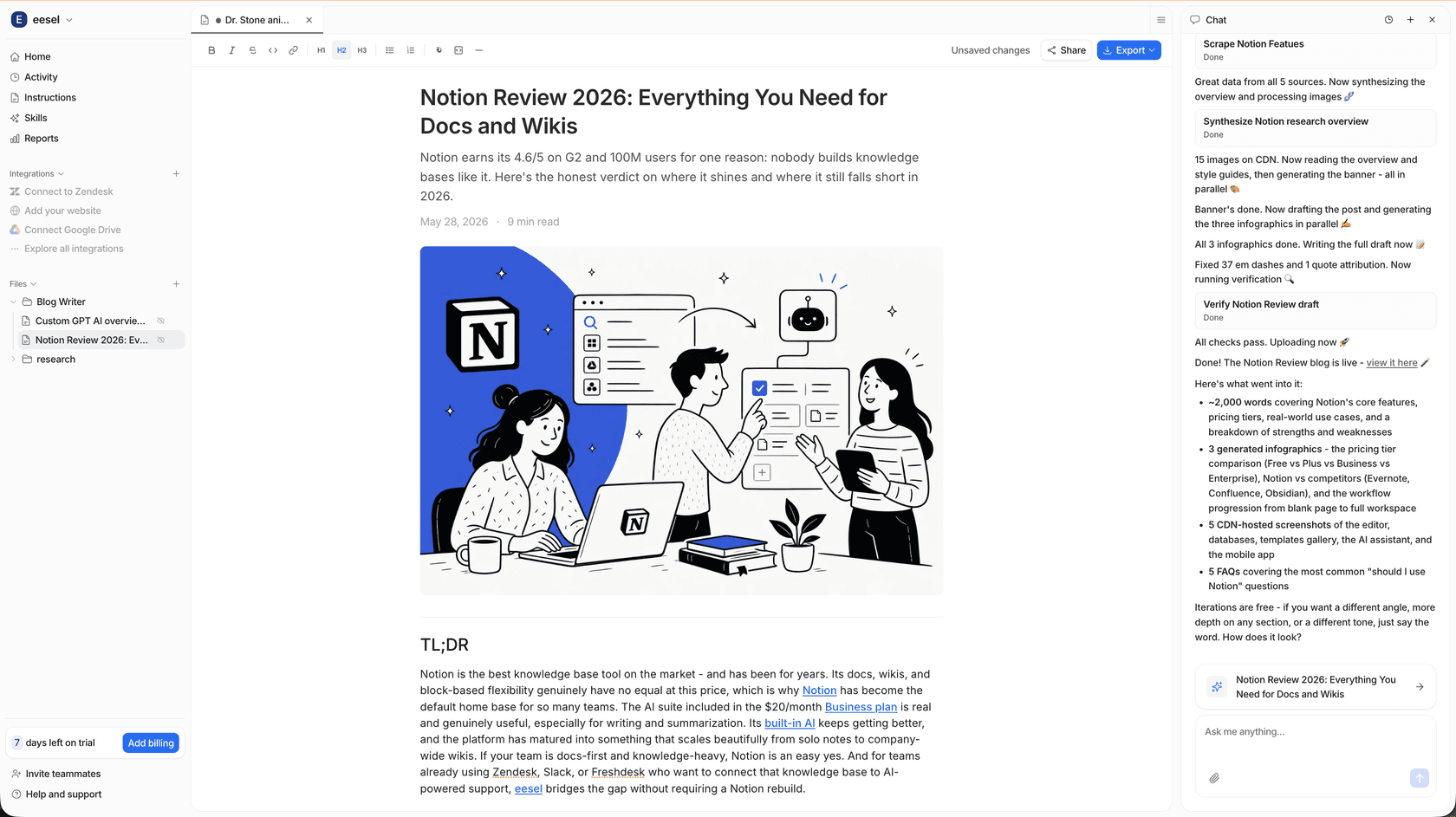
The core concept behind eesel AI is that you don't configure a tool, you hire a teammate. For agencies, this mental model is a significant shift for AI agency content operations. Instead of wrestling with complex prompt engineering, you hire a specialized AI Content Writer that joins your team, learns your brand voice in minutes, and starts producing drafts that actually sound like your team.
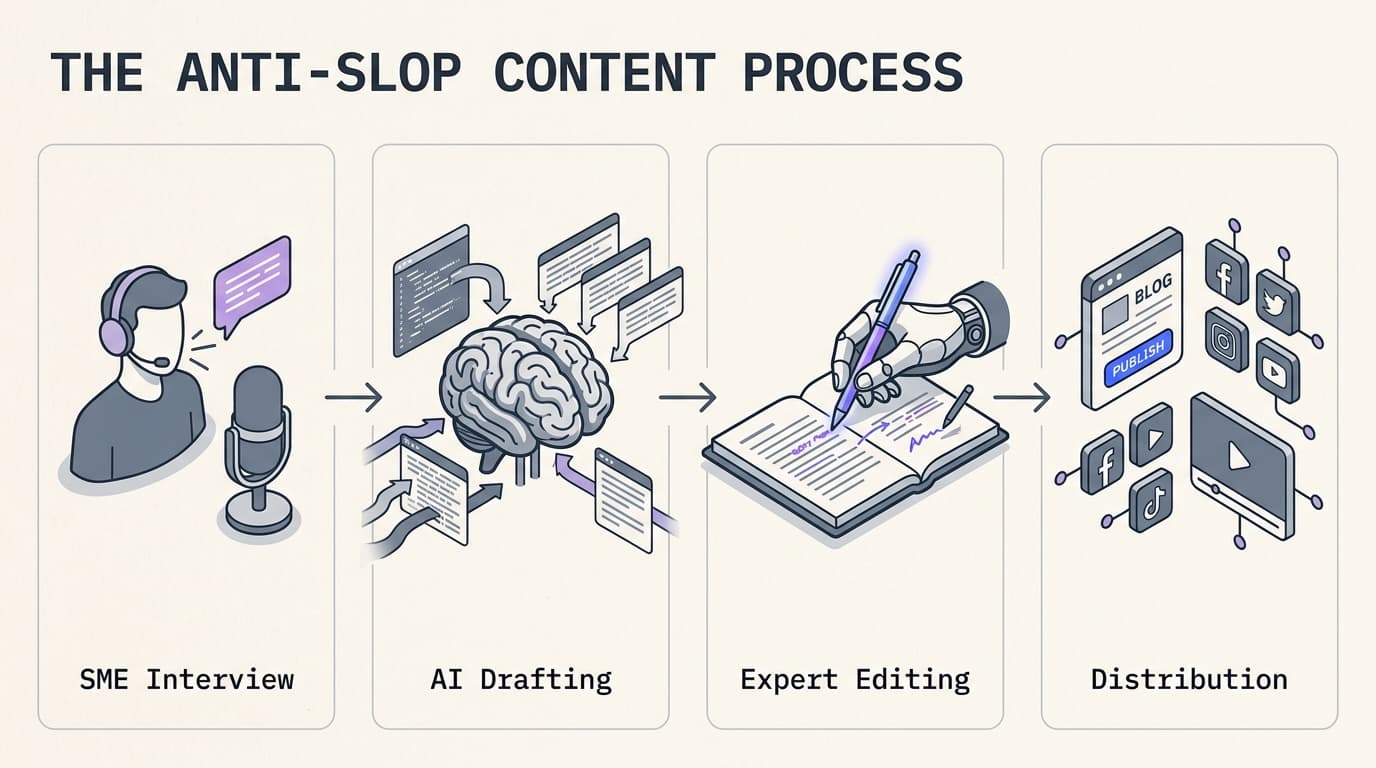
What makes our AI Content Writer stand out is the focus on avoiding AI slop. It doesn't just pull from its training data. It uses voice to text SME interviews to capture raw insights from your clients. This ensures every blog post is grounded in a unique human point of view, which is exactly what search engines are looking for in 2026.
We've found that our AI support agent and writer teammates can onboard in minutes by reading your existing documents, help center articles, and website. This continuous learning means the teammate gets smarter the more you use it, eventually handling frontline support or complex content drafting with 94% accuracy.
| Plan | Price | Key Features |
|---|---|---|
| Free plan | $0 | 100 credits, no card |
| Teammate | From $299/mo | 500 credits (1 credit per ticket or chat), no seat fees |
| Blog post | $4 each | Full researched blog draft |
Pros:
- Flat $4 per blog post, with no platform fee or per-seat fees
- Vertical-specific agents for Support, Writing, and Triage
- Seamless SME interview feature to prevent generic content
Cons:
- Not built for agencies who want one click generic content without human input
2. Claude
Claude has become the gold standard for content agencies that prioritize a natural, human like tone. While other models can sometimes sound formulaic or "robotic," Claude is widely praised for its superior synthesis and structured writing. This makes it an ideal pick for the drafting phase of the content lifecycle.
The standout feature for agencies is the 200,000 token context window. You can feed Claude massive client briefs, entire data exports, or dozens of past articles to ensure the model has a deep understanding of the client's world before it writes a single word. This context is what allows agencies to maintain quality at scale.
I switched to Claude 3.5 Sonnet for content writing, never looked back... other models were too robotic.

| Plan | Monthly Price | Key Limits/Inclusions |
|---|---|---|
| Free | $0 | Access to Claude 3.5 Sonnet |
| Pro | $20 | 5x more usage than Free tier |
| Team | $25 (per user) | Admin tools, higher usage, min 5 users |
Pros:
- Superior reasoning and natural prose compared to competitors
- Large context window for complex client data
- Artifacts workspace for side by side editing
Cons:
- Requires expert prompting to avoid generic framing
- Message caps even on paid plans during peak periods
3. Surfer SEO
If Claude is the writer, Surfer SEO is the editor and strategist. It takes the guesswork out of on page optimization by analyzing the top ranking competitors for your target keyword in real time. For agencies, Surfer is essential for ensuring that every piece of content has the data backed structure it needs to rank.
The platform's Content Editor provides a numerical score that updates as you write, suggesting specific keywords, headings, and images based on what is currently working on the SERP. Agencies can use this to create clear briefs for writers or to auto optimize existing drafts in minutes.
| Plan | Annual Price | Seats | Key Limits |
|---|---|---|---|
| Discovery | $49/mo | 1 | 120 documents |
| Standard | $99/mo | 3 | 360 documents, AI Tracker (25 prompts) |
| Pro | $182/mo | 5 | 360 documents, daily AI refresh |
| Peace of Mind | $299/mo | 10 | Unlimited documents, API access |
Pros:
- Eliminates SEO guesswork with mathematical scoring
- Topical map generation helps build long term authority
- Plugs directly into Google Docs and WordPress
Cons:
- Can lead to "copycat" content if recommendations are followed too rigidly
- Surfer AI credits are an additional cost per article
4. Opus Clip
Repurposing content is one of the most effective ways for an agency to provide more value to clients, and Opus Clip is the best tool for the job. It uses AI to take a long form video, like a podcast or webinar, and automatically cut it into viral shorts for TikTok and Instagram.
The platform's secret sauce is the Virality Score™, which analyzes the "hook" and storytelling of each clip to predict its success. It also handles the tedious parts of editing, like adding dynamic captions and automatically re-framing the video to 9:16 format.
The AI does a good job finding attention-grabbing moments and creating clips that feel native to TikTok/Instagram... it saves a ton of time.
| Plan | Monthly Price | Key Limits |
|---|---|---|
| Free | $0 | 60 credits/mo (watermarked) |
| Starter | $15 | 150 credits/mo |
| Pro | $29 | 3,600 credits/year, AI B-roll |
Pros:
- Turns one hour of video into a week of social content in minutes
- Automated AI B-roll improves visual engagement
- Supports over 20 languages for global clients
Cons:
- May require manual fine tuning for specific B2B brand aesthetics
- The free tier includes a watermark on all exports
5. Gumloop
Gumloop is the "connective tissue" that turns a collection of AI tools into a cohesive agency workflow. It is a drag and drop automation platform that allows you to build agentic workflows without writing code. You can use it to scrape websites, distill data, and pass that information between different LLMs like Claude and GPT-5.
For agencies, Gumloop is particularly powerful for scaling research and distribution. You can build a workflow that automatically monitors a client's competitors, extracts their latest blog topics, and generates a research brief for your team in Slack.
| Plan | Monthly Price | Credits included |
|---|---|---|
| Free | $0 | 5,000 |
| Pro | $37 | 20,000+ |
| Enterprise | Custom | Custom |
Pros:
- Model agnostic (use any LLM without your own API keys)
- Deep built in web scrapers for research
- Scales beyond the limitations of simple tools like Zapier
Cons:
- Steeper learning curve than most one click AI tools
- Credit based pricing can be hard to predict for complex runs
6. Notion AI
Most content agencies already use Notion for project management, which is why Notion AI is such a powerful addition. It acts as a workspace assistant that can search across all your client briefs, meeting notes, and project plans to surface the information you need in seconds.
The Q&A feature is the standout here. You can ask, "What were the core brand pillars we agreed on for Client X?" and Notion AI will find the exact document and summarize the answer. This eliminates the "internal search tax" that slows down agency teams as they scale.
| Plan | Price | Notion AI Access |
|---|---|---|
| Free | $0/mo | Limited Notion AI trial |
| Business | $20/user/mo | Full Notion AI included |
| Enterprise | Custom | Full Notion AI included |
Pros:
- Seamlessly integrated into your existing documents
- Autofill turns docs into dynamic databases
- Connects to Slack and Google Drive for broader search
Cons:
- Requires well organized internal documentation to be effective
- Per user pricing can get expensive for large agency teams
7. Perplexity
Perplexity has replaced traditional search engines for many agency strategists. It is an Answer Engine that provides direct, cited answers to complex questions, making it perfect for market research and competitor analysis.
What sets Perplexity apart is its transparency. Every claim includes a footnote that links directly to the primary source. This allows agencies to build strategy decks with verifiable data from premium sources like Pitchbook and Wiley, ensuring they never accidentally present "AI hallucinations" to a client.
| Plan | Monthly Price | Annual Price | Key Features |
|---|---|---|---|
| Free | $0 | $0 | Standard search, daily Pro Search |
| Pro | $20 | $17/mo | 300+ Pro Searches/day, model selection |
| Max | $200 | $167/mo | 10k Computer credits, massive file limits |
Pros:
- Eliminates hallucinations with direct source citations
- Access to the latest models like Claude Sonnet 4.6 and GPT-5
- Perplexity Computer automates complex research digests
Cons:
- Still requires human verification for highly technical niches
- The "Pro" features are subject to daily usage limits
Tips for building your 2026 agency AI stack
Building a dream team stack is about more than just buying subscriptions. It requires a fundamental shift in how your agency operates. Here are three tips for making the transition:
- Audit your bottlenecks: Don't just add AI for the sake of it. Find where your team is currently spending the most time (extracting client insights, formatting videos, or manual keyword research) and hire a specialized agent for that specific gap.
- Prioritize brand voice governance: Content agencies live or die by their ability to sound like their clients. Ensure every tool you use has a way to standardize brand rules and claim standards across the team.
- Focus on SME integration: The most successful agencies in 2026 are those that treat AI as a way to amplify human expertise, not replace it. Use tools that make it easy to capture human POV early in the process.
How to get started with eesel AI today
If you are ready to scale your agency without sacrificing quality, the best first step is to hire your first AI teammate. You don't need a complex setup or a massive budget.
- Hire your teammate in minutes: Pick the agent you need (Support, Content, or Triage) and get started for free.
- Connect your knowledge base: Let eesel AI learn your business by reading your docs and website.
- Start scaling quality content: Use our AI Content Writer to turn expert interviews into high performing SEO content without the slop.
The future of content agencies is specialized, agentic, and human first. Hire your eesel AI teammate today and see how much faster your team can move when they have the right help.