The way we search is getting a major facelift. Instead of typing a few keywords and sifting through blue links, people are now just asking AI for answers. They're using Google's AI Overviews, ChatGPT, and Perplexity to get direct responses, not a list of websites to research.
This shift means our old SEO playbook is due for an update. This is all about Answer Engine Optimization (AEO), the new way to get your brand seen. While traditional SEO tools are adapting, a new wave of dedicated answer engine optimization tools is here to help you track and influence what these AI models are saying.
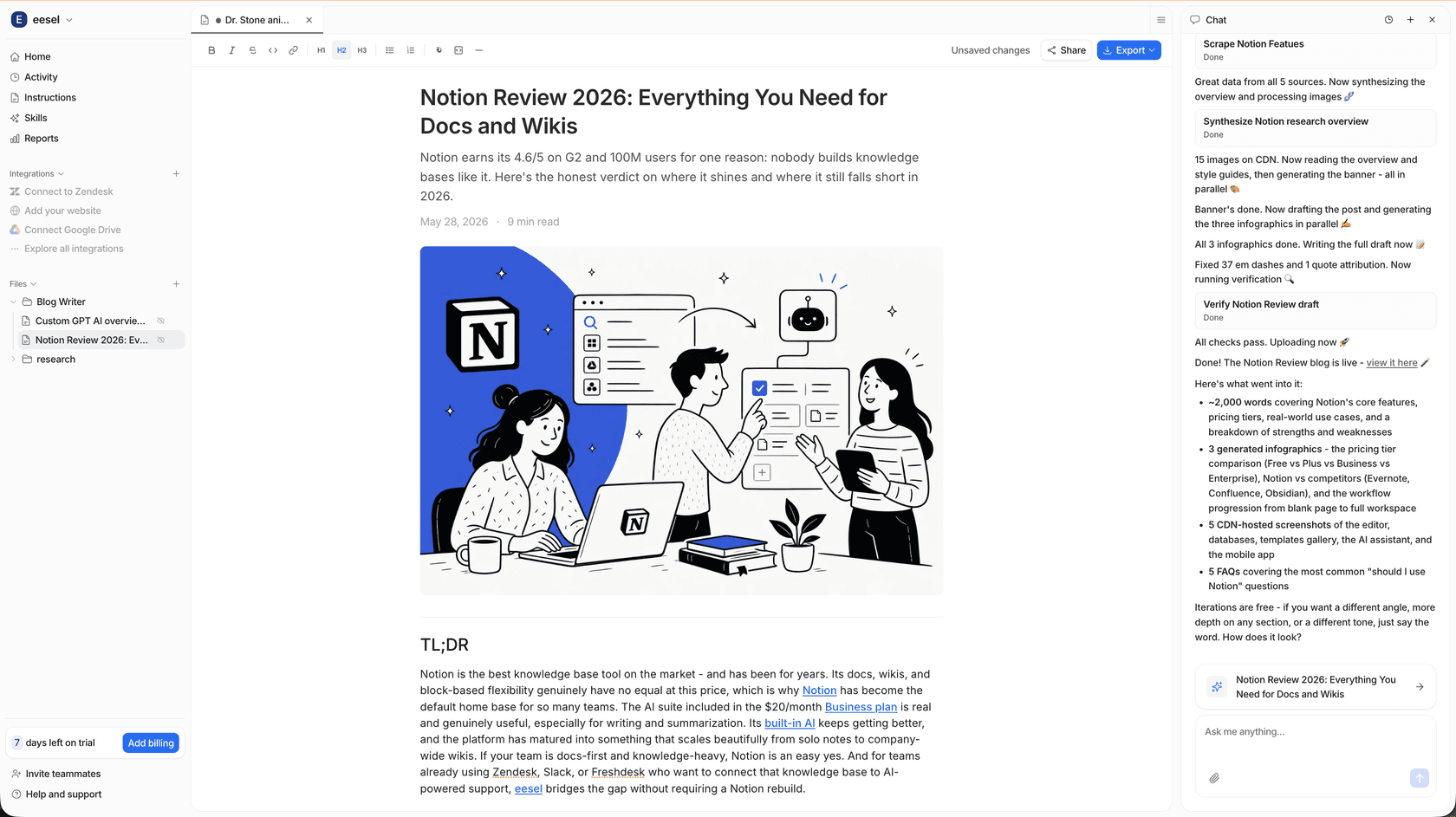
But what if you could do more than just monitor? What if you could create content that's built to be picked up by AI from the start? That’s where tools like the eesel AI blog writer come into play, helping you generate AEO-optimized content so you can become a source AI engines trust.
What are answer engine optimization tools?
Answer Engine Optimization (AEO) is about positioning your brand and content as the go-to source for AI models. The aim is to have your business mentioned, recommended, and cited directly in AI-generated answers on platforms like ChatGPT, Perplexity, and Google AI Overviews.
So, what do these tools do? They essentially let you peek behind the AI curtain. They track how often your brand gets mentioned, check if the sentiment is positive or negative, see which competitors are getting the spotlight, and give you ideas on how to boost your visibility where it counts now.
This is different from the SEO you're used to. Traditional SEO tools are all about keyword rankings, backlinks, and getting traffic from search engine results pages (SERPs). AEO tools, however, care about citation frequency, your "share of voice" in AI responses, and how well you're being recommended. As the team at Ahrefs notes, AEO is about surfacing your brand inside AI answers, not just ranking pages. It operates on a different playing field.
How we chose the best answer engine optimization tools
To cut through the noise, we looked at these tools from a simple, practical angle. We wanted to find platforms that actually help you get things done, not just ones that bury you in data.
Here’s what we looked for:
- AI engine coverage: Does the tool track the big names? We’re talking ChatGPT, Gemini, Perplexity, and Google AI Overviews. The more, the better.
- Actionable insights: It’s one thing to see data; it’s another to know what to do with it. We chose tools that provide clear, actionable recommendations.
- Creation vs. monitoring: Does the tool just report on where you stand, or does it help you create the content needed to move up?
- Value for money: Is the price fair for what you get? We focused on tools that offer real value, especially for small and mid-sized businesses.
Comparison of the top answer engine optimization tools
Here's a quick look at how the top tools stack up.
| Tool | Best For | Key Features | Pricing Model |
|---|---|---|---|
| eesel AI blog writer | Proactive content creation | AI blog generation, built-in AEO, auto-assets | Credit-based |
| Semrush | Existing Semrush users | AI Visibility Score, prompt research | Subscription |
| Ahrefs Brand Radar | Enterprise-level brand monitoring | Largest AI prompt database, multi-engine tracking | Standalone or Add-on |
| Otterly.AI | Startups and SMBs | Affordable tracking, GEO audit tool | Subscription |
| HubSpot AEO Grader | Free initial audits | Vulnerability identification, content recommendations | Free |
A deep dive into the 5 best answer engine optimization tools
Let's get into the details of what makes each of these tools work and who they're really built for.
1. eesel AI blog writer: The best for creating AEO-optimized content
While many AEO tools focus on monitoring your visibility, the eesel AI blog writer centers on creation. It's built to generate publish-ready blog content that is designed to be cited by AI engines.
- Pros: Instead of giving you a rough draft, this tool produces a complete, AEO-optimized blog post from a single keyword. It automatically includes things that AI models value, like images, infographics, data tables, and social proof from Reddit quotes. It uses a human-like tone, so you avoid the generic feel of many other AI writers. This approach allows you to create optimized content from the start.
- Cons: It's a content creation tool, not a dedicated monitoring platform. If you need to constantly track competitor mentions across hundreds of specific prompts, you'll want to pair it with a specialized AEO tracking tool.
- Pricing:
- It's completely free to try, so you can see the quality for yourself.
- The paid plan starts at $99 for 50 blog generations.
- Why we chose it: This tool proactively addresses AEO by helping you create optimized content at scale. It’s the tool we used to grow our own blog from 70k to over 750k impressions in just three months. Since it’s free to try, there’s no risk in taking it for a spin.
2. Semrush: The best for integrating AEO into an existing SEO workflow
For marketers already using Semrush, their AI Visibility Toolkit is a convenient way to get started with AEO. It’s a natural extension of a platform you likely use every day.
- Pros: The main advantage here is convenience. You can track your AI visibility right next to your traditional SEO metrics. The toolkit gives you an "AI Visibility Score" to benchmark your performance, competitor research to find gaps, and prompt research to see what your audience is asking AI. It's a smooth way to add AEO to your current strategy.
- Cons: The AI toolkit is one of its newer features and is still evolving compared to its core SEO tools. The number of prompts you can track is fairly limited on the lower-tier plans, which might not be enough for a full-scale AEO campaign.
- Pricing:
- Access is included in Semrush One plans.
- The Starter plan begins at around $165/month (when billed annually) and lets you track 50 prompts.
- Why we chose it: Semrush is an SEO giant, and its entry into AEO makes the concept more accessible for millions of marketers. If you're looking for a single platform to manage both your SEO and AEO work, it’s a solid choice.
3. Ahrefs Brand Radar: The best for enterprise brand monitoring
If you're a larger brand that needs to keep a close watch on what AI is saying about you, Ahrefs Brand Radar is a comprehensive tool. It's built for monitoring at scale and is powered by a huge database of real user prompts.
- Pros: Ahrefs says it has the largest AI visibility database available, using actual search-backed prompts instead of made-up ones. It tracks your mentions across six major AI platforms, including Google AI Overviews, ChatGPT, and Perplexity. The interface is clean and makes it easy to see where you're winning and where your competitors have an advantage.
- Cons: Unlike their core SEO tools, Brand Radar isn't included in the standard Ahrefs plans. It's an optional add-on or a standalone product, which should be factored into your budget.
- Pricing:
- You can buy it as a standalone tool, with pricing starting at $199/month.
- Why we chose it: For enterprise teams that need to track their brand's reputation across the most important AI engines, Brand Radar’s massive, high-quality prompt database is a major plus.
4. Otterly.AI: The best for startups and SMBs
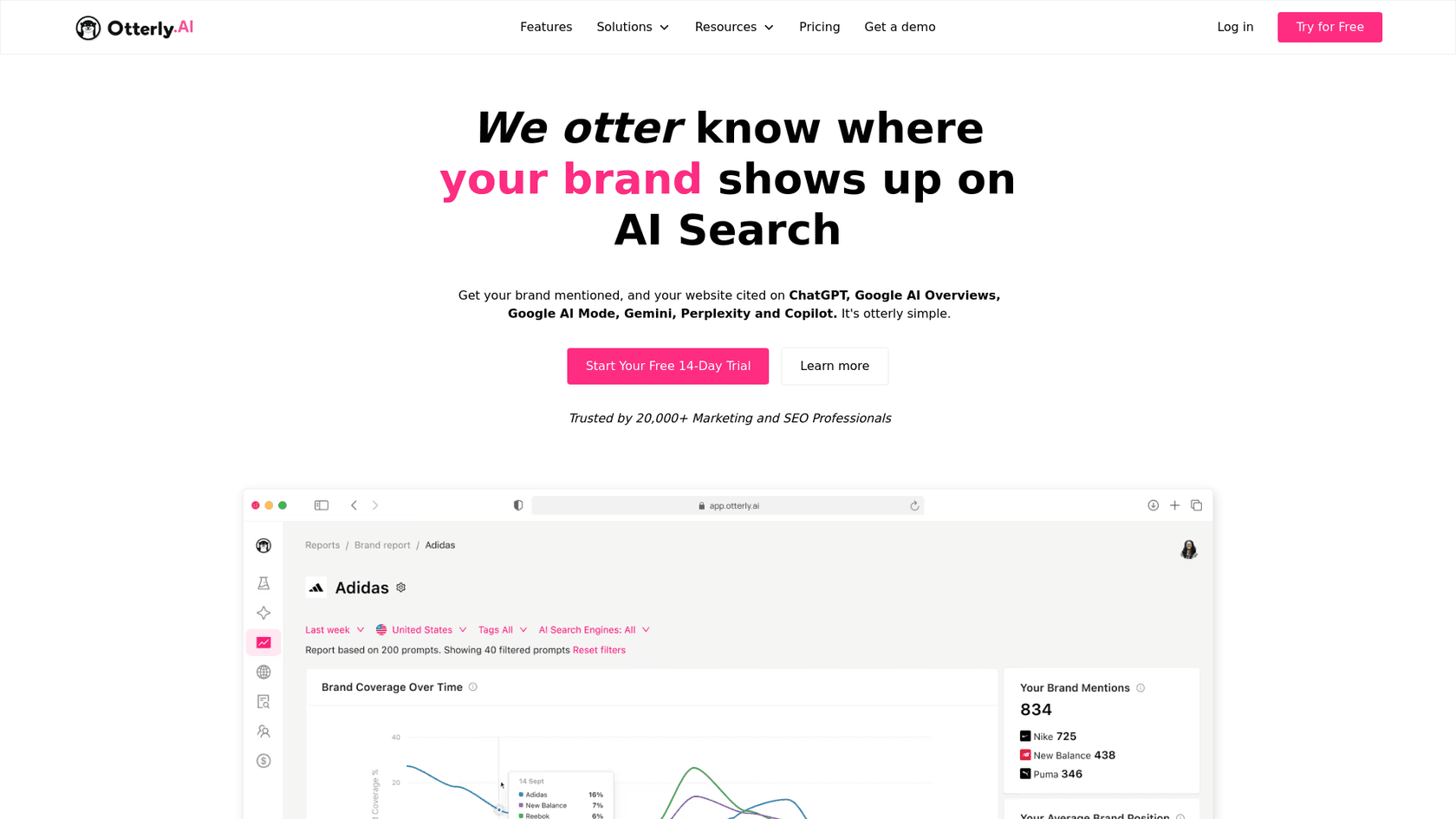
Otterly.AI is a great fit for startups, small businesses, and agencies that want to get into AEO tracking without a large investment. It’s affordable, simple, and gets the job done.
- Pros: The pricing is very competitive, with a Lite plan starting at just $29/month. The platform is focused and very easy to use. You get the essentials, like a brand visibility index, citation tracking, and a handy GEO Audit tool to analyze on-page factors. It covers six major AI platforms, so you’re not missing out on key data.
- Cons: While it's great for the price, the feature set isn't as deep as what you'd find in an enterprise-level solution. If you need detailed custom reporting or API access, you might outgrow it as your team gets bigger.
- Pricing:
- Lite: $29/month for 15 prompts
- Standard: $189/month for 100 prompts
- Premium: $489/month for 400 prompts
- It also offers a 14-day free trial with full access.
- Why we chose it: Otterly.AI makes AEO tracking accessible to almost anyone. It's a fantastic starting point for smaller teams to begin monitoring their AI presence and build a case for more investment later on.
5. HubSpot AEO Grader: The best for a free starting point
If you're just curious about where your content stands in the world of AI search, HubSpot's free AEO tool is a great way to find out. It gives you a quick snapshot of your readiness for free.
- Pros: It’s 100% free and incredibly simple to use. HubSpot says its AEO tools help identify vulnerable content and gives you some basic recommendations to fix it. If you're already using HubSpot, it's worth checking out.
- Cons: This is more of a one-time audit tool, not a continuous monitoring platform. You can't track how your visibility changes over time or set up alerts, which limits its use for an ongoing AEO program.
- Pricing:
- Free.
- Why we chose it: It’s the easiest and most accessible entry point into AEO. It helps you wrap your head around the basic principles of AI optimization without any financial commitment.
How to choose the right answer engine optimization tools for you
Picking the right tool comes down to answering a few simple questions.
- Start with your goal: What are you trying to do right now? If you just want a baseline, a free tool like HubSpot's is perfect. If you need to monitor your brand closely, Ahrefs is your best bet. If you want to integrate with your existing SEO work, go with Semrush. And if you're tracking on a tight budget, Otterly.AI is a fantastic choice.
- Think about creation vs. monitoring: This is a key consideration. If your biggest challenge is producing enough high-quality, optimized content to get noticed, then a tool like the eesel AI blog writer should be your priority. If you already have a ton of content and just need to see how it's performing, focus on one of the monitoring tools.
- Consider your budget: Your budget will naturally point you in the right direction. Startups can get huge value from Otterly.AI, while enterprise teams might need the power of Ahrefs Brand Radar.
- Always start with a free audit or trial: Before you commit, get a feel for the landscape. Use a free tool or sign up for a trial to see where you currently stand with AI visibility. This gives you a benchmark to measure your success. And since the eesel AI blog writer is free to try, you can generate your first optimized article without spending a dime.
To get a better visual understanding of how AEO works and why it's different from traditional SEO, check out this helpful video from Simplilearn.
The future is answers, and your brand needs to be one of them
Answer Engine Optimization isn't just another buzzword. It's a core part of being discovered online in 2026. For brands that want to stay visible, it's no longer optional.
While monitoring tools are great for showing you where you stand, remember that you can't track what doesn't exist. Creating high-quality, AEO-optimized content is what ultimately gets you cited and recommended by AI. This is key to succeeding in this new era of search.
If you're ready to create content designed for AI engines, you can try the eesel AI blog writer for free and generate your first optimized blog post.