

Trying to pick the right AI tool for your content team can feel like you're comparing apples and oranges. You've got Notion, the all-in-one workspace that practically runs on team productivity, and then you have Semrush, a marketing powerhouse loaded with more data than you can imagine.
So, why are we even comparing them? Because both have jumped into AI-powered content features, making them real options for marketing and content teams. They come at it from completely different angles, but their goal is pretty similar: helping you create better content.
This guide will break down their features, what they're best for, and how much they cost to help you figure out which one actually fits your workflow. And if you find that neither one is the perfect fit for scaling high-quality blog content, we'll introduce you to a more focused alternative, the eesel AI blog writer, which is built specifically for that job.
What is Notion AI vs Semrush?
Before we get into the details, let's get one thing straight: Notion and Semrush were built for totally different reasons. Understanding their origins is the key to figuring out how their AI features can (or can't) help you.
What is Notion AI?
Notion is like that super-organized friend who has a color-coded planner for everything. It’s a flexible, unified workspace where teams can manage knowledge bases, track projects, and work on documents together. It's the central hub for getting things done.
Notion AI is an assistant that lives right inside this ecosystem. Think of it as a productivity booster that helps you write faster, summarize long meeting notes, and brainstorm ideas without ever leaving your page. It’s designed to make your internal work smoother, not to be a standalone SEO tool. It’s trusted by some big names, including OpenAI, Figma, and Ramp.
What is Semrush?
If Notion is the organized planner, Semrush is the master strategist with a wall full of charts and data. It’s a massive suite of tools built for SEO, content marketing, competitor research, and paid advertising. It’s where marketers go to understand what’s happening online and how to win.
Its AI features, like the SEO Writing Assistant and the new AI Visibility toolkit, are designed to give your content a competitive edge. They help you create and optimize content that performs better in search engines and the new world of AI-driven search. It's no wonder that major brands like Shopify, Samsung, and Amazon rely on it.
A comparison of core features
While both platforms have "AI" in their toolkit, what they actually do with it is worlds apart. Their main features are tailored for completely different jobs, so let's break down where each one shines.
Notion AI: A focus on productivity
Notion’s main job is to make your team’s internal life easier. Its biggest strengths are:
- Creating internal wikis: A single source of truth for company knowledge.
- Managing projects: Kanban boards, timelines, and task lists all in one spot.
- Taking meeting notes: With AI Meeting Notes, you can instantly generate summaries and action items.
- Building documentation: Great for product specs, standard operating procedures, and internal guides.
Notion AI helps with all of this. It can turn a messy brain dump into a structured outline, summarize a 10-page document into a few bullet points, or draft an internal announcement in seconds. It’s all about improving the work you’re already doing inside Notion.
The catch: For content marketers, Notion AI lacks the deep SEO data needed for a solid content plan. It can't tell you about keyword volume, what your competitors are ranking for, or analyze the search results pages. It’s basically writing in a bubble, disconnected from the data that brings in organic traffic.
Semrush: A focus on SEO
Semrush is built for marketers who live and breathe data. Its core strengths give you a complete view of the digital landscape:
- Keyword research: Finding the terms your audience is searching for.
- Site audits: Discovering technical SEO issues that could be holding you back.
- Backlink analysis: Seeing who links to you and your competitors.
- Rank tracking: Monitoring your search engine performance over time.
- Competitor traffic analysis: Keeping an eye on what’s working for others.
Its main purpose is to help you build a data-backed content strategy. You can find ranking opportunities, create detailed content briefs, and track your content’s impact on your bottom line. With tools like the AI Visibility toolkit, you can even see how visible your brand is in AI-powered search results from ChatGPT and Google AI Overviews.
The downside: All that power comes with a learning curve. For a writer who just wants to create a great blog post, the Semrush dashboard can be a bit much. It's an amazing tool for analysis and optimization, but it's not designed to be a simple, streamlined writing space.
AI writing tools: A head-to-head comparison
Alright, let's get to the main event: how do these two platforms actually handle writing and creating content? This is where their different philosophies really show.
Content creation with Notion AI
Notion AI is best described as a general writing assistant. It’s super handy for getting your thoughts down on the page. You can ask it to brainstorm ideas for a blog post, write a first draft, check your grammar, or change your writing tone from formal to casual.
Its biggest strength is its context awareness within your workspace. If you have a bunch of notes and research docs on a topic, Notion AI can use that information to help you draft content. It’s like having a teammate who has read all the same background material.
The problem: Notion AI operates without any external SEO context. It doesn't know what articles are currently ranking for your target keyword, what questions people are asking online, or what search intent Google is trying to satisfy. The content it produces is often a good starting point, but it's rarely ready to compete in search results without a lot of SEO work.
Content creation with Semrush
Semrush comes at content from the opposite direction. Its tools, like the SEO Writing Assistant (SWA), are all about optimization. You usually write your content somewhere else (like Google Docs) and then use the SWA to improve it.
The SWA gives you real-time feedback based on your target keywords and an analysis of the top-ranking articles. It’ll give you suggestions on readability, tone of voice, originality, and, of course, SEO. It helps you add related keywords and make sure your content structure matches what Google is looking for.
The limitation: While it's fantastic for optimization, Semrush isn't designed to generate a complete, publish-ready article from a single prompt. It provides the framework and suggestions, but you still have to do the heavy lifting of writing and putting the final piece together. It also doesn't automatically create things like custom images, tables, or video embeds, which are key for engaging blog posts today.
| Feature | Notion AI | Semrush |
|---|---|---|
| Primary Function | General writing & productivity | SEO content optimization |
| SEO Data Integration | No | Yes (keyword data, SERP analysis) |
| Use Case | Brainstorming, drafting, summarizing | Real-time SEO suggestions, briefs |
| Output | Text drafts within Notion | Optimized text, content briefs |
| Workflow | Integrated within workspace | Standalone tools, Google Docs add-on |
Pricing breakdown: Notion AI vs Semrush
Money talks, so let's look at what it costs to get these AI features. Their pricing models are just as different as their features.
Notion AI pricing plans
Notion is pretty generous with its pricing. It offers a great free plan for individuals, with paid plans like Plus starting at $10 per user per month.
The Notion AI features are included in the higher-tier plans. They come fully with the Business plan ($20 per user per month) and the Enterprise plan. If you're on the Free or Plus plan, you get a limited number of AI actions to try before you need to upgrade. This makes Notion AI a relatively affordable add-on if your team already uses Notion as its main workspace.
Semrush pricing plans
Semrush is a professional-grade marketing tool, and its pricing shows it. Its subscription model is more complex, with different plans and add-ons.
The SEO Writing Assistant is only available on the Guru plan ($249.95 per month) and the Business plan ($499.95 per month). If you want more AI writing capabilities, the AI Writing Assistant app is a separate add-on for $25 per month. The new AI Visibility Toolkit is also an add-on, costing $99 per month on its own.
Alternatively, you can get a bundle of these features with the Semrush One plan, which starts at $165.17 per month when billed annually. Either way, it's a serious investment for teams that need a full suite of marketing analytics tools.
An alternative for dedicated blog writing: eesel AI blog writer
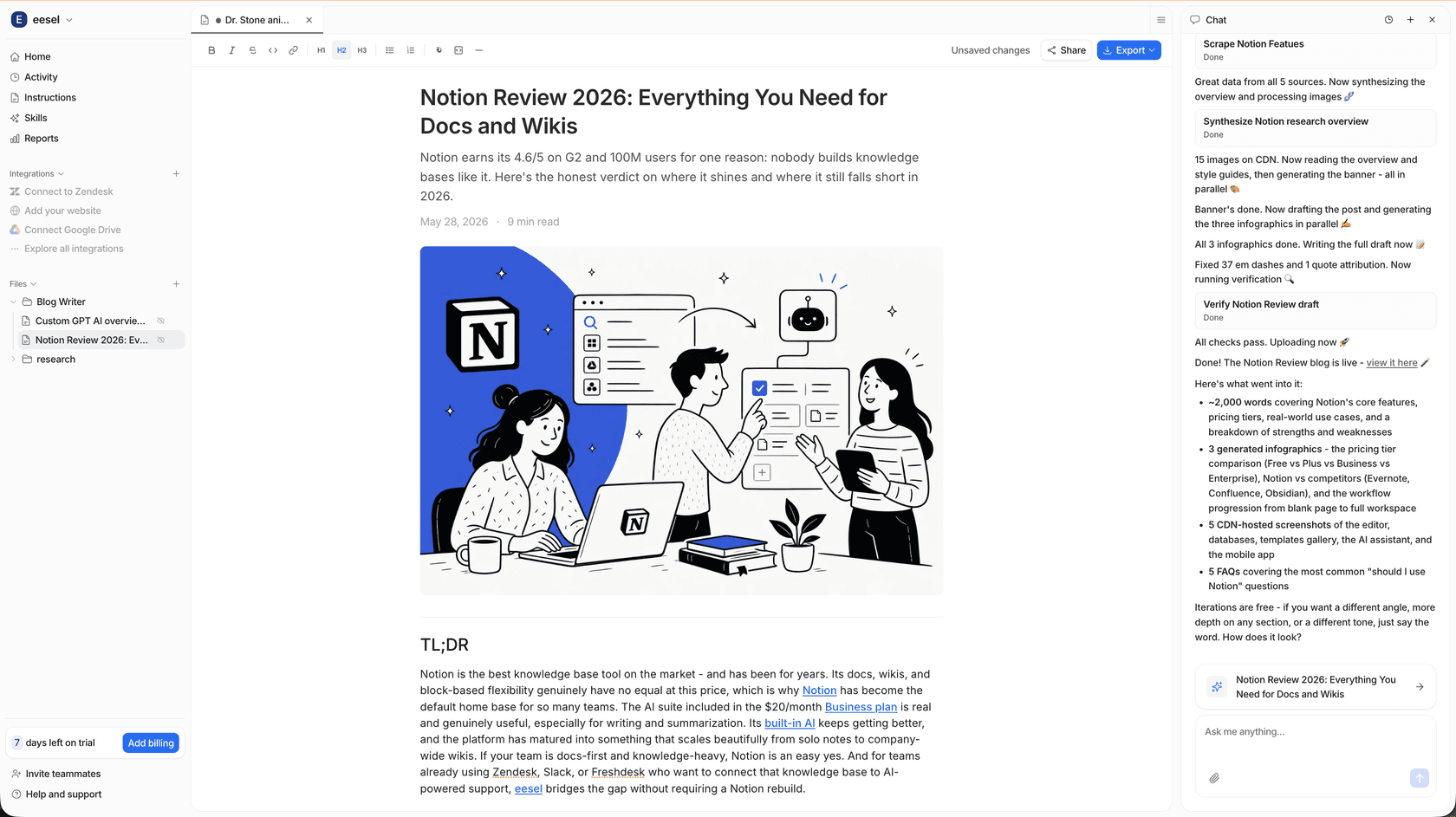
It's a specialized tool designed to do one thing really well: turn a single keyword into a complete, media-rich, and SEO-optimized blog post that’s ready to publish. It bridges the gap between a general productivity tool and a complex SEO suite.
Here’s what makes it different:
- Context-Aware Research: Unlike generic AI writers, it automatically understands the search intent behind your topic. Writing a comparison post? It pulls in pricing data. A product review? It finds technical specs.
- Automatic Assets: It doesn't just give you a wall of text. It generates a full post with AI images, infographics, tables, and even embeds relevant YouTube videos. This saves hours of manual work.
- Social Proof Integration: To add a layer of authenticity, it can pull real, relevant quotes from Reddit forums, showing that you understand the actual conversations happening around your topic.
- AEO Optimization: It's built not just for traditional SEO but also for Answer Engine Optimization. This means your content is structured to appear in AI answer engines like Perplexity and Google AI Overviews.
We're not just selling it; we're using it. It’s the same tool we used to grow our own impressions from 700 to 750,000 per day in just three months by publishing over 1,000 optimized blogs. The best part? It's completely free to try, so you can see the quality for yourself without any commitment.
Making the right choice: Notion AI vs Semrush
Choosing between Notion AI and Semrush really comes down to what your team's main job is. There’s no single "best" tool, only the right tool for your specific needs.
Here’s a simple way to look at it:
- Choose Notion AI if: Your team already lives and breathes inside the Notion ecosystem. You need an integrated AI assistant to help with internal productivity, meeting summaries, and first drafts of internal documents. Your main goal is collaboration and knowledge management.
- Choose Semrush if: Your priority is building a data-driven SEO and content strategy. You have the budget for a powerful marketing suite and need deep analytics, competitor research, and optimization tools to win in search.
- Try the eesel AI blog writer if: Your main goal is to scale the production of high-quality, SEO-optimized blog content efficiently. You want to go from keyword to a publish-ready post in minutes, without the complexity of a full SEO suite or the SEO limitations of a general-purpose writer.
For a broader look at how tools like Notion AI and Semrush fit into the modern marketing stack, check out this video which explores some of the top AI tools available for marketers today.