It seems like more and more people are starting their searches with AI Overviews and chatbots like ChatGPT. Because of this, simply ranking on Google doesn't quite cut it anymore. The new goal is getting your brand seen inside these AI-generated answers. If your brand isn't mentioned or cited, you're basically invisible to a lot of potential customers. This shift has given rise to something called Generative Engine Optimization (GEO) and a whole new category of SEO AI tools built to track and boost this kind of visibility.
This comparison covers content creation, visibility tracking, and website-readiness checks using vendor documentation. This list will walk you through tools that show you where you stand in AI search, what your competition is up to, and how to tweak your content to get noticed. We'll look at what each tool is good for, who should use it, and how much it costs. At eesel AI, we saw this change coming and used our own eesel AI blog writer to grow our organic impressions from 700 to 750,000 per day, creating content specifically for this new search landscape.From what I’ve seen (and backed by recent studies), it’s still hard to get mentioned by AIs if you don’t rank in the top 10 on Google. So yes, traditional SEO still matters. But GEO isn’t just SEO 2.0 - it’s a new paradigm. Mentions seem more important than backlinks. Click-through rates don’t matter, visibility inside the answer is what counts. Structured content and authority still help, but in different ways.

What are AI visibility tools and why do they matter?
AI visibility tools, sometimes called AI monitoring or GEO tools, are platforms that keep an eye on how your brand, products, and content show up in answers from AI search engines and Large Language Models (LLMs). This includes platforms like ChatGPT, Perplexity, and Google's AI Overviews.
They're different from the rank trackers you might be used to, which just tell you your position on a Google results page. Instead, these tools focus on two main things:
- Mentions: This is when an AI names your brand or product directly in an answer, like saying, "A good tool for this is Surfer."
- Citations: This happens when an AI uses your content to build its answer and includes a link back to your site.
To get this information, the tools run tons of different prompts through various AI models. They're looking to see which brands and websites get recommended most often for topics related to your industry. This information is important because people are clicking on standard search results less and less. Getting seen inside the AI answer is what matters now, and these platforms are how you measure it.
How we chose the best platforms for AI visibility
To put this list together, we looked at each platform using a consistent set of criteria that matter to modern SEO and content teams. We wanted tools that give you data you can actually use, not just numbers that look good in a report.
Here’s what we focused on:
- Engine Coverage: For monitoring tools, we considered coverage across major AI platforms. We also include content creation and readiness diagnostics, which serve different purposes and do not measure live rankings.
- Data Accuracy and Depth: We gave extra points to tools that provide clear numbers on both brand mentions and content citations. We also checked if they used direct UI scraping instead of APIs, which can give more realistic, user-facing results.
- Actionable Insights: A good tool should do more than just show you charts; it should help you figure out your next move. We looked for features that give optimization tips, competitor analysis, and content gap ideas.
- User Experience: The platform needed to be straightforward and easy to get around in. Since this is a new type of tool, a simple interface and clear onboarding are a big deal.
- Value for Money: We considered whether the price tag made sense for the features offered, keeping in mind options for different budget sizes.
A comparison of the best AI visibility tools in 2026
Here's a quick look at the tools we’re about to cover. Each one has its own specialty, whether it's creating the content you need to get seen, monitoring big enterprise brands, or fitting into an SEO workflow you already have.
| Tool | Best For | Key Feature | Starting Price |
|---|---|---|---|
| eesel AI blog writer | Content creation for AI visibility | Automatic AEO-optimized content & assets | $99 for 50 blogs |
| Arobis AI | Website AI-readiness checks | Free diagnostic score, not live recommendation tracking | Free |
| Peec AI | Agencies & mid-market teams | AI search analytics with UI scraping for accuracy | €89/month |
| Semrush | Existing Semrush users | Integrated SEO and AI visibility tracking | $99/month add-on |
| Surfer | Content teams | Aligning content with AI ranking signals | $95/month add-on |
| Ahrefs Brand Radar | Competitor benchmarking | Tracks mentions across 6 major AI platforms | $199/month per index |
The 6 best platforms for AI visibility in 2026
Here’s a more detailed look at each tool, what it’s best at, and who might find it most useful.
1. eesel AI blog writer
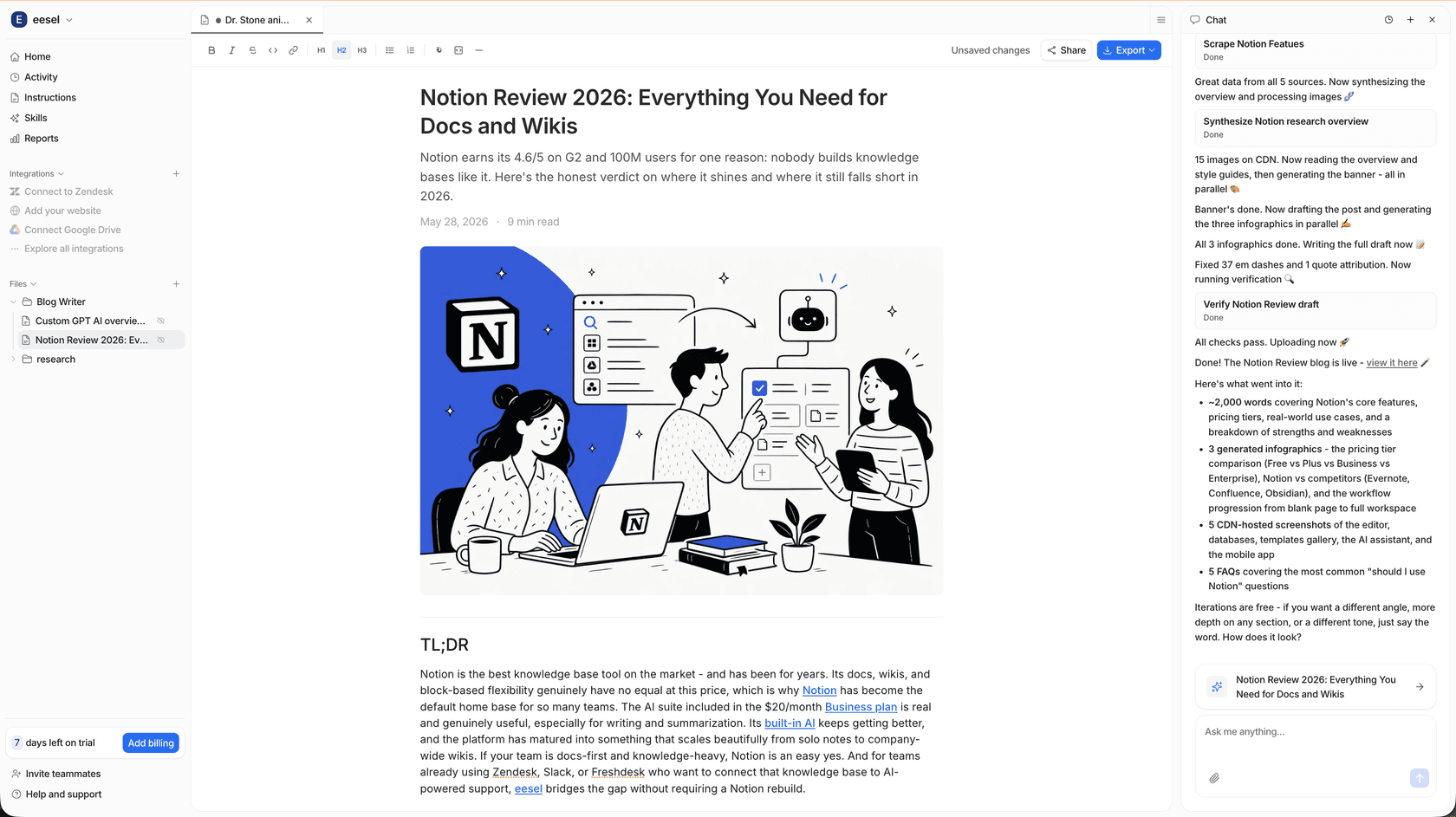
Beyond tracking mentions, another aspect of AI visibility is creating content that AI models are likely to cite. The eesel AI blog writer is a tool designed for this purpose. It helps build a brand's presence by generating content optimized for search engines and AI. You give it a keyword, and it produces a full, publish-ready blog post that's optimized for both traditional SEO and new Answer Engine Optimization (AEO).
The tool generates text and also includes AI-generated images, infographics, and tables. It also finds and embeds relevant YouTube videos and real quotes from Reddit to create the kind of rich, varied content that AI systems tend to prefer. It researches the topic and weaves in your brand context so that product mentions don't feel forced.
Pros: This tool focuses on content creation rather than analysis. It has AEO best practices built-in, like clear answer-first formats and FAQ sections, which makes it more likely your content will be used in AI Overviews and chatbot answers. The automatic inclusion of visuals and social proof saves a ton of manual effort.
Cons: Since it's a content generation tool, it doesn't offer continuous, real-time tracking of AI mentions or competitor scores. It's best used to power your content strategy, maybe alongside a dedicated monitoring tool to see the results.
Pricing: The eesel AI blog writer is free to try. The paid Early Bird plan is $99 for 50 blog generations per month.
2. Arobis AI
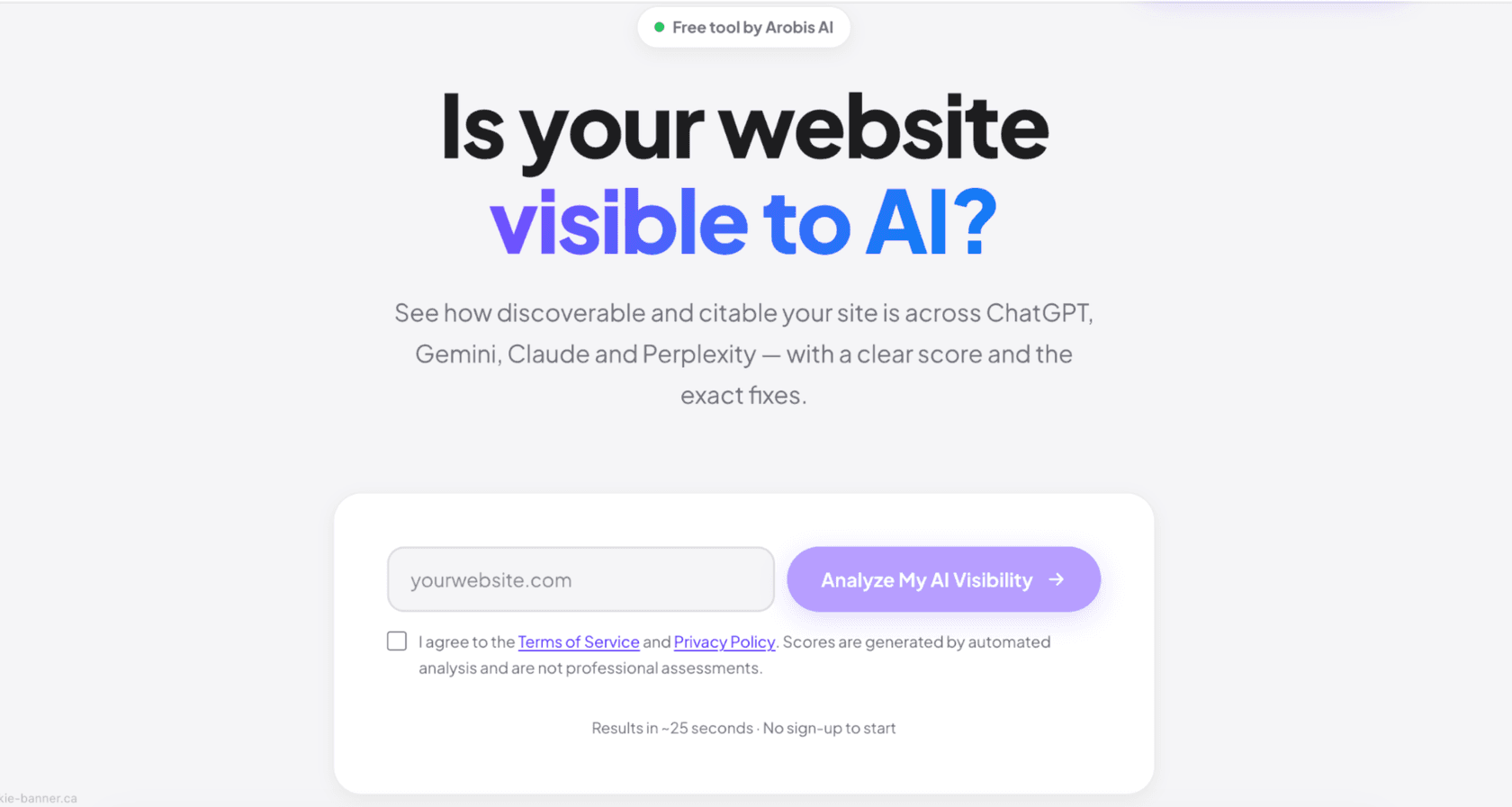
Arobis AI offers a free AI Visibility Checker for assessing how ready a website is for AI search. Enter your domain to receive a readiness score based on crawler access, structured data, page structure, content signals, and technical health.
The distinction matters: this checker evaluates your website rather than running live recommendation prompts against each AI engine. Its score can help identify website improvements, but it does not establish whether buyers are currently seeing your brand in AI answers.
Pros: The score is free to access without signing up, making it an accessible starting point for teams reviewing their site's readiness before investing in ongoing monitoring.
Cons: It is a diagnostic rather than a live ranking or recommendation tracker. A high score does not guarantee mentions or citations. The detailed fix plan requires a contact form.
Pricing: The Arobis AI Visibility Checker is free to use.
3. Peec AI
Peec AI offers AI search analytics for marketing teams who need to analyze their visibility in LLMs. The platform tracks brand mentions, position, and sentiment across ChatGPT, Perplexity, and Google AI Overviews.
One of its main selling points is how it collects data. Peec AI uses UI scraping technology to interact with AI models just like a person would. This helps ensure the data reflects what real users see, not just cleaner API responses. Its simple interface and features like AI-suggested prompts make it pretty easy to pick up, even for teams new to GEO.We use peec AI and it’s good for all the main LLMs (ChatGPT, Perplexity, Claude)
Pros: Peec AI is great at delivering authentic data and clear metrics on visibility, position, and sentiment. Its reporting features, including exports and a Looker Studio connector, are useful for agencies.
Cons: The basic plans are focused on a few core AI engines. If you want to track other models like Gemini or Claude, you'll need to pay extra for the Enterprise plan.
Pricing: Peec AI's Starter plan is available for €89 per month and lets you track up to 25 prompts.
4. Semrush
For teams that are already using Semrush, the AI Visibility Toolkit is a logical next step. Semrush uses its huge database to give you insights into how your brand is doing in AI search engines.
The toolkit is made to work smoothly with other Semrush features, so you can see your SEO and GEO data in one place. It includes an AI-ready site audit to find technical problems that could be blocking AI crawlers, helps identify topics that drive LLM traffic, and gives you strategic advice to improve your visibility.
Pros: The biggest plus is its integration with the rest of Semrush's SEO tools. This lets teams manage their whole search strategy from one platform and compare performance between traditional and AI search.
Cons: The toolkit is an add-on, which means it adds to the overall cost of a Semrush subscription. The amount of data and features might also be a bit much for teams who just want a simple AI tracking tool.
Pricing: The AI Visibility Toolkit is an add-on that starts at $99 per month for one domain.
5. Surfer
Surfer is a content optimization platform that has added features to meet the needs of AI-powered search. Its AI Tracker is an add-on that monitors mentions and citations across major LLMs, such as ChatGPT, Google AI Overviews, and Perplexity.
Similar to Peec AI, Surfer focuses on data accuracy by scraping real answers from AI interfaces instead of relying on APIs. Its main strength is helping you create content that's ready to perform well. Surfer's Content Editor looks at top-ranking pages and gives you real-time tips on keywords, structure, and topics to cover, making sure your content has what both search engines and AI models are looking for.
Pros: Surfer does a good job of connecting content creation with SEO performance. Its tools are built into a logical workflow that takes you from finding a topic to writing and auditing, which is very helpful for content teams.
Cons: Surfer's AI visibility tracking is an add-on and might not be as detailed as dedicated GEO platforms. It's more focused on content optimization than deep brand monitoring or sentiment analysis.
Pricing: The AI Tracker is a paid add-on to a Surfer subscription, with plans starting at $95 per month for tracking 25 prompts.
6. Ahrefs Brand Radar
Ahrefs has gotten into the AI visibility game with its Brand Radar tool. This feature is built to monitor brand mentions across a bunch of AI chatbots, including Google AI Overviews, ChatGPT, Perplexity, Microsoft Copilot, and Gemini.
Using Ahrefs' huge data infrastructure, Brand Radar has one of the largest AI visibility databases available, drawing from over 271 million search-backed prompts. It's particularly good for competitive intelligence, letting you see not just where your brand is mentioned, but also where your competitors are, which can show you where the gaps are in your strategy.
Pros: If you're already an Ahrefs user, Brand Radar is an easy addition that works within a platform you already know. It's especially useful for benchmarking against competitors and getting a feel for the competitive landscape in AI answers across many different AI models.
Cons: Brand Radar is a newer, more focused tool. It doesn't yet have some of the deeper analytics you'd find in other platforms, like sentiment analysis or AI crawler visibility tracking. It's also one of the more expensive add-ons.
Pricing: Brand Radar is available as an add-on to an Ahrefs plan, starting at $199 per month for a single index like AI Overviews.
Understanding the theory behind AI visibility is one thing, but seeing how it works in practice can make all the difference. For a deeper dive into how Large Language Models are changing the search landscape and what you can do to adapt, the following video offers practical advice on gaining visibility in platforms like ChatGPT.
Tips for improving AI visibility
- Create 'citation-worthy' content: AI models are built to reference sources that are authoritative and well-organized. Spend time creating ultimate guides, detailed comparison pages, glossaries, and pages with statistics. These formats present information in a way that's easy for an AI to pull from and cite.
- Adopt an answer-first structure: Set up your content to give a direct answer to a key question right at the top, usually just below the main heading. Use clear, question-based headers (like "What is generative engine optimization?") followed by a short definition. This makes your content easy for AI Overviews to "lift."
- Strengthen E-E-A-T signals: Show your Experience, Expertise, Authoritativeness, and Trust. Add clear author bios, write from first-hand experience ("We tested..."), and include original data or visuals. AI systems are less likely to trust or cite generic content.
- Automate high-quality content production: The only way to scale AI visibility is to be consistent. Most teams can't manually create dozens of perfectly optimized articles. Using a tool like the eesel AI blog writer lets you automate the creation of content that already follows these best practices, from its structure and assets to its AEO.
Choosing the right platform for AI visibility
The way people search is changing, and visibility inside AI-generated answers has become increasingly important. The tools on this list provide different ways to handle this new reality. Big platforms like Semrush and Ahrefs are adding AI tracking to their existing toolkits, while specialized tools like Peec AI are focused on giving you authentic, user-focused data.
A comprehensive strategy for AI visibility often involves both monitoring performance and creating a consistent flow of high-quality, optimized content. While monitoring tools provide data on current performance, content generation tools help produce the assets needed to improve it.
If you're ready to start building your brand's presence in AI search instead of just tracking it, begin by creating content made for this new environment. You can try the eesel AI blog writer for free and generate your first publish-ready, AEO-optimized article in just a few minutes.