

ChatGPT vs Writesonic at a glance
| Question | ChatGPT | Writesonic |
|---|---|---|
| Starting point | A question, file, or evolving brief | A visibility, content, or audit workflow |
| Core strength | Broad conversation and revision | Search-focused tracking and content operations |
| Evidence to inspect | Prompt, attached sources, and output | Prompt set, tracked answers, audit, and page evidence |
| Human owner | Checks claims and final intent | Checks whether a proposed fix is appropriate |
What each tool is for
ChatGPT: explore and develop an approved brief
ChatGPT is useful when the work is not yet a fixed process: challenge an angle, turn approved notes into an outline, find an unanswered objection, or revise for a new reader. Projects can keep related chats, files, and instructions together. The important input is still the brief: name the audience, source owner, claims that require evidence, and what the draft must not say.
Writesonic: visibility work alongside content work
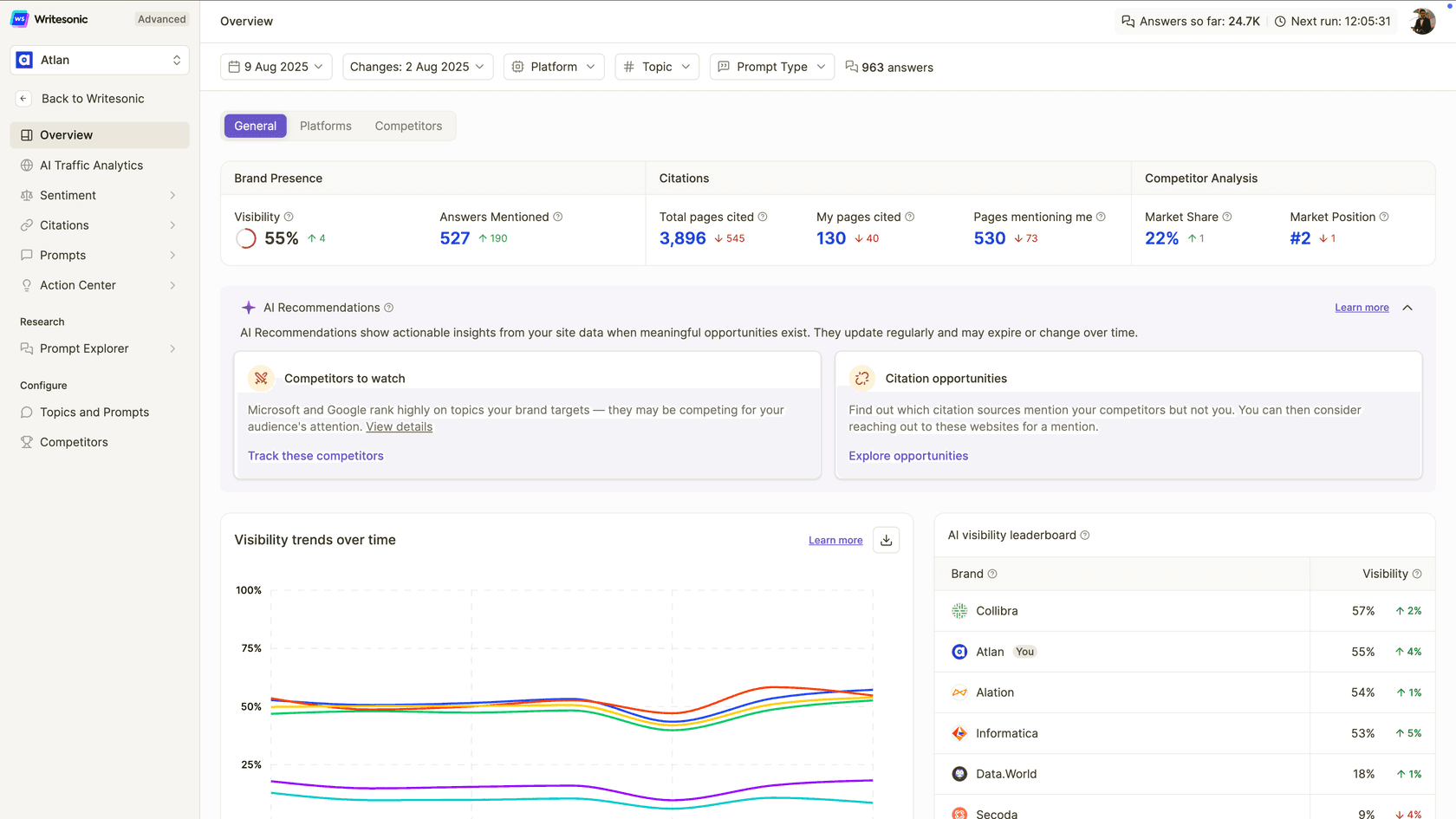
This is an earlier interface example from Writesonic's product documentation, not data from a test we ran. The Advanced label in the image is not its current entry-plan name.
Writesonic's current pricing page positions it as an AI search visibility and SEO platform. Its Starter plan lists tracking across ChatGPT, Gemini, and Google AI Overviews, 50 prompts and 50 answers tracked daily, 15 AI articles per month, and 10 site audits; its higher plans expand those allowances and features.
That makes Writesonic worth considering when a team needs a dedicated place to watch a defined set of prompts and connect that work to content or site audits. It does not make every suggested change correct. A tracked answer may reflect the wrong prompt, locale, date, or source. Treat it as a lead for investigation.
Compare the content workflow, not just the generated text
Drafting and revising an article
ChatGPT gives an editor room to change the assignment: question a brief, compare outlines, or rewrite a section while discussing why it needs to change. That is useful when the article's angle is still unsettled. Projects can organize the supplied material, but the team still needs a defined editorial process.
Writesonic offers a more guided optimization step. Its SEO Checker guide describes selecting content and keywords, running analysis, reviewing recommendations, and comparing the original with a proposed rewrite before replacing it. The guide says access varies by plan. A higher content score is the tool's assessment; it is not a measured improvement in traffic, accuracy, or reader usefulness.
Visibility monitoring versus a conversation
Writesonic's documentation separates brand mentions, share of voice, sentiment, and citation sources. Those are different questions: a brand can be mentioned without its site being cited. A team can investigate which prompts produced an answer and which pages supported it, rather than treating every metric as a single ranking.
ChatGPT can help analyze an authorized export and reason about gaps in it. A single ChatGPT conversation is not a recurring, controlled measurement of the prompts, regions, and engines a visibility platform tracks. Keep the measurement process separate from the assistant's interpretation.
Integrations and publishing permissions
Check what an integration actually does. For example, Writesonic's current WordPress integration guide describes installing an AI Traffic Analytics plugin with administrator access and a site-specific API key. That guide is not evidence of a blog-publishing integration. Analytics collection, content generation, and CMS publication need separate checks.
Likewise, a ChatGPT subscription is not an OpenAI API subscription. If your workflow depends on a custom publishing application, evaluate its API costs, access, and CMS permissions separately. Do not grant either tool publishing access merely to test a draft.
The practical choice
Use ChatGPT when the team needs to understand the problem before it decides on a change. It is the better fit for an editorial conversation: what is the reader trying to do, what evidence is missing, and which claim should be removed?
Use Writesonic when ongoing AI-search visibility and SEO operations are themselves part of the job. Its current plans bundle tracking, article allowances, audits, and plan-specific workflow access. The value is having those recurring checks in one product, not a promise that an article will rank or appear in an AI answer.
For both, separate observation from action. A visibility result can suggest an update; it cannot approve a new product claim, overwrite a page, or establish causation after traffic moves.
Pricing: compare the included operating limits
ChatGPT Plus is $20/month. ChatGPT Business Standard is $25 per user/month on monthly billing or $20 per user/month billed annually, with a two-seat minimum. API usage is separate.
Writesonic's annual prices are Starter $79/month, Basic $199/month, and Growth $399/month; its monthly cards are $99, $249, and $499. Starter includes one user and project, 15 AI articles/month, 10 audits of 100 pages, and 50 prompts/50 answers tracked daily. The page says annual billing saves 20%; Enterprise is custom. Compare the limit that matches the job, then recheck the live plan page before purchase.
Review a visibility finding with eesel CLI
Suppose an SEO owner finds a competitor in answers to “Which helpdesk supports multilingual support?” They save the observed answer, exact prompt, date, locale, citations, and approved product documentation in a review brief. They want an outline that explains the supported languages without borrowing an unverified competitor claim. eesel CLI lets their existing coding agent help prepare that editorial work in the same workspace used by the dashboard.
Sign into the existing workspace with npx @eesel/cli login, inspect npx @eesel/cli agents, and replace Search review below with the intended teammate's name or ID. The workspace owner selects a non-production teammate with consequential actions disabled or absent, permits the approved upload, and checks npx @eesel/cli billing before authorizing paid chat.
A human, script, Claude Code, Codex, or Cursor can use the CLI. It requires Node.js 18.17+ and returns JSON. First inspect the existing files and standing rules; do not assume a tracked finding has already been imported.
npx @eesel/cli files ls --agent "Search review"
npx @eesel/cli instructions --agent "Search review"
npx @eesel/cli files upload ./approved-writesonic-visibility-brief.md --agent "Search review"
npx @eesel/cli chat "Review the uploaded approved-writesonic-visibility-brief.md. Separate observed visibility data from claims we can publish. Return missing evidence, a proposed outline, and questions for the product owner. Do not publish, change a page, or run an external action." --agent "Search review"
The coding agent can read the returned JSON and flag an outline that confuses supported languages with languages merely mentioned in the competitor's answer. The editor checks the evidence themselves: naming the file is a normal-language request, not a special attachment selector. After an owner-approved article change, recheck the actual page and the same visibility measurement separately. CLI output cannot prove deployment, a citation, or causal impact.
chat is paid work and the upload changes the workspace. Do not assume every action pauses for approval. --dry-run can show a write call without sending that write, but reads still run first; it does not isolate the teammate's permissions.
Sources
- Projects in ChatGPT
- What is ChatGPT Plus?
- ChatGPT Business billing and seats
- Writesonic pricing
- eesel CLI documentation
Use eesel CLI to make a visibility brief reviewable

eesel's AI blog writer gives a content team a teammate for the editorial workflow. Use the dashboard for the visual workspace or eesel CLI for approved source review. Keep the source owner and final CMS check with people, not a terminal command.
Try eesel or book a demo with a real visibility brief.
Frequently asked questions
What is the main difference between ChatGPT and Writesonic?
ChatGPT is a broad conversational assistant. Writesonic combines content tooling with AI-search visibility tracking, site audits, and plan-dependent workflows. Choose based on whether you need open-ended help or a search-focused operating surface.
Can ChatGPT replace Writesonic for SEO work?
ChatGPT can help plan, draft, and critique supplied material. It does not by itself give a team Writesonic’s current plan-specific visibility tracking and audit surface. Neither removes the need to verify data and decide what should be changed.
How much does Writesonic cost?
Writesonic lists annual-billing Starter at $79/month, Basic at $199/month, and Growth at $399/month; monthly cards are $99, $249, and $499. Enterprise is custom. Check its pricing page because included prompts, articles, audits, users, and projects vary by tier.
How much does ChatGPT cost?
ChatGPT Plus is $20 per month. ChatGPT Business Standard is $25 per user/month on monthly billing or $20 per user/month billed annually, with a two-seat minimum; API use is separate.
Do visibility metrics prove an article will rank or be cited?
No. A tracked prompt or audit is evidence to investigate, not a ranking or citation guarantee. Check the query, source data, page change, and outcome over time.